Relationships are Key to Preparedness

It’s been said and written, by so many of us across all the varying practices of emergency management, that the essence of what we do is about relationships. Why is that?

While emergency managers and emergency management agencies have some resources, those are of very limited scope and quantity. So when needs are identified in the community, we work with partner agencies to obtain resources and coordinate efforts. We solve complex problems, which wouldn’t be so complex if they were easy to solve. Our contact lists hold incredible value, but that value isn’t just in an email or phone number, it’s in the relationships that we forge with those on the other end. That relationship may be nothing more than familiarity – we’ve met a couple of times in meetings. Or perhaps the relationship runs deeper from working on various projects or even incidents together. Some of us even forge friendships with the people with which we work. Even familiarity brings with it a credibility that goes beyond a cold call, and the better relationships we forge means that people are more naturally inclined to help and to prioritize that help.

While we certainly find ourselves forging new relationships in response and recovery operations, the best time to do that is now. But when we look at preparedness constructs, forging relationships are rarely mentioned. Readers know I’m a big fan of the POETE preparedness elements – Planning, Organizing, Equipping, Training, and Exercises. I’ve written earlier about adding an A to the front of that – Assessing – although assessments may be part of planning, they can also be a stand-alone activity. Something I like about POETE/APOETE is that it is philosophically the order in which we do these activities, at least to begin any preparedness project. It starts with a plan, supported by internal and external organizational support, followed by acquisition of equipment or systems to support plan implementation, training of staff on the plan and the equipment/systems, then exercising it all. Aside from the ‘form a planning team’ step in developing a plan, I’ve largely put any relationship-centered activity under the Organizing element, but if we look at POETE as a programmatic order of operations, that’s far too late. I think Organizing is still very relevant where it is, because following the development of a plan, we need to ensure that internal and external organizations are aligned to support plan readiness and execution, but relationship building in general is a distinct, ongoing activity in which everyone in emergency management must engage.

Looking at POETE/APOETE as the elements of preparedness, and in consideration of the need to add Relationships to the acronym, and in further consideration of the order of the acronym emphasizing the general workflow, I propose that we add an R right up front. As such, my new version of POETE is now RAPOETE. I’ll let you figure out your own pronunciation of the acronym, but I think this is an important recognition of a critical element of preparedness that has been underrepresented at best among its peers. Relationship building, just like the other preparedness elements, also requires deliberate effort on the part of emergency managers. While it may be less tangible, it strongly supports the collective success of all our preparedness efforts.

Long live RAPOETE!

What are your thoughts?

© 2026 Tim Riecker, CEDP

Emergency Preparedness Solutions, LLC®

Addressing Surge Staffing Needs

Our vast array of emergency plans often call for staffing a slate of identified positions. Hopefully, those positions are at least defined in our plans with given roles and responsibilities, but that may not be enough. Largely, those emergency positions that are directly associated with a daily role are easily assigned (i.e. a highway engineer or a behavioral health clinician). Ideally, those associated with incident command system (ICS) or emergency operations center (EOC) positions should be easily assigned as well, though unless you have a designated incident management team (IMT) or EOC staff actually trained in their given emergency positions (very few jurisdictions have either), then it’s not as easily done.

Beyond those more technical positions, what of staff for your emergency call center, or the non-technical staff identified in your point of distribution (POD) plan, family assistance center (FAC) plan, join information center (JIC) plan, or others? It’s easy for us to say we need ‘reception’ staff and even provide a job aid to outline general responsibilities, but is that enough? Do we need to include a listing of ideal knowledge, skills, and abilities (KSAs) that staff should have?

How do the logistics of it all work? Are you able to provide all the necessary equipment (such as a laptop) or do staff need to bring theirs? Do you know how you will recruit for these positions? It may be simple if you draw staff from within your agency, but if you need additional, that can complicate matters. Do you need to work with a human resources (HR) department? Are there unions involved? Do immediate supervisors have any say? What of their regular jobs? (Do partner agencies have continuity plans they can activate to support this?) Are volunteers appropriate to support the staffing need? Can people be trained ahead of time? Will just in time training be adequate? (If so, we need to develop that NOW) Have you considered mutual aid? Staffing agencies? Contracted services? Are there liability concerns? Is your information technology (IT) department able to support the operation? Can they accommodate agency-owned devices as well as those brought in by others?  Can ‘outsiders’ access your network, applications, and printers?

The need this points to for agencies with significant emergency functions is a surge or emergency staffing plan. While a model exists in public health for such a plan, these are rarely seen in the wild. Development of such a plan, even with the use of a template, should be guided by the same CPG 101 planning process we use for all other emergency planning projects, starting with assembling a planning team. As eluded to in the previous paragraph, this should involve administrative agencies that would be needed to support implementation, such as HR, IT, and procurement, as well as your office of emergency management (if it’s an agency other than the OEM developing the plan). I’d also suggest that, just like any other emergency plan, the surge staffing plan should be exercised. Again, public health seems to be ones leading this effort through current CDC exercise requirements (see page 10).

To be clear, though, just because public health is leading the charge on this, doesn’t mean that other agencies that could experience surge staffing needs shouldn’t be doing this. This includes offices of emergency management. Even though OEMs have great networks and are typically the keepers of mutual aid plans, doesn’t mean that many of the administrative and support matters don’t need to be addressed. I’d also suggest that public works and highway departments could use such a plan, as could social services agencies.

While tools like hardware, software, and AI might be able to act as a force multiplier and help us do certain work more effectively, our jobs, especially during disasters, still require people to make it happen.

© 2026 Tim Riecker, CEDP

Emergency Preparedness Solutions, LLC®

A National Weather Safety Board

This week, Illinois Congressman Eric Sorensen, reported to be the only meteorologist member of Congress, introduced the National Weather Safety Board Act. (note that as of this time, there is no published text of the bill to reference, only press releases from the Congressman’s office).

Per the press release, the bill apparently “establishes an independent review board to investigate major weather-related disasters to determine what went wrong, what worked, and how the nation can better protect lives and property in the future.” “The Board would examine preparedness, forecasting, warnings, and emergency response across federal agencies. After that process, the board would issue public recommendations to prevent future tragedies.” “Under the legislation, the NWSB would be composed of experts in meteorology, hydrology, emergency management, communications, social science, and academia. Following qualifying major disasters, the Board would vote on whether to launch an investigation, subpoena records if necessary, and issue both preliminary and final reports with actionable recommendations to agencies, including the National Oceanic and Atmospheric Administration, the National Weather Service, FEMA, the Army Corps of Engineers, and the FCC.”

NBC’s article on the bill indicated that it “outlines specific kinds of events that would qualify as weather disasters subject to the board’s scrutiny. The list includes any event that the president designates as a major disaster under the Stafford Act. Other severe weather events that involve at least 10 fatalities or 100 injuries would also qualify, as would events the board considers ‘rapid-onset’ mass casualty events.”

While I think this is a great idea, it is also very limiting. It is not as comprehensive as the National Disaster Safety Board, which has been introduced several times and for some reason never gained enough traction to go to vote. While weather events certainly account for the majority of disasters in the US (and elsewhere across the globe), they aren’t the only cause of disasters. Nor are they the only disasters declared under the authority of the Stafford Act. Further, the press releases also seem to indicate a very federal focus. The National Disaster Safety Board bills all indicated inclusion and coordination with all levels of government.

There are some other differences between what has been proposed for the National Weather Safety Board and the National Disaster Safety Board related to research and data collection, though fortunately that gap (at least in terms of weather) seems to be filled by the Weather Research and Forecasting Innovation Reauthorization Act of 2026.

Not that I wouldn’t welcome the development of a National Weather Safety Board, but I think the concept can be improved and I question why we are limiting ourselves to weather events when there are other hazards that can and should be included in such a concept.

© 2026 Tim Riecker, CEDP

Emergency Preparedness Solutions, LLC®

ICS Doesn’t Solve Incident Problems

Lately I’ve been seeing another uptick in people espousing use of the Incident Command System (ICS) as a solution to incident management problems which far exceed what ICS actually is or does. Time and again I read posts and comments speaking of ICS as if it is the only thing needed for successful incident management. It appears that people think that ICS will solve problems. It doesn’t. People solve problems. Use of ICS can facilitate some of that problem solving, but people are still required. ICS won’t dictate what the priorities are of any given incident. It won’t tell you who is in charge of the incident. What I’m seeing in many of these posts seems to indicate a continued misunderstanding of what ICS is and is not and a false sense of security that seems to go with that.

These kinds of statements take me back to a stakeholder interview I conducted about 12 years ago, several months after the area was struck by a major hurricane. I asked what needs they had to better prepare for future incidents and the response was something akin to ‘Oh, we’re totally prepared now that we’ve had ICS training’. Let that statement sink in for a moment. They had no concerns about the severe lack of emergency plans or resources for the jurisdiction. Even knowing that functional issues such as swift water rescue or mass care were serious areas for improvement from the hurricane response, he felt they were ready for whatever might come solely because of ICS training. The false sense of security is frightening and extremely concerning, especially since this statement came from the town’s fire chief.

ICS is a great box of tools, with standards of organizational management practice and resources that support the incident management organization. It’s great for aligning different agencies and organizations into a temporary organization with common purpose. The use of ICS solves a lot of problems with our incident management organization, but it doesn’t solve incident problems. ICS doesn’t make evacuation decisions. ICS doesn’t figure out how to deal with contaminated first responders. ICS doesn’t solve the problems of a community without potable water. ICS doesn’t make resource allocation decisions. These are problems that people need to solve. While the benefits of ICS certainly set us up for more effective problem solving, ICS does not solve incident problems. While we may have policies on the use of ICS, ICS itself is not a policy. While our plans may call for the use of ICS, ICS itself is not a plan. While the use of ICS is a standard for organizing our response, ICS itself is not a standard for what we do in that response.

How have we come to this fundamental misunderstanding? The biggest exposure people have to ICS is through training. If you aren’t familiar with my decade+ crusade, ICS Training Sucks, I encourage you to take a look. The principal issue being shortfalls in the current curriculum. Specifically, there are a lot of gaps in the current ICS curriculum used in the US (which commonly serves as the basis for curricula used in other nations). There are so many gaps that the courses don’t even accomplish many of their own objectives properly, much less actually accomplish the goals of helping people understand and use ICS. Through my rants on ICS training, I have rarely thrown shade at ICS instructors, as they are doing the best they can with what they have, but I think instructors need to shoulder some of the responsibility for such a fundamental and not uncommon misunderstanding. Identifying what ICS is and isn’t is generally one of the first things covered in any introductory ICS training, and it’s up to instructors to communicate this clearly and ensure that course participants understand, regardless of how the course material addresses it. Being able to discern and explain what ICS is and is not is a foundational element of knowledge for anyone expected to use ICS or work within an ICS organization.

Statements people make on ICS often draw my attention and I’m quite commonly disappointed by the lack of understanding that people aren’t even aware of. We need to speak about such things clearly and factually. The implementation of ICS, especially advanced concepts, can be challenging, but the fundamentals should be common knowledge among those working as first responders, in emergency management, and related fields. I see ICS literacy as becoming a larger and larger issue, and one that needs to be addressed soon.

Off to refill my tea, as ICS won’t do that for me either.

©2026 Tim Riecker, CEDP – The Contrarian Emergency Manager

Emergency Preparedness Solutions, LLC®

The EOC is About Bureaucracy, not Response

Take a deep breath. It’s going to be OK. Really.

The National Incident Management System (NIMS) gives us the definition of an Emergency Operations Center (EOC) as “locations where staff from multiple agencies typically come together to address imminent threats and hazards and to provide coordinated support to incident command, on-scene personnel, and/or other EOCs.”

I’ll agree with this, but I’ll also suggest this isn’t a complete definition.

EOCs are really about building a bridge between emergency needs and our daily bureaucracy. In the context of response, we have a given set of agencies and organizations, such as first responders and others, that operate in that arena almost exclusively. Their bureaucracies are actually built around their response missions. They are generally built for speed and are supported by procedures and policies to support this. But during a large emergency or disaster, the needs of the incident exceed the capabilities of these response forces, requiring other, less traditional, agencies and organizations to not only provide support, but services as well. While we have seen an increase in these ‘non-traditional’ responders becoming involved, it doesn’t occur with enough frequency to make it a standard of practice. Rather, the focus in these agencies and organizations is still their daily missions, of which the vast majority is not disaster related. Their bureaucracies are built for the day-to-day, not for speed. This is all OK. Bureaucracy isn’t a four-letter word, but in the world of emergency and disaster management we need to understand why certain bureaucracies are built the way they are and figure out how to flex them to shorten reaction time.

Enter the EOC – a room (physical, virtual, in hybrid) where the intent is for bureaucracy and speed to awkwardly coexist. While our traditional response agencies and their counterparts (often at higher levels of government) will always be needed to contribute, the EOC isn’t built just for them. The EOC is also built for those who don’t respond with lights and sirens, but are just as important to supporting our communities during times of disaster.

We need to consider that disasters offer extraordinary circumstances with problems that can’t be solved by traditional means. We need to be creative. We also need to recognize how interconnected all facets of our community lifelines are. In order to conquer the extraordinary, we need everyone. We need to identify the capabilities and capacities held by agencies and organizations we might not typically see involved in an incident. Take a look through the list of departments your own city, village, or county has. The Clerk’s Office? The Planning Department? The Purchasing Department? The Office for Mental Health? The IT Department? Office for the Aging? Child and Family Services? Human Resources? Weights and Measures? There are so many more.

The intent of the EOC is to bring together representatives of these agencies and organizations to help streamline their assistance and support. The EOC should cut the proverbial red tape, but key to that is ensuring that each organization is properly represented. With no disrespect intended toward middle managers, as they often are the ones who really run an organization, EOCs require representation from executive-level leadership of these agencies and organizations. The EOC needs the people who have authority to cut through red tape when required.

So how do we approach this in emergency management: APOETE.

Assessing – Seek first to understand. Identify what agencies and organizations may be needed and when. What do they have? What can they do? What are their limitations?

Planning – Integrate them into emergency planning and encourage them to develop their own emergency plans that address they can work within their own bureaucracies.

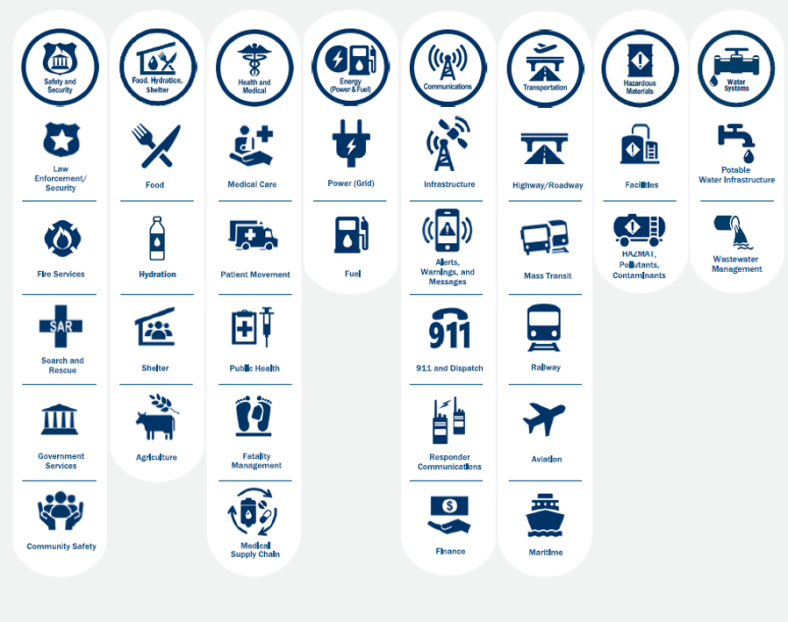
Organizing – Meet with them and meet collectively. Bring representatives onto working groups that work in preparedness, response, and/or recovery (consider the Community Lifelines as a place to start). This promotes mutual understanding and inclusiveness.

Equipping and Systems – Ensure that all partners have access to the systems used to support incident management.

Training and Exercises – Broaden the invite lists for training and exercises to help these partners gain knowledge and become more involved.

In the end, it’s about working together toward a common cause, aka unity of effort. To maximize the utility of our EOCs, we need to stop looking at an EOC through the lens of the first responder. Flip that perspective and begin looking at the EOC through the lens of government bureaucracy. Consider what these partners need to be successful. How and when can we streamline? Don’t try to turn them into first responders – that’s the wrong expectation. Rather, we need to meet them where they are, respect what they do, and understand why they have certain protocols in place. That will give us a foundation of understanding to work from.

End note: I’ll also suggest that this reality is another reason why ICS-based organizational models for EOCs are less than effective. The organization of an EOC needs to serve a different purpose than what we often try to force it into. Check out the Incident Support Model as a great alternative.

© 2025 Tim Riecker, CEDP

Emergency Preparedness Solutions, LLC®

Revisiting POETE

One of my most popular posts has been my original post on POETE from July 2014. In the 11+ years has passed since that post, I continue leveraging the concept in every way I can. In case you’ve not heard of the concept, I certainly urge you to click the link above and read my original post. Briefly, POETE stands for Planning, Organizing, Equipping, Training, and Exercises. These are collectively known as the elements of preparedness. POETE is more than a checklist to me. It’s a strategic lens for realistically building and sustaining capabilities. Whether you are building a new emergency operations plan, launching a new public health preparedness initiative, or refining multiagency coordination activities, POETE offers a structured way to think through what takes to help ensure these endeavors are implementation-ready.

While I’ve written on these in the past, my continued and diverse application of POETE has broadened my perspective on application, so here are some fresh thoughts.

Assessing – On occasion, I throw an A in front of the acronym for Assessing. While assessments are an early activity of Planning, there are also plenty of stand-alone assessment activities which should be regarded of their own accord. Assessments can and should inform everything else we do in preparedness. Good assessments can provide us with justification for certain activities and investments and can often give us a data-driven approach. Along with many of the risk assessments common across emergency management, like the Threat, Hazard Identification, and Risk Assessment (THIRA), I’d also suggest that (well written) after-action reports (AARs) can also do the job. A well-developed AAR for an incident, event, or exercise can provide objective analysis of observed activities or discussions. When writing an AAR, we should always keep in mind that part of achieving the goal of improvement may involve requests and justifications for funding.

Planning – I’ve written a lot on the topic of emergency planning through the years. Overall, my take on most emergency plans is that they suck. Horribly. They aren’t worth the time, money, or effort invested in writing them. So many people go about it wrong. A true plan needs to be a blueprint for action. Good plans are operationally-focused, guiding decisions and actions. They should not just be theory and policy, as so many are. At best, I’d call something like that a framework, but it’s certainly not a plan.

Organizing – Organizing is largely about structure, roles, and responsibilities, but you can’t even get there without first building relationships and partnerships. Everything we do in emergency management is about relationships. It’s about knowing who has the thing you need – be it a physical resource, specialized knowledge, or specific authority. Last week I wrote a new piece on Community Lifelines. The central activity of doing anything with Community Lifelines is building relationships. Once those relationships are in place, then other activities will follow.

Equipping – I’ve always been very big on tools matching the mission. Equipment in this context means any and all resources available to us. The key aspect of this is alignment. Are the tools we use matching up to our threats, our people, and our procedures? While it’s understandable to have to update procedures to match a new resource, we should be very cautious about the resource dictating procedure. Our resources need to work for us, not the other way around.

Training – I feel like we have been gradually moving away from compliance being the center of the training universe. Yes, there is still plenty of training that is required for various purposes – there should be and there will always be. But I’ve been getting more requests from clients to develop custom training because they realize that little to no training exists to meet their needs. More people are realizing, for example, that ICS training is absolutely not the fit for EOC staff. Similarly, they are realizing that existing EOC training might begin to approach their needs, but the implementation of their specific EOC model really requires customized training. Overall, training needs to be role-based. We need to be training people what we want them to do. We need to give them the knowledge to succeed, not just generalized training for a broad group hoping that people will be able to ascertain what pertains to them and what does not. We also need to realize that, since most training in emergency management is response-oriented, the things they are being trained to do are things they don’t do often and/or don’t do them under pressure. So frequency of training and job aids are essential to their success.

Exercises – The thing I do the highest volume of. Luckily, I love to do them! Exercises are about testing our plans and capabilities before they are tested for real. Pay attention to good exercise design and never forget that the end product is a worthwhile AAR. I still see so many softball AARs out there. AARs that pat people on the back for a job well done while only acknowledging the superficial opportunities to improve – often times because they don’t want to hurt anyone’s feelings. I don’t ever write an AAR for the purpose of offending anyone, but if we don’t expose what doesn’t work, the chances of it ever being addressed are so much lower than if we had documented it.

While we have the acronym of (A)POETE, it’s important to keep in mind that it’s not intended to be a linear process. It’s iterative and constantly in need of attention. Each component is informed by the others. While I generally believe that Planning is still the foundation of preparedness and it should heavily influence all other elements, those other elements can still influence Planning. POETE activities should be used to build our capabilities. These activities help us prepare with purpose, focus, and intent.

© 2025 Tim Riecker, CEDP

Emergency Preparedness Solutions, LLC®

Replacing ESFs with Community Lifelines

I’ve written previously about my concerns with using Emergency Support Functions in many state, local, territorial, and tribal (SLTT) emergency operations centers. The ESF structure was never intended for SLTT use, and while it may have some successes with the largest of the states and metropolitan areas, it’s generally not a good fit.

I’ve also written previously about Community Lifelines and the benefits thereof. Consider, however, that Community Lifelines, while designed originally for the organization of information by FEMA regional offices when they monitor a disaster, can have much broader applicability. We can and should be using Community Lifelines across every phase / mission area of Emergency Management.

Lately I’ve been having more and more conversations about Community Lifelines with clients, at conferences, and with others who are interested in learning more about them and how to use them. Across emergency management we often find or are provided with approaches to problems that are single-use. We should regularly explore opportunities to expand those single-use applications, increasing the utility of the concept at hand. Given the shortcomings of ESFs for most jurisdictions and the much broader applicability of Community Lifelines for every jurisdiction under the sun, I suggest that Community Lifelines cannot only be operationalized to be a viable replacement for ESFs, they can do so much more. Here are my arguments in support of replacing ESFs with a Community Lifelines – driven organization in SLTT EOCs as well as emergency management programs as a whole:

  1. Community Lifelines are community-focused and more comprehensive of the needs of a community, whereas ESFs are driven by functions which may have limited capabilities or capacities in any given jurisdiction.
  2. Community Lifelines can be operationalized just like ESFs, with primary and support agencies and organizations.
  3. Community Lifelines are focused on stabilizing critical services with built-in mechanisms for assessing impacts and establishing priorities.
  4. Community Lifelines more directly support the inclusion of the private sector, along with government, NGOs, and quasi-government owners/operators.
  5. Community Lifelines provide better preparedness and resilience initiatives.
  6. Community Lifelines provide us with a basis for measuring progress across all phases or mission areas. The only thing we can measure in an ESF is what we might have available to leverage in a response.
  7. Community Lifelines connect resilience, response, and recovery since they are the focal point. While the National Response Framework and National Recovery Framework still have national relevance, the transition from ESFs to Recovery Support Functions (RSFs) is challenging at best.
  8. The inclusion of Community Lifelines in our EOC structure is easy and agnostic to the organizational model used in the EOC. ESFs include functions that are part of the typical overhead management of an EOC, such as ESF 5 (Information and Planning), ESF 7 (Logistics), and ESF 15 (External Affairs), which is an awkward integration.
  9. Community Lifelines lend to better partnerships and preparedness. The ESF plans of most jurisdictions are truly little more than a general scope of the ESF with a list of participating agencies and organizations.

We need to change our mindset of emergency management being centered on response. Yes, response is the big shiny thing. It’s the thing we practice for and anticipate. A more wholistic and comprehensive approach is available to us, however, by using Community Lifelines as the foundation of our work. I suggest that jurisdictions develop Community Lifeline Implementation Plans, which are fundamentally strategic plans identifying how Community Lifelines can be used in Prevention/Protection/Mitigation, Preparedness, Response, and Recovery. Consider how the relationships forged with the owners/operators of Community Lifeline partners can support each of those phases and activities, increasing the resiliency of our community as a whole by making each partner more resilient; and by understanding and preparing for the response and recovery needs of our community through the collective effort of Community Lifeline partners.

Emergency management is more than response. It is a comprehensive effort to support our communities before, during, and after disaster.

© 2025 Tim Riecker, CEDP

Emergency Preparedness Solutions, LLC®

Generative AI in EM

We’ve recently seen a significant increase in discussion about applications of artificial intelligence (AI) (generative AI, to be more specific) in the emergency management (EM) space. In just a few minutes of scrolling through my LinkedIn feed this morning I’ve come across four user posts and one user-posted article expressing caution and concern about the use of AI in a full range of EM-related work, and one post extolling the advantages of using AI in certain EM applications. These posts expressing caution included topics such as being disingenuous in our work, inaccuracies of AI products, and accountability for use. The post in favor indicated ease of use and efficiency as principal advantages.

AI can certainly be a tool with many applications to support aspects of our job. It can short cut a lot of activities for us, saving huge amounts of time. It can generate ideas or create an outline to work from. But it cannot reliably and completely replace what we do. I see it as a complementary tool – one that still requires human input, intervention, and review to be successful. In examining the pros and cons, we can’t just look at it superficially, though. There are concerns of information security, intellectual property, inaccuracies, environmental impact, and ethical accountability to consider.

There are concerns about where generative AI platforms source their data. In essence, it can be seen as a type of crowd sourcing, pulling data from across the internet, similar to how we might in doing research. However, generative AI does not often cite its sources and has been heavily criticized by writers and artists of plagiarism. I’ve actually run a few tests of my own, asking a generative AI tool to write about certain topics that are very niche, with myself being one of the few people writing on those topics. While it did cite me as a source on a couple of occasions, it typically did not, though there were clearly word-for-word phrases sourced from my own writing. Additionally, generative AI is not skilled in discerning truth from misinformation or disinformation, potentially leading to significant inaccuracies. On the flip side, anything you input into a public generative AI platform, such as an emergency plan, is now part of that AI’s dataset, bringing potential security concerns to the discussion.

What has me even further concerned is the cognitive impact on those who habitually use AI to do much of their work. MIT did a study which concluded that overuse of AI harms critical thinking. Microsoft partnered with Carnegie Mellon for a study that came to similar conclusions. We should also be aware of the environmental impacts of AI data farms, (and here is another article for your reference) which is a significantly growing concern around the world.

In regard to the impacts on critical thinking, I have severe concerns about the need to raise the bar of emergency manager knowledge, skills, and abilities (KSAs), not just as a matter of progressing the profession, but because of some serious gaps we’ve recently seen identified in after action reports (AARs), media statements, social media posts, and other releases that demonstrate a huge lack of understanding of key concepts among emergency managers. While the use of generative AI may help support the work involved in various projects, I would argue that it is not promoting or advancing individual KSAs in the field of emergency management (aside from those needed to interface with AI). If unplugging an emergency manager from AI tools results in us no longer having a knowledgeable, skilled, and able emergency manager, we have a major problem. 

I say all this not ignorant of the fact that I have friends and colleagues who use generative AI to help them develop content, such as their LinkedIn posts. Largely, these individuals have been transparent about their use of generative AI, indicating that they use it either up front to help provide structure to an idea which they then use as a framework to flesh out on their own, or at the end of their own creative process to tighten up their work. Overall, I don’t see much detriment in these approaches and uses, and have even acknowledged that my college students may be using it in these ways and providing them some guidance that supports successful use while helping them to ensure accuracy and avoid any allusion of plagiarism. It’s when people habitually use generative AI to pass off work as their own with little to no human input that I have concern. I also have friends and colleagues working with much broader applications of AI, for which I have concerns. While my concerns aren’t necessarily opposition, as I clearly see the benefits of these tools and uses for what we do in EM, I still see a lot of potential for eroding KSAs and critical thinking in our field, which is something we cannot afford. Yet I remain cautiously optimistic of a net gain. 

For those that choose to use it to generate content and outputs, be ethical and transparent about it. There is no shame in using AI, just consider citing it as you would a source (because it’s not your work) just as you should be with any other sources, and obviously be aware of the pros and cons of using generative AI. Generative AI is still a developing technology, a toddler perhaps in terms of relative growth, and I think even proponents should be skeptical, as skepticism can help address many of these concerns. Consider that toddlers can be fun, but they can cause absolute chaos and can’t be left unattended for even a moment.

I’m reminded of a saying with its roots in project management that goes something like this: You can have it cheap, fast, or good, but you can only pick two. Here’s what the options look like:

  • Fast and good won’t be cheap.
  • Good and cheap won’t be fast.
  • Fast and cheap won’t be good.

It seems to me that most people using generative AI are trying to pick the ‘fast and cheap’ options, which bring about the majority of concerns associated with quality and integrity in this article, but when we look beyond the superficial, into things like the environmental impacts of AI data farms and the cognitive impacts to high-volume users, the end result certainly isn’t cheap, no matter what options we pick.

©2025 Tim Riecker, CEDP

Emergency Preparedness Solutions, LLC®

Why Aren’t We Asking Questions and Demanding Answers?

Having been on the road practically every week this year has made blogging a bit of a challenge. I’ve had some engagement on LinkedIn, often in discourse on the issues facing disaster and emergency management brought on largely by the current administration.

You’ve probably heard of the concept of mushroom management, right? Keep people in the dark and feed them shit. That’s what we’re getting regarding the future of FEMA, which makes it extremely difficult for practitioners to chart a course ahead for this field. The only information we receive is poorly communicated intent and obfuscation. Those who are supposed to be representing the profession either aren’t asking the right questions or are being ignored.

Let’s take a look at this horrible bit of journalism from earlier in the month (I’ll note that most news outlets have been using the same quotes and generally haven’t brought us anything new either).

I’ll break this down a bit. First, the headline: Trump and Noem detail planned FEMA changes: ‘We’re going to give out less money’. Commentary: There is NO detail in the article or in anything the administration has communicated about this. Simply stating that they are going to give out less money leaves a whole lot of questions. Much of the narrative has been around funds associated with declared emergencies and major disasters, but there is a whole lot of other funding that FEMA manages. More on this later.

A quote early in the article: “We want to wean off FEMA and we want to bring it down to the state level… We’re moving it back to the states.” Commentary: If I’ve not made this abundantly clear before, DISASTER MANAGEMENT HAS ALWAYS BEEN A STATE (and local, tribal, and territorial) ISSUE. What exactly is being moved back to the states? Further, as I’ve stated in a previous article, I’m not opposed to a ‘weaning off’ of federal funds, but there should be a plan in place for this which is implemented over time and communicated with enough lead time to allow state, local, tribal, and territorial governments to begin adjusting budgets. Also, this again begs the question of exactly what funding is being changed. We need information so this can be addressed.  

The next quote in the article: “We’re going to give out less money… It’s going to come from the President’s Office” Commentary: How, exactly, is it coming from the President’s office? The Stafford Act assigns FEMA with the responsibility for coordinating federal disaster assistance. So are we changing the law?

The next item I want to poke at is a quote from Secretary Noem in the article, which reads “the administration is building communication and mutual aid agreements among states to respond to each other so that they can stand on their own two feet…”. Commentary: Does she mean the Emergency Management Assistance Compact (EMAC)? The same EMAC that has its roots going back to 1992 and was ratified by Congress in 1996 as a nation-wide system of state-to-state mutual aid and used very effectively since then? That mutual aid system? Or is the administration building something else? This seems to be a greatly misinformed quote.

With no apology for my language, what in the actual fuck is going on here?

I pointed out the article as being a horrible bit of journalism because it’s simply reporting quotes and NO ONE IS ASKING QUESTIONS. (Or if they are, they aren’t being answered). There are a lot of questions that need to be asked and answered. This is a big issue. A complicated issue. It requires a whole lot of clarity. The problem is, it seems that those making decisions really don’t know anything about the topic or what they are doing.

Over the past couple of months we’ve seen leaked budget proposals that impact emergency and disaster management grants, public health emergency preparedness grants, and the like. Those grants that aren’t being completely cut in these proposals are being reduced by tens of percentage points, equating to tens, and sometimes hundreds of millions of dollars. Regardless of the long-term impacts of these decreases, this is massively disruptive in the short term. Disruptive to the point that entire programs will be gutted and our collective ability to respond to disasters will be dangerously impacted. Again, I ask what is the plan or is the administration simply hacking and slashing away at things? As no existence of a plan, much less a strategy, has been mentioned, I can only believe this to be arbitrary and uninformed.

So many people are acknowledging there are issues with FEMA and that addressing them can be good, and I won’t dispute that, but that’s as far as they go. It’s a statement, a justification, an excuse, but it’s not a conversation. This needs to be a conversation. Uninformed change is bad. Misguided change is bad. Change for the sake of change is bad. As I stated in a recent LinkedIn post, emergency managers need to get their shit together. While the usual pace of government and bureaucracy can be frustratingly slow at times, we have systems in place for a reason. Change at this level must be well considered with input garnered from across the practice. The rhetoric and bull in a China shop approach might excite those who are easily impressed with superficial, performative bullshit; but it shouldn’t for those of us with some intelligence and background in this. We have a lot of smart people in emergency and disaster management, but I’m not hearing a lot of voices.

Who should ask questions? What percentage of elected officials at the federal level even know what the Emergency Management Performance Grant (EMPG) is? I’m betting it’s pretty low. Do they even realize there are prevention, preparedness, and hazard mitigation funds and programs or do they only know about assistance after a disaster? It’s easy for us to point a finger at the membership organizations for not doing enough advocacy and outreach (are they?), but that job isn’t theirs alone. It’s on ALL of us to get elected officials to understand what these programs are and why they are necessary, or at least advocate a better way to enact cuts. If you don’t know how to contact your members of Congress, start here and tell them the current approach is unacceptable. Likewise, if you haven’t contacted your state elected officials, you need to do so as well. The writing seems to be on the wall that these significant cuts in funding are coming and they need to discuss (with practitioners!!!) how to deal with it.

Regardless of the outcome of FEMA’s status and that of federal program funding, disaster management will continue, but the impacts may very likely be severe, and not just in the short term. There will be lasting impacts which will need to be addressed through years to come and at a much greater cost than delaying this politically-driven action in exchange for a more thoughtful approach.

TR

Cutting Grant Funds Cuts National Practices

As some rumors become reality for the current fiscal year and budget memos are leaked for the coming fiscal year, one thing is clear – states, local governments, tribal governments, and territories (SLTTs) will be receiving significantly less federal grant funding for preparedness. While some programs are expected to be outright eliminated, others are being reorganized and refocused with significant budget cuts. While not all change is bad, there is a significant shift in preparedness priorities that is largely politically motivated and lacking foundations in reality. I wrote last month on the Future of the US Emergency Management System, which focuses mostly on FEMA-centric topics, but we are also seeing and expecting major cuts to public health emergency preparedness (PHEP) grant funds, the elimination of certain PHEP programs, and indirect impacts to PHEP from cuts to other public health programs.  Similar cuts are also expected with the Hospital Preparedness Program (HPP). While I don’t think preparedness funds will be completely cut, the impacts will be significant until SLTTs are able to adjust their own budgets to address what priorities they can.  

Grant funding, however, is not only to the direct advantage of the recipients. Compliance with grant rules has long supported national standards (note that I use this term loosely. See this article for more information). FEMA preparedness grants, PHEP grants, and HPP grants, among others, have required the adoption of the National Incident Management System (NIMS), the use of the Homeland Security Exercise and Evaluation Program (HSEEP), national focus on certain threats or hazards, and reasonable consistency in building and sustaining defined capabilities. Grants have been the proverbial carrot that encouraged compliance and participation. While some of the results have been poorly measured (see my annual commentary on the National Preparedness Reports), the benefits of others have been much more tangible. Keeping things real, compliance with many of these requirements by some recipients may have been lackluster at best. Enforcement of these requirements has been practically non-existent (despite rumors of the “NIMS Police” circulating for years), which I think is a shame. That said, I think most recipients worked to meet most requirements in good faith; perhaps partly because someone’s signature attested to it, but I think mostly because many of these requirements were viewed as best practices. As such, while the requirements may be going away if there is no carrot for compliance, I think many jurisdictions will continue implementation.

All this, however, looks at past requirements. But what of new practices that would benefit from nation-wide implementation? I fear that without practices being required as part of a grant, adoption will be minimal. We would have to count on several factors for adoption to take place.

1) Emergency managers would need to be informed of the practice and the benefits thereof. Let’s be honest, most emergency managers are not well informed of new practices and concepts. Often, they simply don’t have the time to do any more than what they are doing, but unfortunately some may not care. Agencies like FEMA have also been notoriously bad at circulating information on new programs, practices, and concepts.

2) Emergency managers would have to agree that the practice can be beneficial to them.

3) Emergency managers would need the resources (time, staff, funds, etc.) to actually implement the practice.

4) In a multi-agency environment, partner agencies are more willing to support activities if they are told it’s a grant requirement – even if it’s not their own grant requirement. They may be reluctant to commit resources to something that is simply perceived as a good idea.

There are certainly a number of challenges ahead for emergency management in the broadest of applications. What I discuss here only scratches the surface. Let’s not lose sight of the benefits of best practices and standards, even if no one is telling us we need to adhere to them. That’s a hallmark of professionalism. We need to collectively advocate for our profession and the resources necessary to perform the critical functions we have. We need to take the time to advocate and to be deliberate in our actions. We need to secure multiple funding streams from every level of government possible. We need to identify efficiencies and leverage commonalities among partner agencies. Yes, lend your voice to the national organizations, but know that it’s up to you to advocate in your municipality, county, and state – and those efforts are now more important than ever.

©2025 Tim Riecker, CEDP

Emergency Preparedness Solutions, LLC®