AHIMTA Incident Management Certification

I was very pleased to see last week’s announcement by the All-Hazards Incident Management Team Association (AHIMTA) about their certification services for incident management personnel. From their website, AHIMTA is utilizing the National Incident Management System (NIMS) and the National Qualification System (NQS) as the baseline for their AHIMTA Incident Management Certification System (AIMCS). Information, including trainee application information can be found at https://www.ahimta.org/certification. In many ways, the AIMCS is a continuation of the Interstate Incident Management Qualifications System (IIMQS) Guide that AHMITA developed in 2012.

AHIMTA is providing a much-needed service, filling a vacuum that has always existed in the all-hazards incident management team (IMT) program in the US. While FEMA is responsible for maintaining the NQS, they have not actually provided certification or qualification of IMTs or IMT personnel. Last year it was decided that the US Fire Administration would discontinue their management of the AHIMT program. While the USFA didn’t provide any certification services, the program guidance they provided was valuable. They were also the primary federal agency doing anything with external AHIMTs. While some states have implemented the FEMA NQS standard for IMTs and associated positions, others have not. Even among the states that have, some have only done so, officially, for state-sponsored teams/personnel and not for those affiliated with local governments or other entities. Clearly gaps exist that must be filled. AHIMTA has continued to advocate for quality AHIMTs and personnel across the nation.

AHIMTA’s role as a third-party certification provider presents an interesting use case. While not unique, a third party providing a qualification certification (not a training certificate) based on a federal standard is not necessarily common. AHIMTA doesn’t have any explicit authority to provide this certification from FEMA or others, but as a respected organization in the AHIMT area of practice, I don’t think their qualifications to do so can be denied. Certification demands a certain rigor and even assumes liability. The documentation of the processes associated with their certification are well documented in their AIMCS Guide. While AHIMTA can’t require their certification, states and other jurisdictions may very well adopt it as the standard by which they will operate, and can make it a requirement for their jurisdiction. Aside from some very specific certifications that have existed, such as those for wildfire incident management personnel, much of AHIMT practices has been self-certification, which can vary in quality and rigor. The AIMCS program can provide consistency as well as relieve the pressure from states and other jurisdictions in forming and managing their own qualification systems. There will also be an expected level of consistency and excellence that comes from AHIMTA.

All that said, I continue to have reservations about membership organizations offering professional certifications. While membership organizations arguably have some of the greatest interest in the advancement of their profession and adherence to standards, as well as the pool of knowledge within their practice, the potential for membership influencing the process or injecting bias against non-members can never fully be eliminated. I feel that certifications should be provided by government agencies or fully independent organizations that are not beholden to a membership. Not wishing to stall AHIMTA’s progress or success in this program, I’m hopeful they may be willing to create a separate organization solely for the purposes of certification credentialing. I’d also love to see, be it offered in conjunction with this program or otherwise, an EOC qualification certification program, ideally centered upon FEMA’s EOC Skillsets, but with qualification endorsements for various EOC organizational models, such as the Incident Support Model.

I’m very interested to see the progress to be made by the AIMCS and how states and other jurisdictions adopt it as their standard. This certification should have significant impact on the continued development of quality all-hazard incident management teams.

What are your thoughts on this certification program?

© 2023 Timothy Riecker, CEDP
Emergency Preparedness Solutions, LLC®

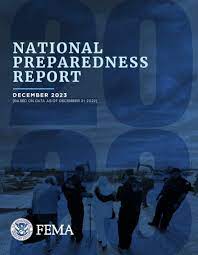
2023 National Preparedness Report

Every year at this time of year, FEMA delivers the National Preparedness Report. Much like that one relative that is always a horrible gifter around the holidays, the infamous legacy of a long line of NPRs persists, reinforcing the waste of time, effort, and money through lack of value. It truly pains me to be so negative about these documents, but the disappointment of these documents pains me more. The development of the NPR is a great opportunity to provide analysis of meaningful information, yet it is consistently inconsistent in the style and format presented every year, and falls severely short of any potential this document could have. That said, there are always a couple of shining moments that each report has, if only they could embrace those and use them every year! If you would like a summary of the abysmal history of NPRs through the years, you can find my previous posts here.

The 2023 NPR (which is developed from 2022 data) kicks off in a laughable fashion in the Introduction and Executive Summary, which identifies four key findings:

  1. Increasing Frequency, Severity, and Cost of Disasters
  2. High Community-Level Risk
  3. Ongoing Individual and Household Preparedness Gaps
  4. Lack of Standardized Building Code Adoption

This is followed immediately by three recommendations:

  1. Target Investments Towards Particular Core Capabilities and Mission Areas
  2. Reduce All-Hazards Challenges Through Targeted Actions and Increased Coordination
  3. Address National Gaps to Prepare for Catastrophic Disasters

Following the Introduction and Executive Summary, the report is structured with information on Risks, followed by what they claim are ‘trends’ in Capabilities, Focus Areas of certain Core Capabilities, and a conclusion. Let’s take a quick look at each.

A formatting issue that immediately struck me as I explored the sections was that they carried through numbering of sub sections which began in the Introduction. Seems minor, but it’s awkward and made me think in the first (Risk) section that I had missed something when the first numbered subsection (three pages into the section) started with 4. Overall, the section on Risks provides some good summaries and graphics that emphasize the increasing frequency, severity, and cost of disasters, providing both annual trend information (I like this!) as well as information specific to 2022. Page 10 of the document provides an interest graph derived from national 2022 THIRA/SPR data that lists hazards of concern. The top 5 hazards of concern listed are:

  1. Cyber Attack
  2. Pandemic
  3. Flood
  4. Active Shooter (can we PLEASE universally adopt the term Active Shooter/Hostile Event??)
  5. Earthquake

Wanting to see if/how dots were connected, I read ahead a bit on these to see if there were any connections. In the Focus Areas section, Cybersecurity is prominently identified within the discussion on the Public Health, Healthcare, and EMS Capability as a threat to the healthcare sector. While this is true, the Cybersecurity threat permeates every other sector, which is only vaguely alluded to in the discussion on the Long-Term Vulnerability Reduction Capability. The Public Health, Healthcare, and EMS Capability did reinforce Pandemic preparedness needs, though the Active Shooter and Earthquake concerns had virtually no mention in the document beyond the Threat/Hazard discussion.

While I do appreciate the mention of the National Risk Index in this section (it’s a great tool), they miss the opportunity to really contextualize and cross reference threats and hazards of concern.

The section on Capabilities highlighted something I found both interesting and confusing…

In the Response mission area, communities report low levels of grant investment and lower target achievement in Mass Care Services and Logistics and Supply Chain Management. Communities also consider Mass Care Services a high priority capability. These capabilities and three of the four Recovery Core Capabilities fall within these ranges and may warrant increased grant investments.

My commentary: If communities are identifying Mass Care Services to be a high priority, why are they investing lower levels of grant funds into that capability?

The first subsection of the Capabilities section is Individual and Household Preparedness. While clearly an important area of discussion, it’s not a Core Capability, nor does the report associate any Core Capabilities with this topic. The next subsection on Community Preparedness does make some connections to Core Capabilities. It’s in this subsection that the updated chart of Grant Funding by Core Capability is provided. Yet again, the Housing Core Capability is among the loss leaders, with no sign of that ship being steered on the proper course. I find it interesting to note that Supply Chain Integrity and Security, and Economic Recovery are also among the lowest investments, despite some severe lessons learned from COVID-19 in those areas.

Among the leaders in Grant Funding by Core Capability are Planning, Operational Coordination, and Operational Communications. All that money spent, yet those areas continue to be consistently among the highest areas for improvement in after-action reports. I’d love to see an audit detailing more precisely what activities that money is being spent on within these Core Capabilities and what the outcomes of those activities are, as I suspect we are spending a whole lot of money with little resulting value. I’ll also note that this is only 2022 data. Every year I’ve written about the NPR I’ve suggested the need for multi-year analysis so we can actually identify trends, progress, and gaps over time. Single year snapshot-in-time data has such limited value.

The last subsection in the Capabilities Section is National Preparedness. Much of the information in this section is provided in a table on National-Level Capability Gaps and Recommendations. The table is organized by POETE but also includes areas on Capacity and Coordination (I’d suggest that the items contained in these two areas could have been placed within POETE). The introduction to this table states that the table summarizes high-level gaps and recommendations at the national level across all Core Capabilities. While in essence this something I’ve suggested in my commentary on previous year’s reports, this is TOO high level. It’s so high level that it is completely absent of any context or detail to really be meaningful. I’m also left wondering (doubting, really) if future grant funding will target any of these recommendations.

The next section is Focus Areas. This section highlights four specific Core Capabilities:

  1. Fire Management and Suppression
  2. Logistics and Supply Chain Management
  3. Public Health, Healthcare, and EMS
  4. Long-Term Vulnerability Reduction

While the reason for these four, specifically, to be covered is pretty evident based upon associated risk, threats, hazards, and needed improvements; I’m still left wondering why only these four, especially when significant gaps were identified in so many other Core Capabilities, as well as the lack of progress I noted earlier on other Core Capabilities despite extraordinary investment.

Each of these Core Capabilities is organized by a discussion of associated risk – which included some quality identification of trends, costs, and impacts; capability gaps; and management opportunities. Overall, the content in these areas is fine, but nothing really earthshattering. The Management Opportunities, which are mostly corrective actions, have focus ranging from federal, to SLTT, NGO and Private Sector, and Individuals and Households. Some good ideas are listed, similar to last year’s approach, but as with the previous section, I’m still left wondering if any of these actions will become funded priorities.

I noted in the Conclusion that the report does include an email address for feedback. I don’t think I ever saw this before, but I’ll be sending my collected commentary from this year and previous years to hopefully spur some changes to make the report more valuable than a superficial summary.

© 2023 Timothy Riecker, CEDP

Emergency Preparedness Solutions, LLC®

Gaps in ICS Doctrine and Documents

Last month I got to spend several days with some great international colleagues discussing problems and identifying solutions that will hopefully have a meaningful and lasting impact across incident management and emergency response. No, this wasn’t at an emergency management conference; this was with an incredible group of ICS subject matter experts convened by ICS Canada, with a goal of addressing some noted gaps in ICS doctrine, training, and other related documents. While the focus was specific to the documents under the purview of ICS Canada, most of these matters directly apply to ICS in the United States as well.

Overall, our doctrine, curriculum, etc. (collectively, documents) across ICS is a mess. Broadly, the issues include:

  • Poor definitions of key concepts and features of ICS.
  • Lack of proper emphasis or perspective.
  • Lack of inclusion of contemporary practices. (management concepts, social expectations, moral obligations, even legal requirements, etc.)
  • Lack of continuity from doctrine into supporting documents and curriculum. – Everything needs to point back to doctrine. Not that every tool needs to be explicitly included in the doctrine, but they should be based upon consistent standards.
  • A need to support updated training to improve understanding and thus implementation.

As we discussed among the group and I continued thought on this, I’ve realized that ICS, as it relates to the US (NIMS) has so little doctrine spread across a few NIMS documents (the core NIMS doctrine, National Qualification System documents, and a few guidance/reference documents – which aren’t necessarily doctrine). In the US, via the National Wildfire Coordinating Group (NWCG), we used to have a whole array of documents which could be considered ICS doctrine (in the days of NIIMS <yes, that’s two ‘eyes’>). When the responsibility for the administration of ICS (for lack of better phrasing) shifted to DHS, these documents were ‘archived’ by the NWCG and not carried over or adopted by the NIMS Integration Center (NIC) in DHS who now has responsibility for NIMS oversight and coordination. The NIC has developed some good documents, but in the 20 years since the signing of HSPD-5 (which created and required the use of NIMS) it seems the greatest progress has been on resource typing and little else.

Looking at current NIMS resources, I note that some are available from the core NIMS site https://www.fema.gov/emergency-managers/nims while others are available from EMI at https://training.fema.gov/emiweb/is/icsresource/. All these documents really need to be consolidated into one well organized site with doctrine identified separate from other resources and documents (i.e. job aids, guidance, etc.).

I thought it might be fun to find some examples so I decided to open up the ICS 300 instructor guide, flip through some pages, and look at a few concepts identified therein that might not have much doctrinal foundation. Here’s a few I came up with:

  • Formal and Informal Communication
    • These concepts aren’t cited anywhere in NIMS documents. While superficially they seem to be pretty straight forward, we know that communication is something we constantly need improvement in (see practically any after-action report). As such, I’d suggest that we need inclusion and reinforcement of foundational communications concepts, such as these, in doctrine to ensure that we have a foundation from which to instruct and act.
  • Establishing Command
    • This is mentioned once in the core NIMS doctrine with the simple statement that it should be done at the beginning of an incident. While often discussed in ICS courses, there are no foundational standards or guidance for what it actually means to establish command or how to do it. Seems a significant oversight for such an important concept.
  • Agency Administrator
    • While this term comes up several times in the core NIMS doctrine, they are simple references with the general context being that the Agency Administrator will seek out and give direction to the Incident Commander. It seems taken for granted that most often the Incident Commander needs to seek out the Agency Administrator and lead up, ask specific questions, and seek specific permissions and authorities.
  • Control Objectives
    • Referenced in the course but not defined anywhere in any ICS document.
  • Complexity Analysis
    • The course cites factors but doesn’t reference the NIMS Incident Complexity Guide. Granted, the NIMS Complexity Guide was published in June 2021 (after the most recent ICS 300 course material), but the information in the Complexity Guide has existed for some time and is not included in the course materials.
  • Demobilization
    • Another big example of the tail wagging the dog in NIMS. Demobilization is included across many ICS trainings, but there is so little doctrinal foundation for the concept. The core NIMS doctrine has several mentions of demobilization, even with a general statement of importance, but there is no standard or guidance on the process of demobilization beyond what is in curriculum – and training should never be the standard.

For ICS being our standard, we haven’t established it well as a standard. A lot of work needs to be done to pull this together, fill the gaps, and ensure that all documents are adequately and accurately cross-referenced. This will require a significant budget investment in the National Integration Center and the formation of stakeholder committees to provide guidance to the process. We need to do better.

What doctrine and document gaps do you see as priorities in NIMS?

© 2023 Tim Riecker, CEDP

Emergency Preparedness Solutions, LLC®