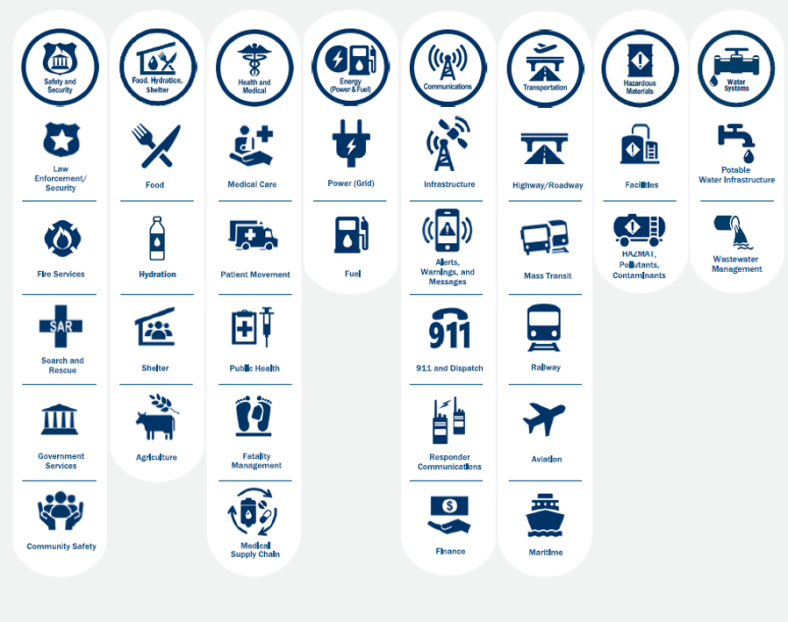
In all great ideas, the devil, as they say, is in the details. Implementing new concepts often requires preparations to ensure that the implementation goes smoothly. We often rush to implementation, perhaps excited for the results, perhaps not thinking through the details. Without proper preparation, that implementation can fail miserably. Integrating and implementing the Community Lifelines is no exception.
Just like everything else we do in preparedness, we should turn to the capability elements of planning, organizing, equipping, training, and exercises (POETE) to guide our preparedness for Community Lifeline implementation.
Planning and Organizing
I’m coupling these two capability elements together as they so strongly go hand-in-hand. Determining how you want to use Community Lifelines is an important early step. I’d suggest developing a Community Lifeline Implementation Plan for your jurisdiction that not only identify how you will use them in response and recovery operations, but details of how their use fits within your response and recovery management structure, how information will flow, who is responsible for what, how information is reported, and to who it is reported. The Implementation Plan should also outline the preparedness steps needed and how and where information will be catalogued.
I’ve seen several Community Lifeline integrations across local, county, and state jurisdictions, these mostly being visual status displays, but there can be some complexity in how we even get to that display.
We all know from CPG-101 that forming a planning team is the first step of emergency planning. While not itself really the capability element of Organizing, the stakeholders that will be assembled for this will extend across all capability elements and into response and recovery operations.
Before identifying stakeholders, we need to examine each Community Lifeline down to the sub-component levels, which first necessitates determining which components and sub-components are applicable to your jurisdiction. For example, within the Transportation Community Lifeline, if your jurisdiction has no Aviation resources or infrastructure, you may choose to not include that component.
Once you have made the determination as to what components and sub-components of each Community Lifeline will be included, it’s not time to form your planning teams for each. Depending on the size of your jurisdiction, you could form teams at the Community Lifeline level, the component level, or the sub-component level. You could even use different approaches for each (i.e. The Community Lifeline of Water Systems may only involve a few stakeholders to address all components and sub-components, whereas Health and Medical may require distinct teams for each component). Since much of the Community Lifelines is centered on or strongly relates to critical infrastructure, many of our stakeholders will be from the private sector. Hopefully these are partners you have engaged with before, but if not, this is a great opportunity to do so.
In meeting with each of these stakeholders/stakeholder groups, providing them with an orientation to the Community Lifelines concept will be important. Be sure to talk about this within the contexts of whole-community preparedness, public-private partnerships, critical infrastructure, and the five mission areas. This should include the expectation for these to be long-term working groups that will provide information updates before, during, and after a disaster. It will be important to obtain from each the following information (at minimum) for each function and/or facility:
- Legal owners and operators
- Primary and alternate points of contact (and contact info for each) (Note that these should be emergency/24 hour contacts)
- Existing emergency plans
- Protection activities
- Prevention activities
- Mitigation activities
- Preparedness activities
- Response and recovery priorities
- Critical continuity and supply chain issues
- Sensitive information concerns
Processes will need to be mapped to identify how information will be obtained in an incident from the owners/operators of each facility or function, what information will be expected, in what format, and how often. Internal (EOC) procedures should identify how this information will be received, organized, and reported and how it will influence operational priorities for response and recovery. Since the visual representation of the Community Lifelines is the face of the system, you should also determine what the benchmarks are within each Community Lifeline, component, and sub-component for differentiating between status (i.e. what failures will bring status from green to yellow, and from yellow to red) and how the status of one may influence the status of others.
Equipment (and Systems)
It is important to catalogue the information you obtain from preparedness activities as well as in implementation. Consider GIS integrations, as there is an abundance of information that involves geolocation. I’ll make a special shout out here to the Community Lifeline Status System (CLSS) project, which is funded by the DHS Science and Technology (S&T) Directorate and is being developed by contract to G&H International. When rolled out, the CLSS will be available at no cost to every jurisdiction in the US to support Community Lifeline integration. Having been fortunate enough to get a private in-depth tour of the system, I’m thoroughly impressed. The CLSS is based on Arc GIS and provides a lot of customizable space to store all this preparedness information.
Using a system such as CLSS to display and share Community Lifelines information is also a benefit. While most displays I’ve seen simply show the icon and status color for each Community Lifeline, an interactive dashboard type of system can help provide additional context and important information. This is something CLSS also provides.
Training and Exercises
As with any new plans or processes, training is an important part of supporting implementation. Training audiences will include:
- EOC personnel
- Owners/Operators of Community Lifelines infrastructure
- Officials who will receive Community Lifelines information
Proper training requires that different audiences should receive training to address their specific needs.
Similarly, exercises should purposely test these processes, and use of Community Lifelines should be incorporated into exercises often. Community Lifelines status and information should be engaged in exercises to inform and support decision making.
///
If you already know the benefits of the Community Lifelines, hopefully you see the advantages of adequate preparedness to get the most out of them. The stakeholder groups you assemble to support planning should be everlasting, as information on their vulnerabilities, capabilities, and activities are likely to change over time. Beyond direct Community Lifeline applications, these are all great partners for a variety of emergency management activities to support the whole community. The preparedness efforts, and maintenance thereof (sorry, but it’s not just a one-time thing) is a significant investment (and could likely be a full-time job for even a moderately sized jurisdiction) but it should pay incredible dividends over and over again.
Are you using Community Lifelines? What have you learned about the need to prepare for their use?
© 2024 Tim Riecker, CEDP
 The Contrarian Emergency Manager