2017 Health Security Index

The 2017 National Health Security Preparedness Index has been released by the Robert Wood Johnson Foundation.  The Index provides measures of data nationally and for each state in the US across six public health domains, which include:

  1. Health security surveillance
  2. Community planning and engagement
  3. Information and incident management
  4. Healthcare delivery
  5. Countermeasure management
  6. Environmental and occupational health

The documents found on the website indicate a continued trend of improvement across the nation, but progress is slow, with some states lagging behind significantly according to the study, particularly in the deep south and mountain west regions.

The report identifies the following factors as having the greatest influence on the increase and intensity of US and global health threats:

  • Newly emerging and resurgent infectious diseases like Zika, MERS, and Ebola.
  • Growing antibiotic resistance among infectious agents.
  • Incomplete vaccination coverage.
  • Globalization in travel and trade patterns.
  • Political instability, violence and terrorism risks.
  • Aging infrastructure for transportation, housing, food, water, and energy systems.
  • Extreme weather events including storms, fires, floods, droughts, and temperature extremes.
  • Cyber-security vulnerabilities.

I think it’s important to note that while some of the factors listed above are distinctly within the public health realm, others are more universal in nature.  So not only are the findings of this study relevant to everyone, because public health is relevant to everyone, but many of the factors that influence the threats fall within areas of responsibility of broader emergency management and homeland security.

Public health matters are near the top of my list of greatest concern.  This report clearly shows that while we have made great strides in public health preparedness, we have a long way to go.  There is also no end game.  We don’t get to say we won after playing four quarters, three periods, or nine innings.  These are efforts in which we must persist, and not only with today’s tools and capabilities, but we must constantly look toward new tools.  However, as we do this, new threats will emerge.  It may seem intimidating, but it’s essential.

What are you doing to further public health preparedness capabilities?

© 2017 – Timothy Riecker, CEDP

Emergency Preparedness Solutions, LLC

When in Doubt, Speak from Experience

Last week I had the pleasure of being invited to speak at a conference on incident management. This two-conference covered a variety of topics ranging from preparedness, response, and recovery; and while there was a lot of discussion on mass shootings, the conference covered all hazards.  There were a number of great presenters providing interesting insight and information.  Of course one of the most interesting and effective ways of learning, in public safety and other industries, is through lessons learned of actual incidents and events.  We had some detailed reviews of various incidents, including the Dallas shooting, the Aurora theater shooting, and the San Bernardino shooting.  These had extraordinary detail and discussion, driven by presenters who worked those incidents.

There was one presenter, however, who enjoyed telling stories of incidents which he had no involvement in.  Generally, most people who do such a thing have the common sense of keeping it to brief illustrative points based on specific factual information.  If someone is taking a scholarly approach, we would see more detail, but based upon their research and interviews.  This particular presenter, we’ll call him Bart (name changed), took neither approach.  He was a retired Sherriff’s deputy from a county in California.  He clearly had enough credentials to get himself invited to things, but if this was his general pattern of presenting, I’m guessing he rarely gets invited back.

Aside from his presentations not at all addressing the topic, he liked to tell stories, speaking at length about incidents and locations he has never been involved in.  He even admitted to not having any involvement, and instead citing ‘something he read’ as his source.  This would be sketchy on the surface, but it was even more frustrating when he told stories of NYC 9/11 and recent events in the National Capital Region with myself and a colleague seated at the front table… myself having worked a variety of aspects of 9/11 and my colleague who presently works in the National Capital Region.

Bart presented twice, once the first day, and again on the second day.  While we casted a couple of corrections his way on the first day, we were mostly shocked that he would venture into such territory, providing information that was at best 80% fact.  During his presentation the second morning, we were much less forgiving.  His continued anecdotes about these areas and incidents were relentless, and his lack of facts in the telling of these stories was simply unprofessional.  We called him out on it several times and it was clear from body language and general lack of interest that the room fully understood what was going on.

My general rule of thumb is to speak from experience.  Don’t tell someone else’s story.  That’s not to say you can’t speak about an incident or event you weren’t involved in, just make sure you stick to the facts and be respectful that you have ventured into someone else’s territory.  If you were involved in an incident, you may be inclined to be a bit more casual about your manner because you lived it, but if you weren’t at the incident, keep it formal, cite your fact, associate it with your point, and move on.  Don’t be Bart.

Needless to say, I had several conversations with the conference organizer, who had no prior experience with Bart and was rather appalled at his presentations.

When in doubt, speak from experience.  Don’t be Bart.

© 2017 – Timothy Riecker, CEDP

Emergency Preparedness Solutions, LLC

Incident Management & Proper Demobilization Planning

A fair amount of courses, especially those oriented toward the Incident Command System (ICS), mention demobilization, but that mention is usually fairly gratuitous.  Even the core ICS courses generally only offer a couple of paragraphs or a handful of bullet points.  The ICS 300, since it does focus more on incident planning, does contain some good additional material, but it’s still quite brief.  Demobilization is a best practice of incident management, along with staging areas, that are rarely done properly.  It’s not a surprise, though… there isn’t a lot of emphasis on them in ICS and related training, and generally what is out there is pretty poor quality.  This has been further emphasized through nine separate functional exercises I’ve conducted over the past couple of months where it was easily identified that most participants weren’t really familiar with what demobilization meant to them and their organizations. This is no slight on them… it comes down to training.

There is certainly room for improvement when it comes to the ICS National Training Curriculum.  In case you aren’t familiar, I’ve written pretty extensively on it in the past.  And yes, I still believe that ICS Training Sucks (click here to check out a few articles I’ve written on the topic).  In regard to demobilization, much of what is out there (including the ICS curriculum and otherwise), in addition to the couple of paragraphs or handful of bullet points, also puts a lot of emphasis on the Demobilization Check-Out (ICS form 221).  By all means, STOP THAT.  Throwing another form in front of people without proper context simply serves to confuse them further.  I’m not saying we need to train everyone to be a Demobilization Unit Leader (there is a specific course for that… and it’s less than great), but shoving another form in front of someone for seven seconds doesn’t do a damn bit of good… and in fact it probably does some measure of harm – especially for building the case made by some that ICS is nothing but a bunch of bureaucracy.  We need to actually show purpose.

Largely, those bits of prose contained in courses do a decent job in explaining why we need to demobilize.  Simply put, we don’t want people and other resources standing around for hours before they are told they can go home.  Along with this is usually the book answer of when we begin to plan for demobilization – that’s as soon as we order the resource.  In reality, I’ll give that a ‘kind of’ instead of a resounding agreement.  Most of the time, no, we’re not considering that, especially at the onset of an incident.  But we do need to start considering it early on, especially when we no longer need a lot of resources at the end of the first phase of an incident.  Further down the road, we also tend to have a lot of expensive resources and teams that need to be disengaged and dismantled from our incident organization and the operating area rather carefully before they can be sent home.  These deliberate actions are another good reason for proper demobilization planning.

Demobilization planning?  Yes, planning.  NOT the ICS 221.  That form is nothing more than an accountability sheet.  It is NOT a plan.  First off, demobilization planning is a team effort.  There needs to be involvement and input across much of the command and general staff of your incident management structure (be it a formal incident management team or otherwise).  It’s a planning effort, so it should be centered within your Planning Section.  For a larger incident, certainly designate a Demobilization Unit to do coordinate this.

How do we even make this happen?  First, the concept needs to be sold to command.  They will initially say no.  Expect it.  Many Incident Commanders not well practiced in formal demobilization think that even discussion of the term must be reserved for late in the game.  It might take a couple of attempts and a need to make your case.  Demob doesn’t signal an end to the entire operation, and in fact additional resources may be flowing into the incident as others are being demobilized.  Once command is sold on it, then it needs to be discussed with the entire command and general staff.  Everyone has input.  Most of the resources belong to ops, so they should be able to identify when certain resources will complete their operations and will no longer be needed.  The logistics organization may have a fair amount of resources in place largely to support operations, therefore, as certain operations are demobilized, logistics may also be able to demobilize some of their resources.  They may also want certain things returned and accounted for, such as radios.  And if any hazardous material was present, the Medical Unit within logistics may be arranging long-term medical monitoring, which needs to become part of demobilization.  The Liaison Officer may be getting pressured by outside agencies or organizations to release resources and/or may have to explain to certain assisting agencies why their resources are no longer needed.  Finance/Administration is aware of how much certain resources are costing the responsible party, both in direct costs as well as maintenance costs.  There may be others with input as well.

As this discussion occurs, Planning/Demobilization should be keeping good notes as these comments, concerns, and priorities may become part of the demobilization plan.  The plan itself consists of five standard sections:

  1. General information – what does this plan pertain to and generally, what’s it about (it’s an overview).
  2. Responsibilities – This identifies, within the ICS structure, who is responsible for what in regard to demobilization
  3. Release Priorities – These are the agreed upon priorities identified by command and general staff.
  4. Release Procedures – This should have the most detail, starting with identification, authorization, and notification of the resource of their impending demobilization status. How far ahead of the demobilization are they advised?  Who do they have to talk to along the way?  What equipment should be returned?  Do they need to submit any reports or paperwork?  Who do they actually sign out with?  How and when do they return home?  Based on the nature of the incident, consider a mandatory overnight before they can travel, medical monitoring, and a debrief.  And always require resources to confirm that they have arrived safely back to their home station.  This, by the way, is where you reference the ICS 221 form, which will maintain accountability of the demobilization process.  Certainly customize this form to match your procedures.
  5. Reference Information – This can include travel information, contact information for key personnel (such as the Demobilization Unit Leader), maps, schedules, reminders, and other info.

Like the majority of implementations of ICS, demobilization planning is generally accomplished in the head of the IC and perhaps other staff.  That’s likely fine for more routine type 5 incidents, and even some type 4 incidents.  There may be some type 4 incidents that have enough complexity and disparity of resources, that a written plan is a good idea.  Certainly anything more complex should have a written plan.  Just as we should be writing incident action plans for planned events, demobilization plans should also be used.  If anything, it makes for good practice.  For the same argument, it’s also great for exercises (not only for the players, but also for exercise management).

Looking for a demobilization plan template?  Here’s one.  I’m not familiar with the authors, but it’s a fairly standard template for such a plan.  I’m generally wary of templates, but this is pretty basic.  If you might find yourself in the position of organizing incident demobilization for your agency or jurisdiction, save it and start modifying it now.  There are likely a set of standard priorities and procedures which you can identify now that you can include in the plan.  Be sure to have an ICS 221 that you can modify for implementation as well.  Just be sure to not ‘finalize’ either one of these… just like an IAP, they are documents developed specifically for an incident, event, or exercise.

So there you have it, a bit of demobilization planning advice from someone who is trained and experienced in actually doing it.  I hope this was helpful.  Of course I’m happy to provide some direct advice as well as happy to hear from others who are experienced themselves in demobilization.  What best practices have you identified?

© 2017 – Timothy Riecker, CEDP

Emergency Preparedness Solutions, LLC

 

Operational Readiness – What is It?

A recent project I’ve been working on references ‘operational readiness’ as a key element of the training course.  We all know what operational readiness is, right?  We use the term all the time.  Surely, we must be able to find it defined in some key doctrine of FEMA.  Surprisingly not (and please, don’t call me Shirly).

Ah the internet… you’ll never find a more wretched hive of scum and villainy.  Searches for the definition of operational readiness reveal two different concepts.  The first is a corporate perspective on operational readiness, which focuses on an organization’s ability to do what it is supposed to do on a daily basis.  This definition also seems to be adopted by hospitals.  While tangential, the focus on daily operations isn’t really what we are looking at relative to emergency management.  The second is of military derivation.  Drawn akin to combat readiness, the definition speaks to the capability of a unit, system, or equipment to perform the function for which it was designed.  Yes, this gets a lot closer; such as operational readiness of an EOC to perform as intended when it is activated.  I find it interesting, however, that such a simple, yet powerful concept isn’t defined within our own area of practice.

Edit: A few days after publishing this article I did find a definition of operational readiness in the context of emergency management.  The source is Title 6 (Domestic Security) of the US Code § 741 (National Preparedness System).  Title 6 is essentially the codification of the Homeland Security Act of 2002.  The definition provided therein is largely akin to the definition provided previous of  military derivation, but at least we have something linked directly to emergency management.  See https://www.law.cornell.edu/uscode/text/6.  

If we examine the definitions of each word, there is a bit of redundancy.  One of the definitions of the word operational (an adjective), provided by Merriam-Webster, states ‘ready for or in condition to undertake a desired function’.  A definition provided by the same source for readiness (a noun) states ‘ready for immediate use’.  (weren’t we always taught to not use the word we were defining in the definition?).  Anyhow, this doesn’t seem particularly helpful to us.

Let’s consider what our expectations are of operational readiness in the context of emergency management and homeland security.  Fundamentally (and reinforced by what we covered in the previous paragraph), both words, operational and readiness, imply an ability to perform within defined parameters at any time.  Readiness is often seen as a synonym of preparedness, although I would suggest that in this context, readiness is achieved through preparedness.  If we don’t have each of our POETE elements in order, our state of readiness is likely to be severely diminished.

The context of the term operational readiness generally focuses on a goal we want to achieve and maintain.  We want units, systems, and equipment (reasonably drawn from the militarily-derived definition) to perform in an emergency response to accomplish intended results.  I like to emphasize a difference from the military definition in that last part.  While we have expectations of resources to perform as they were designed to, in emergency management we do on occasion call upon resources (units, systems, and equipment) to perform, not necessarily as they were designed or originally intended, but in creative ways, either pre-planned or ad-hoc.  I think that our definition of operational readiness must leave room for innovation – which is application (and thus readiness) at a higher taxonomy level.

All that aside, I’m not intending to create a definition for the term here, but largely wanted to raise awareness of the lack of a definition within our own area of practice and provide some consideration for what we expect the term to mean through our regular usage.  There is certainly discussion that can be had on measuring operational readiness, which is a separate topic that I’ve largely explored (although not using that particular phrasing) through posts on preparedness and POETE assessments (see the previous link provided).

What thoughts do you have on operational readiness as a term and a concept? Have you come across a definition in emergency management or homeland security doctrine that I might have missed?

© 2017 – Timothy Riecker, CEDP

Emergency Preparedness Solutions, LLC
ARFF Supports I-85 Fire

Great image from Fox 5 Atlanta, showing ARFF engines from Hartsfield-Jackson Atlanta International Airport assisting with the I-85 fire in Atlanta.  From what I’ve read, these resources are credited with containing the fire by use of fire suppression foam.  Airports can provide a variety of resources to the communities they are in. Joint preparedness activities can strengthen these relationships.

A New Standard for Emergency Management Programs

Over two years ago I wrote on the two primary standards for emergency management programs in the United States – the Emergency Management Accreditation Program (EMAP) and the National Fire Protection Association (NFPA) 1600: Standard on Disaster/Emergency Management and Business Continuity Programs.  These two standards are voluntary in their adoption and provide common sense guidelines on proven effectiveness and best practices for emergency management programs.  EMAP goes the additional step in offering accreditation for jurisdictions and/or programs based upon compliance with their standards.

Recently, New York’s Governor Cuomo announced what is apparently the nation’s first state-coordinated local emergency management accreditation program.  New York’s program is based upon 21 standards, created and maintained by a committee co-chaired by the NYS Emergency Management Association and the NYS Office of Emergency Management.  The accreditation process identified by NYS’ program guidance is fairly similar to EMAP’s, with application, preparation, a site visit, and committee review.

On the plus side, New York’s system is a further encouragement of the use and application of standards and has enough similarity to EMAP which puts the two accreditations on a close enough path that a jurisdiction can pursue both with little deviation.  The processes of preparation, an on-site review, and final accreditation council review are very similar. Further, agencies accredited through the New York State program are granted the ability to display the accreditation program logo, similar to EMAP, as a matter of pride and recognition.  New York’s system also requires a periodic reaccreditation, which encourages jurisdictions to maintain their accreditation standards.

Where New York’s program differs from EMAP…

  • EMAP accreditation is available to any entity, whereas New York’s appears to be specifically designed for local/county emergency management offices, although it does acknowledge the need for a whole community approach to emergency management
  • EMAP standards identify what components must be in place, not the means and methods used to accomplish those components. This is a significant difference from New York State’s program, which rather heavy handedly dictates means and methods, including mandatory completion of New York State’s emergency management and certification training by key staff, completion of the State’s County Emergency Preparedness Assessment (CEPA) program, and active use of the NY Responds system.  While fundamentally, I agree with promoting these as standards across the state, requiring them for accreditation can lead to a stagnated or stalled program if better training or systems are made available and the standard is not able to be kept current.  Required means and methods also stall innovation, which is another reason by NFPA 1600 and EMAP shy away from this practice.  That said, the aforementioned means and methods are the standard of practice in New York State, so this is a good opportunity to reinforce use of those standards.

New York’s new standard provides a solid exploration into the new territory of state-coordinated accreditation.  I’m a big proponent of states’ rights, and firmly believe this to be a good practice, especially when such accreditations reflect the principles of nationally recognized standards such as EMAP and NFPA 1600.  I don’t view New York’s system as being competitive with EMAP, rather it is quite complimentary.  With additional interests in standards, I’m hopeful that all standards will remain contemporary and cutting edge, constantly encouraging excellence and striving for improvements.

As always, I’m interested in your thoughts on state-coordinated accreditation and emergency management standards in general.

© 2017 – Timothy Riecker, CEDP

Emergency Preparedness Solutions, LLC

Thinking Beyond the Active Shooter

While there is obviously a great deal of attention placed on preparing for, preventing, and responding to active shooter events, is that where the focus really needs to be?  Yes, active shooter incidents are devastating, but they aren’t taking into consideration the full potential of we might be facing.  The DHS definition of ‘active shooter’ actually allows room for additional potential, but the term is still misleading and indicates the presence of only one perpetrator.  (DHS definition: “Active shooter is an individual actively engaging in killing or attempting to kill people in a confined and populated area.”)

First, let’s consider that more than one person could be perpetrating the incident.  Second, let’s consider that the perpetrator/perpetrators might be using something other than or in addition to firearms.  This could include edged weapons, blunt weapons, improvised explosives, or other threats.  Third, let’s consider an increased complexity, including synchronized attacks conducted by one or more independent teams occurring at multiple locations sequentially or in close succession.

To address these potentials, we’ve heard the terms ‘Active Assailant’, which certainly addresses individual(s) using any form of weapon(s) in their attack methodology.  This can also address the more highly complex incident type, which is commonly referred to as a ‘Complex Coordinated Attack’ or ‘Complex Coordinated Terrorist Attack’.  In essence, we are talking about the same conceptual incident, with varying complexity.  But what’s the difference?

The difference is that we should be preparing for a credible worst-case scenario.  While a single shooter is more likely to occur in most places, we’ve seen incidents of knife attacks such as those in recent months in London and Japan.  We’ve also seen motor vehicle attacks in Berlin and NiceThe Columbine High School attack involved firearms, knives, and improvised explosive devices, although the latter weren’t successfully detonated.  For their own reasons, none of these seem to match up with the impression most have with the term ‘Active Shooter’.  ‘Active Assailant’ might be better a better term generally for these kinds of incidents.   More specifically, by current standards, Columbine would likely meet the definition of ‘Complex Coordinated Attack’.  A complex coordinated attack doesn’t necessarily require a high value target or an international terrorist group to perpetrate.

When a jurisdiction plans for a flood, they generally don’t prepare for a couple of road washouts that might occur with a hard rain storm.  They should be preparing for the sudden destructive power of flash floods and the slower but equally devastating potential of areal flooding.   If the jurisdiction is prepared for the credible worst-case scenario, their preparations should be able to address flooding of a lower magnitude.  I’d argue the same for the range of active assailant incidents.  Active shooter incidents are one specific type of active assailant incident, but are not what our preparedness activities should be focused on, as these kinds of incidents can be much more complex and devastating.  Preparedness efforts should, instead, focus on the complex coordinated attack, which is arguably the most multifaceted and impactful type of this incident.  Preparing for the credible worst-case scenario will help ensure our preparedness across the entire spectrum of this kind of incident.

As always, feedback is appreciated.

© 2017 – Timothy Riecker, CEDP

Emergency Preparedness Solutions, LLC

Reviewing Health Care and Public Health Capabilities

Most in emergency management and homeland security are aware of the National Preparedness Goal’s 32 Core Capabilities, but are you aware of the Health Care and Public Health capabilities promulgated and published by the HHS/ASPR and the CDC?

Recently updated, the 2017-2022 Health Care Preparedness and Response Capabilities are assembled by the US Department of Health and Human Services (HHS) Assistant Secretary for Preparedness and Response (ASPR).  According to ASPR, these capabilities are intended to ‘describe what the health care delivery system must do to effectively prepare for and respond to emergencies that impact the public’s health’.  The health care delivery system includes health care coalitions (HCCs), hospitals, and EMS.  These consist of four capabilities:

  1. Foundation for Health Care and Medical Readiness
  2. Health Care and Medical Response Coordination
  3. Continuity of Health Care Service Delivery
  4. Medical Surge

The Centers for Disease Control and Prevention (CDC) (also part of HHS) publishes the Public Health Preparedness Capabilities.  The current version of the Public Health capabilities is dated 2011, with the CDC being anticipated to begin updating the document in late summer of 2017.  The CDC’s Public Health Preparedness Capabilities help to establish standards for state and local public health preparedness through 15 capabilities, which are:

  1. Community Preparedness
  2. Community Recovery
  3. Emergency Operations Coordination
  4. Emergency Public Information and Warning
  5. Fatality Management
  6. Information Sharing
  7. Mass Care
  8. Medical Countermeasure Dispensing
  9. Medical Material Management and Distribution
  10. Medical Surge
  11. Non-Pharmaceutical Interventions
  12. Public Health Laboratory Testing
  13. Public Health Surveillance and Epidemiological Investigation
  14. Responder Safety and Health
  15. Volunteer Management

Similar to the use of the Core Capabilities in emergency management and homeland security broadly, I see the ASPR and CDC sets of capabilities as providing an opportunity to identify capabilities which are functionally focused.  Aside from the three common Core Capabilities (Planning, Public Information and Warning, and Operational Coordination), there is only one public health/health care-specific Core Capability: Public Health, Health Care, and Emergency Medical Services.  It makes sense for these areas to need to further identify and refine their own capabilities.  It might be interesting to see other sub-sets of public safety, such as fire and law enforcement do the same relative to the Core Capabilities they each heavily participate in.  Or it might send us down a rabbit hole we don’t need to jump down…

That said, I always champion opportunities for synergy and streamlining of existing systems and doctrine, and I’m rather disappointed that has not been done.  There is clearly overlap between the ASPR and CDC capabilities as compared to the Core Capabilities; that being apparent in even the titles of some of these capabilities addressing topics such as operational coordination, mass care, and public information and warning.

Corresponding to the recent release of ASPR’s updated Health Care Preparedness and Response Capabilities, I sat through a webinar that reviewed the update.  The webinar gave an opportunity for me to ask if there was any consideration given to structuring these more similarly to the National Preparedness Goal’s Core Capabilities.  In response, ASPR representatives stated they are working with the Emergency Preparedness Grant Coordination Working Group, which consists of ASPR, CDC, Health Resources and Services Administration, DHS/FEMA, US DOT, and the National Highway Traffic Safety Administration.  This working group has developed an interim crosswalk, applicable to the current documents, and expected to be updated with the CDC’s update to the Public Health Preparedness Capabilities.  While a crosswalk helps, it still acknowledges that each are operating within their own silos instead of fully coordinating and aligning with the National Preparedness Goal.  The world of preparedness is dynamic and made even more complex when efforts aren’t aligned.

Regardless of the lack of alignment, these are great tools.  Even if you aren’t in public health and health care, you should become familiar with these documents, as they represent important standards in these fields.  Similar to the Core Capabilities, grants and preparedness activities are structured around them.  If you interface with public health and health care, you have even more reason to become familiar with these – as they are likely referenced in multi-agency discussions and you should be aware of the similarities and differences between these and the Core Capabilities.

© 2017 – Timothy Riecker, CEDP

Emergency Preparedness Solutions, LLC

Pre-Disaster Recovery Planning Guidance

So much of preparedness focuses on the Response mission area, which is necessary, given the need to protect life and property in the immediate aftermath of a disaster; but we should never leave disaster recovery by the way side.  I’ve blogged in the past about the significant lack of Recovery mission area exercises we typically see, but we shouldn’t forget that the foundation of preparedness is planning.  How does your pre-disaster recovery plan look?

If jurisdictions have a pre-disaster recovery plan at all (and I mean beyond two paragraphs in their comprehensive emergency management plan), it’s typically focused on debris management.  This isn’t without good cause.  Debris management is incredibly complex, has a lot of benchmarks to follow in terms of best practices, and must include all of FEMA’s requirements, which largely stem from lessons learned in debris management.  Having a debris management plan in place can also qualify a jurisdiction to receive a higher percentage of reimbursement.  That said, debris management isn’t the only aspect of recovery that must be planned for.

FEMA recently released the Pre-Disaster Recovery Planning Guide for State Governments (November 2016).  I’ll admit, the first thing I looked for in the document were references to CPG-101, which is FEMA’s established standard for planning.  I was thrilled to find that it’s not only mentioned, but much of the document is based upon CPG-101.  Found in the document’s early narrative are topics such as the importance of aligning disaster recovery with hazard mitigation, as well as aligning disaster recovery with response.  These are two important factors which make disaster recovery even more complex, as disaster recovery is clearly not only an end state itself, but also a bridge between response and mitigation.

The document also outlines the differences and similarities between pre-disaster recovery planning and post-disaster recovery planning.  Another important distinction.  Many give the excuse of not having a vigorous pre-disaster recovery plan because there are too many unknown variables to anticipate and plan for.  I usually throw my bullshit flag on this statement.  While there is some truth to the statement, it’s also a convenient excuse.  For the same reasons why we create emergency operations plans before a disaster ever strikes, we must develop recovery plans before a disaster strikes.  While there are unknowns, there are also many solid assumptions we can make for the foundation of our planning.  We can identify key activities, assign responsibility, and work toward identifying gaps and building capability and capacity.  Once a disaster does occur, we then pull people out of the response to begin drawing up more specific plans for disaster recovery, hopefully capitalizing on our pre-disaster planning efforts.

Much of the document is a breakdown of CPG-101 planning steps in the context of disaster recovery.  They give some great examples and references throughout the document.  From my quick review, this is a pretty solid document.  While the intended audience is state government, I see easy applicability of this document to most, if not all, local governments – so long as it’s approached with a scaled perspective.

I’m very pleased that FEMA continues to tie preparedness standards together, doing away with decades long practices of response-oriented preparedness tasks being handled one way, while the tasks of other mission areas are handled very differently.  Across the whole spectrum of preparedness, in consideration of every mission area and each of the POETE elements, we need to start identifying critical intersections which will help us capitalize on efforts.  We need to do away with the isolation and siloing of these, and begin working more collaboratively.  From this, we will see greater success.

Consume and ponder.  Feedback is always appreciated.

© 2017 – Timothy Riecker, CEDP

Emergency Preparedness Solutions, LLC

Measuring Preparedness – An Executive Academy Perspective

A recent class of FEMA’s Emergency Management Executive Academy published a paper titled Are We Prepared Yet? in the latest issue of the Domestic Preparedness Journal.  It’s a solid read, and I encourage everyone to look it over.

First off, I wasn’t aware of the scope of work conducted in the Executive Academy.  I think that having groups publish papers is an extremely important element.  Given that the participants of the Executive Academy function, presently or in the near future, at the executive level in emergency management and/or homeland security, giving others the opportunity to learn from their insight on topics discussed in their sessions is quite valuable.  I need to do some poking around to see if papers written by other groups can be found.

As most of my readers are familiar, the emphasis of my career has always been in the realm of preparedness.  As such, it’s an important topic to me and I tend to gravitate to publications and ideas I can find on the topic.  The authors of this paper bring up some excellent points, many of which I’ve covered in articles past.  They indicate a variety of sources, including literature reviews and interviews, which I wish they would have cited more completely.

Some points of discussion…

THIRA

The authors discuss the THIRA and SPR – two related processes/products which I find to be extremely valuable.  They indicate that many believe the THIRA to be complex and challenging.  This I would fully agree with, however I posit that there are few things in the world that are both simple and comprehensive in nature.  In particular regard to emergency management and homeland security, the inputs that inform and influence our decisions and actions are so varied, yet so relevant, that to ignore most of them would put us at a significant disadvantage.  While I believe that anything can be improved upon, THIRA and SPR included, this is something we can’t afford to overly simplify.

What was most disappointing in this topic area was their finding that only a scant majority of people they surveyed felt that THIRA provided useful or actionable information.  This leaves me scratching my head.  A properly done THIRA provides a plethora of useful information – especially when coupled with the SPR (POETE) process.  Regardless, the findings of the authors suggest that we need to take another look at THIRA and SPR to see what can be improved upon, both in process and result.

Moving forward within the discussion of THIRA and SPR, the authors include discussion of something they highlight as a best practice, that being New York State’s County Emergency Preparedness Assessment (CEPA).  The intent behind the CEPA is sound – a simplified version of the THIRA which is faster and easier to do for local governments throughout the state.  The CEPA includes foundational information, such as a factual overview of the jurisdiction, and a hazard analysis which ranks hazards based upon likelihood and consequence.  It then analyses a set of capabilities based upon the POETE elements.  While I love their inclusion of POETE (you all know I’m a huge fan), the capabilities they use are a mix of the current Core Capabilities (ref: National Preparedness Goal) and the old Target Capabilities, along with a few not consistent with either and a number of Core Capabilities left out.  This is where the CEPA falls apart for me.  It is this inconsistency with the National Preparedness Goal that turns me off.  Any local governments looking to do work in accordance with the NPG and related elements, including grants, then need to cross walk this data, as does the state in their roll-up of this information to their THIRA and SPR.

The CEPA continues with an examination of response capacity, along the lines of their response-oriented capabilities.  This is a valuable analysis and I expect it becomes quite a reality check for many jurisdictions.  This is coupled with information not only on immediate response, but also sustained response over longer periods of time.  Overall, while I think the CEPA is a great effort to make the THIRA and POETE analysis more palatable for local jurisdictions, it leaves me with some concerns in regard to the capabilities they use.  It’s certainly a step in the right direction, though.  Important to note, the CEPA was largely developed by one of the authors of the paper, who was a former colleague of mine working with the State of New York.

The Process of Preparedness

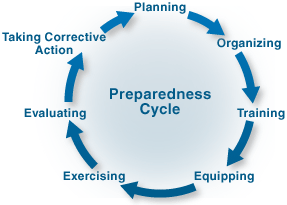
There are a few topic areas within their paper that I’m lumping together under this discussion topic.  The authors make some excellent points about our collective work in preparedness that I think all readers will nod their heads about, because we know when intuitively, but sometimes they need to be reinforced – not only to us as practitioners, but also to other stakeholders, including the public.  First off, preparedness is never complete.  The cycle of preparedness – largely involving assessment, planning, organizing, equipping, training, and exercising – is just that – a cycle.  It’s endless.  While we do a great deal of work in each of these, our accomplishments are really only temporary.

The authors also mention that our information is not always precise.  We base a lot of what we do in preparedness on information, such as a hazard analysis.  While there are some inputs that are factual and supported by science, there are many that are based on speculation and anecdote.  This is a reality of our work that we must always acknowledge.  As is other of their points – there is no silver bullet.  There is no universal solution to all our woes.  We must constantly have our head in the game and consider actions that we may not have ever considered before.

ICS Improvement Officer

The authors briefly discuss a conceptual position within the ICS Command Staff they call the ICS Improvement Officer.  The concept of this fascinating, if not a bit out of place in this paper given other topics of discussion.  Essentially, as they describe this position, it is someone at the Command Staff level who is responsible for providing quality control to the incident management processes and implementations of the organization.  While I’ve just recently read this paper and haven’t had a lot of time to digest the concept, I really can’t find any fault with the concept.  While the planning process itself is supposed to provide some measure of a feedback loop, there isn’t anyone designated in the organization to shepherd that process beginning to end and ultimately provide the quality control measures necessary.  In practice, I’ve seen this happen collaboratively, among members of the Command and General Staff of a well-staffed structure, as well as by the individual who has the best overall ICS insight and experience in an organization – often the Planning Section Chief.  The authors elude to this position also feeding an AAR process, which contributes to overall preparedness.  I like this idea and I hope it is explored more, either formally or informally.

Conclusion

There are a number of other topic areas of this paper which I haven’t covered here, but I encourage everyone to read on their own.  As mentioned earlier, I’d like to see more of the research papers that come from FEMA’s Emergency Management Executive Academy available for public review.  Agree or disagree with their perspectives, I think their discussions on various topics are absolutely worth looking at.  It’s these discussions like these which will ultimately drive bigger discussions which will continue to advance public safety.

I’m always interested in the perspectives of my readers.  Have you read the paper?  What do you think of the discussion topics they presented?

© 2017 – Timothy M Riecker, CEDP

Emergency Preparedness Solutions, LLC