What Planning Format To Use?

Comprehensive Preparedness Guide 101 (CPG 101) describes three format options for your emergency operations plan (EOP): The traditional functional EOP format, the Emergency Support Function (ESF) format, and the agency/department focused format.  As mentioned in CPG 101 the traditional functional EOP format is the most popular and widely used.  It generally provides for three major sections – the basic plan, functional annexes, and hazard specific annexes.  The traditional format provides for the greatest flexibility and allows a jurisdiction or organization to easily evolve their plan as the need for addressing additional issues or hazards is recognized.  Continuity of Government/Continuity of Operations (COG/COOP) plans are easily integrated as annexes as our newer concepts such as resiliency plans and climate change plans. 

Agency/department focused EOP formats provide utility for those folks that like to crack open the book looking to answer the question ‘what is expected of me?’.  This format offers some flexibility, but under most occurrences where the need to address a new issue arises edits need to be made through much of the plan to identify and address each agency’s involvement in said issue.  It can also be awkward to include other associated plans, such as the afore mentioned COOP and COG plans.  It does work for smaller communities, though, whose hazards and other planning areas stay fairly static. 

The ESF EOP format is modeled after the National Response Framework (NRF) (originally the Federal Response Plan) which addresses functions by grouping agencies and organizations with responsibility and resources to address those functions.  This model has worked fairly well for the federal government given their structure and the general federalist approach of most agencies (aside from those agencies with direct authorities such as the US Coast Guard).   There is some flexibility in this model with the ability to include both support and hazard specific annexes, but one must be cautioned not to confuse the ESF annexes with the support annexes.  The key word in the format is ‘support’, which is largely what the federal government does in response to a disaster. 

Last week Lucien Canton posted an article Emergency Support Functions: Misunderstood and Misapplied.  Read this!  As usual, Lu states his point expertly as he discusses the pros, cons, and uses for the ESF structure.  Many jurisdictions, in an effort to mirror a system which seems to work for the federal government, create their EOP in an ESF format.  I’ve rarely ever seen it well applied – at least not in the form that the feds use.  Understanding that the feds structure their ESFs to address policy and coordination, these same needs may not exist at a state or local level.  Therefore states and locals change the ESF structure.  While there is certainly no requirement to use only those ESFs which are used in the NRF, using a different format can cause great confusion.  For example, what is ESF #12 (Energy) in the NRF may be an ESF for economic recovery for a city or county.  Now we have what we’ve been trying to avoid in incident management – a lack of common terminology. 

Each jurisdiction and organization should choose which format works best for them.  I would strongly recommend the traditional format which is the easiest to shape to meet your needs rather than trying to work within an awkward planning framework.  Remember that no plan is ever perfect, but requires regular attention to ensure that it evolves with and addresses your needs.  Don’t try to tackle it all at once, either, or on your own.  Proper planning is a team effort requiring input from multiple stakeholders in your jurisdiction or organization.  CPG 101 references ‘whole community’ planning which is a great idea to ensure that you capture multiple perspectives and that all stakeholders are bought into the process and the product.  Take on your planning work in small bites, one component at a time.  First work on the base plan – the most essential part.  Then identify those functional and hazard specific annexes which are most important – accomplish those next.  To help guide your work it will help to create a project chart for your planning efforts identifying timelines and benchmarks, stakeholders, and needed inputs.  Finally, don’t forget to exercise your plans to validate them! 

Lastly, my marketing plug – If you need help planning please contact Emergency Preparedness Solutions!  EPS is experienced in working with governments, private sector, and not for profits in all facets of preparedness including assessment, planning, training, and exercises.  We are happy to discuss your needs and determine the best way to meet them. 

What planning format do you prefer and why?

© 2014 – Timothy Riecker


What, if Anything, Will Change in Law Enforcement?

The events this past month in Ferguson, MO have caught not only national but international attention.  As I’ve mentioned in earlier blog posts and comments to others, we still do not yet know all the facts of what actually transpired in the death of Michael Brown, therefore I urge everyone to hold off on any analysis or judgment and allow the family to grieve and judicial processes to work. 

The other topic of discussion related to Ferguson, MO has been the use of police force and the equipment used by law enforcement.  This has spurred a number of national-level news stories and even a request by the President to examine the programs which provide surplus military-grade equipment to law enforcement authorities.  One such article can be found here

Such inquiries can certainly be conducted but the fact of the matter is that the items that law enforcement is obtaining, such as body armor and armored vehicles, can be purchased on the open market.  Armored vehicles of some type have been in the possession and use of law enforcement agencies decades before this post-9/11 program ever existed.   The primary intent of the post-9/11 program is to bolster the resources of law enforcement agencies in the event that they encounter a terrorist threat.  Having these resources for that purpose doesn’t mean we should moth-ball them away in the event of a terrorist attack, however.  They should be used so our officers are familiar with them.  We’ve certainly seen other legitimate uses such as responses to mass shootings, busting drug labs, and gang-related responses and arrests.  Examine the case of the 1997 North Hollywood bank robbery where heavily armed and armored men simply had their way with LAPD.  Law enforcement should never be caught in this type of situation again.  A badge and a six-shooter just don’t cut it any more.  Gun control laws have proven wholly ineffective against criminals who are determined to obtain high powered weapons.  Clearly law enforcement must continue to have the upper hand to defeat these criminals and protect the public. 

The CBS article referenced in the second paragraph does bring about some interesting examples of potential overzealousness in the use of these resources, however.  Note that I do say ‘potential’, as a mere mention by the media does not tell the whole story, but we have seen articles with similar mentions over the last few years which do give cause to at least raise an eyebrow.  The article suggests that perhaps additional training is needed in the deployment and use of such resources.  I would suggest that the use of these resources must first be rooted in policy and procedure, accountability, and then training – just like everything else done in law enforcement and throughout most of public safety.  I’m sure most departments who possess these resources already have such things in place, but some may not.  Clearly we need to balance officer safety with operational necessity and even public perspective. 

While I’ve worked with law enforcement for years, I’ve never worked in law enforcement.  I’m curious about what others think.  What, if anything, will change in law enforcement as a result of the events in Ferguson, MO? 

© 2014 – Timothy Riecker

Emergency Visions Experts Corner

I’m proud to announce that I have been recently included in the Emergency Visions Experts Corner.  Emergency Visions is a company I have recently been chatting with regarding their technology solutions for THIRA and resource management.  The Emergency Visions software solutions are well thought through to ensure applicability across any jurisdiction or organization helping clients to track data real-time and perpetually to aid in preparedness, response, and recovery efforts. 

As part of their Experts Corner, I will partner with Emergency Visions to provide topical information, similar to this blog, and also have plans to conduct a webinar this October with them and their partner Carahsoft on the THIRA process and integrating THIRA results into other preparedness endeavors.  I encourage you to check out some of the blog posts and webinars already listed on the Emergency Visions website.  I’ll post information on the upcoming webinar once we have the details hammered out. 

Thanks as always for following this blog.  I’m grateful for the opportunity to continue to share ideas with others in the emergency management and homeland security field. 

– Tim Riecker

An Academic Study in Ferguson Civil Disorder

From an academic and emergency management lessons learned perspective, there will be a great deal to learn from the events in Ferguson, Missouri.  In this brief article on Western Illinois University’s Emergency Management program, faculty comment on how a few of the courses within their degree program expect to analyze this social disaster. 

I anticipate a lot of post-incident analysis once we have the facts of this event.  Respecting the loss of life as we do in any disaster, the practice of emergency management within the greater professions of public safety and even government administration stand to learn a great deal from an after action analysis of this incident to help us improve by preparing for and preventing the impacts of future incidents. 

Cyber Security Video – Stop. Think. Connect

Students and faculty from Grand Valley State University created a video for the West Michigan Cyber Security Consortium and the US Department of Homeland Security’s campaign on cyber security called Tapping In – Stop. Think. Connect.  The information site for the video (including a link to the video) can be found here – Stop. Think. Connect.

It’s a clever video about the dangers of hackers, the importance of individual vigilance, and ways to maintain your own cyber security.  Overall the video is well done and the music is catchy, although I think the production is a bit long (five and a half minutes), leading to the message getting a back seat to the music.  I do like the characterization and the vignettes that drive the video and the overall message.  I’m hopeful they will edit down the piece to provide video segments a bit more palatable to our short attention spans and conducive to inclusion in advertising campaigns. 

More of this is needed.  The public at large seems to pay little attention to cyber security and the role that individuals play in it.  While data infiltrations of large corporations like Target get a great deal of media attention, hackers and phishing scams lead to data and identity theft of individuals on a daily basis. 

How do you promote cyber security in your organization or jurisdiction?  What materials and methods do you use to promote it?  Do you feel you are reaching your audience?  

© 2014 – Timothy Riecker

Keeping Up With Changes in Emergency Management

As with many things in life, the field of emergency management has changed and will continue to do so.  Much of this change is an evolution – generally positive and productive adjustments to make us more effective and efficient in what we do supported by doctrine and models to guide our actions and provide consistency of application.  Sometimes changes are made which simply give the illusion of progress or are applied much like a Band-Aid as a knee-jerk stop-gap measure which usually fail unless a better implementation is put in place.  Many of the better thought out applications, however, do tend to stick.  While we have seen a great deal of change in the field over the last 14 years, we have largely seen a clear progression with practitioners and policy makers learning from previous programs. 

Yesterday I encountered two separate instances which did not apply current practices and policies. The first was an advertisement for a training program which discussed the four phases of emergency management.  The second was an article in which the author stated that ‘…preparedness is no longer part of the (emergency management) lexicon…’.  The two items, while different, are related in that they both indicate a lack of understanding in the evolution we have made from the four phases of emergency management – mitigation, preparedness, response, and recovery. 

In a nutshell, these long standing phases began to change soon after the terrorist attacks of 9/11 with the integration of homeland security with emergency management resulting in the inclusion of ‘prevention’ into the emergency management phases – thus prevention, mitigation, preparedness, response, and recovery.  As minor as this seems, it was quite a change for those of us who had been in the world of the four phases for a while and was a difficult pill to swallow.  Along with the human nature of resistance to change there was still a feeling that the matter wasn’t quite fully settled – in other words, more change would come. 

For several years different models were kicked around but none really gained traction until the issuance of Presidential Policy Directive 8 (PPD8), which created the National Preparedness Goal and the National Preparedness System.  These begat things like the Core Capabilities (a revamping of the predecessor Target Capabilities) and the introduction of the Threat and Hazard Identification and Risk Assessment (THIRA) as well as a new way of viewing the major activities within emergency management and homeland security – the five mission areas of prevention, protection, mitigation, response, and recovery.  These five mission areas have re-defined, or perhaps more accurately defined what it is that we do in emergency management and homeland security. 

The traditional four phases were often depicted in a cycle.  Taken literally, this meant that you progressed from one phase to the next in a series.  The truth of the matter was that each of the four phases could actually run simultaneously.  There was also a misunderstanding that preparedness was an isolated activity, when in actuality our preparedness efforts applied to all activities.  With the further evolution of homeland security the foundational activities of prevention and then protection were identified and defined.  Pulling together these five mission areas – prevention, protection, mitigation, response, and recovery – the National Preparedness System provides for distinct preparedness activities identified for each mission area, an organization of the Core Capabilities within each mission area, and national planning frameworks which identify the role and goals of each mission area in achieving the national preparedness goal.  Not only has preparedness not gone away, but it has been elevated in status. 

PPD8 was probably the presidential directive with the greatest and broadest impact on our field of practice since Homeland Security Presidential Directive 5 (HSPD5) in 2003 which drove the implementation of the National Incident Management System (NIMS).  Keeping up with critical changes in our evolution such as these is absolutely imperative for practitioners.  Not only do these policy changes impact how we do our jobs individually and programmatically, but they impact how we coordinate with each other, which is and always will be the foundational essence of emergency management. 

How do you keep up with changes in our field of practice?

© 2014 Timothy Riecker

Crowdsourcing CPR

Emergency Management Magazine has run a great article on LA County Fire Department linking its dispatch system to an app that will notify CPR trained citizens of the need for their lifesaving skills.  This app, PulsePoint, has apparently been in existence for a while and has, according to the article, 650 emergency response systems linked to it from across the country.

I was not aware of this app, but I think the concept of crowdsourcing lifesaving skills like CPR is great – especially given the narrow window of time that emergency medicine can be effective following cardiac arrest.  This concept leads me to think of what other areas within public safety can be crowdsourced, relying on the good will of citizens to provide aid in times of need.

What possibilities do you see?

– Tim Riecker


UPDATE

After posting this blog I downloaded the PulsePoint app on my phone.  I was amazed at the number of locations PulsePoint serves across the country.  While there were none near me I still activated the alerting feature on the app as I do travel to many of the locations listed.  When searching for the app in the App Store, I also came across PulsePoint AED, which is another crowdsourcing app which allows users to help identify the locations of AEDs in their communities (this database is cross referenced with the CPR app so users can be alerted to the location of an AED).  There didn’t seem to be any indicated in my area, so there likely are not any users around here as of yet.  I’ll certainly be keeping an eye out for these locations when I’m out in the community and contributing to PulsePoint’s database.

Robin Williams

Please forgive this digression from my normal topical blog. Like others in the world I am deeply saddened by the news of the passing of Robin Williams. He was a brilliant actor and comedian who seemed to touch the lives of every person who saw any of his many comedy acts, TV shows, or movies.

His performances made viewers laugh and cry – Sometimes funny, sometimes serious, but always amazing.

It is reported that Mr Williams suffered from depression. I think we all know someone who has or is suffering from depression, maybe it’s even you. Through my life it has touched me and people I love. Please be sure to get help for yourself or support those that need it in getting help. It is easier said than done, but depression can be overcome.

Rest in peace Robin Williams. You will live on in your art and in our hearts.

Oh Captain, my Captain!

Having a Resource Management Common Operating Picture

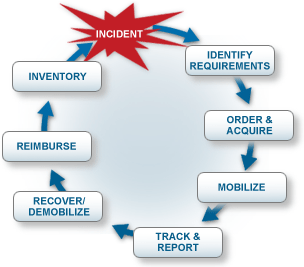
Resource management is one of the most complex aspects of emergency management.  The resource management cycle could be seen as a microcosm of the emergency management cycle with a number of steps operating in sequence and some simultaneously before, during, and after a disaster.  We need to properly establish our resource management systems, procedures, and policies and keep them, as well as our inventories, up to date.

Referencing the Core Capabilities, the capabilities of Public and Private Services and Resources, Planning, Critical Transportation, and Operational Coordination all have bearing on resource management.  Resource management is also one of the key components of NIMS.  The following graphic on the resource management cycle comes from NIMS doctrine.  While this is largely a logistics issue, the importance of it all cuts across all levels of all organizations.

NIMS Resource Management Cycle

NIMS Resource Management Cycle

Consider each of the steps identified in the resource management cycle.  There is quite a bit of complexity to each.  An additional challenge is that they are always in motion as requirements regularly change, new resources are obtained, and obsolete resources are retired from service.  Often one change in a step of the cycle requires changes cascading to other steps.  Also consider the variety of people involved in each step.  No one agency or department has all the resources, therefore we are relying on information from others to create a common operating picture of resource management.  Additionally, the regularity of changes in this information require us to have establish and maintain a system which allows for real-time tracking of this information.

Any information can be viewed in a variety of manners.  A fairly simple web-based tool can allow for multiple stakeholders to input data and change resource status, but the display of that information the reporting available from such as system allows for better utility.  The integration of GIS can help us identify not only where our resources are, but what their status is (NIMS provides us with three resources status indicators: Assigned, Available, and Out of Service), as well as detailed information on the resource such as the kind and type (again, these are NIMS-driven definitions that describe the capability of a resource), the owner of the resource along with contact information, and other information including technical, operational, and maintenance information.

In a pre-incident condition we should know what we have, what capability of those resources, and the conditions for deployment.  Operating under ICS, once an incident occurs, Logistics obtains resources for the incident where tracking becomes the responsibility of the Resource Unit in the Planning Section.  After an incident, these resources return to their owners where they are maintained and re-inventoried.  Depending on the incident, owners may be reimbursed for their use which requires reporting on a variety of metrics.

Wildfire incident management practices brought us the T-Card system – a great low-tech way of tracking incident resources.  A T-Card system is easy to learn and deploy and does a great job of tracking resources but can be very labor intensive and certainly has a delay in reporting.  I’ve also used spreadsheets and stand alone databases, which allow for more flexibility and automated reporting, but still suffer from a delay with a single point of data input and management.  Networked systems allow for immediate inclusion of staging areas, bases, and other mobilization or stockpile areas and are suited for simple and complex incidents.  Consider leveraging technology to maximize your resource management common operating picture on both a daily basis and for incident management.  Of course it’s always good to have a low-tech back up (and the know-how to use it!).

What systems do you have in place for resource management?  What best practices have you identified?

© 2014 Timothy Riecker


USGS Updates Earthquake Hazard Maps

Heritage Preservation's avatarState Heritage Emergency Partnership

The U.S. Geological Survey released their updated National Seismic Hazard Maps, showing 42 of the lower 48 states have a reasonable chance of facing damage from ground shaking in the next 50 years. Last updated 6 years ago, these new maps were developed with new ground motion models and compare changes between the 2008 maps and the 2014 ones.

The highest risk is on the west coast, intermountain west, and several clusters in the central and eastern United States. That really hasn’t changed since the 2008 map; instead, the potential severity and strength of earthquakes was upgraded for those areas based on new data. For example, risk was upgraded in the eastern United States and the New Madrid Zone based in part on recent earthquakes there.

The Pacific Northwest’s risk was upgraded due to similarities between its seismic hazards and those of Japan and Chile, both of which experienced…

View original post 43 more words