Good article.

Brandon Greenberg's avatarDisasterNet

The is a great article from a leading disaster researcher about the privatization of emergency management.  via The U.S. Emergency Management System Is Not Perfect, but It Works – Room for Debate – NYTimes.com.

Here is the full text:

Questions regarding the privatization of the Federal Emergency Management Agency or the assignment of its functions to states must be addressed within the context of the agency’s responsibilities and how it functions in relation to state and local government capabilities.

Most people think of FEMA as a disaster response agency, but that is only partly true. FEMA has many responsibilities both during disasters and at other times. These responsibilities include assisting states, local governments, tribal governments and U.S. territories in the preparation of disaster mitigation plans aimed at taking long-term steps to reduce losses from future disasters, pursuant to the Disaster Mitigation Act of 2000; providing funding and guidance so…

View original post 603 more words

Didn’t I Say to Be Smart and Use Common Sense?

I’m pretty sure I said that in my last post…

Don’t let this be you.  Seriously.  Accountability is a four letter word to some, and it will come back at you if you don’t stay smart and use common sense.  With landfall of Hurricane Sandy imminent, New Jersey Governor Chris Christie issued a mandatory coastal evacuation order to get citizens out of harm’s way – a smart move given the dangers the storm posed including massive walls of water from storm surge.  For some reason, Atlantic City Mayor Lorenzo Langford established shelters in his city, wasting time, valuable resources, and giving citizens a false sense of security when they were very much in danger.  The result was Governor Christie having to send National Guard forces in to rescue these poor folks.  The very public verbal beating that Governor Christie gave Mayor Lorenzo was brutal to say the least.  Governor Christie is one man I would not want to make enemies with.

Hurricane Sandy strikes Atlantic City.

One of my favorite Star Wars quotes is from Episode 1: The Phantom Menace, where Liam Neeson’s character, Jedi Master Qui-Gon Jinn stated ‘There’s always a bigger fish’.  Remember this.  Everyone has to answer to someone else.  Even chief elected officials have to answer to someone – city councils, tax payers, etc.  I’d be surprised if there wasn’t a call for accountability in this case.  We also can’t lose sight of what’s right.  In emergency management, saving lives is always the #1 priority… always!

My heart goes out to victims of Hurricane Sandy.  For those of you who experienced little or no impact, please consider volunteering or donating to relief efforts.  I’d like to suggest The Salvation Army.   Donations may be made to the Salvation Army through www.salvationarmyusa.org or through 1-800-SAL-ARMY. Donors may contribute $10 via their phone bill by text messaging the word STORM to 80888 and confirming the donation with the word “yes.”

Hurricane Sandy – Be Prepared and Stay Safe!

I’m finishing my preparations for a quick trip to California to help evaluate an earthquake exercise.  All the while, I’m watching Hurricane Sandy come up the coast after creating some havoc in the Caribbean.  According to the latest National Hurricane Center advisory, Sandy will make landfall in southern New Jersey, and progress inland to central Pennsylvania before turning north and heading through New York State, the track taking it through the Finger Lakes area.  From there, the current advisory predicts that the storm will turn to the northeast, saturating New England.  It’s going to be a very wet, rainy week as Sandy slows soon after making landfall.  Of particular concern here in New York is the western portion of the state which has received a fair amount of rainfall over the last couple of days from the cold front that has progressed here from the mid west.


Thus far, there seems to be an appropriate amount of concern over this storm.  While I’ve heard some folks say that people are overly concerned, I don’t think officials are crying wolf with this.  First, as I’m sure you’ve read in the media, many factors of this storm are unprecedented or rarely seen, particularly the collision with the cold front – resulting in many of the hurricane advisories including snow in their forecast – SNOW for a HURRICANE!  Who would have ever thought that would happen?  Second, the storm is maintaining hurricane strength right up to landfall, bringing significant winds and storm surge with it.  New York City is taking actions which to my recollection are fully in compliance with their hurricane plans, such as low elevation evacuations, closing of mass transit and tunnels ahead of the storm, and other protective actions.  States of emergency have been declared all along the northeast states, with the President declaring an emergency in Maryland, which will be the first to feel the full effects of the category 1 storm with sustained winds of 75 miles per hour.  I expect the President will make similar declarations ahead of the storm reaching subsequent states.  States along the projected impact path all have activated their emergency operations centers (EOCs), pulling together local, state, and federal agencies, as well as some not for profits such as the American Red Cross and The Salvation Army, to coordinate efforts and situational information.

I’ve received storm preparedness information from several sources already, including Ready.gov, the Small Business Administration, Time Warner Cable, and National Grid.  I’m certain utility companies in other area are doing the same outreach to their customers.  Locally, the Erie Canal is being closed and water levels dropped to help mitigate against flooding, which has devastated communities along the waterway in the past.  Local governments are putting out preparedness public service announcements to citizens to help ensure they are prepared.  You’ve heard me comment before about the complacency of much of our population when it comes to emergency preparedness.  Please pay heed to what is being suggested and spread the word that preparedness for this storm is serious.  Be sure to have a few days of water, food, medications, and batteries for flashlights.  Keep your cell phone charged and pay attention to weather information and emergency alerts.  If you are a New Yorker, now is a great time to subscribe to NY-ALERT to be certain to receive emergency information.  If you are outside of New York, many states now have similar alerting systems.  Even clearing away leaves and debris, which is plentiful this time of year, from storm sewers and culverts will be a big help.  If you manage or own a business, be sure to pull out your emergency and continuity plans (you have these, right?) and be sure to keep your employees and other stakeholders informed of what’s going on.

I’m sure that when I return I’ll be helping with some disaster response and recovery activities in the area.  The better you prepare and the smarter you are, the less responders have to risk their lives and valuable resources, so be smart, be prepared, and stay safe!

Find Out What You Need

As mentioned in previous posts, I am, by trade, a trainer.  Many of those years have been in the realm of public safety and emergency management, but I’ve had the opportunity to apply my trade to a few other areas as well.  Quite possibly the most important things I’ve learned, both by training as well as  experience, is the necessity of a needs assessment.  A needs assessment, as defined by The 30-Second Encyclopedia of Learning & Performance is “a systematic study or survey of an organization for the purpose of making recommendations, and is often employed … to get to the cause of a performance problem.”  This definition is on page three of the book, by the way.  It’s that important.

In training and other professions we do needs assessments all the time; some formal, many informal.  So informal, in fact, that oftentimes we don’t realize we’re doing them.  I’m big on common sense and in trusting professionals, but I think this oft lackadaisical approach leads to incomplete and sometimes shoddy results – not where we want to be as professionals.

In the instance of doing a training needs assessment of an organization, one needs to be certain to assess both internally and externally.  One internal focus, obviously is the employees themselves.  First, we look at the tasks – what do they do, how do they do it, and how well do they actually do it (aka actual outcome).  We compare this to expectations the performance expectations (which, ideally, are documented).  The gap between actual outcome and expected outcome is, usually, a training need.  These would translate to what I call Tier I training needs – those necessary to do business.

To digress a bit, here’s where a trainer often times becomes an organizational development consultant.  Likely, the processes a company performs haven’t been looked at in years, with layers of policy and procedure added every time a problem was identified.  The trainer, upon examination, may find that the process itself is faulty or outdated, which wouldn’t be a performance deficiency of the employees.  These types of findings should be noted to management immediately.

Still looking internally, the trainer also needs to look at the wants and desires, in terms of training, of both management and the employees.  Management may have training they want applied to all employees (by the way, this is worth analyzing, as often times something like this is ‘a good idea’ vs something identified by way of a needs assessment’) and the employees themselves (or their union) may want to incorporate training to allow for development, career paths, etc.  These are all certainly viable candidates for Tier II training needs – those that aid the organization.

A good needs assessment must also look externally as well.  The Tier I external factor would be safety and regulatory requirements – i.e. the legal things that must be done, such as OSHA training.  External Tier II factors would be non-required industry standards.  These are things usually obtained by way of certifications, conferences, etc.  While they aren’t necessary, they can help the company’s resume and aid in keeping the company near the head of their industry.  So often do we see these as some of the only trainings that employees receive, which is very frustrating.  These are typically rather expensive (especially when you factor in lost productivity and travel), are not focused (at least on the needs of the employer), and the ‘training’ received is usually not shared at all with the employer.

Needs assessments are certainly applied in other areas.  In emergency planning we do things like a hazard analysis, a vulnerability assessement and a capabilities assessment to determine preparedness needs.  In emergency response we do a situational assessment to determine what is needed to resolve the incident – often times over and over again, as these needs change as the scope of the incident changes.  In disaster recovery we analyze the needs of victims and survivors so we can provide the best services to them.  Needs assessments are vital to many professions and fields of practice.  It seems we’ve lost the quality of services that managers and customers expect.  I feel that much of this is related to people being lazy, not taking pride in what they do, and taking short cuts in their work.  If you short cut a needs assessment, you cut short your potential.  Do it right and start off your whole process with the right information to do the job right.

My top business books

After finishing the latest Nancy Duarte book, Persuasive Presentations (read my blog post on it), I did a bit of rearranging of the book shelf in my office.  I have lots of books… LOTS of books.  Sadly, there is only room for one book shelf in my office.  This keeps my top reference books handy – mostly on the topics of business management, training, and emergency management.  I actually get asked, on occasion, to provide a book recommendation in one of these subject areas.  So, in the event that you might be interested, here are my top business-oriented books, with some commentary.

The Baldrige Guide to Executive Manners – I can’t tell you how many times I’ve referenced this book.  It’s a wealth of information for anyone in business or government.  It contains everything from common cultural issues, dress codes, communication nuances, and seating at events.  When I first got it, I actually read through it (not word for word!) cover to cover – which is really the best way to familiarize yourself with what’s in it.  It is a touch dated, but largely etiquette and protocol don’t change much.

Oh to have a library this beautiful!!!!

Getting Started in Consulting by Alan Weiss – Dr. Weiss is a consulting genius, pure and simple.  The man has been doing it successfully for a very long time.  So successfully, that the skills he developed and knowledge he gained in doing it, he shares with others through a multitude of books, speaking engagements, his website, and other venues.  If you are looking to get into consulting work, no matter what it might be, this is the foundational book you need to help you lay out how you will structure your business and interact with clients.  I’ve read some of this more focused books as well.

Flawless Execution by James Murphy – Jim Murphy is a consultant who has brought what he learned in a successful career as a fighter pilot to the

corporate world.  He has built a company around these principles, incorporating the sexy environment of flight suites and pilot lingo, to engage businesses and help them become more successful.  It’s a pretty straight forward read, actually using concepts similar to the Incident Command System (ICS) that we use in Emergency Management, to identify goals, objectives, strategies, and tactics to stay focused and accomplish tasks.

The 360 Degree Leader by John Maxwell – In my mind, no business reference list is complete without John Maxwell.  This is just one of several of his books that I own, but I feel it is by far the best.  Maxwell illustrates from every angle how anyone within an organization is a leader and can exercise influence.  You don’t have to be ‘in charge’ to lead.  Maxwell always provides external references through his website which have great tools to help you assess your capabilities.

Guide to Managerial Communication by Mary Munter – Another book which I have referenced time and again.  It’s in its 9th edition now… mine is the fourth edition and the info on Amazon indicates that it’s been updated to include more contemporary info.  It’s one of the few college texts that I ever kept.  It covers a variety of communication issues, writing design and style, a bit of info on presentations, and even some formats for memos and letters.  Very handy.

That’s my short list on business reads.  I’ll likely post lists on training books as well as emergency management books sometime in the future.

“Outside of a dog, a book is man’s best friend. Inside of a dog it’s too dark to read.”  ― Groucho Marx

Duarte Done

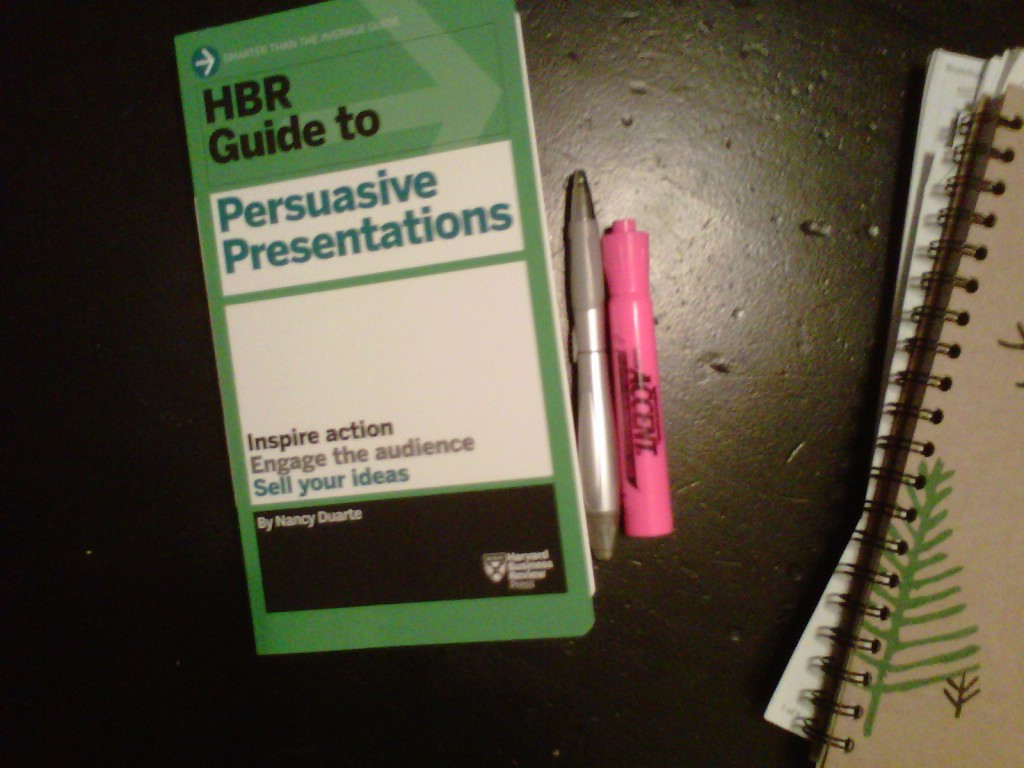
A few days ago I finished the latest Nancy Duarte book, Persuasive Presentations, published by Harvard Business Review.  See my earlier post, Presentations… Inspired, for some additional background on this.

Photo courtesy of Alex Rister who also wrote about this book.

Persuasive Presentations was a very fast paced read.  I love the format of this book.  It was composed of a number of mini chapters, each only two to three pages long.  Nancy is no hypocrite – she practices what she preaches.  While a book is no presentation, many of the concepts regarding habits of adult learners, attention spans, etc., still apply.  Therefore, she chopped her content up into small manageable bites.  No long drawn out chapters here.  No complicated explanations.  It was all very straight forward.To help drive home the point, she makes external references, provides graphics and illustrations, and cross references within the book.  She covers everything from the needs assessment (audience and topic), to development, design, format and medium, reading the audience, presenting via video, incorporating social media, and follow-up.  This is a great book for the new presenter or trainer, or the seasoned professional.  I can even see it as reading for an undergraduate level course on communications and presentations.  Nancy covers all the relevant topics including contemporary subject matter.  A great read – highly recommended.  Thanks Nancy!

Speed Networking

Last week our local chamber of commerce, of which my company – Emergency Preparedness Solutions – is a member held an event called speed networking.  Admittedly, prior to the announcements for said event, I had never heard of it.  Of course we’ve all heard of speed dating – and have even seen it on TV and in movies (i.e. Hitch) – where men typically circulate through an orderly room of women, having only a few minutes to ask questions about each other and perhaps make a love connection.  Speed networking is quite similar.

Representatives of various businesses and organizations were arranged opposite each other within a room (sadly, not the swanky, stylish room you witnessed the speed dating occurring in Hitch), having only two minutes to give their elevator speech and another two to listen to the pitch of the person across from them.  You both exchange business cards and any other materials you might have (I had a flyer highlighting our business continuity services).  At the ring of the bell everyone on one side of the table moved down a seat.

It was a pretty neat opportunity.  Two minutes isn’t long, and depending on the level of interaction, sometimes wasn’t long enough.  It was a very fast paced, near exhausting, activity.  In the end, I met with about twenty businesses and organizations.  With some there was clearly interest, with others – not so much.  But that’s how things go in the business world.  I was a bit disappointed that I didn’t get to meet with the other business representatives who were the ‘movers’, as I was.  I’m not sure how they would make that work… likely some complex algorithm of some sort which is well beyond my understanding.  Still, it was an engaging opportunity to meet with these businesses and pitch my services.

I’ve been to quite a few business networking events, all of which seem to be a bit awkward as people tend to gravitate to those they know.  You hate to break into a conversation at the risk of being rude or appearing overly pushy.  Once in a while you’ll get introduced to someone, which is the best opening, but that’s a fairly rare occurence.  The structure of the speed networking forces you to engage with someone new, and you are both there for the same purpose – what a great idea!  There was even someone attending who I have met with several times before to discuss partnering up and making mutual referrals.  Since we already knew what the other did, we took the opportunity to discuss what our next steps would be, which included a meet and greet with their top clients – score!

If you ever have an opportunity to take part in one of these events, I strongly encourage you to do so.  It’s a great deal for small businesses, especially new ones.  They are fun, engaging, and the best bang for your buck in terms of meeting people.  FYI – the chamber charged $10 for the event, which included lunch.  How can you go wrong?

Public Warning and The Science Behind EM

Rescuers at the L’AQUILA, Italy earthquake.

I was completely shocked to read this article at NBC News about six scientists and a government official in Italy being convicted of manslaughter and causing criminally negligent injury for their failure to predict an earthquake in 2009.  The article doesn’t give a lot of background, including what their statements or warnings may or may not have been.  It does mention that there were several smaller quakes in the months preceding a devastating 6.3 magnitude earthquake that killed over 300 people.  It goes on to elude that the scientists (seismologists, presumably) perhaps didn’t give these smaller quakes much consideration as possible precursors to a larger earthquake.

I’m not a geologist, nor do I play one on TV, but we all know that we can’t predict earthquakes with any measure of reliability.  Here in the northeast there are plenty of small quakes, which are generally no cause for alarm.  Italy, however, is earthquake prone.  One would think that people would have in their minds that the possibility of a sizeable earthquake is always present, especially after a series of smaller earthquakes.  Unless these scientists really downplayed that possibility (which would be ludicrous in that region of the world), I just don’t see how they can be held responsible.  Some disasters we can predict, others – such as earthquakes, we just can’t.  This is a dangerous precedent that I truly hope doesn’t catch on.  There are scientists in a variety of fields that are strong partners with emergency management.  While we know that the sciences (or the human interpretation of them) are often times imperfect, we go with the best information available to drive the planning and decisions we make.  Admittedly, it’s a gamble to a degree – a darn dangerous gamble – but I challenge anyone to find a better way.  If we cry wolf every time the possibility of something occurs, the population will become complacent and ignore our warnings.  We must strive for better science, achieve better balance, and maintain common sense.

Terrorist Arrested in NYC – Bomb Plot Foiled

A 21 year old Bangladeshi national in the US, here on a student visa, was arrested two days ago for attempting to detonate a 1,000 pound bomb outside the Federal Reserve bank in Manhattan.  This was the result of a three month long sting operation by the FBI and the local Joint Terrorism Task Force (JTTF).  Congratulations to the agents and officers of the FBI and coordinating agencies who foiled this plot, and thank you for keeping our nation safe!

Homeland Security Today provides some initial details of the plot in what is, surprisingly, not a top national news story.  I’m honestly shocked by this –   Folks, this is big news!  Based on the information provided, the detonation of a bomb this size (had it been real) would have done just as much damage as that caused by Timothy McVeigh at the Murrah Building in Oklahoma City.  That bomb killed 168 and injured almost 700 people.

While there have been a lot of criticisms of our nation’s intelligence functions lately (see my earlier post on Fusion Centers), this is one of the true success stories.  Let’s congratulate all of the officials involved in finding and catching this radical.  I’m sure the employees of the Manhattan Federal Reserve bank and their loved ones are truly thankful.