Emergency Management – Who Knows About Your Plans?

In emergency management and homeland security we put a lot of emphasis on planning.  Plans are important, afterall.  We need to take the time to identify what our likely hazards are and how we will address them.  But what happens when the plan is complete?  We congratulate members of the planning team and send them final copies.  Those copies get filed electronically or end up on a shelf, a trophy of our accomplishment and hard work.  Congratulations!

So… that’s it?  Is that all?

NO!  Of course not!  People need to be trained to the plan.  “Trained?” you ask.  Yes – trained.  Not just sent a copy and told to review it.  Let’s be honest, here.  Even assuming the highest degree of dedication and professionalism, many people simply won’t give it the time and attention it needs.  Very quickly the plan will get buried on their desks or the email will become one of dozens or hundreds in the inbox.  Even if they do give it a look through, most will only give a quick pass through the pages between meetings (or during a meeting!), not giving much attention to the details in the plan.

How effective do you expect people to be?

Sports analogy – when a coach creates new plays, do they simply give them to the players to become familiar with and expect proficiency?  No.  Of course not.  We’re all familiar with the classic, if not cliché, setting of the coach reviewing plays on a chalk board with the players in a locker room.  That’s training.  Then after that training, they go out in the field and practice the plays.

Back to our reality… The first real step of making people familiar with the plan is to review it with them.  This usually doesn’t need to be a sleep inducing line-for-line review of the plan (unless it is a detailed procedure), but a review of the concepts and key roles and responsibilities.  In fact, that’s who you invite to the training – those who are identified in the plan.  This is likely to include people in your own agency as well as people in other agencies (emergency management, after all, is a collaborative effort).  In states with strong county governments, we often see county-level emergency management offices creating plans that dictate or describe the activities of local governments and departments.  Most often, the local departments have no awareness of these plans, much less receive any training on them.  I’m guessing that plan won’t work.

Once you’ve trained these key stakeholders, be sure to conduct exercises on various aspects of the plan.  Exercises serve not only to validate plans, but to also help further familiarize stakeholders with the plan, their roles, and expectations of others.  When we plan, we tend to make many assumptions which exercises help to work through.  Through exercising we also identify other needs we may have.

Need help with planning? Training? Exercises?  EPS can do it!  Link below.

© 2016 – Timothy Riecker

Emergency Preparedness Solutions, LLC 


Updating ICS Training: Identification of Core Competencies

The crusade continues.  ICS training still sucks.  Let’s get enough attention on the subject to get it changed and make it more effective.

If you are a new reader of my blog, or you happened to miss it, check out this post from last June which should give you some context: Incident Command System Training Sucks.

As mentioned in earlier posts on the topic, the ICS-100 and ICS-200 courses are largely OK as they current exist.  Although they could benefit from a bit of refinement, they accomplish their intent.  The ICS-300 course is where we rapidly fall apart, though.  Much of the ICS-300 is focused on the PLANNING PROCESS, which is extremely important (I’ve worked a lot as an ICS Planning Section Chief), however, there is knowledge that course participants (chief and supervisor level responders) need to know well before diving into the planning process.

First responders and other associated emergency management partners do a great job EVERY DAY of successfully responding to and resolving incidents.  The vast majority of these incidents are fairly routine and of short duration.  In NIMS lingo we refer to these as Type IV and Type V incidents.  The lack of complexity doesn’t require a large organization, and most of that organization is dedicated to getting the job done (operations).  More complex incidents – those that take longer to resolve (perhaps days) and require a lot more resources, often ones we usually don’t deal with regularly – are referred to as Type III incidents.  Type III incidents, such as regional flooding or most tornados, are localized disasters.  I like to think of Type III incidents as GATEWAY INCIDENTS.  Certainly far more complex than the average motor vehicle accident, yet not hurricane-level.  The knowledge, skills, and abilities applied in a Type III, however, can be directly applied to Type II and Type I incidents (the big ones).

It’s not to say that what is done in a car accident, conceptually, isn’t done for a hurricane, but there is so much more to address.  While the planning process certainly facilitates a proactive and ongoing management of the incident, there are other things to first be applied.  With all that said, in any re-writing and restructuring of the ICS curriculum, we need to consider what the CORE COMPETENCIES of incident management are.

What are core competencies?  One of the most comprehensive descriptions I found of core competencies comes from the University of Nebraska – Lincoln, which I summarized below.  While their description is largely for a standing organization (theirs), these concepts easily apply to an ad-hoc organization such as those we establish for incident management.

Competency: The combination of observable and measurable knowledge, skills, abilities and personal attributes that contribute to enhanced employee performance and ultimately result in organizational success. To understand competencies, it is important to define the various components of competencies.

  • Knowledge is the cognizance of facts, truths and principles gained from formal training and/or experience. Application and sharing of one’s knowledge base is critical to individual and organizational success.
  • A skill is a developed proficiency or dexterity in mental operations or physical processes that is often acquired through specialized training; the execution of these skills results in successful performance.
  • Ability is the power or aptitude to perform physical or mental activities that are often affiliated with a particular profession or trade such as computer programming, plumbing, calculus, and so forth. Although organizations may be adept at measuring results, skills and knowledge regarding one’s performance, they are often remiss in recognizing employees’ abilities or aptitudes, especially those outside of the traditional job design.

When utilizing competencies, it is important to keep the following in mind:

  • Competencies do not establish baseline performance levels
  • Competencies support and facilitate an organization’s mission 
  • Competencies reflect the organization’s strategy; that is, they are aligned to short- and long-term missions and goals.
  • Competencies focus on how results are achieved rather than merely the end result. 
  • Competencies close skill gaps within the organization.
  • Competency data can be used for employee development, compensation, promotion, training and new hire selection decisions.

So what are the CORE COMPETENCIES OF INCIDENT MANAGEMENT?  What are the knowledge, skills, and abilities (KSAs) that drive organizational success in managing and resolving an incident?  Particularly for this application, we need to focus on WHAT CAN BE TRAINED.  I would offer that knowledge can be imparted through training, and skills can be learned and honed through training and exercises; but abilities are innate, therefore we can’t weigh them too heavily when considering core competencies for training purposes.

All in all, the current ICS curriculum, although in need of severe restructuring, seems to cover the knowledge component pretty well – at least in terms of ICS ‘doctrine’.  More knowledge needs to be imparted, however, in areas that are tangential to the ICS doctrine, such as emergency management systems, management of people in the midst of chaos, and other topics.  The application of knowledge is where skill comes in. That is where we see a significant shortfall in the current ICS curriculum.  We need to introduce more SCENARIO-BASED LEARNING to really impart skill-based competencies and get participants functioning at the appropriate level of Bloom’s Taxonomy.

Aside from the key concepts of ICS (span of control, transfer of command, etc.), what core competencies do you feel need to be trained to for the average management/supervisor level responder (not an IMT member)?  What knowledge and skills do you feel they need to gain from training?  What do we need a new ICS curriculum to address?

(hint: this is the interactive part!  Feedback and comments welcome!)

As always, thanks to my fellow crusaders for reading.

© 2016 – Timothy Riecker

Emergency Preparedness Solutions, LLC
Thinking Back and Looking Ahead – A Blogging Year in Review

Here it is, the close of one year and the dawn of another.  As with most of you, I’m taking some time to reflect on the past and look ahead to the future.  2015 was my best blogging year yet, doubling last year’s readership, for which I am thankful.  I’ve been humbled in getting readers from around the globe – 127 nations in all.  While most came from the US, I have a great number of readers in Canada and Australia.  Based on who commented, my readers include public safety and business continuity professionals, academics and scholars, and those simply curious about what we do and how we do it.  My thanks to you all!

2015

In case you may have missed them, below are my five most popular posts:

Incident Command System Training Sucks (June)  This post prompted a lot of discussion directly on my blog site as well as in numerous LinkedIn discussion forums.  I received phone calls, emails, and had several in person conversations about the need to revamp ICS training to make it more effective.  While sadly I’ve received no feedback directly from the National Integration Center, I will continue the crusade to get better and more effective ICS training for stakeholders.

ICS Training Sucks… So Let’s Fix It (September)  Riding the coat-tails of Incident Command System Training Sucks, this post reflected a bit more on what needed to be done to improve the curriculum.  I received lots of feedback on this post as well.

The Need for Practical Incident Command Training (March)  This post preceded Incident Command System Training Sucks, and marked my mental progression from an earlier post (which is listed next) to this piece’s most popular successor in the ad-hoc series.

Preparedness – ICS Is Not Enough (January)  This piece reflected mostly on ICS as a component of preparedness, identifying that many agencies think they are prepared simply because their staff have taken some ICS courses and they include the terms in their plans.  In this we see the danger of the requirements of NIMS, which often mean compliance to many people.

The Death of ADDIE? (November 2012)  Yes, this one was written back in my first year of blogging.  This piece still holds strong and I see many search terms about ADDIE and the Successive Approximation Model (SAM) which bring people to the post.  While I’m still an avid user and advocate of ADDIE, the emergence of SAM shows there is more than one way to skin the proverbial cat.

Looking ahead:

Clearly the topic of ICS training is an important one to those in emergency management and homeland security.  As mentioned, I will continue my crusade to advocate for better and more effective training in ICS for our personnel.

I also had the pleasure of co-authoring a post this year with Mr. Ralph Fisk of Fisk Consultants.  Prior to the release of the new Star Wars film, The Force Awakens, we wrote about public safety interests for jurisdictions, law enforcement, theater management, and the general public.  Fortunately there were no shootings or other similar violent incidents that arose during the first couple weeks of showing this blockbuster film.  It was fun collaborating with Ralph and we have already discussed some possible topics for collaboration in 2016.  I hope to do the same with others as well as hosting guest posts from other experts in public safety.

I hope all of you enjoy reading these posts as much as I like writing them.  Each post provides an opportunity for me to learn and to share what I have learned.  It has become a great networking tool and marketing tool for my consulting practice.  Together I hope we can improve the important work we do in emergency management, homeland security, business continuity, and public safety as a whole.  The thoughts you share on posts are greatly appreciated and I look forward to interacting with you all in 2016.

Health, wealth, and happiness in the New Year!

© 2015 – Timothy Riecker

Emergency Preparedness Solutions, LLC


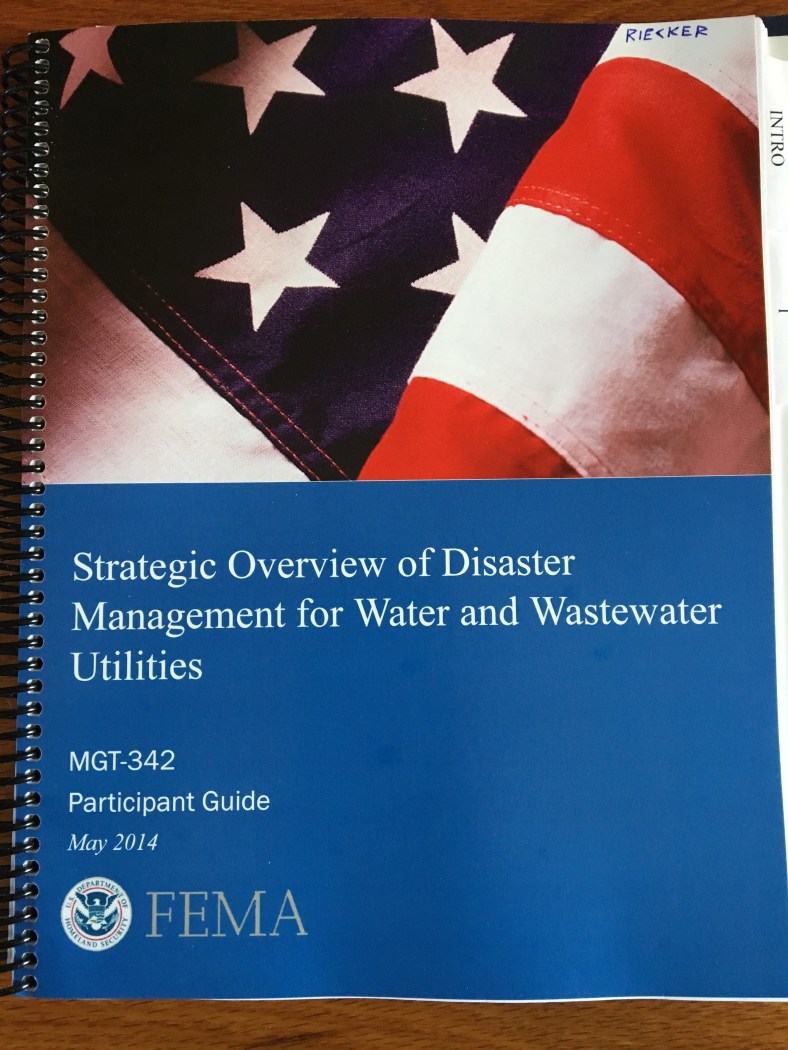
Course Review: MGT-342 Strategic Overview of Disaster Management for Water and Wastewater Utilities

I took the opportunity yesterday to attend the aforementioned class held at the New York State Preparedness Training Center in Oriskany, New York.  This half day (0800-1200) course was well attended by water and wastewater personnel from around central New York, a couple of emergency management types, and even a representative from a local brewery (no samples, sadly).  This DHS approved course is designed and instructed by personnel from the Texas A&M Engineering Extension Service (TEEX) National Emergency Response and Rescue Training Center (NERRTC).

IMG_1263

Through my career in emergency management I have regularly worked, albeit tangentially, with water and wastewater professionals, which are generally regarded as a niche of public works.  In many small towns across the nation, water and wastewater systems are among the only critical infrastructure these small towns have.  In larger municipalities, water and wastewater systems are extensive and necessary for not only their residents, but for business and industry as well.  We often see impacts to water and wastewater systems from disasters ranging from earthquakes, to utility outages, floods, and other disasters, including criminal acts.  I’m always interested in an opportunity to learn more and this course was convenient in location and schedule.

This course is a condensed half-day version of a two-day course also taught by TEEX.  When instructors reviewed the morning’s agenda, I was skeptical, and rightfully so.  The participant manual, like most products developed by TEEX, is excellently done, with an abundance of reference material.  Even if the material was to be just reviewed, I knew that addressing most, if not all of it, would be a significant task for the instructors.  The lead instructor was very knowledgeable and experienced in the subject matter and very well spoken.  While he had a lot of value to provide to participants, he may have provided a bit too much relative to getting through the three units of the course as intended.

The course units are largely broken into three main topic areas: Threats, Preparedness, and Response; all obviously relative to water and wastewater systems.  The first unit, Threats, was covered thoroughly, taking nearly the full class time.  The information provided was excellent and realistic in scope.  Examples of actual impacts to water and wastewater systems around the world from a variety of threats and hazards were used to drive the point home about the vulnerability of these systems.  I was dismayed, though, that the second unit, Preparedness, was not covered at all.  Fortunately, there is a great amount of materials in the participant guide for after class reference.

The third unit, Response, also contains a great deal of information, especially for those who are not used to complex and multi-agency responses.  Unfortunately, we only had time to review a case study which was in the unit.  While the case study (the Charleston, WV spill from January 2014) was excellent and certainly time well spent, it would have been great to dig into the other response related materials in the course.  Again, at least we have these for post-course review.

This content of this course is quite valuable, relevant, and up to date.  It was expertly instructed, discounting some time management issues.  I do think, though, that the instructional design in more to blame, as the quantity of content contained in the course is simply too much to be adequately covered in a half day.  It certainly had me wanting to take the two day course, and definitely from the same instructor.  I provided similar comments on the course evaluation sheet, and I hope they do make some necessary changes to this class to maximize the amount of information provided.  Would I still recommend this course – yes, but just know going into it (at least in its present form) that you may not experience delivery of all the material.  If the quality of material and instruction is any indication of what to expect in the two day course, though, I would absolutely recommend it.

If you have any questions on the course, or experiences of your own, I’d love to hear them.

  • TR

The Need for More Scenario-Based Learning

Think back through all the courses you’ve taken.  It’s a lot – I know.  What ones stand out the most?  I’m willing to be they are the ones that were the most engaging.  Not only did you enjoy them, but you learned a lot from them and still remember quite a bit of it.

It’s no secret that training adults can be challenging.  Training professionals in emergency services is certainly no different.  The challenges are even greater as the number of required training courses continually increase, requiring more and more ass-in-chair time every year for responders and other professions.  A great deal of training programs we see out there still seem to be holding out for the sake of traditional delivery styles, much to the detriment of our learners.  Why?  Designing traditional lecture-based learning is easy to do!  Figure out what people need to learn, develop content, slap together some PowerPoint, and voila!  Hell, even I’m guilty.

The fact of the matter is that we all know this is wrong.  Yes, it’s easy to do on our end, but the value and impact of the learning is pretty low.  People don’t want to be lectured to for hours on end.  We know that learning is most effective when we mix things up and when we increase interaction.  One of the best ways of engaging learners effectively is through scenario-based learning.

Now I’m not just talking about using a scenario at the end of the course to see if people can apply what they’ve learned over the past two days.  Yes, scenarios can be used as a test of sorts, but they are most effective for actual learning.  So when should you use scenarios?  Why not start the course with one?  It immediately gets people thinking, which is a good thing especially with an 8 am start time to the course.   If you use a lot of scenarios in a course, can they all be related?  Sure.  Maybe.  Maybe not.  It all depends on what the purpose of the scenario is.  In training responders, threading a common scenario through a course is usually helpful.  Scenarios can get complicated when we need to establish a common understanding of what is going on, where it is, what resources are available, etc.  As such, it helps to use the same foundational scenario throughout the course (or at least regularly revisit it), and continue to introduce new problems or a different focus based upon the path of the training.  Using a common foundational scenario saves time so you don’t have to start anew introducing all new information each time and it keeps learners comfortable.  That said, it may occasionally be valuable to change things up a bit.

Do you need to use HSEEP to develop course scenarios?  No.  While these aren’t exercises in the strictest sense, we can benefit considerably from many of the principles and concepts of HSEEP.  Develop what you need to give learners the information they need to participate and the information you and/or other instructors need to properly facilitate and evaluate.

Adult learners like to be challenged.  Lecturing them for hours on end will only challenge their ability to not fall asleep – which may only be accomplished by their challenge for a new high score on the new app they just put on their phone.  The best way to challenge adult learners is to give them problems to solve.  A well written scenario will help introduce these problems in a framework which is both familiar and challenging to them.  Depending on how the scenario is provided, such as a compelling background story or use of video, learners will establish an emotional connection to the scenario which prompts a visceral desire to solve these problems.  Even one scenario is powerful and can prompt a lot of interaction.  It can prompt individual responses to questions, group discussions, and group collaborations.

Finally, don’t forget to evaluate both your learners and the scenario itself.  At the conclusion of each scenario conduct a hotwash and feedback session with learners to discuss what they accomplished and possible areas for improvement.  Also be sure to gain feedback from them and other instructors on how well the scenario worked and what can be improved upon.

Just like any other aspect of instructional design, the integration of scenarios can be time consuming but it’s an investment that will pay off.  To capitalize on the value of your scenarios, make sure the activities and expected outcomes of each scenario are associated with the learning objectives of the course and engage learners to the proper degree (i.e. the proper level of Bloom’s Taxonomy).  Yes, scenarios also take a fair amount of class time to execute.  That time needs to be well accounted for in your instructional design and course planning.  However, if properly designed, learners can learn just as much content if not more through interactive scenarios as compared to lecture-based training.

What types of scenarios have you integrated into courses?  How did learners respond to them?  How can we do a better job of integrating more scenario-based learning into our courses?

Need help designing scenario-based learning?  Let EPS help!

© 2015 – Timothy Riecker

Emergency Preparedness Solutions, LLC

WWW.EPSLLC.BIZ

FEMA Releases a Consolidated Online Training Course Catalog for First Responder Training

This is a great resource I discovered last week that has just been officially announced this week. It is comprehensive and easy to use. Check it out and see what’s out there! – TR 

(Official release follows)

FEMA released a consolidated online training catalog for the First Responder Training System, including courses available through the Emergency Management Institute (EMI), the Center for Domestic Preparedness (CDP), the National Domestic Preparedness Consortium (NDPC) and the Continuing Training Grant (CTG) program. The site was developed in response to customer requests and is known as the “National Training & Education Online Course Catalog.” It allows users to search for all FEMA preparedness training initiatives in one location.  

The main entry page of the combined catalog briefly describes each training organization—EMI, CDP, and the National Training and Education Division—while providing a list of training courses in each catalog, along with links for scheduling and individual websites for each training organization. First responders can access the consolidated course catalog by clicking directly at www.firstrespondertraining.gov/NTE

The catalog itself is searchable and can be viewed in full or by the individual NTE training entities. Users are able to filter by organization and/or training provider, delivery type, discipline, core capability and mission area at www.firstrespondertraining.gov/ntecatalog.

Course catalog feedback can be sent to firstrespondertraining@fema.dhs.gov.

The Human Aspect of ICS and Overcoming Transitional Incidents

Most often when we consider the Incident Command System (ICS), we think of boxes in an organization chart, forms to be completed, and specific processes to be followed.  True, these are, in essence, aspects of ICS, but they alone will not pave the way to success.  What we must remember is that ICS is conducted by people.

Typically the most difficult aspect of a complex incident is the transition from what we normally do and how we normally respond to elevating our response to a more appropriate level given the scope of the incident.  The groundwork for this transition lies in our initial response, which many experienced responders know can set the tone for the entire operation.  This initial response is based largely on the decisions we make with the information we have.  While there are policies, plans, procedures, play books, checklists, and myriad training that help to inform us, it all comes down to the human factor.  People make decisions based upon the stimuli they are presented with and their own experiences.

Chief Cynthia Renaud in her paper The Missing Piece of NIMS: Teaching Incident Commanders How to Function in the Edge of Chaos discusses approaches to initial response as an oft forgotten aspect of how we teach ICS.  While we know that responders conduct initial responses all the time, there is a significant difference in scope between a routine incident and a complex incident.  This difference in scope requires a different and more open mindset.  While our size up actions may generally be the same, we need to think bigger and this kind of thinking is difficult to train.

The implementation of the ‘bigger’ (i.e. beyond what is routinely used) aspects of ICS is also a challenging mindset for responders.  These aspects of ICS, such as the initial delegation of other organizational aspects and the need for a written Incident Action Plan, do not come easily when they are not practiced.  The fact of the matter is that the implementation of ICS requires a conscious, deliberate decision accompanied by people with knowledge and skilled intent to guide its expansion suitable to the incident at hand.  It also requires a bigger picture mindset recognizing the need to expand the management of the response proportionate to the complexity of the incident and the resources required to address it.  When is it needed?  How do we do it?

One problem is that most of the people we count on to manage these initial responses are trained to manage tactics, not large incidents.  They excel at managing a handful of resources in a rapid deployment and resolving an incident quickly.  This is exactly what they are needed for and they do it well.  Chief Renaud indicates a need to train these first level supervisors to recognize complex incidents for what they are and give them the tools (and authority) to implement broader measures, including an expanded implementation of ICS.

I’m a firm believer in ICS, but I know that people have to drive it.  It’s not something we can put on autopilot and expect it to bring us to our destination.  It has to be consciously and deliberately implemented.  When people criticize ICS, I often find that their criticism is due to false expectations and inappropriate implementation.  With that, I firmly believe we need to do a better job at training to address these issues and help responders better understand the system and demystify its use.

How do we make our training better for the average (non Incident Management Team) responder?  How do we help bridge this gap between the routine and the complex?

© 2015 – Timothy Riecker

Emergency Preparedness Solutions, LLC

www.epsllc.biz 

Emergency Managers Need to be More Like Engineers and Less Like Shopkeepers

I was inspired by this short (~1 minute) video from TrainingJournal.com.  In the presenter’s brief but pointed message, he describes many trainers as being akin to shopkeepers, providing organizations often times with rote solutions just as a shopkeeper will pull a product off their shelves. He goes on to say that this these solutions are usually effective, but only for a limited duration.  He offers, instead, that trainers need to be more like engineers, examining every facet of a problem and constructing lasting solutions.  As an experienced trainer and proponent of a detailed root cause analysis, I couldn’t agree more, but as I readied myself to write a post about the implications of this on training, my mind carried this metaphor to many of our practices in emergency management.

Consider how often we quickly dismiss identified gaps with an assumed solution.  Write a plan, conduct a training, install a bigger culvert.  Those are usually our solutions to an identified problem.  Are they wrong?  No – we’re correct more often than not.  Are these lasting solutions?  Rarely!  How often does the problem rear its head again within a relatively short span of time?  How do we address the re-occurrence?  As shop keepers we simply pull another solution off the shelf.  Can we do better?

The things we do in emergency management are often based upon best and current practices.  We address problems through the prevalent way of dealing with such things industry-wide.  Emergency management has a great community of practice.  I’ve mentioned in several previous blog posts the spirit of sharing we have and the benefits we see come of that.  It doesn’t seem often, though, that we engage in an industry-wide groupthink to solve various problems.  We use and adapt ideas of individuals and small groups, we see a steady and determined progression of the practices within our progression, but we rarely see ‘game changing’ ideas that revolutionize how prevent, prepare for, respond to, or recover from disasters.  Why is this?

Perhaps we need a greater collective voice locally, where practitioners are dealing with the problems directly?  Our methods of practice in emergency management are generally driven by the federal government (THIRA, NIMS, HSEEP, etc.).  I’m not saying any of these are bad – in fact they are excellent standards that we need to continue to refine and apply, but it’s generally not the federal government that is dealing directly with the constant flow of issues being dealt with at a state, and even more so, a local level.  We need to follow that metaphor of being engineers to apply more permanent solutions to these problems.  We need to create, innovate, and problem solve. Or do we?

Necessity, as they say, is the mother of invention.  We often miss the necessity of improving because we have current, functional solutions – we have things that work.  So why fix it if it’s not broken?  I say we can do better.  The realization of the need for lasting solutions is the necessity we need.  If the solutions we have on the shelf don’t work for us 100%, let’s figure out a better way.

I don’t know what or how, but I’m sure that as a community we can identify needs and prioritize what must be addressed.  Given the right people, time, and maybe a bit of money, we can be innovative and effect some lasting change.

I’d love to hear what others think on this topic.

© 2015 – Timothy Riecker

Emergency Preparedness Solutions, LLC

www.epsllc.biz

Dig Deeper – Ask ‘Why?’ Five Times

Be an archaeologist and DIG DEEPER!

Be an archaeologist and DIG DEEPER!

An old boss of mine once told me that to find the real root of any problem you should ask ‘Why?’ five times.  This sage Yoda-like advice has served me well ever since.  Of course it’s not always necessary to ask it the full five times; in fact you often find the foundational cause sooner.  Nonetheless, this approach will inevitably guide you toward discovering what needs to be fixed.

Those who follow my blog know that I post mostly within two thematic areas – emergency management or training.  The ‘ask why’ methodology applies to both of these areas and darn near anything else I can think of.  My thoughts are below on both themes.  Of course training in the field of emergency management is a combination of the two!

In Emergency Management

I’ve posted numerous times on topics such as hazard analysis, Threat and Hazard Identification and Risk Assessment (THIRA), and other similar topics in emergency management.  It is so incredibly necessary for us to identify needs and vulnerabilities, and to understand our community’s capabilities in order to properly prepare for future disasters and emergencies.  I’ve learned that in public safety, when asking a question, you often get a story and that story is often related to a past incident.  While the story may be elaborate, it usually gives you little substance.  Anecdotes aren’t enough.  You need to dig deeper.

As a culture within public safety we are still trying to drive practitioners to be more analytical.  Quality after action reports are a big step in the right direction.  The benefits of after action reports for incidents, not just exercises, are huge.  After action reports should lead to improvement plans, but without identifying the real reason behind what went wrong we can’t fix the problems.  After action reports require an analysis to dig deeper into the observed action to discover what really needs to be addressed.

In Training

In November I published an article in Training Magazine titled The Importance of Analysis to Identify Root Cause.  While I didn’t reference the ‘ask why’ methodology directly, the subject matter of the article lends itself to this approach.  As a trainer, when a problem is presented to you to ‘fix with training’, you need to figure out what the real issues are so that 1) you can confirm that it is in fact a training issue, and 2) you can determine what the objectives and methodologies of the training need to be.  Without properly identifying and defining the needs you are doomed to fail and will likely be putting forth a lot of effort with little gain.  While the results may put some people on the defensive, they can point the organization in the right direction to address inefficiencies and performance problems.

In any needs assessment, don’t simply accept the first answer given to you – dig deeper!  It’s amazing what you will find!

© 2014 – Timothy Riecker

Is the Department of Defense Planning for a Zombie Attack?

No, not really.  But they are using the zombie scenario as highly effective training tool.

I reference, of course, the recent news releases (such as this one from ForeignPolicy.com) concerning the United States Strategic Command document titled: CONPLAN-8888 – Counter-Zombie Dominance (April 30, 2011).  You’ll see in the Disclaimer section of the document, beginning on the second page, that this scenario was selected because of its improbability of occurring, unlike other scenarios which may be used as the basis for training and exercises, which could be mis-perceived by the public.

The training they refer to is the Joint Operations Planning Process (JOPP).  Typically the word ‘Joint’ in military doctrine refers to activities which include two or more branches of military service. Not only do the US Military Services use joint planning and conduct joint operations, but the Army and Air National Guards do as well.  For as much as it makes sense, the concept of ‘jointness’ has really only seen large-scale attention in the last decade or so.  Having worked extensively with the National Guard in recent years, the ‘jointness’ has become the foundation of nearly all activity.  This is a great accomplishment as there is considerable competition between the branches, sometimes to the level of disdain, and certainly a great many differences, even in terminology and rank structure.  Despite the decades-long existence of the Joint Chiefs of Staff, true joint integration at an operational level rarely occurred and was generally not executed well.

Joint operations are simply a military version of the Incident Command System (ICS), where different disciplines and agencies – some often very different from each other – can function together within one organizational structure for the purpose of addressing an incident.  If you are interested in additional information on Joint Planning and Operations, I suggest you visit the DoD’s Joint Electronic Library where you can find documents which I have referenced often when working with the National Guard on preparedness and response activities – including the Universal Joint Task List (UJTL) (similar to the old DHS Universal Task List, in concept) and the Joint Publications (such as Joint Publication 5-0, Joint Operation Planning – which is the foundation for JOPP).

As mentioned in earlier posts, I love the integration of zombies and other apocalyptic lore into preparedness activities.  While tongue in cheek, they help planners and responders do away with pre-conceived notions they may have with other, more realistic scenarios.  In emergency management, we know that every incident is different.  While we learn from our experiences and hopefully apply what we learned to the new challenges we face, we sometimes go into the next incident with a bias.  The introduction of totally fictional scenarios, such as a zombie attack, help make the situation faced completely new – while many of the specific problems faced are things we do have plans for, such as mass fatalities, hazmat, contagious diseases, etc.  It’s a great approach which I strongly advocate.  The only caution we may have is that the premise of the scenario itself may cause some to not take the activity seriously or may cause a distraction.

Have you used any non-traditional or totally fictional scenarios?  What were they?  How were they received?

/s/

Tim Riecker