Crowdsourced Weather

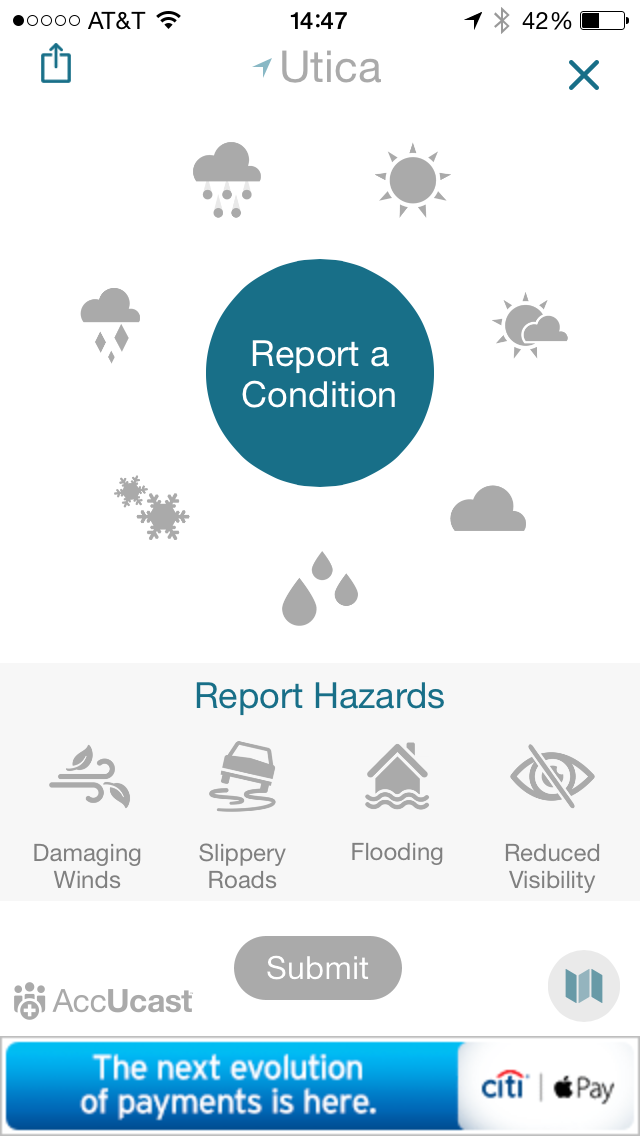
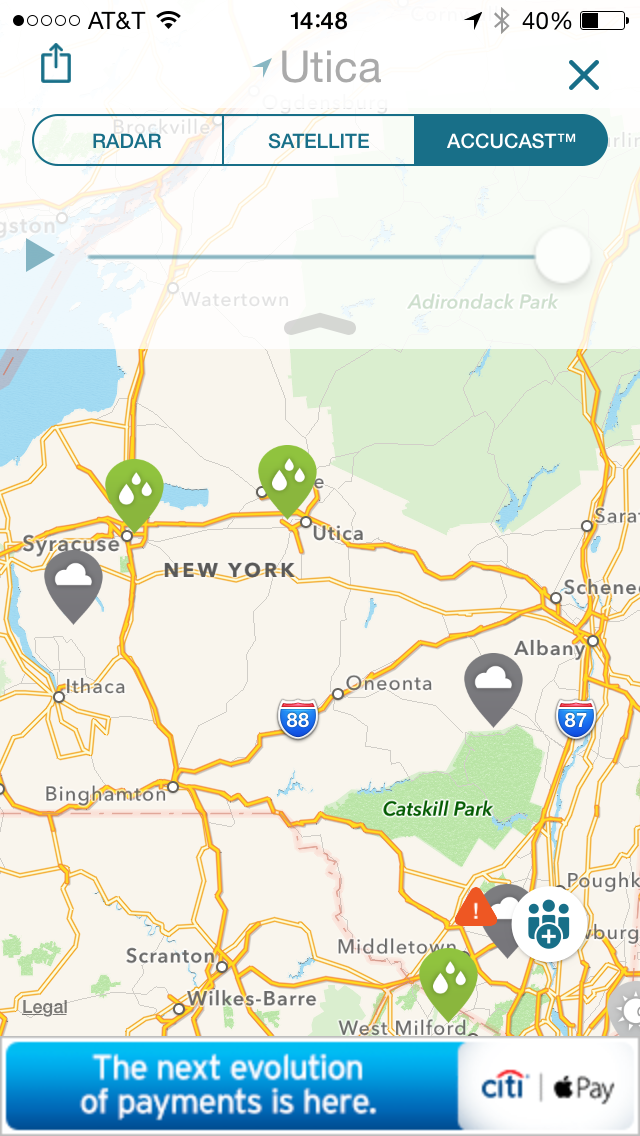
Now this is cool… Back in July, AccuWeather’s iOS app incorporated a crowdsourcing feature called AccuCast which allows users to report weather and weather related hazards where they are.  This data is then available as an option in the weather map displays accessible in the app.

Screen images included below.  More information available from http://www.accuweather.com/en/press/50601069.

AccuWeather AccuCast Screen Shots

AccuWeather AccuCast Screen Shots

AccuWeather2

TR

Firearms in Emergency Kits?

Cannon Beach, Oregon, a community in the Cascadia subduction zone, has an interesting program in which they store the preparedness kits of residents for them.  A link to the city’s program is here: http://ci.cannon-beach.or.us/community/cachecontainer.html.  In summary, the city provides the opportunity for residents (for a small fee) to store containers (provided by the city) of emergency supplies within city-owned cache locations.  They offer 5 gallon pails (with lids), 30 gallon drums, and 55 gallon drums.  These kits are stored securely in shipping containers at the predesignated locations.

I’m a bit ambivalent about the concept.  While it certainly encourages and enables people and families to have kits that perhaps otherwise wouldn’t, it does remove these kits from their possession.  Not having the kits in your possession limits the ability to add to/maintain the kit and certainly makes them ineffective during a shelter in place scenario.  I, for one, would rather have my kit readily available to me and all family members without having to address:

1) potentially unsafe travel,

2) the ability to access the container (will someone be there to let me in?),

3) a potential state of unrest in the vicinity of the container,

4) will the container still be there (we’ve seen these things easily moved by mother nature).

Note that the informational material on their website does encourage people to also have go-bags for a combination approach, which is a good idea.

Now that I’ve warmed you up with some background – off to the main topic…  I was first alerted to Cannon Beach’s concept via a news article about someone storing a firearm in their kit.  http://www.opb.org/news/article/should-your-emergency-preparedness-kit-include-a-firearm/.  The article states that an individual kept a firearm in their kit, which was stored by the city in a storage container which was broken into and stolen.  Firearms, by the way, are not permitted per the city’s guidance.  But should firearms (Cannon Beach’s program aside) be included in emergency kits?

Up front, I’d never recommend that firearms be kept in an emergency kit simply based upon liability.  That said, it’s an individual decision but could be a good idea.  Certainly anyone who chooses to do so should ensure that it is done legally and safely.  One must also consider why they want to have a firearm in their kit.  Is it for personal protection or for hunting?  Or both?  In the case of the article I referenced, it was a handgun, which could really only be used effectively for personal protection.

While we see very limited violence and looting during disasters, it certainly could be possible.  I would never suggest that someone not have the ability to protect themselves or their family.  I would suggest, however, that anything in your kit should have as many purposes as possible.  A handgun is less than ideal for hunting.  However, including a firearm for hunting (rifle or shotgun) will likely exceeded the physical space of your kit, so this needs to be considered.

I would also suggest that, again just like anything else in your kit, you be proficient in using it. Among the few who keep and maintain preparedness kits, many buy things and just stick them in there.  They never read the instructions or become familiar with their use.  Consider a water purifier for example.  Any brand that I’m familiar with needs to be submerged and backwashed prior to use to remove smaller particulates from the carbon filter.  If someone is keeping something as dangerous as a firearm, they had better be proficient in its use!

The bottom line is that we are not likely to see a scenario out of The Walking Dead.  While we have seen some devastating incidents, such as Hurricane Katrina, which had limited the effectiveness of law enforcement for a time, this is not the norm within disasters.  Some may be considering an extreme, perhaps apocalyptic, scenario, and wanting to protect themselves, which is fine.  Just be smart about it.

What are your thoughts on firearms in emergency kits?  How about the municipal storage of kits like Cannon Beach’s program?

Lots of food for thought…

© 2015 – Timothy Riecker

Emergency Preparedness Solutions, LLC
WWW.EPSLLC.BIZ

Deadly Explosions

By now I’m sure you’ve all heard of the two horrible explosions that took place over the last 24 hours – one in Tianjin, China; the other in Baghdad, Iraq.  The explosion in the port city of Tianjin occurred soon after fellow consultant Ralph Fisk and I had both separately published posts about the dangers of human caused disasters.  The explosion in Baghdad, the result of a terror attack, occurred less than 12 hours ago.

The explosions in Tianjin occurred in the port area of the city and originated as fires among shipping containers.  The origin of the fires is yet unknown or released to the public by the Chinese government.  Chemicals and explosives were within some of the containers, with reports of chemical odors still lingering there hours after the explosions occurred.  At this point, according to CNN, 50 persons are confirmed dead with more than 500 hospitalized.  Among the dead are 12 firefighters.  Many more people are missing, including dozens more firefighters.  If you’ve not seen any of video of the explosions, it is grimly spectacular.  CNN has obtained several videos from people who were recording the fire turned explosion.  http://www.cnn.com/2015/08/13/asia/china-tianjin-explosions/index.html.  This will certainly be a continuing story to keep an eye on.

In Baghdad, ISIS has reportedly claimed responsibility for a truck bomb which was detonated in in a busy market, killing dozens and injuring nearly 100 people.  Sadly we have become practically desensitized to occurrences of violence in the Middle East.  While each of them is horrible, this incident is particularly tragic with the loss of this many lives.

I rarely post about current disasters or incidents as there is plenty of commentary already out there from the media and quasi-media.  The tragedy of these, however, underscores our need to be aware of the potential for these incidents to occur and what we need to do to prepare for and respond to them.  We also need to be prepared to address the cascading impacts of these incidents – mass care, mass casualty, and mass fatality issues are certainly paramount, but we also need to consider matters such as business and government continuity.

Foundationally, it helps to know something about explosives.  For my readers who are US citizens, be sure to check out the first responder training available from the New Mexico Tech Energetic Materials Research and Testing Center (EMRTC).  They run DHS sponsored training programs such as Incident Response to Terrorist Bombings (IRTB).  These courses are intensive and greatly valuable, diving into the physics and chemistry of different explosive types and classes, terrorist methodologies, and plenty of show and tell in their range.  The course gives a solid appreciation for what explosives can do and gives you a relative awareness of how much explosive it takes to cause a certain amount of damage.  For those who are not US citizens, I believe they do work with the US State Department to review applications on a case by case basis.  I’m curious as to what type of similar training is available in other countries to domestic responders.

We are truly lucky to not suffer incidents such as these as often as other nations do.  Understand, though, that this is only due to safety and security measures that we have in place.  Accidents, however, are inevitable, as are the successful efforts of those who wish to do us harm.  We must continue to do what we can to prevent these types of incidents but also be ready for when they do occur.

© 2015 – Timothy Riecker

Emergency Preparedness Solutions, LLC
WWW.EPSLLC.BIZ

Are You Really Considering All Hazards?

Natural hazards, such as flooding, tornados, wildfire, and earthquakes, bring about the greatest losses, calculated in nearly every metric possible, as compared to human-caused incidents.  Human-caused incidents, either accidental or intentional, still bring tremendous impact to communities world-wide on a daily basis.  While working to prepare for, mitigate, respond to, and recover from natural hazards will always continue to be important, it seems that many still often forget about human-caused incidents despite all the conversations out there.

Human-caused incidents include a variety of hazards such as infrastructure failure, transportation accidents, hazardous materials incidents, and intentional attacks.  These are all things which we can fit into our traditional model of Prepare, Mitigate, Respond, and Recover.  The National Planning Goal introduced the model of the five Mission Areas – Prevention, Protection, Mitigation, Response, and Recovery – to help address our many of our major functions (Core Capabilities) for human-caused incidents (note that Preparedness is now a higher level concept that applies to all Mission Areas).  While this Mission Area model has helped bring these key activities into the greater fold of what we do, it has also kept them largely isolated through the thought that many human-caused incidents are only addressed through Prevention and Protection Mission Area activities.

Nowhere, it seems, do we see this more than in the area of hazard mitigation.  The vast majority of hazard mitigation plans which exist only address natural hazards (even at the state level).  Since many readers view this blog for my opinion, here it is – this is archaic and dangerous thinking!  We have all seen hazard mitigation plans which claim they are ‘all hazards’, yet only list natural hazards.  That’s fine, if by some unbelievable circumstance, your jurisdiction is only impacted by natural hazards.  This is a circumstance which I am highly doubtful of.  Some mitigation plans get a little more realistic and will address human-caused hazards such as dam failure and/or hazardous materials release, which were likely the greatest human-caused threats they may have been vulnerable to in the previous century.  In today’s world this still doesn’t quite get us to where we need to be.  There are a great many mitigation activities which we can leverage against human-caused incidents.

How do we fix this?  It’s easy – start with conducting a hazard analysis.  A hazard analysis, be it as a stand-alone activity or part of the THIRA process, should review all possible hazards which your jurisdiction, company, or organization is vulnerable to.  It should be comprehensive, not just limited to the set of natural hazards.  Along with infrastructure failure and hazardous materials incidents (both in-transit and fixed site), consider hazards such as active shooters, cyber attacks, improvised explosives, and civil unrest.  This may require bringing some additional subject matter experts into the room for your hazard analysis – like your IT director.  In a hazard analysis, each hazard is ranked (at a minimum) by its likelihood to occur and its severity of impact should it occur.

A well conducted hazard analysis provides the basis for everything we do in emergency management and homeland security.  It not only informs our activities such as planning, training, and exercises, it also helps assign priority to those hazards which require the greatest focus and allocation of resources.

© 2015 – Timothy Riecker

Emergency Preparedness Solutions, LLC

WWW.EPSLLC.BIZ

NIMS Alert – FEMA Seeks Feedback on Federal Interagency Operational Plans

Take some time to review and comment on these.  Be heard!  TR

<from press release>

FEMA is requesting stakeholder feedback on working drafts of four of the five Federal Interagency Operational Plans (FIOPs):  Protection, Mitigation, Response, and Recovery. The Prevention FIOP is Unclassified and For Official Use Only (FOUO)/Law Enforcement Sensitive (LES), Restricted Access and therefore available to appropriate personnel through separate and secure communication means. The FIOPs describe how the Federal government aligns resources and delivers core capabilities. Each FIOP outlines the concept of operations for integrating and synchronizing existing national-level Federal capabilities to support the whole community.

This update of the FIOPs focuses on discrete, critical content revisions, and confirming edits as a result of comments received on the National Preparedness Goal and National Planning Frameworks. Additional changes in the draft are the result of the lessons learned from implementing the FIOPs and recent events, as well as the findings of the National Preparedness Report.  The FIOPs and feedback submission forms may be found at http://www.fema.gov/ppd-8-news-updates-announcements.

To ensure all feedback is properly handled, reviewers are asked to use the provided feedback submission form to submit feedback and recommendations. Please provide any comments and recommendations, using the submission form, to PPD8-Engagement@fema.dhs.gov by Tuesday, September 2, 2015 at 5:00 PM EDT.

Well OF COURSE Drones Can Be Used As WEAPONS

It’s rather insane that it took this long for the US Department of Homeland Security to issue a warning to law enforcement about the potential use of drones/UAVs as weapons or to further the criminal enterprise.  If you’re not familiar with the DHS bulletin, see this CBS News story.

For those of you who have been steady readers of mine, you can probably tell that I’m pro-drone.  However, just like anything else, someone is bound to adapt the technology for their own malicious purposes.  While we are still getting our act together in figuring out how to apply UAV technology for myriad good and purposeful things, there have been those out there trying to figure out how to use the same technology for advancing criminal and terrorist agendas.

Amazon and others want to use UAVs to deliver packages.  Well guess what –drug cartels will certainly be using them to deliver packages of drugs.  The US military uses UAVs to strike at terrorists in unfriendly territory.  Terrorists, criminals, or even your run-of-the-mill stupid people, can do the same.  Have you seen this article about a teen who mounted a handgun to a UAV?  UAVs are great for providing a birds-eye view of any situation, but when operating in a disaster environment they can’t impede responders as they did in the recent wildfires in California.

I have no doubts that terrorists somewhere, foreign or domestic, are playing with UAV electronics and explosives to determine how best to deliver those deadly packages.  As inevitable as it is, do we ban the use of UAVs?  Well we haven’t banned cars or moving vans, and both have been used to transport explosives.  The good outweighs the bad, so we have to figure out how best to deal with it.

The fact of the matter is that all well intended technology can be used for not so good purposes.  Does this mean we do away with the technology?  No.  Does this mean we do away with innovation?  No.  It does mean that we have to stay a step ahead of those who have ill intent or practice in stupidity.  Prevention, protection, and mitigation against these things is a constant challenge.  We now need to be aware of a new threat and address it.  It’s something we’ve done through time.  People built walls around their towns to protect themselves and their property from people and animals who would do them harm.  Attackers innovated and approached walls with ladders, so defenders built taller walls and other defensive technologies.  Today we use physical barriers to prevent vehicles from getting too close to buildings, locked doors to prevent entry, and cameras to monitor.  Perhaps the threat of an attack from the air will require other measures.

Has your company or jurisdiction considered the threat UAVs may pose to your interests?  What are your thoughts on deterring attacks?

© 2015 – Timothy Riecker

EMERGENCY PREPAREDNESS SOLUTIONS, LLC

WWW.EPSLLC.BIZ

At what point are we FEAR-MONGERING?

By now we’ve all read or at least heard of the piece in The New Yorker about the impending doom that shall be wrought by the Cascadia subduction zone.  It brings about some interesting thoughts.  Certainly the foundational premise of the article is based in some measure of science.  There IS a Cascadia subduction zone and a major quake here COULD certainly be devastating.  This article has sparked a few pieces by others which took their bit of sensationalism to a much higher level.  Keep in mind, however, that sensationalism sells.

The situation begs some questions of our own profession, though.  Where is that line for emergency management and homeland security?  Of course we endeavor to be factual, but we also want to be convincing and COMPELLING.  We want people to take action.  How far do we have to go to get our point across that there are hazards which people need to prepare for?  How far do we have to go to describe the situations which people need to prepare for?  At what point are we SENSATIONALIZING?  At what point are we FEAR-MONGERING?  What kind of moral obligation do we have?

This post and these questions were actually inspired by this morning’s blog post from author Chuck Wendig titled “Fear is Fucking Us All Up”.  Mr. Wendig’s blog is raw, humorous, and insightful on a variety of topics.  I highly recommend giving it a look.  Reader beware – Chuck Wendig uses more than a bit of profanity (in case you couldn’t tell from the title of his post).  If you are offended, don’t read it!

© 2015 – Timothy Riecker

EMERGENCY PREPAREDNESS SOLUTIONS, LLC

WWW.EPSLLC.BIZ

Most Disasters are NOT Extraordinary Occurrences – OR Crowdsourcing Volunteers

I listen to A LOT of podcasts.  While some are focused on emergency management and homeland security, most are pop culture related and have nothing at all to do with EM/HS.  At least not directly.

Listening to a recent podcast, it struck me how often the hosts mention disaster-related occurrences.  During this podcast there were several mentions of disaster related issues including the Louisiana theater shooting (which was breaking news while they were recording) and the Tom Selleck legal drama in California over stolen water (which ultimately relates back to their drought issues).  The same podcasters (one of which is in New England, the other in the National Capital Region) often comment through the year on weather-related incidents which impact them and others including winter storms, flooding, and warmer weather storm damages.

The point is that most disasters are not extraordinary occurrences.  Routine incidents aside, some measure of disaster occurs fairy regularly, certainly around the world and even just within any of our nations.  Turn on the news tonight and see for yourself.  So WHY, I ask, is there such a mentality with the general public (and maybe even with us public safety types) about disasters being out of the ordinary occurrences?  Sure they don’t happen within our own jurisdiction every day, but they happen somewhere EVERY DAY.  I’m not saying we have to be paranoid about it, but I see the COMPLACENCY getting WORSE.  We discuss preparedness often, and the aspect of getting the public better engaged in preparedness almost as much, yet we have yet to see real, meaningful success in this.

We’ve recently seen a bit of a paradigm shift in how we deal with climate change (insert groaning sound here).  For many years we tried to prevent it, as if we could.  The reality is that part of it is influenced by the actions of humanity and part of it by the natural cycle of our planet.  There are things we simply shouldn’t be doing and we still need to work on those, but we have also come to grips with the inevitability of the impacts.  We have realized that they will happen no matter what we do and we have decided that we need to ADAPT in order to survive.

Adaptation is an important realization for us (I’m now speaking in generality – not just climate change issues).  If there are things that we pound our heads against the wall over in futility, such as public engagement, maybe we are doing it all wrong?  I’m not saying that we stop trying to engage the public.  There are certainly successes we have seen, but I don’t think we are seeing the return on investment we should be.

Let’s look at society today.  People seem to have less time ability interest in volunteering or committing to efforts ahead of time.  We have to understand and acknowledge that first and foremost.  Have we turned into soulless uncaring creatures?  No, of course not.  We have just seen a shift in culture.  Trying to fight this culture is foolish.  Instead, we need to adapt.  How do we adapt?

Social media is the greatest embodiment of our need for instantaneous information and feedback.  It doesn’t take much preparation (download some apps, create accounts, find friends).  The vast majority of the information that rolls across the screen is crap, but every once in a while there is a worthwhile nugget that will garner some responses.  Sometimes (usually disasters or a new statement by Donald Trump) information that comes across garners a great deal of attention and people want to take action.  Do they know how to take meaningful action?  Often not.  But they will follow along with the good ideas of others.  (aka leaders).

Let’s broaden this concept within public engagement.  What this essentially comes down to is managing spontaneous volunteers – a concept we have seen much need for in EM for years.  I think we need to emphasize this more than ever.  We also need to update the way we think about it.  These spontaneous volunteers will not only show up at town hall, the fire house, local diner, or house of worship; they will show up online via Twitter and Facebook.  They will be locals, they will be from out of state, across the country, or across the planet.   ALL of them can be engaged.  Let’s crowdsource volunteers in emergency management.  We just need to identify how to engage them.  Identify gaps and figure out how these good natured people can fill those gaps with little no upfront investment of time or effort on their part.  Build plans that address spontaneous volunteer engagement – both in the physical aspect as well as virtual.  Train to these plans and test these plans.  Let’s stop struggling against old ways of thinking.  Improvise, adapt, and overcome.

As always, I’d love to hear your thoughts on this.

I do want to take a moment to thank my followers and readers – something I don’t do enough of.  Your support and comments are greatly appreciated.  Also, if you like my blog, spread the word.  Please feel free to forward/repost/retweet to friends, family, colleagues, and complete strangers.

©2015 – Timothy Riecker

EMERGENCY PREPAREDNESS SOLUTIONS, LLC

WWW.EPSLLC.BIZ

We need to talk MORE about Emergency Management

My company is currently finishing a contract which involved almost two dozen site visits to local government entities (cities and towns) to meet with local officials (emergency management, police, fire, EMS, schools, elected officials, public works/highway, etc.) to discuss certain emergency management and homeland security needs they may have.  The topics we needed to address were set in conjunction with our client and the meeting times were capped at 4 hours.  Based on the discussion generated by those we met with, discussions took anywhere between an hour and a half to all four hours.  At the end of most of these meetings, many people who we met with thanked us for bringing them the opportunity to discuss emergency management with such depth.

At first I was a bit puzzled about this gratitude… the meeting was intended for us to gather information from them, so it was us who thanked them for their time and input.  Why would they thank us?  They could talk about this stuff any time they wanted to, right?  In theory, yes.  In practice, NO.

Looking back at the project in retrospect we saw the value in the opportunity we provided these local stakeholders.  Absent a recent disaster or a specific issue of concern, it’s a rare occasion that local leadership takes the time to convene and discuss emergency management and homeland security matters.  We, rather serendipitously, provided them with an opportunity to do talk about many facets of EM/HS, to share thoughts and ideas, and to identify needs.

In many local government meetings (town/village/city council, selectboard, etc.) the topic of emergency management (or anything related to it) is generally not on the agenda.  Some may have a formal briefing by department heads, which would include the fire department or police department (if they have one), but these are usually fairly general statements.  Because of the depth of discussion that can take place, I don’t even think that these monthly governance meetings are the right venue for most discussion.  I would suggest that jurisdictions have a separate meeting, at least quarterly, to discuss emergency management in depth, with all department heads, elected officials, and others present and participating.  Preparedness should be discussed across the spectrum of all mission areas.

Many of the jurisdictions we met with had seen tropical storm impacts within the last few years – and that was the last time, for many of them, that the impacts and lessons learned were discussed.  What of their corrective actions?  Aside from a few largely individual efforts, little progress had been made.  Stakeholders self identified this gap, some commenting directly about the necessity to meet more often.  Many brought up gaps that were identified after the tropical storm, or even more recently, which were never addressed.

Along with the success of our intended project, we hope that at least some of those jurisdictions were able to get energized and organized to revisit some of those past concerns and move forward to make some progress with preparedness and mitigation efforts.

What do you do in your jurisdiction to prompt more discussion about EM/HS?

© 2015 – Timothy Riecker

Emergency Preparedness Solutions, LLC

WWW.EPSLLC.BIZ