Business Continuity Training in the Mohawk Valley

I’m very pleased to be working with the Mohawk Valley Small Business Development Center (SBDC) in Utica, NY to present a seminar for small business owners and others who may be interested in how to prepare their businesses for disaster.  I’ll be providing information and resources on the steps you should take to prepare your business and your employees.  The seminar will be held on Thursday July 10 at the SBDC offices at SUNY IT from 9:00 – 10:30 am.  To register please call 315-792-7547 or email palazzp@sunyit.edu.  The workshop fee is $15.

There will also be a presentation on July 17 on Cyber Security conducted by Mr. James Carroll of Security Management Partners.  Registration and fee information is the same.

I hope to see you there!

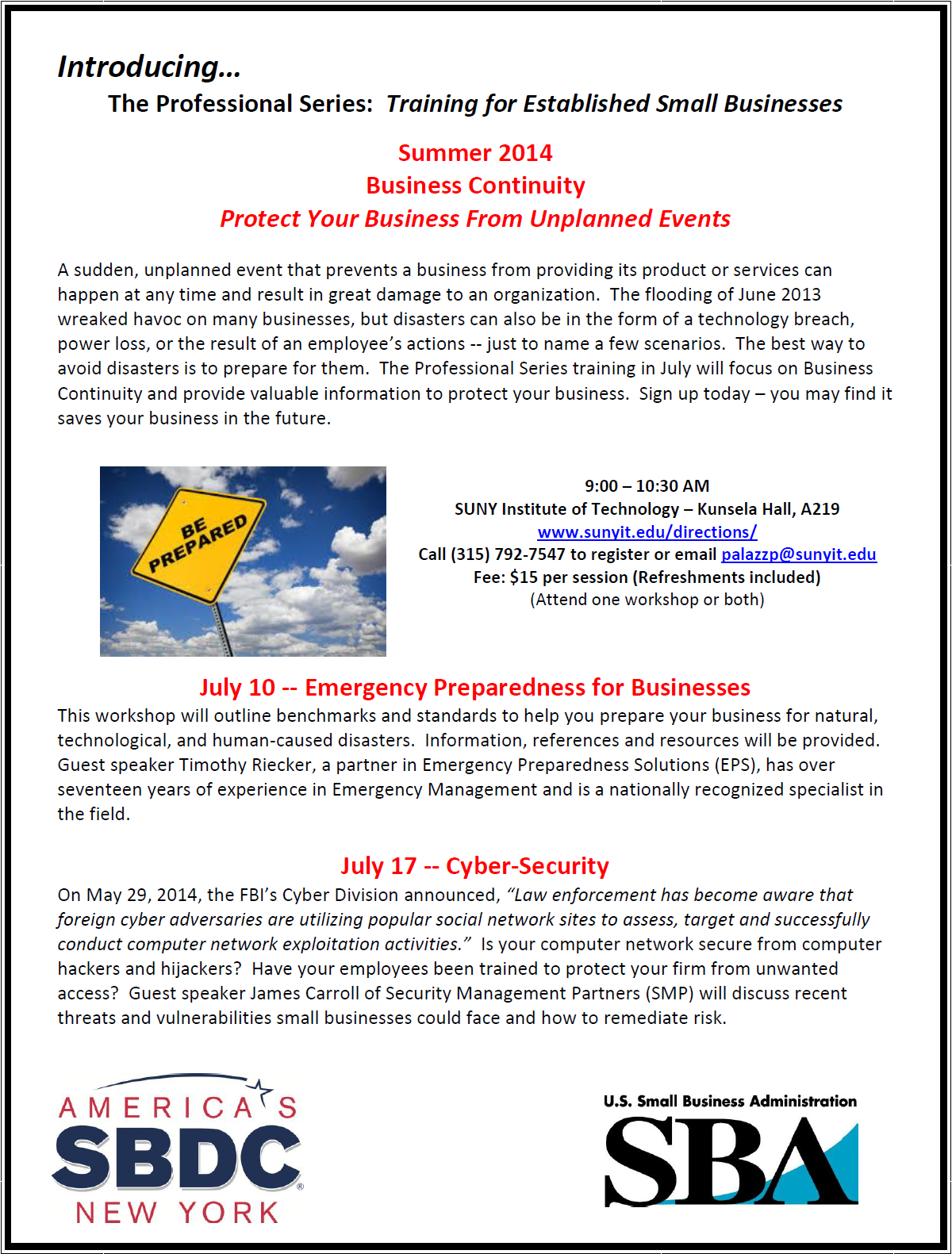
MV Business Continuity Flyer

MV Business Continuity Flyer

Business Continuity – More than just a plan

Don't throw away all of your effort to build your business - Be prepared!  (image courtesy of FEMA)

Don’t throw away all of your effort to build your business – Be prepared! (image courtesy of FEMA)

Every year businesses are forced to close due to the impacts of disaster.  Research from the National Federation of Independent Business (NFIB) tells us that the top four threats to business suffering the impact of disaster are:

  1. Power Loss
  2. Loss of Sales and Customers
  3. Length of Recovery
  4. Uninsured Loss

How can businesses protect themselves against these impacts?  Planning for them is, of course, the easy answer.  Just like governments, though, wouldn’t it make the most sense for a business to have an emergency preparedness program in place?

Consider that small business owners invest a great deal of time, energy, and funding to build and grow their business.  As an independent consultant I can be working on a variety of things on any given day including project management, marketing, and accounting.  Small business owners that deal with products (vs services) often times have even more to deal with including inventory, vendors, and distributors.  The foundation of these entrepreneurial efforts is often times the business plan.  Aspiring business owners put a lot of effort into creating this plan which describes what the business will do, what the market capacity is, what the competition looks like, and even trying to forecast revenues for several years.  A successful business may continue elements of this business plan years later through a strategic plan intended to guide growth and company-wide efforts.  Doesn’t it make sense that if we put so much effort into building and growing our businesses that we put some effort into ensuring that our businesses will survive a disaster?

As a society we generally like plans.  They are an organized tome capturing our assumptions, ideas, and strategies to accomplish something.  Plans are good and certainly help us through a great deal.  A disaster plan, though, is not a disaster program.  The plan may embody our program, helping to guide and inform our decisions in the event of a disaster, but our preparedness efforts must stretch beyond a plan if we are to be successful.  Consider DHS’ POETE capability elements – Planning, Training, Organizing, Equipping, Training, and Exercising.  With these elements in your head scroll back up to those top four threats from the NFIB and give them a moment of thought.  You probably now have some additional ideas as to how you can address and prevent each of those with activity which may go beyond planning.

This recent article from Small Business Trends (which provided my initial inspiration for this blog post) provides a good outline of initial considerations for every business relative to disaster preparedness.

What does your business do to be better prepared?

Shameless plug time: Need help building your business continuity program?  Emergency Preparedness Solutions can help!  Contact us at consultants@epsllc.biz or check out our website at www.epsllc.biz.

© 2014 Timothy Riecker


Emergency Management and Considerations for Visiting Populations

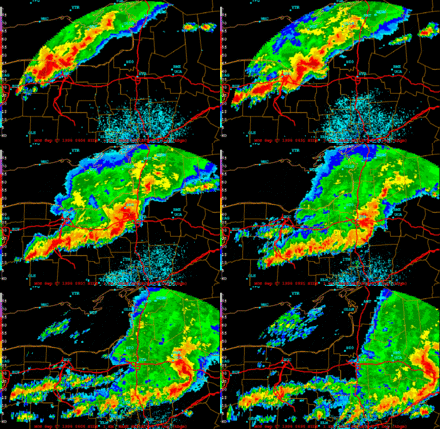
Radar loop, Labor Day 1998 Upstate New York.  This storm impacted the New York State Fair.

Radar loop, Labor Day 1998 Upstate New York. This storm impacted the New York State Fair.

The inspiration for this blog was a paper posted to LLIS by Dr. Susanne Becken, Professor of Sustainable Tourism at Griffith University (Australia) and Lincoln University (New Zealand).  The paper is titled The Christchurch Earthquake and the Visitor Sector, which is also available from this link if you don’t have LLIS access.

Dr. Becken highlights the Christchurch earthquake of February 22, 2011, which killed 185 people from more than 20 nations, 80 of which were listed as visiting, rather than residing in, Christchurch.  She states that as a result of this M 7.1 earthquake infrastructure was badly damaged, accommodation capacity was reduced by half, and the number of international visitors dropped by almost 30 percent in the aftermath.  Dr. Becken identifies many of the challenges visitors had, including loss of travel documentation and other important items, and the value of the tourism industry in the area to assist response efforts (such as providing lodging for displaced citizens as well as responders from out of the area).

This paper brings to mind the vast amounts of visitors and transient populations that are found in many communities across the nation.  When visiting an attraction such as an amusement park, where tens of thousands of people congregate on any given summer day, take a look around.  Many of the amusement parks I know of are in fairly rural areas.  These towns are likely to have small volunteer fire departments and may not even have their own police services, instead relying on a county Sheriff’s Department or State Police.  How about a small city that has popular attractions at certain times of the year, such as horse tracks or other sporting events?  These events will also draw tens of thousands of people from near and far, staying in hotels, motels, and campgrounds.  Sure, these small cities might have a 24-hour staffed fire department, and probably even a small police force.  But how prepared are these types of areas for an incident that can cause mass casualties and fatalities?

Incidents such as this underscore the need for our preparedness to be through and needs-based.  As part of our Threat and Hazard Identification and Assessment (THIRA), which is the latest evolution of the traditional hazard analysis (see CPG-201), we must be sure to recognize visitors and transient populations and the events that bring them to our areas.  We should consider tourist attractions, field days, concerts and performances, large conventions, sporting events, and even college populations.  The potential impacts, in the event of a disaster, are certainly greater with these populations given that they are likely to be unfamiliar with the area, don’t reside locally and probably have no local contacts, and aren’t familiar with the threats.  Given the nature of the event they are attending, they may very well be consuming alcohol, as well.  All this makes for a rather fragile and dependent population in the event of disaster.

Planning on the macro (community) level should consider the specifics mentioned above.  With this information you can estimate the resources needed for certain scenarios (this is part of your THIRA), which will lead you determine gaps which you then plan to address.  Take some time to examine the demographics of the visiting populations.  These demographics will help determine their level of need in the event of a disaster and some areas of support you may need to provide.  Your local chamber of commerce and/or tourism authority can be an important planning partner for this information and other purposes.  Certainly consider the nature of the events and the age range of the attendees.  Are there language or cultural issues that should be prepared for?  Much of this specific information can be obtained event by event, looking at the micro (event-specific) level of planning for these events.  In New York State, a mass gathering permit is supposed to be issued for any event estimating attendance over a certain number.  The primary purpose of these permits is to ensure that officials are aware of the event and that potable water and sanitation is appropriately available, as well as other caveats.  Most states have a similar type of permitting requirement.  Become familiar with it and use it to your advantage.

In any of these events, how will you handle alert and notification in the event of a disaster?  You may have sirens in place, but would a visitor know what it means?  Given that such a high percentage of people have cell phones, use of area blast messaging may be an appropriate consideration.

A lesson learned from airline crashes can and should be brought into your planning: family assistance centers.  Family assistance centers were brought about in the aftermath of the crash of TWA Flight 800, realizing the importance of providing support and information to the families and loved ones of victims.  This concept has been applied as a standard to other mass fatality incidents since then and has proven to be beneficial to all parties.

Be sure to conduct preparedness exercises on these plans, and include members of your local hospitality and tourism industry as they will certainly be involved in some aspect of the greater response should an incident occur.

Sometimes local communities view visiting populations as a hassle, particularly when they don’t have the care for the host community that the locals do.  These populations are usually important to the economy of the local area and, depending in the event, will be back year after year.  No matter what your take is on that argument, you must consider the safety of any visitors or tourists as if they were your own citizens.  Be prepared through regular planning, training, and exercising activities and be sure to include your local chamber of commerce, tourism and hospitality industry as they are not only stakeholders, but they have a great deal of support and information to provide.  Most importantly, remember that all good preparedness efforts begin with a solid needs assessment.  Conduct a THIRA for your community, you might be surprised with what you discover!

What experiences do you have with planning for visiting populations?

The Emergency Manager as a Consultant

Lately I’ve gotten into watching these reality consulting shows like Bar Rescue and Restaurant: Impossible.  Both of these shows use a similar model, providing a prolific expert (Bar Rescue’s Jon Taffer and Restaurant: Impossible’s Robert Irvine) in their respective fields to aid a failing business.  These consultants are supported by a team of specialists and often a construction crew to remodel the business.  Sometimes it’s a just a few tweaks of the menu that’s needed, other times it’s a whole new way of thinking on the part of owners, management, and employees.  These are some of the best shows out there displaying conceptually some of the things consultants can do, albeit in a compressed and slightly dramatic mode.

Robert Irvine, the Consultant with Restaurant: Impossible

Robert Irvine, the Consultant with Restaurant: Impossible

That said, as many of my readers know, I work as an emergency management and homeland security consultant.  I’ve worked in the ranks of emergency management and public safety now for nearly 19 years.  Through this time, I’ve had the pleasure of working with a multitude of emergency management professionals at many levels; including counties and local jurisdictions and corporations.  These emergency managers, I’ve found, often play the part of a consultant.

While other department heads in county and local governments or corporations often make recommendations to CEOs (in this case Chief Elected Officials or Chief Executive Officers) these usually only impact their own department or have minimal impact on other parts of the organization.  Emergency managers make recommendations that often times impact the entire jurisdiction or organization – be they recommendations on mitigation, preparedness, recovery – and especially response.  Sometimes, unfortunately, the emergency manager doesn’t report to the CEO on a daily basis – which I think is a major mistake.  While others may be primarily concerned with saving their own operations in the event of disaster, the emergency manager’s goal is to preserve as much of the jurisdiction or organization as possible – with the priorities being life safety, incident stabilization, and property conservation.  These three tenants, preached mostly in Incident Command System courses, are applicable to both government and the private sector.  In both sectors, these priorities lead us logically to business continuity, ensuring that we minimize our losses and are able to continue operations.

As the profession of the emergency manager continues to evolve, including myriad training opportunities, education up to and including Ph.Ds., and professional certifications, the emergency manager is viewed more and more as a specialist and subject matter expert.  Emergency managers are expected to provide expert advice and guidance.  The emergency manager needs to stay current and up to date with the profession; not that the ‘science’ of emergency management changes much, but there are certainly new best practices, trends, and legal and regulatory requirements that need to be kept up on.  Whether an organization calls upon the emergency manager as an employee or brings in an actual consultant, this person is providing expert recommendations that impact the jurisdiction or organization as an enterprise system, not just a name or a spot on a map.  Just like in Bar Rescue or Restaurant: Impossible, the emergency manager may make recommendations that some people don’t like; but they called upon the emergency manager for their expertise.  The emergency manager is the consultant that can save your organization!

Strenghtening 9-1-1 Systems

Tim RieckerThis morning, Government Security News (GSN) published an article regarding the FCC‘s examination of last June’s derecho storms that severely impacted Virginia, Maryland, West Virginia, DC, and Ohio.  The FCC looked into the long-lasting down time of 9-1-1 call centers in these impacted areas, provided comment, as well as recommendations – which largely are pretty sound.

If you’ve read earlier blog posts of mine, you’ll know that I more-often-than-not tend to defend utility companies.  Yes, we can all be better prepared, but I believe that sometimes the expectations are unreasonably high, especially with wide-spread disasters.   Also, utility companies are just that – companies – their primary goal is to be profitable.  With this in mind, there comes a point when the cost of mitigation may, at least in the short-term, make them unprofitable.  While in theory I would say ‘suck it up’, share holders tend not to see things that way.  So that does leave us with a bit of a quandary.

9-1-1 is an absolutely critical service.  Outages and disturbances in these systems occur every day throughout the nation, but are typically short in duration.  The derecho left 3.6 million people with interrupted 9-1-1 service, some for many days.  While there are general infrastructure issues that result from storms that can impact a utility system, this was compounded after the derecho by continued high winds for a few days, making many repairs impossible.  The FCC report cites, however, a few easy fixes that could have greatly reduced both the number of outages and the duration of many of these outages – including emergency power generators at central offices and distribution hubs.  There were also planning gaps that were discovered, that, once addressed should help reduce impacts by both number and duration.  I believe we also need to harness the technology we have to discover redundancies and back-ups that can be implemented in the even of future system failures.

Every incident is a learning experience for all involved – and hopefully even for those fortunate enough to not be involved.  The challenge is accepting these lessons learned and applying them to improve our measure of preparedness, increasing our awareness, and better enabling us to respond more effectively the next time around.

What lessons have you learned from disasters???

DANGER: Templates in use

Timothy Riecker

Sorry… I thought this image was really funny!

Last night I spent some time reviewing the Comprehensive Emergency Management and Continuity of Operations Plan (which should not be combined into one document) for a small town.  Having reviewed more plans from within the State of New York than I can count, it was readily obvious that a state-provided template was (mis)used in the making of this plan.  The end result: a poorly written plan that can’t be operationalized.

First off, I must say that there is nothing wrong with the template that was used.  This template has been provided and is regularly updated by the Planning staff of the State’s Office of Emergency Management.  Good templates help to ensure consistent formats are applied and all baseline legal and necessary content is included.  There are many planning templates out there across the nation and globally for emergency plans.  Some are good, many are not so good.  The closest I tend to get to a template is using it as a reference.  I generally see the use of templates akin to a Jean-Claude van Damme movie: you think it’s a good idea at first, you soon discover that you don’t really like it but for some reason can’t leave it, and in the end you are left wondering what really happened.

One must keep in mind when using a planning template that one size does not fit all… actually one size doesn’t fit anyone.  While a template, as stated earlier, will provide you with a format and essential content, they don’t provide YOUR detailed information.  If you simply use the template the way most people (wrongly) do, you are essentially doing the Mad Libs version of emergency planning by plugging in titles and locations where it tells you to.  But where does this get you?  Is the plan ‘customized’ simply because you filled in the blanks with your information?  Of course not.  The plan needs to make sense.  The easiest way to determine if it makes sense or not is to read it.  A good plan should provide a strategic-level narrative of how your company, jurisdiction, or organization will respond to and manage the impacts of a disaster.  Who is in charge, and of what?  What does the organization look like?  What priorities must be addressed?

Templates really should be viewed as guidance documents – this will help prevent most user errors.  Plans address needs – so a good needs assessment (threats and hazards) up front will help identify the content of the plan.  Don’t forget to read the plan while you are writing it to make sure that it makes sense.  Consider how it will be used and by whom.  Do we write emergency plans just to fulfill a legal requirement or do we write them so we can use them???

Managing An Exercise Program – Part 2: Developing the Preparedness Strategy

This post is part of a 10-part series on Managing an Exercise Program. In this series I provide some of my own lessons learned in the program and project management aspects of managing, designing, conducting, and evaluating Homeland Security Exercise and Evaluation Program (HSEEP) exercises. Your feedback is appreciated!

Managing an Exercise Program – Part 1

Managing an Exercise Program – Part 2: Develop a Preparedness Strategy

Managing an Exercise Program – Part 3: Identify Program Resources and Funding

Managing an Exercise Program – Part 4: Conduct an Annual Training & Exercise Planning Workshop.

Managing an Exercise Program – Part 5: Securing Project Funding

Managing an Exercise Program – Part 6: Conducting Exercise Planning Conferences

Managing an Exercise Program – Part 7: Develop Exercise Documentation

Managing an Exercise Program – Part 8: Preparing Support, Personnel, & Logistical Requirements

Managing an Exercise Program – Part 9: Conducting an Exercise

Managing an Exercise Program – Part 10: Evaluation and Improvement Planning


In my last post, I outlined the initial needs of managing a preparedness exercise program, including sources of information for a preparedness assessment.  Recognized as a best practice, I’m following the model of the Homeland Security Exercise and Evaluation Program (HSEEP).  The next step of program management is developing a preparedness strategy.

HSEEP Cycle

HSEEP Cycle

The development of a preparedness strategy is an activity that will involve the highest levels of your organization.  Drawing upon the data collected in the last step (the preparedness assessment), the preparedness strategy will address overcoming the identified gaps in your preparedness.  The mnemonic to remember here is POETE or Planning, Organization, Equipment, Training, and Exercises.  The gaps you identified in your assessment should fall into one of these categories.

Once you have catalogued your gaps, you must develop strategies to overcome each gap.  Here are some helpful hints in strategic planning:

1) Define the gap and identify the underlying cause(s).

2) Create objectives to overcome each gap.  Remember that objectives must be SMART (Specific, Measurable, Attainable, Realistic, and Time-oriented).

3) Establish priorities.  Some gaps may have a higher priority to accomplish based on the vulnerability they pose, legal or regulatory requirements, or other matters.  Additionally, some objectives may need to be accomplished prior to others for many of the same reasons, as well as practical flow of processes.

4) Assign required actions – identify specific actions required to accomplish each objective (there may be several).  Identify who will be responsible for each action and who will be responsible for supporting their work.  Establish a realistic deadline.  NOTE: some gaps may take a long time (years) to overcome.  As such, do the best you can to outline objectives and keep in mind that strategic plans are ‘living documents’.  Early on, you may not be assigning tasks to overcoming certain gaps, but someone will be responsible for monitoring related issues.

5) Marry needed resources to each action item established above.  This may be personnel, funding, facilities, etc.

6) As work is being done to accomplish these tasks, continual monitoring and assessment is necessary to ensure that everyone is staying on track and that the strategic plan continues to reflect the direction and priorities of today.

There are many references out there for strategic planning.  With a bit of insight you can translate this guidance into something useful for these purposes.  The end goal of this step is to have a document in hand that identifies what your organization needs to accomplish to be better prepared.  From this, you will soon develop exercise goals which will be the cornerstone of your exercise program.

What successes have you found from your strategic planning experience?

Coming soon – Managing an Exercise Program Part 3: Identifying Program Resources and Funding.

Managing an Exercise Program – Part 1

This post is part of a 10-part series on Managing an Exercise Program. In this series I provide some of my own lessons learned in the program and project management aspects of managing, designing, conducting, and evaluating Homeland Security Exercise and Evaluation Program (HSEEP) exercises. Your feedback is appreciated!

Managing an Exercise Program – Part 1

Managing an Exercise Program – Part 2: Develop a Preparedness Strategy

Managing an Exercise Program – Part 3: Identify Program Resources and Funding

Managing an Exercise Program – Part 4: Conduct an Annual Training & Exercise Planning Workshop.

Managing an Exercise Program – Part 5: Securing Project Funding

Managing an Exercise Program – Part 6: Conducting Exercise Planning Conferences

Managing an Exercise Program – Part 7: Develop Exercise Documentation

Managing an Exercise Program – Part 8: Preparing Support, Personnel, & Logistical Requirements

Managing an Exercise Program – Part 9: Conducting an Exercise

Managing an Exercise Program – Part 10: Evaluation and Improvement Planning


From inception to improvement planning, I think preparedness exercises provide great value to the jurisdictions, companies, and organizations that do them.  From a seminar to a full-scale exercise, there is much to be learned by participants as well as the strengths and areas for improvement identified from emergency plans.  I’ve been inspired to write a series of blog posts on each of the phases within the Homeland Security Exercise Evaluation Program (HSEEP) cycle.  The cycle, shown below, encompasses not just the steps in executing an exercise (project management), it includes exercise program management as well, which I think is often neglected.  Doings exercises is great, but to ensure continuity, quality, and continuous improvement, any entity that does exercises should have an exercise program.  Having a structured exercise program will ensure that your organization capitalizes on your exercise investments to the greatest degree possible.  Just like any other functional program, it needs to be managed.
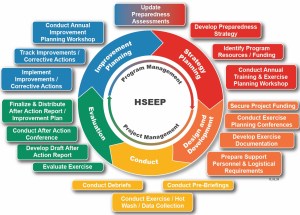
HSEEP Cycle

Each blog post will give some insight and lessons learned from my own experiences with exercises large and small and I will reflect on exercise program management responsibilities throughout the cycle.  For more in-depth information on exercise program management, I refer you to HSEEP Volume I.  I will also have an update on this HSEEP volume in the near future as DHS will soon release a revision.

The first thing I want to cover is exercise program management as a general concept.  As stated in HSEEP Volume I, “Exercise program management is directed toward achieving the objectives established during the multi-year planning process…”.  As an exercise program grows, so should the responsibilities of managing it.  Most organizations don’t need a full-time exercise program manager, but they will require someone with the flexibility to vary how much time they spend on the exercise program.  The planning and conduct of an exercise can take up a considerable amount of time, and the program manager needs to shepherd this process.  In small organizations, the exercise program manager may be one of the few people involved in these activities as well.

Obviously the person in charge of an exercise program needs to be knowledgeable and experienced in exercises.  As with the oversight of any program, you need to have the right person in place.  Some caution should be used here, however – there are plenty of folks with LOTS of exercise experience… BUT the vast majority of experience out there is as a player.  Players, as a general rule, don’t experience all the machinations behind putting an exercise together.  Someone may have been a player in the largest exercise known to human kind, but that doesn’t make them adept at exercises.  There is plenty of training out there addressing various areas of exercises: the HSEEP training course, Exercise Design, Exercise Evaluation, and others.  These are great – but the world is full of ‘trained’ people.  Do they have the experience to do the job?  It doesn’t take a lot of experience, in fact, in my opinion, a little experience can go a long way – especially if it’s the right experience and they were taught the right way to do it from someone with a lot of experience.  I’ve fully immersed interns in many of the areas of exercise program management and would be fully confident in their ability to run a program for an organization.

As mentioned above, exercise program management centers on the multi-year training and exercise plan (MYTEP), which makes sense as this document will outline requirements, goals, and benchmarks for the program.  Building this plan is not the first, though.  We know that before we can write a plan, we need to do an analysis or an assessment of where we stand.  This is why the first step in the HSEEP cycle (above) is Updating Preparedness Assessments.  As much of a fan as I am of the HSEEP documents, they do fall rather short on providing guidance relative to this step.  It can be broken down easily enough, though.

A preparedness assessment, to me, would identify where we stand and where we want to be in terms of preparedness.  The resultant gap would then feed the second step in the HSEEP cycle – developing a preparedness strategy.  Let’s define preparedness: traditionally, it involves planning, training, and exercising; we can build from this to give us the data we need.  An absolute priority is identifying and assessing risk.  Hopefully your jurisdiction has a recent hazard analysis or THIRA, or your company or organization has a recent business impact analysis (BIA).  Having a recent hazard analysis done will identify the threats you need to be prepared for.  If you don’t have a recent one of these, I would suggest that you are way ahead of yourself with exercises and need to take a step back in emergency management to do one of these and build a plan.  Based upon the results of your hazard analysis, do you have the necessary plans (and are they up to date?) to address the hazards?

The second assessment should be a capabilities assessment.  You can reference FEMA‘s list of core capabilities to ensure that you are examining everything you need to.  Keep in mind that not everyone needs to have every capability.  You may not have a need for certain capabilities or it may not be feasible for you to have it based upon costs – so long as you can obtain that capability from someone else in times of disaster.  However, there are certain capabilities, based upon your hazards, that you want to ensure that you have.  If you don’t have them, they need to be developed.  That’s a gap.

A third assessment, related to the second, would be to identify needs to develop personnel capabilities – specifically through the means of training.  Yep, a Training Needs Assessment.  I’ve blogged previously about this.  Your identified needs become another gap to include in your preparedness assessment.

Lastly, you should do an assessment of exercises and real life events to date.  While you are just starting to formalize your exercise program, I still think an assessment of exercise progress to date is important.  While you may not have had a formal program, you have likely done some exercises or at least participated in someone else’s.  What plans have been tested with these exercises?  How long ago were they conducted?  Do you have After Action Reports?  (Read my article in Emergency Management Magazine on the importance of AARs and implementing corrective actions).  How about lessons learned and after action reports from actual incidents?  What gaps from these still need to be addressed?

All of this data and these documents can be pulled together and referenced in a simple, cohesive document outlining your preparedness needs.  It seems like a lot of work, but without identifying our needs, we can’t move forward with an effective exercise program.

What are your thoughts on identifying preparedness needs?  Is there anything I’ve missed?

Thanks for reading and be on the lookout for part two of Managing an Exercise Program where I will outline the development of a preparedness strategy.
 

NYC Transportation Post Hurricane Sandy

This study – Transportation During and After Hurricane Sandy – was brought to my attention by Claire Rubin by way of her blog.  Thank you Claire!

This is a great study and very timely.  Having worked with these transportation entities in the past, I can attest that what they have accomplished is not easily done.  The variety of agencies that cover the array of transportation systems and modes in the greater NYC area creates challenges – City agencies, State agencies, and multi-state authorities.  Each owns not only their own modes, but their own infrastructure as well.  They also have their own reporting chain, making coordinated decision-making a challenge.  Additionally, any decisions made that impact transportation systems must also consider evacuations.  Systems and infrastructure can’t be shut down until evacuations have been effected.  The folks on Long Island have to move to higher ground or out of the area completely before bridges are shut down around NYC.

They have come a long way through the last several years.  The study mentions some significant flooding in 2004 and 2007 in which lessons were learned.  We also conducted an exercise, the largest of its kind at the time, in the summer of 2008 simulating landfall of a hurricane in the NYC metro area.  This exercise provided great feedback and spurred changes to both state and local plans.  In 2011, Irene came up the coast, eerily following a track very similar to our simulated hurricane in 2008.  Plan improvements were made again, and they will be yet again in the aftermath of Hurricane Sandy.

A significant item that was barely touched upon in this paper is the role of the private sector.  Much of the impact of private sector policy is demonstrated on page 25 of the study, where we see that prior to the hurricane only 2% of New Yorkers telecommuted, whereas following the hurricane (November 1-2) 22% telecommuted.  It’s great to see that so many companies saw the sense in allowing employees to telecommute instead of contributing to the transportation nightmare that occurred on these days.  I would challenge more private entities to do the same!  The best way to implement this, of course, is to include it in your business continuity plan.

In Emergency Management it is not only important that we improvise, adapt, and overcome; we must also learn and change.  We must turn lessons observed into lessons learned by creating a corrective action plan and actually implementing these changes.  It’s positive to see these types of documents, all After Action Reports (AARs) in their own right, which use facts and observations to highlight what went well and what needs to be improved upon.  The challenge is making these changes.  Change, good or bad, is stressful and counterintuitive to us.  We default to what is comfortable (i.e. ‘the way we’ve always done things’).  Change may require funding – sometimes vast amounts of it.  Some change is drastic, some subtle, some long-term, some immediate.  Nonetheless, with the ultimate goal of saving lives, we must change.  That, if anything, is our burden.

Power Restoration Post-Disaster: How Long is Too Long?

Homeland Security Today ran an article reprinted from an AP article titled Power Outage Time After Sandy Not Extraordinary.  The article outlines an AP analysis of outage times from other hurricanes and storms and compares these to the duration of outages experienced by customers as a result of Hurricane Sandy.  To be honest, I’m not sure that the science behind this study is totally sound (it appears they compared only the duration of outages) as there are many factors involved in such a comparison to make it meaningful (such as type and age of infrastructure, damage to infrastructure, strength of hurricane, etc.).  That said, their apples to oranges comparison does lead to some legitimate statements.

I’m certainly not intending to diminish the issues associated with prolonged power outages.  For many it is an inconvenience (and we are extremely over reliant on electrical energy), but it does impact the health and well-being of a good portion of our population – especially in temperature extremes.  Through my experience in emergency management, however, it seems that many people are quite vocal about even the shortest of power outages.  These complaints quickly become political.  I even recall several years ago being pressured by a governor to ensure that power was restored prior to the Superbowl.  Yes, these things are important – practically and politically – but we also need to be realistic and understanding of the situation.

That situation comes down to the battle being fought by the utility companies.  Energy utilities are regulated, meaning that they are constantly bombarded by politicians and special interest groups.  Part of this regulation requires them to have disaster plans in place to address emergency outages and restoration.  With the experience of working 19 federally declared disasters, I’ve seen utility companies in action time and again – and to be completely honest, they impress the hell out of me.  They mobilize massive fleets of not only their own people, vehicles, and equipment but also those of other utility companies from far and wide as part of an elaborate and often used mutual aid system.  These crews need to be supervised, fed, housed, and supplied.  The logistics of power restoration is a massive undertaking – especially after a regional event such as Hurricane Sandy, where companies up the coast and throughout the northeast are all competing for the same resources – especially utility poles.

Utilities conduct restoration efforts in priority, first addressing urgent needs, such as hospitals and nursing homes, while also trying to effect repairs of their energy superstructure, such as primary distribution lines and substations.  After that, they need to literally examine every line in their system – with priority given to those that feed larger populations.  This takes time.  Consider that they are initially fighting lingering weather conditions and may be held back by additional foul weather such as heavy rains and high winds which can hinder their efforts and even set them back with additional damages.  After a storm, they are also working on clearing debris so they can safely access their infrastructure.  Combined, this is a lot of time, effort, and resources – all of which costs a lot of money.

There is no benefit to a utility company dragging their feet on a restoration effort.  Given the expenses and the negative press, they want to finish it as quickly as they possibly can.  Can they do it better?  Of course – there is always room for improvement.  The article says that “…Sandy caused 8.5 million power outages across 21 states, the highest outage total ever.”

The utility restoration effort found an unlikely ally – New Jersey Governor Chris Christie – who applauded their work.  A lesson other governors should probably learn.  Let’s work with them and support their efforts instead of being so quick to criticize.