NYPD Active Shooter Recommendations and Analysis – December 2012

Timothy Riecker

NYPD Logo

This document, updated by NYPD last month in the wake of the Sandy Hook shooting, was brought to my attention through LLIS.  It’s also posted on the NYPD’s website here.  This document is a good compilation of practitioner research; official recommendations suitable for schools, businesses, and public buildings; and reflects on the ‘Run, Hide, Fight’ recommendations we’ve seen (NYPD’s version is a little more of a mouth-full – Evacuate, Hide, Take Action).  I like that they provide some information relative to attackers including gender, age, number of attackers (98% of active shooter incidents are carried out by a single attacker), planning tactics, targets, number of casualties, location of attack, weapons used, attack resolution, and other statistics – with this data provided for over 300 case studies (all included in the document).

The real value of this document is that the information which is provided to the reader allows for better informed (instead of emotional or ‘trendy’) decisions on facility security and planning relative to active shooter scenarios.

Thanks to the fine folks at NYPD for doing this work and sharing it with the public safety community.

Active Shooter Video – Run, Hide, Fight

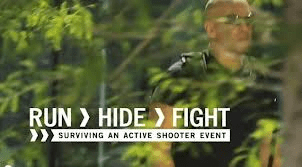
Timothy RieckerAlabama Homeland Security, at the request of the Governor, modified the City of Houston’s Run, Hide, Fight video in the aftermath of the Sandy Hook school shooting.  Despite a few comments I’ve seen around the internet about the video being ‘sensationalized’, I think it’s a very well done video hitting emotions as best as possible through an instructional video.

It appears that the concept of ‘Run, Hide, Fight’ is the best approach we have against these types of horrific incidents.  It makes sense.

See the video here.


– Tim Riecker

Managing an Exercise Program – Part 3: Identifying Program Resources and Funding

This post is part of a 10-part series on Managing an Exercise Program. In this series I provide some of my own lessons learned in the program and project management aspects of managing, designing, conducting, and evaluating Homeland Security Exercise and Evaluation Program (HSEEP) exercises. Your feedback is appreciated!

Managing an Exercise Program – Part 1

Managing an Exercise Program – Part 2: Develop a Preparedness Strategy

Managing an Exercise Program – Part 3: Identify Program Resources and Funding

Managing an Exercise Program – Part 4: Conduct an Annual Training & Exercise Planning Workshop.

Managing an Exercise Program – Part 5: Securing Project Funding

Managing an Exercise Program – Part 6: Conducting Exercise Planning Conferences

Managing an Exercise Program – Part 7: Develop Exercise Documentation

Managing an Exercise Program – Part 8: Preparing Support, Personnel, & Logistical Requirements

Managing an Exercise Program – Part 9: Conducting an Exercise

Managing an Exercise Program – Part 10: Evaluation and Improvement Planning


Exercises can be very resource intensive, have no doubt about that.  Generally speaking, the more you invest in them, though, the more you get out of them.  Certainly discussion-based exercises are usually not as expensive as operations-based exercises.  For all exercise types, however, the largest costs are in the design (staff or consultant time, as well as meeting time), and conduct (again, staff or consultant time, plus the time of the participants).  What resources do you need for your exercise program as a whole?  How do you get them?

First of all, let’s discuss human resources.  In Managing an Exercise Program – Part 1, I discussed the importance of having an exercise program manager and what some of the qualifications should be for that person.  A program manager is probably the most important human resource you could have for exercises, but certainly this person can’t do it alone.  A good exercise program is able to leverage the experience, support, and ideas of others – both within and outside.  The exercise program manager needs to be a great networker, able to draw people from various agencies into a mutually beneficial partnership.  Some of these agencies will come and go, but some will be strong, permanent partners.  Each partner agency, including your own, should be contributing to the efforts of the group – not only with ideas, but with people to serve as controllers, evaluators, planning team members, etc., physical resources suitable for whatever types of exercises you conduct, and perhaps even funding.

In March of 2008, I founded and co-chaired the New York State Exercise Coordination Committee, composed of several state agencies, departments, authorities, and the Red Cross.  Meeting regularly and communicating often, we were able to pool our resources not only for each individual exercise, but for exercise program management as a whole throughout New York State.  We formulated consistent policies and practices, allocated Homeland Security funds state-wide for exercises and corrective actions, and developed and delivered exercise-related workshops and training courses.  We became the core group for the Training & Exercise Planning Workshop (more on this in the next part) and applied for and coordinated funding requests to FEMA for the Regional Exercise Support Program (RESP), which provided contractor resources to state and local exercise initiatives.  We were not only able to help each other, but we were able to benefit the state as a whole.  This model can be applied to other states; county and local governments; and consortia of public, private, and not for profit groups.

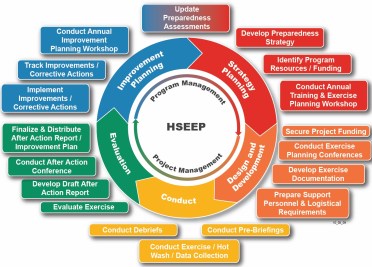
Keep in mind that the HSEEP cycle is just that, a cycle.  You will constantly be revisiting each of these steps – sometimes out-of-order – including determining needs and sourcing of resources.

HSEEP Cycle

HSEEP Cycle

What resources do you think you will need to manage your program?

Be on the lookout for Managing an Exercise Program – Part 4: Conducting an Annual Training & Exercise Planning Workshop.

Active Shooter Info from DHS

Good active shooter info from DHS.

Bruce Harman's avatarThe Security Takeaway

The tragedy in Newtown, Conn.  raised awareness of the Active Shooter threat. Listed below please find links to a number of reference and training resources which highlight response to the Active Shooter threat.

DHS Reference Materials:

DHS, Active Shooter – Booklet:   How to Respond www.dhs.gov/xlibrary/assets/active_shooter_booklet.pdf

 FEMA Online Courses:

Active Shooter:  What You Can Do http://training.fema.gov/EMIWeb/IS/IS907.asp


View original post

10 Myths About Mass Shootings

Last night I came across a blog by James Alan Fox, a Professor of Criminology, Law, and Public Policy at Northeastern University.  The blog was posted in the Chronicle of Higher Education and provides some interesting information relative to mass shootings.  Sadly, it doesn’t provide us with any conclusions or solutions, but does dispel some of the concepts and information that are out there about mass shootings.  Information like this will hopefully prevent us from diving into knee-jerk reactions.

The worst part of all this is that there is often times not actionable intelligence that law enforcement can follow-up on to prevent these types of incidents.  It’s not anything like an organized terrorist effort that involves a great deal of communication between conspirators.  The result is that mass shootings can occur literally anywhere and at any time.  Schools, movie theaters, community centers, malls, restaurants, and post offices are all among the places we go and expect to be safe.  We all wish we had an answer.

Here’s Professor Fox’s blog…

Top 10 Myths About Mass Shootings

December 18, 2012, 2:42 pm

By James Alan Fox

Even before the death toll in last Friday’s school massacre in Newtown, Conn., was determined, politicians, pundits, and professors of varied disciplines were all over the news, pushing their proposals for change. Some talked about the role of guns, others about mental-health services, and still more about the need for better security in schools and other public places. Whatever their agenda and the passion behind it, those advocates made certain explicit or implied assumptions about patterns in mass murder and the profile of the assailants. Unfortunately, those assumptions do not always align with the facts.

Myth: Mass shootings are on the rise. Reality: Over the past three decades, there has been an average of 20 mass shootings a year in the United States, each with at least four victims killed by gunfire. Occasionally, and mostly by sheer coincidence, several episodes have been clustered closely in time. Over all, however, there has not been an upward trajectory. To the contrary, the real growth has been in the style and pervasiveness of news-media coverage, thanks in large part to technological advances in reporting.

Myth: Mass murderers snap and kill indiscriminately. Reality: Mass murderers typically plan their assaults for days, weeks, or months. They are deliberate in preparing their missions and determined to follow through, no matter what impediments are placed in their path.

Myth: Enhanced background checks will keep dangerous weapons out of the hands of these madmen. Reality: Most mass murderers do not have criminal records or a history of psychiatric hospitalization. They would not be disqualified from purchasing their weapons legally. Certainly, people cannot be denied their Second Amendment rights just because they look strange or act in an odd manner. Besides, mass killers could always find an alternative way of securing the needed weaponry, even if they had to steal from family members or friends.

Myth: Restoring the federal ban on assault weapons will prevent these horrible crimes. Reality: The overwhelming majority of mass murderers use firearms that would not be restricted by an assault-weapons ban. In fact, semiautomatic handguns are far more prevalent in mass shootings. Of course, limiting the size of ammunition clips would at least force a gunman to pause to reload or switch weapons.

Myth: Greater attention and response to the telltale warning signs will allow us to identify would-be mass killers before they act. Reality: While there are some common features in the profile of a mass murderer (depression, resentment, social isolation, tendency to blame others for their misfortunes, fascination with violence, and interest in weaponry), those characteristics are all fairly prevalent in the general population. Any attempt to predict would produce many false positives. Actually, the telltale warning signs come into clear focus only after the deadly deed.

Myth: Widening the availability of mental-health services and reducing the stigma associated with mental illness will allow unstable individuals to get the treatment they need. Reality: With their tendency to externalize blame and see themselves as victims of mistreatment, mass murderers perceive the problem to be in others, not themselves. They would generally resist attempts to encourage them to seek help. And, besides, our constant references to mass murderers as “wackos” or “sickos” don’t do much to destigmatize the mentally ill.

Myth: Increasing security in schools and other places will deter mass murder. Reality: Most security measures will serve only as a minor inconvenience for those who are dead set on mass murder. If anything, excessive security and a fortress-like environment serve as a constant reminder of danger and vulnerability.

Myth: Students need to be prepared for the worst by participating in lockdown drills. Reality: Lockdown drills can be very traumatizing, especially for young children. Also, it is questionable whether they would recall those lessons amid the hysteria associated with an actual shooting. The faculty and staff need to be adequately trained, and the kids just advised to listen to instructions. Schools should take the same low-key approach to the unlikely event of a shooting as the airlines do to the unlikely event of a crash. Passengers aren’t drilled in evacuation procedures but can assume the crew is sufficiently trained.

Myth: Expanding “right to carry” provisions will deter mass killers or at least stop them in their tracks and reduce the body counts. Reality: Mass killers are often described by surviving witnesses as being relaxed and calm during their rampages, owing to their level of planning. In contrast, the rest of us are taken by surprise and respond frantically. A sudden and wild shootout involving the assailant and citizens armed with concealed weapons would potentially catch countless innocent victims in the crossfire.

Myth: We just need to enforce existing gun laws as well as increase the threat of the death penalty. Reality: Mass killers typically expect to die, usually by their own hand or else by first responders. Nothing in the way of prosecution or punishment would divert them from their missions. They are ready to leave their miserable existence, but want some payback first.

In the immediate aftermath of the Newtown school shootings, there seems to be great momentum to establish policies and procedures designed to make us all safer. Sensible gun laws, affordable mental-health care, and reasonable security measures are all worthwhile, and would enhance the well-being of millions of Americans. We shouldn’t, however, expect such efforts to take a big bite out of mass murder. Of course, a nibble or two would be reason enough.

Power Restoration Post-Disaster: How Long is Too Long?

Homeland Security Today ran an article reprinted from an AP article titled Power Outage Time After Sandy Not Extraordinary.  The article outlines an AP analysis of outage times from other hurricanes and storms and compares these to the duration of outages experienced by customers as a result of Hurricane Sandy.  To be honest, I’m not sure that the science behind this study is totally sound (it appears they compared only the duration of outages) as there are many factors involved in such a comparison to make it meaningful (such as type and age of infrastructure, damage to infrastructure, strength of hurricane, etc.).  That said, their apples to oranges comparison does lead to some legitimate statements.

I’m certainly not intending to diminish the issues associated with prolonged power outages.  For many it is an inconvenience (and we are extremely over reliant on electrical energy), but it does impact the health and well-being of a good portion of our population – especially in temperature extremes.  Through my experience in emergency management, however, it seems that many people are quite vocal about even the shortest of power outages.  These complaints quickly become political.  I even recall several years ago being pressured by a governor to ensure that power was restored prior to the Superbowl.  Yes, these things are important – practically and politically – but we also need to be realistic and understanding of the situation.

That situation comes down to the battle being fought by the utility companies.  Energy utilities are regulated, meaning that they are constantly bombarded by politicians and special interest groups.  Part of this regulation requires them to have disaster plans in place to address emergency outages and restoration.  With the experience of working 19 federally declared disasters, I’ve seen utility companies in action time and again – and to be completely honest, they impress the hell out of me.  They mobilize massive fleets of not only their own people, vehicles, and equipment but also those of other utility companies from far and wide as part of an elaborate and often used mutual aid system.  These crews need to be supervised, fed, housed, and supplied.  The logistics of power restoration is a massive undertaking – especially after a regional event such as Hurricane Sandy, where companies up the coast and throughout the northeast are all competing for the same resources – especially utility poles.

Utilities conduct restoration efforts in priority, first addressing urgent needs, such as hospitals and nursing homes, while also trying to effect repairs of their energy superstructure, such as primary distribution lines and substations.  After that, they need to literally examine every line in their system – with priority given to those that feed larger populations.  This takes time.  Consider that they are initially fighting lingering weather conditions and may be held back by additional foul weather such as heavy rains and high winds which can hinder their efforts and even set them back with additional damages.  After a storm, they are also working on clearing debris so they can safely access their infrastructure.  Combined, this is a lot of time, effort, and resources – all of which costs a lot of money.

There is no benefit to a utility company dragging their feet on a restoration effort.  Given the expenses and the negative press, they want to finish it as quickly as they possibly can.  Can they do it better?  Of course – there is always room for improvement.  The article says that “…Sandy caused 8.5 million power outages across 21 states, the highest outage total ever.”

The utility restoration effort found an unlikely ally – New Jersey Governor Chris Christie – who applauded their work.  A lesson other governors should probably learn.  Let’s work with them and support their efforts instead of being so quick to criticize.

Hurricane Sandy – Be Prepared and Stay Safe!

I’m finishing my preparations for a quick trip to California to help evaluate an earthquake exercise.  All the while, I’m watching Hurricane Sandy come up the coast after creating some havoc in the Caribbean.  According to the latest National Hurricane Center advisory, Sandy will make landfall in southern New Jersey, and progress inland to central Pennsylvania before turning north and heading through New York State, the track taking it through the Finger Lakes area.  From there, the current advisory predicts that the storm will turn to the northeast, saturating New England.  It’s going to be a very wet, rainy week as Sandy slows soon after making landfall.  Of particular concern here in New York is the western portion of the state which has received a fair amount of rainfall over the last couple of days from the cold front that has progressed here from the mid west.


Thus far, there seems to be an appropriate amount of concern over this storm.  While I’ve heard some folks say that people are overly concerned, I don’t think officials are crying wolf with this.  First, as I’m sure you’ve read in the media, many factors of this storm are unprecedented or rarely seen, particularly the collision with the cold front – resulting in many of the hurricane advisories including snow in their forecast – SNOW for a HURRICANE!  Who would have ever thought that would happen?  Second, the storm is maintaining hurricane strength right up to landfall, bringing significant winds and storm surge with it.  New York City is taking actions which to my recollection are fully in compliance with their hurricane plans, such as low elevation evacuations, closing of mass transit and tunnels ahead of the storm, and other protective actions.  States of emergency have been declared all along the northeast states, with the President declaring an emergency in Maryland, which will be the first to feel the full effects of the category 1 storm with sustained winds of 75 miles per hour.  I expect the President will make similar declarations ahead of the storm reaching subsequent states.  States along the projected impact path all have activated their emergency operations centers (EOCs), pulling together local, state, and federal agencies, as well as some not for profits such as the American Red Cross and The Salvation Army, to coordinate efforts and situational information.

I’ve received storm preparedness information from several sources already, including Ready.gov, the Small Business Administration, Time Warner Cable, and National Grid.  I’m certain utility companies in other area are doing the same outreach to their customers.  Locally, the Erie Canal is being closed and water levels dropped to help mitigate against flooding, which has devastated communities along the waterway in the past.  Local governments are putting out preparedness public service announcements to citizens to help ensure they are prepared.  You’ve heard me comment before about the complacency of much of our population when it comes to emergency preparedness.  Please pay heed to what is being suggested and spread the word that preparedness for this storm is serious.  Be sure to have a few days of water, food, medications, and batteries for flashlights.  Keep your cell phone charged and pay attention to weather information and emergency alerts.  If you are a New Yorker, now is a great time to subscribe to NY-ALERT to be certain to receive emergency information.  If you are outside of New York, many states now have similar alerting systems.  Even clearing away leaves and debris, which is plentiful this time of year, from storm sewers and culverts will be a big help.  If you manage or own a business, be sure to pull out your emergency and continuity plans (you have these, right?) and be sure to keep your employees and other stakeholders informed of what’s going on.

I’m sure that when I return I’ll be helping with some disaster response and recovery activities in the area.  The better you prepare and the smarter you are, the less responders have to risk their lives and valuable resources, so be smart, be prepared, and stay safe!

Red Cross ReadyRating Program

I recently sat through a webinar on the Red Cross ReadyRating Program.  Admittedly, I’ve perused their site before, and even recommended their services – which I certainly understood – but I never realized how in-depth their program goes.  The webinar was hosted by Agility Recovery, who regularly puts on brief and informative programs of good quality. 

The ReadyRating program is a web-based service, absolutely free of charge, that provides businesses, organizations, and schools with a free disaster readiness assessment tool.  The tool seems to be useful to entities large and small, even allowing larger businesses or organizations with multiple locations to conduct an assessment for each location folded in under the same account.  The user answers questions and the tool quantifies the entity’s measure of preparedness and provides customized reports showing various data in a variety of formats (charts, report card, etc).  ReadyRating apparently even grades the amount of community participation the entity has relative to preparedness efforts (see my previous post re: Public-Private Partnerships).  The tool also enables creation of a customized emergency response plan – something I’m a little cautious of (generally speaking, I’m not in favor of ‘fill in the blank’ planning) – but I’ve not actually used the tool, so I can’t speak from direct experience on it.

ReadyRating refers to their users as ‘members’ – and they have a fairly impressive membership, both in numbers (2,689 businesses and organizations, 570 schools) as well as in names (they list the likes of Anheuser Busch, Grainger, Monsanto, and others).  Feedback from members is very favorable, and the tool provides for the ability to do re-assessments and showing progress to the user – that’s great encouragement to them!  They even show comparisons with other members (anonymously) (comparisons are provided nationally, state-wide, number of employees, and by industry).

ReadyRating is quite an impressive tool – and it’s free!  I have it listed on the links page of my company’s website – Emergency Preparedness Solutions, LLC along with other resources.  Check it out!

Public-Private Partnerships: A Necessity in Emergency Management

Over the last several years there have been volumes of articles written on the value of public-private partnerships in Emergency Management.  So why is it still like pulling teeth?  Yes, we have great private sector partners in EM – the likes of WalMart, UPS, Grainger, and others.  The value of having these partnerships has certainly been demonstrated through the years, in both local disasters and national-level disasters.  Even in preparedness, these partnerships help carry our message to the masses.  FEMA promotes a program called PS-Prep, designed to engage private sector preparedness while encouraging their involvement locally in emergency management efforts.

Government simply can’t do it without the private sector.  It’s not because the public sector is lacking, it’s because of the position and resources available to the private sector.  They have more resources and greater flexibility.  Why wouldn’t they want to help?  Their customers and employees live in the area.  It’s a solid decision to invest in the community (or communities) in which your company is located.  It doesn’t always involve a financial commitment – it encourages preparedness for the business itself; it provides an opportunity to engage employees in community efforts (all with the company name being recognized – it’s free marketing!); and perhaps an opportunity to provide products – discounted or free – to relief efforts in the aftermath of a disaster.  Commodities such as building materials, water, and food are in great need in the aftermath of a disaster.  Even trucks and people.  Yes, these things all cost money, but there is a lot of free press and good will that goes along with it.

There are plenty of businesses that contribute after a disaster occurs – certainly they want to help.  They can all have more impact, however, by joining up with local emergency preparedness efforts before a disaster ever occurs.  Joining a community organization, such as a VOAD, or entering into memorandums of understanding with local emergency management agencies prior to a disaster makes a huge impact.  The partnerships made with other businesses, government agencies, and community organizations will also be to their benefit.

Businesses large and small – consider both the preparedness of your company and your community.  There are opportunities to be had with both!

Every Business Should Have a Plan to Stay in Business

Over the last few weeks I’ve had the pleasure of making a number of presentations to and connections with businesses and organizations over the topic of Business Continuity.  I’m thrilled that people are thinking about this and that my interactions brought about some great discussions.

Businesses can and do fail in the aftermath of a disaster!

Let’s look at some numbers:

  • Over 25% of businesses do not reopen following a major disaster (Institute for Business and Home Safety)
  • 70% of small firms that experience a major data loss go out of business within a year (Price Waterhouse Coopers)
  • 80% of companies that do not recover from a disaster within one month are likely to go out of business (Bernstein Crisis Management)
  • Of those businesses that experience a disaster and have no emergency plan, 43 percent never re-open; of those that do reopen, only 29 percent are still operating two years later (The Hartford Financial Services Group)

The Institute for Business and Home Safety says that each year disasters such as floods, hurricanes, tornadoes, and wildfires force thousands of businesses to close.  But even more common events, such as building fires, cause the same result.  So what can you do?

  • Ensure that your building meets local code and safety standards, including electric, plumbing, chemical storage, and fire safety (don’t forget the smoke and carbon monoxide detectors and fire extinguishers!).
  • Check your insurance plan to ensure that you are getting the best coverage possible.
  • Back up computer data and files regularly to an offsite location.
  • Create a disaster plan for your business to address life safety issues.
    • Create a business continuity plan to address how you will stay in business after a disaster.

There are a number of resources for business preparedness available at the following:

TR