The EOC is About Bureaucracy, not Response

Take a deep breath. It’s going to be OK. Really.

The National Incident Management System (NIMS) gives us the definition of an Emergency Operations Center (EOC) as “locations where staff from multiple agencies typically come together to address imminent threats and hazards and to provide coordinated support to incident command, on-scene personnel, and/or other EOCs.”

I’ll agree with this, but I’ll also suggest this isn’t a complete definition.

EOCs are really about building a bridge between emergency needs and our daily bureaucracy. In the context of response, we have a given set of agencies and organizations, such as first responders and others, that operate in that arena almost exclusively. Their bureaucracies are actually built around their response missions. They are generally built for speed and are supported by procedures and policies to support this. But during a large emergency or disaster, the needs of the incident exceed the capabilities of these response forces, requiring other, less traditional, agencies and organizations to not only provide support, but services as well. While we have seen an increase in these ‘non-traditional’ responders becoming involved, it doesn’t occur with enough frequency to make it a standard of practice. Rather, the focus in these agencies and organizations is still their daily missions, of which the vast majority is not disaster related. Their bureaucracies are built for the day-to-day, not for speed. This is all OK. Bureaucracy isn’t a four-letter word, but in the world of emergency and disaster management we need to understand why certain bureaucracies are built the way they are and figure out how to flex them to shorten reaction time.

Enter the EOC – a room (physical, virtual, in hybrid) where the intent is for bureaucracy and speed to awkwardly coexist. While our traditional response agencies and their counterparts (often at higher levels of government) will always be needed to contribute, the EOC isn’t built just for them. The EOC is also built for those who don’t respond with lights and sirens, but are just as important to supporting our communities during times of disaster.

We need to consider that disasters offer extraordinary circumstances with problems that can’t be solved by traditional means. We need to be creative. We also need to recognize how interconnected all facets of our community lifelines are. In order to conquer the extraordinary, we need everyone. We need to identify the capabilities and capacities held by agencies and organizations we might not typically see involved in an incident. Take a look through the list of departments your own city, village, or county has. The Clerk’s Office? The Planning Department? The Purchasing Department? The Office for Mental Health? The IT Department? Office for the Aging? Child and Family Services? Human Resources? Weights and Measures? There are so many more.

The intent of the EOC is to bring together representatives of these agencies and organizations to help streamline their assistance and support. The EOC should cut the proverbial red tape, but key to that is ensuring that each organization is properly represented. With no disrespect intended toward middle managers, as they often are the ones who really run an organization, EOCs require representation from executive-level leadership of these agencies and organizations. The EOC needs the people who have authority to cut through red tape when required.

So how do we approach this in emergency management: APOETE.

Assessing – Seek first to understand. Identify what agencies and organizations may be needed and when. What do they have? What can they do? What are their limitations?

Planning – Integrate them into emergency planning and encourage them to develop their own emergency plans that address they can work within their own bureaucracies.

Organizing – Meet with them and meet collectively. Bring representatives onto working groups that work in preparedness, response, and/or recovery (consider the Community Lifelines as a place to start). This promotes mutual understanding and inclusiveness.

Equipping and Systems – Ensure that all partners have access to the systems used to support incident management.

Training and Exercises – Broaden the invite lists for training and exercises to help these partners gain knowledge and become more involved.

In the end, it’s about working together toward a common cause, aka unity of effort. To maximize the utility of our EOCs, we need to stop looking at an EOC through the lens of the first responder. Flip that perspective and begin looking at the EOC through the lens of government bureaucracy. Consider what these partners need to be successful. How and when can we streamline? Don’t try to turn them into first responders – that’s the wrong expectation. Rather, we need to meet them where they are, respect what they do, and understand why they have certain protocols in place. That will give us a foundation of understanding to work from.

End note: I’ll also suggest that this reality is another reason why ICS-based organizational models for EOCs are less than effective. The organization of an EOC needs to serve a different purpose than what we often try to force it into. Check out the Incident Support Model as a great alternative.

© 2025 Tim Riecker, CEDP
Emergency Preparedness Solutions, LLC®

Replacing ESFs with Community Lifelines

I’ve written previously about my concerns with using Emergency Support Functions in many state, local, territorial, and tribal (SLTT) emergency operations centers. The ESF structure was never intended for SLTT use, and while it may have some successes with the largest of the states and metropolitan areas, it’s generally not a good fit.

I’ve also written previously about Community Lifelines and the benefits thereof. Consider, however, that Community Lifelines, while designed originally for the organization of information by FEMA regional offices when they monitor a disaster, can have much broader applicability. We can and should be using Community Lifelines across every phase / mission area of Emergency Management.

Lately I’ve been having more and more conversations about Community Lifelines with clients, at conferences, and with others who are interested in learning more about them and how to use them. Across emergency management we often find or are provided with approaches to problems that are single-use. We should regularly explore opportunities to expand those single-use applications, increasing the utility of the concept at hand. Given the shortcomings of ESFs for most jurisdictions and the much broader applicability of Community Lifelines for every jurisdiction under the sun, I suggest that Community Lifelines cannot only be operationalized to be a viable replacement for ESFs, they can do so much more. Here are my arguments in support of replacing ESFs with a Community Lifelines – driven organization in SLTT EOCs as well as emergency management programs as a whole:

  1. Community Lifelines are community-focused and more comprehensive of the needs of a community, whereas ESFs are driven by functions which may have limited capabilities or capacities in any given jurisdiction.
  2. Community Lifelines can be operationalized just like ESFs, with primary and support agencies and organizations.
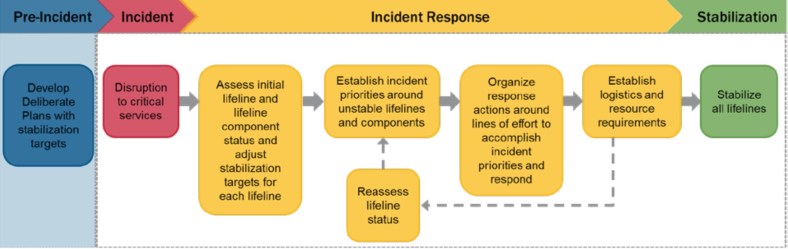
  3. Community Lifelines are focused on stabilizing critical services with built-in mechanisms for assessing impacts and establishing priorities.
  4. Community Lifelines more directly support the inclusion of the private sector, along with government, NGOs, and quasi-government owners/operators.
  5. Community Lifelines provide better preparedness and resilience initiatives.
  6. Community Lifelines provide us with a basis for measuring progress across all phases or mission areas. The only thing we can measure in an ESF is what we might have available to leverage in a response.
  7. Community Lifelines connect resilience, response, and recovery since they are the focal point. While the National Response Framework and National Recovery Framework still have national relevance, the transition from ESFs to Recovery Support Functions (RSFs) is challenging at best.
  8. The inclusion of Community Lifelines in our EOC structure is easy and agnostic to the organizational model used in the EOC. ESFs include functions that are part of the typical overhead management of an EOC, such as ESF 5 (Information and Planning), ESF 7 (Logistics), and ESF 15 (External Affairs), which is an awkward integration.
  9. Community Lifelines lend to better partnerships and preparedness. The ESF plans of most jurisdictions are truly little more than a general scope of the ESF with a list of participating agencies and organizations.

We need to change our mindset of emergency management being centered on response. Yes, response is the big shiny thing. It’s the thing we practice for and anticipate. A more wholistic and comprehensive approach is available to us, however, by using Community Lifelines as the foundation of our work. I suggest that jurisdictions develop Community Lifeline Implementation Plans, which are fundamentally strategic plans identifying how Community Lifelines can be used in Prevention/Protection/Mitigation, Preparedness, Response, and Recovery. Consider how the relationships forged with the owners/operators of Community Lifeline partners can support each of those phases and activities, increasing the resiliency of our community as a whole by making each partner more resilient; and by understanding and preparing for the response and recovery needs of our community through the collective effort of Community Lifeline partners.

Emergency management is more than response. It is a comprehensive effort to support our communities before, during, and after disaster.

© 2025 Tim Riecker, CEDP

Emergency Preparedness Solutions, LLC®

Preparing for Community Lifelines Implementation

In all great ideas, the devil, as they say, is in the details. Implementing new concepts often requires preparations to ensure that the implementation goes smoothly. We often rush to implementation, perhaps excited for the results, perhaps not thinking through the details. Without proper preparation, that implementation can fail miserably. Integrating and implementing the Community Lifelines is no exception.

Just like everything else we do in preparedness, we should turn to the capability elements of planning, organizing, equipping, training, and exercises (POETE) to guide our preparedness for Community Lifeline implementation.

Planning and Organizing

I’m coupling these two capability elements together as they so strongly go hand-in-hand. Determining how you want to use Community Lifelines is an important early step. I’d suggest developing a Community Lifeline Implementation Plan for your jurisdiction that not only identify how you will use them in response and recovery operations, but details of how their use fits within your response and recovery management structure, how information will flow, who is responsible for what, how information is reported, and to who it is reported. The Implementation Plan should also outline the preparedness steps needed and how and where information will be catalogued.

I’ve seen several Community Lifeline integrations across local, county, and state jurisdictions, these mostly being visual status displays, but there can be some complexity in how we even get to that display.

We all know from CPG-101 that forming a planning team is the first step of emergency planning. While not itself really the capability element of Organizing, the stakeholders that will be assembled for this will extend across all capability elements and into response and recovery operations.

Before identifying stakeholders, we need to examine each Community Lifeline down to the sub-component levels, which first necessitates determining which components and sub-components are applicable to your jurisdiction. For example, within the Transportation Community Lifeline, if your jurisdiction has no Aviation resources or infrastructure, you may choose to not include that component.

Once you have made the determination as to what components and sub-components of each Community Lifeline will be included, it’s not time to form your planning teams for each. Depending on the size of your jurisdiction, you could form teams at the Community Lifeline level, the component level, or the sub-component level. You could even use different approaches for each (i.e. The Community Lifeline of Water Systems may only involve a few stakeholders to address all components and sub-components, whereas Health and Medical may require distinct teams for each component). Since much of the Community Lifelines is centered on or strongly relates to critical infrastructure, many of our stakeholders will be from the private sector. Hopefully these are partners you have engaged with before, but if not, this is a great opportunity to do so.

In meeting with each of these stakeholders/stakeholder groups, providing them with an orientation to the Community Lifelines concept will be important. Be sure to talk about this within the contexts of whole-community preparedness, public-private partnerships, critical infrastructure, and the five mission areas. This should include the expectation for these to be long-term working groups that will provide information updates before, during, and after a disaster. It will be important to obtain from each the following information (at minimum) for each function and/or facility:

  • Legal owners and operators
  • Primary and alternate points of contact (and contact info for each) (Note that these should be emergency/24 hour contacts)
  • Existing emergency plans
  • Protection activities
  • Prevention activities
  • Mitigation activities
  • Preparedness activities
  • Response and recovery priorities
  • Critical continuity and supply chain issues
  • Sensitive information concerns

Processes will need to be mapped to identify how information will be obtained in an incident from the owners/operators of each facility or function, what information will be expected, in what format, and how often. Internal (EOC) procedures should identify how this information will be received, organized, and reported and how it will influence operational priorities for response and recovery. Since the visual representation of the Community Lifelines is the face of the system, you should also determine what the benchmarks are within each Community Lifeline, component, and sub-component for differentiating between status (i.e. what failures will bring status from green to yellow, and from yellow to red) and how the status of one may influence the status of others.

Equipment (and Systems)

It is important to catalogue the information you obtain from preparedness activities as well as in implementation. Consider GIS integrations, as there is an abundance of information that involves geolocation. I’ll make a special shout out here to the Community Lifeline Status System (CLSS) project, which is funded by the DHS Science and Technology (S&T) Directorate and is being developed by contract to G&H International. When rolled out, the CLSS will be available at no cost to every jurisdiction in the US to support Community Lifeline integration. Having been fortunate enough to get a private in-depth tour of the system, I’m thoroughly impressed. The CLSS is based on Arc GIS and provides a lot of customizable space to store all this preparedness information.

Using a system such as CLSS to display and share Community Lifelines information is also a benefit. While most displays I’ve seen simply show the icon and status color for each Community Lifeline, an interactive dashboard type of system can help provide additional context and important information. This is something CLSS also provides.

Training and Exercises

As with any new plans or processes, training is an important part of supporting implementation. Training audiences will include:

  • EOC personnel
  • Owners/Operators of Community Lifelines infrastructure
  • Officials who will receive Community Lifelines information

Proper training requires that different audiences should receive training to address their specific needs.

Similarly, exercises should purposely test these processes, and use of Community Lifelines should be incorporated into exercises often. Community Lifelines status and information should be engaged in exercises to inform and support decision making.

///

If you already know the benefits of the Community Lifelines, hopefully you see the advantages of adequate preparedness to get the most out of them. The stakeholder groups you assemble to support planning should be everlasting, as information on their vulnerabilities, capabilities, and activities are likely to change over time. Beyond direct Community Lifeline applications, these are all great partners for a variety of emergency management activities to support the whole community. The preparedness efforts, and maintenance thereof (sorry, but it’s not just a one-time thing) is a significant investment (and could likely be a full-time job for even a moderately sized jurisdiction) but it should pay incredible dividends over and over again.

Are you using Community Lifelines? What have you learned about the need to prepare for their use?

© 2024 Tim Riecker, CEDP

Emergency Preparedness Solutions, LLC®

Metrics and Data Analytics in Emergency Management

I’ve lately seen some bad takes on data analytics in emergency management. For those not completely familiar, data analytics is a broad-based term applied to all manner of data organization, manipulation, and modeling to bring out the most valuable perspectives, insights, and conclusions which can better inform decision-making. Obviously, this can be something quite useful within emergency management.

Before we can even jump into the analysis of data, however, we need to identify the metrics we need. This is driven by decision-making, as stated above, but also by operational need, measurement of progress, and reporting to various audiences, which our own common operating picture, to elected officials, to the public. In identifying what we are measuring, we should regularly assess who the audience is for that information and why the information is needed.

Once we’ve identified the metrics, we need to further explore the intended use and the audience, as that influences what types of analysis must be performed with the metrics and how the resultant information will be displayed and communicated.

I read an article recently from someone who made themselves out to be the savior of a state emergency operations center (EOC) by simply collecting some raw data and putting it into a spreadsheet. While this is the precursor of pretty much all data analysis, I’d argue that the simple identification and listing of raw data is not analytics. It’s what I’ve come to call ‘superficial’ data, or what someone on Twitter recently remarked to me as ‘vanity metrics’. Examples: number of people sheltered, number of customers with utility outages, number of people trained, number of plans developed.

We see a lot of these kinds of data in FEMA’s annual National Preparedness Report and the Emergency Management Performance Grant (EMPG) ‘Return on Investment’ report generated by IAEM and NEMA. These reports provide figures on dollars spent on certain activities, assign numerical values to priorities, and state how much of a certain activity was accomplished within a time period (i.e. x number of exercises were conducted over the past year). While there is a place for this data, I’m always left asking ‘so what?’ after seeing these reports. What does that data actually mean? They simply provide a snapshot in time of mostly raw data, which isn’t very analytical or insightful. It’s certainly not something I’d use for decision-making. Both of these reports are released annually, giving no excuse to not provide some trends and comparative analysis over time, much less geography. Though even in the snapshot-of-time type of report, there can be a lot more analysis conducted that simply isn’t done.

The information we report should provide us with some kind of insight beyond the raw data. Remember the definition I provided in the first paragraph… it should support decision-making. This can be for the public, the operational level, or the executive level. Yes, there are some who simply want ‘information’ and that has its place, especially where political influence is concerned.

There are several types of data analytics, each suitable for examining certain types of data. What we use can also depend on our data being categorical (i.e. we can organize our data into topical ‘buckets’) or quantitative. Some data sets can be both categorical and quantitative. Some analysis examines a single set of data, while other types support comparative analysis between multiple sets of data. Data analytics can be as simple as common statistical analysis, such as range, mean, median, mode, and standard deviation; while more complex data analysis may use multiple steps and various formulas to identify things like patterns and correlation. Data visualization is then how we display and communicate that information, through charts, graphs, geographic information systems (GIS), or even infographics. Data visualization can be as important as the analysis itself, as this is how you are conveying what you have found.

Metrics and analytics can and should be used in all phases of emergency management. It’s also something that is best planned, which establishes consistency and your ability to efficiently engage in the activity. Your considerations for metrics to track and analyze, depending on the situation, may include:

  • Changes over time
    • Use of trend lines and moving averages may also be useful here
  • Cost, resources committed, resources expended, status of infrastructure, and measurable progress or effectiveness can all be important considerations
  • Demographics of data, which can be of populations or other distinctive features
  • Inclusion of capacities, such as with shelter data
  • Comparisons of multiple variables in examining influencing factors (i.e. loss of power influences the number of people in shelters)
    • Regression modeling, a more advanced application of analytics, can help identify what factors actually do have a correlation and what the impact of that relationship is.
  • Predictive analytics help us draw conclusions based on trends and/or historical data
    • This is a rabbit you can chase for a while, though you need to ensure your assumptions are correct. An example here: a hazard of certain intensity occurring in a certain location can expect certain impacts (which is much of what we do in hazard mitigation planning). But carry that further. Based on those impacts, we can estimate the capabilities and capacities that are needed to respond and protect the population, and the logistics needed to support those capabilities.
  • Consider that practically any data that is location-bound can and should be supported with GIS. It’s an incredible tool for not only visualization but analysis as well.
  • Data analytics in AARs can also be very insightful.

As I mentioned, preparing for data analysis is important, especially in response. Every plan should identify the critical metrics to be tracked. While many are intuitive, there is a trove of Essential Elements of Information (EEI) provided in FEMA’s Community Lifelines toolkit. How you will analyze the metrics will be driven by what information you ultimately are seeking to report. What should always go along with data analytics is some kind of narrative not only explaining and contextualizing what is being shown, but also making some inference from it (i.e. what does it mean, especially to the intended audience).

I’m not expecting that everyone can do these types of analysis. I completed a college certificate program in data analytics last year and it’s still challenging to determine the best types of analysis to use for what I want to accomplish, as well as the various formulas associated with things like regression models. Excel has a lot of built-in functionality for data analytics and there are plenty of templates and tutorials available online. It may be useful for select EOC staff as well as certain steady-state staff to get some training in analytics. Overall, think of the variables which can be measured: people, cost, status of infrastructure, resources… And think about what you want to see from that data now, historically, and predicted into the future. What relationships might different variables have that can make data even more meaningful. What do we need to know to better support decisions?

Analytics can be complex. It will take deliberate effort to identify needs, establish standards, and be prepared to conduct the analytics when needed.

How have you used data analytics in emergency management? What do you report? What decisions do your analytics support? What audiences receive that information and what can they do with it?

© 2021 Tim Riecker, CEDP

Emergency Preparedness Solutions, LLC®

8 Predicted Changes to Emergency Management Post-Pandemic

In public safety we learn from every incident we deal with.  Some incidents bring about more change than others.  This change comes not just from lessons learned, but an effort to apply change based upon those lessons. In recent history, we’ve seen significant changes in emergency management practice come from disasters like the 9/11 terrorist attacks and Hurricane Katrina, with many of the changes so significant that they are actually codified and have led to new doctrine and new practices at the highest levels.  What changes can we expect from the Coronavirus pandemic?

Of course, it’s difficult to predict the future.  We’re also still in the middle of this, so my thoughts may change a month or two into the future.  Any speculation will begin with idealism, but this must be balanced with pragmatism.  Given that, the items I discuss here are perhaps more along the lines of changes I would like to see which I think have a decent chance of actually happening. 

  1. Legislation.  Similar to the aforementioned major disasters, this too will spawn legislation from which doctrine and programs will be derived.  We are always hopeful that it’s not politicians who pen the actual legislation, but subject matter experts and visionaries with no political agendas other than advancing public health preparedness and related matters. 
  2. More public health resources. This one, I think, is pretty obvious.  We need more resources to support public health preparedness, prevention, and detection efforts.  Of course, this begins with funding which will typically be spawned from the legislation mentioned previous.  Public health preparedness is an investment, though like most preparedness efforts, it’s an investment that will dwindle over time if it’s not properly maintained and advanced to address emerging threats and best practices.  Funding must address needs, programs to address those needs, and the resources to implement those programs. 
  3. Further integration of public health into emergency management.  Emergency management is a team sport.  Regardless of the hazard or the primary agencies involved, disasters impact everyone and many organizations and practices are stakeholders in its resolution and can contribute resources to support the resolution of primary impacts and cascading effects.  Despite some gains following 9/11, public health preparedness has still been treated like an acquaintance from another neighborhood. The legislation, doctrine, programs, and resources that we see MUST support an integrated and comprehensive response.  No longer can we allow public health to be such an unfamiliar entity to the rest of the emergency management community (to be clear – the fault to date lies with everyone). 
  4. Improved emergency management preparedness.  Pulling back to look at emergency management as a whole, we have certainly identified gaps in preparedness comprehensively.  Plans that were lacking or didn’t exist at all.  Equipment and systems that were lacking or didn’t exist at all.  People who didn’t know what to do.  Organizations that weren’t flexible or responsible enough.  Processes that took too long.  Poor assumptions on what impacts would be. We can and must do better.
  5. An increase in operational continuity preparedness.  We’ve been preaching continuity of operations/government for decades, yet so few have listened. The Coronavirus pandemic has shown us so many organizations jumping through their asses as they figure it all out for the first time.  By necessity they have figured it out, some better than others.  My hope here is that they learned from their experience and will embrace the concepts of operational continuity and identify a need to leverage what they have learned and use that as a basis for planning, training, exercises, and other preparedness efforts to support future continuity events. 
  6. Further expansion of understanding of community lifelines and interdependencies of critical infrastructure.  This pandemic gave us real world demonstrations of how connected we are, how vulnerable some of our critical infrastructure is, and what metrics (essential elements of information) we should be monitoring when a disaster strikes.  I expect we will see some updated documents from DHS and FEMA addressing much of this. 
  7. More/better public-private partnerships.  The private sector stepped up in this disaster more than they previously ever had. Sure, some mistakes were made, but the private sector has been incredibly responsive and they continue to do so.  They have supported their communities, customers, and governments to address needs they identified independently as well as responding to requests from government.  They changed production.  Increased capacity.  Distributed crisis messages.  Changed operations to address safety matters.  Some were stretched to capacity, despite having to change their business models.  Many companies have also been providing free or discounted products to organizations, professionals, and the public.  We need to continue seeing this kind of awareness and responsiveness.  I also don’t want to dismiss those businesses, and their employees, that took a severe financial hit.  Economic stabilization will be a big issue to address in recovery from this disaster, and I’m hopeful that our collective efforts can help mitigate this in the future. 
  8. An improved preparedness mindset for individuals and families.  Despite the panic buying we saw, much of the public has finally seemed to grasp the preparedness messaging we have been pushing out for decades.  These are lessons I hope they don’t forget. Emergency management, collectively, absolutely must capitalize on the shared experience of the public to encourage (proper) preparedness efforts moving forward and to keep it regularly in their minds. 

In all, we want to see lasting changes – a new normal, not just knee-jerk reactions or short-lived programs, that will see us eventually sliding backwards.  I’m sure I’ll add more to this list as time goes on, but these are the big items that I am confident can and (hopefully) will happen.  I’m interested in your take on these and what you might add to the list.

Be smart, stay safe, stay healthy, and be good to each other. 

© 2020 Timothy Riecker, CEDP

Emergency Preparedness Solutions, LLC

Thoughts on How to Improve the Planning Standard

I hope everyone is settling into the new year nicely.  One of the things I started off this year doing was going through CPG 101 and providing input to FEMA for the update of this foundational document.  (note: if you haven’t yet, get your comments in now as the deadline is soon approaching!)  CPG 101, and its predecessors, are time tested and well honed in the guidance provided on the process used for planning.  While it’s frustrating to see and hear that some people still don’t use it, that’s no fault of the document itself, but rather one of human implementation, or lack thereof.

I thought I’d share some of the feedback I sent along to FEMA on what I would like to see in the CPG 101 update.  Looking over my submission, there were two main themes I followed:

  1. Integration of other doctrine and standards
  2. Development of job aids to support use and implementation

I feel that integration of other relevant doctrine and standards into CPG 101 is incredibly important.  We know that preparedness covers an array of activities, but planning is the foundational activity, which all other activities reflect upon.  In past articles I’ve addressed the need to identify these various standards collectively, to show that while these are individual activities with their own outputs, identifying how they can and should be interconnected, offering greater value if used together.  Things like Community Lifelines, THIRA/SPR, HSEEP, and Core Capabilities need to not only be mentioned often, but with examples of how they interconnect and support planning and even each other.

Job aids are tools that support implementation.  I think job aids can and should be developed and included in the updated CPG 101 for each step of the planning process.  While some of us write plans fairly often, there are many who don’t or are going into it for the first time.  These are essentially the ideal conditions for job aids.  They help guide people through the key activities, provide them with reminders, and ultimately support better outcomes. Not only would I like to see job aids, such as check lists and work sheets, for each step, I’d also think that something that covers the whole process comprehensively, essentially a project management perspective, would be incredibly helpful to many people.

There were a couple of one-off suggestions that might not fit the categories mentioned above.  One of which was having more emphasis on the value of data from the jurisdiction’s hazard mitigation plan.  The hazard analysis conducted for hazard mitigation planning is considerably thorough, and can provide great information to support a hazard analysis (or even a THIRA for those brave enough) for purposes of emergency planning.  To be honest, this was something I didn’t really learn until about ten years into my career.  Many of the people I learned from in Emergency Management often leaned so far into response that they disregarded the value of things like mitigation or recovery.  I still find this a lot in our profession.  Once I finally took the time to go through a hazard mitigation plan, I realized the incredible amount of information contained within.  In many cases, there is more information than what is needed for the hazard analysis of an emergency plan, as the narrative and analysis in a hazard mitigation plan often goes into a measure of scientific detail, but this, too, can certainly have value for emergency planning.  Similarly, I also suggested that FP 104-009-2 (the Public Assistance Program and Policy Guide) be included as a reference in CPG 101.  Jurisdictions will strongly benefit from having plans, such as those on debris management, meeting FEMA’s reimbursement guidelines.

Lastly, I encouraged FEMA to include any content that will support plan writers in developing plans that are simply more useful.  So many plans are just a lot of boilerplate narrative, that in the end don’t tell me WHO is responsible for WHAT and HOW things will get done.  It’s so easy for us to be dismissive of action steps when writing a plan, assuming that people will know who has the authority to issue a public alert or the steps involved in activating an EOC.  CPG 101 should reinforce the need for plans to define processes and actions, identify authority, and assign responsibility.  Flow charts, decision trees, maps, charts, and other graphics and job aids are incredibly helpful to ensure that a plan is thorough while also being useful.

That’s the feedback I provided to FEMA, along with a bit of narrative as to why those things are important for inclusion in an updated CPG 101.  I’m curious to hear about the feedback that others provided.  We all tackle these documents from different perspectives, and that’s why I truly appreciate the efforts FEMA makes in these public calls for comment when they are updating certain key documents.

© 2020 – Timothy Riecker, CEDP

Emergency Preparedness Solutions, LLC®℠


The 2019 National Preparedness Report, or ‘How Are We Measuring Preparedness?’

FEMA recently released the 2019 National Preparedness Report.  Simply put, I’m confused.  Nothing in the report actually lines up with doctrine.  It leaves me wondering how we are actually measuring preparedness.  So what’s the issue?

While the National Preparedness Report is initially structured around the five mission areas (Prevention, Protection, Mitigation, Response, and Recovery), the only full inclusion of the Core Capabilities in the report is a table on page 9, outlining usage of grant funds per Core Capability.  After this, the Core Capabilities for each mission are listed in the title page for each mission area within the detailed findings for those mission areas.  No detail of progress within these Core Capabilities is provided, however.  With the absence of this analysis, we are not seeing data on the progression of preparedness, which, per the National Preparedness Report, is measured through the lens of each of the Core Capabilities.

This is further confused on pages 45 and 48, in particular, where tables list the Community Lifelines with some sort of correlated ‘capabilities’ (noted with a lowercase ‘c’… thus not the Core Capabilities).  These capabilities are not from any doctrine that I can find or recall, including the components and subcomponents for each Community Lifeline provided in the Community Lifelines Toolkit.  For each of these they provide some analytical data, but it’s unclear what this is based upon.  The methodology provided early in the document does nothing to identify why this change in format has occurred or where these specific data sets come from, much less why they are deviating from the previous format and the standards provided through the National Preparedness Goal.

Some perspective… It would seem logical that the National Preparedness Report would be assessing our national state of preparedness relative to the National Preparedness Goal, as it has since its inception.  The National Preparedness Goal is structured around the five mission areas and the 32 Core Capabilities.  With the emergence of the Community Lifelines and their inclusion in the recent update of the National Response Framework, it makes sense that we will see Community Lifelines further integrated into standards, doctrine, and reports, but they have yet to be integrated into the National Preparedness Goal (the current version is dated 2015).  We have not yet seen a comprehensive crosswalk between the Community Lifelines and the Core Capabilities, but it should be recognized that there are certain aspects, even if you just examine the Response Mission Area, that don’t match up.

In an unrelated observation on the National Preparedness Report, the trend continues with citing after action reports from the year, but not actually providing any analysis of lessons learned and how those are being applied across the nation.

Bottom line… while there are some valuable nuggets of information included in this report, I find most of it to be confusing, as it lacks a consistent format on its own, as well as inconsistency with the existing standard of measurement as defined by the National Preparedness Goal.  Why is this a big deal?  First, it’s a deviation from the established standard.  While the standard may certainly have room for improvement, the standard must first be changed before the metrics in the reporting can be changed.  Second, with the deviation from the standard, we aren’t able to measure progress over time.  All previous National Preparedness Reports have provided data within the scope of Core Capabilities, while this one largely does not.  This breaks the possibility of any trend analysis.  Third, there is no reasoning provided behind the capabilities (lowercase ‘c’) associated with each of the Community Lifelines in the report.  It’s simply confusing to the extent that it becomes irrelevant because the information provided is not within the existing lexicon which is used for measurement of practically everything in preparedness.

Simply put, this year’s report is even more disappointing than those provided in previous years.  In fact, since it doesn’t conform with the current standard, I’d suggest it’s not even valid.  This should be far better.

Thoughts?

© 2019 – Timothy Riecker, CEDP

Emergency Preparedness Solutions, LLC


An Updated Community Lifelines Toolkit and Relationships to Incident Management

Earlier this year, FEMA released guidance on the Community Lifelines.  I wrote a piece in the spring about integrating the concept into our preparedness and response activities.  Last month, FEMA issued updated guidance for Community Lifeline Implementation through Toolkit 2.0.  In this update, FEMA cites some lessons learned in actually applying the Lifeline concept in multiple exercises across the nation, as well as from feedback received by stakeholders. Based on these lessons learned and feedback, they have made some adjustments to their toolkit to reflect how they understand, prioritize, and communicate incident impacts; the structure and format for decision-making support products. And planning for these impacts and stabilization prior to and during incidents.  They have also made some changes based upon the updated National Response Framework.  The documents associated with the updated Community Lifelines all seem to reflect an inclusion in the efforts of the National Response Framework.  It’s great to see FEMA actually tying various efforts together and seeking to provide grounded guidance on application of concepts mentioned in doctrine-level documents.

The biggest addition to the Community Lifelines update is the inclusion of the FEMA Incident Stabilization Guide.  The ‘operational draft’ is intended to serve as a reference to FEMA staff and a resource to state, local, and tribal governments on how “FEMA approaches and conducts response operations”.  It’s a 77-page document the obviously leans heavily into the Community Lifelines as a standard for assessing the impacts to critical infrastructure and progress toward restoration, not only in response, but also into recovery operations.  It even reflects on bolstering Community Lifelines in resilience efforts, and ties in the THIRA and capability analysis efforts that states, UASIs, and other governments conduct.  I’m not sure the document is really a review of how FEMA conducts operations, as they say, but it does review the ideology of a portion of those operations.  Overall, there is some very useful information and references contained in the document, but this brings me to a couple of important thoughts:

  1. The utility of this document, as with the entire Community Lifelines concept, at the state and local level is only realized through integration of these concepts at the state and local levels.
  2. We finally have guidance on what ‘incident stabilization’ really entails.

To address the first item… In my first piece on Community Lifelines, I had already mentioned that if states or communities are interested in adopting the concept of Community Lifelines, that all starts with planning.  An important early step of planning is conducting assessments, and the most pertinent assessment relative to this initiative would be to identify and catalog the lifelines in your community.  From there the assessment furthers to examine their present condition, vulnerabilities, and align standards for determining their operational condition aligned with the Community Lifelines guidelines.  I would also suggest identifying resiliency efforts (hopefully these are already identified in your hazard mitigation plan) which can help prevent damages or limit impacts.  As part of your response and short-term recovery lexicon, procedures should be developed to outline how lifeline assessments will be performed, when, and by who, as well as where that information will be collected during an incident.

As for my second item, the concept of incident stabilization has an interesting intersection with a meeting I was invited to last week.  I was afforded the opportunity to provide input to an ICS curriculum update (not in the US – more on this at a later time), and as part of this we discussed the standard three incident priorities (Life Safety, Incident Stabilization, and Property Conservation).  We identified in our discussions that incident stabilization is incredibly broad and can ultimately mean different things to different communities, even though the fundamental premise of it is to prevent further impacts.  This Incident Stabilization Guide is focused exclusively on that topic.  In our endeavor to make ICS training better, more grounded, less conceptual, and more applicable; there is a great deal of foundational information that could be distilled from this new document for inclusion in ICS training to discuss HOW we actually accomplish incident stabilization instead of making a one-off mention of it.

Going a bit into my continued crusade against the current state of ICS training… I acknowledge that any inclusion of this subject matter in ICS training would still be generally brief, and really more of a framework, as implementation still needs to be grounded in community-level plans, but this document is a great resource.  This also underscores that “learning ICS” isn’t just about taking classes.  It’s about being a professional and studying up on how to be a more effective incident manager.  ICS is simply a tool we use to organize our response… ICS is NOT inclusive of incident management.  Not only are we teaching ICS poorly, we are barely teaching incident management.

While I’ve been away for a while working on some large client projects, I’m looking forward to ending the year with a bang, and getting in a few more posts.  It’s great that in my travels and interactions with colleagues, they regularly mention my articles, which often bring about some great discussion.  I’m always interested in hearing the thoughts of other professionals on these topics.

© 2019 Timothy Riecker, CEDP

Emergency Preparedness Solutions, LLC®

A New National Response Framework

Yesterday FEMA announced the release of an updated National Response Framework (the fourth edition).  The most notable changes in this version of the NRF are the inclusion of Community Lifelines and a change to Emergency Support Function (ESF) #14.  Previously, ESF #14 was Long-Term Community Recovery.  With efforts to further engage and coordinate with the private sector in disaster response, ESF #14 has been changed to Cross-Sector Business and Infrastructure.

So what of Long-Term Community Recovery?  The National Disaster Recovery Framework (2016) outlines Recovery Support Functions (RSFs), which, at the federal level, are organized as coordinating structures along with the ESFs.  There are six RSFs, which generally align with the Core Capabilities for the Recovery Mission Area.  For anyone who has worked with FEMA in disaster recovery operations, you know these can be massive organizations, so why create an even large organization?  This structure should support the ESFs in focusing on immediate needs, while the RSFs can address long-term recovery.  When the Federal disaster response organization is initially set up for a disaster, the ESFs are immediately put to work to support state and local emergency needs.  In this phase, the RSFs are able to organize, gather data, and plan for eventually being the lead players as response transitions to recovery.  Recovery is very much a data-driven operation.  As this transition occurs, with the RSFs taking over, many of the ESF resources can be demobilized or tasked to the RSFs.

What does this mean for states and locals?  Fundamentally, nothing.  States simply need to have an appropriate interface with the new ESF #14.  Do states and locals need to mirror this organization?  No, and in fact most of the time when I see an organization centered around ESFs, I tend to cringe.  The ESF/RSF system works for the federal government because of the multitude of federal agencies that have responsibility or involvement in any given function.  Fundamentally, ESFs/RSFs are task forces.  Recall the ICS definition of a task force, being a combination of resources of varying kind and type.

Certainly, most local governments, aside from perhaps the largest of cities, simply don’t have this measure of complexity and bureaucracy.  It can work for some state governments, but for many it may not make sense.  Let’s consider ESF #1 – Transportation.  How many state agencies do you have that have responsibility and assets related to transportation?  In some states, like New York, there are many, ranging from State DOT, NYS Parks, the Thruway Authority, and the multitude of other bridge, road, and transit authorities in the State. Smaller states may only have a State DOT.  One agency doesn’t make a task force.  There are other options for how you organize your emergency operations plan and your EOC that can make more sense and be far more effective.  Essentially what I’m saying is to not mirror the way the feds organize because you think you have to.  All plans must be customized to YOUR needs.

On to the integration of community lifelines.  The goal of the new ESF #14 is to not only engage the private sector, but also coordinate cross-sector operations for stabilizing community lifelines.  I’m interested to see how this plays out, since the community lifelines are already addressed by other ESFs, so I suspect that once the new framework is tested, there may be some supplemental materials that come out to balance this.  That said, the integration of community lifelines is a good thing and I’m glad to see this gaining more traction and truly being integrated rather than existing as a good idea that’s never actually tasked.  Integration of community lifelines is something that every state and local government can at least track, if not take action on, depending on their capability and resources.  The updated NRF added some additional context to community lifelines, with information that supports integrating this concept into planning, response, and recovery.  I happen to appreciate this community lifeline focused timeline that is in the NRF.

While the focus of the NRF is on how the federal government will response, it is intended to be reflective of a whole community response.  It doesn’t necessarily provide guidance (nor should it) on planning, but it certainly serves as a reference.  Since it seems the feds are going all in on the community lifeline concept, I urge state, local, tribal, and territorial governments to examine how they can integrate them into your operations.  That all starts with planning.  It may begin as a function of situational awareness, but then what actions should a jurisdiction take when lifelines are impacted?  Even if a jurisdiction doesn’t have the capabilities to address the root cause, they still need to address the affects.

What thoughts do you have on the NRF update?

© 2019 – Timothy Riecker, CEDP

Emergency Preparedness Solutions, LLC

Preparedness: Integrating Community Lifeline Considerations

Much of preparedness is about getting us ready to conduct situational assessment and prioritization of actions.  We train people and develop resources, such as drones, field-deployed apps, and geographic information systems (GIS) to support situational assessment.  The information we obtain from these assessments help in the development and maintenance of situational awareness and, when shared across disciplines, agencies, and jurisdictions, a common operating picture.  Based upon this information, leaders at all levels make decisions.  These decisions often involve the prioritization of our response and recovery actions.  Ideally, we should have plans in place that establish standards for how we collect, analyze, and share information, and also to support the decision making we must do in prioritizing our actions.  Exercises, of course, help us to validate those plans and practice associated tasks.

One significant hurdle for us is how overwhelming disasters can be.  With just slight increases in the complexity of a disaster, we experience factors such as large geography, extensive damages, high numbers of lives at risk, hazardous materials, and others.  Certainly, we know from Incident Command System training that our broad priorities are life safety, incident stabilization, and property conservation – but with all that’s happening, where do we start?

One thing that can help us both assessment and prioritization are community lifelines.  From FEMA: “Community lifelines reframe incident information to provide decision-makers with impact statements and root causes.”  By changing how we frame our data collection, analysis, thinking, and decision-making, we can maximize the effectiveness of our efforts.  This shouldn’t necessitate a change in our processes, but we should incorporate community lifelines into our preparedness activities.

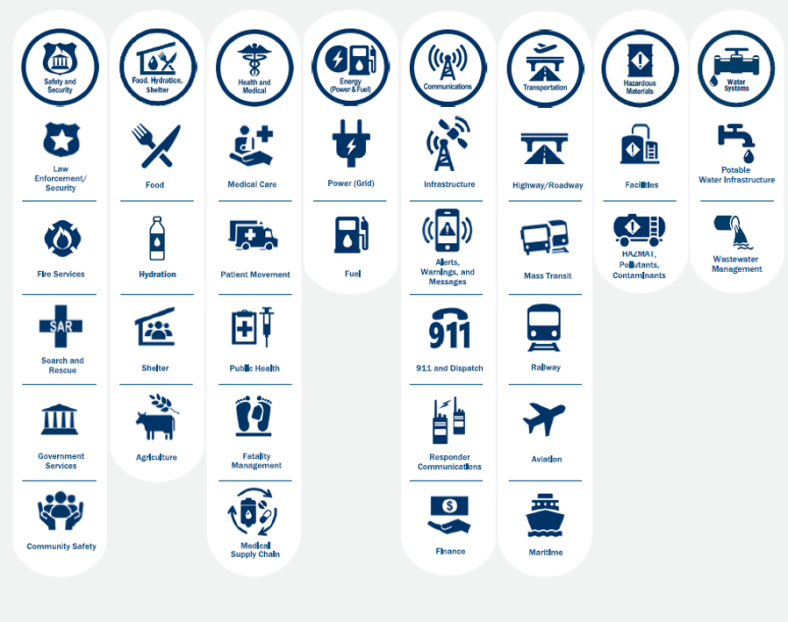
The community lifelines, as identified by FEMA, are:

  • Safety and Security
  • Food, Water, and Sheltering
  • Health and Medical
  • Energy
  • Communications
  • Transportation
  • Hazardous Materials

If this is your first time looking at community lifelines, they certainly shouldn’t be so foreign to you.  In many ways, these are identified components of our critical infrastructure.  By focusing our attention on this list of items, we can affect a more concerted response and recovery.

FEMA guidance goes on to identify components we should be examining for each community lifeline.  For example, the lifeline of Health and Medical includes the components of:

  • Medical Care
  • Patient Movement
  • Public Health
  • Fatality Management
  • Health Care Supply Chain

Each component is then broken down into sub-components. Continuing the example, within the component of Fatality Management, you can examine sub-components such as:

  • Mortuary and post-mortuary services
  • Transportation, storage, and disposal resources
  • Body recovery and processing
  • Family assistance

Of course, you can dig even deeper when analyzing any of these sub-components to identify the status and root cause of failure, which will then support the prioritization of actions to address the identified failures.  First we seek to stabilize, then restore. The organization of situation reports, particularly those shared with the media, public, and other external partners might benefit from being organized by community lifelines.  These are concepts that are generally tangible to many people, and highlight many of the top factors we examine in emergency management.

Back in March of this year, FEMA released the Community Lifelines Implementation Toolkit, which provides some great information on the lifelines and some information on how to integrate them into your preparedness.  These can go a long way, but I’d also like to see some more direct application as an addendum to CPG-101 to demonstrate how community lifelines can be integrated into planning.  Further, while I understanding that FEMA is using the community lifeline concept for its own assessments and reporting, the community aspect of these should be better emphasized, and as such identifying some of the very FEMA- and IMAT-centric materials on this page as being mostly for federal application.

Has your jurisdiction already integrated community lifelines into your preparedness?  What best practices have you identified?

© 2019 – Timothy Riecker, CEDP

Emergency Preparedness Solutions, LLC℠®