7 Emergency Management Priorities for the Next Administration

Heritage.org recently published a piece outlining the top four homeland security priorities for the next administration, which can be found here.  It’s a thought provoking article that certainly identifies some important issues.  In the same spirit, I’d like to offer what I think are the emergency management priorities for the next administration.

1) Support an Effective FEMA Organizational Model

The Heritage.org model pointed out several issues with the DHS organization that need to be addressed sooner rather than later.  I’d like to add some FEMA-specific items to their suggestions, regardless of if FEMA is kept within DHS or not (honestly, I think that ship has sailed and FEMA is there to stay).

In building a bit of background for this article, I took a look at FEMA’s current strategic plan, knowing that the document already identifies some of their priorities.  Within in that list of priorities, they mention mission and program delivery, becoming an expeditionary organization, posturing and building capability for catastrophic disasters, and strengthening their organizational foundation.  To me, these four all directly relate to their organizational model.

Along with having a strong central administration of programs, FEMA needs to have agility in their program delivery.  This is best accomplished through the FEMA regional offices, which act as an extension of the ‘central administration’ by coordinating directly with states and neighboring regions to apply those programs in the best possible manner within the guidelines of the program.  While this is currently performed, it is not performed to the greatest extent possible.  John Fass Morton provides some great perspective on this approach in his book ‘Next-Generation Homeland Security’.  Info on the book can be found here.

2) Bolster Risk Reduction Programs

I write often about preparedness, as that has always been a focus of my career.  Risk reduction, however, is essential to eliminating or reducing the impacts of hazards on communities.  Risk reduction includes all aspects of hazard mitigation and resilience, which are ideally applied at the local level but supported by state and federal programs, policies, and resources.

While the National Weather Service has implemented and promoted the StormReady program, which encourages community resilience, the best program we have ever had in our field is Project Impact.  I’d love to see a revival of Project Impact (call it that or something else – I don’t really care), incorporating the concepts of StormReady as well as other best practices in risk reduction.  A big part of this program MUST be incentivization, especially access to funds that can be applied for in the present for hazard mitigation activities.

3) Build a Better Cybersecurity Program

This item was added to the list by a colleague of mine.  It’s also found on the Heritage.org list.  It must be pretty important, then.

Yes, there are a LOT of initiatives right now involving cybersecurity, but I think there can be more.  Jon, the same colleague who suggested this for my list has also stated repeatedly that cybersecurity is really a Core Capability that cuts across all mission areas – Prevention, Protection, Response, Mitigation, and Recovery.  The recent update of the National Preparedness Goal suggests this, but sadly doesn’t commit.

What do we need in regard to cybersecurity?  First of all, we need to demystify it.  There are plenty of people out there who have just enough tech savvy to turn on their computer, send some email, and post to Facebook.  While that may work for them, they are likely intimidated by talk of cybersecurity, hackers, and the like.  We need to continue programs in plain speak that will help to inform the average consumer about how to protect themselves.

Better coordination with the private sector will pay off heavily when it comes to cybersecurity.  Not only is the private sector generally better at it, they also have a tendency to attract experts through better incentives than the government can offer, such as higher pay.  Cybersecurity also impacts everyone.  We’ve seen attacks of all types of systems.  The only way to stop a common enemy is to work together.  Let’s think of it as a virtual whole-community approach.

4) Prepare for Complex Coordinated Attack

Another of Jon’s suggestions.  While terrorism is often quickly shoved into the category of homeland security, there is a lot that emergency management can assist with.  These types of attacks (think Mumbai or Paris) have a significant impact on a community.  They require a multi-faceted approach to all mission areas – again, Prevention, Protection, Response, Mitigation, and Recovery.  While law enforcement is clearly a lead, they must be strongly supported by emergency management as part of a whole-community approach to be successful. Preparedness across all these mission areas must be defined and supported by federal programs.

5) Infrastructure Maintenance

We have roads, bridges, rail, pipes, and other infrastructure that MUST be maintained.  Maintenance (or replacement) will not only prevent failure of the infrastructure as a disaster itself, but will also make it more resilient to impacts from other disasters.  Yes, these are projects with huge price tags, but what alternative do we have?

6) Continuity of Existing Model Programs

There are few things more infuriating than a new administration wiping the slate clean of all predecessor programs to make room for their own.  While every administration is entitled to make their own mark, getting rid of what has been proven to work is not the way to do that.  Eliminating or replacing programs has a significant impact all the way down the line, from the federal program administrators, to the state program people, to the local emergency managers who are often understaffed and underfunded to begin with.

Changing gears is not as simple as using a different form tomorrow, it requires research and training on the new program and costs time to re-tool.  While I would never say there is nothing new under the emergency management sun, as I believe we are still innovating, I’m pretty skeptical of some new appointee walking into their job and making wholesale changes.  While improvements can certainly be made, summary execution of successful programs does no one any good.  Let’s not make change simply for the sake of change.

Related to this, I fully support the efforts of FEMA in the last few years to gain comprehensive input on changes to documents and doctrine through the formation of committees and public comment periods.  This approach works!

7) Pull Together Preparedness Programs

NIMS, HSEEP, NPG, THIRA, etc… While each of these programs have their own purpose and goals, more  can be done to bring them together.  I’m not suggesting a merger of programs – that would simply make a huge mess.  What I’m suggesting is to find the connections between the programs, where one leads to another or informs another, and highlight those.  Things like better application of the Core Capabilities within HSEEP exercises to have a more effective evaluation of NIMS capabilities (I suggested this while being interviewed for a GAO report), or referencing the THIRA when building a multi-year training and exercise plan.  While some jurisdictions may already do this, these are best practices that should be embraced, promoted, and indoctrinated.  These links typically don’t add work, in fact they capitalize on work already done, allowing one project/program/process to be informed or supported by another, creating efficiencies and supporting a synchronization of efforts and outcomes.

There is my list of seven.  What are your thoughts on the list?  There are certainly plenty of other ideas out there.  If you had the ear of the next President, what would you suggest be their administration’s emergency management priorities?

© 2016 – Timothy Riecker

Emergency Preparedness Solutions, LLCYour Partner in Preparedness

ICS: Who doesn’t need it?

In a recent discussion thread, someone shared some material for a new program that promotes resiliency for disaster housing.  While the intent of the program is good, there was one thing that struck me – it stated that it was based on the incident command system (ICS).  My question – why?

ICS is a great system.  It’s proven to be effective WHEN APPLIED PROPERLY.  That’s the catch, though, isn’t it?  A great many after action reports (AARs) identify areas for improvement relative to various facets of ICS after incidents, events, and exercises.  The organizations that the AARs are usually focused on are professional response organizations – fire, police, EMS, public works, public health, emergency management, etc.  These are organizations that generally get LOTS OF PRACTICE in applying ICS.  So what’s the problem?

The problem is that most organizations that do use ICS don’t get enough practice in applying ICS beyond smaller incidents.  So if responders, who are using ICS, have difficulty with expanded application despite some practice and more advanced training, how are organizations who don’t use it all expected to be able to remember it much less apply it properly on even the most basic of incidents?  (More on my issues with ICS training here, in case you’ve missed posts over the last year or so.)

So back to the main topic of this post – who doesn’t need ICS training?  I would suggest that those persons and organizations that don’t fit the broad definition of responders DON’T NEED IT.  While this may be blasphemous to some, consider the time and effort wasted on getting people trained to understand ICS who will NEVER USE IT.  “But what if they do need it?” you ask?

I’m challenged to really find that need.  Why does the management of an apartment complex need to know or understand ICS?  I find the thought of that foolish and wasteful.  Sure, they can be a partner in disaster preparedness, response, and recovery.  Does that make them a responder?  No. Will they become part of the ICS organization?  NO!  Is there any reason why they would need to use ICS to manage their own organization?  NO!!! They manage their organization every day through what should be a very effective model for them.  Why the hell do we want to change that?  We need to stop pushing our complex shit on other people who don’t need it.

I’m of two thoughts on this… One, there are people who are so gung-ho over including everyone under the sun into emergency management that they feel compelled to bring them into the profession.  News flash people – if they wanted to be emergency managers, they would.  There is no practical reason for them to be trained in the vast complexities of emergency management.  Two, there are people who don’t really understand the applications of emergency management themselves, and therefore try to make adaptations of the system for every variety of stakeholder out there.  This is something I’ve struggled with very often as people try to adapt ICS to their organization and, in doing so, change the foundational principles of ICS (span of control, terminology, organizational structure, etc.).  Further, every organization thinks they have an INCIDENT COMMANDER.  STOP!!!

ICS is not for everyone.  I’m not being elitist or exclusionary, I’m being practical.  That’s not to say that certain stakeholders shouldn’t at least be familiar with what it is, but still not every stakeholder or partner, and they certainly don’t need to know how to actually apply it.  For many, simply having a point of contact with certain departments or through the 911 center is enough.  Certainly if some have an interest in it they can ask, or take a class either in person or online.  (I would never withhold a training opportunity from anyone.)  This should certainly give them enough to satisfy their curiosity.

Along with my crusade to make better ICS training for responders (even non-traditional ones), I would suggest that we need to do a better job of advising other organizations about how they interact with the system.  Simply throwing ICS training at them DOESN’T WORK.  It creates false expectations and generates more confusion.

So please, fire away with your thoughts.  Who do you think shouldn’t have ICS training?  What would you change about the current ICS training model/requirements? 

Shameless plug time: Need ICS training or training in other areas of emergency management?  How about meaningful and practical emergency plans you can actually implement?  Exercises to test those plans and give staff an opportunity to practice implementing plans?  Emergency Preparedness Solutions can help!  Link to info below!

© 2016 – Timothy Riecker

Emergency Preparedness Solutions, LLC

Emergency Management: Coordinating a System of Systems

Emergency management, by nature, is at the nexus of a number of other practices and professions, focusing them on solving the problems of emergencies and disasters.  It’s like a Venn diagram, with many entities, including emergency management, having some overlapping interests and responsibilities, but each of them having an overlap in the center of the diagram, the place where coordination of emergency management resides. That’s what makes the profession of emergency management fairly complex – we are not only addressing needs inherent in our own profession, we are often times doing it through the application of the capabilities of others.  It’s like being the conductor of an orchestra or a show runner for a television show. It doesn’t necessarily put emergency management ‘in charge’, but they do become the coordination point for the capabilities needed.

Presentation1


This high degree of coordination depends on the functioning and often integration of a variety of systems.  What is a ‘system’?  Merriam-Webster offers that a system is a “regularly interacting or interdependent group of items forming a unified whole.”  Each agency and organization that participates in emergency management has its own systems.  I’d suggest that these broadly include policies, plans, procedures, and the people and technologies that facilitate them – and not just in response, but across all phases or mission areas.  Like the Venn diagram, many of these systems interact to (hopefully) facilitate emergency management.

There are systems we have in many nations that are used to facilitate components of emergency management, such as the National Incident Management System (NIMS), the Incident Command System (ICS) (or other incident management systems), and Multi-Agency Coordination Systems (MACS).  These systems have broad reach, working to provide some standardization and common ground through which we can manage incidents by coordinating multiple organizations and each of their systems.  As you can find indicated in the NIMS doctrine, though, NIMS (and the other systems mentioned) is not a plan.  While NIMS provides us with an operational model and some guidance, we need plans.

Emergency Operations Plans (EOPs) help us accomplish a coordination of systems for response, particularly when written to encompass all agencies and organizations, all hazards, and all capabilities.  Likewise, Hazard Mitigation Plans do the same for mitigation activities and priorities.  Many jurisdictions have smartly written disaster recovery plans to address matters post-response.  We also have training and exercise plans which help address some preparedness measures (although generally not well enough).  While each of these plans helps to coordinate a number of systems, themselves becoming systems of systems, we are still left with several plans which also need to be coordinated as we know from experience that the lines between these activities are, at best, grey and fuzzy (and not in the cuddly kitten kind of way).

The best approach to coordinating each of these plans is to create a higher level plan.  This would be a comprehensive emergency management plan (CEMP).  Those of you from New York State (and other areas) are familiar with this concept as it is required by law.  However, I’ve come to realize that how the law is often implemented simply doesn’t work. Most CEMPs I’ve seen try to create an operational plan (i.e. an EOP) within the CEMP, and do very little to actually address or coordinate other planning areas, such as the hazard mitigation plan, recovery plans, or preparedness plans.

To be successful, we MUST have each of those component plans in place to address the needs they set out to do so.  Otherwise, we simply don’t have plans that are implementation-ready at an operational level.  Still, there is a synchronicity that must be accomplished between these plans (for those of you who have experienced the awkward transition between response and recovery, you know why).  The CEMP should serve as an umbrella plan, identifying and coordinating the goals, capabilities, and resources of each of the component plans.  While a CEMP is generally not operational, it does help identify, mostly from a policy perspective, what planning components must come into play and when and how they interrelate to each other.  A CEMP should be the plan that all others are built from.

Presentation2

I’m curious about how many follow this model and the success (or difficulty) you have found with it.

As always, if you are looking for an experienced consulting firm to assist in preparing plans or any other preparedness activities, Emergency Preparedness Solutions is here to help!

© 2016 – Timothy Riecker

Emergency Preparedness Solutions, LLC

H.R. 4397 – The Rail Safety Act

A few days ago I came across a notice of the introduction of HR 4397, aka the Rail Safety Act.  Text of the bill can be found here: https://www.govtrack.us/congress/bills/114/hr4397/text.  This bill was introduced by Rep. Ron Kind (D-WI) and had been assigned to House Committee on Transportation and Infrastructure on January 28th.  The essence of the bill… “To direct the Administrator of the Federal Emergency Management Agency to provide for caches of emergency response equipment to be used in the event of an accident involving rail tank cars transporting hazardous material, crude oil, or flammable liquids.”

If you follow the link provided above, you will get the full text of the bill, which honestly doesn’t tell much more.  I’m rather ambivalent about things like this.  We have a history of pre-positioning equipment and supplies for a variety of disasters.  Organizations such as the American Red Cross function this way, as do various agencies of the US federal government.  In 1999 the National Pharmaceutical Stockpile (NPS) was expanded to preposition medical supplies around the nation as a preparedness effort for a biological or chemical attack.  This program expanded in 2003 and became the Strategic National Stockpile (SNS).  In 2006, FEMA/DHS developed a program to pre-position disaster supplies (mostly mass care types of supplies) in certain disaster prone areas around the nation.  While we also have a variety of specialized teams, that’s a slightly different matter.

One key struggle of prepositioning supplies and equipment largely boils down to who will be responsible for them.  Supplies and equipment need to be secured and maintained.  This requires some regularity of check in to ensure they are ready to be deployed at a moment’s notice.  Each location needs a deployment plan, identifying how these assets will be deployed.  As part of this planning, there must be a trigger mechanism for requesting these supplies.  The supplies must deploy and reach their destination in such a time frame to be effective.  Of course upon arrival of the cache, responders must be familiar with what is there, take time to unpack it and inspect it, and be readily able to use it (therefore they must be pre-trained in the use of the equipment).  So who will be responsible for these caches?  State governments?  Local governments?  Rail carriers?  First responders?

Hazardous materials response is one of the most highly regulated aspects of public safety.  It is governed in the US by the Occupational Health and Safety Administration (OSHA) regulation 1910.120.  There is a strong emphasis on preparedness and protocol.  Only individuals trained to certain levels can conduct certain actions in a hazardous materials response.  Most responders, due to the fairly low ranking hazard of a major hazardous material release in their jurisdiction, do not have the degree of training needed to utilize some of what I expect would be in a cache of supplies as ordered by the Rail Safety Act.  That said, every jurisdiction in the US has access to a hazardous materials team – either from a nearby jurisdiction or from the state.  These teams have the specialized training and equipment needed to address a hazmat incident.  Now that we’ve gotten to that, what, exactly, is the need that the Rail Safety Act is addressing?

Sure, these caches of supplies may provide more of whatever is needed, but there are a few issues here.  First of all, it will take people to examine what is being delivered, to unpack it, and to ready it for deployment.  Often, the biggest issue on a response such as this is a lack of trained personnel.  Second, will the materials being provided by the cache be interoperable with what the hazmat team is using?  While we have gotten better at standardizing equipment, there are still many issues out there.  Tab A requires Slot A.  Slot B simply won’t work.

I suppose what I’m really interested in here is a definition of need.  Has there been any type of needs assessment or feasibility study conducted for this?  I’m doubtful.  Most bills are generally introduced at a whim by well-intentioned but ill-informed politicians.  The last thing we need is another requirement to work within that does us little good – even if it is to be funded by the rail carriers.

I’m curious if anyone out there happens to know about this bill or any need supporting it.

© 2016 – Timothy Riecker

Continuity of Government – Preservation of Records and Data

A common but often low priority issue in emergency management is the loss of physical records and electronic data from a disaster.  To be honest, I ignored the issue for much of my career.  It wasn’t until working on a contract in the northeast and meeting with a lot of local governments did my eyes really open to the importance of the issue.  While this article focuses on preservation of records for governments, it can certainly apply to businesses, not for profits, and even individuals.

Many of the local governments we interfaced with on a completely unrelated contract, were talking about their experiences with Tropical Storm Irene.  Town officials told of their efforts hauling boxes of town records either to a higher floor of town offices or removing them offsite, with water to their knees or even waist high.  Needless to say, many records were lost.

While some of these offices were in known floodplains, others simply suffered from an extraordinary event and the fault of a place where we commonly store things – the basement.  Towns (and other municipal offices) often store physical copies of tax maps and records, property deeds, permits, flood insurance information (ironic, isn’t it?), human resources data for town employees, town financial records, court records, birth certificates, death certificates, marriage certificates, divorce certificates, and other information.  The loss of this information can have an impact, not only historically, but also on current government operations.

Continuity of government and continuity of operations plans should identify those records which are most important.  These are called vital records.  Vital records should have the highest degree of protection.  The National Archives offers some guidance on the protection of vital records.  While the guidance applies to federal agencies, there is still plenty of valuable information which can be applied to other organizations.

Every municipality should examine records storage as part of their continuity of operations and continuity of government planning.  It’s not to say that records can’t be stored in the basement of a building, but mitigation efforts must be made to flood proof the building as much as possible, including water alarms and sump pumps connected to emergency power systems.  Paper and water don’t mix – so get your records off the floor and consider waterproof storage solutions.  Ventilation is also important to prevent molding.

If mitigation is too costly, then you need to consider relocating the records.  Regardless of where your records are, you should have a component of your continuity of operations plan that addresses emergency relocation of records – when, how, to where, and who.  Digital storage is obviously a great solution.  Some towns I spoke with had decided after the storm to scan their records.  Catching up to a hundred plus years of records can be pretty time consuming and practically unsurmountable for most municipal offices.  This is a service that can be hired out.  Be sure to follow sound data protection standards for both storage and access to ensure the continuity of these records.

In the event that records do get wet, all is not necessarily lost.  The Preservation Directorate of the US Library of Congress has a lot of information on preservation of records, including a variety of resources and training opportunities.  There are also companies that specialize in document preservation and recovery after a disaster.  While it’s probably a good idea to identify who you might reach out to in the event of such a loss, know that this is expensive and it’s generally far more cost effective to mitigate against the risk.

Need assistance with government continuity or continuity of operations planning?  EPS can help!  consultants@epsllc.biz.

© 2016 – Timothy Riecker

Emergency Preparedness Solutions, LLC

The Force Awakens – A Potential Soft Target?

“There has been an awakening.  Have you felt it?”  This line from the first trailer of the new Star Wars movie is chilling.  Many of my readers are aware that I am a HUGE Star Wars fan.  As you would expect, I am incredibly excited about the release of Star Wars: The Force Awakens next week.

download

Image courtesy of Disney and Lucasfilm Ltd.

With the recent terror attacks and shootings, though, safety at the theater has certainly been on my mind.  We need to work together as a whole community – theater goers, theater owners/managers and staff, law enforcement, and municipalities.

When I first starting thinking about writing a post on this, I quickly realized that I needed some input from an expert in security.  I reached out to a colleague that not only has the qualifications, but is also a fellow blogger and consultant: Ralph Fisk.  You can find Ralph’s blog here: https://fiskconsultants.wordpress.com/.  He has some great insights on security and risk assessment matters – I strongly suggest you check out his blog, follow, participate, etc.  Ralph agreed to collaborate on a piece related to this global event.  He is also posting this same article on this blog.  Enjoy – and May the Force be With You!

– TR

~

(This article, cross-posted and co-authored by Ralph Fisk and Tim Riecker, draws collectively on our experiences and expertise to provide guidance to municipalities, theaters, and movie goers on awareness, preparedness, and response concerns as we look toward this global event.)

The rapidly approaching release of Star Wars: The Force Awakens stands to be the largest premiere in theater history.  It has already broken a multitude of pre-sale records, with more records certainly to be broken on opening day and opening weekend, both domestically and internationally.  Even if you aren’t a Star Wars fan, you must certainly be at least aware of a new movie being released.  But what does this have to do with emergency management and homeland security?

On July 20, 2012 James Eagan Holmes killed 12 and injured 70 others when opening fire on patrons in an Aurora, CO theater.  This mass murder took place at the midnight premiere of the Batman film The Dark Knight Rises. The recent terrorist attacks in Paris involved a music venue, in which nearly 100 people were killed.  Gathering places like movie theaters are just one more item on the list of potential soft targets for people wishing to do harm, be they terrorists, disgruntled, or disturbed.

IMDB provides a listing of international release dates for The Force Awakens here.  We caution that this list isn’t entirely accurate.  For example, while December 18th is the official release date of The Force Awakens in the US, thousands will be seeing the movie at a select list of theaters participating in a 7pm special premiere time on the 17th.  While you should certainly be aware of the date and time of this premiere at your local theaters, it should be emphasized that theaters will be packed with fans for some time.

While there are no credible threats involving this premiere that we are aware of, municipalities, theaters, and movie goers all need to be aware of the potential for an attack and what each can do.  Surprisingly, despite high visibility active shooter and terrorist events of the past few years, most municipalities still do not have appropriate preparedness measures in order.  While there isn’t time to assemble a solid response plan prior to the premiere of The Force Awakens, there is still plenty of time for beneficial, albeit ad-hoc preparedness efforts.

Our thoughts are below…

With the release of the much anticipated next chapter of the Star Wars Saga, The Force Awakens; theaters and local first responders need to have a heightened level of awareness. There are a number of potential threat indicators associated with this release:

1)            Of course the current terrorism threat situation is first and foremost in our minds

2)            The history of an Active Shooter Attacks on movie theaters goes back to 1989 during the screening of Harlem Nights in Chicago, Sacramento, and Richmond California; on 20 July 2012 during the midnight release, in Aurora, Colorado, of the much anticipated film – Batman: The Dark Knight Rises; another Active Shooter Incident that involved another movie theater in Lafayette, Louisiana on 23 July 2015 during the screening of Train Wreak.

3)            But also other considerations should be given to just the more than “normal” volume of theater goers, and which possible incidents could result from that.

Theaters are known to be soft targets and as such we need to be aware of the threat and how to address it.

We are going to cover the first two indicators listed above as they are not only the largest possible casualty producers, but also pose the greatest immediate impact.

Below are some suggestions and considerations for an ad hoc plan not just for the venues featuring these events; but also for those that maybe in attendance.

Introduction:

Most Active Shooter Incidents, an estimated 90%, are single actor attacks, meaning unless that person has been overt in their planning, little is known about the possibility of an Active Shooter Attack;

Unlike Terrorist Cells; which typically contain up to 4 – 6 members, not just for ease of control and planning, but also for the strict adherence to Operational Security, on the part of the Terrorists.

The difference between the two attacks may appear to be subtle to the uninitiated;

The main goal of an Active Shooter incident is to cause as much destruction as possible in a very short time span; Active Shooter incidents are different from other weapons related crimes in that they intend to commit mass murder.

Terrorist Attacks however have a very distant signature. They are commented for a number of political or ideological reasons; and may result in mass murder or hostage taking. Terrorist attacks may seem very methodical in nature of the execution.

Terrorism:

Terrorism is all around us, whether we chose to look for it or not. Terrorist Groups tend to fall into one of six different categories;

  • Nationalist/Separatist – Sometimes referred to as Freedom Fighters
  • Religious – and we are not just talking about Radical Islamic terrorists here
  • Political – which include; right and left-wing
  • Anarchist – Freedom without the burden of a Central Government
  • ECO/Animal Rights – Motivated by Environmental/Animal Political Policies
  • Single Issue Causes – involves the use of force and violence for the purpose of coercing a government and/or population to modify its behavior with respect to a specific area of concern. Typically, these types of organizations do not have an overall political agenda

Which any number of these groups with related or different causes are already operating in the heart of the Country. Terrorist Attacks could have one or more of these four main objectives;

  • Recognition of the groups’ cause or purpose
  • Coercion toward the populace and/or government to the groups’ ideology
  • Intimidation to cause fear or terror; to cause the populace to lose faith in their governments’ ability to protect them
  • Provocation: attacks are aimed to cause the ruling government to take repressive actions against the population; demonstrate the weakness of the government and the strength of the terror organization

It would be almost impossible to go into the ideology of every single group. Suffice it to say, that they all mean to get their points across, sometimes with protesting, sometimes with criminal destruction of property, and yes, sometimes they will introduce violence.

Violence could be in almost any form imaginable. The most used form of violence directed towards a population tends to lean toward Armed Attacks and/or Bombings (Including suicide bombings); because for the most part these are relatively inexpensive approaches, the logistics to effect these types of attacks are relatively easy to obtain and these tend to produce the most casualties and incite the most fear in the general population. Between 1998 and 2007 out of the estimated 28000 terrorist attacks around the world, almost 21000 involved one of these two types of tactics.

Other terror techniques also used could include; Assassination, Arson, Hijacking, Hostage Taking, Kidnapping, Sabotage, Seizure, Sniper Attacks/Mass Shootings, Threats or Hoaxes, Cyber Terrorism, Agricultural Terrorism, Civil Disturbances and Weapons of Mass Destruction (WMD). WMD is the use of any weapon or device that is intended or has the capability to cause death or serious bodily injury to a significant number of people through the release; dissemination; or impact of one of the following means; Toxic or poisonous chemicals or their precursors; diseases, biological organisms; radiation or radioactivity.

Combined attacks of different types have also been used in the recent past. The attacks on the United States on 11 September 2001 included the use of Airplanes as Weapons of Mass Destruction; the Terrorists Hijacked the planes through the use of an armed attack, albeit the arms were box-cutters, and crashed the planes into buildings causing the planes themselves to be used as WMD’s

Terrorists seek to create public fear and anxiety in order to influence government policy. Through the randomness and unpredictability of their acts, terrorists attempt to undermine confidence in government’s ability to protect the public. Terrorists hope the resulting insecurity fuels public demands for government concessions in order to stop the terrorist acts.

Today, as has been evident with recent terror attacks and attempted attacks, terrorist target selection wants to affect the maximum number of innocent people, in order to generate the fear, they desire. As the government has mobilized to protect our infrastructure from attack, our less protected target; schools, universities, shopping malls, et al., become more attractive targets.

As other sites and venues are “hardened” for security, these measures cannot be implemented across all avenues of society. One, it would infringe on our basic constitutional rights, two, the potential cost associated with “hardening” every facility would surely bankrupt the organization or governmental body imposing such restrictions, and three, we would become a “jailed” society.

Planning for terror incidents doesn’t require you have access to CIA, FBI or other intelligence organizational files, it, for the most part, only requires Common Sense, Situational Awareness of your surroundings, and a Communications Plan.

Some things to take into consideration when you’re making your plans to be in these potential soft target environments:

  • Remain Alert
  • Develop an informed vigilance; meaning, know what possible terror threats could be in your area or the area you’re going to
  • Let someone, not going with you, know your plans; where you’re going; when you expect to return
  • Attempt to blend in with your surroundings, Don’t try to stand out
  • Know your surroundings; Know how to exit the area you will be in; what is the shortest way out; have an alternate plan should that not be a viable opinion should there be an issue
  • Communicate that information to your family and others with you
  • Identify a meeting place if you become separated

Report any suspicious activity. Again remember to use your common sense; examples of suspicious actions could include:

  • People loitering in the same general area without a recognizable legitimate reason; people who appear preoccupied with a specific building or area; electronic audio and video devices in unusual places
  • Just because someone seems to belong there, they might not be whom they seem especially if they are exhibiting any of the actions stated above
  • DO NOT TRY TO DEAL WITH ANY INDIVIDUAL YOURSELF contact the venue security or Law Enforcement Personnel
  • Look for things out-of-place; bags left unattended; packages; persons attempting to conceal items either on their person or receptacles

In threatening situations, take steps to reduce your exposure – leave the immediate area

If an incident does occur; follow the instructions of venue staff, emergency personnel and first responders.  If you are close to the incident walk away with your hands visible.  Walk, do not run as secondary injuries can occur to you or others; move toward the walls as people evacuating a building tend to gravitate in the center

Active Shooter:

Although mass killings have been around for some time, Active Shooter incidents have only relatively recently come into the main stream. I’m not going to mention them as most of you reading this post know the infamous locations of these horrific incidents.

 The National Tactical Officers Association defines an Active Shooter as:

  • One or more subjects who participate in a random or systematic shooting spree
  • Demonstrating their intent to continuously cause serious physical injury or death to others
  • Their overriding objective appears to be that of mass murder, rather than some other criminal conduct such as robbery, hostage taking, etc.
  • In most cases some type of firearm is used, however, the Active Shooter may use any weapon that may be available
  • A suspect is considered an active shooter if he or she is still actively shooting, has access to additional potential victims, and has a willingness to harm others until stopped by authorities or his/her own suicide

Most Active Shooter incidents are often over within 10 to 15 minutes, in a 2012 FBI Active Shooter report, 37% of Active Shooter incidents last under five minutes, before law enforcement arrived on the scene, individuals must be prepared both mentally and physically to deal with an active shooter.

We will cover some very basic steps to plan for, react to and recover from an Active Shooter Incident. As with every planning recommendation I give; this is not all inclusive, I would highly recommend you attend an Active Shooter Training Seminar or ask for a visit from your local law enforcement organization that can give you a block of instruction on Active Shooter.

No matter where you find yourself, at work, in a restaurant, or any other venue where people congregate, you could very well be a target for an individual or individuals’ intent on causing great harm.

First rule in any Emergency Situation, Active Shooter included;

YOU ARE THE MOST IMPORTANT PERSON IN THE EQUATION! YOUR SAFETY IS PARAMOUNT!

I have talked numerous times about maintaining your situational awareness. When you arrive at any venue take a few seconds to find the exits; which one is closest to you; how will you evacuate the area should you have too? What is around you that could protect you? I personally like sitting at booth tables in restaurants; with my back against a wall or other solid object: having a complete view of the whole restaurant if possible and facing the door.

Remember there are three basic fundamentals to reacting to an Active Shooter Incident;

RUN – Leave everything behind; find that exit and GET OUT! Encourage others to come with you, but if they don’t want to leave, REMEMBER YOU ARE THE MOST IMPORTANT PERSON IN THE EQUATION!

HIDE – Put as many barriers/walls between you and the shooter as you can, turn off cell phones, radios, any device that could make a noise and give up your position! Lock or block the door; hide under a desk, remain quiet and claim!

FIGHT — AS A LAST RESORT, AND ONLY WHEN YOUR LIFE IS IN IMMINENT DANGER: Act as aggressively as possible against him/her; Throwing items and improvising weapons; Committing to your actions; Attempt to incapacitate the active shooter; (EXERCISE EXTREME PREJUDICE IN YOUR ACTIONS) That last part isn’t a fancy movie catch phrase; remember you are in a fight for your life!

Once police arrive on the scene here are a few do’s and don’ts;

DON’T:

  • Run up to the police; Their first priority will be to eliminate the threat(s) and secure the scene to allow EMS to come in and assess and treat casualties
  • Avoid making quick movements toward officers such as attempting to hold on to them for safety
  • Don’t stop to ask officers for help or direction when evacuating, just proceed in the direction from which officers are entering the premises.

DO:

  • Be VERY AWARE! That once Law Enforcement Personnel arrive on the scene you may very well be considered a suspect. That is normal response protocol
  • DO AS YOUR TOLD, it is BETTER YOU PLACE YOUR HANDS OVER TOP YOUR HEAD
  • YOU may be told to get on the ground…. Just do it…… Better to be treated like a criminal at first and then cleared, than being shot. You made it that far, go home at the end of the day

Active Shooter Preparedness is also becoming a very large part of Workplace Violence Planning and Training.

Although it is good to receive some rudimentary training on Active Shooter; each organization will need to tailor their response plans to fit into their building lay out.

Corporate Climates cannot afford to have a lackadaisical approach to workplace violence, emergency response or security, this is a leadership/management issue. Corporate Leadership must take ownership of safety, emergency response and workplace violence responsibilities for their organizations and require their First-tier leaders to stress the importance of these processes and procedures, one of the first things I learned about leadership was, led by example. You can direct more people into doing what you want if you first do it yourself! If you don’t, what makes you think that the employees will!

Active Shooter Awareness has to be incorporated with emergency response planning and work place violence planning; you are setting yourself and your company up for failure by not planning, training and conducting exercises.

This next point has greatly concerned me, I have seen some reports lately that companies are being sued for conducting Active Shooter Awareness Training and most, if not all claimants say they were traumatized by the training. Well I’ll simply put it this way, would you rather have some knowledge and a sense of what to expect should you ever have to act in an Active Shooter Situation; or would you rather be a victim. A 2012 FBI Active Shooter report indicated that over 50% of Active Shooter Incidents occurred at a business.

I’d also recommend that you receive some treatment for Post-Traumatic Stress (PTSD) after the incident, as you would have seen and experienced things that no person should every have too.

Recommendations both for Active Shooter and Terror Attacks for those that may not have a developed response plan

Municipalities;

  • Consider activating, even with minimum staffing, the local Emergency Operations Center
  • Consider “up-staffing” Law Enforcement, Fire and EMS Personnel, not only the first night but a number of consecutive nights as well
  • Consider a review of local mutual aid plans (Police, Fire, EMS)
  • Consider having a Public Safety Organizational meeting prior to release

Law Enforcement Organizations;

  • Consider high visibility patrols in theater areas, not only the first night, but a number of consecutive nights as well
  • Meet with theater owners/management to discuss awareness, protocols, and expectations
  • Consider reviewing your Active Shooter and Terrorism Response Plans
  • Act immediately on any reported perceived threats
  • Consider “Up-staffing” patrol personnel
  • Consider a review of local mutual aid plans
  • Check with local FBI Field office, Joint Terrorism Task Force, or if so supported, Fusion Center; prior to release night for any updates of possible threats

Fire/EMS

  • Consider having one medical and one fire unit “staged” close to the venue
  • Consider reviewing your Active Shooter and Terrorism Response Plans
  • Consider “up-staffing” the closet Engine/Ladder/EMS Companies
  • If possible, predesignate locations for Medical and Fire Staging Locations
  • Consider Review Local Mutual Aid Plans

Theater Company

  • Consider coordinating with local law enforcement for security
  • Brief Theater Staff that will be working those nights, on Emergency Response and Active Shooter Plans
  • Maintain a Passive Security Posture the entire night; Some Passive Security measure suggestions can be found above
  • Know the limitations of the theater rooms and know when they are close to capacity
  • Assign personnel with no other responsibility but to observe theater patrons; Only in an observe and report capacity
  • Consider review of local mutual aid plans
  • All theater staff must know where all the exits are and how to lead patrons to them; remind the staff the closest exit maybe behind them

Conclusion

As a sociality we have become increasingly dangerous, in that we have to worry about the seemingly random act of an Active Shooter; although most are not random at all, but go through as many as five phases before the shooter executes his/her actions. I fear that we will continue on this path of wanton violence and the better educated you are, not to these types of incidents, but any type, the better you will be to handle the situation.

As with any planning you do, whether you’re planning for a natural disaster or human initiated events/incidents, you need to take into account your own special considerations, also keep in mind that these planning and situational mindset ideas will not always be all inclusive. Your primary focus should be on personal safety, continued situational awareness and exercise your common sense.

The world has changed over the last few decades, more than anyone of us could have ever imagined. Thirty years ago, the only emergency-related thing we had to worry about at school was the surprise annual fire drill. The escalating violence in our world and attacks on soft targets like schools, churches, and hospitals has taught us that we are no longer safe in those places we once considered as morally protected sanctuaries. We must strive to provide a safe environment for all of us.

Emergency Management and Considerations for Visiting Populations

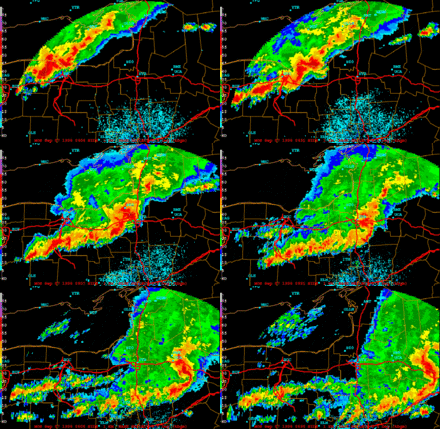
Radar loop, Labor Day 1998 Upstate New York.  This storm impacted the New York State Fair.

Radar loop, Labor Day 1998 Upstate New York. This storm impacted the New York State Fair.

The inspiration for this blog was a paper posted to LLIS by Dr. Susanne Becken, Professor of Sustainable Tourism at Griffith University (Australia) and Lincoln University (New Zealand).  The paper is titled The Christchurch Earthquake and the Visitor Sector, which is also available from this link if you don’t have LLIS access.

Dr. Becken highlights the Christchurch earthquake of February 22, 2011, which killed 185 people from more than 20 nations, 80 of which were listed as visiting, rather than residing in, Christchurch.  She states that as a result of this M 7.1 earthquake infrastructure was badly damaged, accommodation capacity was reduced by half, and the number of international visitors dropped by almost 30 percent in the aftermath.  Dr. Becken identifies many of the challenges visitors had, including loss of travel documentation and other important items, and the value of the tourism industry in the area to assist response efforts (such as providing lodging for displaced citizens as well as responders from out of the area).

This paper brings to mind the vast amounts of visitors and transient populations that are found in many communities across the nation.  When visiting an attraction such as an amusement park, where tens of thousands of people congregate on any given summer day, take a look around.  Many of the amusement parks I know of are in fairly rural areas.  These towns are likely to have small volunteer fire departments and may not even have their own police services, instead relying on a county Sheriff’s Department or State Police.  How about a small city that has popular attractions at certain times of the year, such as horse tracks or other sporting events?  These events will also draw tens of thousands of people from near and far, staying in hotels, motels, and campgrounds.  Sure, these small cities might have a 24-hour staffed fire department, and probably even a small police force.  But how prepared are these types of areas for an incident that can cause mass casualties and fatalities?

Incidents such as this underscore the need for our preparedness to be through and needs-based.  As part of our Threat and Hazard Identification and Assessment (THIRA), which is the latest evolution of the traditional hazard analysis (see CPG-201), we must be sure to recognize visitors and transient populations and the events that bring them to our areas.  We should consider tourist attractions, field days, concerts and performances, large conventions, sporting events, and even college populations.  The potential impacts, in the event of a disaster, are certainly greater with these populations given that they are likely to be unfamiliar with the area, don’t reside locally and probably have no local contacts, and aren’t familiar with the threats.  Given the nature of the event they are attending, they may very well be consuming alcohol, as well.  All this makes for a rather fragile and dependent population in the event of disaster.

Planning on the macro (community) level should consider the specifics mentioned above.  With this information you can estimate the resources needed for certain scenarios (this is part of your THIRA), which will lead you determine gaps which you then plan to address.  Take some time to examine the demographics of the visiting populations.  These demographics will help determine their level of need in the event of a disaster and some areas of support you may need to provide.  Your local chamber of commerce and/or tourism authority can be an important planning partner for this information and other purposes.  Certainly consider the nature of the events and the age range of the attendees.  Are there language or cultural issues that should be prepared for?  Much of this specific information can be obtained event by event, looking at the micro (event-specific) level of planning for these events.  In New York State, a mass gathering permit is supposed to be issued for any event estimating attendance over a certain number.  The primary purpose of these permits is to ensure that officials are aware of the event and that potable water and sanitation is appropriately available, as well as other caveats.  Most states have a similar type of permitting requirement.  Become familiar with it and use it to your advantage.

In any of these events, how will you handle alert and notification in the event of a disaster?  You may have sirens in place, but would a visitor know what it means?  Given that such a high percentage of people have cell phones, use of area blast messaging may be an appropriate consideration.

A lesson learned from airline crashes can and should be brought into your planning: family assistance centers.  Family assistance centers were brought about in the aftermath of the crash of TWA Flight 800, realizing the importance of providing support and information to the families and loved ones of victims.  This concept has been applied as a standard to other mass fatality incidents since then and has proven to be beneficial to all parties.

Be sure to conduct preparedness exercises on these plans, and include members of your local hospitality and tourism industry as they will certainly be involved in some aspect of the greater response should an incident occur.

Sometimes local communities view visiting populations as a hassle, particularly when they don’t have the care for the host community that the locals do.  These populations are usually important to the economy of the local area and, depending in the event, will be back year after year.  No matter what your take is on that argument, you must consider the safety of any visitors or tourists as if they were your own citizens.  Be prepared through regular planning, training, and exercising activities and be sure to include your local chamber of commerce, tourism and hospitality industry as they are not only stakeholders, but they have a great deal of support and information to provide.  Most importantly, remember that all good preparedness efforts begin with a solid needs assessment.  Conduct a THIRA for your community, you might be surprised with what you discover!

What experiences do you have with planning for visiting populations?

Lucien Canton Webinar Recording: Are Your Emergency Operations Plans Realistic?

Last week EM Forum hosted one of the better webinars I’ve attended recently.  The presenter was Lucien Canton, CEM, a fellow Emergency Management Consultant.  His topic was “Are your emergency operations plans realistic?  A group discussion on planning assumptions”.  This presentation was in obvious response to his excellent blog article, Paper Plans and Fantasy Documents, which I blogged about a few weeks ago.  In both his article and the webinar, Lu talks about the need to ensure that plans make sense and can actually be implemented, not just cover legal requirements.

For ease, I’ve pasted the EMForum follow up email here, which provides a link to the webinar recording in various formats.  Highly recommended if you didn’t catch the original airing!


The Webinar recording of the February 13th EMForum.org program, “Are Your Emergency Operations Plans Realistic? A Group Discussion on Planning Assumptions,” with emergency management consultant, Lucien G. Canton CEM®, is now available. This is a large file and requires Windows Media Player or Windows Media Components for QuickTime or a similar product to view. The recording is also available in MP4 format for mobile users. The TranscriptAudio Podcast, as well as Ratings and Comments are available from the Background Page. The Audio Podcast and MP4 recordings are also available from the iTunes Store.

Collegiate Emergency Management

Ever since attending college at SUNY Oswego and serving as chief of our campus ambulance (the first and longest-serving all student-run college ambulance – SAVAC) I’ve had a completely different perspective than most students on the community that is a college campus.  This experience resonated with me through my emergency management career.  As a result, I’ve paid special attention to colleges and universities; helping university police, college public safety entities, and other campus partners to be better prepared by providing training, supporting exercises, and reviewing plans.  I’m fortunate to have friends and colleagues around the nation who are emergency managers for their colleges as well as those who are involved in emergency management degree programs which further the professionalism of our field.  All these folks have worked hard to enhance their colleges’ preparedness through efforts not only targeting college faculty and staff, but also students – which can be a challenge with this regularly changing population.  I’ve seen training offered to students ranging from CPR and First Aid courses, to Campus CERT (community emergency response team), to EMT training.  These types of courses, offered to students, are certainly an investment, but one that can pay off not only for the campus community but beyond the campus when these students graduate.

Colleges and universities have a tremendous amount of resources.  These resources allow a certain measure of self-sufficiency.  I was reminded of this by a recent article about Tufts University working to keep their campus operational after Nemo.  Campuses are truly communities, with hundreds or thousands of residents, hundreds of commuters, and an infrastructure to support it all including roads, facilities, healthcare, and food.  Not only must they have emergency plans in place, but also business continuity plans.  Largely, their number one hazard is fire – and colleges take fire safety very seriously – but they all have their own unique hazard profile which they must address just like any other community.

I have always encouraged colleges to work with their local communities and vice-versa.  There are a number of case studies out there, certainly of local communities aiding campuses during fires, shootings, and other emergencies and disasters.  But there are also instances of colleges helping the local communities.  Not only do campuses have public safety resources (these encompass the entire range of law enforcement – from security guards, to peace officers, to police), but they also have some public works resources, and a vast number of potential volunteers that can all be deployed to aid a local community.  Depending on the education the college provides, these volunteers can range from general labor, to those being trained as social workers, medical providers, veterinarians, and other professions which can provide direct assistance under the supervision of an experienced professional.  This is not only a huge force multiplier to aid the community but also provides real, hands-on experience to the students.  Likely an experience they will never forget.  We’ve also seen colleges and universities provide assistance to local communities on-campus.  Campuses have served as shelters (both in dorms and other facilities, such as gymnasiums) and feeding facilities through their dining halls.  When off term, campuses have massive potential to serve as incident bases, supporting the needs of a larger incident by providing services for incident personnel and resources (remember your ICS training?) through their lodging and feeding capability, medical facilities, loading docks, garages and maintenance facilities, and even just their open spaces.

Colleges and universities have to ensure their own preparedness just like any other community, but they should also work with their local communities and even their county emergency manager on cooperative emergency management relationships.  Local responders should be familiar with the campus, its hazards, facilities, and the people who operate it.  The campus can further relationships by hosting training programs for area responders and emergency managers and should include area responders in any preparedness exercises they conduct.  Engaging the student population in preparedness efforts will have great impact on the campus’s emergency program and will provide skills that the students will carry with them forever.