A Decontamination Game Changer

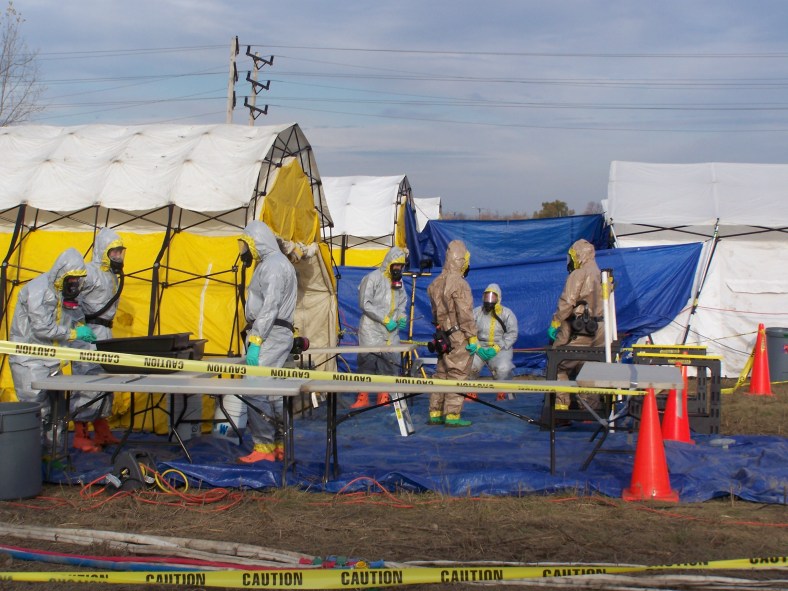
Last week, the way we remove chemical contamination from victims of a terror attack or chemical accident has changed… well, not quite yet, but it should soon.  A partnership between the US Department of Health and Human Services’ (HHS) Office of the Assistant Secretary for Preparedness and Response (ASPR) and the University of Hertfordshire in England and Public Health England found that “…removing clothes removes up to 90 percent of chemical contamination and wiping exposed skin with a paper towel or wipe removes another nine percent of chemical contamination.  After disrobing and wiping with a dry cloth, showering and drying off with a towel or cloth provides additional decontamination, bringing contamination levels down 99.9 percent.”

100_2534

Essentially, what they discovered was that despite recommendations for doing so, victims have often not been required to disrobe for decontamination.  When victims would progress through a decontamination (water spray down), much of the chemical they have been exposed to remains in the clothing and trapped against the skin.  Clearly this is not effective.

I see this new methodology being a significant change to how we decontaminate victims.  As the study hypothesizes, decontamination is much more effective when the chemical is wiped from the body after the victim disrobes.  Following this, they may progress then through a water spray.  This, essentially, adds a step to the typical protocols used in North America, Europe, and other locations.  I’m told the wipe methodology has been used in Japan for some time now.  I also believe that wipes have been in use by the US (and other) military forces for units in the field.

Links of interest:

HHS Press Release on the study.

Implementation of new protocols in the UK and other European nations

Many thanks to my colleague Matt for passing this information on to me.

As with any new procedure, the devil is in the details.  Standards must be established and adopted, supplies and equipment must be identified and obtained, personnel must be trained, and exercises must be conducted to validate.

I’m interested to hear opinions on these findings and recommendations, as well as thoughts on implementation in the US and abroad.

© 2016 – Timothy Riecker, CEDP

Emergency Preparedness Solutions, LLC Your Partner in Preparedness


Failed Attempts to Measure NIMS Compliance – How can we get it right?

Yesterday the US Government Accountability Office (GAO) released a report titled Federal Emergency Management Agency: Strengthening Regional Coordination Could Enhance Preparedness Efforts.  I’ve been waiting for a while for the release of this report as I am proud to have been interviewed for it as a subject matter expert.  It’s the second GAO report on emergency management I’ve been involved in through my career.

The end game of this report shows an emphasis for a stronger role of the FEMA regional offices.  The GAO came to this conclusion through two primary discussions, one on grants management, the other on assessing NIMS implementation efforts.  The discussion on how NIMS implementation has thus far been historically measured shows the failures of that system.

When the National Incident Management System (NIMS) was first created as a nation-wide standard in the US via President Bush’s Homeland Security Presidential Directive (HSPD) 5 in 2003, the NIMS Integration Center (NIC) was established to make this happen.  This was a daunting, but not impossible task, involving development of a standard (lucky much of this already existed through similar systems), the creation of a training plan and curricula (again, much of this already existed), and encouraging something called ‘NIMS implementation’ by every level of government and other stakeholders across the nation.  This last part was the really difficult one.

As identified in the GAO report: “HSPD-5 calls for FEMA to (1) establish a mechanism for ensuring ongoing management and maintenance of the NIMS, including regular consultation with other federal departments and agencies and with state and local governments, and (2) develop standards and guidelines for determining whether a state or local entity has adopted NIMS.”

While there was generally no funding directly allocated to NIMS compliance activities for state and local governments, FEMA/DHS associated NIMS compliance as a required activity to be eligible for many of its grant programs.  (So let’s get this straight… If my jurisdiction is struggling to be compliant with NIMS, you will take away the funds which would help me to do so????)  (the actual act of denying funds is something I heard few rumors about, but none actually confirmed).

NIMS compliance was (and continues to be) a self-certification, with little to no effort at the federal level to actually assess compliance.  Annually, each jurisdiction would complete an online assessment tool called NIMSCAST (the NIMS Compliance Assistant Support Tool).  NIMSCAST ran until 2013.

NIMSCAST was a mix of survey type questions… some yes/no, some with qualified answers, and most simply looking for numbers – usually numbers of people trained in each of the ICS courses.  From FEMA’s NIMS website: “The purpose of the NIMS is to provide a common approach for managing incidents.”  How effective do you think the NIMSCAST survey was at gauging progress toward this?  The answer: not very well.  People are good at being busy but not actually accomplishing anything.  It’s not to say that many jurisdictions didn’t make good faith efforts in complying with the NIMS requirements (and thus were dedicated to accomplishing better incident management), but many were pressured and intimidated, ‘pencil whipping’ certain answers, fearing a loss of federal funding.   Even for those will good faith efforts, churning a bunch of people through training courses does not necessarily mean they will implement the system they are trained in.  Implementation of such a system required INTEGRATION through all realms of preparedness and response.  While NIMSCAST certainly provided some measurable results, particularly in terms of the number of people completing ICS courses, that really doesn’t tell us anything about IMPLEMENTATION.  Are jurisdictions actually using NIMS and, if so, how well?  NIMSCAST was a much a show of being busy while not accomplishing anything as some of the activities it measured.  It’s unfortunate that numbers game lasted almost ten years.

In 2014, the NIC (which now stands for the National Integration Center) incorporated NIMS compliance questions into the Unified Reporting Tool (URT), including about a dozen questions into every state’s THIRA and State Preparedness Report submission.  Jurisdictions below states (unless they are Urban Area Security Initiative grant recipients) no longer need to provide any type of certification about their NIMS compliance (unless required by the state).  The questions asked in the URT, which simply check for a NIMS pulse, are even less effective at measuring any type of compliance than NIMSCAST was.

While I am certainly being critical of these efforts, I have and continue to acknowledge how difficult this particular task is.  But there must be a more effective way.  Falling back to my roots in curriculum development, we must identify how we will evaluate learning early in the design process.  The same principal applies here.  If the goal of NIMS is to “provide a common approach to managing incidents”, then how do we measure that?  The only acceptable methodology toward measuring NIMS compliance is one that actually identifies if NIMS has been integrated and implemented.  How do we do that?

The GAO report recommends the evaluation of after action reports (AARs) from incidents, events, and exercises as the ideal methodology for assessing NIMS compliance.  It’s a good idea.  Really, it is.  Did I mention that they interviewed me?

AARs (at least those well written) provide the kinds of information we are looking for.  Does it easily correlate into numbers and metrics?  No.  That’s one of the biggest challenges with using AARs, which are full of narrative.  Another barrier to consider is how AARs are written.  The HSEEP standard for AARs is to focus on core capabilities.  The issue: there is no NIMS core capability.  Reason being that NIMS/ICS encompasses a number of key activities that we accomplish during an incident.  The GAO identified the core capabilities of operational coordination, operational communication, and public information and warning to be the three that have the most association to NIMS activities.

The GAO recommends the assessment of NIMS compliance is best situated with FEMA’s regional offices.  This same recommendation comes from John Fass Morton who authored Next-Generation Homeland Security (follow the link for my review of this book).  Given the depth of analysis these assessments would take to review AAR narratives, the people who are doing these assessments absolutely must have some public safety and/or emergency management experience.  To better enable this measurement (which will help states and local jurisdictions, by the way), there may need to be some modification to the core capabilities and how we write AARs to help us better draw out some of the specific NIMS-related activities.  This, of course, would require several areas within FEMA/DHS to work together… which is something they are becoming better at, so I have faith.

There is plenty of additional discussion to be had regarding the details of all this, but its best we not get ahead of ourselves.  Let’s actually see what will be done to improve how NIMS implementation is assessed.  And don’t forget the crusade to improve ICS training!

What are your thoughts on how best to measure NIMS implementation?  Do you think the evaluation of AARs can assist in this?  At what level do you think this should be done – State, FEMA Regional, or FEMA HQ?

As always, thanks for reading!

© 2016 – Timothy Riecker

National Preparedness Goal: Second Edition Just Released

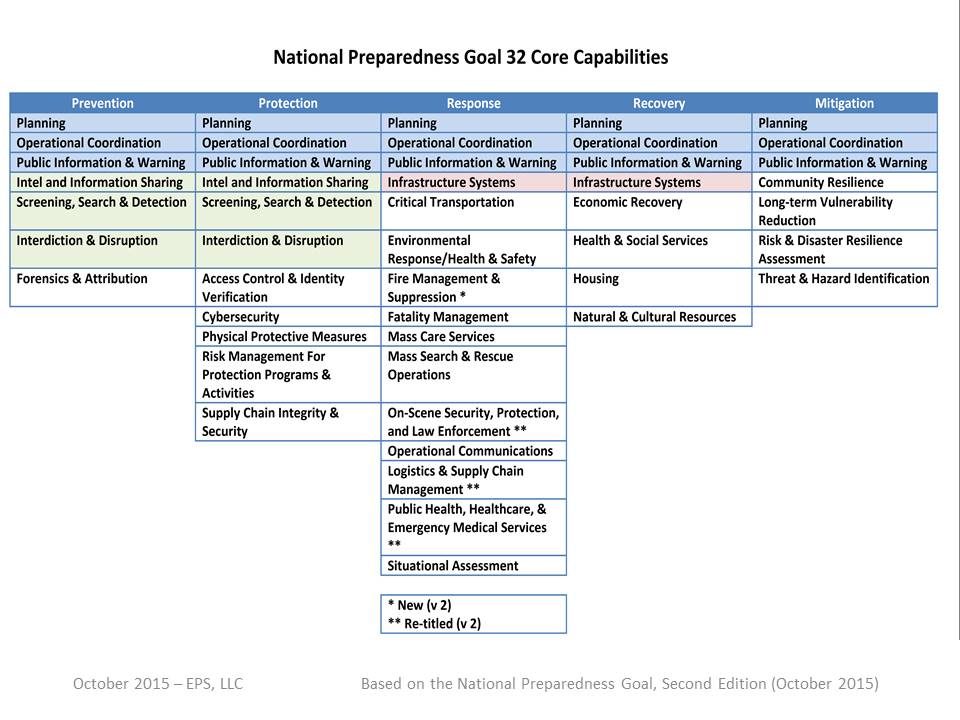
Today FEMA released the second edition of the National Preparedness Goal.  This document, which only has a few substantive changes from the original, provides a vision for preparedness across the nation.  It is best known for identifying the five mission areas of Prevention, Protection, Mitigation, Response, and Recovery; along with the Core Capabilities.  Many thanks to my colleague Jon who brought this release to my attention.  The updated National Preparedness Goal and associated documents can be found here.

There are not many changes in this update, and the changes that are included should be of little surprise if you reviewed the draft released for public comment several months back.  Up front, the update provides some editorial clarification on the definitions and relationships between the federal government and tribes as well as US territories.  It also provides more emphasis on the concept of whole community and the special populations within the whole community which may require additional protections and actions.

Perhaps the most significant changes are reflected in the Core Capabilities, of which there are now 32.  In the preamble to the Core Capabilities which discusses the concept of Risk, it is interesting to note that the Core Capability of Cybersecurity was specifically highlighted as having applicability across all Mission Areas – a concept which I fully agree with.  I’m left wondering, then, why it was not re-defined as a common Core Capability.

NPG 32 Core Capabilities

NPG 32 Core Capabilities

Other changes to the Core Capabilities include the renaming of the On-Scene Security and Protection Core Capability to On-Scene Security, Protection, and Law Enforcement; and the Public Health and Medical Services Core Capability to Public Health, Healthcare, and Emergency Medical Services.  Additionally, the Public and Private Services and Resources Core Capability was renamed to Logistics and Supply Chain Management, which seems to provide better recognition of the intent of that Core Capability.  Finally, a new Core Capability was added – Fire Management and Suppression.

Three of these changes seems to revolve around a stronger recognition and inclusion of the traditional first responder services of Law Enforcement, Fire Service, and Emergency Medical Services; all of which seemed to get lost in the bigger picture of the earlier capability discussions.  I’m hopeful these changes will help bring these services to the table in more communities when capabilities are discussed.  I’m a firm believer that the Core Capabilities provide a consistent, scalable, foundation for discussion of preparedness for every community.

© 2015 – Timothy Riecker

Emergency Preparedness Solutions, LLC

WWW.EPSLLC.BIZ 

Are You Really Considering All Hazards?

Natural hazards, such as flooding, tornados, wildfire, and earthquakes, bring about the greatest losses, calculated in nearly every metric possible, as compared to human-caused incidents.  Human-caused incidents, either accidental or intentional, still bring tremendous impact to communities world-wide on a daily basis.  While working to prepare for, mitigate, respond to, and recover from natural hazards will always continue to be important, it seems that many still often forget about human-caused incidents despite all the conversations out there.

Human-caused incidents include a variety of hazards such as infrastructure failure, transportation accidents, hazardous materials incidents, and intentional attacks.  These are all things which we can fit into our traditional model of Prepare, Mitigate, Respond, and Recover.  The National Planning Goal introduced the model of the five Mission Areas – Prevention, Protection, Mitigation, Response, and Recovery – to help address our many of our major functions (Core Capabilities) for human-caused incidents (note that Preparedness is now a higher level concept that applies to all Mission Areas).  While this Mission Area model has helped bring these key activities into the greater fold of what we do, it has also kept them largely isolated through the thought that many human-caused incidents are only addressed through Prevention and Protection Mission Area activities.

Nowhere, it seems, do we see this more than in the area of hazard mitigation.  The vast majority of hazard mitigation plans which exist only address natural hazards (even at the state level).  Since many readers view this blog for my opinion, here it is – this is archaic and dangerous thinking!  We have all seen hazard mitigation plans which claim they are ‘all hazards’, yet only list natural hazards.  That’s fine, if by some unbelievable circumstance, your jurisdiction is only impacted by natural hazards.  This is a circumstance which I am highly doubtful of.  Some mitigation plans get a little more realistic and will address human-caused hazards such as dam failure and/or hazardous materials release, which were likely the greatest human-caused threats they may have been vulnerable to in the previous century.  In today’s world this still doesn’t quite get us to where we need to be.  There are a great many mitigation activities which we can leverage against human-caused incidents.

How do we fix this?  It’s easy – start with conducting a hazard analysis.  A hazard analysis, be it as a stand-alone activity or part of the THIRA process, should review all possible hazards which your jurisdiction, company, or organization is vulnerable to.  It should be comprehensive, not just limited to the set of natural hazards.  Along with infrastructure failure and hazardous materials incidents (both in-transit and fixed site), consider hazards such as active shooters, cyber attacks, improvised explosives, and civil unrest.  This may require bringing some additional subject matter experts into the room for your hazard analysis – like your IT director.  In a hazard analysis, each hazard is ranked (at a minimum) by its likelihood to occur and its severity of impact should it occur.

A well conducted hazard analysis provides the basis for everything we do in emergency management and homeland security.  It not only informs our activities such as planning, training, and exercises, it also helps assign priority to those hazards which require the greatest focus and allocation of resources.

© 2015 – Timothy Riecker

Emergency Preparedness Solutions, LLC

WWW.EPSLLC.BIZ

NIMS Alert – FEMA Seeks Feedback on Federal Interagency Operational Plans

Take some time to review and comment on these.  Be heard!  TR

<from press release>

FEMA is requesting stakeholder feedback on working drafts of four of the five Federal Interagency Operational Plans (FIOPs):  Protection, Mitigation, Response, and Recovery. The Prevention FIOP is Unclassified and For Official Use Only (FOUO)/Law Enforcement Sensitive (LES), Restricted Access and therefore available to appropriate personnel through separate and secure communication means. The FIOPs describe how the Federal government aligns resources and delivers core capabilities. Each FIOP outlines the concept of operations for integrating and synchronizing existing national-level Federal capabilities to support the whole community.

This update of the FIOPs focuses on discrete, critical content revisions, and confirming edits as a result of comments received on the National Preparedness Goal and National Planning Frameworks. Additional changes in the draft are the result of the lessons learned from implementing the FIOPs and recent events, as well as the findings of the National Preparedness Report.  The FIOPs and feedback submission forms may be found at http://www.fema.gov/ppd-8-news-updates-announcements.

To ensure all feedback is properly handled, reviewers are asked to use the provided feedback submission form to submit feedback and recommendations. Please provide any comments and recommendations, using the submission form, to PPD8-Engagement@fema.dhs.gov by Tuesday, September 2, 2015 at 5:00 PM EDT.

PPD-8 Revisions and National Engagement Period

A NIMS Alert has just been released announcing the opening of the national engagement (comment) period on revisions to PPD-8 (National Preparedness Goal).  Most notably, these revisions include updated definitions for 10 Core Capabilities and the creation of one new Core Capability – Fire Management and Suppression.

These last few years I have found that FEMA has been more responsive than ever to stakeholder feedback and this is another great opportunity to ensure that their guidance and doctrine continues to be relevant and meaningful to those of us who use it.

A link to the PPD-8 revision site and national engagement period is here: http://www.fema.gov/media-library/assets/documents/103912.

TR

Capability Prioritization

The THIRA (Threat and Hazard Identification and Risk Assessment) process is the most comprehensive hazard analysis in emergency management and homeland security.  It provides more information than the traditional hazard analysis by examining each hazard through the lens of each of the 31 Core Capabilities which have been specifically defined by the stakeholders of the jurisdiction.  The end result of the THIRA is a snapshot of the hazards a jurisdiction faces and the identification of what is needed to handle that hazard within each of the five mission areas (Prevention, Protection, Response, Recovery, and Mitigation).  It can be a complex process, but well worth the investment of time for a jurisdiction.  More, however, can be learned and the THIRA should inform more than just your plans.

For states and UASIs (Urban Area Security Initiative jurisdictions), the process continues in the form of the SPR (State Preparedness Report).  The SPR uses the THIRA data and applies a POETE (Planning, Organizing, Equipping, Training, and Exercising) analysis to each capability.  The POETE analysis drills deeper into each capability, allowing the jurisdiction to better understand their strengths and weaknesses within each capability.  This is extremely valuable information and clearly there are benefits to more than just states and UASIs conducting a POETE analysis.  The SPR process also prompts jurisdictions to assign a priority to each capability – High, Medium, or Low.  All in all, this provides a depth of data, but what does it all mean?

While the SPR process expands on the THIRA foundation by prompting a more in-depth analysis of each capability, the end result is a multitude of data points.  Taken individually, a jurisdiction can examine details of a specific capability, but further analysis needs to be undertaken to see the big picture.  Many jurisdictions rate quite a few of the 31 Core Capabilities as a High priority.  So what do you focus on?  If everything is a priority then nothing is a priority!

In response to this, Emergency Preparedness Solutions, LLC has developed a proprietary Capability Prioritization which incorporates stakeholder-assigned priorities while also considering the ratings provided in the POETE analysis.  The results of the Capability Prioritization provide a relative priority ranking of the Core Capabilities for the jurisdiction which can give the jurisdiction a better view of the overall priorities for continued development of preparedness strategies across the POETE spectrum, policy issues, investment justification, and resource allocation.

Emergency Preparedness Solutions, LLC is skilled and experienced in conducting THIRAs and POETE Analysis – plus we equip your jurisdiction with usable data and recommendations based on our findings.  Contact us today to jumpstart and focus your preparedness efforts.  The investment will pay off!  Be Proactive, Be Prepared! ™

logo w tagline


© 2014 – Timothy Riecker

Preparing for Ebola – and Whatever Else May Come

Unless you’ve been living under a rock lately, you should be quite aware of the headlining threat in public health and public safety – Ebola hemorrhagic fever.  Ebola has been in existence for quite a while, but the current outbreak of this deadly virus in western Africa has garnered much attention.  Thus far, beyond western Africa, infected persons have been identified in Spain and the United States.  The ease and frequency of air travel, combined with the virulence of Ebola have led to a frenzied reaction by politicians, the media, and our health care system.  While we are at a stage in the US where only a handful of infected persons have been identified, this virus is quite dangerous and could easily and rapidly spread.

While I’m not a public health expert, preparedness is universal.  Public health is at the tip of the spear for this fight and must be supported by other professions within public safety and beyond – that’s what emergency management is all about.  That said, this is proving to be quite a test for our public health partners.  The consequences of failure could be devastating.

Considering the five mission areas, we are most strongly functioning within Prevention, Protection, and Response for Ebola.  Certainly the three common Core Capabilities of Planning, Operational Coordination, and Public Information and Warning are all fully engaged across the three mission areas.  Additionally, we are seeing a great deal of work within in the Intelligence and Information Sharing; Screening, Search, and Detection; Public Health and Medical; and Situational Assessment Core Capabilities; along with some work in other capabilities to a lesser degree.  Why is it important to recognize the mission areas and Core Capabilities?  It helps to keep us focused and prompts us to examine the critical activities for each.

In which mission areas and Core Capabilities does your agency fit in?

What are you responsible for?

Are you doing it?

Do you have all the information you need to do it safely and effectively or are you waiting for public health to call and tell you what to do?  I’m betting you haven’t gotten that phone call.

In a situation like this, we are seeing a lot of activity and emphasis at the Federal level through US Health and Human Services and the Centers for Disease Control.  Their focus is on solving the problem in front of them.  While they have people engaged in getting messages out and engaging partners, they have a lot to accomplish and likely haven’t gotten to all the stakeholders.  We will hopefully see some more aggressive messaging given the circumstances that have been described at the Texas hospital where Ebola patients have been treated.  So what should you do?  Hopefully your agency is already in contact with your local health department to discuss both your role in the public safety system and the potential exposures and vulnerabilities you may have to Ebola.  If your local health department doesn’t seem to have much information, reach up to your state health department.  Don’t wait to get a call… by then it could be too late.

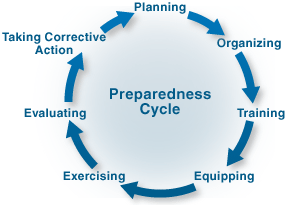
Very simply, we are looking at preparations for your agency’s role.  These preparations, although slightly different based on the agency, apply to all agencies; from first responder agencies, to local government, K-12 and higher education schools, hospitals, private sector, and not for profits.  Let’s break this down with the Preparedness Cycle:

The Preparedness Cycle - FEMA

The Preparedness Cycle – FEMA

Plans, policies, procedures – do you have them in place and up to date?  Depending on the role and function of your agency you can have several of the following – emergency operations plan, emergency procedures, infection control plan and procedures, public health plan, communicable disease or pandemic influenza plan.  You should engage with public health experts to ensure that your plans, policies, and procedures address everything known about Ebola.  You may need to create some procedures specifically addressing issues pertaining to Ebola and your agency’s role.  Do your plans, policies, and procedures link up to your agency’s critical activities for each Core Capability you are engaged in?  What agencies do you need to coordinate with to be effective?

Organizing – depending on your agency’s role, you may need to make some internal changes or designations within your organization to better streamline your activities.

Training – train everyone who has anything to do with any component of the plan in what they need to do.  This is a great opportunity to ensure that everyone is trained up in their role of the emergency operations plan.  If your agency has physical contact with the public, training in personal protective equipment (PPE), identification of signs and symptoms, and patient care are extremely important.  Given the detail of the activities and the just-in-time training, job aids will be a great help to your staff to ensure that they follow the procedures you provide for them.  Don’t get caught short… communicate to your staff in what is going on, what your agency is or may be responsible for, and what they will be called upon to do.

Equipping – your staff need the right equipment for the job.  Not only PPE, but the forms and databases used to record information, decontamination equipment, etc.  It is extremely important that staff are trained not only in how to use equipment but to prevent contamination of equipment and prevention of cross contamination.  Do you have all the equipment you need?  If not, who does?

Exercising – Conduct table top exercises to talk through policies and higher levels plans to validate and become familiar with them.  Identify shortfalls and correct them immediately.  Conduct drills to test the skills of staff for specific activities and larger exercises – functional or full scale – to test multiple functions and plans.

Evaluating – Evaluation is a constant throughout all of the preparedness cycle.  We need to evaluate every step within the preparedness cycle and make adjustments and improvements as needed.  Embrace best practices and fix shortfalls.  This leads directly to the next step…

Taking Corrective Action – Some corrective actions are quick and easy fixes while others can take a while or cost money above budget to address.  A corrective action plan (aka improvement plan) will help you keep track of what needs to be fixed, the priority it holds, who is responsible for making it happen, and a strategy to make it happen – it’s a living document.

The preparedness cycle can be applied to any hazard, be it Ebola or a flood.  With all this attention on Ebola, it’s a great opportunity to pull plans off the shelf and have discussions with internal and external stakeholders on these preparedness steps.

© 2014 – Timothy Riecker
Keeping Up With Changes in Emergency Management

As with many things in life, the field of emergency management has changed and will continue to do so.  Much of this change is an evolution – generally positive and productive adjustments to make us more effective and efficient in what we do supported by doctrine and models to guide our actions and provide consistency of application.  Sometimes changes are made which simply give the illusion of progress or are applied much like a Band-Aid as a knee-jerk stop-gap measure which usually fail unless a better implementation is put in place.  Many of the better thought out applications, however, do tend to stick.  While we have seen a great deal of change in the field over the last 14 years, we have largely seen a clear progression with practitioners and policy makers learning from previous programs. 

Yesterday I encountered two separate instances which did not apply current practices and policies. The first was an advertisement for a training program which discussed the four phases of emergency management.  The second was an article in which the author stated that ‘…preparedness is no longer part of the (emergency management) lexicon…’.  The two items, while different, are related in that they both indicate a lack of understanding in the evolution we have made from the four phases of emergency management – mitigation, preparedness, response, and recovery. 

In a nutshell, these long standing phases began to change soon after the terrorist attacks of 9/11 with the integration of homeland security with emergency management resulting in the inclusion of ‘prevention’ into the emergency management phases – thus prevention, mitigation, preparedness, response, and recovery.  As minor as this seems, it was quite a change for those of us who had been in the world of the four phases for a while and was a difficult pill to swallow.  Along with the human nature of resistance to change there was still a feeling that the matter wasn’t quite fully settled – in other words, more change would come. 

For several years different models were kicked around but none really gained traction until the issuance of Presidential Policy Directive 8 (PPD8), which created the National Preparedness Goal and the National Preparedness System.  These begat things like the Core Capabilities (a revamping of the predecessor Target Capabilities) and the introduction of the Threat and Hazard Identification and Risk Assessment (THIRA) as well as a new way of viewing the major activities within emergency management and homeland security – the five mission areas of prevention, protection, mitigation, response, and recovery.  These five mission areas have re-defined, or perhaps more accurately defined what it is that we do in emergency management and homeland security. 

The traditional four phases were often depicted in a cycle.  Taken literally, this meant that you progressed from one phase to the next in a series.  The truth of the matter was that each of the four phases could actually run simultaneously.  There was also a misunderstanding that preparedness was an isolated activity, when in actuality our preparedness efforts applied to all activities.  With the further evolution of homeland security the foundational activities of prevention and then protection were identified and defined.  Pulling together these five mission areas – prevention, protection, mitigation, response, and recovery – the National Preparedness System provides for distinct preparedness activities identified for each mission area, an organization of the Core Capabilities within each mission area, and national planning frameworks which identify the role and goals of each mission area in achieving the national preparedness goal.  Not only has preparedness not gone away, but it has been elevated in status. 

PPD8 was probably the presidential directive with the greatest and broadest impact on our field of practice since Homeland Security Presidential Directive 5 (HSPD5) in 2003 which drove the implementation of the National Incident Management System (NIMS).  Keeping up with critical changes in our evolution such as these is absolutely imperative for practitioners.  Not only do these policy changes impact how we do our jobs individually and programmatically, but they impact how we coordinate with each other, which is and always will be the foundational essence of emergency management. 

How do you keep up with changes in our field of practice?

© 2014 Timothy Riecker

Having a Resource Management Common Operating Picture

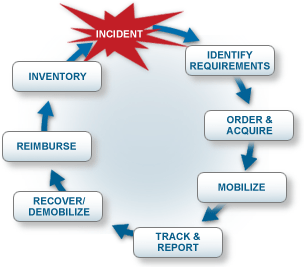
Resource management is one of the most complex aspects of emergency management.  The resource management cycle could be seen as a microcosm of the emergency management cycle with a number of steps operating in sequence and some simultaneously before, during, and after a disaster.  We need to properly establish our resource management systems, procedures, and policies and keep them, as well as our inventories, up to date.

Referencing the Core Capabilities, the capabilities of Public and Private Services and Resources, Planning, Critical Transportation, and Operational Coordination all have bearing on resource management.  Resource management is also one of the key components of NIMS.  The following graphic on the resource management cycle comes from NIMS doctrine.  While this is largely a logistics issue, the importance of it all cuts across all levels of all organizations.

NIMS Resource Management Cycle

NIMS Resource Management Cycle

Consider each of the steps identified in the resource management cycle.  There is quite a bit of complexity to each.  An additional challenge is that they are always in motion as requirements regularly change, new resources are obtained, and obsolete resources are retired from service.  Often one change in a step of the cycle requires changes cascading to other steps.  Also consider the variety of people involved in each step.  No one agency or department has all the resources, therefore we are relying on information from others to create a common operating picture of resource management.  Additionally, the regularity of changes in this information require us to have establish and maintain a system which allows for real-time tracking of this information.

Any information can be viewed in a variety of manners.  A fairly simple web-based tool can allow for multiple stakeholders to input data and change resource status, but the display of that information the reporting available from such as system allows for better utility.  The integration of GIS can help us identify not only where our resources are, but what their status is (NIMS provides us with three resources status indicators: Assigned, Available, and Out of Service), as well as detailed information on the resource such as the kind and type (again, these are NIMS-driven definitions that describe the capability of a resource), the owner of the resource along with contact information, and other information including technical, operational, and maintenance information.

In a pre-incident condition we should know what we have, what capability of those resources, and the conditions for deployment.  Operating under ICS, once an incident occurs, Logistics obtains resources for the incident where tracking becomes the responsibility of the Resource Unit in the Planning Section.  After an incident, these resources return to their owners where they are maintained and re-inventoried.  Depending on the incident, owners may be reimbursed for their use which requires reporting on a variety of metrics.

Wildfire incident management practices brought us the T-Card system – a great low-tech way of tracking incident resources.  A T-Card system is easy to learn and deploy and does a great job of tracking resources but can be very labor intensive and certainly has a delay in reporting.  I’ve also used spreadsheets and stand alone databases, which allow for more flexibility and automated reporting, but still suffer from a delay with a single point of data input and management.  Networked systems allow for immediate inclusion of staging areas, bases, and other mobilization or stockpile areas and are suited for simple and complex incidents.  Consider leveraging technology to maximize your resource management common operating picture on both a daily basis and for incident management.  Of course it’s always good to have a low-tech back up (and the know-how to use it!).

What systems do you have in place for resource management?  What best practices have you identified?

© 2014 Timothy Riecker