EOC Management Organization

FEMA recently released a draft Operational Period Shift Brief Template for EOCs, open to public comment.  The document is fine, though there was one glaring issue… it assumes an ICS-based model is in use in the EOC.

With the release of the NIMS refresh, we were given some ‘official’ options for EOC management structures.  Unfortunately, we aren’t seeing much material that supports anything other than an ICS-based structure.  An ICS-based structure may certainly be fine, but every organization should examine their own needs to identify what works best for them.  Story time…

We recently completed a contract that included the development of a plan for a departmental operations center for a state agency.  The plan had to accommodate several considerations, including interaction with regional offices and operations, interaction with the State EOC, and integration of a call center.  When we talked to people, examined form and function, and looked at fundamental needs, the end result was an ICS-based organization.  While accommodations had to be made for translating their own agency structure and mission, it fit rather well.

For a contract we are currently working on, we are developing an EOC plan for a private utility.  Again, we reviewed documents, talked to people, and identified the fundamental needs of the company and the EOC organization.  The end result is shaking out to be something a little different.  At a glance, it’s largely ICS-based, but has some aspects of the Incident Support Model, while also having its own unique twists.  One particular observation was that their company’s daily structure has functions combined that we would normally break up in traditional ICS.  Breaking these functions up for an incident would be awkward, disruptive, and frankly, rather absurd.  Not only would personnel be dealing with something out of the ordinary, they would be changing the flow of corporate elements that have been placed together by necessity in their daily operations, which would detract from their efficiency during the incident.

My third example is a contract we are just getting started on.  This project involves developing an EOC plan for a municipality.  While we’ve had some initial discussions, we aren’t sure what the end result will be just yet.  The client isn’t set on any particular structure and is open to the process of discovery that we will be embarking on.  As I’ve thought about their circumstances and the recent and current work we’ve done on this topic, there are a few things that have come to mind.

  1. While NIMS is all about standardization and interoperability, the range of utility of emergency operations centers, in any form, and the mission, organization, an innate bureaucracy of the ‘home agency’ have a heavy influence on what the EOC’s organization will look like.
  2. While there still should be some standard elements to an EOC’s organization, there is generally less fluidity to the composition of an EOC, especially as it compares to a field-level incident command where the composition of the responding cadre of organizations can radically differ.
  3. Consider the doctrinal core concepts of ICS as really core concepts of incident management, thus we can apply them to any structure. These concepts are fundamental and should exist regardless of the organization used.  Some examples…
    1. Unity of Command
    2. Modular organization
    3. Manageable span of control
    4. Consolidated action plans
    5. Comprehensive resource management
  4. We need to acknowledge that the full benefit of organization standardization, exhibited by the ability of incident management personnel to be assigned to a new EOC and be able to immediately function, is potentially compromised to an extent, but that can be largely mitigated by adherence to the core concepts of ICS as mentioned previous. Why?  Because the system and processes of incident management are still largely the same.  These new personnel need just a bit of an orientation to the organizational structure being used (particularly if they are to be assigned in a leadership capacity at any level).

The most important consideration is to develop a plan.  That will provide extensive benefit, especially when done properly.  Follow the CPG 101 guidance, build a team, do some research, and weigh all options.  The end goal is to identify an organizational structure that will work for you, not one that you need to be forced into.  Bringing this around full circle, we need to know that with whatever system you decide to use, expect that you will need to develop your own training, job aids, and other support mechanisms since they largely don’t exist for anything outside of an ICS-based structure.  Note that even for an ICS-based model, there are needs… consider that there is no ‘official’ planning P for EOCs (one that is less tactics-focused), and, of course, that ICS training alone isn’t enough to run your EOC by.

I don’t place any blame for this need… consider that FEMA, with finite resources just like the rest of us, tries to produce things that are of the greatest utility to as much of the nation as possible, and right now, most EOCs are run on an ICS-based model.  While I hope this will expand over time, every entity will still be responsible for developing their own training on how they will organize and respond.  No training developed by a third party for a mass audience can ever replace the value of training designed specifically to address your plans.

I’m interested in hearing what changes are being made to your EOC organizations and how you are addressing needs.

© 2019 Timothy Riecker, CEDP

Emergency Preparedness Solutions, LLC

Preparedness: Integrating Community Lifeline Considerations

Much of preparedness is about getting us ready to conduct situational assessment and prioritization of actions.  We train people and develop resources, such as drones, field-deployed apps, and geographic information systems (GIS) to support situational assessment.  The information we obtain from these assessments help in the development and maintenance of situational awareness and, when shared across disciplines, agencies, and jurisdictions, a common operating picture.  Based upon this information, leaders at all levels make decisions.  These decisions often involve the prioritization of our response and recovery actions.  Ideally, we should have plans in place that establish standards for how we collect, analyze, and share information, and also to support the decision making we must do in prioritizing our actions.  Exercises, of course, help us to validate those plans and practice associated tasks.

One significant hurdle for us is how overwhelming disasters can be.  With just slight increases in the complexity of a disaster, we experience factors such as large geography, extensive damages, high numbers of lives at risk, hazardous materials, and others.  Certainly, we know from Incident Command System training that our broad priorities are life safety, incident stabilization, and property conservation – but with all that’s happening, where do we start?

One thing that can help us both assessment and prioritization are community lifelines.  From FEMA: “Community lifelines reframe incident information to provide decision-makers with impact statements and root causes.”  By changing how we frame our data collection, analysis, thinking, and decision-making, we can maximize the effectiveness of our efforts.  This shouldn’t necessitate a change in our processes, but we should incorporate community lifelines into our preparedness activities.

The community lifelines, as identified by FEMA, are:

  • Safety and Security
  • Food, Water, and Sheltering
  • Health and Medical
  • Energy
  • Communications
  • Transportation
  • Hazardous Materials

If this is your first time looking at community lifelines, they certainly shouldn’t be so foreign to you.  In many ways, these are identified components of our critical infrastructure.  By focusing our attention on this list of items, we can affect a more concerted response and recovery.

FEMA guidance goes on to identify components we should be examining for each community lifeline.  For example, the lifeline of Health and Medical includes the components of:

  • Medical Care
  • Patient Movement
  • Public Health
  • Fatality Management
  • Health Care Supply Chain

Each component is then broken down into sub-components. Continuing the example, within the component of Fatality Management, you can examine sub-components such as:

  • Mortuary and post-mortuary services
  • Transportation, storage, and disposal resources
  • Body recovery and processing
  • Family assistance

Of course, you can dig even deeper when analyzing any of these sub-components to identify the status and root cause of failure, which will then support the prioritization of actions to address the identified failures.  First we seek to stabilize, then restore. The organization of situation reports, particularly those shared with the media, public, and other external partners might benefit from being organized by community lifelines.  These are concepts that are generally tangible to many people, and highlight many of the top factors we examine in emergency management.

Back in March of this year, FEMA released the Community Lifelines Implementation Toolkit, which provides some great information on the lifelines and some information on how to integrate them into your preparedness.  These can go a long way, but I’d also like to see some more direct application as an addendum to CPG-101 to demonstrate how community lifelines can be integrated into planning.  Further, while I understanding that FEMA is using the community lifeline concept for its own assessments and reporting, the community aspect of these should be better emphasized, and as such identifying some of the very FEMA- and IMAT-centric materials on this page as being mostly for federal application.

Has your jurisdiction already integrated community lifelines into your preparedness?  What best practices have you identified?

© 2019 – Timothy Riecker, CEDP

Emergency Preparedness Solutions, LLC℠®

Airport Emergency Planning

Through my career I’ve had the opportunity to work with a number of airports on preparedness efforts.  In the past couple of years, that interaction has been greatly amplified through a contract my company successfully completed involving the development of exercises for airports.  As part of this effort, we designed, conducted, and evaluated exercises at ten airports of varying sizes across the nation, from Georgia to Alaska, Massachusetts to California.  Since the primary intent of exercises is to validate plans, we of course requested and reviewed airport emergency plans (AEPs) from each location as part of our preparation for each exercise.

For those not in the know, the requirement for AEPs originates with Federal Aviation Regulation 14 CFR Part 139, which wholly establishes the standards for the certification of airports.  The requirements for AEPs are further refined in DOT/FAA Advisory Circular 150-5200-31C published in May of 2010.   The Advisory Circular is largely implementation guidance.  It’s quite comprehensive and outlines a planning structure, references emergency management doctrine and standards of practice such as NIMS and the National Response Framework, and models a planning process, which mirrors that of CPG-101.  The NFPA also provides guidance in NFPA 424: Guide for Airport/Community Emergency Planning, which reflects on all these as well.

Just like any community emergency operations plan (EOP), AEPs I’ve reviewed run the full spectrum of quality.  Some plans are thorough and comprehensive, while other plans are so focused on meeting the letter of the regulation that they fall short of meeting real needs and being implementation-ready, even though they technically meet the requirements set forth in §139.325.  Regulated industries, which airports largely are, often have a challenge when it comes to emergency planning.  We see this same challenge in radiological emergency plans as well.  The laws and regulations seem to provide so much structure that it is perceived that local variables and subjective analysis aren’t allowed.  As an example, §139.325 states:

“the plan must contain instructions for response to:

  1. Aircraft incident and accidents
  2. Bomb incidents, including designation of parking areas for the aircraft involved
  3. Structural fires
  4. Fires at fuel farms or fuel storage areas
  5. Natural disaster
  6. Hazardous materials/dangerous goods incidents
  7. Sabotage, hijack, or other unlawful interference with operations
  8. Failure of power for movement area lighting
  9. Water rescue situations (as appropriate)”

While the planning process isn’t prescribed in §139.325, nor does it specify if other hazards can be included in the AEP, the Advisory Circular (AC) does expound on this and prescribes a planning process, including a hazard analysis.  The AC states “Through the hazards analysis program, guidance has been provided to assist in the identification of those hazards and disasters specific to an airport that warrant planning attention”.  That phrasing indicates that airports should be planning for hazards beyond what is required by §139.325, yet I’ve seen many that do not.

Obviously ‘natural disaster’ covers a considerable amount of proverbial territory.  Jurisdictions undergo extensive hazard analysis and hazard mitigation planning to identify the breadth and scope of these hazards (which should include all hazards, not just natural disasters).   Many jurisdictions develop very comprehensive EOPs and annexes to address the response needs of each of their primary hazards.  I saw this as a significantly missing component in many AEPs, which treated ‘natural disasters’ as a single hazard.  Further, as many airports stick to the minimum requirement for planning, they fail to address other hazards which could impact them, ranging from dam failure, and nuclear power facility incidents, to currently hot topics such as active shooter/hostile event response (ASHER) and communicable diseases.

Some airports have thankfully recognized the need for expanding beyond the required hazards and have developed plans that better address all of their needs.  On the unfortunate side, again as a regulated industry, I’ve also seen some airports having two sets of plans… one that meets regulation and the other that they feel is more practical for implementation.  Clearly this isn’t the way to go either.  A single, consolidated plan can be developed that meets all needs.

Airports are an interesting animal.  Regardless of governance structure, they are part of the communities which surround them.  Larger airports are also communities of their own, having significant capability, sometimes more than the surrounding jurisdictions.  Airport emergency planning should acknowledge and involve their community relationships and must address all hazards, not just the ones required by Part 139.  Just as with any other type of emergency plan, they must be implementation-ready.  To do so typically requires the added development of standard operating guidelines (SOGs) and job aids, such as check lists and forms.  Plans should also be developed to address recovery issues and business continuity, not just response.  An airport, regardless of governance structure, operates like a business, with many other stakeholders dependent upon their stability and ability to address and rapidly recover from incidents.  They are also obviously transportation hubs, dealing with large volumes of people and significant dollar figures in freight and commerce.

Airport emergency managers have many of the same challenges as the emergency managers of any other community.  Staffing and funding rarely line up with requirements and other priority matters.  I encourage community emergency managers to reach out to their local airports and coordinate, as many hands make easier work for everyone.  Of course, if any airports are seeking assistance in enhancing their preparedness, please contact us as we would love to work with you!

© 2018 – Timothy Riecker, CEDP

Emergency Preparedness Solutions, LLC™


Pre-Disaster Recovery Planning Guidance

So much of preparedness focuses on the Response mission area, which is necessary, given the need to protect life and property in the immediate aftermath of a disaster; but we should never leave disaster recovery by the way side.  I’ve blogged in the past about the significant lack of Recovery mission area exercises we typically see, but we shouldn’t forget that the foundation of preparedness is planning.  How does your pre-disaster recovery plan look?

If jurisdictions have a pre-disaster recovery plan at all (and I mean beyond two paragraphs in their comprehensive emergency management plan), it’s typically focused on debris management.  This isn’t without good cause.  Debris management is incredibly complex, has a lot of benchmarks to follow in terms of best practices, and must include all of FEMA’s requirements, which largely stem from lessons learned in debris management.  Having a debris management plan in place can also qualify a jurisdiction to receive a higher percentage of reimbursement.  That said, debris management isn’t the only aspect of recovery that must be planned for.

FEMA recently released the Pre-Disaster Recovery Planning Guide for State Governments (November 2016).  I’ll admit, the first thing I looked for in the document were references to CPG-101, which is FEMA’s established standard for planning.  I was thrilled to find that it’s not only mentioned, but much of the document is based upon CPG-101.  Found in the document’s early narrative are topics such as the importance of aligning disaster recovery with hazard mitigation, as well as aligning disaster recovery with response.  These are two important factors which make disaster recovery even more complex, as disaster recovery is clearly not only an end state itself, but also a bridge between response and mitigation.

The document also outlines the differences and similarities between pre-disaster recovery planning and post-disaster recovery planning.  Another important distinction.  Many give the excuse of not having a vigorous pre-disaster recovery plan because there are too many unknown variables to anticipate and plan for.  I usually throw my bullshit flag on this statement.  While there is some truth to the statement, it’s also a convenient excuse.  For the same reasons why we create emergency operations plans before a disaster ever strikes, we must develop recovery plans before a disaster strikes.  While there are unknowns, there are also many solid assumptions we can make for the foundation of our planning.  We can identify key activities, assign responsibility, and work toward identifying gaps and building capability and capacity.  Once a disaster does occur, we then pull people out of the response to begin drawing up more specific plans for disaster recovery, hopefully capitalizing on our pre-disaster planning efforts.

Much of the document is a breakdown of CPG-101 planning steps in the context of disaster recovery.  They give some great examples and references throughout the document.  From my quick review, this is a pretty solid document.  While the intended audience is state government, I see easy applicability of this document to most, if not all, local governments – so long as it’s approached with a scaled perspective.

I’m very pleased that FEMA continues to tie preparedness standards together, doing away with decades long practices of response-oriented preparedness tasks being handled one way, while the tasks of other mission areas are handled very differently.  Across the whole spectrum of preparedness, in consideration of every mission area and each of the POETE elements, we need to start identifying critical intersections which will help us capitalize on efforts.  We need to do away with the isolation and siloing of these, and begin working more collaboratively.  From this, we will see greater success.

Consume and ponder.  Feedback is always appreciated.

© 2017 – Timothy Riecker, CEDP

Emergency Preparedness Solutions, LLC

Do We Need Different Systems for Catastrophic Incidents?

We’ve long heard, albeit in small pockets, people proclaiming that emergency management and public safety need different systems for larger incidents vs smaller incidents.  For years, the Incident Command System (ICS) fought that stigma, with many saying that ICS is only used for hazardous materials incidents (specifically because of OSHA requirements) or for large incidents that required such a high degree of organization.  Following the release of HSPD-5 and the resultant requirements for everyone to use the National Incident Management System (NIMS), we finally seemed to transcend that mentality – although we are still seeing people apply ICS poorly, and often with the thought that it will all work out fine when a large incident occurs.

Since the mid-2000s, coupled with the push for ‘catastrophic planning’, I’ve been hearing people proclaiming that catastrophic incidents require different systems – be it for planning or management.  Recently, I’m hearing this mentioned again.  Yet, interestingly enough, none of the arguments identify specifically what it is about our current systems of preparedness or incident management that fail at the sight of a catastrophic incident.

While I’m a critic of various aspects of our current systems, I’m a believer in them overall.  Do we need a new system of planning?  No, we just need to do it better.  When we plan for a catastrophic level event, we must consider that NOTHING will work in the aftermath of such an incident.  I’m shocked that some people are still counting on the existence and functionality of critical infrastructure following a catastrophic event.  No roads, no communications, no life lines.  These surprised disclosures are revealed in the After Action Reports (AARs) of incidents and exercises that test catastrophic incidents, such as the recent Cascadia Rising exercise.

Fundamentally, are these losses all that different than what we experience in smaller disasters?  Not so much.  Smaller disasters still take out our roads and disable our communications systems – but such disasters are small enough that we can work around these issues.  So how is it a surprise that a large hurricane or earthquake will do even more damage?  It really shouldn’t be.  It’s essentially a matter of scale.

That said, I certainly acknowledge the difficulties that come with the combined impacts of a catastrophic disaster, coupled with the sheer magnitude of it all.  There are challenges offered that we don’t normally see, but a new system of planning is not the answer.  The current frameworks and standards, such as CPG-101 and NFPA 1600 are absolutely substantial.  The processes are not flawed.  The issue is a human one.  We can’t blame the standards.  We can’t blame the plans.  The responsibility lies with the people at the table crafting the plan.  The responsibility lies with them to fully understand the hazards and the potential impacts of those hazards.  Conducting a hazard analysis is the first step for a planning team to accomplish, and I think this is often taken for granted.  While the traditional hazard analysis has value, the current standard is the Threat and Hazard Identification and Risk Assessment (THIRA).  It is an exhausting and detailed process, but it is highly effective, with engaged teams, to reveal the nature and impacts of disasters that can impact a community.  Without a solid and realistic understanding of hazards, including those that can attain catastrophic levels, WE WILL FAIL.  It’s that simple.

As we progress through the planning process and identify strategies to accomplish objectives, alternate strategies must be developed to address full failures of infrastructure and lack of resources.  Assumptions are often made in plans that we will be able to apply the resources we have to fix problems; and if those resources are exhausted, we will ask for more, which will magically appear, thus solving our problems.  Yes, this works most of the time, but in a catastrophic incident, this is pure bullshit.  This assumption needs to be taken off the table when catastrophic incidents are concerned.  The scarcity of resources is an immediate factor that we need to address along with acknowledging that a severely damaged infrastructure forces us out of many of the technological and logistical comforts we have become accustomed to.  It doesn’t require a new system of planning – just a realistic mentality.

This all logically ties to our incident management system – ICS.  ICS is fully able to accommodate a catastrophic-level incident.  The difficulties we face are with how we apply it (another human factor) and integration of multiple ICS organizations and other incident management entities, such as EOCs.  The tenant in ICS is that one incident gets one incident command system structure.  This is obviously not a geo-political or practical reality for a catastrophic incident that can have a large footprint.  This, however, doesn’t mean that we throw ICS out the window.  This is a reality that we deal with even on smaller disasters, where different jurisdictions, agencies, organizations, and levels of government all have their own management system established during a disaster.  Through implementations such as unified command, multi-agency coordination, agency representatives and liaison officers, and good lines of communication we are able to make effective coordination happen.  (Side note: this is absolutely something I think we need to plan for and tighten up conceptually.  It’s often pulled together a bit too ad-hoc for my comfort).

While some time and effort needs to be applied to develop some solid solutions to the issues that exist, I’m confident that we DO NOT need to create alternate preparedness or response systems for addressing catastrophic incidents – we simply need to apply what we have better and with a more realistic perspective.  The answers won’t come easy and the solutions might be less than ideal, but that’s the nature of a catastrophic event.  We can’t expect it to be easy or convenient.

© 2016 – Timothy Riecker, CEDP

Emergency Preparedness Solutions, LLCYour Partner in Preparedness

If You Aren’t Assessing Hazards, What Are You Basing Your Preparedness On?

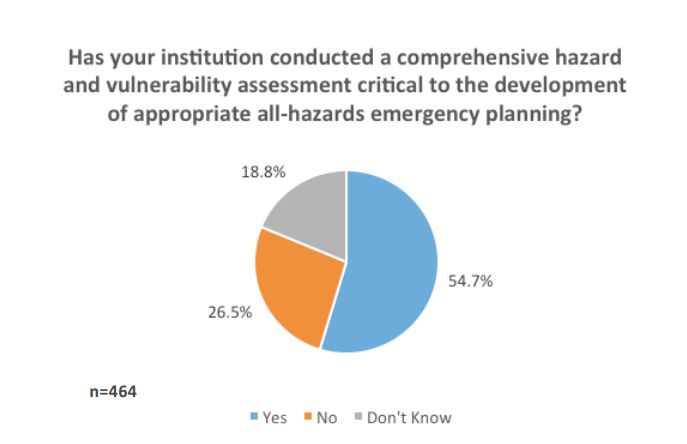
I just read an article from Campus Safety Magazine which cited a report on college campus preparedness.  Some of the numbers are a bit disturbing.  To me, the most serious numbers are from this graphic, which came from the Margolis Healy 2015 Campus Safety Survey:

Hazard_Assessment_Margolis_Healy_2015

According to this graphic, 26.5% of college campuses surveyed have not conducted a hazard and vulnerability assessment and 18.8% do not know if they have conducted an assessment.  Given that this study identified that 86% of colleges have an emergency operations plan, there is a significant number within this study who have what I would consider baseless plans.

Given these statistics, I’m left wondering WHY these campuses haven’t conducted a hazard analysis.  Potential reasons?

  • Didn’t know they needed to
  • Didn’t want to
  • Assumed they were aware of the hazards, impacts, etc.

I’m sure there are some other potential reasons for why they didn’t conduct a hazard analysis, but these are bound to be the big ones.  Regardless of the reason, I’m left assuming that, besides the plan being based upon no actual hazard information, the rest of the plan is BASELESS, INEFFECTUAL CRAP.

Forgive me for being blunt (you don’t have to), but if you aren’t assessing hazards, what are you basing your preparedness on?  Just as planning is the cornerstone of preparedness, a hazard analysis is the foundation of planning.  Therefore no (or a poor) hazard analysis will very likely result in a poor plan, and a poor plan will very likely result in poor preparedness efforts overall.

I’m not just picking on college campuses.  While this study targeted institutions of higher education, this same concern (likely with similar statistics) applies to EVERYONE – jurisdictions and government agencies, the private sector, and not for profits.

So what are we dealing with?  The parties responsible for creating these emergency plans are either UNINFORMED, LAZY, or UNDERFUNDED/UNDERSTAFFED.  To me, none of these are valid excuses.

  • Uninformed? Study up!  It’s not difficult to find out what the planning standards are.  (see the next paragraph)
  • LAZY? QUIT YOUR JOB! – you shouldn’t be in public safety.
  • Underfunded or understaffed? Welcome to public safety.  What could possibly help justify more funding or staff than a solid assessment?

If you need information on planning standards, check out these posts.  I talk about CPG-101, which is the foundation for emergency planning in the US; and a variety of other planning and hazard analysis related topics.

Need help?  It just so happens that I’m a well-qualified consultant.  Our website is linked below.

© 2015 – Timothy Riecker

Emergency Preparedness Solutions, LLC

Examining Needs-Based Emergency Planning

For the past decade and one half we have seen documents such as Civil Preparedness Guide (CPG) 1-8 (1990), State and Local Guide (SLG) 101 (1996), and two versions of Comprehensive Preparedness Guide (CPG) 101 (2009 and 2010) provide us with continually advancing standards and guidance for emergency planning.   We have seen the focus points of planning evolve from assumption-based, to threat and risk-based, to capability-based planning through each of these iterations.  With the release of each new standard, however, the lessons learned from the previous have been preserved, bringing with them remnants of the earlier standards.  Our current standard, Comprehensive Preparedness Guide 101 (2010), maintains a focus on capability-based planning but still stresses the importance of formulating assumptions in our planning as well as identifying threats and risks.  Each of these elements is important, but in these examinations we seem to be forgetting something very important – what is the need?

Planning assumptions, risk and threat, and capabilities assessments are all important informers of emergency planning and must remain in the lexicon for us to be successful.  It seems, though, that while these elements contribute to our planning efforts, they still don’t define the true need.  In examining the real need in any jurisdiction, we need to identify these other elements but we can’t take the jurisdiction itself for granted.  Identifying the needs of the jurisdiction will help us, along with the other elements, to identify what the impacts of a disaster will be and how prepared we are to address them.  Too often we see emergency planning efforts which are very rote, paying little attention to the real needs of the jurisdiction.

If you have followed my blog for any length of time, you likely recall that I am a huge proponent of needs assessments.  As a trainer, a proper needs assessment is everything.  It leads us to the identification of what the desired behavior is and is a critical first step in determining how we will effectively train individuals to achieve it.  Earlier this month I had an article published in Training Magazine on the Importance of Analysis to Identify Root Cause.  The same principles of needs assessment can be easily applied to emergency planning.  Very simply, needs drive objectives.

The identification of needs for a jurisdiction involves an examination of both the physicality of the jurisdiction as well as the population.  Elements of the physicality of the jurisdiction include size and geography, accessibility of areas within the jurisdiction, and critical infrastructure and key resources contained within the jurisdiction.  Examining the population demographics includes age ranges, income levels, disability, vulnerable and at risk populations (the CDC Social Vulnerability Index is a great resource), languages, cultures, religions, population densities, and the ratios of full time residents to transients/visitors, and commuters.  GIS can provide us with much of this information both individually and in aggregate.

Once we collect this data, an analysis is important to identify what it all means (aka defining the need).  Where are there vulnerabilities within the jurisdiction in a steady state?  Under which scenarios exist increased vulnerabilities – such as a bridge that provides the only access to an area of the jurisdiction being washed out.  What religious and cultural matters must be considered in disaster response?  What needs exist for communicating with those with limited English proficiency?  The answers to these questions will inform strategies contained in our emergency plans and annexes.

Good planners dig to these depths and produce quality operational plans – but most don’t.  Plans which have not been written with this detailed process are doomed to fail as the needs of the jurisdiction have not been weighed with our assumptions, threats and risks, and capabilities.  The THIRA process helps to move us in the right direction by asking us to provide threats and hazards with context (our planning assumptions) and then establishing capability targets which will address these impacts.  Still, it’s not direct or detailed enough to provide us with all the information we need.

While CPG 101 guides us to know our communities and to understand the consequences of a potential incident, the current focus on capabilities, while important, is a focus on us – public safety.  The focus must be on the jurisdiction as a whole and an identification and understanding of potential impacts and the resultant needs of the jurisdiction.  It’s not so much a change in process as it is a change in emphasis.  We must first understand needs before we can plan to address them.

Thoughts?

© 2014 – Timothy Riecker

What Planning Format To Use?

Comprehensive Preparedness Guide 101 (CPG 101) describes three format options for your emergency operations plan (EOP): The traditional functional EOP format, the Emergency Support Function (ESF) format, and the agency/department focused format.  As mentioned in CPG 101 the traditional functional EOP format is the most popular and widely used.  It generally provides for three major sections – the basic plan, functional annexes, and hazard specific annexes.  The traditional format provides for the greatest flexibility and allows a jurisdiction or organization to easily evolve their plan as the need for addressing additional issues or hazards is recognized.  Continuity of Government/Continuity of Operations (COG/COOP) plans are easily integrated as annexes as our newer concepts such as resiliency plans and climate change plans. 

Agency/department focused EOP formats provide utility for those folks that like to crack open the book looking to answer the question ‘what is expected of me?’.  This format offers some flexibility, but under most occurrences where the need to address a new issue arises edits need to be made through much of the plan to identify and address each agency’s involvement in said issue.  It can also be awkward to include other associated plans, such as the afore mentioned COOP and COG plans.  It does work for smaller communities, though, whose hazards and other planning areas stay fairly static. 

The ESF EOP format is modeled after the National Response Framework (NRF) (originally the Federal Response Plan) which addresses functions by grouping agencies and organizations with responsibility and resources to address those functions.  This model has worked fairly well for the federal government given their structure and the general federalist approach of most agencies (aside from those agencies with direct authorities such as the US Coast Guard).   There is some flexibility in this model with the ability to include both support and hazard specific annexes, but one must be cautioned not to confuse the ESF annexes with the support annexes.  The key word in the format is ‘support’, which is largely what the federal government does in response to a disaster. 

Last week Lucien Canton posted an article Emergency Support Functions: Misunderstood and Misapplied.  Read this!  As usual, Lu states his point expertly as he discusses the pros, cons, and uses for the ESF structure.  Many jurisdictions, in an effort to mirror a system which seems to work for the federal government, create their EOP in an ESF format.  I’ve rarely ever seen it well applied – at least not in the form that the feds use.  Understanding that the feds structure their ESFs to address policy and coordination, these same needs may not exist at a state or local level.  Therefore states and locals change the ESF structure.  While there is certainly no requirement to use only those ESFs which are used in the NRF, using a different format can cause great confusion.  For example, what is ESF #12 (Energy) in the NRF may be an ESF for economic recovery for a city or county.  Now we have what we’ve been trying to avoid in incident management – a lack of common terminology. 

Each jurisdiction and organization should choose which format works best for them.  I would strongly recommend the traditional format which is the easiest to shape to meet your needs rather than trying to work within an awkward planning framework.  Remember that no plan is ever perfect, but requires regular attention to ensure that it evolves with and addresses your needs.  Don’t try to tackle it all at once, either, or on your own.  Proper planning is a team effort requiring input from multiple stakeholders in your jurisdiction or organization.  CPG 101 references ‘whole community’ planning which is a great idea to ensure that you capture multiple perspectives and that all stakeholders are bought into the process and the product.  Take on your planning work in small bites, one component at a time.  First work on the base plan – the most essential part.  Then identify those functional and hazard specific annexes which are most important – accomplish those next.  To help guide your work it will help to create a project chart for your planning efforts identifying timelines and benchmarks, stakeholders, and needed inputs.  Finally, don’t forget to exercise your plans to validate them! 

Lastly, my marketing plug – If you need help planning please contact Emergency Preparedness Solutions!  EPS is experienced in working with governments, private sector, and not for profits in all facets of preparedness including assessment, planning, training, and exercises.  We are happy to discuss your needs and determine the best way to meet them. 

What planning format do you prefer and why?

© 2014 – Timothy Riecker


Creating Operational Emergency Plans

I was inspired for this article from an email I received earlier today from Lu Canton, a rather prolific emergency management consultant who has branched a bit into consulting consultants.  His email today (a forward from his blog) was about making emergency plans ‘real’.  His point was that many planners focus on checking the boxes of the list of planning requirements (those prescribed by law, regulation, etc.) rather than focusing on ensuring that you have a plan that can actually be implemented.  He conducted a webinar over a year ago which I had blogged about.

Planning requirements are important, as they largely stem from lessons learned from earlier incidents.  Granted, some of these requirements come about being translated through the eyes and ears of politicians whose staffers write the legislation and don’t understand emergency management at all – resulting in convoluted, contradictory, and poorly focused requirements.  Requirements lead to standards, helping to ensure that emergency managers are addressing the needs of their jurisdiction and best practices in the industry.  To help guide us through this, many higher level agencies provide templates.  I’ve pontificated in the past about the danger of templates, which have a place in reminding us of these requirements and help us with format and flow, but are often misused by individuals who simply seek to fill in the blank with the name of the jurisdiction and claim they have a finalized plan.

How do we avoid falling into this trap?  Follow the planning process!  FEMA’s Comprehensive Preparedness Guide (CPG) 101 provides an overview of this process for creating emergency operations plans.  The two initial steps – forming a planning team and conducting a hazard analysis – are absolutely critical to the integrity of the process and ensuring a quality plan that meets the needs of your jurisdiction by addressing your threats and hazards.  Planning teams then need to consider these threats and hazards, make reasonable assumptions about their impacts (using a credible worst case scenario), then identify resources and strategies the jurisdiction will undertake to solve the problems they will face.

Does all this mean that a plan needs to be written from scratch?  Of course not!  In fact I strongly encourage people against it.  It’s practically guaranteed that you will forget a critical element.  One of the greatest things in the emergency management community is how we learn from each other.  You can reference templates you find, examine plans of your neighboring jurisdictions or jurisdictions similar to you, check out what is on LLIS.  There is plenty of great content you can examine and apply for your own use.  Just ensure that you carefully review and consider how it applies to you.

As you write the plan, think the details through.  This will help ensure that your plan is operational, not just meeting requirements.  Discuss with your planning team what is expected of each assisting and cooperating agency for each incident type.  Who will be in charge?  What resources will be necessary and where will you get them from?  What would the objectives be and what processes and decision points must be conducted to accomplish those objectives.  As you create the plan, map out these processes and ensure that you’ve considered the who, what, where, when, and how of each step in each process.  Recall that you are planning at a strategic level, not a tactical level.  Planning at a tactical level is nearly impossible with a pre-incident (aka ‘deliberate’) plan.  Tactics will be addressed during the actual response, hopefully referencing the EOP/CEMP you are writing now, and implemented through an incident action plan (IAP).

Remember, though, the proof is in the pudding, as they say.  Your plan needs to be tested to ensure viability.  Use a table top exercise to test policy and decisions, then a functional exercise to test the implementation of the plan and higher level tactics.  Full scale exercises and drills can test the tactical implementation of plans.  Good evaluation of the exercises will lead to planning improvements.  For insight on the exercise process, you can check out my exercise management series of posts referenced here.

Remember: when it comes to planning – keep it real!

Tim Riecker

Are you Planning for All Hazards?

Image

While I’m amazed by the number of jurisdictions and businesses that don’t have any emergency plans at all, I’m almost nearly amazed by those who only have isolated, single hazard plans. I’ve seen plenty of entities with only fire plans or flood plans.

How does this happen? Many small towns may ask their local fire chief to write an emergency plan for the town – this plan often times outlines the fire response structure but ignores other hazards. Sometimes this myopic view of planning takes place because of a focus or near panic over one particular hazard. These situations are generally not the fault of the people who wrote them. Just because someone is in public safety doesn’t mean they know every facet of it. Emergency planning is as much of a niche as pump operations in the fire service or special tactics in law enforcement. It requires a certain set of knowledge, skills, and experience to be successful and effective.

While it’s logical that a larger jurisdiction will have a more complex emergency plan than a smaller jurisdiction, there are still foundational elements that are common to all. Perhaps the most critical of these is the necessity to plan for all hazards. All hazards planning, if you’re not familiar with the concept, is a process beginning with the identification of the hazards which can impact a community, the impacts associated with each hazard (also known as vulnerability), and the probability of each hazard impacting the community (also known as risk). This is called a Hazard Vulnerability Analysis (HVA). By rating the vulnerability and risk factors for each hazard, a fairly simple algorithm can be used to provide an overall ranking for each hazard. Additional information, such as the availability of resources to respond to each hazard can be included as well.

Obviously there is a lot of context that needs to go into such an assessment, which is best conducted by a planning team to gain the most amount of input. Comprehensive Preparedness Guide (CPG) 101, published by FEMA/DHS, provides much more information on the planning process as a whole. Historical disaster information should be referenced, but not to the extent of outweighing other inputs. Fluctuations over time in population, topography and development, and climate change are all leading to, as the investment world states it, historical information not necessarily being indicative of future performance.

Scientific data should also be examined, such as flood maps and wild fire risk. Communities should be sure to reference information on hazardous materials, which is required reporting by industry per the Emergency Planning and Community Right to Know Act of 1986 (also known as SARA Title III). Once you have identified and ranked all the hazards, you know what ones to focus on. Perhaps it is the top 8, or maybe the top 12 that indicate a high enough vulnerability and/or high enough risk to incorporate into your planning efforts. Once these are identified, you continue through the CPG 101 planning process to create a comprehensive plan. A comprehensive plan incorporates all elements needed to address the responses to these incidents. Given that the majority of responses are largely similar, regardless of the hazard, one concept of operations will address this in the plan. Separate plans, written as annexes or appendices, then can be created for hazards with very specific issues, such as a pandemic, or to address specific functions, such as evacuation and sheltering.

Is it possible to anticipate every disaster that could possible impact your community? Can your community possibly predict being trampled by a giant man of marshmallow or having busses tossed aside by fire breathing dinosaurs from Japan? No? Then don’t spend much time on these things. Be realistic. That said, a Comprehensive Emergency Management Plan (CEMP) – which is a plan that considers all hazards, all resources, and the whole community – can even help account for hazards you didn’t identify. Do you think Chelyabinsk, Russia had a plan for meteor strikes? Not likely. However, consider how the components of a CEMP could have addressed critical areas of response: mass casualty, search and rescue, debris management, sheltering.

I recall a number of years ago, prior to the 2013 occurrence in Chelyabinsk, where there was a bit of media frenzy over near earth objects (NEOs) such as meteors. The public information officer (PIO) for the state’s emergency management agency received a call from a media outlet inquiring if the state had a plan for meteor strike. The PIO answered ‘yes’, qualifying that with a statement about the value of comprehensive planning. Was there a specific plan for meteor strikes? No. The likelihood is so slim that it’s not worth putting effort toward (although I’m sure someone has). Does the CEMP cover all the necessary response components? Absolutely.

Author’s note: Unfortunately I don’t recall where I got the picture from, so I’m unable to give proper credit. If anyone knows or claims it, I’ll gladly give credit or pull it down.