Use of Pre-Developed Exercises – Proceed with Caution

I was recently asked by a client about my thoughts on pre-developed or ‘canned’ exercises.  As it turns out, I have a lot of feelings about them, most of them negative.  Pre-developed exercises, if properly understood and applied, can be a huge help, but the big problem is that we’re dealing with human nature, and some people are just damn lazy.  Garbage in, garbage out.

We need to keep in mind that exercises, fundamentally, are developed to validate plans.  Not my plans.  Your own plans.  While standards of practice mean that most plans have a high degree of commonality (i.e. a HazMat response plan for a jurisdiction in California will be largely the same as one for a jurisdiction in New York State), it’s often the deviations from the standards and the local applications that need to be tested most.  So it doesn’t do well for anyone to replicate an exercise that doesn’t test your own plans.  Similarly, the foundation of exercise design is objectives.  While the pre-developed exercise may have a theme that coincides with what you want to test, sheltering, for example, there are a lot of different aspects of sheltering.  The pre-developed exercise might not focus on what you need to exercise.  With all this, anyone who wants a quality exercise from something pre-developed is going to have to do a lot of re-development, which might be more frustrating than starting from scratch.
HSEEP1

If you want a quality exercise, you really can’t short cut the process.  Not only might HSEEP be required for whatever grant funding you are using for the exercise, but it’s a best practice – and for good reason.  So often people want to cut corners.  If you do, the final product will look like you’ve cut corners.  It might lack proper context, good reference documents, or meaningful evaluation.   The exercise planning meetings have defined purpose, and the documents help capture that process and communicate the intent to specific audiences.

On the other hand, there are proper ways to use materials from a previously developed exercise to benefit your own exercise.  The development of good questions in discussion-based exercises and injects for operations-based exercises can be a challenge.  Reviewing other exercises, especially when there might be some similarity or overlap in objectives, can be a huge help, so long as they are properly contextualized and relate back to objectives for your exercise.  This isn’t a copy and paste, though… as it all should still be applied within the exercise design process.

There are some exercises out there that might seem like exceptions to what I’ve written above.  The first that comes to mind are FEMA’s Virtual Table Top Exercises (VTTX).  The VTTX is a great program, conducted monthly, focusing on different themes and hazards.  FEMA’s Emergency Management Institute (EMI) assembles a package of materials that go to each community registered for the event, allowing a measure of local customization.  While jurisdictions may use this material differently, it is at least an opportunity to discuss relevant topics and hopefully capture some ideas for future implementation.

Similarly, my company, Emergency Preparedness Solutions, recently completed a contract with the Transportation Research Board for a project in which we developed a number of ‘generic’ exercises for airports.  These functional exercises, facilitated through a web-based tool, can be easily customized to meet the needs of most airports across the nation and are written with objectives focused on the fundamentals of EOC management within the timeline of an incident.  While specific plans aren’t directly referenced in the exercises, airport personnel are able to examine the structure of response in their EOC and can reflect on their own plans, policies, and procedures.  Similar to FEMA’s VTTX series, they aren’t a replacement for a custom-developed exercise, but they can help examine some fundamentals and start some important discussions.  I’m not able to get into much more detail on this project, as the final report has yet to be published, but look forward to future posts about it.

All in all, I tend to caution against using pre-developed exercises.  I simply think that most people don’t use them with the right intent and perspective, which can severely limit, or even skew, outcomes.  That said, there exists potential for pre-developed exercises to be properly applied, so proceed with caution and with your wits about you.  Understanding that time, money, and other resources can be scarce, emergency management has always done well with ‘borrowing best practices’.  While there is sometimes nothing wrong with that, short cutting the process will often short cut the benefits.  Do it right.  Use of a custom-developed exercise is going to maximize benefit to your community or organization.

© 2018 – Timothy Riecker, CEDP

EPS New logo

HSEEP Training – Is it Required

Continuing from my previous blog post, I’ll answer a search phrase used to bring someone to my blog.  Earlier this month, someone searched ‘Is HSEEP training mandatory?’.  We speak, of course, of the Homeland Security Exercise and Evaluation Program, which is the DHS-established standard in exercise program and project management.

The short answer to the question: Maybe.

Generally speaking, if your exercise activities are funded directly or indirectly by a federal preparedness grant, then grant language usually requires that all exercises are conducted in accordance with HSEEP.  While most federal grant guidance doesn’t explicitly state that exercise personnel must be formally trained in HSEEP, it’s kind of a no-brainer that the fundamental way to learn the standards of practice for HSEEP so you can apply them to meet the funding requirement is by taking an HSEEP course.  If you are a jurisdiction awarded a sub-grant of a federal preparedness grant or a firm awarded a contract, there may exist language in your agreement, placed there by the principal grantee, that specifically requires personnel to be trained in HSEEP.

Beyond grant requirements, who you work for, who are you, and what you do generally don’t dictate any requirement for HSEEP training.  Aside from the federal grant funding or contracts mentioned, there is no common external requirement for any organization to have their personnel trained in HSEEP.  If your organization does require it, this is likely through a management-level decision for the organization or a functional part of it.

So, while HSEEP is a standard of practice, training in HSEEP, in general terms, is not a universal requirement.  That said, I would certainly recommend it if you are at all involved in the management, design, conduct, or evaluation of exercises.  FEMA’s Emergency Management Institute (EMI) offers HSEEP courses in both a blended learning and classroom format.  The emergency management/homeland security offices of many states and some larger cities offer them as well.

© 2018 Timothy Riecker, CEDP

Emergency Preparedness Solutions, LLC SM

Studying Strange Disasters – The Boston Molasses Flood

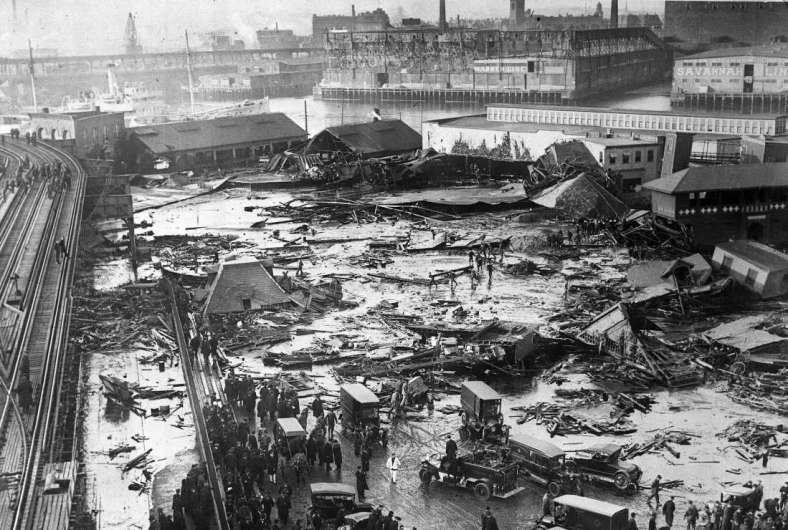
27366-molasses_flood-flickr

Aftermath of the Boston Molasses Flood.  Source: Boston Public Library

Anyone who has been in the trade of emergency management will likely tell you to always expect the unexpected.  No two disasters are ever the same.  While we can predict similarities from one flood, fire, or hurricane to another, there are always different impacts, needs, and circumstances which often give us cause to consider different means and methods in our response.  Some disasters are noted for specific uniquenesses in their impacts, needs, or circumstances which tend to be a theme of sorts for that disaster.  Every once in a while, however, a disaster occurs which was largely unexpected.

99 years ago this month, the City of Boston encountered one of those unexpected disasters when a flood of over two million gallons of molasses rushed through several blocks of Boson’s North End, killing 21 people and several horses, injuring 150 people, and destroying numerous buildings.  The molasses took weeks to clean and the cause and origin investigation took years, with a final ruling against the company which owned the massive storage tank being found liable.

While I had originally intended to write more about the incident in-depth, I think it most prudent to steer readers toward some of the sources I had looked at, as the information is quite interesting.

While an incident like this seems so unlikely as to never occur again, never say never.  In 2013 over 200,000 gallons of molasses was spilled into Honolulu Harbor.  While no people were killed or buildings destroyed from this pipe leak, the fish kill in the harbor was massive.

And yes, even a beer spill can be hazardous.  In 1814 several tanks containing over 300,000 gallons of beer ruptured in London.  The tidal wave of ale damaged and destroyed several structures and killed 8 people, aged 3 to 63.

We often think about hazardous materials as only being volatile chemicals which can ignite or cause harmful, noxious fumes.  We must consider that any substance in sufficient quantity introduced into a space where it’s not supposed to be can be extremely hazardous, both to people and the environment.  A flood is the most fundamental of these… I don’t think we need to detail the threat and impacts from flood waters.  But as you assess hazards in your community, consider that bulk storage of things like milk, grains, or other materials, which we often don’t consider hazardous, can cause great impact should they be unleashed on people, infrastructure, and the environment.  While our safety regulations (a mitigation measure) are certainly stronger than those which were in place in the 1800s and early 1900s, the hazards still exist.  Be smart and don’t dismiss those hazards outright.

What out of the ordinary hazards concern you?

© 2018 – Timothy M. Riecker, CEDP

Emergency Preparedness Solutions, LLC SM

Public Area Security National Framework

The Transportation Security Administration (TSA) recently released this report in cooperation with a variety of stakeholders which provides information and guidance on preparedness, prevention, and response activities to strengthen the public spaces of transportation venues.  While the focus of the document is on airports, the information in the document is great not only across all transportation venues, but other public spaces as well.  I think there are great takeaways for other areas of vulnerability, such as malls, convention centers, event spaces, and others.

To be honest, there is nothing particularly earthshattering in this document.  The document is brief and identifies a number of best practices across emergency management and homeland security which will help agencies and organizations prevent, protect, prepare, and respond to threats, particularly attacks.  That said, the document does accomplish providing concise information in one document on key activities that absolutely should be considered by entities which control public-access spaces.  I would also suggest that this document is still 100% relevant to those which have some access controls or entry screenings.

Information in the document is segmented into three key tenets: Information Sharing, Attack Prevention, and Infrastructure and Public Protection.  Within these tenets are found recommendations such as relationship building, communication strategies, vulnerability assessments, operations centers, planning, training, and exercises.  Most of the recommendations provide examples or leading best practices (although no links or sources of additional information, which is a bit disappointing).

The framework is worth a look and can probably serve as an early foundation of activity for those who haven’t yet done much to prepare their spaces for an attack.

© 2017 – Timothy Riecker, CEDP

Emergency Preparedness Solutions, LLC

Supporting a Public Safety Training Program

Today happens to be National Teacher’s Day.  Be sure to show some appreciation for the teachers and professors who have influenced you and provide quality experiences for your kids.  Also consider expanding the definition of ‘teacher’.  In the public safety professions, we do a lot of training.  Some of us have structured academies, and while others may not, there are a lot of training opportunities provided locally, state-wide, and nationally.  Depending on the size and scope of your agency, you may run your own training program for internal, and potentially external stakeholders.

For a few years, I ran the training and exercise program of a state emergency management agency.  We delivered training programs state-wide to a variety of stakeholders.  We also developed some training programs to address needs which curricula from FEMA or other national providers could not meet.  Fundamentally, delivering training is easy, but properly managing a training program can have challenges.  Some thoughts…

  • Find the right people for the job. While we hired some personnel full time to be trainers, we also used people from elsewhere in the agency, as well as personnel from partner agencies, and hired some as 1099 employees.  There are a lot of highly qualified individuals in public safety – if you don’t know any, just ask, and they will be sure to tell you!  Assuming their qualifications are valid, are the most experienced and knowledgeable people always the best instructors?  Absolutely not.  While they may be subject matter experts, it doesn’t mean they have good presentation skills, much less comfort in doing so.  On the flip side, you might also have someone with little experience who has great delivery skills.  That might be a person to develop.
  • Quality control. When people are delivering training, peek in once in a while.  I traveled around the state regularly, and once in a while would see if one of our courses was being held somewhere along my route.  If I had the time, I would stop in and see how things were going.  While the visit was a surprise, our instructors knew this is something that might happen.  There are a few things this accomplishes.  First of all, it gives you an opportunity to observe and provide feedback.  Everyone can improve, and hopefully they can handle some constructive feedback.  Evaluation, formal or informal, is positive for the instructor and the program.  Look for consistency of practice (see the next bullet point) and professionalism.  On one of my surprise visits, I found an instructor wearing jeans and a sweatshirt.  When I discussed it with him, his response was that he was ‘retired’ (teaching for the agency was a retirement job for him) and that he could do whatever he wanted to.  After that discussion was happy to retire him further. Stopping in also shows support for your instructors and for the program as a whole.  Weather traveling across the state or down the hall, instructors want to know they are being supported.  A big part of support is simply being present.
  • Consistency counts. Training programs should be consistent.  While we might change around some examples or in-class scenarios, training delivered in one location by instructor a should largely match the training delivered another day, in a different location by instructor b.  Coming up through the ranks as a field trainer, I was part of a group that wanted to heavily modify the courses we delivered.  As I rose to management, I realized how detrimental this was.  If improvements are warranted, work with your instructors to integrate those improvements into the course.  Make sure that improvements are in line with best practices, not only in instructional design (remember: content must match objectives), but also with the subject matter.  Consistency not only ensures that all your learners are provided the same information, but also makes your curriculum and instructors more legally sound.  Too often we see instructors ‘going rogue’, thinking that they know a better way.
  • Programs need systems. A big part of building and maintaining a program is having adequate systems in place.  Systems require policies, procedures, and tools.  This is largely the behind the scenes stuff of a training program.  This includes annual curriculum reviews, performance reviews of instructors, selection/hiring and firing of instructors, maintaining instructors (see the next bullet), ordering course materials, maintaining training records, posting a course, course registrations, course cancellations, and so much more.  While it sounds bureaucratic, there should be a piece of paper that covers every major activity, identifying how it’s done, by who, with what approvals, and at what time.  Systems make sure that things aren’t missed, give you a basis of performance to evaluate the system and to train new staff, and help ensure consistency.  Systems contribute to your professionalism and are also good practices for business continuity.  Lots of credit to Cindy who was highly dedicated to establishing systems!
  • Keep instructors engaged. With either a large or small training shop, it’s important to maintain contact with your instructors.  Not just in handing them assignments and shuffling paperwork, but to really engage them.  We established twice a year ‘instructor workshops’, bringing our instructors together for two days.  From a management and administrative perspective, we used some of this time to express appreciation for their work, and provide information on curriculum updates and other information.  We encouraged much of the workshop agenda to be developed by the instructors themselves, with professional development provided by their peers.  This could include instructor development, after action reviews of incidents, case studies, and a variety of other activities and information.

Those are just a few tips and lessons learned.  I’m sure you may also have some to add to the list – and please do!

© 2017 – Timothy Riecker, CEDP

Emergency Preparedness Solutions, LLC

Measuring Preparedness – An Executive Academy Perspective

A recent class of FEMA’s Emergency Management Executive Academy published a paper titled Are We Prepared Yet? in the latest issue of the Domestic Preparedness Journal.  It’s a solid read, and I encourage everyone to look it over.

First off, I wasn’t aware of the scope of work conducted in the Executive Academy.  I think that having groups publish papers is an extremely important element.  Given that the participants of the Executive Academy function, presently or in the near future, at the executive level in emergency management and/or homeland security, giving others the opportunity to learn from their insight on topics discussed in their sessions is quite valuable.  I need to do some poking around to see if papers written by other groups can be found.

As most of my readers are familiar, the emphasis of my career has always been in the realm of preparedness.  As such, it’s an important topic to me and I tend to gravitate to publications and ideas I can find on the topic.  The authors of this paper bring up some excellent points, many of which I’ve covered in articles past.  They indicate a variety of sources, including literature reviews and interviews, which I wish they would have cited more completely.

Some points of discussion…

THIRA

The authors discuss the THIRA and SPR – two related processes/products which I find to be extremely valuable.  They indicate that many believe the THIRA to be complex and challenging.  This I would fully agree with, however I posit that there are few things in the world that are both simple and comprehensive in nature.  In particular regard to emergency management and homeland security, the inputs that inform and influence our decisions and actions are so varied, yet so relevant, that to ignore most of them would put us at a significant disadvantage.  While I believe that anything can be improved upon, THIRA and SPR included, this is something we can’t afford to overly simplify.

What was most disappointing in this topic area was their finding that only a scant majority of people they surveyed felt that THIRA provided useful or actionable information.  This leaves me scratching my head.  A properly done THIRA provides a plethora of useful information – especially when coupled with the SPR (POETE) process.  Regardless, the findings of the authors suggest that we need to take another look at THIRA and SPR to see what can be improved upon, both in process and result.

Moving forward within the discussion of THIRA and SPR, the authors include discussion of something they highlight as a best practice, that being New York State’s County Emergency Preparedness Assessment (CEPA).  The intent behind the CEPA is sound – a simplified version of the THIRA which is faster and easier to do for local governments throughout the state.  The CEPA includes foundational information, such as a factual overview of the jurisdiction, and a hazard analysis which ranks hazards based upon likelihood and consequence.  It then analyses a set of capabilities based upon the POETE elements.  While I love their inclusion of POETE (you all know I’m a huge fan), the capabilities they use are a mix of the current Core Capabilities (ref: National Preparedness Goal) and the old Target Capabilities, along with a few not consistent with either and a number of Core Capabilities left out.  This is where the CEPA falls apart for me.  It is this inconsistency with the National Preparedness Goal that turns me off.  Any local governments looking to do work in accordance with the NPG and related elements, including grants, then need to cross walk this data, as does the state in their roll-up of this information to their THIRA and SPR.

The CEPA continues with an examination of response capacity, along the lines of their response-oriented capabilities.  This is a valuable analysis and I expect it becomes quite a reality check for many jurisdictions.  This is coupled with information not only on immediate response, but also sustained response over longer periods of time.  Overall, while I think the CEPA is a great effort to make the THIRA and POETE analysis more palatable for local jurisdictions, it leaves me with some concerns in regard to the capabilities they use.  It’s certainly a step in the right direction, though.  Important to note, the CEPA was largely developed by one of the authors of the paper, who was a former colleague of mine working with the State of New York.

The Process of Preparedness

There are a few topic areas within their paper that I’m lumping together under this discussion topic.  The authors make some excellent points about our collective work in preparedness that I think all readers will nod their heads about, because we know when intuitively, but sometimes they need to be reinforced – not only to us as practitioners, but also to other stakeholders, including the public.  First off, preparedness is never complete.  The cycle of preparedness – largely involving assessment, planning, organizing, equipping, training, and exercising – is just that – a cycle.  It’s endless.  While we do a great deal of work in each of these, our accomplishments are really only temporary.

The authors also mention that our information is not always precise.  We base a lot of what we do in preparedness on information, such as a hazard analysis.  While there are some inputs that are factual and supported by science, there are many that are based on speculation and anecdote.  This is a reality of our work that we must always acknowledge.  As is other of their points – there is no silver bullet.  There is no universal solution to all our woes.  We must constantly have our head in the game and consider actions that we may not have ever considered before.

ICS Improvement Officer

The authors briefly discuss a conceptual position within the ICS Command Staff they call the ICS Improvement Officer.  The concept of this fascinating, if not a bit out of place in this paper given other topics of discussion.  Essentially, as they describe this position, it is someone at the Command Staff level who is responsible for providing quality control to the incident management processes and implementations of the organization.  While I’ve just recently read this paper and haven’t had a lot of time to digest the concept, I really can’t find any fault with the concept.  While the planning process itself is supposed to provide some measure of a feedback loop, there isn’t anyone designated in the organization to shepherd that process beginning to end and ultimately provide the quality control measures necessary.  In practice, I’ve seen this happen collaboratively, among members of the Command and General Staff of a well-staffed structure, as well as by the individual who has the best overall ICS insight and experience in an organization – often the Planning Section Chief.  The authors elude to this position also feeding an AAR process, which contributes to overall preparedness.  I like this idea and I hope it is explored more, either formally or informally.

Conclusion

There are a number of other topic areas of this paper which I haven’t covered here, but I encourage everyone to read on their own.  As mentioned earlier, I’d like to see more of the research papers that come from FEMA’s Emergency Management Executive Academy available for public review.  Agree or disagree with their perspectives, I think their discussions on various topics are absolutely worth looking at.  It’s these discussions like these which will ultimately drive bigger discussions which will continue to advance public safety.

I’m always interested in the perspectives of my readers.  Have you read the paper?  What do you think of the discussion topics they presented?

© 2017 – Timothy M Riecker, CEDP

Emergency Preparedness Solutions, LLC


Gauging Return on Investment in Preparedness: Organizing

As a continuation of the Gauging Return on Investment in Preparedness series (read the first one on Planning here), this post’s focus is on the POETE element of Organizing.  There are a number of ‘organizing’ efforts we engage in through our preparedness endeavors.  Some are temporary, like establishing working groups to solve a certain problem; while some are intended to be long-term, like forming an incident response team.

Why organize?  Most organizational efforts are fueled by the need to capitalize on the power of many.  What one person can do, more people can do better.  Problem solving, responding, etc.  Often our organizational efforts are internal, but, particularly in public safety, we coordinate with other agencies.  We might be building a professional response organization, such as an Incident Management Team (IMT), or perhaps we are building a community organization, such as a Community Emergency Response Team (CERT).

What costs are associated with organizational activities?  Foundationally, it’s simply the staff time needed to prepare for, attend, and perform follow up work from meetings and other organizational efforts.  Depending on how complex our efforts are, however, and the intent of our organizational efforts, this can take on full time duties.  You also have to consider who is being drawn into these efforts and what the ‘replacement cost’ is of their time – meaning, what is the cost of someone else performing their work while they are involved in the meetings, etc.?  We also need to identify what costs might be associated with organizing?  The remaining POETE elements (Planning, Equipping, Training, and Exercising) can probably lead you to identifying these.

What are the benefits (value) of organizing?In order to identify the return on our investment, we need to be able to ascertain the benefits our organizational efforts bring – some may be tangible and relatable in dollar figures, others may be more intangible and amorphic.

As with many preparedness efforts, we find ourselves needing to make reasonable assumptions to identify cost savings or value.  We need to follow the bouncing ball of our efforts.  As an example… If we create a CERT team, citizens will be better able to tend to their own needs in the event of a disaster.  This leads to less immediate need of limited resources (first responders), allowing them to focus on more critical needs (i.e. saving lives and protecting infrastructure).   In this example we can make some assumptions about the types of infrastructure to be impacted by a certain incident and the costs associated with it becoming incapacitated.

In regard to saving lives, it’s difficult for us to attach a dollar value to that.  We often say that lives are priceless, and while that may be true, we sometimes need to make an educated guess.  Depending on who you are reporting figures to, they may be satisfied with a reasonable number of lives being saved… others may want to actually compare apples to apples (that is, dollars to dollars).  If you engage the use of your favorite internet search engine and search ‘what is the value of a life’, or something similar, you will find a number of results.  In perusing some of these results myself, I found that the dollar figure assigned to a life is obviously subjective and very much related to the industry in which the question is being asked.  This particular article makes for an interesting read on the subject.  Spoiler alert: they peg the value of a human life at $5M USD (2011).

In the end, organizational efforts need to have a purpose providing a net value.  Even in routine matters and daily business, we should examine the cost of organizational efforts – particularly meetings.  Meetings are one of my biggest bugaboos, as they are often too long, have little purpose, and the objectives can be met in a much more efficient manner.

What ideas do you have on determining the return on investment for organizational activities?

© 2015 – Timothy Riecker

Emergency Preparedness Solutions, LLC

www.epsllc.biz 

Firearms in Emergency Kits?

Cannon Beach, Oregon, a community in the Cascadia subduction zone, has an interesting program in which they store the preparedness kits of residents for them.  A link to the city’s program is here: http://ci.cannon-beach.or.us/community/cachecontainer.html.  In summary, the city provides the opportunity for residents (for a small fee) to store containers (provided by the city) of emergency supplies within city-owned cache locations.  They offer 5 gallon pails (with lids), 30 gallon drums, and 55 gallon drums.  These kits are stored securely in shipping containers at the predesignated locations.

I’m a bit ambivalent about the concept.  While it certainly encourages and enables people and families to have kits that perhaps otherwise wouldn’t, it does remove these kits from their possession.  Not having the kits in your possession limits the ability to add to/maintain the kit and certainly makes them ineffective during a shelter in place scenario.  I, for one, would rather have my kit readily available to me and all family members without having to address:

1) potentially unsafe travel,

2) the ability to access the container (will someone be there to let me in?),

3) a potential state of unrest in the vicinity of the container,

4) will the container still be there (we’ve seen these things easily moved by mother nature).

Note that the informational material on their website does encourage people to also have go-bags for a combination approach, which is a good idea.

Now that I’ve warmed you up with some background – off to the main topic…  I was first alerted to Cannon Beach’s concept via a news article about someone storing a firearm in their kit.  http://www.opb.org/news/article/should-your-emergency-preparedness-kit-include-a-firearm/.  The article states that an individual kept a firearm in their kit, which was stored by the city in a storage container which was broken into and stolen.  Firearms, by the way, are not permitted per the city’s guidance.  But should firearms (Cannon Beach’s program aside) be included in emergency kits?

Up front, I’d never recommend that firearms be kept in an emergency kit simply based upon liability.  That said, it’s an individual decision but could be a good idea.  Certainly anyone who chooses to do so should ensure that it is done legally and safely.  One must also consider why they want to have a firearm in their kit.  Is it for personal protection or for hunting?  Or both?  In the case of the article I referenced, it was a handgun, which could really only be used effectively for personal protection.

While we see very limited violence and looting during disasters, it certainly could be possible.  I would never suggest that someone not have the ability to protect themselves or their family.  I would suggest, however, that anything in your kit should have as many purposes as possible.  A handgun is less than ideal for hunting.  However, including a firearm for hunting (rifle or shotgun) will likely exceeded the physical space of your kit, so this needs to be considered.

I would also suggest that, again just like anything else in your kit, you be proficient in using it. Among the few who keep and maintain preparedness kits, many buy things and just stick them in there.  They never read the instructions or become familiar with their use.  Consider a water purifier for example.  Any brand that I’m familiar with needs to be submerged and backwashed prior to use to remove smaller particulates from the carbon filter.  If someone is keeping something as dangerous as a firearm, they had better be proficient in its use!

The bottom line is that we are not likely to see a scenario out of The Walking Dead.  While we have seen some devastating incidents, such as Hurricane Katrina, which had limited the effectiveness of law enforcement for a time, this is not the norm within disasters.  Some may be considering an extreme, perhaps apocalyptic, scenario, and wanting to protect themselves, which is fine.  Just be smart about it.

What are your thoughts on firearms in emergency kits?  How about the municipal storage of kits like Cannon Beach’s program?

Lots of food for thought…

© 2015 – Timothy Riecker

Emergency Preparedness Solutions, LLC

WWW.EPSLLC.BIZ

Most Disasters are NOT Extraordinary Occurrences – OR Crowdsourcing Volunteers

I listen to A LOT of podcasts.  While some are focused on emergency management and homeland security, most are pop culture related and have nothing at all to do with EM/HS.  At least not directly.

Listening to a recent podcast, it struck me how often the hosts mention disaster-related occurrences.  During this podcast there were several mentions of disaster related issues including the Louisiana theater shooting (which was breaking news while they were recording) and the Tom Selleck legal drama in California over stolen water (which ultimately relates back to their drought issues).  The same podcasters (one of which is in New England, the other in the National Capital Region) often comment through the year on weather-related incidents which impact them and others including winter storms, flooding, and warmer weather storm damages.

The point is that most disasters are not extraordinary occurrences.  Routine incidents aside, some measure of disaster occurs fairy regularly, certainly around the world and even just within any of our nations.  Turn on the news tonight and see for yourself.  So WHY, I ask, is there such a mentality with the general public (and maybe even with us public safety types) about disasters being out of the ordinary occurrences?  Sure they don’t happen within our own jurisdiction every day, but they happen somewhere EVERY DAY.  I’m not saying we have to be paranoid about it, but I see the COMPLACENCY getting WORSE.  We discuss preparedness often, and the aspect of getting the public better engaged in preparedness almost as much, yet we have yet to see real, meaningful success in this.

We’ve recently seen a bit of a paradigm shift in how we deal with climate change (insert groaning sound here).  For many years we tried to prevent it, as if we could.  The reality is that part of it is influenced by the actions of humanity and part of it by the natural cycle of our planet.  There are things we simply shouldn’t be doing and we still need to work on those, but we have also come to grips with the inevitability of the impacts.  We have realized that they will happen no matter what we do and we have decided that we need to ADAPT in order to survive.

Adaptation is an important realization for us (I’m now speaking in generality – not just climate change issues).  If there are things that we pound our heads against the wall over in futility, such as public engagement, maybe we are doing it all wrong?  I’m not saying that we stop trying to engage the public.  There are certainly successes we have seen, but I don’t think we are seeing the return on investment we should be.

Let’s look at society today.  People seem to have less time ability interest in volunteering or committing to efforts ahead of time.  We have to understand and acknowledge that first and foremost.  Have we turned into soulless uncaring creatures?  No, of course not.  We have just seen a shift in culture.  Trying to fight this culture is foolish.  Instead, we need to adapt.  How do we adapt?

Social media is the greatest embodiment of our need for instantaneous information and feedback.  It doesn’t take much preparation (download some apps, create accounts, find friends).  The vast majority of the information that rolls across the screen is crap, but every once in a while there is a worthwhile nugget that will garner some responses.  Sometimes (usually disasters or a new statement by Donald Trump) information that comes across garners a great deal of attention and people want to take action.  Do they know how to take meaningful action?  Often not.  But they will follow along with the good ideas of others.  (aka leaders).

Let’s broaden this concept within public engagement.  What this essentially comes down to is managing spontaneous volunteers – a concept we have seen much need for in EM for years.  I think we need to emphasize this more than ever.  We also need to update the way we think about it.  These spontaneous volunteers will not only show up at town hall, the fire house, local diner, or house of worship; they will show up online via Twitter and Facebook.  They will be locals, they will be from out of state, across the country, or across the planet.   ALL of them can be engaged.  Let’s crowdsource volunteers in emergency management.  We just need to identify how to engage them.  Identify gaps and figure out how these good natured people can fill those gaps with little no upfront investment of time or effort on their part.  Build plans that address spontaneous volunteer engagement – both in the physical aspect as well as virtual.  Train to these plans and test these plans.  Let’s stop struggling against old ways of thinking.  Improvise, adapt, and overcome.

As always, I’d love to hear your thoughts on this.

I do want to take a moment to thank my followers and readers – something I don’t do enough of.  Your support and comments are greatly appreciated.  Also, if you like my blog, spread the word.  Please feel free to forward/repost/retweet to friends, family, colleagues, and complete strangers.

©2015 – Timothy Riecker

EMERGENCY PREPAREDNESS SOLUTIONS, LLC

WWW.EPSLLC.BIZ

Examining Needs-Based Emergency Planning

For the past decade and one half we have seen documents such as Civil Preparedness Guide (CPG) 1-8 (1990), State and Local Guide (SLG) 101 (1996), and two versions of Comprehensive Preparedness Guide (CPG) 101 (2009 and 2010) provide us with continually advancing standards and guidance for emergency planning.   We have seen the focus points of planning evolve from assumption-based, to threat and risk-based, to capability-based planning through each of these iterations.  With the release of each new standard, however, the lessons learned from the previous have been preserved, bringing with them remnants of the earlier standards.  Our current standard, Comprehensive Preparedness Guide 101 (2010), maintains a focus on capability-based planning but still stresses the importance of formulating assumptions in our planning as well as identifying threats and risks.  Each of these elements is important, but in these examinations we seem to be forgetting something very important – what is the need?

Planning assumptions, risk and threat, and capabilities assessments are all important informers of emergency planning and must remain in the lexicon for us to be successful.  It seems, though, that while these elements contribute to our planning efforts, they still don’t define the true need.  In examining the real need in any jurisdiction, we need to identify these other elements but we can’t take the jurisdiction itself for granted.  Identifying the needs of the jurisdiction will help us, along with the other elements, to identify what the impacts of a disaster will be and how prepared we are to address them.  Too often we see emergency planning efforts which are very rote, paying little attention to the real needs of the jurisdiction.

If you have followed my blog for any length of time, you likely recall that I am a huge proponent of needs assessments.  As a trainer, a proper needs assessment is everything.  It leads us to the identification of what the desired behavior is and is a critical first step in determining how we will effectively train individuals to achieve it.  Earlier this month I had an article published in Training Magazine on the Importance of Analysis to Identify Root Cause.  The same principles of needs assessment can be easily applied to emergency planning.  Very simply, needs drive objectives.

The identification of needs for a jurisdiction involves an examination of both the physicality of the jurisdiction as well as the population.  Elements of the physicality of the jurisdiction include size and geography, accessibility of areas within the jurisdiction, and critical infrastructure and key resources contained within the jurisdiction.  Examining the population demographics includes age ranges, income levels, disability, vulnerable and at risk populations (the CDC Social Vulnerability Index is a great resource), languages, cultures, religions, population densities, and the ratios of full time residents to transients/visitors, and commuters.  GIS can provide us with much of this information both individually and in aggregate.

Once we collect this data, an analysis is important to identify what it all means (aka defining the need).  Where are there vulnerabilities within the jurisdiction in a steady state?  Under which scenarios exist increased vulnerabilities – such as a bridge that provides the only access to an area of the jurisdiction being washed out.  What religious and cultural matters must be considered in disaster response?  What needs exist for communicating with those with limited English proficiency?  The answers to these questions will inform strategies contained in our emergency plans and annexes.

Good planners dig to these depths and produce quality operational plans – but most don’t.  Plans which have not been written with this detailed process are doomed to fail as the needs of the jurisdiction have not been weighed with our assumptions, threats and risks, and capabilities.  The THIRA process helps to move us in the right direction by asking us to provide threats and hazards with context (our planning assumptions) and then establishing capability targets which will address these impacts.  Still, it’s not direct or detailed enough to provide us with all the information we need.

While CPG 101 guides us to know our communities and to understand the consequences of a potential incident, the current focus on capabilities, while important, is a focus on us – public safety.  The focus must be on the jurisdiction as a whole and an identification and understanding of potential impacts and the resultant needs of the jurisdiction.  It’s not so much a change in process as it is a change in emphasis.  We must first understand needs before we can plan to address them.

Thoughts?

© 2014 – Timothy Riecker