The EOC is About Bureaucracy, not Response

Take a deep breath. It’s going to be OK. Really.

The National Incident Management System (NIMS) gives us the definition of an Emergency Operations Center (EOC) as “locations where staff from multiple agencies typically come together to address imminent threats and hazards and to provide coordinated support to incident command, on-scene personnel, and/or other EOCs.”

I’ll agree with this, but I’ll also suggest this isn’t a complete definition.

EOCs are really about building a bridge between emergency needs and our daily bureaucracy. In the context of response, we have a given set of agencies and organizations, such as first responders and others, that operate in that arena almost exclusively. Their bureaucracies are actually built around their response missions. They are generally built for speed and are supported by procedures and policies to support this. But during a large emergency or disaster, the needs of the incident exceed the capabilities of these response forces, requiring other, less traditional, agencies and organizations to not only provide support, but services as well. While we have seen an increase in these ‘non-traditional’ responders becoming involved, it doesn’t occur with enough frequency to make it a standard of practice. Rather, the focus in these agencies and organizations is still their daily missions, of which the vast majority is not disaster related. Their bureaucracies are built for the day-to-day, not for speed. This is all OK. Bureaucracy isn’t a four-letter word, but in the world of emergency and disaster management we need to understand why certain bureaucracies are built the way they are and figure out how to flex them to shorten reaction time.

Enter the EOC – a room (physical, virtual, in hybrid) where the intent is for bureaucracy and speed to awkwardly coexist. While our traditional response agencies and their counterparts (often at higher levels of government) will always be needed to contribute, the EOC isn’t built just for them. The EOC is also built for those who don’t respond with lights and sirens, but are just as important to supporting our communities during times of disaster.

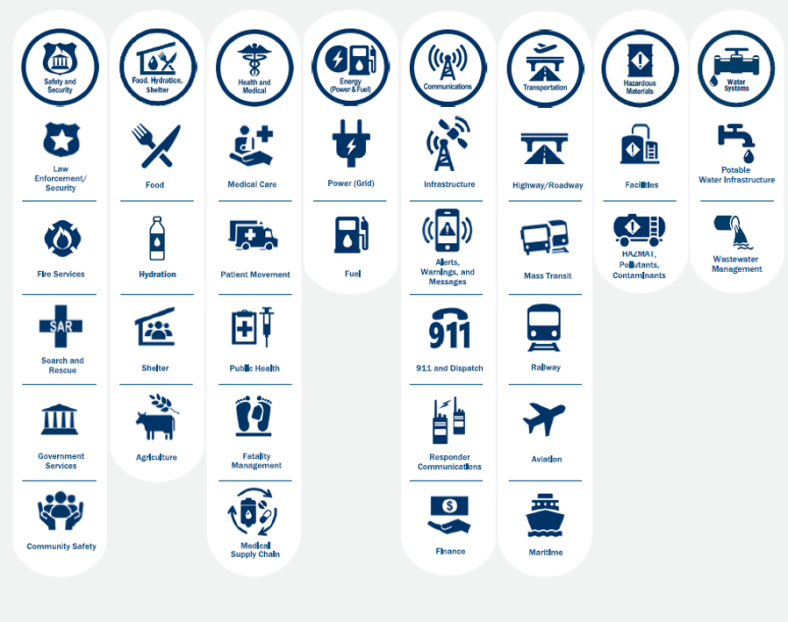
We need to consider that disasters offer extraordinary circumstances with problems that can’t be solved by traditional means. We need to be creative. We also need to recognize how interconnected all facets of our community lifelines are. In order to conquer the extraordinary, we need everyone. We need to identify the capabilities and capacities held by agencies and organizations we might not typically see involved in an incident. Take a look through the list of departments your own city, village, or county has. The Clerk’s Office? The Planning Department? The Purchasing Department? The Office for Mental Health? The IT Department? Office for the Aging? Child and Family Services? Human Resources? Weights and Measures? There are so many more.

The intent of the EOC is to bring together representatives of these agencies and organizations to help streamline their assistance and support. The EOC should cut the proverbial red tape, but key to that is ensuring that each organization is properly represented. With no disrespect intended toward middle managers, as they often are the ones who really run an organization, EOCs require representation from executive-level leadership of these agencies and organizations. The EOC needs the people who have authority to cut through red tape when required.

So how do we approach this in emergency management: APOETE.

Assessing – Seek first to understand. Identify what agencies and organizations may be needed and when. What do they have? What can they do? What are their limitations?

Planning – Integrate them into emergency planning and encourage them to develop their own emergency plans that address they can work within their own bureaucracies.

Organizing – Meet with them and meet collectively. Bring representatives onto working groups that work in preparedness, response, and/or recovery (consider the Community Lifelines as a place to start). This promotes mutual understanding and inclusiveness.

Equipping and Systems – Ensure that all partners have access to the systems used to support incident management.

Training and Exercises – Broaden the invite lists for training and exercises to help these partners gain knowledge and become more involved.

In the end, it’s about working together toward a common cause, aka unity of effort. To maximize the utility of our EOCs, we need to stop looking at an EOC through the lens of the first responder. Flip that perspective and begin looking at the EOC through the lens of government bureaucracy. Consider what these partners need to be successful. How and when can we streamline? Don’t try to turn them into first responders – that’s the wrong expectation. Rather, we need to meet them where they are, respect what they do, and understand why they have certain protocols in place. That will give us a foundation of understanding to work from.

End note: I’ll also suggest that this reality is another reason why ICS-based organizational models for EOCs are less than effective. The organization of an EOC needs to serve a different purpose than what we often try to force it into. Check out the Incident Support Model as a great alternative.

© 2025 Tim Riecker, CEDP

Emergency Preparedness Solutions, LLC®

Revisiting POETE

One of my most popular posts has been my original post on POETE from July 2014. In the 11+ years has passed since that post, I continue leveraging the concept in every way I can. In case you’ve not heard of the concept, I certainly urge you to click the link above and read my original post. Briefly, POETE stands for Planning, Organizing, Equipping, Training, and Exercises. These are collectively known as the elements of preparedness. POETE is more than a checklist to me. It’s a strategic lens for realistically building and sustaining capabilities. Whether you are building a new emergency operations plan, launching a new public health preparedness initiative, or refining multiagency coordination activities, POETE offers a structured way to think through what takes to help ensure these endeavors are implementation-ready.

While I’ve written on these in the past, my continued and diverse application of POETE has broadened my perspective on application, so here are some fresh thoughts.

Assessing – On occasion, I throw an A in front of the acronym for Assessing. While assessments are an early activity of Planning, there are also plenty of stand-alone assessment activities which should be regarded of their own accord. Assessments can and should inform everything else we do in preparedness. Good assessments can provide us with justification for certain activities and investments and can often give us a data-driven approach. Along with many of the risk assessments common across emergency management, like the Threat, Hazard Identification, and Risk Assessment (THIRA), I’d also suggest that (well written) after-action reports (AARs) can also do the job. A well-developed AAR for an incident, event, or exercise can provide objective analysis of observed activities or discussions. When writing an AAR, we should always keep in mind that part of achieving the goal of improvement may involve requests and justifications for funding.

Planning – I’ve written a lot on the topic of emergency planning through the years. Overall, my take on most emergency plans is that they suck. Horribly. They aren’t worth the time, money, or effort invested in writing them. So many people go about it wrong. A true plan needs to be a blueprint for action. Good plans are operationally-focused, guiding decisions and actions. They should not just be theory and policy, as so many are. At best, I’d call something like that a framework, but it’s certainly not a plan.

Organizing – Organizing is largely about structure, roles, and responsibilities, but you can’t even get there without first building relationships and partnerships. Everything we do in emergency management is about relationships. It’s about knowing who has the thing you need – be it a physical resource, specialized knowledge, or specific authority. Last week I wrote a new piece on Community Lifelines. The central activity of doing anything with Community Lifelines is building relationships. Once those relationships are in place, then other activities will follow.

Equipping – I’ve always been very big on tools matching the mission. Equipment in this context means any and all resources available to us. The key aspect of this is alignment. Are the tools we use matching up to our threats, our people, and our procedures? While it’s understandable to have to update procedures to match a new resource, we should be very cautious about the resource dictating procedure. Our resources need to work for us, not the other way around.

Training – I feel like we have been gradually moving away from compliance being the center of the training universe. Yes, there is still plenty of training that is required for various purposes – there should be and there will always be. But I’ve been getting more requests from clients to develop custom training because they realize that little to no training exists to meet their needs. More people are realizing, for example, that ICS training is absolutely not the fit for EOC staff. Similarly, they are realizing that existing EOC training might begin to approach their needs, but the implementation of their specific EOC model really requires customized training. Overall, training needs to be role-based. We need to be training people what we want them to do. We need to give them the knowledge to succeed, not just generalized training for a broad group hoping that people will be able to ascertain what pertains to them and what does not. We also need to realize that, since most training in emergency management is response-oriented, the things they are being trained to do are things they don’t do often and/or don’t do them under pressure. So frequency of training and job aids are essential to their success.

Exercises – The thing I do the highest volume of. Luckily, I love to do them! Exercises are about testing our plans and capabilities before they are tested for real. Pay attention to good exercise design and never forget that the end product is a worthwhile AAR. I still see so many softball AARs out there. AARs that pat people on the back for a job well done while only acknowledging the superficial opportunities to improve – often times because they don’t want to hurt anyone’s feelings. I don’t ever write an AAR for the purpose of offending anyone, but if we don’t expose what doesn’t work, the chances of it ever being addressed are so much lower than if we had documented it.

While we have the acronym of (A)POETE, it’s important to keep in mind that it’s not intended to be a linear process. It’s iterative and constantly in need of attention. Each component is informed by the others. While I generally believe that Planning is still the foundation of preparedness and it should heavily influence all other elements, those other elements can still influence Planning. POETE activities should be used to build our capabilities. These activities help us prepare with purpose, focus, and intent.

© 2025 Tim Riecker, CEDP

Emergency Preparedness Solutions, LLC®

Replacing ESFs with Community Lifelines

I’ve written previously about my concerns with using Emergency Support Functions in many state, local, territorial, and tribal (SLTT) emergency operations centers. The ESF structure was never intended for SLTT use, and while it may have some successes with the largest of the states and metropolitan areas, it’s generally not a good fit.

I’ve also written previously about Community Lifelines and the benefits thereof. Consider, however, that Community Lifelines, while designed originally for the organization of information by FEMA regional offices when they monitor a disaster, can have much broader applicability. We can and should be using Community Lifelines across every phase / mission area of Emergency Management.

Lately I’ve been having more and more conversations about Community Lifelines with clients, at conferences, and with others who are interested in learning more about them and how to use them. Across emergency management we often find or are provided with approaches to problems that are single-use. We should regularly explore opportunities to expand those single-use applications, increasing the utility of the concept at hand. Given the shortcomings of ESFs for most jurisdictions and the much broader applicability of Community Lifelines for every jurisdiction under the sun, I suggest that Community Lifelines cannot only be operationalized to be a viable replacement for ESFs, they can do so much more. Here are my arguments in support of replacing ESFs with a Community Lifelines – driven organization in SLTT EOCs as well as emergency management programs as a whole:

  1. Community Lifelines are community-focused and more comprehensive of the needs of a community, whereas ESFs are driven by functions which may have limited capabilities or capacities in any given jurisdiction.
  2. Community Lifelines can be operationalized just like ESFs, with primary and support agencies and organizations.
  3. Community Lifelines are focused on stabilizing critical services with built-in mechanisms for assessing impacts and establishing priorities.
  4. Community Lifelines more directly support the inclusion of the private sector, along with government, NGOs, and quasi-government owners/operators.
  5. Community Lifelines provide better preparedness and resilience initiatives.
  6. Community Lifelines provide us with a basis for measuring progress across all phases or mission areas. The only thing we can measure in an ESF is what we might have available to leverage in a response.
  7. Community Lifelines connect resilience, response, and recovery since they are the focal point. While the National Response Framework and National Recovery Framework still have national relevance, the transition from ESFs to Recovery Support Functions (RSFs) is challenging at best.
  8. The inclusion of Community Lifelines in our EOC structure is easy and agnostic to the organizational model used in the EOC. ESFs include functions that are part of the typical overhead management of an EOC, such as ESF 5 (Information and Planning), ESF 7 (Logistics), and ESF 15 (External Affairs), which is an awkward integration.
  9. Community Lifelines lend to better partnerships and preparedness. The ESF plans of most jurisdictions are truly little more than a general scope of the ESF with a list of participating agencies and organizations.

We need to change our mindset of emergency management being centered on response. Yes, response is the big shiny thing. It’s the thing we practice for and anticipate. A more wholistic and comprehensive approach is available to us, however, by using Community Lifelines as the foundation of our work. I suggest that jurisdictions develop Community Lifeline Implementation Plans, which are fundamentally strategic plans identifying how Community Lifelines can be used in Prevention/Protection/Mitigation, Preparedness, Response, and Recovery. Consider how the relationships forged with the owners/operators of Community Lifeline partners can support each of those phases and activities, increasing the resiliency of our community as a whole by making each partner more resilient; and by understanding and preparing for the response and recovery needs of our community through the collective effort of Community Lifeline partners.

Emergency management is more than response. It is a comprehensive effort to support our communities before, during, and after disaster.

© 2025 Tim Riecker, CEDP

Emergency Preparedness Solutions, LLC®

Generative AI in EM

We’ve recently seen a significant increase in discussion about applications of artificial intelligence (AI) (generative AI, to be more specific) in the emergency management (EM) space. In just a few minutes of scrolling through my LinkedIn feed this morning I’ve come across four user posts and one user-posted article expressing caution and concern about the use of AI in a full range of EM-related work, and one post extolling the advantages of using AI in certain EM applications. These posts expressing caution included topics such as being disingenuous in our work, inaccuracies of AI products, and accountability for use. The post in favor indicated ease of use and efficiency as principal advantages.

AI can certainly be a tool with many applications to support aspects of our job. It can short cut a lot of activities for us, saving huge amounts of time. It can generate ideas or create an outline to work from. But it cannot reliably and completely replace what we do. I see it as a complementary tool – one that still requires human input, intervention, and review to be successful. In examining the pros and cons, we can’t just look at it superficially, though. There are concerns of information security, intellectual property, inaccuracies, environmental impact, and ethical accountability to consider.

There are concerns about where generative AI platforms source their data. In essence, it can be seen as a type of crowd sourcing, pulling data from across the internet, similar to how we might in doing research. However, generative AI does not often cite its sources and has been heavily criticized by writers and artists of plagiarism. I’ve actually run a few tests of my own, asking a generative AI tool to write about certain topics that are very niche, with myself being one of the few people writing on those topics. While it did cite me as a source on a couple of occasions, it typically did not, though there were clearly word-for-word phrases sourced from my own writing. Additionally, generative AI is not skilled in discerning truth from misinformation or disinformation, potentially leading to significant inaccuracies. On the flip side, anything you input into a public generative AI platform, such as an emergency plan, is now part of that AI’s dataset, bringing potential security concerns to the discussion.

What has me even further concerned is the cognitive impact on those who habitually use AI to do much of their work. MIT did a study which concluded that overuse of AI harms critical thinking. Microsoft partnered with Carnegie Mellon for a study that came to similar conclusions. We should also be aware of the environmental impacts of AI data farms, (and here is another article for your reference) which is a significantly growing concern around the world.

In regard to the impacts on critical thinking, I have severe concerns about the need to raise the bar of emergency manager knowledge, skills, and abilities (KSAs), not just as a matter of progressing the profession, but because of some serious gaps we’ve recently seen identified in after action reports (AARs), media statements, social media posts, and other releases that demonstrate a huge lack of understanding of key concepts among emergency managers. While the use of generative AI may help support the work involved in various projects, I would argue that it is not promoting or advancing individual KSAs in the field of emergency management (aside from those needed to interface with AI). If unplugging an emergency manager from AI tools results in us no longer having a knowledgeable, skilled, and able emergency manager, we have a major problem. 

I say all this not ignorant of the fact that I have friends and colleagues who use generative AI to help them develop content, such as their LinkedIn posts. Largely, these individuals have been transparent about their use of generative AI, indicating that they use it either up front to help provide structure to an idea which they then use as a framework to flesh out on their own, or at the end of their own creative process to tighten up their work. Overall, I don’t see much detriment in these approaches and uses, and have even acknowledged that my college students may be using it in these ways and providing them some guidance that supports successful use while helping them to ensure accuracy and avoid any allusion of plagiarism. It’s when people habitually use generative AI to pass off work as their own with little to no human input that I have concern. I also have friends and colleagues working with much broader applications of AI, for which I have concerns. While my concerns aren’t necessarily opposition, as I clearly see the benefits of these tools and uses for what we do in EM, I still see a lot of potential for eroding KSAs and critical thinking in our field, which is something we cannot afford. Yet I remain cautiously optimistic of a net gain. 

For those that choose to use it to generate content and outputs, be ethical and transparent about it. There is no shame in using AI, just consider citing it as you would a source (because it’s not your work) just as you should be with any other sources, and obviously be aware of the pros and cons of using generative AI. Generative AI is still a developing technology, a toddler perhaps in terms of relative growth, and I think even proponents should be skeptical, as skepticism can help address many of these concerns. Consider that toddlers can be fun, but they can cause absolute chaos and can’t be left unattended for even a moment.

I’m reminded of a saying with its roots in project management that goes something like this: You can have it cheap, fast, or good, but you can only pick two. Here’s what the options look like:

  • Fast and good won’t be cheap.
  • Good and cheap won’t be fast.
  • Fast and cheap won’t be good.

It seems to me that most people using generative AI are trying to pick the ‘fast and cheap’ options, which bring about the majority of concerns associated with quality and integrity in this article, but when we look beyond the superficial, into things like the environmental impacts of AI data farms and the cognitive impacts to high-volume users, the end result certainly isn’t cheap, no matter what options we pick.

©2025 Tim Riecker, CEDP

Emergency Preparedness Solutions, LLC®

Why Aren’t We Asking Questions and Demanding Answers?

Having been on the road practically every week this year has made blogging a bit of a challenge. I’ve had some engagement on LinkedIn, often in discourse on the issues facing disaster and emergency management brought on largely by the current administration.

You’ve probably heard of the concept of mushroom management, right? Keep people in the dark and feed them shit. That’s what we’re getting regarding the future of FEMA, which makes it extremely difficult for practitioners to chart a course ahead for this field. The only information we receive is poorly communicated intent and obfuscation. Those who are supposed to be representing the profession either aren’t asking the right questions or are being ignored.

Let’s take a look at this horrible bit of journalism from earlier in the month (I’ll note that most news outlets have been using the same quotes and generally haven’t brought us anything new either).

I’ll break this down a bit. First, the headline: Trump and Noem detail planned FEMA changes: ‘We’re going to give out less money’. Commentary: There is NO detail in the article or in anything the administration has communicated about this. Simply stating that they are going to give out less money leaves a whole lot of questions. Much of the narrative has been around funds associated with declared emergencies and major disasters, but there is a whole lot of other funding that FEMA manages. More on this later.

A quote early in the article: “We want to wean off FEMA and we want to bring it down to the state level… We’re moving it back to the states.” Commentary: If I’ve not made this abundantly clear before, DISASTER MANAGEMENT HAS ALWAYS BEEN A STATE (and local, tribal, and territorial) ISSUE. What exactly is being moved back to the states? Further, as I’ve stated in a previous article, I’m not opposed to a ‘weaning off’ of federal funds, but there should be a plan in place for this which is implemented over time and communicated with enough lead time to allow state, local, tribal, and territorial governments to begin adjusting budgets. Also, this again begs the question of exactly what funding is being changed. We need information so this can be addressed.  

The next quote in the article: “We’re going to give out less money… It’s going to come from the President’s Office” Commentary: How, exactly, is it coming from the President’s office? The Stafford Act assigns FEMA with the responsibility for coordinating federal disaster assistance. So are we changing the law?

The next item I want to poke at is a quote from Secretary Noem in the article, which reads “the administration is building communication and mutual aid agreements among states to respond to each other so that they can stand on their own two feet…”. Commentary: Does she mean the Emergency Management Assistance Compact (EMAC)? The same EMAC that has its roots going back to 1992 and was ratified by Congress in 1996 as a nation-wide system of state-to-state mutual aid and used very effectively since then? That mutual aid system? Or is the administration building something else? This seems to be a greatly misinformed quote.

With no apology for my language, what in the actual fuck is going on here?

I pointed out the article as being a horrible bit of journalism because it’s simply reporting quotes and NO ONE IS ASKING QUESTIONS. (Or if they are, they aren’t being answered). There are a lot of questions that need to be asked and answered. This is a big issue. A complicated issue. It requires a whole lot of clarity. The problem is, it seems that those making decisions really don’t know anything about the topic or what they are doing.

Over the past couple of months we’ve seen leaked budget proposals that impact emergency and disaster management grants, public health emergency preparedness grants, and the like. Those grants that aren’t being completely cut in these proposals are being reduced by tens of percentage points, equating to tens, and sometimes hundreds of millions of dollars. Regardless of the long-term impacts of these decreases, this is massively disruptive in the short term. Disruptive to the point that entire programs will be gutted and our collective ability to respond to disasters will be dangerously impacted. Again, I ask what is the plan or is the administration simply hacking and slashing away at things? As no existence of a plan, much less a strategy, has been mentioned, I can only believe this to be arbitrary and uninformed.

So many people are acknowledging there are issues with FEMA and that addressing them can be good, and I won’t dispute that, but that’s as far as they go. It’s a statement, a justification, an excuse, but it’s not a conversation. This needs to be a conversation. Uninformed change is bad. Misguided change is bad. Change for the sake of change is bad. As I stated in a recent LinkedIn post, emergency managers need to get their shit together. While the usual pace of government and bureaucracy can be frustratingly slow at times, we have systems in place for a reason. Change at this level must be well considered with input garnered from across the practice. The rhetoric and bull in a China shop approach might excite those who are easily impressed with superficial, performative bullshit; but it shouldn’t for those of us with some intelligence and background in this. We have a lot of smart people in emergency and disaster management, but I’m not hearing a lot of voices.

Who should ask questions? What percentage of elected officials at the federal level even know what the Emergency Management Performance Grant (EMPG) is? I’m betting it’s pretty low. Do they even realize there are prevention, preparedness, and hazard mitigation funds and programs or do they only know about assistance after a disaster? It’s easy for us to point a finger at the membership organizations for not doing enough advocacy and outreach (are they?), but that job isn’t theirs alone. It’s on ALL of us to get elected officials to understand what these programs are and why they are necessary, or at least advocate a better way to enact cuts. If you don’t know how to contact your members of Congress, start here and tell them the current approach is unacceptable. Likewise, if you haven’t contacted your state elected officials, you need to do so as well. The writing seems to be on the wall that these significant cuts in funding are coming and they need to discuss (with practitioners!!!) how to deal with it.

Regardless of the outcome of FEMA’s status and that of federal program funding, disaster management will continue, but the impacts may very likely be severe, and not just in the short term. There will be lasting impacts which will need to be addressed through years to come and at a much greater cost than delaying this politically-driven action in exchange for a more thoughtful approach.

TR

Cutting Grant Funds Cuts National Practices

As some rumors become reality for the current fiscal year and budget memos are leaked for the coming fiscal year, one thing is clear – states, local governments, tribal governments, and territories (SLTTs) will be receiving significantly less federal grant funding for preparedness. While some programs are expected to be outright eliminated, others are being reorganized and refocused with significant budget cuts. While not all change is bad, there is a significant shift in preparedness priorities that is largely politically motivated and lacking foundations in reality. I wrote last month on the Future of the US Emergency Management System, which focuses mostly on FEMA-centric topics, but we are also seeing and expecting major cuts to public health emergency preparedness (PHEP) grant funds, the elimination of certain PHEP programs, and indirect impacts to PHEP from cuts to other public health programs.  Similar cuts are also expected with the Hospital Preparedness Program (HPP). While I don’t think preparedness funds will be completely cut, the impacts will be significant until SLTTs are able to adjust their own budgets to address what priorities they can.  

Grant funding, however, is not only to the direct advantage of the recipients. Compliance with grant rules has long supported national standards (note that I use this term loosely. See this article for more information). FEMA preparedness grants, PHEP grants, and HPP grants, among others, have required the adoption of the National Incident Management System (NIMS), the use of the Homeland Security Exercise and Evaluation Program (HSEEP), national focus on certain threats or hazards, and reasonable consistency in building and sustaining defined capabilities. Grants have been the proverbial carrot that encouraged compliance and participation. While some of the results have been poorly measured (see my annual commentary on the National Preparedness Reports), the benefits of others have been much more tangible. Keeping things real, compliance with many of these requirements by some recipients may have been lackluster at best. Enforcement of these requirements has been practically non-existent (despite rumors of the “NIMS Police” circulating for years), which I think is a shame. That said, I think most recipients worked to meet most requirements in good faith; perhaps partly because someone’s signature attested to it, but I think mostly because many of these requirements were viewed as best practices. As such, while the requirements may be going away if there is no carrot for compliance, I think many jurisdictions will continue implementation.

All this, however, looks at past requirements. But what of new practices that would benefit from nation-wide implementation? I fear that without practices being required as part of a grant, adoption will be minimal. We would have to count on several factors for adoption to take place.

1) Emergency managers would need to be informed of the practice and the benefits thereof. Let’s be honest, most emergency managers are not well informed of new practices and concepts. Often, they simply don’t have the time to do any more than what they are doing, but unfortunately some may not care. Agencies like FEMA have also been notoriously bad at circulating information on new programs, practices, and concepts.

2) Emergency managers would have to agree that the practice can be beneficial to them.

3) Emergency managers would need the resources (time, staff, funds, etc.) to actually implement the practice.

4) In a multi-agency environment, partner agencies are more willing to support activities if they are told it’s a grant requirement – even if it’s not their own grant requirement. They may be reluctant to commit resources to something that is simply perceived as a good idea.

There are certainly a number of challenges ahead for emergency management in the broadest of applications. What I discuss here only scratches the surface. Let’s not lose sight of the benefits of best practices and standards, even if no one is telling us we need to adhere to them. That’s a hallmark of professionalism. We need to collectively advocate for our profession and the resources necessary to perform the critical functions we have. We need to take the time to advocate and to be deliberate in our actions. We need to secure multiple funding streams from every level of government possible. We need to identify efficiencies and leverage commonalities among partner agencies. Yes, lend your voice to the national organizations, but know that it’s up to you to advocate in your municipality, county, and state – and those efforts are now more important than ever.

©2025 Tim Riecker, CEDP

Emergency Preparedness Solutions, LLC®

The Future of the US Emergency Management System

It’s been a stressful time for emergency management as of late. Obviously, a lot of attention is focused on the Federal Emergency Management Agency (FEMA) and its unknown future. This unknown future stems from criticisms of efficiency and effectiveness, and accusations of fraud. Some have said FEMA is a bloated, overly bureaucratic agency that isn’t agile enough to have optimal efficiency. While some claims may have substantial truth to them, other claims are exaggerated, while some have been proven false. Changes are being enacted, discussed, and speculated.

A council is being formed to advise on the future of FEMA, but changes are already occurring. The National Advisory Council has been disbanded; FEMA’s Emergency Management Institute and partner National Fire Academy have had their operations suspended pending a review of curricula (by who and for what seems to be unknown); employees have been laid off; documents and other information have been removed from the FEMA website; and orders are in place to remove all references to certain concepts and programs related to things such as climate change and equity – which are relevant and important to what we do.

But it’s not just FEMA that will feel current and potential impacts. FEMA has a great deal of impact on emergency management systems across the nation and abroad. Policies, directives, funding, programs, and ideas that FEMA implements, even if not intended to be applied at a state, local, tribal, and territorial (SLTT) level, often are. FEMA’s mission is comprehensive, supporting preparedness through doctrine, training, exercises, and grants; disaster response through coordination of resources, specialized teams, and incident management; and disaster recovery and mitigation through doctrine, processes, and grants. And these are just broad examples. FEMA is also not the only federal agency that does emergency management. A vast majority of federal agencies do. While some have their own inherent authorities, FEMA’s job is to coordinate them all, and not just for the benefit of SLTTs, but also for all branches of the federal government.

The changes that have occurred already within FEMA and other federal emergency management partners, such as the National Oceanic and Atmospheric Administration (NOAA) and components of the Department of Health and Human Services (HHS), along with the specter of changes to come has led to an abundance of speculation across emergency management. Some of this speculation seems reasonable, while other speculation seems greatly misinformed and shows that even some who work in emergency management don’t understand emergency management. (example: The Director of the Louisiana Governor’s Office of Homeland Security and Emergency Preparedness stated that “disaster response is generally organized into three stages – each with different levels of oversight. Local officials handle the initial response during the first 72 hours after a disaster, the state then handles the second phase from 3 to 14 days after the event, and FEMA’s role typically begins after two weeks”. This is not an emergency management concept in the US. If it were, it would be outlined in the National Response Framework.)

A common complaint in this mess of rhetoric is that local governments don’t have enough control before, during, and after disasters. These statements are clearly made by those who are misinformed on the emergency management system in place in the United States. Again, I point to the National Response Framework, which clearly reinforces that emergency management broadly and disaster response specifically is supposed to be a locally executed program, supported at the state and federal level. States’ rights are a significant part of our Constitution, and most states are home rule states. Even those states which are governed by Dillon’s Rule (where local governments have only the powers explicitly granted to them by law) still have local governments with significant responsibility for their communities. In the United States, emergency management, like other functions, operates under a federalist construct, meaning that SLTTs have primary authority and responsibility for managing emergencies. The federal government then serves to provide support when SLTTs are overwhelmed. This is the foundation of the National Response Framework.

On March 4th of this year, a Congressional Subcommittee on Emergency Management and Technology convened a hearing entitled “Future of FEMA: Perspectives from the Emergency Management Community”. Leadership of the subcommittee seemed to not be certain of the purpose of this hearing as there were two differing statements of purpose given at different times – the first was to assess the current role of FEMA. The second was to solicit feedback from stakeholders which can guide the White House council in what areas can be reformed. While there may be some overlap between these two statements of purpose, they are yet very different. The hearing included very brief testimony from four witnesses engaged in emergency management. Speaking to the first statement of purpose, while most of the testimony given was thoughtful and relevant, I’d barely say that four brief statements (plus some Q&A) qualify as an assessment. As for the second statement of purpose, given that the White House’s council hasn’t even been formed, I’m not sure that anything from this hearing would be submitted to or considered by the council. Even if it were, I think specific statements may require more context, substantiation, and explanation.

One common theme I’ve heard from many, including some of those who gave testimony at this Congressional Subcommittee, is that FEMA’s disaster recovery funding is overly bureaucratic and takes too long to get into the hands of local governments. Many have been promoting the replacement of this funding system with block grants, which would give grant recipients (SLTTs) quicker access to funds and more control over how they are used. A current example of such a program is FEMA’s Building Resilient Infrastructure and Communities (BRIC) grants administered by FEMA’s hazard mitigation program. If you are interested, pros and cons of block grants are detailed fairly well in this GAO report and this CRS report.

While I agree that block grants can deliver the funds faster and allow for more flexibility in spending, there are some concerns I have with accountability, especially since there seems to be little standard in how block grants are audited. Block grants can also be strongly subjected to political pressures, which can result in disparities of effectiveness of the intent of the grant. While I acknowledge that FEMA’s disaster recovery grant program is highly bureaucratic, it is so for a reason – checks and balances. For example, the Public Assistance program imposes checks at every step before, during, and after a project, ensuring that the grantees are in fact even eligible to receive the funds; reviewing and approving a detailed project plan to ensure that the project is reasonable given disaster damages, that the project will improve upon what was previously in place; that the project follows applicable codes and standards; and that the project undergoes environmental and cultural impact reviews; among other things. Each of these items is verified during and after project implementation. These are all activities necessary to ensure that the project is a good investment of taxpayer dollars. Block grants tend not to have these kinds of checks and balances associated with them, which leads to a lot of concern.

I certainly acknowledge that most things can be improved upon. There are almost always efficiencies to be gained, but agencies and systems should be reviewed by those who have knowledge of those functions and why those systems are in place. Cuts should not be indiscriminate. I’ll also suggest that for any wholesale changes to things such as disaster recovery, laws, such as the Stafford Act, may need to be changed. This cannot be done at the whim of an administration. I’ll also agree that, even within the bounds of a federalist system, SLTTs should be more responsible, resilient, and invested in their emergency management programs. For decades SLTT emergency management programs have been funded at significant levels by grant programs such as the annual Emergency Management Performance Grant (EMPG). This causes significant concern for sustainability and continuity, and it has been a recent worry by many that grant programs like this will be summarily done away with (note that other SLTT programs like public health have similar grant funding streams). Obviously, this would decimate emergency management programs which were not prepared to shoulder these budgets, resulting in losses of numerous component programs, jobs, and capabilities across all phases of emergency management. With these grant programs in place for decades, there was rarely any incentive for SLTTs to self-fund these programs to any significant extent, so I think SLTTs and elected officials should be held blameless for not doing so. If there were to be a disengagement of federal funding, in whole or in part, for these programs, I suggest that it should be a phased approach, giving SLTTs a period of time, perhaps even ten years, to assess funding needs and develop budget plans to incrementally absorb these costs. Doing so will help ensure the sustainment of programs and services for their communities and stakeholders.

Change is coming. As stated in my post from a few weeks ago, we must take advantage of the opportunity, whether we like the circumstances or not. I also recognize that we may not have much control of what happens. While it’s long been the concept that where FEMA goes, so does the nation (at least in terms of emergency management), we may be forced to disengage from that concept. We may need to forge our own path forward. Depending on the direction taken and the leadership that may rise, we may see a new era in emergency management. Will emergency management as a function fail? No. It won’t. We will find a way. We must keep in mind that governance is a marathon, not a sprint.

I’m reminded of a statement by Calvin Coolidge which I’ve reflected on for much of my adult life:

Press on. Nothing in the world can take the place of perseverance. Talent will not; nothing is more common than unsuccessful men with talent. Genius will not; unrewarded genius is almost a proverb. Education will not; the world is full of educated derelicts. Persistence and determination alone are omnipotent. Press on!

©2025 Tim Riecker, CEDP

Emergency Preparedness Solutions, LLC®

Taking the Reins

Through the past several years of my blog, the central theme of my posts has really been to ask ‘why?’. Why do we do the things we do in emergency management? Why do we accept things as they are? Why haven’t we endeavored to change, update, or improve upon some of these things that range, at best, from mediocracy to, at worst, absolute crap?

A boss of mine many (so many) years ago taught me the concept of ‘ask why five times’ if you want to get to the root of anything. Of course, you need to seek the proper people to ask or sources to conduct your research, but the concept still stands – often we can’t just ask ‘why’ once and expect that one answer to explain everything for us.

Our field of practice is filled with so many things which can be considered standards. They may be true standards, such as NFPA 1660, or simply a de facto standard – something that has become widely accepted in practice, such as CPG 101.

Standards are a double-edged sword. On the better side, they give us commonality. We can expect that, if reasonably applied, the outputs will have substantial similarity and will, at minimum, meet a base-line expectation. Consistency is generally viewed as good and beneficial in largely any application. On the other hand, standards can stifle innovation. They can encourage laziness. They often promote shortcuts like templates, which, while there are benefits, largely remove the inclination of critical thinking from the work that is done and assume that all applications can fit within someone else’s concept of how things should be.

As we face a significant possibility of a number of de facto standards from FEMA no longer being maintained due to changes in focus and reduction in force – things like the homeland security exercise and evaluation program (HSEEP), CPG 101, and even the National Incident Management System (NIMS) – how will things be done in what may become a new era of emergency management?

There are some that are shilling the downfall of emergency management. While I don’t think this extreme is quite realistic, there will most certainly be some significant changes and impacts to which we must adapt. In the realm of standards (and likely other gaps created), I feel the profession will realize the need to take care of itself, taking a path of self-determination and filling a role that has been, most successfully, done by FEMA. Early on, in the absence of a central coordinating entity (FEMA) maintaining these de facto standards, we will see several disparate efforts of upkeep, with results likely following a bell curve of quality – most will be deemed reasonable, though outliers will exist on both ends of the spectrum, with one side being garbage and the other fairly inspired and progressive. Here enters opportunity. Opportunity for improvement, innovation, different perspectives, and simply seeking better ways of doing things. Though this process begs some questions – Whose version will reign supreme? And what authority does the author have to publish any given standard? Is some measure of authority even required for such a thing for it to be, even unofficially, adopted by the profession?

I feel that regardless of this circumstance, we must periodically examine our standards of practice. Ask ‘why?’ five times (or really however many times is necessary). This can range from asking the same question over and over until you get to some foundational answer you are seeking, or asking a chain of related questions to poke at different sides of the standard. Consider questions like ‘Why does the standard exist?’, ‘Why does the standard exist as it is?’, ‘How did this standard evolve?’, ‘What are the strengths of the current standard?’, ‘What are the weaknesses of the current standard?’, ‘What can we do better and how?’.

There has been some effort lately (also spearheaded by FEMA) toward the concept and implementation of continuous improvement. Standards should also fit within this movement. Standards need to evolve and change and support the practice, though they should be constructed in such a fashion that does not limit a range of application (i.e. can it be used by states as well as small towns? Does it need to be?) or stifle innovation. And while evolution is necessary, I’ll also caution against wholesale change – unless a truly better way is developed and validated. Standards should not change based simply on someone’s good idea, a different perspective, or political influence. Standards (true or de facto) or any part thereof and in any industry should be peer developed and peer reviewed. Changes need to be carefully considered, but also not feared. While I feel FEMA has been a good steward of our standards of practice, that time may be coming to an end, at least for a while. The standards of practice across emergency management must be maintained if this disruption comes to fruition. This is a challenge. This is an opportunity. This is a necessity. We must rise to the occasion.

© 2025 – Tim Riecker, CEDP

Emergency Preparedness Solutions, LLC®

2024 National Preparedness Report – Another Missed Opportunity

The annual National Preparedness Report (NPR) is a requirement of Presidential Policy Directive 8, which states that the NPR is based on the National Preparedness Goal. The National Preparedness Goal, per the FEMA website, is “A secure and resilient nation with the capabilities required across the whole community to prevent, protect against, mitigate, respond to, and recover from the threats and hazards that pose the greatest risk.” The capabilities indicated in the National Preparedness Goal are specifically the 32 Core Capabilities.

The 2024 NPR is developed to reflect data and information from 2023. As with previous NPRs, I have a lot of concern about the ultimate value of the document. While I’m sure a lot of time, effort, and money was spent gathering an abundance of data from across the nation to support this report, this year’s report, following the unfortunate trend of its predecessors, doesn’t seem to be worth the investment. As with the others, this report falls short on adequate scope, information, and recommendations. Certainly, there is a challenge to be acknowledged of not only gathering a massive quantity of information from across the country but also examining and reporting this information in aggregate, as most federal reports are burdened to do. That said, I see little excuse to not provide a meaningful report.

In this year’s report, following the introductory materials, is a section on risks, which is largely a reflection of the high impact disasters of 2023 seen across the US; the most challenging threats and hazards; and the intersections of risk and vulnerability. All in all, this is an adequate snapshot of these topics in summary, with some solid points and a level of analysis that I would expect through the rest of the document, which includes trends over time, and identification of factors which influence the findings. There are several maps and charts which provide good data visualization and several mentions of bridging data between agencies such as FEMA, NOAA, and CDC. A good start.

The next section is Capabilities. This section has two areas of narrative – community preparedness and individual and household preparedness. Given the significant efforts to bolster capabilities throughout the federal government and in state, tribal, and territorial governments, it seems these levels are obviously missing if we are to suggest that all local governments are simply communities, so I’m not sure why this is specifically titled community preparedness. Does it not include the efforts of states or others? Page 18 of the report provides a chart similar to what we’ve seen in previous reports which shows how much money was spent on each capability (in communities… again, what does this include or exclude?) for 2023. The chart also indicates the percentage of communities achieving their capability targets.

As with the reports from the previous year, I ask: So what? This is a snapshot in time and lacking context. A trend analysis accounting for at least the past several years would be quite insightful, as would some description of what the funds within each capability were primarily spent on – broadly planning, organizing, equipping, training, and exercises, but I’d like to see even more specifics. There are a few random examples in the narrative, but a lot is still lacking. I’d also like to see some analysis of relative success or value of these investments. In regard specifically to the percentage of communities who feel they have achieved their capability target, I have to eye roll a bit at this, as this is often the most subjective (and sometimes smoke and mirrors) aspect of the Threat and Hazard Identification and Risk Assessment (THIRA). This chart currently has little value other than a ‘gee whiz’ factor of seeing how much money is spent on each capability.

I’ll also include a specific observation of mine here: the Core Capability of Mass Care Services, which in the previous year’s report was indicated as a high-priority capability, continues a trend (I’m only aware of the trend from looking back at previous reports since trend data is not included in the report) of having one of the lowest achievement percentages and investments. I’m hopeful that’s why it’s included in the next section as a focus area.

The other area of narrative in the Capabilities section is individual and household preparedness. All in all, the information presented here is fine and even includes a slight bit of trend analysis, though in 2023 a much more comprehensive reporting of this information was provided under separate cover. I think an improved version of something like the 2023 report should be incorporated into the NPR.

The next section of the NPR is Focus Areas, which includes the Core Capabilities of Mass Care Services, Public Information and Warning, Infrastructure Systems, and Cybersecurity. Each focus area includes narrative on risk, capabilities and gaps, and management opportunities – which all provide great information. There is a brief mention of how these focus areas were selected. While I’m fine with having a deeper analysis of certain focus areas, I think the NPR should still provide a comprehensive review of all Core Capabilities.

While the management opportunities listed for each of the four focus areas are essentially recommendations, the report itself only provides two recommendations which are labeled as such. These recommendations are identified in the document’s introduction with a bit of narrative (and the conclusion with none), that thankfully provides some suggestions for actionable implementation, but I was left feeling both surprised and disappointed that the National Preparedness Report, which really should be providing an analysis of all 32 Core Capabilities which serve as the foundation for nation’s preparedness goal, has only two recommendations for improving our preparedness. Two. That’s it. There should be an abundance of recommendations. This is the information that emergency managers and decision-makers within the field of practice need within federal agencies and state, local, tribal, and territorial (SLTT) governments. Another missed opportunity to provide value.

The 2024 NPR is extremely similar to the past several years in format and general content, and as such I’m not surprised by the lack of value. I continue to stand by my statement across these past several years in regard to this report: the emergency management community should not be accepting this type of reporting. While I recognize that through PPD8, it is defined that the audience for this report is the President and the Secretary of Homeland Security, the utility of such a report can and should have a much broader reach across all of emergency management, and idealistically to tax payers as well, who should be able to access better information on how their tax dollars are spent within preparedness – which impacts everyone. States, UASIs, and other entities who submit information annually for this report should also be disappointed that this is what is published about their hard work, and the emergency management membership organizations should also be demanding better. This report has the potential to be meaningful, insightful, and influential, yet FEMA misses the opportunity every single year to do so. The data exists, and the stories of the activities, accomplishments, and gaps can all be told. With the application of some reasonable analysis and recommendations, the document could be much more impactful.

It’s been said by many that emergency managers are notorious for not marketing well, and this document is proof positive of that. Those of us working in this profession know there is so much more to be examined and described that can tell of not only what we have accomplished but also of the work to be done. We find ourselves in a time where the purpose and value of FEMA is being questioned by a number of people; a time where some inefficiencies, missteps, and even failures are being put under a very critical microscope and seemingly being used to fuel a suggestion of eliminating FEMA. Greater efficiencies can certainly be identified and gaps addressed, but our reluctance to tell the stories of what we do clearly lend to misunderstandings and a severe lack of awareness that exist about our field of practice – one in which there is no organization of greater prominence and importance than FEMA. While the NPR is not at fault for these shortcomings, it is a contributor. When reports like this miss opportunities to do more and be more year over year, that snowballs and becomes a much greater issue. We need to do better.

© 2015 – Timothy Riecker, CEDP

Emergency Preparedness Solutions, LLC®

Five Domains of Incident Management

Earlier this summer, RAND, under contract to CDC as part of a five-year project related to examining and assessing incident management practices in public health, developed and released the Incident Management Measurement Toolkit. Overall, I think the tool developed is a solid effort toward standardizing the evaluation of incident management. The tool guides a depth of examination into incident management practices. It can be a bit daunting at a glance, but the methodology of evaluation is generally what I’ve been practicing over the past several years for developing incident and event AARs. I’d also suggest that it’s scalable in application.

I feel it’s important to note that incident management teams involved in non-public health applications were also engaged in the research. The outcomes of the project and the inclusion of non-public health incident management practices in the research indicate to me that this tool can be applied broadly and not limited to public health applications.

Serving as a foundation for the assessment tool and methodology are five Domains of Incident Management that the project team identified. Provided with key activities, these include:

  1. Situational Awareness and Information Sharing – Perception and characterization of incident-related information to identify response needs.
  2. Incident Action and Implementation Planning – Ongoing articulation and communication of decisions in coherent incident action plans.
  3. Resource Management and Mobilization – Deployment of human, physical, and other resources to match ongoing situational awareness, identification of roles, and relevant decisions.
  4. Coordination and Collaboration – Engagement and cooperation between different stakeholders, teams, and departments in managing the incident.
  5. Feedback and Continuous Quality Improvement – The need for ongoing evaluation and refinement of incident management processes.

In consideration of these domains, I think the activities inherent within them are fairly agnostic of the type of incident management system (i.e. ICS) used. I also think these same domains can be applied for recovery operations, again, regardless of the system or organization being utilized; as well as the principal practice at work (public health, emergency management, fire service, law enforcement, etc.).

I’ve been intending to write about these domains for a while, but each time I considered them, something stood out to me as being a bit askew. I finally realized that these really aren’t domains that encompass all of incident management. Rather, these domains are better associated with an incident management system, such as the Incident Command System (ICS). The first three domains are very clearly applied directly to an incident management system, and the fourth is the general concept of multiagency coordination, which is a common concept of incident management systems. The last domain is simply quality management which is certainly integral across various incident management systems.

While I don’t believe my view undermines the tool’s value, it highlights the need for a clearer understanding of its limitations. An incident management system, like ICS, is just one part of incident management and doesn’t cover all related activities. Some tasks in incident management, such as setting priorities, decision-making, troubleshooting, and dealing with political and social issues, are often not directly related to the tactical management systems we use. Additionally, many important aspects fall within leadership that aren’t covered by the NIMS doctrine or the Planning P. Although organizing resources is a central part of incident management, there are many other activities not addressed in a tactical response that may influence tactical applications but are not part of a defined incident management system. While one could argue these activities fit into the five identified domains, I feel this analysis doesn’t provide a complete picture of a complex response. More information would be needed.

That said, I really like this toolkit. I think it provides a structured mechanism for evaluating common practices of incident management systems, which itself can provide a foundation for a more comprehensive assessment of incident management. That comprehensive assessment, beyond the incident management system, is also more anecdotal and often requires persons experienced in asking the right questions and clarifying perspectives and opinions – things that ultimately can’t be done (or at least done easily) with an assessment tool.

So regardless of what the nature of your incident is, consider using the Incident Management Measurement Toolkit as part of your AAR process.

What are your thoughts on the RAND tool? Have you used it? What do you think of the five domains they have identified?

©2024 Timothy Riecker, CEDP

Emergency Preparedness Solutions, LLC®