Deliberate Planning – Strategic Planning and Business Continuity

Many organizations put forth extraordinary effort to develop strategic plans to give concerted organization-wide direction to the organization for the coming 3-5 years.  Like many of my readers, I have been part of several strategic planning efforts in different organizations, sometimes helping to lead the way.  There is a great deal of value to strategic planning as it helps not only refine the organization’s vision, but also develops objectives to help it get there while (ideally) bringing the entire organization on board – from finance, to HR, to operations, and facilities – everyone is facing in the same direction and striving to accomplish the same goals.  Just as strategic planning should not be performed in a vacuum, business continuity planning should not either.  Just as strategic planning engaged the whole organization, as should business continuity planning.

If the efforts of strategic planning and business continuity planning have such foundational similarities, why not bring the two together?  As the goals of these two efforts are distinctly different we certainly can’t merge the efforts, but the overlaps provide for easily exploitable opportunities within the organization.  How?

First, make business continuity and resilience a goal of your strategic plan.  What does this do for the organization?  Just like the other goals identified in strategic planning, it provides a documented leadership-driven purpose which will engage the whole organization.  Every business unit in an organization has a stake in business continuity.  Just with other goals within your strategic plan, the specific actions will be identified through objectives – be it a start to your business continuity program or a continuation and improvement thereof.  As mentioned in previous posts, business owners and managers put forth a great deal of effort to build and expand their businesses, but we also need plans to stay in business in the event of a disaster.

Second, once the strategic plan is completed, you now have a group of people from across the organization who now hopefully work well together – engage them!  Turn your strategic planning committee into your business continuity committee.  Good strategic planning provides for someone (ideally the planning group) to monitor the implementation of the strategic plan.  This takes minimal time compared to developing the strategic plan, allowing for this group – who has already worked together for some time and has gone through the group dynamics of forming, storming, norming, and performing – to focus on another task.  Why pull together another group of different people?  It’s a waste of time and the team will lag in performance.  Simply reengage them and change their focus.  This group is a great asset who has already proven they can represent their business units while still having an organization-wide perspective.

Third, mine data from the strategic planning process to support business continuity.  A thorough strategic planning process has examined the organization from many angles and perspective – particularly through a SWOT analysis (strengths, weaknesses, opportunities, and threats).  While a SWOT analysis is performed from a business standpoint, much of the data obtained and derived from this analysis can inform both your hazard analysis and the identification of mission essential functions – these are the things which you MUST DO to stay in business and to minimize the greatest losses.

Lastly, continue the relationship between strategic planning and business continuity.  Both work in a cycle of continuous improvement and those cycles obviously intersect – not just at one point but potentially at multiple junctures; an important consideration of a business continuity program is the impact which disasters may have not only on current business operations but also on planned business initiatives.  This shared knowledge and insight between two planning efforts conducted within one group is invaluable.  As strategic planning continues, new objectives for the business continuity program should be included while resiliency opportunities identified through the business continuity program should inform the strategic plan helping the organization overall to become more resilient and sustainable.

What are your thoughts on the synergy between strategic planning and business continuity?  What other opportunities do you see?

As always, if you need help starting, growing, or rebuilding your business continuity or emergency management program, Emergency Preparedness Solutions, LLC can help.  Contact us through www.epsllc.biz or directly at consultants@epsllc.biz.

© 2014 – Timothy Riecker
What’s the (next) Big Idea in Emergency Management?

Innovation.  It seems to be what everyone clamors for.  In emergency management we see people striving for it across the board: in government and in education we try to build the better emergency management mouse trap.  We establish think tanks to find new solutions and the private sector looks for better ways to protect their investments.  But what is it that we are looking for?  What systemic problems do we still face in emergency management that require change? 

There is plenty out there that needs to be improved upon.  There always will be.  Until we can prepare for, prevent, and mitigate disasters to the point that little to no response is ever needed and no loss of life occurs we will continue to strive for better ways of doing things.  I’m guessing that day is a long way off, so we have plenty of work to do.  Before we can innovate, however, we must find cause.  Necessity, as they say, is the mother of invention.  So what needs exist that must be corrected? 

Certainly our after action reports (AARs) identify areas of needed change.  But those generally only show us gaps in local systems.  Threat and Hazard Identification and Risk Analysis (THIRA) likewise shows gaps in local systems.  Does this information ever get fed to higher levels?  Of course it does… in some measure but only some of the time.  States assemble State Preparedness Reports (SPRs) which, in current practice, conduct an analysis of each core capability through each of the POETE elements (planning, organizing, equipping, training, and exercising).  These in turn inform the National Preparedness Report (NPR).  The 2014 NPR was released by FEMA earlier this month, identifying areas for improvement in several of the core capabilities.  This is certainly a resource to help us identify needs, but none of these resources or mechanisms are perfect.  What is missing?  How do we improve them?

Interestingly enough, some opine that we aren’t examining the right data.  The Congressional Research Service suggests that we might need better measures of preparedness, according to their report and this article from FierceHomelandSecurity.com.  The report gives no answers, but poses several questions.  Overall, what can we do better?

Returning to innovation, where do the gaps truly exist?  How do we validate those gaps?  Can we address those gaps with current systems or do we need to create new systems (innovations)?  If it is with current systems, what are the barriers to getting the gaps addressed in the short term?  If it is not with current systems where does the innovation come from? 

Despite having worked in Emergency Management for over fifteen years and having seen, felt, and experienced the myriad changes which have occurred – especially since 9/11 – and with every administration subsequent to the attacks I really hadn’t sat and considered the changes that have occurred.  I’m about half way through an amazing book by John Fass Morton called Next-Generation Homeland Security: Network Federalism and the Course to National Preparedness.  The first 200 pages or so of the book provide a thorough review of civil defense/emergency management/homeland security through decades and over a dozen presidential administrations.  The gravity of it all has left my head spinning.  So many changes – and most simply for the sake of politics.  Much of it seems like wasted effort, but Mr. Morton connects the dots so brilliantly and identifies that D certainly could not have happened if not for A, B, and C… even though C and A were essentially the same.  IT seems that through these years so much has occurred, but so little has actually changed.  I would argue that the practice of emergency management is in a better place now than ever, but what will emergency management look like tomorrow?  Will our continued evolution be through measured change or through innovation?  What makes that determination? 

© 2014 – Timothy Riecker


What, if Anything, Will Change in Law Enforcement?

The events this past month in Ferguson, MO have caught not only national but international attention.  As I’ve mentioned in earlier blog posts and comments to others, we still do not yet know all the facts of what actually transpired in the death of Michael Brown, therefore I urge everyone to hold off on any analysis or judgment and allow the family to grieve and judicial processes to work. 

The other topic of discussion related to Ferguson, MO has been the use of police force and the equipment used by law enforcement.  This has spurred a number of national-level news stories and even a request by the President to examine the programs which provide surplus military-grade equipment to law enforcement authorities.  One such article can be found here

Such inquiries can certainly be conducted but the fact of the matter is that the items that law enforcement is obtaining, such as body armor and armored vehicles, can be purchased on the open market.  Armored vehicles of some type have been in the possession and use of law enforcement agencies decades before this post-9/11 program ever existed.   The primary intent of the post-9/11 program is to bolster the resources of law enforcement agencies in the event that they encounter a terrorist threat.  Having these resources for that purpose doesn’t mean we should moth-ball them away in the event of a terrorist attack, however.  They should be used so our officers are familiar with them.  We’ve certainly seen other legitimate uses such as responses to mass shootings, busting drug labs, and gang-related responses and arrests.  Examine the case of the 1997 North Hollywood bank robbery where heavily armed and armored men simply had their way with LAPD.  Law enforcement should never be caught in this type of situation again.  A badge and a six-shooter just don’t cut it any more.  Gun control laws have proven wholly ineffective against criminals who are determined to obtain high powered weapons.  Clearly law enforcement must continue to have the upper hand to defeat these criminals and protect the public. 

The CBS article referenced in the second paragraph does bring about some interesting examples of potential overzealousness in the use of these resources, however.  Note that I do say ‘potential’, as a mere mention by the media does not tell the whole story, but we have seen articles with similar mentions over the last few years which do give cause to at least raise an eyebrow.  The article suggests that perhaps additional training is needed in the deployment and use of such resources.  I would suggest that the use of these resources must first be rooted in policy and procedure, accountability, and then training – just like everything else done in law enforcement and throughout most of public safety.  I’m sure most departments who possess these resources already have such things in place, but some may not.  Clearly we need to balance officer safety with operational necessity and even public perspective. 

While I’ve worked with law enforcement for years, I’ve never worked in law enforcement.  I’m curious about what others think.  What, if anything, will change in law enforcement as a result of the events in Ferguson, MO? 

© 2014 – Timothy Riecker

An Academic Study in Ferguson Civil Disorder

From an academic and emergency management lessons learned perspective, there will be a great deal to learn from the events in Ferguson, Missouri.  In this brief article on Western Illinois University’s Emergency Management program, faculty comment on how a few of the courses within their degree program expect to analyze this social disaster. 

I anticipate a lot of post-incident analysis once we have the facts of this event.  Respecting the loss of life as we do in any disaster, the practice of emergency management within the greater professions of public safety and even government administration stand to learn a great deal from an after action analysis of this incident to help us improve by preparing for and preventing the impacts of future incidents. 

Keeping Up With Changes in Emergency Management

As with many things in life, the field of emergency management has changed and will continue to do so.  Much of this change is an evolution – generally positive and productive adjustments to make us more effective and efficient in what we do supported by doctrine and models to guide our actions and provide consistency of application.  Sometimes changes are made which simply give the illusion of progress or are applied much like a Band-Aid as a knee-jerk stop-gap measure which usually fail unless a better implementation is put in place.  Many of the better thought out applications, however, do tend to stick.  While we have seen a great deal of change in the field over the last 14 years, we have largely seen a clear progression with practitioners and policy makers learning from previous programs. 

Yesterday I encountered two separate instances which did not apply current practices and policies. The first was an advertisement for a training program which discussed the four phases of emergency management.  The second was an article in which the author stated that ‘…preparedness is no longer part of the (emergency management) lexicon…’.  The two items, while different, are related in that they both indicate a lack of understanding in the evolution we have made from the four phases of emergency management – mitigation, preparedness, response, and recovery. 

In a nutshell, these long standing phases began to change soon after the terrorist attacks of 9/11 with the integration of homeland security with emergency management resulting in the inclusion of ‘prevention’ into the emergency management phases – thus prevention, mitigation, preparedness, response, and recovery.  As minor as this seems, it was quite a change for those of us who had been in the world of the four phases for a while and was a difficult pill to swallow.  Along with the human nature of resistance to change there was still a feeling that the matter wasn’t quite fully settled – in other words, more change would come. 

For several years different models were kicked around but none really gained traction until the issuance of Presidential Policy Directive 8 (PPD8), which created the National Preparedness Goal and the National Preparedness System.  These begat things like the Core Capabilities (a revamping of the predecessor Target Capabilities) and the introduction of the Threat and Hazard Identification and Risk Assessment (THIRA) as well as a new way of viewing the major activities within emergency management and homeland security – the five mission areas of prevention, protection, mitigation, response, and recovery.  These five mission areas have re-defined, or perhaps more accurately defined what it is that we do in emergency management and homeland security. 

The traditional four phases were often depicted in a cycle.  Taken literally, this meant that you progressed from one phase to the next in a series.  The truth of the matter was that each of the four phases could actually run simultaneously.  There was also a misunderstanding that preparedness was an isolated activity, when in actuality our preparedness efforts applied to all activities.  With the further evolution of homeland security the foundational activities of prevention and then protection were identified and defined.  Pulling together these five mission areas – prevention, protection, mitigation, response, and recovery – the National Preparedness System provides for distinct preparedness activities identified for each mission area, an organization of the Core Capabilities within each mission area, and national planning frameworks which identify the role and goals of each mission area in achieving the national preparedness goal.  Not only has preparedness not gone away, but it has been elevated in status. 

PPD8 was probably the presidential directive with the greatest and broadest impact on our field of practice since Homeland Security Presidential Directive 5 (HSPD5) in 2003 which drove the implementation of the National Incident Management System (NIMS).  Keeping up with critical changes in our evolution such as these is absolutely imperative for practitioners.  Not only do these policy changes impact how we do our jobs individually and programmatically, but they impact how we coordinate with each other, which is and always will be the foundational essence of emergency management. 

How do you keep up with changes in our field of practice?

© 2014 Timothy Riecker

Having a Resource Management Common Operating Picture

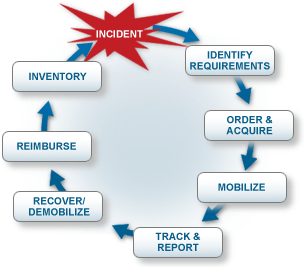
Resource management is one of the most complex aspects of emergency management.  The resource management cycle could be seen as a microcosm of the emergency management cycle with a number of steps operating in sequence and some simultaneously before, during, and after a disaster.  We need to properly establish our resource management systems, procedures, and policies and keep them, as well as our inventories, up to date.

Referencing the Core Capabilities, the capabilities of Public and Private Services and Resources, Planning, Critical Transportation, and Operational Coordination all have bearing on resource management.  Resource management is also one of the key components of NIMS.  The following graphic on the resource management cycle comes from NIMS doctrine.  While this is largely a logistics issue, the importance of it all cuts across all levels of all organizations.

NIMS Resource Management Cycle

NIMS Resource Management Cycle

Consider each of the steps identified in the resource management cycle.  There is quite a bit of complexity to each.  An additional challenge is that they are always in motion as requirements regularly change, new resources are obtained, and obsolete resources are retired from service.  Often one change in a step of the cycle requires changes cascading to other steps.  Also consider the variety of people involved in each step.  No one agency or department has all the resources, therefore we are relying on information from others to create a common operating picture of resource management.  Additionally, the regularity of changes in this information require us to have establish and maintain a system which allows for real-time tracking of this information.

Any information can be viewed in a variety of manners.  A fairly simple web-based tool can allow for multiple stakeholders to input data and change resource status, but the display of that information the reporting available from such as system allows for better utility.  The integration of GIS can help us identify not only where our resources are, but what their status is (NIMS provides us with three resources status indicators: Assigned, Available, and Out of Service), as well as detailed information on the resource such as the kind and type (again, these are NIMS-driven definitions that describe the capability of a resource), the owner of the resource along with contact information, and other information including technical, operational, and maintenance information.

In a pre-incident condition we should know what we have, what capability of those resources, and the conditions for deployment.  Operating under ICS, once an incident occurs, Logistics obtains resources for the incident where tracking becomes the responsibility of the Resource Unit in the Planning Section.  After an incident, these resources return to their owners where they are maintained and re-inventoried.  Depending on the incident, owners may be reimbursed for their use which requires reporting on a variety of metrics.

Wildfire incident management practices brought us the T-Card system – a great low-tech way of tracking incident resources.  A T-Card system is easy to learn and deploy and does a great job of tracking resources but can be very labor intensive and certainly has a delay in reporting.  I’ve also used spreadsheets and stand alone databases, which allow for more flexibility and automated reporting, but still suffer from a delay with a single point of data input and management.  Networked systems allow for immediate inclusion of staging areas, bases, and other mobilization or stockpile areas and are suited for simple and complex incidents.  Consider leveraging technology to maximize your resource management common operating picture on both a daily basis and for incident management.  Of course it’s always good to have a low-tech back up (and the know-how to use it!).

What systems do you have in place for resource management?  What best practices have you identified?

© 2014 Timothy Riecker


Business Continuity and Emergency Management Standards and Requirements

When building a business continuity or emergency management program – or the foundation of that program in a business continuity or emergency management plan – there is a lot of research that needs to be performed before much work can even begin.  Some of the most critical research is the identification of the standards and requirements which apply to your program/plan.  Note a significant difference in terminology between requirement and standard.  Requirements are generally items that are in passed into law or included in regulation.  Standards are typically developed by standards organizations or accrediting bodies and are generally looked upon as best practices within an industry.  Standards are also more likely to be regularly updated whereas requirements (laws) are generally updated on a less often basis.

Where should you look for requirements and standards which apply to you?  Much of it is based upon what industry you are in and where you are located.

Start locally.  Research local laws and codes which may have requirements for certain industries.  Local emergency management planning codes that I’ve seen include industries that use or produce specific chemicals, healthcare facilities, day care programs, and the hospitality industry (hotels and resorts), to name a few.  These codes may require certain planning or notification elements which you must address.  You should search the codes/laws of your city/town/village as well as your county.  The clerks or emergency management officials for those jurisdictions should be of great help to you.  States usually also have specific planning requirements found in state law and/or regulation which cover requirements for local jurisdictions as well as many of the industries mentioned previously.  Contact your state emergency management agency as well as the state agency that regulates your industry for the best information.

Local and state laws comprise most of the requirements you will find – however certain industries may have federal laws or regulations which must be followed – many of these come from the EPA.  Nationally, however, you are more likely to find standards.  FEMA’s standard for emergency planning (which largely applies to jurisdictions but can certainly be used by other organizations) is found in Comprehensive Preparedness Guide (CPG) 101 – Developing and Maintaining Emergency Operations Plans.  While there is no up front legal requirement to follow CPG 101 from FEMA, it may be a requirement of grant funding – yet another requirement you must explore and address.  Certain industries seeking ISO (International Standards Organization) accreditation may need to follow various ISO standards on emergency management and safety.  Overall, if your industry has a professional association or accrediting body, they are an excellent resource for you.

But isn’t there some standard that applies broadly to everyone?  Yes – that is NFPA 1600.  The National Fire Protection Association (NFPA) creates standards which apply to many industries and are often legally adopted as code by jurisdictions.  The NFPA itself does not create law or regulation but they drive many of the standards we see across the nation in many applications including chemical production and handling, engineering, electrical, plumbing, building and development codes, fire codes and others.  NFPA documents are developed through a consensus standards development process approved by the American National Standards Institute (ANSI).  NFPA 1600 is the Standard on Disaster/Emergency Management and Business Continuity Programs.  Typically access to NFPA documents requires membership or a fee per document (their material is copyrighted), however NFPA 1600 is seen as so critical and broad-reaching that the NFPA offers access to the document free of charge.

NFPA 1600 is comprehensive yet open enough for individual application.  You won’t see from NFPA 1600 any detailed guidance in how to write a plan, but you will see the steps of a planning process and key benchmarks they recommend be addressed in a plan.  In addition to planning, the standard also addresses program management, training and exercises, and program improvement.  Intended to be used as a tool, the standard also includes program evaluation checklists and references other best practices in emergency management and business continuity including DRII (Disaster Recovery Institute International) and United Nations programs.  An annex within the standard even addresses family preparedness programs intended for employees.

While the standards you must follow are dependent upon your location and industry, NFPA 1600 can be applicable to all organizations and should be referenced in the building and maintenance of your emergency management and business continuity plan.  For those of you dependent upon access to information on your mobile devices, they even have a free NFPA 1600 mobile app (I reference it often!).

Adherence to requirements and standards helps ensure that your program meets or exceeds all expectations and best practices.  Even if you are not legally obligated to do so, following standards, such as NFPA 1600, provides you with a comprehensive program which will help you better prepare for, respond to, and recover from disaster.

If you need help navigating your emergency management requirements or standards, contact Emergency Preparedness Solutions.  Visit our website at www.epsllc.biz.

© 2014 Timothy Riecker

Don’t Just Prepare for Disasters Passed

As mentioned in an earlier post, I’ve been reading Rumsfeld’s Rules, a bit of a memoir by former Congressman, Secretary of Defense (twice over), and CEO Donald Rumsfeld.  Much of the book is highlighted by quotes which have influenced him in various stages of his life.  One of his anecdotes references the Maginot Line, a multi-layered defensive system created by the French after World War I along their border with Germany, intended to protect France from any future invasion from Germany.  The Maginot Line would have proven a rather effective defense, had Germany used similar strategies in World War II as they had in World War I.  Obviously the Nazis were quite successful in their invasion of France, quickly conquering and occupying the nation.  The difference was that the Nazis were fighting a new war, whereas France was preparing to fight the last war – which is the quote Rumsfeld references with this anecdote.

What can we learn from this in emergency management and homeland security?  It can’t possibly apply to us, can it?  Obviously we base many of our plans and preparations on disasters of the past.  We have an in-depth trove of information from sources like LLIS which allow us to learn from past disasters.  Much of our hazard analysis is based upon what occurred in the past.  We study past disasters, examining them from inception through recovery, arm-chair quarterbacking all facets of response – from command, to organization, to logistics.  From this we learn what practices to embrace and what needs to be improved upon.  Since we’re quoting, it was Benjamin Franklin who said “Experience the best teacher.”

To the contrary, we have a rather prolific saying in emergency management that no two disasters are alike.  So why all this effort to examine the past?  There is a lot to be learned from the past.  As previously mentioned, we spend a lot of time and effort examining earlier disasters so we can learn from them.  While every disaster is different, there are also many commonalities – all of which we can better prepare for.  The past also puts disasters and their magnitude in context for us.  We can’t be stuck in the past, however.  While the next disaster may have similarities to one passed, there will be differences.  It is our job and our responsibility to predict to the greatest extent of our efforts what the impacts will be of future disasters, as well as the hazards they will stem from.  Yes we must learn from the past, but we must always look to the future.

How do we look into the future?  Reconvene your planning groups and discuss this new context.  Engage members to continually reassess what is changing – in the climate, the geography and landscape, and the new or changed technological hazards in our areas.  We must look beyond our borders both literally and figuratively as I outlined in a previous post, and consider all possibilities.  Use exercises which introduce scenarios new to us instead of those based upon disasters of the past to help us contextualize this and better prepare.

My challenge to you – Take an honest look at your plans, policies, procedures, and training – are you preparing to fight the last war or the next one?

© 2014 Timothy Riecker

Preparedness is a Marathon

Logo of the 2014 Utica Boilermaker

Logo of the 2014 Utica Boilermaker

Today marked the 37th running of the Boilermaker, a 15k road race hosted by the City of Utica (New York) for over 17,000 runners from around the world.  The race is a matter of pride for area residents, even those who do not run.

I considered this morning that there are many similarities between a marathon (yes, I’m aware the Boilermaker is in fact not a marathon at just over a third the distance of an actual marathon – work with me on this one) and what an organization, specifically a jurisdiction, must endure for preparedness.

First, preparedness is not a one-off activity, rather it is a culmination of activities.  While the Boilermaker highlights its 15k road race, they have a number of very successful related events including a 5k road race, a three-mile walk, a wheelchair race, and a health and fitness expo.

Preparedness has an ebb and flow of activities just as a marathon has a variety of stretches, turns, and hills.  Both marathons and preparedness should have a high degree of community engagement.  The Boilermaker has a variety of corporate and local business sponsors, engages all services of the City of Utica and many assisting/mutual aid agencies, has a high degree of media coordination, and sees hundreds of volunteers aiding in everything from registration, pre- and post- race clean up, to providing water to athletes along the course.  Our preparedness efforts should also follow this model of whole community engagement.

The most significant difference, however, is that marathons have an end while preparedness is cyclical.

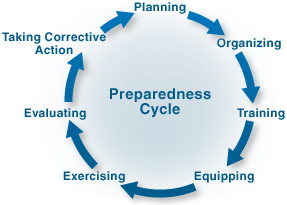
The Preparedness Cycle - FEMA

The Preparedness Cycle – FEMA

The Preparedness Cycle must be worked on all the time and does not end.  To keep morale high and to keep the whole community interested remember to celebrate the accomplishment of each activity just as runners and the community celebrate the completion of their race.  That said, Utica is already preparing for next year’s race.

Congratulations to all of this year’s runners, and congratulations to jurisdictions and organizations beginning their marathon of preparedness.

© 2014 Timothy Riecker

The POETE Analysis – Emergency Planning and Beyond

POETE stands for Planning, Organizing, Equipping, Training, and Exercising. These are the five elements that each jurisdiction should be examining their own capabilities by. By examining their capabilities through each of these elements, a jurisdiction can better define their strengths and areas for improvement.

The POETE analysis, often completed as part of a THIRA (Threat and Hazard Identification and Risk Assessment) is actually a component of the State Preparedness Report (SPR) (note that this was the definition of the acronym at the time of the original post. It is now Stakeholder Preparedness Report), which incorporates THIRA data into this annual submission. When properly conducted, a POETE analysis will examine a jurisdiction’s capability targets. These capability targets, through the THIRA process, are individually defined by each jurisdiction, based upon the capability definitions of each of the 31 Core Capabilities (Note: at the time of my original post there were 31 Core Capabilities. There are now 32). The Core Capabilities were identified in the National Preparedness Goal and are an evolution of the legacy Target Capabilities. Gone are the days when many jurisdictions struggled with the definitions of the Target Capabilities and trying to determine how they applied to jurisdictions large and small across the nation. The new Core Capabilities are divided amongst five mission areas – Prevention, Protection, Response, Recovery, and Mitigation. By referencing Core Capabilities in our preparedness efforts, we have a consistent definition of each area of practice.

When a jurisdiction’s stakeholders conduct a POETE analysis, each element is rated on a scale of 1 to 5 – a rating of 5 indicating that the jurisdiction has all the resources needed and has accomplished all activities necessary for that element within that capability area. Using the Core Capability of Fatality Management as an example the jurisdiction will identify a desired outcome and from that a capability target. CPG-201, the guidance published by DHS/FEMA for conducting a THIRA, outlines this process in detail and provides the following capability target for illustrative purposes:

“During the first 72 hours of an incident, conduct operations to recover 375 fatalities.”

The jurisdiction will examine their efforts and resources for each POETE element for this capability target. Below are thoughts on what could be considered for each element:

Planning: What is the state of their plans for mass fatality management? Do they have a plan? Is it up to date? Does it address best practices?

Organizing: Are all stakeholders on board with mass fatality preparedness efforts? Is there a member of the community yet to be engaged? Are lines of authority during a mass fatality incident clear?

Equipping: Does the jurisdiction have the equipment and supplies available to handle the needs of a mass fatality incident? Are MOUs and contracts in place?

Training: Do responders and stakeholders train regularly on the tasks associated with managing a mass fatality incident? Is training up to date? Is training conducted at the appropriate level?

Exercising: Have exercises been conducted recently to test the plans and familiarize stakeholders with plans and equipment? Has the jurisdiction conducted discussion-based and operations-based exercises? Have identified areas for improvement been addressed?

The jurisdiction’s responses to these questions and the subsequent ratings provided for each POETE element will help them identify areas for improvement which will contribute to the overall capability. From personal experience, I can tell you that the discussions that take place amongst stakeholders which reveal both the efforts applied for each element as well as the frustrations and barriers to progress for each are generally quite productive and great information sharing sessions. It is important to capture as many of the factual elements of this discussion as possible as they add context to the numerical value assigned. Having the right people participating in the effort is critical to ensuring that inputs are accurate and relevant.

Once the POETE analysis is completed, what’s next? As mentioned earlier, the POETE analysis is actually a required component of the annual State Preparedness Report, which must be submitted to FEMA/DHS by each state and territory. Ideally, the results of the POETE analysis should be translated from raw data (numbers) to a narrative, explaining the progress and accomplishments as well as future efforts and barriers; in other words, the ratings should be factually explained and these explanations should feed an actionable strategic plan. The priority rating inherent in the THIRA process will help establish relative priority for each Core Capability within the strategic plan. While this is a requirement for states and territories, a comprehensive strategic plan for any emergency management and homeland security program at any jurisdictional level is obviously beneficial and would reflect positively in an EMAP accreditation.

POETE elements should be incorporated into other emergency management activities as well. When needs are identified and defined based upon Core Capabilities, these should be outlined in the jurisdiction’s multi-year Training and Exercise Plan, which should serve as a guiding document for many preparedness activities. The focus that a POETE analysis provides for each Core Capability can help identify training objectives which can help maintain and improve capability

Consider integrating them into your evaluation of exercises. While the Homeland Security Exercise and Evaluation Program (HSEEP) doctrine makes no mention of POETE, much of HSEEP is based upon capabilities. With a POETE analysis being an integral component of measuring our progress toward a capability, I would suggest including it into exercise evaluations. POETE elements can be included in Exercise Evaluation Guides (EEGs) to capture evaluator observations and should be outlined in the After Action Report (AAR) itself for each observation – giving suggestions for improvements based upon each POETE element. Consider how you could incorporate the POETE elements into an AAR as an outline identifying areas for improvement for the EOC management activities of the Operational Coordination Core Capability. As an example:

Planning: The jurisdiction should update the EOC management plan to incorporate all critical processes. Job aids should be created to assist EOC staff in their duties.

Organizing: Lines of authority were not clear to exercise participants in the EOC. Tasks were assigned to agencies but status of tasks was not effectively monitored.

Equipping: There were not enough computers for participating agencies. EOC management software did not facilitate tracking of resources.

Training: EOC agency representatives were not all trained in the use of EOC management software, creating delays in action and missed assignments. The EOC Manager and Planning Section Chief were well versed in the Planning Process and used it well to facilitate the Planning Process.

Exercising: Isolated drills should be conducted to test notification systems on a regular basis. Discussion based exercises will assist in identifying policy issues associated with suspension of laws and their impact on EOC operations.

The POETE analysis is a process which can help us identify strengths and areas for improvement within our emergency management and homeland security programs. While the POETE analysis can be time consuming, the information gathered for each Core Capability is valuable to any preparedness effort. With such a variety of federally-driven programs and requirements extended throughout emergency management and homeland security, we can find the greatest benefit from those which have the ability to cross multiple program areas – such as the Core Capabilities – allowing us to consolidate the evaluation of these programs into one system, providing maximum benefit and minimizing efforts.

Have you conducted a POETE analysis for your jurisdiction?  Did you find it a worthwhile process?

Looking for help with a POETE analysis?  Emergency Preparedness Solutions, LLC can help!  www.epsllc.biz 

© 2014 Timothy Riecker