Best Practices for the New Year – Standards in Emergency Management Programs

Going into the New Year I’m endeavoring to write a few posts on best practices in emergency management.  The New Year is a great opportunity for us to take a broad look at our emergency management programs to identify needs and develop and implement some strategies to improve.  Instead of looking back in a rather cliché “year in review”, let’s look ahead toward improvement!

I also wanted to express appreciation to all of my blog readers.  Some of you find me directly through my blog’s home at WordPress, some through LinkedIn or Twitter (@triecker or @epsllc), and some through my company’s website – Emergency Preparedness Solutions, LLC.  If you like my blog please share it with others.  Comments are always welcome.

On to our topic… Standards in Emergency Management Programs

All emergency management programs – government, private sector, and not-for-profit – should strive for their programs to meet accepted industry standards.  The two most significant standards in the United States are the National Fire Protection Association (NFPA) 1600: Standard on Disaster/Emergency Management and Business Continuity Programs and the Emergency Management Accreditation Program (EMAP).  The two standards are very similar in content and in fact complimentary, with the most significant difference being that EMAP offers an actual accreditation process.  Both programs offer copies of their standards free of charge, which is reflective of the spirit of sharing and improvement that exists in emergency management.

The NFPA offers the most recent previous version of their standard as a free download from their website.  The NFPA 1600 standard is quite detailed and can be initially overwhelming but really should be referenced piecemeal.  The free EMAP standards are published in a bit less detail, but they provide a very detailed assessment tool for those who initiate the formal accreditation process.  Because neither standard references specific laws or FEMA documents, they are also great references for governments, private sector, and not-for-profits outside the US.

How should you review the standards? 

They both essentially serve as checklists for what is programmatically needed for successful emergency management programs.  They are both organized by functions, such as planning, training, exercises, and logistics allowing a program to see what activities within each area are needed.  Neither standard will tell you how to meet any particular section of their standard, as they don’t want to be seen as favoring any particular published processes or products and want to encourage innovation and resourcefulness.  This also lends itself well to either/both standards being applicable and achievable by large and small organizations alike.

Examining your own emergency management program through the lens of either of these standards provides a great opportunity to see where you stand.  Examine your functions piece by piece, function by function.  Check off what areas you feel meet the standards and highlight those which you feel do not.  Use these areas as a point of reference for improvements.  Conduct a bit of a needs assessment in these areas to identify exactly what needs to be done to improve and meet the standard then create an improvement plan to make it happen.

Having helped organizations with both NFPA 1600 compliance as well as EMAP accreditation, I’ll attest that much of it simply comes down to paperwork and good systems management.  Many of the standards can be addressed through creating and applying polices and solid practices and procedures.  Organized and thorough record keeping is very important for these matters.

What if you don’t have a specific emergency management function or certain activities are conducted by someone else?

Of course you probably should have a specific emergency management function within your community, company, or organization; but many do not.  Needs are often met in these circumstances through an amalgamation of functions found throughout the rest of the jurisdiction, company, or organization.  Hopefully you at least have an emergency management committee (or one which can serve this purpose such as a safety committee) which has representation from these various entities.  Such a committee is an ideal group to review these standards.  An emergency management program isn’t necessarily a specific agency or office; it’s really the entire system.  These standards should be examined through the entire jurisdiction, company, or organization as responsibilities and functions may be spread around.

What advantages do these standards offer for emergency management programs?

There is certainly a piece of mind knowing that your program meets these standards which are based upon industry best practices, even more so if you took advantage of EMAP’s accreditation.  These standards also provide documented justification for grants, budget allocations, resources, and activities which will contribute to a thriving emergency management program.  Overall, however, you will find that your program will be more professional and more responsive to the emergency and disaster needs of your constituency – be it a community, company, or organization.

Meeting these standards is an investment, but mostly of time and effort.  Sure, there are ways you can meet certain standards better by purchasing some cutting edge software or hiring six more people, but these standards are not intended to serve only the most fortunate and affluent emergency management programs.  A program run by a part time emergency manager with minimal funding can still successfully meet these standards.

Maintaining compliance with these standards is important and is an ongoing effort – it’s quite easy to fall off the carnival ride, especially when distracted by our daily routines and changing priorities.  Set a schedule to conduct an annual review of the standards, incorporate your compliance efforts into strategic plans, and regularly refer back to the standards to keep them fresh in your head.

Of course help is available!  Emergency Preparedness Solutions can help your jurisdiction, company, or not-for-profit conduct a Standards Assessment to determine what standards are met, what standards need to be met, and develop a strategic plan to meet these standards.  Through our full range of preparedness services we can also help you meet these standards and develop a maintenance plan for your program.

If you have questions please contact me at tim@epsllc.biz.

Have a wonderful, safe, and productive New Year!

@ 2014 – Timothy Riecker

Dig Deeper – Ask ‘Why?’ Five Times

Be an archaeologist and DIG DEEPER!

Be an archaeologist and DIG DEEPER!

An old boss of mine once told me that to find the real root of any problem you should ask ‘Why?’ five times.  This sage Yoda-like advice has served me well ever since.  Of course it’s not always necessary to ask it the full five times; in fact you often find the foundational cause sooner.  Nonetheless, this approach will inevitably guide you toward discovering what needs to be fixed.

Those who follow my blog know that I post mostly within two thematic areas – emergency management or training.  The ‘ask why’ methodology applies to both of these areas and darn near anything else I can think of.  My thoughts are below on both themes.  Of course training in the field of emergency management is a combination of the two!

In Emergency Management

I’ve posted numerous times on topics such as hazard analysis, Threat and Hazard Identification and Risk Assessment (THIRA), and other similar topics in emergency management.  It is so incredibly necessary for us to identify needs and vulnerabilities, and to understand our community’s capabilities in order to properly prepare for future disasters and emergencies.  I’ve learned that in public safety, when asking a question, you often get a story and that story is often related to a past incident.  While the story may be elaborate, it usually gives you little substance.  Anecdotes aren’t enough.  You need to dig deeper.

As a culture within public safety we are still trying to drive practitioners to be more analytical.  Quality after action reports are a big step in the right direction.  The benefits of after action reports for incidents, not just exercises, are huge.  After action reports should lead to improvement plans, but without identifying the real reason behind what went wrong we can’t fix the problems.  After action reports require an analysis to dig deeper into the observed action to discover what really needs to be addressed.

In Training

In November I published an article in Training Magazine titled The Importance of Analysis to Identify Root Cause.  While I didn’t reference the ‘ask why’ methodology directly, the subject matter of the article lends itself to this approach.  As a trainer, when a problem is presented to you to ‘fix with training’, you need to figure out what the real issues are so that 1) you can confirm that it is in fact a training issue, and 2) you can determine what the objectives and methodologies of the training need to be.  Without properly identifying and defining the needs you are doomed to fail and will likely be putting forth a lot of effort with little gain.  While the results may put some people on the defensive, they can point the organization in the right direction to address inefficiencies and performance problems.

In any needs assessment, don’t simply accept the first answer given to you – dig deeper!  It’s amazing what you will find!

© 2014 – Timothy Riecker

Emergency Management Manuals from Australia

One of the greatest aspects about the field of emergency management is the community of practice we share.  It’s recognized throughout the entire profession that we improve as a practice not only through our own lessons learned buy by sharing and learning from everyone.

The following website provides links to a multitude of manuals on various emergency management related topics from Australia.  http://www.em.gov.au/Publications/Australianemergencymanualseries/Pages/default.aspx  The Aussies deal with all the same hazards we do – with wild fire, flood, and typhoon topping off the list for much of the continent.  Take a few minutes to look through what they have shared – you just might learn something, I know I did!

© 2014 – Timothy Riecker

Preparing for Ebola – and Whatever Else May Come

Unless you’ve been living under a rock lately, you should be quite aware of the headlining threat in public health and public safety – Ebola hemorrhagic fever.  Ebola has been in existence for quite a while, but the current outbreak of this deadly virus in western Africa has garnered much attention.  Thus far, beyond western Africa, infected persons have been identified in Spain and the United States.  The ease and frequency of air travel, combined with the virulence of Ebola have led to a frenzied reaction by politicians, the media, and our health care system.  While we are at a stage in the US where only a handful of infected persons have been identified, this virus is quite dangerous and could easily and rapidly spread.

While I’m not a public health expert, preparedness is universal.  Public health is at the tip of the spear for this fight and must be supported by other professions within public safety and beyond – that’s what emergency management is all about.  That said, this is proving to be quite a test for our public health partners.  The consequences of failure could be devastating.

Considering the five mission areas, we are most strongly functioning within Prevention, Protection, and Response for Ebola.  Certainly the three common Core Capabilities of Planning, Operational Coordination, and Public Information and Warning are all fully engaged across the three mission areas.  Additionally, we are seeing a great deal of work within in the Intelligence and Information Sharing; Screening, Search, and Detection; Public Health and Medical; and Situational Assessment Core Capabilities; along with some work in other capabilities to a lesser degree.  Why is it important to recognize the mission areas and Core Capabilities?  It helps to keep us focused and prompts us to examine the critical activities for each.

In which mission areas and Core Capabilities does your agency fit in?

What are you responsible for?

Are you doing it?

Do you have all the information you need to do it safely and effectively or are you waiting for public health to call and tell you what to do?  I’m betting you haven’t gotten that phone call.

In a situation like this, we are seeing a lot of activity and emphasis at the Federal level through US Health and Human Services and the Centers for Disease Control.  Their focus is on solving the problem in front of them.  While they have people engaged in getting messages out and engaging partners, they have a lot to accomplish and likely haven’t gotten to all the stakeholders.  We will hopefully see some more aggressive messaging given the circumstances that have been described at the Texas hospital where Ebola patients have been treated.  So what should you do?  Hopefully your agency is already in contact with your local health department to discuss both your role in the public safety system and the potential exposures and vulnerabilities you may have to Ebola.  If your local health department doesn’t seem to have much information, reach up to your state health department.  Don’t wait to get a call… by then it could be too late.

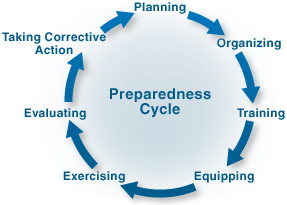
Very simply, we are looking at preparations for your agency’s role.  These preparations, although slightly different based on the agency, apply to all agencies; from first responder agencies, to local government, K-12 and higher education schools, hospitals, private sector, and not for profits.  Let’s break this down with the Preparedness Cycle:

The Preparedness Cycle - FEMA

The Preparedness Cycle – FEMA

Plans, policies, procedures – do you have them in place and up to date?  Depending on the role and function of your agency you can have several of the following – emergency operations plan, emergency procedures, infection control plan and procedures, public health plan, communicable disease or pandemic influenza plan.  You should engage with public health experts to ensure that your plans, policies, and procedures address everything known about Ebola.  You may need to create some procedures specifically addressing issues pertaining to Ebola and your agency’s role.  Do your plans, policies, and procedures link up to your agency’s critical activities for each Core Capability you are engaged in?  What agencies do you need to coordinate with to be effective?

Organizing – depending on your agency’s role, you may need to make some internal changes or designations within your organization to better streamline your activities.

Training – train everyone who has anything to do with any component of the plan in what they need to do.  This is a great opportunity to ensure that everyone is trained up in their role of the emergency operations plan.  If your agency has physical contact with the public, training in personal protective equipment (PPE), identification of signs and symptoms, and patient care are extremely important.  Given the detail of the activities and the just-in-time training, job aids will be a great help to your staff to ensure that they follow the procedures you provide for them.  Don’t get caught short… communicate to your staff in what is going on, what your agency is or may be responsible for, and what they will be called upon to do.

Equipping – your staff need the right equipment for the job.  Not only PPE, but the forms and databases used to record information, decontamination equipment, etc.  It is extremely important that staff are trained not only in how to use equipment but to prevent contamination of equipment and prevention of cross contamination.  Do you have all the equipment you need?  If not, who does?

Exercising – Conduct table top exercises to talk through policies and higher levels plans to validate and become familiar with them.  Identify shortfalls and correct them immediately.  Conduct drills to test the skills of staff for specific activities and larger exercises – functional or full scale – to test multiple functions and plans.

Evaluating – Evaluation is a constant throughout all of the preparedness cycle.  We need to evaluate every step within the preparedness cycle and make adjustments and improvements as needed.  Embrace best practices and fix shortfalls.  This leads directly to the next step…

Taking Corrective Action – Some corrective actions are quick and easy fixes while others can take a while or cost money above budget to address.  A corrective action plan (aka improvement plan) will help you keep track of what needs to be fixed, the priority it holds, who is responsible for making it happen, and a strategy to make it happen – it’s a living document.

The preparedness cycle can be applied to any hazard, be it Ebola or a flood.  With all this attention on Ebola, it’s a great opportunity to pull plans off the shelf and have discussions with internal and external stakeholders on these preparedness steps.

© 2014 – Timothy Riecker

Exercising Foundational Skills with Unorthodox Scenarios

Does the scenario of an exercise activity really matter?  Can we use a zombie scenario to exercise evacuation and sheltering?  Can we use a holiday food distribution to the needy to practice our POD (point of distribution) plan?  Do scenarios always have to be realistic or related to our jurisdiction’s hazards?

I’m a foodie.  As such I find myself occasionally watching shows like Cutthroat Kitchen and Chopped.  These are fun shows that strike a balance of cooking with game shows, including the cash prize in the end.  The competitors are legitimate cooks, some trained in culinary schools, some successful in their careers and earning the title of ‘chef’.  The competitors are given, on the spot, either a dish to create (Cutthroat Kitchen) or a box full of ingredients which must all be incorporated into a dish (Chopped), using a kitchen and pantry generally unfamiliar to them, within a relatively short amount of time – and make it better than their competitors.  Is competing on these shows anything like running a professional kitchen?  Hell no.  Does it make them better cooks?  From interviews I’ve heard, the answer is yes.

Can we recreate this in emergency management?  Of course we can, and we should.  How would this help emergency managers and other public safety professionals?  Recall that within the exercise design component of the HSEEP process the Core Capabilities to be focused on and the objectives to be tested are selected prior to determining the scenario.  This tells us that the activities to be performed are more important than the scenario in which they will be performed.  In these cooking competitions, the participants must fall back on their foundational skills to be successful.  It’s those foundational skills and the activities which they foster that we evaluate in our exercises.

Certainly a scenario has some importance.  It provides context, allowing the participants to get their head into what they are doing.  A scenario can be different, even a bit silly or fantastical (alien invasion, anyone?), but it still has to correlate to the objectives of the exercise; i.e. there must be a compelling reason to perform mass prophylaxis or to evacuate an area.  That said, the scenario is simply a vehicle to get our participants to perform what we intend to test.  Don’t we always tell our participants to not fight the scenario?  Well if it’s something they’ve never before experienced, they have little ground to stand on.

Another benefit to using an unfamiliar or alternate scenario is getting participants to break from the routine and face unexpected and new challenges.  What if digital communications fail?  What if they have to relocate to an alternate EOC? What if that alternate facility is likewise compromised?  Consider using the scenario to remove a critical resource from use.  How will the participants overcome this new problem?  In Cutthroat Kitchen, participants are faced with unseemly injects to their food preparation, such as replacing all cooking utensils with a Swiss Army knife or only being able to cook using a microwave.  Some of your participants may balk at such occurrences, but emergency management is about managing the unknown, the unfortunate, and the unexpected.

Regardless of the measure of reality we choose to base our exercises on, the scenarios we develop are really another level of fiction to help facilitate exercise participation.  Yes, often times we want to test hazard specific plans (a zombie apocalypse exercise can not replace the need of a hurricane exercise), but if the scenario itself doesn’t matter, consider using something ‘outside the box’.  Routine makes us complacent and complacency is very dangerous in emergency management.  We must always expect the unexpected and continually have the mindset to improvise, adapt, and overcome.

© 2014 – Timothy Riecker

Deliberate Planning – Strategic Planning and Business Continuity

Many organizations put forth extraordinary effort to develop strategic plans to give concerted organization-wide direction to the organization for the coming 3-5 years.  Like many of my readers, I have been part of several strategic planning efforts in different organizations, sometimes helping to lead the way.  There is a great deal of value to strategic planning as it helps not only refine the organization’s vision, but also develops objectives to help it get there while (ideally) bringing the entire organization on board – from finance, to HR, to operations, and facilities – everyone is facing in the same direction and striving to accomplish the same goals.  Just as strategic planning should not be performed in a vacuum, business continuity planning should not either.  Just as strategic planning engaged the whole organization, as should business continuity planning.

If the efforts of strategic planning and business continuity planning have such foundational similarities, why not bring the two together?  As the goals of these two efforts are distinctly different we certainly can’t merge the efforts, but the overlaps provide for easily exploitable opportunities within the organization.  How?

First, make business continuity and resilience a goal of your strategic plan.  What does this do for the organization?  Just like the other goals identified in strategic planning, it provides a documented leadership-driven purpose which will engage the whole organization.  Every business unit in an organization has a stake in business continuity.  Just with other goals within your strategic plan, the specific actions will be identified through objectives – be it a start to your business continuity program or a continuation and improvement thereof.  As mentioned in previous posts, business owners and managers put forth a great deal of effort to build and expand their businesses, but we also need plans to stay in business in the event of a disaster.

Second, once the strategic plan is completed, you now have a group of people from across the organization who now hopefully work well together – engage them!  Turn your strategic planning committee into your business continuity committee.  Good strategic planning provides for someone (ideally the planning group) to monitor the implementation of the strategic plan.  This takes minimal time compared to developing the strategic plan, allowing for this group – who has already worked together for some time and has gone through the group dynamics of forming, storming, norming, and performing – to focus on another task.  Why pull together another group of different people?  It’s a waste of time and the team will lag in performance.  Simply reengage them and change their focus.  This group is a great asset who has already proven they can represent their business units while still having an organization-wide perspective.

Third, mine data from the strategic planning process to support business continuity.  A thorough strategic planning process has examined the organization from many angles and perspective – particularly through a SWOT analysis (strengths, weaknesses, opportunities, and threats).  While a SWOT analysis is performed from a business standpoint, much of the data obtained and derived from this analysis can inform both your hazard analysis and the identification of mission essential functions – these are the things which you MUST DO to stay in business and to minimize the greatest losses.

Lastly, continue the relationship between strategic planning and business continuity.  Both work in a cycle of continuous improvement and those cycles obviously intersect – not just at one point but potentially at multiple junctures; an important consideration of a business continuity program is the impact which disasters may have not only on current business operations but also on planned business initiatives.  This shared knowledge and insight between two planning efforts conducted within one group is invaluable.  As strategic planning continues, new objectives for the business continuity program should be included while resiliency opportunities identified through the business continuity program should inform the strategic plan helping the organization overall to become more resilient and sustainable.

What are your thoughts on the synergy between strategic planning and business continuity?  What other opportunities do you see?

As always, if you need help starting, growing, or rebuilding your business continuity or emergency management program, Emergency Preparedness Solutions, LLC can help.  Contact us through www.epsllc.biz or directly at consultants@epsllc.biz.

© 2014 – Timothy Riecker

What’s the (next) Big Idea in Emergency Management?

Innovation.  It seems to be what everyone clamors for.  In emergency management we see people striving for it across the board: in government and in education we try to build the better emergency management mouse trap.  We establish think tanks to find new solutions and the private sector looks for better ways to protect their investments.  But what is it that we are looking for?  What systemic problems do we still face in emergency management that require change? 

There is plenty out there that needs to be improved upon.  There always will be.  Until we can prepare for, prevent, and mitigate disasters to the point that little to no response is ever needed and no loss of life occurs we will continue to strive for better ways of doing things.  I’m guessing that day is a long way off, so we have plenty of work to do.  Before we can innovate, however, we must find cause.  Necessity, as they say, is the mother of invention.  So what needs exist that must be corrected? 

Certainly our after action reports (AARs) identify areas of needed change.  But those generally only show us gaps in local systems.  Threat and Hazard Identification and Risk Analysis (THIRA) likewise shows gaps in local systems.  Does this information ever get fed to higher levels?  Of course it does… in some measure but only some of the time.  States assemble State Preparedness Reports (SPRs) which, in current practice, conduct an analysis of each core capability through each of the POETE elements (planning, organizing, equipping, training, and exercising).  These in turn inform the National Preparedness Report (NPR).  The 2014 NPR was released by FEMA earlier this month, identifying areas for improvement in several of the core capabilities.  This is certainly a resource to help us identify needs, but none of these resources or mechanisms are perfect.  What is missing?  How do we improve them?

Interestingly enough, some opine that we aren’t examining the right data.  The Congressional Research Service suggests that we might need better measures of preparedness, according to their report and this article from FierceHomelandSecurity.com.  The report gives no answers, but poses several questions.  Overall, what can we do better?

Returning to innovation, where do the gaps truly exist?  How do we validate those gaps?  Can we address those gaps with current systems or do we need to create new systems (innovations)?  If it is with current systems, what are the barriers to getting the gaps addressed in the short term?  If it is not with current systems where does the innovation come from? 

Despite having worked in Emergency Management for over fifteen years and having seen, felt, and experienced the myriad changes which have occurred – especially since 9/11 – and with every administration subsequent to the attacks I really hadn’t sat and considered the changes that have occurred.  I’m about half way through an amazing book by John Fass Morton called Next-Generation Homeland Security: Network Federalism and the Course to National Preparedness.  The first 200 pages or so of the book provide a thorough review of civil defense/emergency management/homeland security through decades and over a dozen presidential administrations.  The gravity of it all has left my head spinning.  So many changes – and most simply for the sake of politics.  Much of it seems like wasted effort, but Mr. Morton connects the dots so brilliantly and identifies that D certainly could not have happened if not for A, B, and C… even though C and A were essentially the same.  IT seems that through these years so much has occurred, but so little has actually changed.  I would argue that the practice of emergency management is in a better place now than ever, but what will emergency management look like tomorrow?  Will our continued evolution be through measured change or through innovation?  What makes that determination? 

© 2014 – Timothy Riecker


What, if Anything, Will Change in Law Enforcement?

The events this past month in Ferguson, MO have caught not only national but international attention.  As I’ve mentioned in earlier blog posts and comments to others, we still do not yet know all the facts of what actually transpired in the death of Michael Brown, therefore I urge everyone to hold off on any analysis or judgment and allow the family to grieve and judicial processes to work. 

The other topic of discussion related to Ferguson, MO has been the use of police force and the equipment used by law enforcement.  This has spurred a number of national-level news stories and even a request by the President to examine the programs which provide surplus military-grade equipment to law enforcement authorities.  One such article can be found here

Such inquiries can certainly be conducted but the fact of the matter is that the items that law enforcement is obtaining, such as body armor and armored vehicles, can be purchased on the open market.  Armored vehicles of some type have been in the possession and use of law enforcement agencies decades before this post-9/11 program ever existed.   The primary intent of the post-9/11 program is to bolster the resources of law enforcement agencies in the event that they encounter a terrorist threat.  Having these resources for that purpose doesn’t mean we should moth-ball them away in the event of a terrorist attack, however.  They should be used so our officers are familiar with them.  We’ve certainly seen other legitimate uses such as responses to mass shootings, busting drug labs, and gang-related responses and arrests.  Examine the case of the 1997 North Hollywood bank robbery where heavily armed and armored men simply had their way with LAPD.  Law enforcement should never be caught in this type of situation again.  A badge and a six-shooter just don’t cut it any more.  Gun control laws have proven wholly ineffective against criminals who are determined to obtain high powered weapons.  Clearly law enforcement must continue to have the upper hand to defeat these criminals and protect the public. 

The CBS article referenced in the second paragraph does bring about some interesting examples of potential overzealousness in the use of these resources, however.  Note that I do say ‘potential’, as a mere mention by the media does not tell the whole story, but we have seen articles with similar mentions over the last few years which do give cause to at least raise an eyebrow.  The article suggests that perhaps additional training is needed in the deployment and use of such resources.  I would suggest that the use of these resources must first be rooted in policy and procedure, accountability, and then training – just like everything else done in law enforcement and throughout most of public safety.  I’m sure most departments who possess these resources already have such things in place, but some may not.  Clearly we need to balance officer safety with operational necessity and even public perspective. 

While I’ve worked with law enforcement for years, I’ve never worked in law enforcement.  I’m curious about what others think.  What, if anything, will change in law enforcement as a result of the events in Ferguson, MO? 

© 2014 – Timothy Riecker

An Academic Study in Ferguson Civil Disorder

From an academic and emergency management lessons learned perspective, there will be a great deal to learn from the events in Ferguson, Missouri.  In this brief article on Western Illinois University’s Emergency Management program, faculty comment on how a few of the courses within their degree program expect to analyze this social disaster. 

I anticipate a lot of post-incident analysis once we have the facts of this event.  Respecting the loss of life as we do in any disaster, the practice of emergency management within the greater professions of public safety and even government administration stand to learn a great deal from an after action analysis of this incident to help us improve by preparing for and preventing the impacts of future incidents. 

Keeping Up With Changes in Emergency Management

As with many things in life, the field of emergency management has changed and will continue to do so.  Much of this change is an evolution – generally positive and productive adjustments to make us more effective and efficient in what we do supported by doctrine and models to guide our actions and provide consistency of application.  Sometimes changes are made which simply give the illusion of progress or are applied much like a Band-Aid as a knee-jerk stop-gap measure which usually fail unless a better implementation is put in place.  Many of the better thought out applications, however, do tend to stick.  While we have seen a great deal of change in the field over the last 14 years, we have largely seen a clear progression with practitioners and policy makers learning from previous programs. 

Yesterday I encountered two separate instances which did not apply current practices and policies. The first was an advertisement for a training program which discussed the four phases of emergency management.  The second was an article in which the author stated that ‘…preparedness is no longer part of the (emergency management) lexicon…’.  The two items, while different, are related in that they both indicate a lack of understanding in the evolution we have made from the four phases of emergency management – mitigation, preparedness, response, and recovery. 

In a nutshell, these long standing phases began to change soon after the terrorist attacks of 9/11 with the integration of homeland security with emergency management resulting in the inclusion of ‘prevention’ into the emergency management phases – thus prevention, mitigation, preparedness, response, and recovery.  As minor as this seems, it was quite a change for those of us who had been in the world of the four phases for a while and was a difficult pill to swallow.  Along with the human nature of resistance to change there was still a feeling that the matter wasn’t quite fully settled – in other words, more change would come. 

For several years different models were kicked around but none really gained traction until the issuance of Presidential Policy Directive 8 (PPD8), which created the National Preparedness Goal and the National Preparedness System.  These begat things like the Core Capabilities (a revamping of the predecessor Target Capabilities) and the introduction of the Threat and Hazard Identification and Risk Assessment (THIRA) as well as a new way of viewing the major activities within emergency management and homeland security – the five mission areas of prevention, protection, mitigation, response, and recovery.  These five mission areas have re-defined, or perhaps more accurately defined what it is that we do in emergency management and homeland security. 

The traditional four phases were often depicted in a cycle.  Taken literally, this meant that you progressed from one phase to the next in a series.  The truth of the matter was that each of the four phases could actually run simultaneously.  There was also a misunderstanding that preparedness was an isolated activity, when in actuality our preparedness efforts applied to all activities.  With the further evolution of homeland security the foundational activities of prevention and then protection were identified and defined.  Pulling together these five mission areas – prevention, protection, mitigation, response, and recovery – the National Preparedness System provides for distinct preparedness activities identified for each mission area, an organization of the Core Capabilities within each mission area, and national planning frameworks which identify the role and goals of each mission area in achieving the national preparedness goal.  Not only has preparedness not gone away, but it has been elevated in status. 

PPD8 was probably the presidential directive with the greatest and broadest impact on our field of practice since Homeland Security Presidential Directive 5 (HSPD5) in 2003 which drove the implementation of the National Incident Management System (NIMS).  Keeping up with critical changes in our evolution such as these is absolutely imperative for practitioners.  Not only do these policy changes impact how we do our jobs individually and programmatically, but they impact how we coordinate with each other, which is and always will be the foundational essence of emergency management. 

How do you keep up with changes in our field of practice?

© 2014 Timothy Riecker