FEMA Public Assistance Thresholds aka Do Your Research

I just received my April edition (number 627) of the Natural Hazards Observer (NHO), a bi-monthly publication of the Natural Hazards Center of the University of Colorado at Boulder. As of my posting of this article, they have not yet posted the April edition on their website, but they are likely to do so shortly.  My desire with this particular post is to encourage a thorough analysis of the topic at hand rather than an extremely narrow perspective as was published in the NHO.

First, I feel a need to mention that The Natural Hazards Observer and I have a tenuous on again, off again relationship. I’ve become rather disenchanted with their articles in the past; occasionally disagreeing completely with authors’ premise and approach (not that everyone is necessarily agreeable to mine). I’ve even written the NHO about the fact that a University center whose goal is to research disasters has presented articles that, to me, come across at times as unprofessional and not well thought out. I’m not really knocking the NHO nor is my intent to pick a fight, rather I’ve been trying to be constructive with them.  Given their foundation, I think their readers expect a more scholarly approach. While there is certainly plenty of good information to find in the NHO, some seems questionable. One of their tag lines is ‘Disaster Research News You Can Use’. I often find that their articles have little to do with research, such as the one I cite below, and are really more of a media regurgitation. There are other, more appropriate forums for that – like blogging – rather than a publication that advertises research.

That said, my particular beef with this edition is the first article, titled ‘All’s Not Fair: Illinois Battles Over Being Too Big To Feel FEMA’s Love’. I encourage you to read the article for yourself and form your own impressions. To sum up the general idea of the article, folks in Illinois are questioning FEMA’s Public Assistance (PA) program thresholds for disaster recovery. Specifically, they take issue with these thresholds being based on per-capita amounts. They argue that larger, more populous, states are discriminated against (their words); and further stating that a larger population doesn’t necessarily equate to a state’s ability to self-fund disaster recovery efforts.

Public Assistance (PA), by the way, is focused on recovering public infrastructure (roads, bridges, public buildings, etc.), whereas Individual Assistance (IA) provides direct assistance to individuals to help cover uninsured losses.

When first reading this, two particular issues stood out to me. 1) They don’t mention the fact that FEMA will also examine a county’s per-capita damages for potential declarations, and 2) High populated states quite frequently receive disaster declarations.

The Texas Department of Public Safety has a great document which summarizes the state and county thresholds for 2014. The NHO article makes no mention of the county threshold, which is where most PA declarations are decreed – for a county or counties, rather than the entire state. While the county threshold is higher, it would generally be easier for a localized disaster to be declared (PA) than the entire state, which is mostly unaffected.

As for state declarations, FEMA provides a great summary by state of major declarations (this is the specific number to look at in this case), emergency declarations, and fire management declarations. By scanning down the list, you’ll see that states like Texas, Florida, California, New York, and Louisiana are among the top contenders for declarations. Other large and more populous states, such as Illinois, are not far behind them. This pretty much blows a hole in the premise that larger, more populated states are ‘discriminated against’. Having been in this business for a while, I know that sometimes you win (the request for a declaration) and sometimes you lose. It makes a significant argument for states to have disaster reserve funds.

All that aside; are there issues of fairness in this traditional per-capita assessment of damages within the disaster declaration process? There may certainly be. The assumption of the current process is that a more populous state has a greater tax base from which to draw funds for disaster relief. This assumption, at a glance, makes sense, but may not be the most fair way of determining if a state warrants assistance.  The most significant arguments against this seem to be 1) A lower relative mean income as compared to other states translates into a lower tax base, and 2) Is the tax base even a fair measure of need/capability for a state?

An interesting read on this is a GAO report from 2012. It seems to me, a guy who is not a FEMA disaster recovery expert – but I’ve been around the block a few times – that there are some issues of fairness and perhaps better ways to assess a state’s true need for Federal assistance. A fair discussion of this topic, however, requires having a 360 degree perspective of all the issues involved. Perhaps it’s a good topic for a research journal?

Managing an Exercise Program – Part 9: Conducting an Exercise

This post is part of a 10-part series on Managing an Exercise Program. In this series I provide some of my own lessons learned in the program and project management aspects of managing, designing, conducting, and evaluating Homeland Security Exercise and Evaluation Program (HSEEP) exercises. Your feedback is appreciated!

Managing an Exercise Program – Part 1

Managing an Exercise Program – Part 2: Develop a Preparedness Strategy

Managing an Exercise Program – Part 3: Identify Program Resources and Funding

Managing an Exercise Program – Part 4: Conduct an Annual Training & Exercise Planning Workshop.

Managing an Exercise Program – Part 5: Securing Project Funding

Managing an Exercise Program – Part 6: Conducting Exercise Planning Conferences

Managing an Exercise Program – Part 7: Develop Exercise Documentation

Managing an Exercise Program – Part 8: Preparing Support, Personnel, & Logistical Requirements

Managing an Exercise Program – Part 9: Conducting an Exercise

Managing an Exercise Program – Part 10: Evaluation and Improvement Planning
Image

Since writing Part 8, the new HSEEP guidance (April 2013) was published. Thankfully this update didn’t dictate wholesale changes in the process we’ve all come to be familiar with. There were some subtle changes, such as changing ‘planning conferences’ to ‘planning meetings’, and stressing the involvement of elected officials in the exercise planning process. Similarly, I’m thankful that certain changes weren’t made – one of which was the proposed elimination of terminology of ‘discussion based exercises’ and ‘operations based exercises’. These general identifiers have become commonplace amongst exercise designers for decades. Upon having the opportunity to review a draft version of the new HSEEP guidance, I was quite opposed to that change.

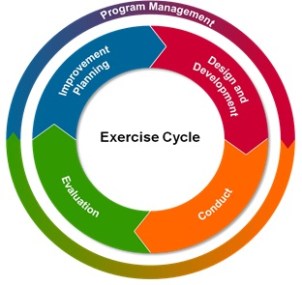
Obviously conducting the exercise is the most exciting part of the process. It’s where all of your hard work comes together. That said, this is where it can all fall apart if you haven’t prepared property in the first eight parts and if you don’t pay attention to detail. I’m breaking exercise conduct down into four smaller parts: Set up, briefings, play, debrief. Remember that my intent with these postings is not to be fully comprehensive, but to emphasize areas where I have learned or have seen others struggle. In all facets of emergency management we need to continue a culture of sharing if we are to be successful.

Set up

The preparations for your exercise should have been finalized in Part 8 where you addressed logistical requirements. You should know where your exercise venue is, how people will be seated/where they will be working, the location and support for a SimCell (if you’re having one), and even matters such as parking, food, restrooms, and audiovisual equipment. Additionally, set up includes having print material available for all participants. When setting up, consider the flow of people, quite literally from the road to the parking lot, from the parking lot to the facility, into the facility through security, sign in, and to their first location for the exercise (this may be their only destination or it may be a large briefing room). Having conducted exercises in locations not familiar to some participants as well as these exercises being larger than the facility’s parking lot can handle, you must ensure that invitation packages have specific directions on how to get to the parking area and how to get from the parking area to the venue. Be sure that signage is prominently displayed. It may even help to have staff directing people. Be sure to also let them know what manner of identification is required to enter the facility. Again, signage is often necessary to get people from the building entrance to check in location and then to the meeting location. Signage for the refreshment area and restrooms may also be needed.

Have everything set up for people before they arrive. Use table tents, if needed, to help identify seating, and have copies of all necessary materials at their seating location. Materials like SitMans and ExPlans have a lot of content, so it’s nice to have these materials available for the early-comers to being reading through.

Be sure to set up early and test EVERYTHING. Make sure AV equipment and communications equipment are tested.

Briefings

Depending on the type of exercise you are conducting, there can be a number of briefings needed to take place before the exercise begins. Some of these briefings may need to take place well in advance, even a day or more before the exercise, depending on availability of audiences for each of them.

The new HSEEP guidance includes a specific briefing for elected and appointed officials. This is something to usually conduct well in advance of the actual exercise to outline the agenda/timeline of the exercise and what will be expected of them. They will likely want to interface with any media and should know what to say about the exercise. They may also want to ‘kick off’ the exercise at the player briefing.

Controllers, evaluators, and SimCell personnel should receive a briefing to ensure they are familiar with the exercise and their rolls. They all need to know what is expected of them and of the players, how and when to interact with the players, and what may need to be reported to their respective leaders and/or to the exercise director. Evaluators will need to become familiar with their assigned EEGs and what the expectations are for evaluating. Additional time will need to be spent with SimCell personnel to familiarize them with the equipment being used, how the MSEL is structured, and how injects will be delivered. If any actors are being used, they will also need to be briefed on their rolls and what their expectations are. Ensure that everyone is familiar with the safety word in the event of the necessity to immediately stop the exercise.

If observers are expected at the exercise, have a briefing ready for them. I suggest treating them like VIPs when possible (most of them usually are). Don’t just let them walk around to figure things out for themselves. Give them tour guides who can take them throughout the venue and talk about what is happening. Schedule their arrival when possible, and consider having an elected or appointed official there to greet them. Keep in mind that some observers will be very high tier VIPs. Vigilant Guard exercises are often visited by the head of the National Guard Bureau – a four star General. These visits are fantastic and very much emphasize the importance of the exercise, but they can also be a little disruptive. These high-tier VIPs will often come with their own entourage and/or security. They will want a brief tour and will stop often to shake hands and have pictures taken. They may even want a break in the exercise to speak. Try to be aware of these expectations up front if at all possible. If not, just go with the flow and be flexible.

The media is another form of observer. All media should be scheduled. Be sure to make it worth their while, where they can catch some video/picture footage of interesting activities. Maps and wall displays make for great footage as well. Remember operational security! If something is sensitive or classified, it should not be anywhere where it can be seen. The media should also be provided a tour and an opportunity to get a statement from the elected and/or appointed officials. They may also want to interview players. I generally don’t allow this without preparation of the specific player to ensure that the right messages are delivered. Also, be sure to let players know during the player brief that there will be observers and media coming through and what is expected of them.

Lastly, the player briefing. This briefing will introduce players to the purpose of the exercise, the ground rules, the facility, timeline, controllers and evaluators, and expectations. Players should be briefed on how and when to interact with the SimCell if you have one. It should always be reinforced that the exercise is ‘no fault’, and that they, individually, are not being evaluated, rather it is the plans, policies, and procedures they are using that are being evaluated. Lastly, players are briefed on the scenario. Be sure that the ExPlan/SitMan has the detailed scenario for their reference.

Exercise Play

Finally the moment of truth arrives! Remember that the purpose of the exercise is to accomplish the objectives, however, know that you may not accomplish all the objectives in the timeframe you have. Being flexible, and knowing you have to be flexible, are two very important aspects of running an exercise. Regardless of how well we think we’ve written an exercise, the responses to our prompts are entirely up to the players. They may accomplish the objectives faster or slower than you expected. Likewise, they may struggle a bit. This is where good exercise control comes in. Controllers/facilitators should observe the tempo of the exercise. Is everyone engaged? Are they needlessly overwhelmed and frustrated? Are they bored? Are they not following through on activities? All these observations should be reported back to the exercise director and SimCell so the tempo can be moderated.

Be sure to have contingencies in the event that players do or request the unexpected. Additional injects that are held back are always a good idea. You may need them to prompt certain activities in the event that players do not take the initiative to do so. Players may also ask questions or make requests of the SimCell that aren’t expected. While we can’t anticipate every need, we can be prepared for them. Have copies of plans, policies, procedures, and maps available to the SimCell. They may have to take some time to research and come up with an answer then get back to the individual. The SimCell manager should be smart when situations like this arise, however. They should always consider if a potentially inaccurate but reasonable answer is acceptable or if the answer must be completely accurate… or even if the answer is required for exercise play at all. There is no sense having SimCell personnel research an answer if the answer doesn’t much matter within the scope of the exercise.

Multi-day exercises may require the exercise staff to meet at the end of every day for a mini hotwash and to evaluate how the exercise is progressing. Where are the players in respect to where you expected them to be in your design of the exercise? Do you need to retool anything in the MSEL?

On large exercises, it helps for the exercise director to have an aide-de-camp, or assistant. Just like any individual in charge of a large operation, the exercise director is having their attention pulled in many directions and may simply not have the time to address everything, especially in large or multi-venue exercises. Having an assistant is also a great way to train up and coming exercise staff. Certainly consider the use of portable radios to help facilitate communication as well. The exercise director will spend most of their time managing and trouble shooting. They may also have to address some VIP concerns. Be sure to walk around to get a good sense for the exercise as a whole. Are evaluators properly positioned? Are controllers present and visible? Is the SimCell responding to questions adequately? Are players engaged and challenged? Perhaps most importantly, is the boss (the elected/appointed official) happy?

Evaluation is such an important aspect of exercise that I will cover it in its own section – Part 10.

Debriefs

Two significant debriefing activities should take place immediately following the exercise: 1) a player hotwash, 2) an exercise staff debriefing. Players should be led through a facilitated hotwash, reviewing the objectives of the exercise, with evaluators capturing their responses to if/how the objectives were accomplished. Encourage and capture responses both in the positive and the negative: i.e. what did we do well and what do we need to improve upon?

After the player hotwash, a similar process should take place with all exercise staff – controllers, evaluators, and SimCell. I like to not only capture their impressions of if/how objectives were accomplished, but I also like to discuss the conduct of the exercise, again capturing what went well and what needed to be improved upon.


Familiarizing Elected Officials with their Emergency Management Programs

Back in October of 2013, in an article in Emergency Management Magazine, David Silverberg discussed the issue of elected officials rarely being educated about emergencies.  Just last month, David Maack published an article in Emergency Management Magazine about how elected officials can prepare for and respond to emergencies.  Silverberg’s article not only identified the issue, but also pointed out strategies used in some places around the country to help orient elected officials to the world of emergency management. 

The premise of both articles is that this familiarization is obviously lacking, and it’s quite imperative that elected officials are familiar with the concepts of emergency management; the hazards, capabilities, and plans of their jurisdiction; gaps and needed improvements; how to support their emergency manager; and state laws governing emergency management where they are.  I’m a firm believer that elected officials do, in fact, need to support their emergency management programs and their emergency manager.  Not only on a day to day basis, but certainly during a disaster.  The emergency manager is a subject matter expert, and while they take direction from the elected official, the elected official needs to take cues from the emergency manager.  The emergency manager needs to be very clear with their boss about what expectations they have, as well.  Maack’s article includes a great list of steps that emergency managers should reference when giving an orientation to their elected officials.  Obviously it all needs to be put in the proper context for each jurisdiction.

Here in New York State, the regional office of the State’s Office of Emergency Management works with the county/local emergency manager to conduct a Public Officials’ Conference.  These sessions, usually conducted in an evening, are intended to not only familiarize elected and appointed officials of a jurisdiction, but to also communicate what is expected of them and to strengthen the role of the emergency manager as a coordinator and subject matter expert.  While there are some usual content areas in these briefings, such as NIMS, a briefing on the local emergency plan, etc., it is flexible based on the needs identified by the emergency manager.  These sessions, through the years of conducting them, are generally very well received.  One of the most important messages is the flow of emergency management.  People need to know how the system works and who is responsible for what. 

Several years back, when teaching an ICS Basic (I-200) course, one of my participants introduced himself as “the town supervisor – you know, the one who would be the incident commander during an incident”.  I made certain, during the course, to point out that elected officials are generally not the incident commander, rather they are the incident commander’s boss.  I then spent some time pointing out what the roles and responsibilities were of this ‘agency administrator’. 

What thoughts do you have on familiarizing elected officials with emergency management?

Situational Awareness – supporting the CEO’s critical decision-making in a crisis

Great post on situational awareness with many applications for emergency management.

Dominic Cockram's avatarCrisis Thinking

By Dominic Cockram

Situational awarenessThis blog is the second in a series that looks at the challenges of managing information in a crisis and how to ensure the top team gets the information it needs. The first looked at “Managing the Upward Flow of Information in a Crisis – What Matters Most?” Here managing information to build situational awareness is under the spotlight – how to pull together that cohesive and informative picture that gives the boss just what he needs and no more.

It is a fact that almost all crisis teams find information management one of the greatest challenges in responding to an incident. Why does this matter? It matters because effective information management is the bedrock that allows the critical decision-making by the strategic crisis management team that will lead an organisation out of a crisis.

Unlocking the Challenge of Information Management

The key steps to unlock the…

View original post 674 more words

Infographic on Organizational Continuity

Great infographic from Entrepreneur.com!

recoverydiva's avatarRecovery Diva

From Entrepreneur.com — Can Your Organization Survive a Natural Disaster; an Infogram re Business Preparedness for Disasters.  You can browse it online or printed it off as a poster, in 6 pages. Apparently the source is Boston University’s School of Management.

This makes a nice companion to the infographic on business continuitythat I cited last fall.

View original post

Emergency Managers as Curators

The training and development industry, championed by the American Society for Training and Development (ASTD), suggested a couple of years ago that trainer are curators of information. This suggestion caught like wildfire in the training and development community. The ASTD compares a trainer to the curator of a museum who organizes and selects specific items or collections for an exhibit; similar to how trainers draw upon knowledge and information, organizing and selecting certain pieces for training purposes. As a trainer myself, I appreciate the meaning of the analogy and considered that the same analogy could certainly be applied to other professions, particularly Emergency Management.

Do we curate in Emergency Management? Emergency Management is certainly a unique profession. It is highly dependent on a broad set of knowledge, much of which is applied to nearly all activities but some applied very specifically. A county emergency manager could be participating in a nuclear power plant exercise one day and giving a presentation on flood preparedness to local communities the next. Both have to do with preparedness, but each require separate and specific applications of technical knowledge. Emergency managers are often jacks of many trades, perhaps specializing in one or two areas, but typically being reasonably well versed in many other topics. In the event that more knowledge is needed, emergency managers know who to reach out to.

Emergency managers coordinate to a higher degree than most other professions – So much so that the profession is actually dependent upon it. No emergency manager in any community can be successful without coordinating with and having cooperation from other community stakeholders. This premise is applied not only to response, but to all phases of emergency management. At present I’m working on a plan for a community that requires some very specific public health expertise. I can write a plan, but the plan won’t have maximum effectiveness without the input of certain subject matter experts.

Similar to trainers, most emergency managers I know have collections of books and reference materials. Many are from courses or seminars they have attended, text books, trade periodicals, and an extensive collection of electronic files. Lessons Learned Information Sharing (LLIS) is an excellent living library of reference materials from contributors all over the nation which I go to often to review best practices.

So what do you think about emergency managers being curators?

Attacks on Electrical Infrastructure

A February 10, 2014 article in Emergency Management Magazine titled Attack on California Electric Grid Called Terrorism brings about some very interesting speculation on an incident that occurred at an electrical substation near San Jose last year.  Unfortunately the article saves some critical information for the end and left me with a poor initial impression (i.e. assuming that the weapons used were assault rifles).  My early impression of the article, particularly having grown up in the country, was that this was the result of ‘Billy-Bob and Joe decided after a bunch of brewskis they were going to shoot up a substation’, as stated by Mark Johnson, recently retired VP of Pacific Gas and Electric. 

Toward the end of the article, the author identifies information associated to the shooting of the transformers, including the removal of 75 lb manhole covers and the cutting of fiber optic lines.  With this and other information revealed in the article, it seems likely this was more than Billy-Bob and Joe.  It’s suggested by the author that this activity could have been a ‘dress rehearsal’ for terrorists.  While I’m no terrorism expert, I offer that it’s not likely to involve any major entities such as Al-Qaeda, who are, unfortunately, must more clandestine than this – just look at how long it took us to find Bin Laden.  My guess is that this was perpetrated by a local, semi-organized, domestic group.  They did some research, but were clearly sloppy and ultimately unsuccessful, if, in fact, their goal was to cause an outage.  Nonetheless, an act such as this should certainly be categorized as terrorism, despite the origin of the perpetrators and their cause. 

This scenario, however, provides some important food for thought.  I’ve posted previously on the vulnerability of our electrical system to both intentional acts as well as natural disasters.  There are some efforts under way to increase the redundancies of our system and to create micro-grids, which would isolate impacts, which are great mitigation strategies.  The occurrence of this intentional act should bring strong consideration to prevention and protection activities to heighten security and resiliency of this infrastructure.  We need to call on our law makers to work with emergency managers, regulators, and the industry itself to require a multi-faceted approach to include protection, prevention, and mitigation efforts. 

Progress with FAA with UAVs

Tuesday morning I attended a panel discussion hosted by the Greater Utica Chamber of Commerce focused on providing information to areas businesses about the FAA‘s selection of the former Griffiss Air Base/Oneida County Airport as one of six sites in the nation to test integration of Unmanned Aerial Vehicles (UAVs) into commercial airspace.  The presentations were excellent, with efforts centered around the NUAIR Alliance, a conglomerate of public, private, and educational entities working toward testing airspace integration technologies and protocols, as well as various uses and applications of UAVs, including those for agriculture, commercial enterprise, and public safety. 

Interestingly enough, as mentioned by the panelists, UAVs, or drones as they are often referred, have been in regular use in other nations for years.  Japan, for example, has been using UAVs for agricultural applications such as spraying crops, for the last 10 years.  France, too, has been using UAVs for various purposes.  Here in the US, we largely face matters of regulation as the barrier to utilizing UAVs for non-military applications.  The FAA, who would enact these regulations, is largely looking at matters of safety related to the integration of UAVs into commercial airspace.  Researching these matters and making recommendations to the FAA through real life application is the goal of NUAIR.  Amongst the partners of the NUAIR Alliance are private firms who wish to use UAV technology for agricultural and commercial applications.  These companies, smartly, are now in on the ground floor of this technology in the United States.

With most drones being relatively inexpensive, this technology is accessible for both small farmers and large companies.  Amazon, the online retain giant, has already expressed interest in using UAVs to deliver packages.  As for public safety applications (I’ve written before about this), the possibilities are practically endless.  Those who have privacy concerns have little ground for blocking development of these life saving tools.  Current privacy laws, up to and including the US Constitution, already address these concerns and provide the foundation for UAV applications in law enforcement.  The new Fox show, Almost Human, which is set in the future, brilliantly displays heavy use of drones to track suspects and serve other law enforcement purposes which are better served with smaller, more agile UAVs rather than the piloted helicopters we use today.  These are faster to deploy and minimize human risk.  Thus far, the show has not displayed any use of UAVs with the capability to use lethal force.  Law enforcement aside, there are numerous other public safety applications.  A recent article about massive boulders crushing a farm house in Italy displayed images and video, reportedly taken by UAVs.  Consider similar technology leveraged for a missing person search or to gather information on the extent of a wild fire or damages from a tornado. 

The future of UAVs is exciting and I’m thrilled for the test grounds to be practically in my own back yard.  I’m looking forward to the first UAV sighting near my property as the NUAIR partners conduct tests.  Technology certainly is exciting!

EMS Under Fire?

First off, I’d like to give a greeting to all of you.  I’ve been absent from blogging for quite a few months now.  I spent much of last year working in New Jersey as part of a team managing waterway debris removal as the result of Hurricane Sandy.  It was a great experience and often challenging – but I had an opportunity to work with some outstanding people and do some good for the people of New Jersey.  I’m sure in future posts I’ll reflect on some lessons learned from that assignment. 

Since my return I’ve been spending time with family and getting my own business back up and running.  I’ve also re-started the pursuit of my graduate degree.  With all the writing I’ve been doing, I’ve found it challenging to get back into blogging, but have thought about it often.

Earlier this evening I had some inspiration in reading the most recent (January/February 2014) edition of Emergency Management Magazine, in which Jim McKay’s Point of View article (which I could not locate online) spoke about ‘Medics entering the warm zone’ during mass shootings.  This is a topic I’ve had some mixed feelings over for the last couple of months. 

While I understand the urgency to enter the area and save lives – which is the main goal of public safety – we’ve always been taught to do so SAFELY.  This new concept of EMS personnel entering a non-secure active shooter environment is in serious conflict with what we’ve been taught about responder safety.  Are we being too hasty? 

Most times I’ve seen this new concept referenced, it is noted that the medics are outfitted with ballistic vests and helmets and escorted by law enforcement.  A great idea – but is this equipment being made readily available to EMS?  Not to the folks I’ve been speaking to.  Most law enforcement don’t regularly travel with riot gear, aside from their ballistic vests which they usually wear when on duty.  Additionally, are there law enforcement resources available to escort medics so early on in a mass shooting incident?  Often times not.  It seems this concept is not well thought out. 

What about training?  Tactical medic classes have been available for the last few decades, but most medics are not trained as such.  I’ve heard of no movement in EMS training to include information on how to make entry into an unsecured shooting incident, or in law enforcement training regarding providing escort duty to unarmed EMS personnel.  In fact one of the only ‘doctrinal’ references comes from the US Fire Administration, although it doesn’t provide much information.  This entire concept, to be effective, efficient, and safe needs to be prepared for – planning, training, and exercises. 

I’m not alone among my EMS colleagues having experienced looking down the barrel of a shotgun when responding to a call.  It must be considered that responding to an active shooter is NOT that.  It’s much more serious.  I understand that this idea can save lives – but what happens when the first medic loses their life after making entry?  Let’s start with that thought in crafting this new approach.  A dead responder can’t save any lives.