Thoughts and prayers with the victims, families, and responders of the Oklahoma tornados. Text 90999 to donate $10 to the American Red Cross.
Tag Emergency Management
Alan Weiss’ Weekly Morning Memo
From Dr. Weiss’ weekly e-mail to members…
This week’s focus point: The Boston tragedy demonstrated more than anything the basic goodness in people. Strangers helped others without hesitation. The requests of the authorities were accepted without whining or demands for exceptions. The capacity that we all possess to support, assist, and help others is extraordinary. Sometimes it takes trauma to highlight it, but the potential is there every day. It may be appropriate this week to think about donating time or money to a charity, coaching someone who needs help, or even giving someone a break trying to turn across traffic. We shouldn’t need catastrophe to bring out our true character.
Some great words to consider.
To my readers – sorry for my absence these last few weeks – I’ve been (and continue to be) on a disaster deployment. More to come!
Disaster Brokers
A brilliant and insightful blog post! A must read.

BCLC’s Richard Crespin writes about challenges in post-disaster corporate giving and local organizational efforts. Read the original article here.
In eighth grade I had to pick an independent study project. It was the ’80s, the dawn of the Reagan Revolution, and it was cool to emulate Family Ties’ Alex P. Keaton (ok, maybe not cool, but cool enough for me), so I picked investing. This was before online brokers, before E-Trade, even before the Internet, so my dad took me down to the local Sears. That’s right. Sears. For some reason Sears had decided to offer financial services, so the local office of Dean Witter was squeezed between the lay-away desk and the lawn mowers.

As I sat there, a kindly man in shirtsleeves and a tie explained capital markets. Brokers like him earned their money by knowing who wanted something (the buyer) and who had it (the seller). He served not only…
View original post 1,560 more words
A Disasterous Trend: Cuts in Preparedness Funding
This post was initially inspired by an article from CBS News on funding cuts to disaster preparedness programs. These cuts go further and deeper than the current sequester cuts we are now seeing. These cuts are a dangerous and disastrous trend. To quote the article…
“In fiscal year 2010, Congress appropriated $3.05 billion to FEMA for preparedness grants designed to strengthen “our nation’s ability to prevent, protect, respond to, and recover from terrorist attacks, major disasters and other emergencies, …. In fiscal year 2012, that appropriation was less than half that figure – $1.35 billion. The same trend could be seen in FEMA pre-disaster mitigation grants, which fell from $100 million in 2010 to $35.5 million two years later.”
Have all the terrorists gone away? Has Mother Nature stopped having temper tantrums? Have stupid people stopped doing stupid things? I don’t think so! So why the cuts?
Let’s put some things in perspective… On one hand, we do need to have a bit of fiscal prudence and restraint. GAO reports have repeatedly shown that many state and local governments are simply not spending down the grant funds they have been allocated. DHS grants are backed up several grant years with unspent funds. That said, as we peel back the layers of the onion, there are certain facts that need to be mentioned. Why aren’t they spending the money they have been given? First, grant periods have generally been too short. The most significant reason for this is the inefficiency of bureaucracy we live in. Follow this trail… The federal fiscal year begins October 1st. The budget gets passed at some undermined point around that. DHS, along with all the other agencies, get their allocations. They then need time to formulate their grant guidance for the funds going to states and locals. By the time states see this grant guidance and their respective allocations it’s usually close to the end of the second quarter of the federal fiscal year. States then have to formulate their own grant guidance as they pass through funds to locals. All this bureaucracy delays the grant year about six months. Recognizing that nothing could be done about the bureaucracy, DHS finally extended grant years only recently, giving folks a more reasonable amount of time to spend the money.
Another reason why grant funds are slow to spend is that in most cases the grantees don’t actually ask for the money, therefore they don’t have a budget prepared beforehand. DHS distributes funds based upon a formula. While an application exists, it’s nothing more than an afterthought and formality. That leaves states and locals with a pile of cash and no plan on how to spend it. Here lies the beginning of the breakdown in accountability. Now most folks will say that it’s easy to spend money. In government, not so much. Especially when you consider a few factors: 1) every level of government has spending rules (accountability is a good thing, but that can get in the way of efficiency when RFPs have to be issued for darn near everything); 2) a great deal of equipment was purchased in the big push of funds immediately surrounding 9/11 – what else do we need?; and 3) grants are restricting what funds can be spent on (i.e. there are limits on personnel (salary) expenses, and the purchase of disposables and maintenance costs of equipment – which are of particular importance for exercises).
So governments don’t have a lot of time to spend the money and face a few obstacles in getting the money spent. But how is this a factor of cuts? One reason for these cuts is that Congress is seeing that states and locals have a lot of money left over going back several grant years. Failing to realize the whys and wherefores of it all, they are simply giving less money (because, to them, it’s not needed – but nothing could be further from the truth!). They are also looking to reduce spending overall, as the article cites, and that’s a hit that will impact nearly everyone.
Taking a look at the grantees, however, there are a few criticisms. Better and more proactive fiscal planning needs to be implemented. Costs should be forecasted out several years to better anticipate needs. They may, sadly, have to trim programs and streamline operations (although most emergency management programs certainly are not living in the lap of luxury). They also need to be more creative with the declining funds they receive, especially through partnerships and regionalization. An area doesn’t need to be regarded as a UASI or Catastrophic Planning Zone to work cooperatively as a region, which should include some pooling of funds for collective projects.
What can be approached regionally? Most preparedness efforts fit well into that category: planning, training, and exercising. Think about it, you work with your neighbors all the time and disasters don’t seem to stop at the county line, so why not make your cooperation more effective and efficient? In the absence of regional catastrophic planning, which most areas don’t need to do, consider planning for some credible worst case scenarios and cascading impacts such as flooding and mass care. Obviously regional mutual aid planning is essential. How about working with your public health partners? What about the private sector – how can you strengthen your relationships with them? Regional planning conferences are a good start! Regionalized training is obviously a no-brainer and regional exercises are essential making sure that the planning and training are effective and to give folks an opportunity to practice what they have learned. Lastly, speaking as someone who has experience working for government and as a consultant, in many cases it’s actually more cost-effective and easier to coordinate regional preparedness activities by hiring a consulting firm, some of which have proven experience and expertise in working with the multiple stakeholders that a regional effort would include.
As we face reduced funding, we have to be more creative, cooperative, and communicate specific needs on a regular basis up the chain of government. If you are with county or local government, let the state know what your needs are. And don’t just tell them once – be sure to repeat yourself – not in an annoying wintertime house fly kind of way, but when the appropriate opportunity presents itself. Make sure that you show justification for your needs through after action reports and documented strategies and plans. Ask the State to take these needs up to federal partners – and when you have the opportunity to speak with these federal partners directly, take advantage of it; be they representatives of FEMA or your local representative of Congress or US Senator. Remember to be specific and cite the need. Don’t complain but be direct. With funding that emergency management programs simply receive without asking being on the decline, we need to be proactive about receiving funds.
Emergency management and, to a greater degree homeland security, have been fortunate to have a good deal of funding over the last decade. There has been so much money, though, with such short time lines, that things haven’t been done as well as they should have. Now is the time to re-tool and reexamine how we do business. Conduct needs assessments to determine what should be focused on and build upon community partnerships. Consider what the community as a whole – the citizens – are willing to help in preparedness; as well as the private sector. Whole-community partnerships have perhaps never been so important as they are now.
The Century Mark
This is my 100th blog post! To celebrate the occasion I’m going to stray from my regular format to reflect a bit…
I feel quite accomplished by this. Many bloggers never reach this mark, some have surpassed it – even quicker than I did. Certainly many have a bigger following than I do, but mine has steadily grown through these months (thank you!). While I’ve not blogged every day (it’s been about a week since my last post), there were some days when I posted two or even three times. If you are a regular reader, you know that most of my posts revolve around emergency management and homeland security topics and some discuss training and presentations. I enjoy sharing what I find and what I have learned. Sometimes it’s a quick post, linking to an article of interest or reblogging someone else’s post that I found fascinating. Other times it’s something more in-depth. I’m proud to be one of WordPress‘s top emergency management bloggers and I’m humbled by the company I keep.
 In my time, WordPress’s ‘Freshly Pressed’ designation has eluded me, but I’m confident I’ll reach it some day (how is that determined, by the way? I want to know!!!). For my readers who aren’t familiar, the high gurus of WordPress select a few posts each day to be highlighted on their Freshly Pressed (commonly ‘FP’) page, which brings in literally hundreds of readers. It’s a great way for a blog to gain long-term visibility. It’s pretty much the Oscar of blogging… the Bloggy… is that a thing? Wait… OK, just looked into that and it actually is! www.bloggyaward.com. Who knew? Obviously not me!
My path to blogging started on May 19th of last year with Reinvention 101. This first post was about an article in Entrepreneur.com of that same name. The article reflected on Robert Downey, Jr‘s rise to a greater level of success than he previously had before making some poor choices in life. In the article, they outline his progress through five important life lessons as he picked himself up, dusted off, and moved on to greater things:
1) Concentrate on getting ahead one step at a time;
2) Don’t be too proud to accept help;
3) Believe that in the end, your talent will enable people to overlook your past mistakes;
4) It’s never too late to develop self-discipline;
5) Don’t be afraid to play in an ensemble.
In my post I mentioned that I had learned these lessons. Looking back I suppose I was right – I had learned them – but they weren’t all necessarily in practice to the best of my ability at that time. I don’t think they are now, either, but it’s certainly gotten better, more focused, and more intentional. Take a look at these lessons for yourself. I think everyone can apply them to different times in their lives. Businesses and organizations can apply them as well. Greater success is ahead – believe it and believe in yourself!
So there you have it – a brief retrospective on my past 99 blog posts. I greatly appreciate all my readers – the occasional drop-ins, those that wander by for a glance, and those who regularly follow me. I’m hopeful that I share some quality content, some valid points of view, and some relevant lessons learned. If you like my blog, please let me know. Click the little ‘like’ button, follow me, and share posts with others. I greatly welcome comments, so don’t be afraid to speak up.
Now back to your regularly scheduled program…
Thanks! Tim Riecker
DHS Launches Online Cyber Security Education Effort
New York Recovery By the Numbers: Hurricane Sandy
New York Recovery By the Numbers
Release date: February 22, 2013.
Release Number: NR-177.
NEW YORK — Disaster assistance to New York survivors of Hurricane Sandy:
•$2.4 billion in National Flood Insurance Program payments made to policy holders
•Nearly $909.9 million in FEMA grants approved for individuals and households•$788.5 million for housing assistance
•$121.4 million for other needs
•$1.07 billion in SBA disaster loans approved for homeowners, renters and businesses
•$669 million approved in FEMA Public Assistance grants to communities and some nonprofit organizations that serve the public
•5.3 million cubic yards of debris removed (95 percent)
•268,290 people contacted FEMA for help or information
•179,516 housing inspections completed
•160,131 visits to Disaster Recovery Centers
•More than 500 voluntary agencies involved in recovery
•25 languages used to communicate assistance information to survivors
‘Parks and Recreation’ Emergency Drill
Brought to my attention by the e-News Weekly from DRI International. I don’t usually watch Parks and Rec (NBC), but their web site has the full video of their episode from last week (February 14th) in which they conducted an Avian Flu exercise. Some good comedy! Enjoy!
Managing an Exercise Program – Part 8: Preparing Support, Personnel, & Logistical Requirements
This post is part of a 10-part series on Managing an Exercise Program. In this series I provide some of my own lessons learned in the program and project management aspects of managing, designing, conducting, and evaluating Homeland Security Exercise and Evaluation Program (HSEEP) exercises. Your feedback is appreciated!
Managing an Exercise Program – Part 1
Managing an Exercise Program – Part 2: Develop a Preparedness Strategy
Managing an Exercise Program – Part 3: Identify Program Resources and Funding
Managing an Exercise Program – Part 4: Conduct an Annual Training & Exercise Planning Workshop.
Managing an Exercise Program – Part 5: Securing Project Funding
Managing an Exercise Program – Part 6: Conducting Exercise Planning Conferences
Managing an Exercise Program – Part 7: Develop Exercise Documentation
Managing an Exercise Program – Part 8: Preparing Support, Personnel, & Logistical Requirements
Managing an Exercise Program – Part 9: Conducting an Exercise
Managing an Exercise Program – Part 10: Evaluation and Improvement Planning
As I forge ahead in this series on Managing an Exercise Program (thank you all for reading!!), I expect the revised Homeland Security Exercise and Evaluation Program (HSEEP) foundation document to be released soon from the US Department of Homeland Security (DHS). Once that document is released, I’ll be sure to include a summary update in my blog. Having been a reviewer of the draft document about a year ago, I don’t expect a lot of changes, but what does change will have some bits of significance on how we do business in the design, conduct, and evaluation of preparedness exercises.
This installment of Managing an Exercise Program gets us two steps away from actually conducting the exercise. As you can see, putting an exercise together is no small feat. I find that this particular step: Preparing Support, Personnel, and Logistical Requirements, is the one most often glossed over in documents and training. As an example, HSEEP Volume I dedicates only one paragraph to exercise logistical support. As Volume I states in its single paragraph, logistical elements ‘can make the difference between a smooth, seamless exercise and one that is confusing and ineffective.’ Let’s break down our considerations:
The location of the exercise is of significant concern. Often times we are examining facilities, but some exercises are conducted outdoors with no use of facilities at all. If outdoors, you still need to ensure the proper environment and support services, such as restrooms, being available. If your exercise requires water for fire suppression, then proximity to hydrants is essential, unless you are looking to incorporate tanker operations into your exercise. We’re looking for a location that is minimally disruptive to the surrounding area, including traffic and ensuring citizen safety. Consider the need for public messaging, such as static displays, variable message signs (you can get these from your public works connections), and media releases to inform the public of the exercise. Doing so will help satisfy their curiosity, will give you some positive media exposure, and will help you minimize disruption. As an example, I’ll cite an urban search and rescue (USAR) component of the Vigilant Guard New York exercise which I led.
Working with local officials, our USAR specialist and a representative of the New York National Guard exercise team were able to select an appropriate cite for their activities. Set up was extensive, involving multiple loads of building demolition debris and a few cars to be hauled in and specifically placed with the use of heavy equipment. On one side of this lot were a number of three-story apartment buildings, which we sought to minimize impact to. All hauling and set up operations took place during the day while exercise activities, which were 24 hour operations for several days, were minimized during the night. USAR folks come with a lot of equipment… and I’m not just talking a few boxes of stuff, either. Many have tractor trailers and cargo containers to transport their gear. They set up tents where they can unload and unpack much of their gear and provide areas for briefing and down time for personnel. This exercise brought in first responder and National Guard USAR assets from around the state, other states, and Canada. An eating area needed to be on site as well as sanitation. Obviously all these areas needed to be well out-of-the-way of operational areas of the exercise to ensure safety and allow room for the rescue activities. Portable diesel-generated light towers were set up to support night-time operations. A media time was scheduled to allow media to catch some of the action during the week as well. Since some teams were only coming in to exercise for a day, a schedule needed to be established to ensure that they could be accommodated and a traffic plan had to be established to get them to the site. The exercise, which included multiple venues, covered a period of time which included Election Day. With caravans of first responder and National Guard equipment rolling through the area during this time period, we were sure to schedule movements off rush hour and I even had a conversation with the County Board of Elections. In this conversation I briefed them on the locations and activity of the exercise to ensure that it didn’t interfere with their polling locations and provided them with my cell number which I told them to call if there was even the slightest hint of a problem or complaint.
Indoor exercises require the same measure of preparation. You have to ensure that the spaces you use are safe and large enough to accommodate participants. You may have a need for one or more break out rooms or meeting rooms, both for exercise management staff and for players. Unless players are responsible for setting everything up themselves, ensure that power, internet, and telephonic communications are available for them… and can support their needs. Back to Vigilant Guard, the EOC component of the exercise was significant. Based on anticipated use, we actually brought in state emergency management capability for satellite digital communications to support the simcell with internet with phone so we wouldn’t draw on and degrade the in-house capability for players in the EOC. Similar to an outdoor venue, you need to pay heed to needs for parking, restrooms, and food service. It’s also a good media opportunity, so be sure to schedule that well in advance with the media and some VIPs.
In regard to personnel, we’ve touched upon the need for controllers, evaluators, and simulators in previous posts, mostly in regard to planning these needs and ensuring that they are covered with the necessary documents to help with their tasks, such as exercise evaluation guides (EEGs), controller/ evaluator plan, master scenario events list (MSEL), and Exercise Plan. Identify the exercise leadership early – the exercise director, simcell and MSEL managers, and lead controller and evaluator. These individuals, and the supporting staff for them, including simulators, controllers, and evaluators, are likely to come from your exercise planning team. Some may have experience in these tasks, while others may not… something to keep in mind for development of the documents as well as the briefings you conduct for them just prior to the start of the exercise (that’ll be the next part of this series). Don’t just assign folks randomly to positions, draw on their experience. If someone has a strong EMS background, assign them to be controllers, simulators, or evaluators for that area of practice. Be sure that your simulators also have some local experience as well if you are conducting this exercise for an area outside your own. Local flavor brings realism and context to an exercise for the players. Consider radios for controllers and evaluators, especially in large exercise areas. This will allow the exercise director to speak with them and for them to interact with the simcell, letting them know if they need to speed up or slow down. Also consider providing the exercise director with an assistant on large exercises. Often times I’ve found the need for someone to aid me directly in resolving problems, gathering people, and handling miscellaneous tasks that are too much for any one person to handle. It’s also a great learning experience for someone who wants to advance.
Overall, be sure to plan early for all logistical, support, and personnel needs. Plan early for food contracts, ensure that all participants have the necessary supplies to conduct their jobs. Plan ahead for safety as well, ensuring a safe work environment proactively and a good plan and personnel who can react to situations should they arise. Be ready on-the-fly for changes and little or no-notice occurrences, as they almost always happen! Make sure the players have everything they need for the exercise – if not, that lack of preparedness will be what they remember.
What experiences or ideas do you have with supporting an exercise?
Emergency Management and Considerations for Visiting Populations
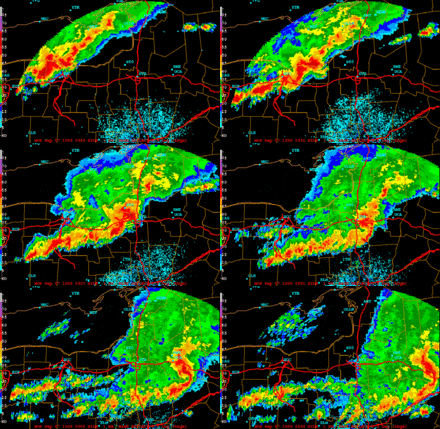
Radar loop, Labor Day 1998 Upstate New York. This storm impacted the New York State Fair.
The inspiration for this blog was a paper posted to LLIS by Dr. Susanne Becken, Professor of Sustainable Tourism at Griffith University (Australia) and Lincoln University (New Zealand). The paper is titled The Christchurch Earthquake and the Visitor Sector, which is also available from this link if you don’t have LLIS access.
Dr. Becken highlights the Christchurch earthquake of February 22, 2011, which killed 185 people from more than 20 nations, 80 of which were listed as visiting, rather than residing in, Christchurch. She states that as a result of this M 7.1 earthquake infrastructure was badly damaged, accommodation capacity was reduced by half, and the number of international visitors dropped by almost 30 percent in the aftermath. Dr. Becken identifies many of the challenges visitors had, including loss of travel documentation and other important items, and the value of the tourism industry in the area to assist response efforts (such as providing lodging for displaced citizens as well as responders from out of the area).
This paper brings to mind the vast amounts of visitors and transient populations that are found in many communities across the nation. When visiting an attraction such as an amusement park, where tens of thousands of people congregate on any given summer day, take a look around. Many of the amusement parks I know of are in fairly rural areas. These towns are likely to have small volunteer fire departments and may not even have their own police services, instead relying on a county Sheriff’s Department or State Police. How about a small city that has popular attractions at certain times of the year, such as horse tracks or other sporting events? These events will also draw tens of thousands of people from near and far, staying in hotels, motels, and campgrounds. Sure, these small cities might have a 24-hour staffed fire department, and probably even a small police force. But how prepared are these types of areas for an incident that can cause mass casualties and fatalities?
Incidents such as this underscore the need for our preparedness to be through and needs-based. As part of our Threat and Hazard Identification and Assessment (THIRA), which is the latest evolution of the traditional hazard analysis (see CPG-201), we must be sure to recognize visitors and transient populations and the events that bring them to our areas. We should consider tourist attractions, field days, concerts and performances, large conventions, sporting events, and even college populations. The potential impacts, in the event of a disaster, are certainly greater with these populations given that they are likely to be unfamiliar with the area, don’t reside locally and probably have no local contacts, and aren’t familiar with the threats. Given the nature of the event they are attending, they may very well be consuming alcohol, as well. All this makes for a rather fragile and dependent population in the event of disaster.
Planning on the macro (community) level should consider the specifics mentioned above. With this information you can estimate the resources needed for certain scenarios (this is part of your THIRA), which will lead you determine gaps which you then plan to address. Take some time to examine the demographics of the visiting populations. These demographics will help determine their level of need in the event of a disaster and some areas of support you may need to provide. Your local chamber of commerce and/or tourism authority can be an important planning partner for this information and other purposes. Certainly consider the nature of the events and the age range of the attendees. Are there language or cultural issues that should be prepared for? Much of this specific information can be obtained event by event, looking at the micro (event-specific) level of planning for these events. In New York State, a mass gathering permit is supposed to be issued for any event estimating attendance over a certain number. The primary purpose of these permits is to ensure that officials are aware of the event and that potable water and sanitation is appropriately available, as well as other caveats. Most states have a similar type of permitting requirement. Become familiar with it and use it to your advantage.
In any of these events, how will you handle alert and notification in the event of a disaster? You may have sirens in place, but would a visitor know what it means? Given that such a high percentage of people have cell phones, use of area blast messaging may be an appropriate consideration.
A lesson learned from airline crashes can and should be brought into your planning: family assistance centers. Family assistance centers were brought about in the aftermath of the crash of TWA Flight 800, realizing the importance of providing support and information to the families and loved ones of victims. This concept has been applied as a standard to other mass fatality incidents since then and has proven to be beneficial to all parties.
Be sure to conduct preparedness exercises on these plans, and include members of your local hospitality and tourism industry as they will certainly be involved in some aspect of the greater response should an incident occur.
Sometimes local communities view visiting populations as a hassle, particularly when they don’t have the care for the host community that the locals do. These populations are usually important to the economy of the local area and, depending in the event, will be back year after year. No matter what your take is on that argument, you must consider the safety of any visitors or tourists as if they were your own citizens. Be prepared through regular planning, training, and exercising activities and be sure to include your local chamber of commerce, tourism and hospitality industry as they are not only stakeholders, but they have a great deal of support and information to provide. Most importantly, remember that all good preparedness efforts begin with a solid needs assessment. Conduct a THIRA for your community, you might be surprised with what you discover!
What experiences do you have with planning for visiting populations?
 The Contrarian Emergency Manager