10 Considerations for Your EOC

Many jurisdictions, agencies, and organizations have emergency operations centers (EOCs) identified in their emergency plans to support incident response and recovery operations.  Through my career, I’ve seen all manner of EOCs, used to support entire incidents or just specific missions, ranging in size from just a handful of people to well over 100 people, various organizational models, and even varying degrees of successful implementation.  I’ve also seen many different locations for EOCs.

An EOC can be established anywhere, but just like any broad statement, there are a number of caveats to that.  Here are 10 things to consider in identifying a location for your EOC:

  1. Out of harm’s way

While it’s difficult to determine where an incident will strike, most jurisdictions have areas that may be less susceptible than others.  While it’s certainly convenient to have your EOC off a major highway, consider that a significant accident on that highway will impact access to your facility.  Locating your EOC near an industrial district or in a flood plain is just asking for trouble.  Be smart about where you locate your EOC relative to your geographic risk profile.

  1. Plenty of parking and accessibility

Few things are more frustrating than arriving to an EOC and not having a place to park.  That’s simply a silly problem to have and reflects greatly on shortsightedness.  If you are stuck in a certain location, plan for an overflow lot, signage, and a shuttle.  Also make sure your building is accessible.  I’ve seen far too many EOCs located either in basements or upper floors without any elevators or other ability for access for people with disabilities.

  1. Utility services and communications with redundancies

It practically goes without saying in our current age of technology, but we need to ensure full utility service in our EOCs.  This includes the basics like electricity, HVAC, and water, but also internet, terrestrial telephone, cellular service, television service (either cable or satellite), and radio communications.  The best facilities will have redundancies in these services to the greatest extent possible.  Generators (with fuel) are rather essential.  Engage your IT staff to ensure maximum flexibility and connectivity with wifi and wireless printing, while still maintaining secure networks.  Each work space should also be able to easily access outlets without running an excess of extension cords (but always have some on hand!).

  1. Meal and break rooms

Constant engagement fuels stress and exhaustion which leads to degradation of our ability to perform.  While work in an EOC may not be so physically strenuous, it can be mentally draining and having respite locations are important.  Both for respite and the sake of keeping work spaces clean, you want to have a separate dining area that can accommodate seating for everyone (at least in shifts), a place to wash hands, refrigeration of food and beverages, potable water and coffee/tea, and space for prepared food to be delivered and maintained within safe temperatures.

  1. Seating and tables

It seems odd to have to say this, but adequate seating is quite important.  I’ve been in EOCs that simply didn’t have it.  While I appreciate the ability of a jurisdiction to set up an ad-hoc EOC, a single six foot table and a few folding chairs aren’t likely to meet your needs.  If you don’t have a dedicated EOC (not everyone needs one!), meeting and conference rooms may have plenty of seating, though if they are too small, you will be extremely limited.  Thankfully folding tables and chairs are reasonably inexpensive and easy to store.  Consider the functional spaces you need to accommodate your EOC’s organization, be it ICS-based, Incident Support Model-based, or Emergency Support Function-based.  Functional groups should have their own work spaces and the arrangement and workspaces they need to accommodate and facilitate their functions.  Always plan for more people than you expect!

  1. Away from distractions

Your EOC shouldn’t be in a space that other wise will receive a lot of foot traffic.  While co-location of facilities can seem like a great idea before an incident, having your EOC in the same building as a shelter or your fire department is probably a bad idea.  It’s not only distracting, but also infringes on utility and communication usage, and even security.

  1. Security

Speaking of security, ensure that access to your EOC is limited only to those who should be there.  Generally, personnel not working in or serving the EOC should not have access to it.  It’s a pain to have civilians, the media, or other random persons wandering into an EOC, especially when they want immediate answers to complicated questions or feel their needs should be addressed first.  Along with ensuring access controls, security procedures should be in place, including a staffed reception desk and sign-in.  Personally, I also prefer armed security (law enforcement) for most EOCs.

  1. Meeting and briefing space

Meetings and briefings are a necessity in incident management.  It’s a way in which we share information, work through problems, and make decisions.  Of course there is always the danger of personnel getting stuck in a perpetual meeting, but that’s a topic for another blog post.  Ideally, your EOC should have adequate breakout space for these meetings and briefings.  An open space with a podium may be necessary for media briefings, and meeting rooms with conference call and video conference capabilities may also be required.  Having a separate space allows a meeting to take place without distraction from the general EOC activity while also being able to discuss sensitive information.

  1. Display space

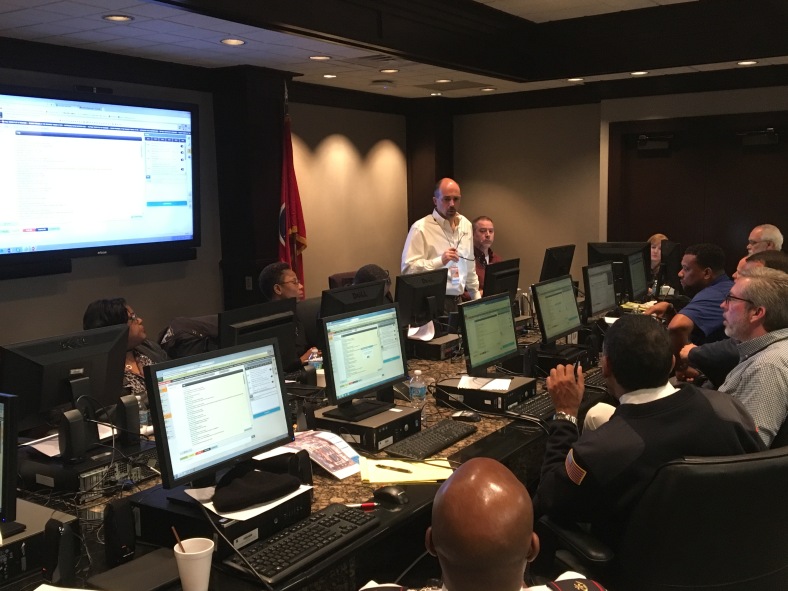
One of the hottest commodities in an EOC is display space.  Space to project with an LCD projector, hang chart paper or maps, and write on with a dry-erase marker is pretty essential to helping ensure that people are informed and information is tracked.  Higher-tech EOCs may elect to have flat screen monitors mounted on the wall, as well.  Easel stands and portable white boards can augment this and make your space more flexible as well.

  1. A good backup site

One of the best tips I can provide about having a great space for an EOC is to have two!  You will be thankful you have that second space identified and planned for in a continuity situation.  If you don’t need it, it can always be used for something else, but if you do need and don’t have it, you will be scrambling to find a location, get your personnel there, and ensure you have supplies, equipment, and other needs addressed.


There are certainly a number of other considerations for EOCs, but paying heed to these ten will get you far.  Your EOC doesn’t need to be a dedicated facility.  It can be any reasonably flexible open space, such as town hall, a large meeting space, a training facility, a hotel conference space, or even a warehouse – your needs should determine your space.  Once you have identified your space, make it functional and ensure that you have an EOC plan and procedures. Train staff, develop job aids to support their tasks, and exercise your plans regularly!

© 2019 – Timothy Riecker, CEDP

Emergency Preparedness Solutions, LLC®℠

A Discussion on Training Needs for the EOC Incident Support Model

Last week I wrote a piece on the Incident Support Model for Emergency Operations Centers (EOCs).  The article got a good amount of attention which prompted some dialogue both on and off line with a variety of practitioners.  So for those who might be integrating this model into their plans, let’s consider what training might be needed to support implementation.

First, I’ll say that I feel foundational ICS training (hopefully we’ll eventually have something better than what we have now since ICS training still sucks) is still necessary, even though the Incident Support Model deviates significantly from the traditional ICS model.  A couple of reasons… first, others are still using ICS, be it in EOCs or in the field.  Second, the principles and concepts of ICS still largely apply to the Incident Support Structure, regardless of the differences in organizational composition.  Perhaps only to the ICS 200 level is necessary since those functioning in an Incident Support Model organization only need be aware of it.

Next, I think we then need an overall Incident Support Model course.  I would envision this similar to an ICS-300 course, which has a more in-depth exploration of the entire organizational structure of the Incident Support Model and discusses the processes inherent in the system, such as the planning process, which would see some revisions to at least the positions involved under this model as compared to that for ICS.

Position-specific training is important, be it for an in-house EOC team(s) or for incident management teams which may be deployed to EOCs using this model.  While many of the position-specific courses in existence for a traditional ICS model are analogous to what we see in the Incident Support Model, there are significant enough changes, I think, to require different training specific for this model if we expect a professionally functioning organization (and we do).

One thing currently missing in the position specific courses is an EOC manager course.  While there is an Incident Commander course, which provides a lot of great information, there are significant enough differences between running an EOC and running an incident command post.  That said, I’m not so sure we need an entirely different course.  Given the propensity for incident management teams (IMTs) to work in EOCs, I think an additional module in the IC training may suffice to ensure that ICs are equipped to work in all environments.

Looking at the composition of the general staff of the Incident Support Model, we can first start with the Situational Awareness Section Chief.  From the ICS IMT model, we have great training for Situation Unit Leaders, which can largely apply to this position in the Incident Support Model with just a few changes, mostly addressing the expansion and elevation of the role.

The new Planning Support Section Chief would require very different training from what current exists for the IMTs. While in-depth training on the planning process is still relevant (with changes to make it specific to this model), as is training on demobilization planning, new training is required to address future planning, which doesn’t have as much content in the current Planning Section Chief course as needed.

Center and Staff Support Section Chief training is largely internal logistics, so really just requires a course that is narrowed in scope from the traditional Logistics Section Chief course, with perhaps some additional content on occupational and facility support matters.

Lastly, the Resource Support Section Chief.  This one is a monster.  It’s really an amalgamation of the Operations Section Chief, the Logistics Section Chief, and the Resource Unit Leader, along with Finance/Admin (if you subscribe to putting it in this section).  There is clearly a lot going on here.  Very little of the traditional ICS IMT courses really apply to this in an EOC environment given the difference in scope and mission for an EOC.  This largely requires completely new training based on functional coordination, mission assignments, and support to deployed resources.  This is a course that will require a lot of work to ground it in reality while also providing enough flexibility to allow for how each EOC may organize within this section.  Similar to the Operations Section in a traditional ICS model, this section may have the most variety from facility to facility and incident to incident.

Certainly other training may be needed, but the command and general staff positions are probably the most urgent to address.  In lieu of FEMA providing this training, some are developing their own training to support implementation of this model.  I’d love to hear about what has been done, the challenges faced, and the successes had.  Given my own passion and interest, I’d certainly love an opportunity to develop training for the Incident Support Model.

© 2018 – Timothy Riecker, CEDP

Emergency Preparedness Solutions, LLC

EOC Skillsets and Position Task Books Finalized

Back in April, FEMA released the drafts of EOC skillset documents and position task books for public comment.  A few days ago, the final versions of these documents were released on FEMA’s National Qualification System (NQS) website: https://www.fema.gov/emergency-managers/nims/components#nqs

While the hub of emergency response is the incident command post, the hub of emergency coordination is the Emergency Operations Center.  While life saving tactics, directed from the ICP, are absolutely essential, a comprehensive and long-term response can’t be sustained without the activities of an EOC.  We have gone far too long in emergency management without having good national guidance on the organization and qualification of personnel in the EOC.

When you crack into the website you may be a bit overwhelmed by all the documents you find.  Don’t look to this as something that must be implemented 100% right away.  Take a deep breath and remember that most things done well in emergency management, ironically enough, are an evolution and take time.  Also remember that while this has been established as guidance, it’s not a requirement.  Implement what you can, when you can.  Focus on establishing a foundation you can build from and do what makes sense for your jurisdiction or organization.

The foundation of everything in emergency management is planning, so whatever you do decide to implement should find its way into plans, which may need to be supported by policy.  While implementing a qualification system with task books can be cumbersome, it can also solve some problems when it comes to having less than qualified personnel working in your EOC.  The position task books are a great way for individuals to see what standards they are being held to and allows them to track progress.  If you don’t feel that the use of position task books will work for your jurisdiction or you are on a slower track to implementation, it’s still worthwhile to examine the skillset documents for each position you have identified in your EOC.  These can support your own developed standards, expectations, and plans; serve as a foundation for training course development; and support exercise evaluation.

Lastly, talk about these with your committees and your peers.  It’s easy to forget about them so keep these visible.  These documents offer an abundance of solid guidance which can strongly support your operational coordination.

What are your thoughts on the EOC skillsets? Do you plan on implementing them in your system?  If so, how?  If not, why not?

Timothy Riecker, CEDP

Emergency Preparedness Solutions, LLC℠

Musings of October – and the Crusade to End Bad ICS Courses

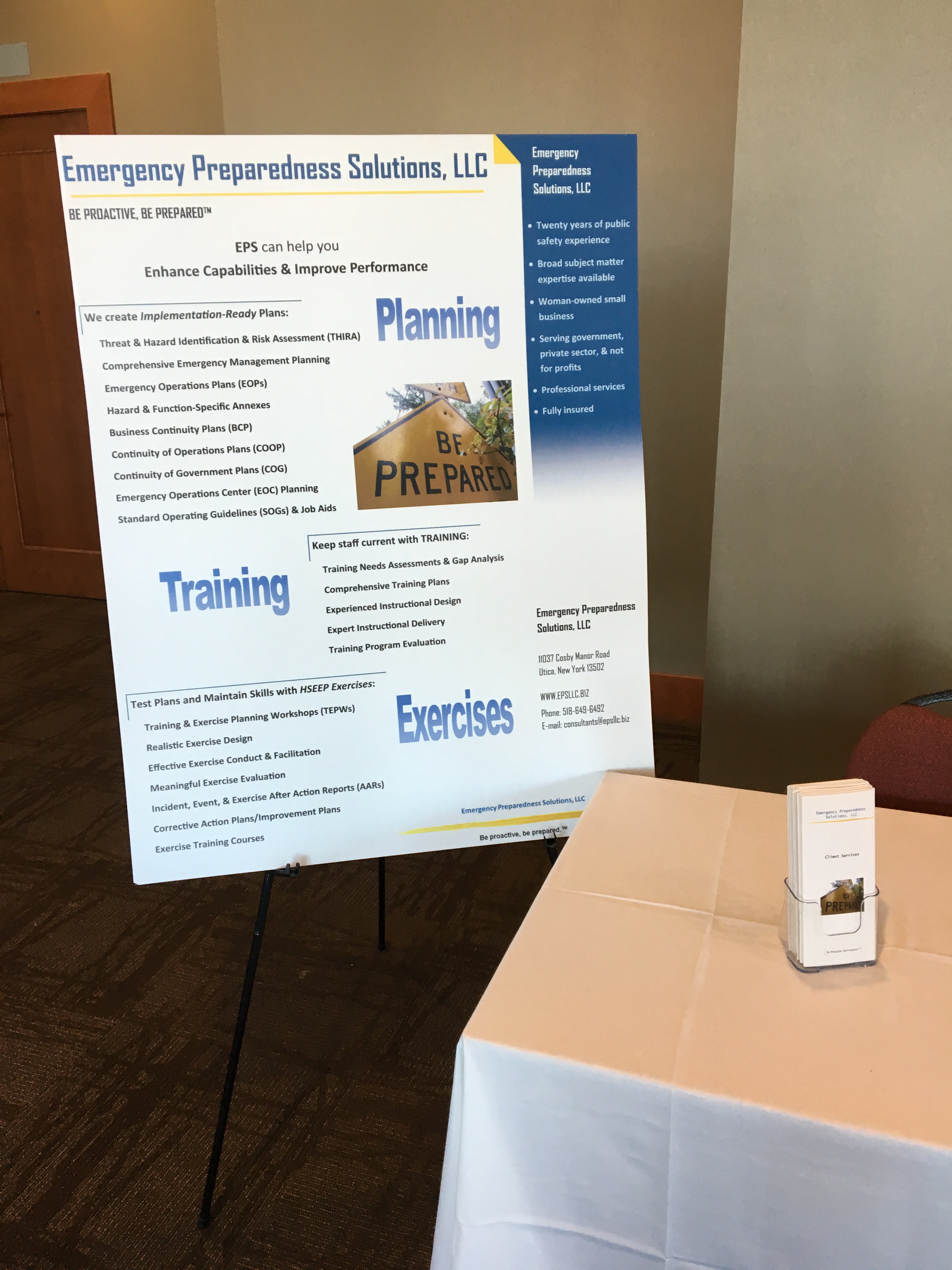
Last month sure was a busy one!  Much of the focus was on marketing for our company Emergency Preparedness Solutions.  I had the opportunity to meet a number of county and local government representatives in a reverse trade show in the Poconos and see some old and new faces at the Vermont Emergency Preparedness Conference.  Pictures of our booth are below.  I also had the opportunity to present with their State Training Officer on the State-Wide Emergency Management and Homeland Security Training Needs Assessment project we completed for the Vermont Division of Emergency Management and Homeland Security a few months ago.  We also need to congratulate Doug Babcock for being honored as Vermont’s Local Emergency Manager of the Year!

IMG_1205

IMG_1206

While those trips were great, the highlight of the month was a trip to Toronto.  The impetus for the trip was the Emergency Preparedness staff of Public Health Ontario, who, after reading my blog posts on the necessity for improvements in Incident Command System (ICS) training, extended an invitation for me to sit in on some training they offer that came about from just that need.  The course I attended was Public Health Emergency Preparedness – An IMS-based Workshop.  Fear not – this is not a reinvention of ICS (or Incident Management System – IMS – as they refer to it in Canada), rather this is an enhancement to the current curriculum.

The Canadian provinces have each adopted curricula for their IMS which are near 100% mirrors of the ICS courses we use here in the States.  While in Toronto, I also had the opportunity to sit in for a bit on an IMS-200 course being conducted by the Toronto Office of Emergency Management.  They were great hosts and have made excellent enhancements to the curriculum for a Toronto-based audience.  (Thank you Sherry and Sarah!) The course offered by Public Health Ontario is truly workshop based, with little lecture and a lot of group work to walk participants through concepts of IMS.  The workshop is positioned between IMS-100 (which most took online) and IMS-200, and is public health focused.

While I’m often weary of discipline-specific courses in emergency management, since the essence of emergency management is cooperative, this workshop absolutely made sense.  Why?  Two big themes built the foundation for this… First, practitioners must be comfortable with their own sand box before they can play with the neighborhood kids.  Second, this particular application works for public health (and several other disciplines) because most of the public health response occurs at the population level, not necessarily at an incident site.  Because of this, public health will almost always function (at least the higher echelons of their incident management structure) from an emergency operations center or departmental operations center.  As such, it pays to invest some training time on a homogeneous audience.  That said, the scenarios that drove the workshop were in no way introverted only to public health concerns and the instructors encouraged thought and discussion toward other activities and associated agencies which would be involved in an incident.

With the positioning of this training between IMS-100 and IMS-200, Public Health Ontario has armed participants with better knowledge and familiarity of the IMS, allowing those who will progress through further (and multi-disciplinary) training a better perspective of how IMS is applied by public health which allows for a better understanding of the system itself.  Not only does the workshop address some internal incident management training needs for public health, it also addresses some of the issues I’ve mentioned previously with ICS training as a whole.  The workshop is expertly designed by the Emergency Preparedness team at Public Health Ontario, and embraces concepts of adult educational methodology which we need to pay more attention to.  The high level of interaction lends to improved transfer of knowledge and better outcomes.  They included information such as the phases of emergency management and the need to reference deliberate planning efforts such as Emergency Operations Plans (EOPs) and Continuity of Operations Plans (COOPs).  This is certainly something we don’t have enough of in ICS courses yet is critically related.  Do you think the majority of our attendees know what these are, much less what is in theirs?  Guess again!

More information on this workshop can be found at https://www.publichealthontario.ca/en/About/Departments/Pages/Incident-Management-System-for-Public-Health.aspx.  Many thanks to Moira, Richard, and Evanna for the invite and the hospitality!

With my road trips complete, I am returning back to the normal pace of work and preparing for another graduate course which begins next month.  I’ve also considered the need to ramp up my concern on this matter of poor ICS curricula from an occasional rant to a crusade.  This is a matter of public safety – from a sociological perspective there is nothing more important than our ability to effectively respond to save lives, stabilize the incident, and preserve property.  Let’s make some changes!

As always, many thanks to my readers; and if you are with a government entity, not for profit, or private interest that is seeking consulting services in the areas of emergency and disaster planning, training, exercises, and anything in between, please feel free to contact me.

© Timothy Riecker

Emergency Preparedness Solutions, LLC