Are you Ready for Hurricane Season 2014?

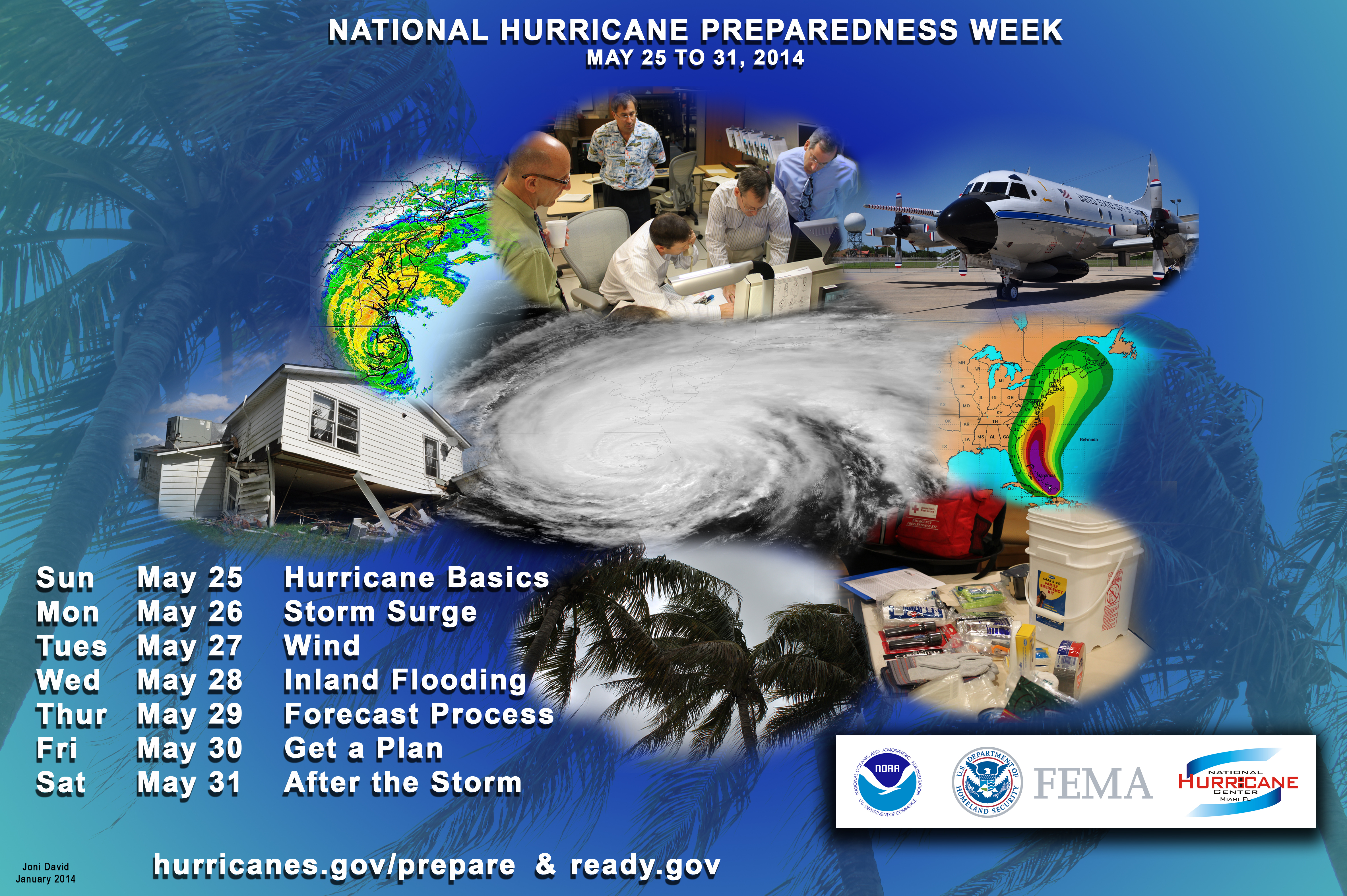
Today begins National Hurricane Preparedness Week, ushering in hurricane season which starts a week from today on June 1st.  In the last 10 years we have seen some absolutely devastating hurricanes, including Hurricane Katrina in 2005 and Hurricane Sandy in 2012.  These storms are powerful, taking lives, destroying homes and infrastructure, and changing the landscape.  We were reminded that these storms can bring strong winds and flooding rainfall not only to coastal areas but well inland where governments and residents may not be as prepared as they should.

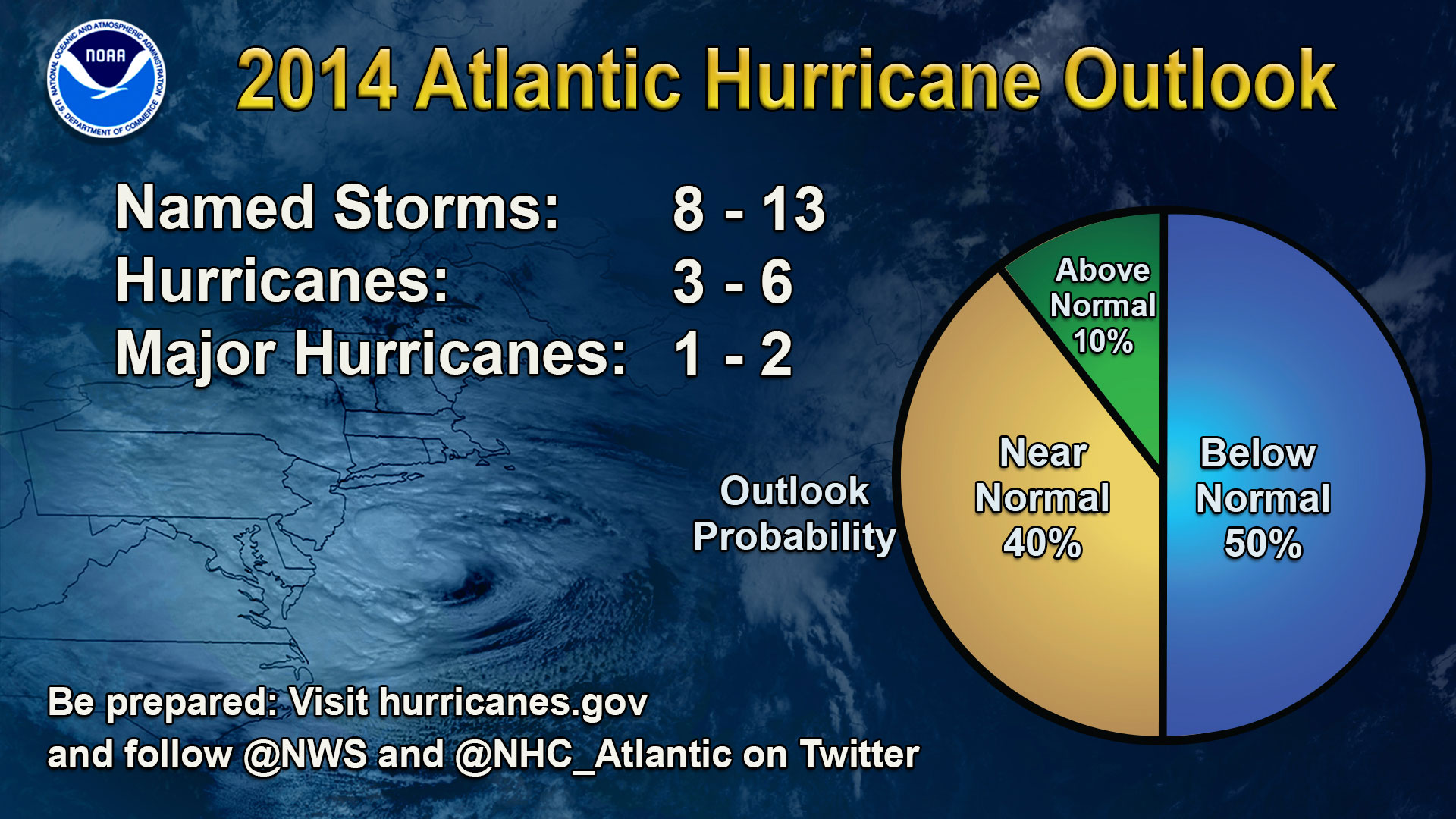
The graphic below is the National Hurricane Center’s prediction for the year.  While there is plenty of science behind this, it’s an imperfect science.  It’s one thing to predict tomorrow’s weather, it’s something else entirely to predict Atlantic storms two months from now.  Like most things in emergency management, it’s a guide – so don’t let it lull you into false confidence.  Be sure to prepare!

2014 Atlantic Hurricane Forecast

2014 Atlantic Hurricane Forecast

What do you need to know to prepare?  The graphic below has a list of seminars conducted by the National Hurricane Center which are accessible via YouTube.  The first one starts today!  Go to this website for more information and the links to the YouTube videos.

Hurricane Preparedness Courses

Hurricane Preparedness Courses

Be smart this year and make sure you and your family are prepared and safe.  Government and business emergency managers – be sure to give your hurricane plans and associated annexes one more look this week to make sure they are current and ready to activate.  Also, there is no time like the present to make improvements.  Just because we’re entering hurricane season doesn’t mean you can’t update plans now.  Don’t wait until hurricane season is over!  Be sure to distribute copies of the plans to key stakeholders and to run a seminar to remind people of the general content of the plan and what is expected of them in the implementation of the plan.  Pay special attention to trigger points, decision points, and succession.  Be sure to verify the availability of key resources; test generators and IT fail overs.

If you are looking for some assistance in reviewing your plans, training staff, or exercising plans please contact Emergency Preparedness Solutions, LLC at consultants@epsllc.biz.  We’re happy to assist you!

Are you ready???

Creating Operational Emergency Plans

I was inspired for this article from an email I received earlier today from Lu Canton, a rather prolific emergency management consultant who has branched a bit into consulting consultants.  His email today (a forward from his blog) was about making emergency plans ‘real’.  His point was that many planners focus on checking the boxes of the list of planning requirements (those prescribed by law, regulation, etc.) rather than focusing on ensuring that you have a plan that can actually be implemented.  He conducted a webinar over a year ago which I had blogged about.

Planning requirements are important, as they largely stem from lessons learned from earlier incidents.  Granted, some of these requirements come about being translated through the eyes and ears of politicians whose staffers write the legislation and don’t understand emergency management at all – resulting in convoluted, contradictory, and poorly focused requirements.  Requirements lead to standards, helping to ensure that emergency managers are addressing the needs of their jurisdiction and best practices in the industry.  To help guide us through this, many higher level agencies provide templates.  I’ve pontificated in the past about the danger of templates, which have a place in reminding us of these requirements and help us with format and flow, but are often misused by individuals who simply seek to fill in the blank with the name of the jurisdiction and claim they have a finalized plan.

How do we avoid falling into this trap?  Follow the planning process!  FEMA’s Comprehensive Preparedness Guide (CPG) 101 provides an overview of this process for creating emergency operations plans.  The two initial steps – forming a planning team and conducting a hazard analysis – are absolutely critical to the integrity of the process and ensuring a quality plan that meets the needs of your jurisdiction by addressing your threats and hazards.  Planning teams then need to consider these threats and hazards, make reasonable assumptions about their impacts (using a credible worst case scenario), then identify resources and strategies the jurisdiction will undertake to solve the problems they will face.

Does all this mean that a plan needs to be written from scratch?  Of course not!  In fact I strongly encourage people against it.  It’s practically guaranteed that you will forget a critical element.  One of the greatest things in the emergency management community is how we learn from each other.  You can reference templates you find, examine plans of your neighboring jurisdictions or jurisdictions similar to you, check out what is on LLIS.  There is plenty of great content you can examine and apply for your own use.  Just ensure that you carefully review and consider how it applies to you.

As you write the plan, think the details through.  This will help ensure that your plan is operational, not just meeting requirements.  Discuss with your planning team what is expected of each assisting and cooperating agency for each incident type.  Who will be in charge?  What resources will be necessary and where will you get them from?  What would the objectives be and what processes and decision points must be conducted to accomplish those objectives.  As you create the plan, map out these processes and ensure that you’ve considered the who, what, where, when, and how of each step in each process.  Recall that you are planning at a strategic level, not a tactical level.  Planning at a tactical level is nearly impossible with a pre-incident (aka ‘deliberate’) plan.  Tactics will be addressed during the actual response, hopefully referencing the EOP/CEMP you are writing now, and implemented through an incident action plan (IAP).

Remember, though, the proof is in the pudding, as they say.  Your plan needs to be tested to ensure viability.  Use a table top exercise to test policy and decisions, then a functional exercise to test the implementation of the plan and higher level tactics.  Full scale exercises and drills can test the tactical implementation of plans.  Good evaluation of the exercises will lead to planning improvements.  For insight on the exercise process, you can check out my exercise management series of posts referenced here.

Remember: when it comes to planning – keep it real!

Tim Riecker

Are you Planning for All Hazards?

Image

While I’m amazed by the number of jurisdictions and businesses that don’t have any emergency plans at all, I’m almost nearly amazed by those who only have isolated, single hazard plans. I’ve seen plenty of entities with only fire plans or flood plans.

How does this happen? Many small towns may ask their local fire chief to write an emergency plan for the town – this plan often times outlines the fire response structure but ignores other hazards. Sometimes this myopic view of planning takes place because of a focus or near panic over one particular hazard. These situations are generally not the fault of the people who wrote them. Just because someone is in public safety doesn’t mean they know every facet of it. Emergency planning is as much of a niche as pump operations in the fire service or special tactics in law enforcement. It requires a certain set of knowledge, skills, and experience to be successful and effective.

While it’s logical that a larger jurisdiction will have a more complex emergency plan than a smaller jurisdiction, there are still foundational elements that are common to all. Perhaps the most critical of these is the necessity to plan for all hazards. All hazards planning, if you’re not familiar with the concept, is a process beginning with the identification of the hazards which can impact a community, the impacts associated with each hazard (also known as vulnerability), and the probability of each hazard impacting the community (also known as risk). This is called a Hazard Vulnerability Analysis (HVA). By rating the vulnerability and risk factors for each hazard, a fairly simple algorithm can be used to provide an overall ranking for each hazard. Additional information, such as the availability of resources to respond to each hazard can be included as well.

Obviously there is a lot of context that needs to go into such an assessment, which is best conducted by a planning team to gain the most amount of input. Comprehensive Preparedness Guide (CPG) 101, published by FEMA/DHS, provides much more information on the planning process as a whole. Historical disaster information should be referenced, but not to the extent of outweighing other inputs. Fluctuations over time in population, topography and development, and climate change are all leading to, as the investment world states it, historical information not necessarily being indicative of future performance.

Scientific data should also be examined, such as flood maps and wild fire risk. Communities should be sure to reference information on hazardous materials, which is required reporting by industry per the Emergency Planning and Community Right to Know Act of 1986 (also known as SARA Title III). Once you have identified and ranked all the hazards, you know what ones to focus on. Perhaps it is the top 8, or maybe the top 12 that indicate a high enough vulnerability and/or high enough risk to incorporate into your planning efforts. Once these are identified, you continue through the CPG 101 planning process to create a comprehensive plan. A comprehensive plan incorporates all elements needed to address the responses to these incidents. Given that the majority of responses are largely similar, regardless of the hazard, one concept of operations will address this in the plan. Separate plans, written as annexes or appendices, then can be created for hazards with very specific issues, such as a pandemic, or to address specific functions, such as evacuation and sheltering.

Is it possible to anticipate every disaster that could possible impact your community? Can your community possibly predict being trampled by a giant man of marshmallow or having busses tossed aside by fire breathing dinosaurs from Japan? No? Then don’t spend much time on these things. Be realistic. That said, a Comprehensive Emergency Management Plan (CEMP) – which is a plan that considers all hazards, all resources, and the whole community – can even help account for hazards you didn’t identify. Do you think Chelyabinsk, Russia had a plan for meteor strikes? Not likely. However, consider how the components of a CEMP could have addressed critical areas of response: mass casualty, search and rescue, debris management, sheltering.

I recall a number of years ago, prior to the 2013 occurrence in Chelyabinsk, where there was a bit of media frenzy over near earth objects (NEOs) such as meteors. The public information officer (PIO) for the state’s emergency management agency received a call from a media outlet inquiring if the state had a plan for meteor strike. The PIO answered ‘yes’, qualifying that with a statement about the value of comprehensive planning. Was there a specific plan for meteor strikes? No. The likelihood is so slim that it’s not worth putting effort toward (although I’m sure someone has). Does the CEMP cover all the necessary response components? Absolutely.

Author’s note: Unfortunately I don’t recall where I got the picture from, so I’m unable to give proper credit. If anyone knows or claims it, I’ll gladly give credit or pull it down.


A Disasterous Trend: Cuts in Preparedness Funding

This post was initially inspired by an article from CBS News on funding cuts to disaster preparedness programs.  These cuts go further and deeper than the current sequester cuts we are now seeing.  These cuts are a dangerous and disastrous trend.  To quote the article…

“In fiscal year 2010, Congress appropriated $3.05 billion to FEMA for preparedness grants designed to strengthen “our nation’s ability to prevent, protect, respond to, and recover from terrorist attacks, major disasters and other emergencies, …. In fiscal year 2012, that appropriation was less than half that figure – $1.35 billion. The same trend could be seen in FEMA pre-disaster mitigation grants, which fell from $100 million in 2010 to $35.5 million two years later.”

Have all the terrorists gone away?  Has Mother Nature stopped having temper tantrums?  Have stupid people stopped doing stupid things?  I don’t think so!  So why the cuts?

Let’s put some things in perspective… On one hand, we do need to have a bit of fiscal prudence and restraint.  GAO reports have repeatedly shown that many state and local governments are simply not spending down the grant funds they have been allocated.  DHS grants are backed up several grant years with unspent funds.  That said, as we peel back the layers of the onion, there are certain facts that need to be mentioned.  Why aren’t they spending the money they have been given?  First, grant periods have generally been too short.  The most significant reason for this is the inefficiency of bureaucracy we live in.  Follow this trail… The federal fiscal year begins October 1st.  The budget gets passed at some undermined point around that.  DHS, along with all the other agencies, get their allocations.  They then need time to formulate their grant guidance for the funds going to states and locals.  By the time states see this grant guidance and their respective allocations it’s usually close to the end of the second quarter of the federal fiscal year.  States then have to formulate their own grant guidance as they pass through funds to locals.  All this bureaucracy delays the grant year about six months.  Recognizing that nothing could be done about the bureaucracy, DHS finally extended grant years only recently, giving folks a more reasonable amount of time to spend the money.

Another reason why grant funds are slow to spend is that in most cases the grantees don’t actually ask for the money, therefore they don’t have a budget prepared beforehand.  DHS distributes funds based upon a formula.  While an application exists, it’s nothing more than an afterthought and formality.  That leaves states and locals with a pile of cash and no plan on how to spend it.  Here lies the beginning of the breakdown in accountability.  Now most folks will say that it’s easy to spend money.  In government, not so much.  Especially when you consider a few factors: 1) every level of government has spending rules (accountability is a good thing, but that can get in the way of efficiency when RFPs have to be issued for darn near everything); 2) a great deal of equipment was purchased in the big push of funds immediately surrounding 9/11 – what else do we need?; and 3) grants are restricting what funds can be spent on (i.e. there are limits on personnel (salary) expenses, and the purchase of disposables and maintenance costs of equipment – which are of particular importance for exercises).

So governments don’t have a lot of time to spend the money and face a few obstacles in getting the money spent.  But how is this a factor of cuts?  One reason for these cuts is that Congress is seeing that states and locals have a lot of money left over going back several grant years.  Failing to realize the whys and wherefores of it all, they are simply giving less money (because, to them, it’s not needed – but nothing could be further from the truth!).  They are also looking to reduce spending overall, as the article cites, and that’s a hit that will impact nearly everyone.

Taking a look at the grantees, however, there are a few criticisms.  Better and more proactive fiscal planning needs to be implemented.  Costs should be forecasted out several years to better anticipate needs.  They may, sadly, have to trim programs and streamline operations (although most emergency management programs certainly are not living in the lap of luxury).  They also need to be more creative with the declining funds they receive, especially through partnerships and regionalization.  An area doesn’t need to be regarded as a UASI or Catastrophic Planning Zone to work cooperatively as a region, which should include some pooling of funds for collective projects.

What can be approached regionally?  Most preparedness efforts fit well into that category: planning, training, and exercising.  Think about it, you work with your neighbors all the time and disasters don’t seem to stop at the county line, so why not make your cooperation more effective and efficient?  In the absence of regional catastrophic planning, which most areas don’t need to do, consider planning for some credible worst case scenarios and cascading impacts such as flooding and mass care.  Obviously regional mutual aid planning is essential.  How about working with your public health partners?  What about the private sector – how can you strengthen your relationships with them?  Regional planning conferences are a good start!  Regionalized training is obviously a no-brainer and regional exercises are essential making sure that the planning and training are effective and to give folks an opportunity to practice what they have learned.  Lastly, speaking as someone who has experience working for government and as a consultant, in many cases it’s actually more cost-effective and easier to coordinate regional preparedness activities by hiring a consulting firm, some of which have proven experience and expertise in working with the multiple stakeholders that a regional effort would include.

As we face reduced funding, we have to be more creative, cooperative, and communicate specific needs on a regular basis up the chain of government.  If you are with county or local government, let the state know what your needs are.  And don’t just tell them once – be sure to repeat yourself – not in an annoying wintertime house fly kind of way, but when the appropriate opportunity presents itself.  Make sure that you show justification for your needs through after action reports and documented strategies and plans.  Ask the State to take these needs up to federal partners – and when you have the opportunity to speak with these federal partners directly, take advantage of it; be they representatives of FEMA or your local representative of Congress or US Senator.  Remember to be specific and cite the need.  Don’t complain but be direct.  With funding that emergency management programs simply receive without asking being on the decline, we need to be proactive about receiving funds.

Emergency management and, to a greater degree homeland security, have been fortunate to have a good deal of funding over the last decade.  There has been so much money, though, with such short time lines, that things haven’t been done as well as they should have.  Now is the time to re-tool and reexamine how we do business.  Conduct needs assessments to determine what should be focused on and build upon community partnerships.  Consider what the community as a whole – the citizens – are willing to help in preparedness; as well as the private sector.  Whole-community partnerships have perhaps never been so important as they are now.
Emergency Management and Considerations for Visiting Populations

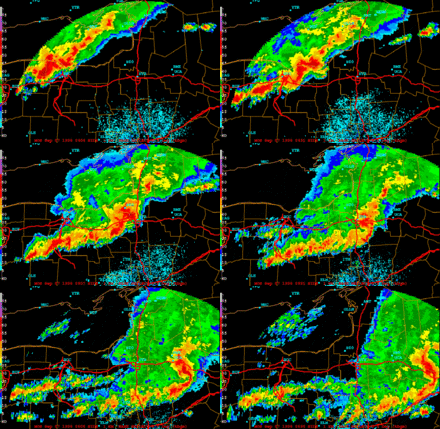
Radar loop, Labor Day 1998 Upstate New York.  This storm impacted the New York State Fair.

Radar loop, Labor Day 1998 Upstate New York. This storm impacted the New York State Fair.

The inspiration for this blog was a paper posted to LLIS by Dr. Susanne Becken, Professor of Sustainable Tourism at Griffith University (Australia) and Lincoln University (New Zealand).  The paper is titled The Christchurch Earthquake and the Visitor Sector, which is also available from this link if you don’t have LLIS access.

Dr. Becken highlights the Christchurch earthquake of February 22, 2011, which killed 185 people from more than 20 nations, 80 of which were listed as visiting, rather than residing in, Christchurch.  She states that as a result of this M 7.1 earthquake infrastructure was badly damaged, accommodation capacity was reduced by half, and the number of international visitors dropped by almost 30 percent in the aftermath.  Dr. Becken identifies many of the challenges visitors had, including loss of travel documentation and other important items, and the value of the tourism industry in the area to assist response efforts (such as providing lodging for displaced citizens as well as responders from out of the area).

This paper brings to mind the vast amounts of visitors and transient populations that are found in many communities across the nation.  When visiting an attraction such as an amusement park, where tens of thousands of people congregate on any given summer day, take a look around.  Many of the amusement parks I know of are in fairly rural areas.  These towns are likely to have small volunteer fire departments and may not even have their own police services, instead relying on a county Sheriff’s Department or State Police.  How about a small city that has popular attractions at certain times of the year, such as horse tracks or other sporting events?  These events will also draw tens of thousands of people from near and far, staying in hotels, motels, and campgrounds.  Sure, these small cities might have a 24-hour staffed fire department, and probably even a small police force.  But how prepared are these types of areas for an incident that can cause mass casualties and fatalities?

Incidents such as this underscore the need for our preparedness to be through and needs-based.  As part of our Threat and Hazard Identification and Assessment (THIRA), which is the latest evolution of the traditional hazard analysis (see CPG-201), we must be sure to recognize visitors and transient populations and the events that bring them to our areas.  We should consider tourist attractions, field days, concerts and performances, large conventions, sporting events, and even college populations.  The potential impacts, in the event of a disaster, are certainly greater with these populations given that they are likely to be unfamiliar with the area, don’t reside locally and probably have no local contacts, and aren’t familiar with the threats.  Given the nature of the event they are attending, they may very well be consuming alcohol, as well.  All this makes for a rather fragile and dependent population in the event of disaster.

Planning on the macro (community) level should consider the specifics mentioned above.  With this information you can estimate the resources needed for certain scenarios (this is part of your THIRA), which will lead you determine gaps which you then plan to address.  Take some time to examine the demographics of the visiting populations.  These demographics will help determine their level of need in the event of a disaster and some areas of support you may need to provide.  Your local chamber of commerce and/or tourism authority can be an important planning partner for this information and other purposes.  Certainly consider the nature of the events and the age range of the attendees.  Are there language or cultural issues that should be prepared for?  Much of this specific information can be obtained event by event, looking at the micro (event-specific) level of planning for these events.  In New York State, a mass gathering permit is supposed to be issued for any event estimating attendance over a certain number.  The primary purpose of these permits is to ensure that officials are aware of the event and that potable water and sanitation is appropriately available, as well as other caveats.  Most states have a similar type of permitting requirement.  Become familiar with it and use it to your advantage.

In any of these events, how will you handle alert and notification in the event of a disaster?  You may have sirens in place, but would a visitor know what it means?  Given that such a high percentage of people have cell phones, use of area blast messaging may be an appropriate consideration.

A lesson learned from airline crashes can and should be brought into your planning: family assistance centers.  Family assistance centers were brought about in the aftermath of the crash of TWA Flight 800, realizing the importance of providing support and information to the families and loved ones of victims.  This concept has been applied as a standard to other mass fatality incidents since then and has proven to be beneficial to all parties.

Be sure to conduct preparedness exercises on these plans, and include members of your local hospitality and tourism industry as they will certainly be involved in some aspect of the greater response should an incident occur.

Sometimes local communities view visiting populations as a hassle, particularly when they don’t have the care for the host community that the locals do.  These populations are usually important to the economy of the local area and, depending in the event, will be back year after year.  No matter what your take is on that argument, you must consider the safety of any visitors or tourists as if they were your own citizens.  Be prepared through regular planning, training, and exercising activities and be sure to include your local chamber of commerce, tourism and hospitality industry as they are not only stakeholders, but they have a great deal of support and information to provide.  Most importantly, remember that all good preparedness efforts begin with a solid needs assessment.  Conduct a THIRA for your community, you might be surprised with what you discover!

What experiences do you have with planning for visiting populations?

Lucien Canton Webinar Recording: Are Your Emergency Operations Plans Realistic?

Last week EM Forum hosted one of the better webinars I’ve attended recently.  The presenter was Lucien Canton, CEM, a fellow Emergency Management Consultant.  His topic was “Are your emergency operations plans realistic?  A group discussion on planning assumptions”.  This presentation was in obvious response to his excellent blog article, Paper Plans and Fantasy Documents, which I blogged about a few weeks ago.  In both his article and the webinar, Lu talks about the need to ensure that plans make sense and can actually be implemented, not just cover legal requirements.

For ease, I’ve pasted the EMForum follow up email here, which provides a link to the webinar recording in various formats.  Highly recommended if you didn’t catch the original airing!


The Webinar recording of the February 13th EMForum.org program, “Are Your Emergency Operations Plans Realistic? A Group Discussion on Planning Assumptions,” with emergency management consultant, Lucien G. Canton CEM®, is now available. This is a large file and requires Windows Media Player or Windows Media Components for QuickTime or a similar product to view. The recording is also available in MP4 format for mobile users. The TranscriptAudio Podcast, as well as Ratings and Comments are available from the Background Page. The Audio Podcast and MP4 recordings are also available from the iTunes Store.

Collegiate Emergency Management

Ever since attending college at SUNY Oswego and serving as chief of our campus ambulance (the first and longest-serving all student-run college ambulance – SAVAC) I’ve had a completely different perspective than most students on the community that is a college campus.  This experience resonated with me through my emergency management career.  As a result, I’ve paid special attention to colleges and universities; helping university police, college public safety entities, and other campus partners to be better prepared by providing training, supporting exercises, and reviewing plans.  I’m fortunate to have friends and colleagues around the nation who are emergency managers for their colleges as well as those who are involved in emergency management degree programs which further the professionalism of our field.  All these folks have worked hard to enhance their colleges’ preparedness through efforts not only targeting college faculty and staff, but also students – which can be a challenge with this regularly changing population.  I’ve seen training offered to students ranging from CPR and First Aid courses, to Campus CERT (community emergency response team), to EMT training.  These types of courses, offered to students, are certainly an investment, but one that can pay off not only for the campus community but beyond the campus when these students graduate.

Colleges and universities have a tremendous amount of resources.  These resources allow a certain measure of self-sufficiency.  I was reminded of this by a recent article about Tufts University working to keep their campus operational after Nemo.  Campuses are truly communities, with hundreds or thousands of residents, hundreds of commuters, and an infrastructure to support it all including roads, facilities, healthcare, and food.  Not only must they have emergency plans in place, but also business continuity plans.  Largely, their number one hazard is fire – and colleges take fire safety very seriously – but they all have their own unique hazard profile which they must address just like any other community.

I have always encouraged colleges to work with their local communities and vice-versa.  There are a number of case studies out there, certainly of local communities aiding campuses during fires, shootings, and other emergencies and disasters.  But there are also instances of colleges helping the local communities.  Not only do campuses have public safety resources (these encompass the entire range of law enforcement – from security guards, to peace officers, to police), but they also have some public works resources, and a vast number of potential volunteers that can all be deployed to aid a local community.  Depending on the education the college provides, these volunteers can range from general labor, to those being trained as social workers, medical providers, veterinarians, and other professions which can provide direct assistance under the supervision of an experienced professional.  This is not only a huge force multiplier to aid the community but also provides real, hands-on experience to the students.  Likely an experience they will never forget.  We’ve also seen colleges and universities provide assistance to local communities on-campus.  Campuses have served as shelters (both in dorms and other facilities, such as gymnasiums) and feeding facilities through their dining halls.  When off term, campuses have massive potential to serve as incident bases, supporting the needs of a larger incident by providing services for incident personnel and resources (remember your ICS training?) through their lodging and feeding capability, medical facilities, loading docks, garages and maintenance facilities, and even just their open spaces.

Colleges and universities have to ensure their own preparedness just like any other community, but they should also work with their local communities and even their county emergency manager on cooperative emergency management relationships.  Local responders should be familiar with the campus, its hazards, facilities, and the people who operate it.  The campus can further relationships by hosting training programs for area responders and emergency managers and should include area responders in any preparedness exercises they conduct.  Engaging the student population in preparedness efforts will have great impact on the campus’s emergency program and will provide skills that the students will carry with them forever.

Planning in Perspective

planI just finished reading an article by Lucien Canton, CEM – who is a well-respected and often published emergency management professional.  He maintains a blog, which he posts to often, and provides great insight to various EM-related topics.  The article that struck my interest was ‘Paper Plans and Fantasy Documents’.  Canton poses the question as a subtitle to his article – ‘Are we over-thinking planning?’.  In all actuality, based on his article and my own experiences, no – in fact we’re under-thinking it by maintaining a cookie cutter approach across the entire nation.

Canton’s commentary is similar to the thoughts I had in an earlier post on the (mis)use of templates in emergency planning.  Standards are good to have in every industry, certainly in emergency management and homeland security.  There are folks who become true experts through a great deal of experience, research, and trial and error.  The best ones share their expertise with the rest of the world in the hopes that we can all benefit.  Eventually, these standards become embraced by ‘standard setters’ – those in government or regulatory bodies who can pass laws, regulations, or codes to compel others to adhere to these standards.  This is all absolutely necessary – but, as Canton mentions, these standards become the basis for how people plan.

Just like I often write in my training-related posts, it’s all about the audience.  Our planning priority must be to meet the needs of the jurisdiction/company/organization who will be using the plan.  The plan must have utility – i.e. it must be usable.  Just because a plan meets established standards, does not mean that it can be operationalized.  Obviously our plans must still meet standards, but that really is a secondary concern to usability.  I think we are missing the forest for the trees and need to seriously re-think how we plan.

Any ideas?

Safeguarding our Electrical Grid – Reblog

More thoughts on the vulnerabilities of our electrical grid.  Great post.

Andy (אברהם נפתלי) Blumenthal's avatarandyblumenthal

Image

Popular Science (28 January 2013) has an interesting article on “How To Save The Electrical Grid.”

Power use has skyrocketed with home appliances, TVs, and computers, causing a significant increase in demand and “pushing electricity through lines that were never intended to handle such high loads.”

Our electrical infrastructure is aging with transformers “now more than 40 years old on average and 70% of transmission lines are at least 25 years old” while at the same time over the last three decades average U.S. household power consumption has tripled!

The result is that the U.S. experiences over 100 mass outages a year to our electrical systems from storms, tornados, wildfires and other disasters.

According to the Congressional Research Service, “cost estimates from storm-related outages to the U.S. economy at between $20 billion and $55 billion annually.”

For example, in Hurricane Sandy 8 millions homes in 21 states lost power, and…

View original post 350 more words