This post is part of a 10-part series on Managing an Exercise Program. In this series I provide some of my own lessons learned in the program and project management aspects of managing, designing, conducting, and evaluating Homeland Security Exercise and Evaluation Program (HSEEP) exercises. Your feedback is appreciated!
Managing an Exercise Program – Part 1
Managing an Exercise Program – Part 2: Develop a Preparedness Strategy
Managing an Exercise Program – Part 3: Identify Program Resources and Funding
Managing an Exercise Program – Part 4: Conduct an Annual Training & Exercise Planning Workshop.
Managing an Exercise Program – Part 5: Securing Project Funding
Managing an Exercise Program – Part 6: Conducting Exercise Planning Conferences
Managing an Exercise Program – Part 7: Develop Exercise Documentation
Managing an Exercise Program – Part 8: Preparing Support, Personnel, & Logistical Requirements
Managing an Exercise Program – Part 9: Conducting an Exercise
Managing an Exercise Program – Part 10: Evaluation and Improvement Planning
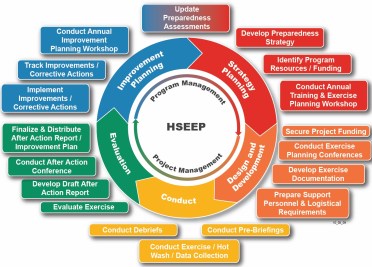
HSEEP Cycle
As HSEEP Volume 1 states, “The basis of effective exercise program management is a Multi-Year Training and Exercise Plan.” The MYTEP is the product of a Training and Exercise Planning Workshop (TEPW), a collaborative which should be conducted annually to update the plan (and the collaborating partners!) with any changes in preparedness priorities, funding, or other influential factors. I really can’t underscore the importance of the TEPW and MYTEP enough – they truly are the backbone of an effective exercise program.
First the TEPW needs to be scheduled and attendees invited. This workshop should include not only your core planning team (discussed a bit in part 3), but should also expand to others within the sphere if influence and coordination. States should invite relevant state agencies, a representation of counties (as it would be unwieldy to invite all of them), key cities and/or Urban Area Security Initiative groups, key Federal partners (like FEMA, EPA, DOE, USCG), as well as major not for profits or VOADS, and critical infrastructure private sector folks or authorities like utility or rail companies or regional transit authorities. Counties should invite key county and state agencies, a representation of local governments, representatives of key groups like the county fire chief’s association, not for profits or VOADs, and those critical infrastructure folks within the county – including school districts and colleges. Cities, towns, and villages should all follow suite similarly. Not for profits and private sector folks need to ensure that they are invited to the table of the meetings of others (are you part of a local emergency planning committee – LEPC???) – and for conducting their own TEPWs (not required, but a good idea) need to consider where their primary operations take place and who they have significant relationships with relative to preparedness. In the end it can be quite a crowd. You want to be certain that the invites go to the right people (i.e. the exercise program managers, if they have them, or the emergency managers for these entities). Stress that this is a workshop – where work gets done – so they can’t just send someone to ‘hold a seat’. It needs to be someone who can represent the organization and its interests in the area of preparedness. The invite should also state what key information they should be prepared with and prepared to discuss, like major preparedness training and exercise initiatives.
The HSEEP website provides some detailed guidance on TEPWs, a sample agenda, and even a draft invite letter and presentation on its resources website. You’ll notice that the agenda is a VERY full day. Don’t try to cut any corners – and I would even encourage a working lunch. It’s frustrating to hold people longer than planned and even more frustrating to spend a full day in a workshop and not accomplish what you set out to do. During the workshop, participants should review priority preparedness capabilities and coordinate exercise and training activities that can improve and validate those capabilities. As a result of the workshop, the Multi-Year Training and Exercise Plan outlines a multi-year schedule and milestones for execution of specific training and exercise activities. Just as importantly, the TEPW helps to deconflict any exercise issues that may exist between these partners, like avoiding scheduling major exercises too closely to each other. As part of this process, be sure to discuss major areas for improvement discovered from After Action Reports of earlier exercises – the implemented improvements should be tested.
During the TEPW, you will start to populate an exercise calendar. Some partners will have dates set, others may only be able to narrow it down to a month or calendar quarter. Around these exercise activities and their known major objectives, training programs can be identified and roughly scheduled as well. This is the beginning of your MYTEP.
Conducting a TEPW and formulating a MYTEP is not only the first step toward HSEEP compliance, it is also the foundation of your program. Through the TEPW, your organization and its partners will identify training and exercise requirements, goals, and benchmarks; ideally forecasted out three to five years. You start with regulatory and other legal requirements, include grant and funding deliverables, and initiatives driven by the organizational mission and emergency management functions. If the organization has a goal of revising a certain emergency plan by the end of the calendar year, then it would be a good idea to include an exercise testing that plan. Through the process of the TEPW, you will identify what level of exercise is appropriate: ranging from a seminar to a full-scale exercise; and opportunities to capitalize on different exercise initiatives, merging exercises and leveraging combined efforts and funding – especially between different agencies and organizations. Finally, you should identify training opportunities to ensure that personnel have the tools they need to function properly.
A TEPW can be complex and fast-paced. There can be a lot of attendees all needing to get their information out. The preparedness of the facilitator and attendees is absolutely critical to the success of the TEPW and the quality of the MYTEP. If you’ve never done one, reach out to someone who has to help you along – including me.
Happy New Year to all and be on the look out for Managing an Exercise Program – Part 5: Securing Project Funding.


 The Contrarian Emergency Manager