Calgary Report on Emergency Preparedness

Be sure to see the update posted at the bottom of this article!


Published in the Calgary Herald (and perhaps elsewhere), Calgary Emergency Management Agency released their 2016 report on the status of preparedness in the city.  While the data contained in the report only has direct relevance if you have interest in the city of Calgary, the concept and themes in the report have some broader relevance to everyone in emergency management.

First, let’s talk about the publication of this report.  I absolutely think this is a best practice and Calgary Emergency Management should be congratulated for it.  The Herald also deserves credit for putting the information out there… we know that media outlets don’t always have the time or ability to publish the information they are provided.  All in all, the information contained in the report should be pretty relatable to most readers.  They detail the hazards, highlight costs of certain past disasters in the province of Alberta, talk about some facts that demonstrate a continued need for preparedness efforts, and they talk about some of their actions and recommended actions for others.  I’m left wondering if these are highlights of a more detailed report.  Either way, it’s a nice bit of information and promotion of emergency management efforts.

Their report starts off providing a list of the top ten hazards and risks in Calgary, with an added bit of information telling what percentage of hazard mitigation efforts are focused on each hazard (I’m not sure what the mitigation percentage is based upon… percent of mitigation budget, perhaps?).  While much of the hazard list is intuitive, it should certainly serve as a good reminder to businesses and citizens about what can impact the area.  This is also a list that I largely suspect could be replicated in many other municipalities around the world, especially those in the colder reaches of the northern and southern hemispheres.

Another section in the report provides a number of bulleted facts related to preparedness in Calgary.  Some of these seem to have originated from a public survey, others from a survey of businesses, while others, such as the number of critical infrastructures in the city, were likely internal or in collaboration with other agencies.  Regardless of the source, they should be eye opening for people.  They are also, as with other information, fairly representative of many other municipalities around the world.  While the numbers may not be exact, I’m sure the percentages are pretty close.

They follow up their facts with two brief sections on hazard mitigation, one focusing on private sector and business continuity and the other from a broader emergency management perspective.  These are all certainly applicable in any of our locations.  Finally, they list their nine focuses for the year.  These nine areas may very well be pulled from an annual strategic plan update for Calgary Emergency Management and are also very relatable to most of us around the world.  They mention things like leveraging risk assessment, sustainability funding for capabilities, emergency plan revisions, public outreach, training and exercises, and others.

It’s great to see an emergency management agency putting information out to the populations they serve.  It adds context to ‘winter weather awareness week’ or other promotions, and provides more information on what emergency management does.  This report also showed that, while there are some differences based on our relative locations, much of what we are dealing with in emergency management is very similar.

Kudos again to CEMA.

© 2016 – Timothy Riecker, CEDP

Emergency Preparedness Solutions, LLC – Your Partner in Preparedness
~ Update

By virtue of posting this article, I was contacted by Ms. Tabitha Beaton who works for Calgary Emergency Management and was one of the principal authors of this report.  A full version of their report can be found here.

TR

7 Emergency Management Priorities for the Next Administration

Heritage.org recently published a piece outlining the top four homeland security priorities for the next administration, which can be found here.  It’s a thought provoking article that certainly identifies some important issues.  In the same spirit, I’d like to offer what I think are the emergency management priorities for the next administration.

1) Support an Effective FEMA Organizational Model

The Heritage.org model pointed out several issues with the DHS organization that need to be addressed sooner rather than later.  I’d like to add some FEMA-specific items to their suggestions, regardless of if FEMA is kept within DHS or not (honestly, I think that ship has sailed and FEMA is there to stay).

In building a bit of background for this article, I took a look at FEMA’s current strategic plan, knowing that the document already identifies some of their priorities.  Within in that list of priorities, they mention mission and program delivery, becoming an expeditionary organization, posturing and building capability for catastrophic disasters, and strengthening their organizational foundation.  To me, these four all directly relate to their organizational model.

Along with having a strong central administration of programs, FEMA needs to have agility in their program delivery.  This is best accomplished through the FEMA regional offices, which act as an extension of the ‘central administration’ by coordinating directly with states and neighboring regions to apply those programs in the best possible manner within the guidelines of the program.  While this is currently performed, it is not performed to the greatest extent possible.  John Fass Morton provides some great perspective on this approach in his book ‘Next-Generation Homeland Security’.  Info on the book can be found here.

2) Bolster Risk Reduction Programs

I write often about preparedness, as that has always been a focus of my career.  Risk reduction, however, is essential to eliminating or reducing the impacts of hazards on communities.  Risk reduction includes all aspects of hazard mitigation and resilience, which are ideally applied at the local level but supported by state and federal programs, policies, and resources.

While the National Weather Service has implemented and promoted the StormReady program, which encourages community resilience, the best program we have ever had in our field is Project Impact.  I’d love to see a revival of Project Impact (call it that or something else – I don’t really care), incorporating the concepts of StormReady as well as other best practices in risk reduction.  A big part of this program MUST be incentivization, especially access to funds that can be applied for in the present for hazard mitigation activities.

3) Build a Better Cybersecurity Program

This item was added to the list by a colleague of mine.  It’s also found on the Heritage.org list.  It must be pretty important, then.

Yes, there are a LOT of initiatives right now involving cybersecurity, but I think there can be more.  Jon, the same colleague who suggested this for my list has also stated repeatedly that cybersecurity is really a Core Capability that cuts across all mission areas – Prevention, Protection, Response, Mitigation, and Recovery.  The recent update of the National Preparedness Goal suggests this, but sadly doesn’t commit.

What do we need in regard to cybersecurity?  First of all, we need to demystify it.  There are plenty of people out there who have just enough tech savvy to turn on their computer, send some email, and post to Facebook.  While that may work for them, they are likely intimidated by talk of cybersecurity, hackers, and the like.  We need to continue programs in plain speak that will help to inform the average consumer about how to protect themselves.

Better coordination with the private sector will pay off heavily when it comes to cybersecurity.  Not only is the private sector generally better at it, they also have a tendency to attract experts through better incentives than the government can offer, such as higher pay.  Cybersecurity also impacts everyone.  We’ve seen attacks of all types of systems.  The only way to stop a common enemy is to work together.  Let’s think of it as a virtual whole-community approach.

4) Prepare for Complex Coordinated Attack

Another of Jon’s suggestions.  While terrorism is often quickly shoved into the category of homeland security, there is a lot that emergency management can assist with.  These types of attacks (think Mumbai or Paris) have a significant impact on a community.  They require a multi-faceted approach to all mission areas – again, Prevention, Protection, Response, Mitigation, and Recovery.  While law enforcement is clearly a lead, they must be strongly supported by emergency management as part of a whole-community approach to be successful. Preparedness across all these mission areas must be defined and supported by federal programs.

5) Infrastructure Maintenance

We have roads, bridges, rail, pipes, and other infrastructure that MUST be maintained.  Maintenance (or replacement) will not only prevent failure of the infrastructure as a disaster itself, but will also make it more resilient to impacts from other disasters.  Yes, these are projects with huge price tags, but what alternative do we have?

6) Continuity of Existing Model Programs

There are few things more infuriating than a new administration wiping the slate clean of all predecessor programs to make room for their own.  While every administration is entitled to make their own mark, getting rid of what has been proven to work is not the way to do that.  Eliminating or replacing programs has a significant impact all the way down the line, from the federal program administrators, to the state program people, to the local emergency managers who are often understaffed and underfunded to begin with.

Changing gears is not as simple as using a different form tomorrow, it requires research and training on the new program and costs time to re-tool.  While I would never say there is nothing new under the emergency management sun, as I believe we are still innovating, I’m pretty skeptical of some new appointee walking into their job and making wholesale changes.  While improvements can certainly be made, summary execution of successful programs does no one any good.  Let’s not make change simply for the sake of change.

Related to this, I fully support the efforts of FEMA in the last few years to gain comprehensive input on changes to documents and doctrine through the formation of committees and public comment periods.  This approach works!

7) Pull Together Preparedness Programs

NIMS, HSEEP, NPG, THIRA, etc… While each of these programs have their own purpose and goals, more  can be done to bring them together.  I’m not suggesting a merger of programs – that would simply make a huge mess.  What I’m suggesting is to find the connections between the programs, where one leads to another or informs another, and highlight those.  Things like better application of the Core Capabilities within HSEEP exercises to have a more effective evaluation of NIMS capabilities (I suggested this while being interviewed for a GAO report), or referencing the THIRA when building a multi-year training and exercise plan.  While some jurisdictions may already do this, these are best practices that should be embraced, promoted, and indoctrinated.  These links typically don’t add work, in fact they capitalize on work already done, allowing one project/program/process to be informed or supported by another, creating efficiencies and supporting a synchronization of efforts and outcomes.

There is my list of seven.  What are your thoughts on the list?  There are certainly plenty of other ideas out there.  If you had the ear of the next President, what would you suggest be their administration’s emergency management priorities?

© 2016 – Timothy Riecker

Emergency Preparedness Solutions, LLCYour Partner in Preparedness

A New NFPA 1600

Several weeks ago (I forgot to post it!) the National Fire Protection Association (NFPA) released the 2016 update of their 1600 standard, and with a slightly different name: Standard on Disaster/Emergency Management and Business Continuity/Continuity of Operations Programs.  More on the name change in a bit.

For those not familiar with NFPA 1600, if you are in the emergency management field, you should be familiar with it.  While not legally binding (unless specifically referenced by a law or regulation), NFPA 1600 is an excellent standard for modeling an emergency management program.  Like any good standard, it provides guidance on what components you should have, but doesn’t tell you how to do it. NFPA 1600 is also very complimentary to the Emergency Management Accreditation Program (EMAP), with no conflicts between these standards – mostly because EMAP foundationally references much of NFPA 1600.  NFPA 1600 can be found here.  The NFPA provides a free download of the standard (it is heavily copyrighted, so exercise prudence in how you handle it) or you can pay to obtain paper copies.

On to the changes in this update.  As mentioned, the title has been altered a bit by adding ‘Continuity of Operations’.  While it doesn’t say so, I’m guessing that some government-types may have approached NFPA 1600 a bit skeptically thinking that it was really intended for the private sector.  The thing is, business continuity is a specific function within emergency management, but largely follows many of the same processes, just with a particular focus.

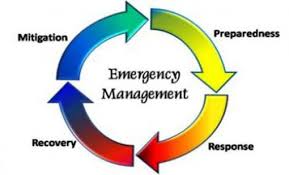
Within the standard, the early section titled ‘The Origin and Development of NFPA 1600’ summarizes the evolution of the standard, and provides some information on the changes to the 2016 update.  They mention that “The purpose of the standard has been changed to reflect the Committee’s decision to emphasize that the standard provides fundamental criteria for preparedness and that the program addresses prevention, mitigation, response, continuity, and recovery.  In other words, “preparedness” is no longer just an element of the program – it is the program.” That perspective on preparedness is a great continued evolution of the concept within emergency management.  While the standard in emergency management used to be the emergency management cycle with preparedness as one phase, that is thankfully beginning to go away (although it’s still seen out there way too much for my taste).

old em cycle

The Old Emergency Management Cycle – DON’T USE THIS ANYMORE!

The truth is preparedness permeates everything we do – all phases (or mission areas) of emergency management.  That’s why there are five mission areas identified in the National Preparedness Goal (Protection, Prevention, Response, Mitigation, and Recovery).  Where is preparedness?  It’s the root of the document (literally… it’s in the name of the document).  Preparedness is addressed for each mission area.  We must prepare to protect, prepare to prevent, prepare to respond, prepare to mitigate, and prepare to recover.

As usual, I digress…

Back to NFPA 1600.  This 2016 update includes language within “crisis management planning to include issues that threaten the reputation of and the strategic and intangible elements of the entity as a result of an event or series of events…”.  Smart move.  These elements of crisis management are something we see in both the public and private sector and certainly should be addressed.

Since business continuity does remain a focus element of the standard, they have continued to enhance those aspects.  As such, they have included information on supply chain risk and information security within the document.  When considering business continuity, we can’t just look at our own operations.  The vulnerabilities of other organizations can certainly impact us, so examining supply chain vulnerabilities is wise.  As for information security, we have seen plenty of internal and external cybersecurity issues to justify that.  Although a bit late, I’m glad the NFPA is keeping up with technology and current trends and hazards.  They have also rewritten much of the business impact analysis section (within Chapter 5) to address continuity planning and recovery planning, with a specific differentiation between the two.

Lastly, they have added Annex C, a small business preparedness guide (good move NFPA!), and have added material on addressing the needs of persons with access and functional needs, as well as adding some information on the role of social media in crisis communications plans.

These are all positive changes for the NFPA 1600 standard.  I encourage everyone who is part of an emergency management program to take a look at it and see what it has to offer.  It’s good guidance and will probably provide some good ideas for helping you grow and maintain an impactful program.

For those interested, I have a couple of past articles on standards in emergency management:

Standards in Emergency Management Programs

Business Continuity and Emergency Management Standards and Requirements


© 2016 – Timothy Riecker

Emergency Preparedness Solutions, LLCWe are your Partner in Preparedness!

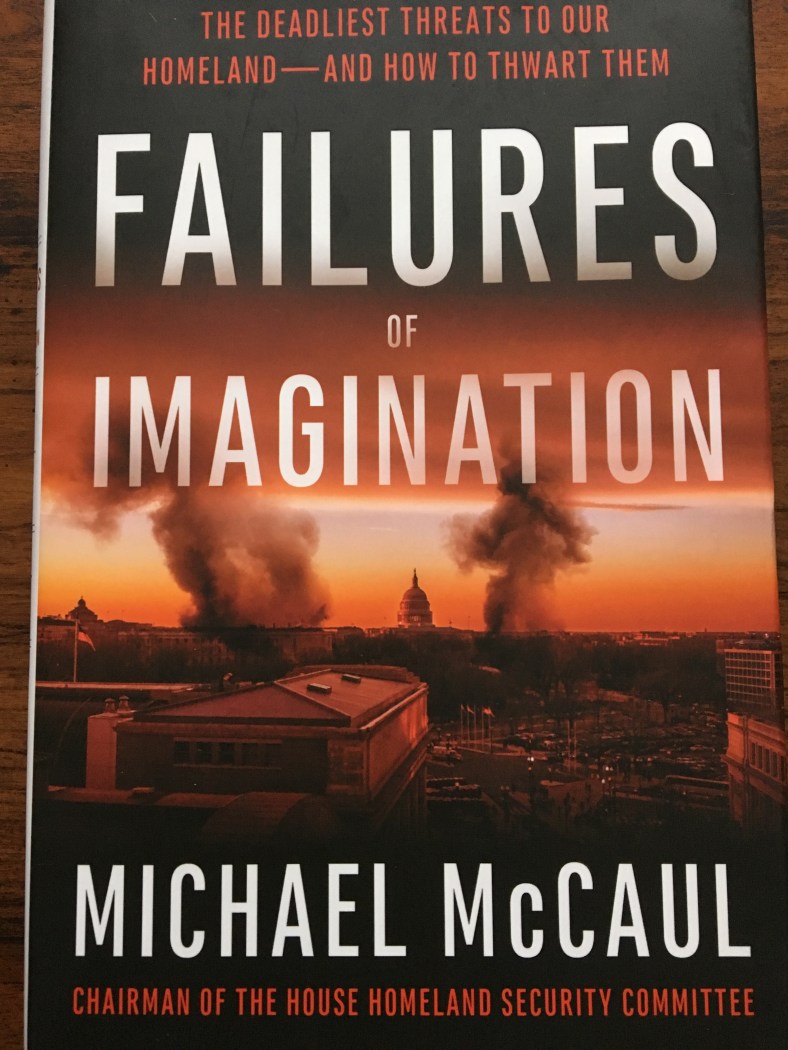
Book Review – Failures of Imagination by Michael McCaul

Failures of Imagination: The Deadliest Threats to our Homeland – and how to Thwart Them by Michael McCaul.  A few months ago I put up a short post when I heard about this book coming out.  I speculated a bit on what I anticipated and fortunately those were good assumptions.

Michael McCaul is chairman of the House Homeland Security Committee.  Congressman McCaul (R-TX) has served with the US Department of Justice and was chief of Counterterrorism and National Security for the US Attorney’s Office in Texas.  Along with chairing the House Homeland Security Committee, he is also a member of the Committee on Foreign Affairs.  The background all contributes to some interesting insights and perspectives on the threats our nation faces.  Several of those threats have been presented to us in this book. FoI

Failures of Imagination presents several scenarios including an attack on our seat of government, a radiological dispersion device (RDD), foreign influence on an election, a mass shooting in a public space, a cyberattack on finance and infrastructure, a bioterrorism attack, an airplane bombing, and an invasion by foreign powers.  Each scenario is introduced with what I will term a short story, followed by a fictionalized executive situation report, and concluded with a factual review of how the scenario is plausible.

The short stories that introduce each scenario are fairly compelling.  They read like any popular thriller novel, establishing two or three converging story lines with a brief bit of character development which quickly establish motive, plot, and execution.  The timelines are set anywhere from two to 10+ years from now.

With the those scenarios set further in the future, I feel the author has taken some liberties assuming that little has changed in comparison to the current global politics and state of affairs, but that doesn’t bother me too much.  I expect that some readers might feel these fictionalized stories sensationalize the scenarios a bit.  While on the surface that is understandable, consider that the plots as they unfold in these stories may not be far from reality, and that the Congressman has discovered that a mix of fiction and non-fiction can help enhance the readers’ experience and sell more books.  Also consider that we often do the same thing when doing scenario-based planning, training, and exercises.

As a follow-on to each scenario’s short story, a mock executive-level situation report is provided which gives an overview of the impacts of each scenario as presented in the short story.   The basis of this is something we also do in many of our preparedness efforts as we try to gauge a realistic scope of impact.  The Congressman outlines in many of these not only the casualties, but broader impacts such as those to the economy, and takes some realistic stabs at longer term recovery matters.  These situation reports give a good perspective to the reader about the potential impacts of each scenario beyond the more narrow scope of the short story.

Lastly, McCaul provides some narrative on how each scenario presented is rooted in reality.  These summaries provide information on the current situation as it relates to each scenario, typically regarding the modus operandi of certain terrorist groups or state sponsors of terrorism, relationships these groups may have with each other across the globe, and weaknesses in our own security construct which may permit these groups to gain access to the US and do us harm.  While much of the information and recommendations provided by Mc Caul in these sections are factual, practical, and eye-opening, I have to admit that I was significantly turned off by several instances of what I can only call antagonistic political finger pointing.  While I don’t disagree with what the Congressman was saying about certain policies and actions of other elected officials which have influenced our ability to prevent, protect, and prepare for these types of attacks, the messages often came across as snarky and partisan – something I have little patience for, especially in this election cycle.

Failures of Imagination certainly delivered.  While the focus of this book is on threats to the US, I would suggest that the foundational issues identified can apply to most nations and are a good read for anyone in emergency management and homeland security.  The short stories included in each scenario feed our desire to be entertained and contribute to the book being a quick read.  While the scenarios overall don’t serve as much of a resource for emergency management planning, as many of these types of scenarios are already in use in our efforts, the book does provide some context for each scenario which could be referenced, especially in regard to impacts.  Of most importance are the recommendations which Congressman McCaul provides for each scenario.  Many of the recommendations indicate higher-level actions we as a government need to take to prevent, protect, and prepare for attacks of these types.  Increased awareness of these actions will hopefully lead to development, funding, and implementation.

© 2016 – Timothy Riecker

ICS: Who doesn’t need it?

In a recent discussion thread, someone shared some material for a new program that promotes resiliency for disaster housing.  While the intent of the program is good, there was one thing that struck me – it stated that it was based on the incident command system (ICS).  My question – why?

ICS is a great system.  It’s proven to be effective WHEN APPLIED PROPERLY.  That’s the catch, though, isn’t it?  A great many after action reports (AARs) identify areas for improvement relative to various facets of ICS after incidents, events, and exercises.  The organizations that the AARs are usually focused on are professional response organizations – fire, police, EMS, public works, public health, emergency management, etc.  These are organizations that generally get LOTS OF PRACTICE in applying ICS.  So what’s the problem?

The problem is that most organizations that do use ICS don’t get enough practice in applying ICS beyond smaller incidents.  So if responders, who are using ICS, have difficulty with expanded application despite some practice and more advanced training, how are organizations who don’t use it all expected to be able to remember it much less apply it properly on even the most basic of incidents?  (More on my issues with ICS training here, in case you’ve missed posts over the last year or so.)

So back to the main topic of this post – who doesn’t need ICS training?  I would suggest that those persons and organizations that don’t fit the broad definition of responders DON’T NEED IT.  While this may be blasphemous to some, consider the time and effort wasted on getting people trained to understand ICS who will NEVER USE IT.  “But what if they do need it?” you ask?

I’m challenged to really find that need.  Why does the management of an apartment complex need to know or understand ICS?  I find the thought of that foolish and wasteful.  Sure, they can be a partner in disaster preparedness, response, and recovery.  Does that make them a responder?  No. Will they become part of the ICS organization?  NO!  Is there any reason why they would need to use ICS to manage their own organization?  NO!!! They manage their organization every day through what should be a very effective model for them.  Why the hell do we want to change that?  We need to stop pushing our complex shit on other people who don’t need it.

I’m of two thoughts on this… One, there are people who are so gung-ho over including everyone under the sun into emergency management that they feel compelled to bring them into the profession.  News flash people – if they wanted to be emergency managers, they would.  There is no practical reason for them to be trained in the vast complexities of emergency management.  Two, there are people who don’t really understand the applications of emergency management themselves, and therefore try to make adaptations of the system for every variety of stakeholder out there.  This is something I’ve struggled with very often as people try to adapt ICS to their organization and, in doing so, change the foundational principles of ICS (span of control, terminology, organizational structure, etc.).  Further, every organization thinks they have an INCIDENT COMMANDER.  STOP!!!

ICS is not for everyone.  I’m not being elitist or exclusionary, I’m being practical.  That’s not to say that certain stakeholders shouldn’t at least be familiar with what it is, but still not every stakeholder or partner, and they certainly don’t need to know how to actually apply it.  For many, simply having a point of contact with certain departments or through the 911 center is enough.  Certainly if some have an interest in it they can ask, or take a class either in person or online.  (I would never withhold a training opportunity from anyone.)  This should certainly give them enough to satisfy their curiosity.

Along with my crusade to make better ICS training for responders (even non-traditional ones), I would suggest that we need to do a better job of advising other organizations about how they interact with the system.  Simply throwing ICS training at them DOESN’T WORK.  It creates false expectations and generates more confusion.

So please, fire away with your thoughts.  Who do you think shouldn’t have ICS training?  What would you change about the current ICS training model/requirements? 

Shameless plug time: Need ICS training or training in other areas of emergency management?  How about meaningful and practical emergency plans you can actually implement?  Exercises to test those plans and give staff an opportunity to practice implementing plans?  Emergency Preparedness Solutions can help!  Link to info below!

© 2016 – Timothy Riecker

Emergency Preparedness Solutions, LLC

Emergency Management: Coordinating a System of Systems

Emergency management, by nature, is at the nexus of a number of other practices and professions, focusing them on solving the problems of emergencies and disasters.  It’s like a Venn diagram, with many entities, including emergency management, having some overlapping interests and responsibilities, but each of them having an overlap in the center of the diagram, the place where coordination of emergency management resides. That’s what makes the profession of emergency management fairly complex – we are not only addressing needs inherent in our own profession, we are often times doing it through the application of the capabilities of others.  It’s like being the conductor of an orchestra or a show runner for a television show. It doesn’t necessarily put emergency management ‘in charge’, but they do become the coordination point for the capabilities needed.

Presentation1


This high degree of coordination depends on the functioning and often integration of a variety of systems.  What is a ‘system’?  Merriam-Webster offers that a system is a “regularly interacting or interdependent group of items forming a unified whole.”  Each agency and organization that participates in emergency management has its own systems.  I’d suggest that these broadly include policies, plans, procedures, and the people and technologies that facilitate them – and not just in response, but across all phases or mission areas.  Like the Venn diagram, many of these systems interact to (hopefully) facilitate emergency management.

There are systems we have in many nations that are used to facilitate components of emergency management, such as the National Incident Management System (NIMS), the Incident Command System (ICS) (or other incident management systems), and Multi-Agency Coordination Systems (MACS).  These systems have broad reach, working to provide some standardization and common ground through which we can manage incidents by coordinating multiple organizations and each of their systems.  As you can find indicated in the NIMS doctrine, though, NIMS (and the other systems mentioned) is not a plan.  While NIMS provides us with an operational model and some guidance, we need plans.

Emergency Operations Plans (EOPs) help us accomplish a coordination of systems for response, particularly when written to encompass all agencies and organizations, all hazards, and all capabilities.  Likewise, Hazard Mitigation Plans do the same for mitigation activities and priorities.  Many jurisdictions have smartly written disaster recovery plans to address matters post-response.  We also have training and exercise plans which help address some preparedness measures (although generally not well enough).  While each of these plans helps to coordinate a number of systems, themselves becoming systems of systems, we are still left with several plans which also need to be coordinated as we know from experience that the lines between these activities are, at best, grey and fuzzy (and not in the cuddly kitten kind of way).

The best approach to coordinating each of these plans is to create a higher level plan.  This would be a comprehensive emergency management plan (CEMP).  Those of you from New York State (and other areas) are familiar with this concept as it is required by law.  However, I’ve come to realize that how the law is often implemented simply doesn’t work. Most CEMPs I’ve seen try to create an operational plan (i.e. an EOP) within the CEMP, and do very little to actually address or coordinate other planning areas, such as the hazard mitigation plan, recovery plans, or preparedness plans.

To be successful, we MUST have each of those component plans in place to address the needs they set out to do so.  Otherwise, we simply don’t have plans that are implementation-ready at an operational level.  Still, there is a synchronicity that must be accomplished between these plans (for those of you who have experienced the awkward transition between response and recovery, you know why).  The CEMP should serve as an umbrella plan, identifying and coordinating the goals, capabilities, and resources of each of the component plans.  While a CEMP is generally not operational, it does help identify, mostly from a policy perspective, what planning components must come into play and when and how they interrelate to each other.  A CEMP should be the plan that all others are built from.

Presentation2

I’m curious about how many follow this model and the success (or difficulty) you have found with it.

As always, if you are looking for an experienced consulting firm to assist in preparing plans or any other preparedness activities, Emergency Preparedness Solutions is here to help!

© 2016 – Timothy Riecker

Emergency Preparedness Solutions, LLC

H.R. 4397 – The Rail Safety Act

A few days ago I came across a notice of the introduction of HR 4397, aka the Rail Safety Act.  Text of the bill can be found here: https://www.govtrack.us/congress/bills/114/hr4397/text.  This bill was introduced by Rep. Ron Kind (D-WI) and had been assigned to House Committee on Transportation and Infrastructure on January 28th.  The essence of the bill… “To direct the Administrator of the Federal Emergency Management Agency to provide for caches of emergency response equipment to be used in the event of an accident involving rail tank cars transporting hazardous material, crude oil, or flammable liquids.”

If you follow the link provided above, you will get the full text of the bill, which honestly doesn’t tell much more.  I’m rather ambivalent about things like this.  We have a history of pre-positioning equipment and supplies for a variety of disasters.  Organizations such as the American Red Cross function this way, as do various agencies of the US federal government.  In 1999 the National Pharmaceutical Stockpile (NPS) was expanded to preposition medical supplies around the nation as a preparedness effort for a biological or chemical attack.  This program expanded in 2003 and became the Strategic National Stockpile (SNS).  In 2006, FEMA/DHS developed a program to pre-position disaster supplies (mostly mass care types of supplies) in certain disaster prone areas around the nation.  While we also have a variety of specialized teams, that’s a slightly different matter.

One key struggle of prepositioning supplies and equipment largely boils down to who will be responsible for them.  Supplies and equipment need to be secured and maintained.  This requires some regularity of check in to ensure they are ready to be deployed at a moment’s notice.  Each location needs a deployment plan, identifying how these assets will be deployed.  As part of this planning, there must be a trigger mechanism for requesting these supplies.  The supplies must deploy and reach their destination in such a time frame to be effective.  Of course upon arrival of the cache, responders must be familiar with what is there, take time to unpack it and inspect it, and be readily able to use it (therefore they must be pre-trained in the use of the equipment).  So who will be responsible for these caches?  State governments?  Local governments?  Rail carriers?  First responders?

Hazardous materials response is one of the most highly regulated aspects of public safety.  It is governed in the US by the Occupational Health and Safety Administration (OSHA) regulation 1910.120.  There is a strong emphasis on preparedness and protocol.  Only individuals trained to certain levels can conduct certain actions in a hazardous materials response.  Most responders, due to the fairly low ranking hazard of a major hazardous material release in their jurisdiction, do not have the degree of training needed to utilize some of what I expect would be in a cache of supplies as ordered by the Rail Safety Act.  That said, every jurisdiction in the US has access to a hazardous materials team – either from a nearby jurisdiction or from the state.  These teams have the specialized training and equipment needed to address a hazmat incident.  Now that we’ve gotten to that, what, exactly, is the need that the Rail Safety Act is addressing?

Sure, these caches of supplies may provide more of whatever is needed, but there are a few issues here.  First of all, it will take people to examine what is being delivered, to unpack it, and to ready it for deployment.  Often, the biggest issue on a response such as this is a lack of trained personnel.  Second, will the materials being provided by the cache be interoperable with what the hazmat team is using?  While we have gotten better at standardizing equipment, there are still many issues out there.  Tab A requires Slot A.  Slot B simply won’t work.

I suppose what I’m really interested in here is a definition of need.  Has there been any type of needs assessment or feasibility study conducted for this?  I’m doubtful.  Most bills are generally introduced at a whim by well-intentioned but ill-informed politicians.  The last thing we need is another requirement to work within that does us little good – even if it is to be funded by the rail carriers.

I’m curious if anyone out there happens to know about this bill or any need supporting it.

© 2016 – Timothy Riecker

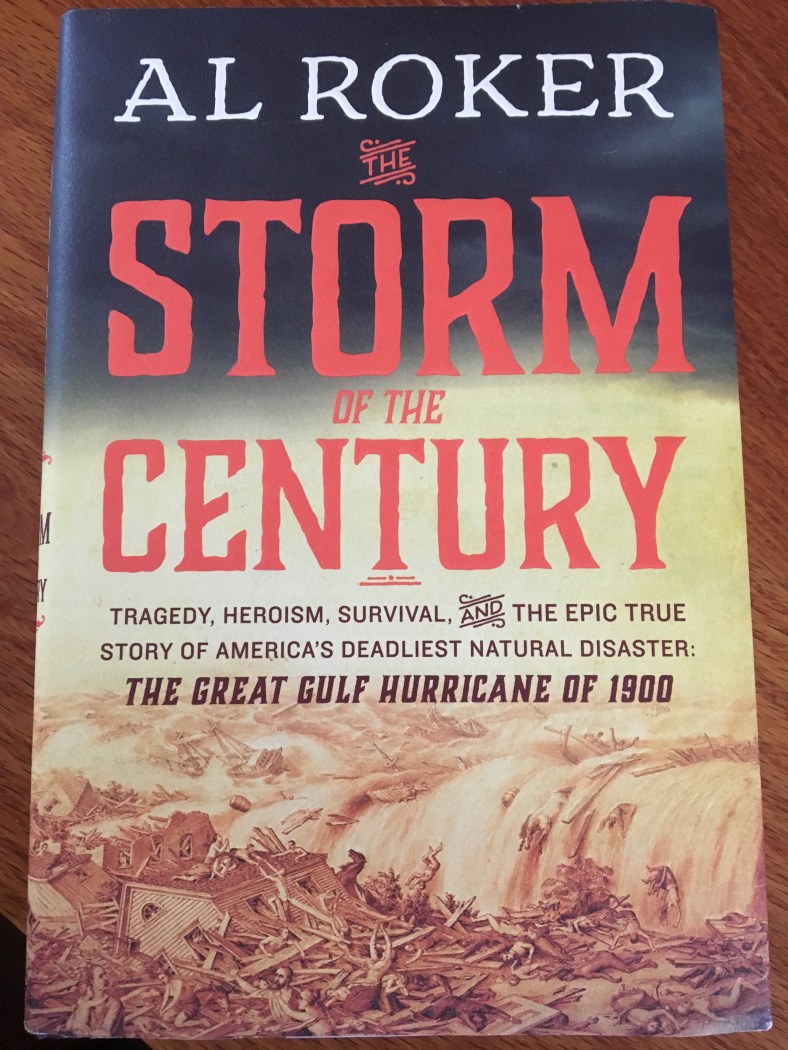
Book Review – The Storm of the Century by Al Roker

Yep, THE Al Roker.  The weather guy.  Fellow SUNY Oswego alum.  Smart, funny, the kind of guy you want to have over for poker night.

Roker has actually written a few books, covering cooking, murder mysteries, family, and weight loss.  The Storm of the Century was released late last year and offers a compelling historical review of the Gulf Hurricane of 1900 that destroyed Galveston, Texas.

IMG_1473

Admittedly, the book was not what I expected.  I anticipated a book that had more structure and was a bit more proper and history-bookish.  While I was pleasantly surprised by the book’s more narrative approach, switching gears mentally took me a while, which is I think why I had a hard time with the first few chapters.  That’s on me, though, and not a reflection on the book itself.

The book is set up almost like a work of fiction, setting the stage of the time and place of our environment and introducing and developing the main characters.  Don’t be fooled, though – this is no work of fiction.  The events described in the book are real, as were the stories of the people.  Roker emphasizes this at the end of book, as he details both formally through a bibliography and informally through narrative, the sources of his information, which include newspapers, scholarly works, historical accounts, and documented eye witness reports.

The book follows the lives of several individuals and families, with the primary focus on Isaac and Joseph Cline, who worked for what became the National Weather Service.  Roker mixes in a number of other personalities from Galveston and other areas.  Notables, such as Clara Barton, Joseph Pulitzer, and William Randolph Hearst also figure into the events of this devastating hurricane.  Roker provides insight on the state of politics and society in the post-Civil War United States, external political relations, and certain beliefs of those in meteorological science at the time, including the Jesuit priests of Cuba.

Roker details the interesting history of the National Weather Service, with its roots in the US Army Signal Corps, as well as some of the science and instrumentation of meteorology.  It’s interesting to see how much we have advanced in the science, yet how much still reflects back on what was done almost 120 years ago.

In the end, the events surrounding The Storm of the Century create a story of human error, tragedy, and perseverance.  In the practices of emergency management we must always keep in mind the human element.  Ultimately, that’s why emergency management exists.  While our focus might be on critical infrastructure, NIMS, or the current organization of FEMA, the reason why must ALWAYS reflect on people and our need to protect them from the impacts of disasters.  The Storm of the Century does just this, putting society front and center.

The Storm of the Century is overall a good read and accessible to many audiences including disaster and meteorology buffs, social scientists, and even those interested in US history.  The book is a great read for colleges and high schools alike, offering insights on society, politics, and science.  And hey, mine is even autographed.  Thanks Al!

IMG_1474

© 2016 – Timothy Riecker

Continuity of Government – Preservation of Records and Data

A common but often low priority issue in emergency management is the loss of physical records and electronic data from a disaster.  To be honest, I ignored the issue for much of my career.  It wasn’t until working on a contract in the northeast and meeting with a lot of local governments did my eyes really open to the importance of the issue.  While this article focuses on preservation of records for governments, it can certainly apply to businesses, not for profits, and even individuals.

Many of the local governments we interfaced with on a completely unrelated contract, were talking about their experiences with Tropical Storm Irene.  Town officials told of their efforts hauling boxes of town records either to a higher floor of town offices or removing them offsite, with water to their knees or even waist high.  Needless to say, many records were lost.

While some of these offices were in known floodplains, others simply suffered from an extraordinary event and the fault of a place where we commonly store things – the basement.  Towns (and other municipal offices) often store physical copies of tax maps and records, property deeds, permits, flood insurance information (ironic, isn’t it?), human resources data for town employees, town financial records, court records, birth certificates, death certificates, marriage certificates, divorce certificates, and other information.  The loss of this information can have an impact, not only historically, but also on current government operations.

Continuity of government and continuity of operations plans should identify those records which are most important.  These are called vital records.  Vital records should have the highest degree of protection.  The National Archives offers some guidance on the protection of vital records.  While the guidance applies to federal agencies, there is still plenty of valuable information which can be applied to other organizations.

Every municipality should examine records storage as part of their continuity of operations and continuity of government planning.  It’s not to say that records can’t be stored in the basement of a building, but mitigation efforts must be made to flood proof the building as much as possible, including water alarms and sump pumps connected to emergency power systems.  Paper and water don’t mix – so get your records off the floor and consider waterproof storage solutions.  Ventilation is also important to prevent molding.

If mitigation is too costly, then you need to consider relocating the records.  Regardless of where your records are, you should have a component of your continuity of operations plan that addresses emergency relocation of records – when, how, to where, and who.  Digital storage is obviously a great solution.  Some towns I spoke with had decided after the storm to scan their records.  Catching up to a hundred plus years of records can be pretty time consuming and practically unsurmountable for most municipal offices.  This is a service that can be hired out.  Be sure to follow sound data protection standards for both storage and access to ensure the continuity of these records.

In the event that records do get wet, all is not necessarily lost.  The Preservation Directorate of the US Library of Congress has a lot of information on preservation of records, including a variety of resources and training opportunities.  There are also companies that specialize in document preservation and recovery after a disaster.  While it’s probably a good idea to identify who you might reach out to in the event of such a loss, know that this is expensive and it’s generally far more cost effective to mitigate against the risk.

Need assistance with government continuity or continuity of operations planning?  EPS can help!  consultants@epsllc.biz.

© 2016 – Timothy Riecker

Emergency Preparedness Solutions, LLC

Emergency Management – Who Knows About Your Plans?

In emergency management and homeland security we put a lot of emphasis on planning.  Plans are important, afterall.  We need to take the time to identify what our likely hazards are and how we will address them.  But what happens when the plan is complete?  We congratulate members of the planning team and send them final copies.  Those copies get filed electronically or end up on a shelf, a trophy of our accomplishment and hard work.  Congratulations!

So… that’s it?  Is that all?

NO!  Of course not!  People need to be trained to the plan.  “Trained?” you ask.  Yes – trained.  Not just sent a copy and told to review it.  Let’s be honest, here.  Even assuming the highest degree of dedication and professionalism, many people simply won’t give it the time and attention it needs.  Very quickly the plan will get buried on their desks or the email will become one of dozens or hundreds in the inbox.  Even if they do give it a look through, most will only give a quick pass through the pages between meetings (or during a meeting!), not giving much attention to the details in the plan.

How effective do you expect people to be?

Sports analogy – when a coach creates new plays, do they simply give them to the players to become familiar with and expect proficiency?  No.  Of course not.  We’re all familiar with the classic, if not cliché, setting of the coach reviewing plays on a chalk board with the players in a locker room.  That’s training.  Then after that training, they go out in the field and practice the plays.

Back to our reality… The first real step of making people familiar with the plan is to review it with them.  This usually doesn’t need to be a sleep inducing line-for-line review of the plan (unless it is a detailed procedure), but a review of the concepts and key roles and responsibilities.  In fact, that’s who you invite to the training – those who are identified in the plan.  This is likely to include people in your own agency as well as people in other agencies (emergency management, after all, is a collaborative effort).  In states with strong county governments, we often see county-level emergency management offices creating plans that dictate or describe the activities of local governments and departments.  Most often, the local departments have no awareness of these plans, much less receive any training on them.  I’m guessing that plan won’t work.

Once you’ve trained these key stakeholders, be sure to conduct exercises on various aspects of the plan.  Exercises serve not only to validate plans, but to also help further familiarize stakeholders with the plan, their roles, and expectations of others.  When we plan, we tend to make many assumptions which exercises help to work through.  Through exercising we also identify other needs we may have.

Need help with planning? Training? Exercises?  EPS can do it!  Link below.

© 2016 – Timothy Riecker

Emergency Preparedness Solutions, LLC