Taking Philanthropy (and more) Beyond the Days of Disaster

Timothy RieckerThe latest edition of Homeland Security Today has an article titled ‘Taking Philanthropy Beyond the Days of Disaster’ , which talks about the need that non-profit organizations who provide disaster services have before and well after a disaster.  Their programs help bring preparedness and other critical services into neighborhoods and to fragile and disadvantaged populations.  The article tells the story of someone who saw this need and formed the Center for Disaster Philanthropy, a foundation centered on helping organizations fund disaster-oriented projects throughout the year.  You also have the choice of giving directly to organizations in your community.  Organizations like the Red Cross, The Salvation Army, and others – that are in every community – provide services year-round and could greatly benefit from your continued help.  Being a philanthropist doesn’t require you to be a millionaire – even contributing ten or twenty dollars during a fund-raiser or dropping a few dollars or some spare change into a kettle makes a huge difference.

Beyond philanthropy, you should also consider volunteering in your community.  Every organization needs more people – and not just during disasters – to meet the needs of those they help – and ANYONE can volunteer, it’s just a matter of finding the right organization and the right role for you.  Jobs can be as diverse as office assistance to disaster response.  Some positions require training, which the organization will provide.  Every organization will help find the position that is right for you.  Organizations are even happy to have entire families volunteer!  Martin Luther King, Jr. Day – January 21st – has also been designated as National Volunteer Day.  Through their website you can find volunteer opportunities (also check volunteermatch.org) as well as volunteer fairs that will be held around the nation on January 21st.  If you have interest in a particular organization, just give them a call and let them know you would like to volunteer.

Whether of yourself or of your wallet, please consider giving – it makes a world of difference.

New Risk Report from the UK

This is a very interesting, insightful, and comprehensive report. Quite an eye-opener on global issues in emergency management.

recoverydiva's avatarRecovery Diva

A new, very worthwhile, report  on Risk Assessment from the Government Office of Science (UK) Jan. 5th: Reducing Risks of Future Disasters: Priorities for Decision Makers. From the foreword:

“Science tells us why disasters happen and where many of the risks lie, and for some disasters we can even forecast when they will occur. The aim of this Report has therefore been to review the latest science and evidence, and to take stock of the further improvements that lie ahead. In so doing, it sets out priorities and options for how DRR [disaster risk reduction] can be substantially improved today and into the future.

The key message is that disaster and death are not the inevitable consequence of greater exposure to hazards. It is possible to stabilise disaster impacts, save lives and protect livelihoods. However, achieving this will require a change in culture and a new approach. Everyone with a…

View original post 100 more words

Today is the Day Before

I subscribe to disaster recovery e-mails from a company called Agility Recovery, whose primary focus is IT disaster recovery but they recognize the value of a comprehensive approach.  They have great marketing and outreach, including regular webinars on various emergency management topics.

This week’s ‘Disaster Recovery Tip’ from Agility made me aware of a new campaign by FEMA (and I must say, FEMA’s campaigns have gotten MUCH better over the last few years – Kudos to FEMA!!!).  This one is entitled ‘The Day Before’, and reminds us that we never know what will happen tomorrow, so we should always be prepared.  Link to the video below.

FEMA: The Day Before

NYPD Active Shooter Recommendations and Analysis – December 2012

Timothy Riecker

NYPD Logo

This document, updated by NYPD last month in the wake of the Sandy Hook shooting, was brought to my attention through LLIS.  It’s also posted on the NYPD’s website here.  This document is a good compilation of practitioner research; official recommendations suitable for schools, businesses, and public buildings; and reflects on the ‘Run, Hide, Fight’ recommendations we’ve seen (NYPD’s version is a little more of a mouth-full – Evacuate, Hide, Take Action).  I like that they provide some information relative to attackers including gender, age, number of attackers (98% of active shooter incidents are carried out by a single attacker), planning tactics, targets, number of casualties, location of attack, weapons used, attack resolution, and other statistics – with this data provided for over 300 case studies (all included in the document).

The real value of this document is that the information which is provided to the reader allows for better informed (instead of emotional or ‘trendy’) decisions on facility security and planning relative to active shooter scenarios.

Thanks to the fine folks at NYPD for doing this work and sharing it with the public safety community.

Active Shooter Video – Run, Hide, Fight

Timothy RieckerAlabama Homeland Security, at the request of the Governor, modified the City of Houston’s Run, Hide, Fight video in the aftermath of the Sandy Hook school shooting.  Despite a few comments I’ve seen around the internet about the video being ‘sensationalized’, I think it’s a very well done video hitting emotions as best as possible through an instructional video.

It appears that the concept of ‘Run, Hide, Fight’ is the best approach we have against these types of horrific incidents.  It makes sense.

See the video here.


– Tim Riecker

Managing an Exercise Program – Part 4: Conduct an Annual Training & Exercise Planning Workshop

This post is part of a 10-part series on Managing an Exercise Program. In this series I provide some of my own lessons learned in the program and project management aspects of managing, designing, conducting, and evaluating Homeland Security Exercise and Evaluation Program (HSEEP) exercises. Your feedback is appreciated!

Managing an Exercise Program – Part 1

Managing an Exercise Program – Part 2: Develop a Preparedness Strategy

Managing an Exercise Program – Part 3: Identify Program Resources and Funding

Managing an Exercise Program – Part 4: Conduct an Annual Training & Exercise Planning Workshop.

Managing an Exercise Program – Part 5: Securing Project Funding

Managing an Exercise Program – Part 6: Conducting Exercise Planning Conferences

Managing an Exercise Program – Part 7: Develop Exercise Documentation

Managing an Exercise Program – Part 8: Preparing Support, Personnel, & Logistical Requirements

Managing an Exercise Program – Part 9: Conducting an Exercise

Managing an Exercise Program – Part 10: Evaluation and Improvement Planning
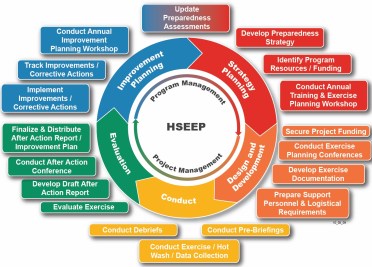
Timothy Riecker

HSEEP Cycle

As HSEEP Volume 1 states, “The basis of effective exercise program management is a Multi-Year Training and Exercise Plan.”  The MYTEP is the product of a Training and Exercise Planning Workshop (TEPW), a collaborative which should be conducted annually to update the plan (and the collaborating partners!) with any changes in preparedness priorities, funding, or other influential factors.  I really can’t underscore the importance of the TEPW and MYTEP enough – they truly are the backbone of an effective exercise program.

First the TEPW needs to be scheduled and attendees invited.  This workshop should include not only your core planning team (discussed a bit in part 3), but should also expand to others within the sphere if influence and coordination.  States should invite relevant state agencies, a representation of counties (as it would be unwieldy to invite all of them), key cities and/or Urban Area Security Initiative groups, key Federal partners (like FEMA, EPA, DOE, USCG), as well as major not for profits or VOADS, and critical infrastructure private sector folks or authorities like utility or rail companies or regional transit authorities.  Counties should invite key county and state agencies, a representation of local governments, representatives of key groups like the county fire chief’s association, not for profits or VOADs, and those critical infrastructure folks within the county – including school districts and colleges.  Cities, towns, and villages should all follow suite similarly.  Not for profits and private sector folks need to ensure that they are invited to the table of the meetings of others (are you part of a local emergency planning committee – LEPC???) – and for conducting their own TEPWs (not required, but a good idea) need to consider where their primary operations take place and who they have significant relationships with relative to preparedness.  In the end it can be quite a crowd.  You want to be certain that the invites go to the right people (i.e. the exercise program managers, if they have them, or the emergency managers for these entities).  Stress that this is a workshop – where work gets done – so they can’t just send someone to ‘hold a seat’.  It needs to be someone who can represent the organization and its interests in the area of preparedness.  The invite should also state what key information they should be prepared with and prepared to discuss, like major preparedness training and exercise initiatives.

The HSEEP website provides some detailed guidance on TEPWs, a sample agenda, and even a draft invite letter and presentation on its resources website.  You’ll notice that the agenda is a VERY full day.  Don’t try to cut any corners – and I would even encourage a working lunch.  It’s frustrating to hold people longer than planned and even more frustrating to spend a full day in a workshop and not accomplish what you set out to do.  During the workshop, participants should review priority preparedness capabilities and coordinate exercise and training activities that can improve and validate those capabilities. As a result of the workshop, the Multi-Year Training and Exercise Plan outlines a multi-year schedule and milestones for execution of specific training and exercise activities.  Just as importantly, the TEPW helps to deconflict any exercise issues that may exist between these partners, like avoiding scheduling major exercises too closely to each other.  As part of this process, be sure to discuss major areas for improvement discovered from After Action Reports of earlier exercises – the implemented improvements should be tested.

During the TEPW, you will start to populate an exercise calendar.  Some partners will have dates set, others may only be able to narrow it down to a month or calendar quarter.  Around these exercise activities and their known major objectives, training programs can be identified and roughly scheduled as well.  This is the beginning of your MYTEP.

Conducting a TEPW and formulating a MYTEP is not only the first step toward HSEEP compliance, it is also the foundation of your program.  Through the TEPW, your organization and its partners will identify training and exercise requirements, goals, and benchmarks; ideally forecasted out three to five years.  You start with regulatory and other legal requirements, include grant and funding deliverables, and initiatives driven by the organizational mission and emergency management functions.  If the organization has a goal of revising a certain emergency plan by the end of the calendar year, then it would be a good idea to include an exercise testing that plan.  Through the process of the TEPW, you will identify what level of exercise is appropriate: ranging from a seminar to a full-scale exercise; and opportunities to capitalize on different exercise initiatives, merging exercises and leveraging combined efforts and funding – especially between different agencies and organizations.  Finally, you should identify training opportunities to ensure that personnel have the tools they need to function properly.

A TEPW can be complex and fast-paced.  There can be a lot of attendees all needing to get their information out.  The preparedness of the facilitator and attendees is absolutely critical to the success of the TEPW and the quality of the MYTEP.  If you’ve never done one, reach out to someone who has to help you along – including me.

Happy New Year to all and be on the look out for Managing an Exercise Program – Part 5: Securing Project Funding.

DANGER: Templates in use

Timothy Riecker

Sorry… I thought this image was really funny!

Last night I spent some time reviewing the Comprehensive Emergency Management and Continuity of Operations Plan (which should not be combined into one document) for a small town.  Having reviewed more plans from within the State of New York than I can count, it was readily obvious that a state-provided template was (mis)used in the making of this plan.  The end result: a poorly written plan that can’t be operationalized.

First off, I must say that there is nothing wrong with the template that was used.  This template has been provided and is regularly updated by the Planning staff of the State’s Office of Emergency Management.  Good templates help to ensure consistent formats are applied and all baseline legal and necessary content is included.  There are many planning templates out there across the nation and globally for emergency plans.  Some are good, many are not so good.  The closest I tend to get to a template is using it as a reference.  I generally see the use of templates akin to a Jean-Claude van Damme movie: you think it’s a good idea at first, you soon discover that you don’t really like it but for some reason can’t leave it, and in the end you are left wondering what really happened.

One must keep in mind when using a planning template that one size does not fit all… actually one size doesn’t fit anyone.  While a template, as stated earlier, will provide you with a format and essential content, they don’t provide YOUR detailed information.  If you simply use the template the way most people (wrongly) do, you are essentially doing the Mad Libs version of emergency planning by plugging in titles and locations where it tells you to.  But where does this get you?  Is the plan ‘customized’ simply because you filled in the blanks with your information?  Of course not.  The plan needs to make sense.  The easiest way to determine if it makes sense or not is to read it.  A good plan should provide a strategic-level narrative of how your company, jurisdiction, or organization will respond to and manage the impacts of a disaster.  Who is in charge, and of what?  What does the organization look like?  What priorities must be addressed?

Templates really should be viewed as guidance documents – this will help prevent most user errors.  Plans address needs – so a good needs assessment (threats and hazards) up front will help identify the content of the plan.  Don’t forget to read the plan while you are writing it to make sure that it makes sense.  Consider how it will be used and by whom.  Do we write emergency plans just to fulfill a legal requirement or do we write them so we can use them???

Tale of An Emergency Manager in Afghanistan

I want to share this story of Mike Cook, the Emergency Manager for the City of Edmonton who spent a year in Afghanistan helping them to improve their fire service and disaster response.  He tells a wonderful, but also sad story of the state of things there.  My congratulations and appreciation to Mike, and those like him, who are committed to helping not only their own communities, but those a world away.

Managing an Exercise Program – Part 3: Identifying Program Resources and Funding

This post is part of a 10-part series on Managing an Exercise Program. In this series I provide some of my own lessons learned in the program and project management aspects of managing, designing, conducting, and evaluating Homeland Security Exercise and Evaluation Program (HSEEP) exercises. Your feedback is appreciated!

Managing an Exercise Program – Part 1

Managing an Exercise Program – Part 2: Develop a Preparedness Strategy

Managing an Exercise Program – Part 3: Identify Program Resources and Funding

Managing an Exercise Program – Part 4: Conduct an Annual Training & Exercise Planning Workshop.

Managing an Exercise Program – Part 5: Securing Project Funding

Managing an Exercise Program – Part 6: Conducting Exercise Planning Conferences

Managing an Exercise Program – Part 7: Develop Exercise Documentation

Managing an Exercise Program – Part 8: Preparing Support, Personnel, & Logistical Requirements

Managing an Exercise Program – Part 9: Conducting an Exercise

Managing an Exercise Program – Part 10: Evaluation and Improvement Planning


Exercises can be very resource intensive, have no doubt about that.  Generally speaking, the more you invest in them, though, the more you get out of them.  Certainly discussion-based exercises are usually not as expensive as operations-based exercises.  For all exercise types, however, the largest costs are in the design (staff or consultant time, as well as meeting time), and conduct (again, staff or consultant time, plus the time of the participants).  What resources do you need for your exercise program as a whole?  How do you get them?

First of all, let’s discuss human resources.  In Managing an Exercise Program – Part 1, I discussed the importance of having an exercise program manager and what some of the qualifications should be for that person.  A program manager is probably the most important human resource you could have for exercises, but certainly this person can’t do it alone.  A good exercise program is able to leverage the experience, support, and ideas of others – both within and outside.  The exercise program manager needs to be a great networker, able to draw people from various agencies into a mutually beneficial partnership.  Some of these agencies will come and go, but some will be strong, permanent partners.  Each partner agency, including your own, should be contributing to the efforts of the group – not only with ideas, but with people to serve as controllers, evaluators, planning team members, etc., physical resources suitable for whatever types of exercises you conduct, and perhaps even funding.

In March of 2008, I founded and co-chaired the New York State Exercise Coordination Committee, composed of several state agencies, departments, authorities, and the Red Cross.  Meeting regularly and communicating often, we were able to pool our resources not only for each individual exercise, but for exercise program management as a whole throughout New York State.  We formulated consistent policies and practices, allocated Homeland Security funds state-wide for exercises and corrective actions, and developed and delivered exercise-related workshops and training courses.  We became the core group for the Training & Exercise Planning Workshop (more on this in the next part) and applied for and coordinated funding requests to FEMA for the Regional Exercise Support Program (RESP), which provided contractor resources to state and local exercise initiatives.  We were not only able to help each other, but we were able to benefit the state as a whole.  This model can be applied to other states; county and local governments; and consortia of public, private, and not for profit groups.

Keep in mind that the HSEEP cycle is just that, a cycle.  You will constantly be revisiting each of these steps – sometimes out-of-order – including determining needs and sourcing of resources.

HSEEP Cycle

HSEEP Cycle

What resources do you think you will need to manage your program?

Be on the lookout for Managing an Exercise Program – Part 4: Conducting an Annual Training & Exercise Planning Workshop.

Kudos to Cleveland

As I was typing away at the State Preparedness Report for a client late into the night last night, I would check new blog posts while the FEMA web tool would save and load new pages (the PREPCAST portal was gruelingly slow as the deadline for every state is December 31st).  Every couple of hours, a new post would go up in the WordPress Emergency Preparedness category from the Cleveland, Ohio Public Safety Department as they updated readers on the weather, road conditions, snow removal, parking, and safety matters.  Essentially, they would provide a mini situation report for the public and include whatever information residents needed to know.

This is certainly a best practice and excellent utilization of a blog to provide up to date information.  Great job Cleveland!

How does your jurisdiction disseminate emergency information?