2017 Health Security Index

The 2017 National Health Security Preparedness Index has been released by the Robert Wood Johnson Foundation.  The Index provides measures of data nationally and for each state in the US across six public health domains, which include:

  1. Health security surveillance
  2. Community planning and engagement
  3. Information and incident management
  4. Healthcare delivery
  5. Countermeasure management
  6. Environmental and occupational health

The documents found on the website indicate a continued trend of improvement across the nation, but progress is slow, with some states lagging behind significantly according to the study, particularly in the deep south and mountain west regions.

The report identifies the following factors as having the greatest influence on the increase and intensity of US and global health threats:

  • Newly emerging and resurgent infectious diseases like Zika, MERS, and Ebola.
  • Growing antibiotic resistance among infectious agents.
  • Incomplete vaccination coverage.
  • Globalization in travel and trade patterns.
  • Political instability, violence and terrorism risks.
  • Aging infrastructure for transportation, housing, food, water, and energy systems.
  • Extreme weather events including storms, fires, floods, droughts, and temperature extremes.
  • Cyber-security vulnerabilities.

I think it’s important to note that while some of the factors listed above are distinctly within the public health realm, others are more universal in nature.  So not only are the findings of this study relevant to everyone, because public health is relevant to everyone, but many of the factors that influence the threats fall within areas of responsibility of broader emergency management and homeland security.

Public health matters are near the top of my list of greatest concern.  This report clearly shows that while we have made great strides in public health preparedness, we have a long way to go.  There is also no end game.  We don’t get to say we won after playing four quarters, three periods, or nine innings.  These are efforts in which we must persist, and not only with today’s tools and capabilities, but we must constantly look toward new tools.  However, as we do this, new threats will emerge.  It may seem intimidating, but it’s essential.

What are you doing to further public health preparedness capabilities?

© 2017 – Timothy Riecker, CEDP

Emergency Preparedness Solutions, LLC

Incident Evaluation

I’ve written at length about the importance of quality evaluation of exercises.  Essentially, if we don’t evaluate exercises, and do it well, the benefits of the exercises are quite limited.  Generally, we don’t see a benefit to incidents.  By their very nature, incidents threaten and impact life, property, and environment – things we don’t view as being beneficial.  However, benefits are often a product of opportunity; and we absolutely should take the opportunity to evaluate our responses.

Many incidents do get evaluated, but through research after the fact.  We retrace our steps, review incident documents (such as incident action plans), interview personnel, and examine dispatch logs.  These efforts usually paint a decent picture of intent and result (things that are often different), but often miss the delta – the difference between the two – as well as other nuances.  When we evaluate an exercise, we do so in real time.  Th evaluation effort is best done with preparation.  Our evaluation plans, methodologies, and personnel are identified in the design phase of the exercise.  Just as we develop emergency operations plans and train personnel to respond, we can develop incident evaluation plans and train personnel to evaluate incident responses.

Understandably, a hurdle we might have is the availability of personnel to dedicate solely to evaluation, especially on larger incidents – but don’t be afraid of asking for mutual aid just to support incident evaluation (just be sure to include them in your preparedness efforts).  Just as regional exercise teams should be developed to provide cooperative efforts in exercise design, conduct, and evaluation; incident evaluation teams should be developed regionally.  To me, it makes sense for many of these personnel to be the same, as they are already familiar with how to evaluate and write up evaluations.

In exercises, we often use Exercise Evaluation Guides (EEGs) to help focus our evaluation efforts.  These are developed based upon identified Core Capabilities and objectives, which are determined early in the exercise design process.  While we don’t know the specific objectives we might use in an incident, we can identify these in general, based upon past experiences and our preparedness efforts for future incidents.  Similarly, our emergency planning efforts should be based around certain Core Capabilities, which can help inform our incident evaluation preparedness efforts.  Job aids similar to EEGs, let’s call them incident evaluation guides (IAGs), can be drafted to prepare for incident evaluation, with adjustments made as necessary when an incident occurs.

Evaluating an incident, in practice, is rather similar to how we would evaluate an exercise, which is why the training for these activities is relatively portable.  Evaluation efforts should avoid evaluating individuals, instead focusing on the evaluation of functions and processes.  Don’t reinvent the wheel – evaluate based upon documented (hopefully!) plans and procedures and use the Homeland Security Exercise and Evaluation Program (HSEEP) standards to guide your process. Incident evaluation must be managed to ensure that evaluation gaps are minimized and that evaluation progresses as it should.  Observations should be recorded and, just as we would for an exercise, prepared for and eventually recorded in an after action report (AAR).

I favor honest after action reports.  I’ve seen plenty of after action reports pull punches, not wanting the document to reflect poorly on people.  Candidly, this is bullshit.  I’ve also heard many legal councils advise against the publication of an after action report at all. Similarly, this is bullshit.  If our actions and the need to sustain or improve certain actions or preparations is not properly recorded, necessary changes are much less likely to happen.  If an AAR isn’t developed, a corrective action plan certainly won’t be – which gives us no trackable means of managing our improvements and disavows our intent to do so.

As a profession, public safety must always strive to improve.  We have plenty of opportunity to assess our performance, not just through exercises, which are valuable, but also through the rigors of incident responses.  Prepare for incident evaluation and identify triggers in your emergency plans for when evaluation will be employed, how, and who is involved.  Begin evaluation as early as possible in an incident – there are plenty of lessons learned in the early, and often most critical moments of our incident response.  Finally, be sure to document lessons learned in an AAR, which will contribute to your overall continuous improvement strategy.

How does your agency accomplish incident evaluation?  If you don’t, why?

Need help with the evaluation of incidents?  We are happy to help!

© 2017 – Timothy Riecker, CEDP

Emergency Preparedness Solutions, LLC

ICS and the Human Factor

A number of my articles have mentioned the unpredictable human factor in executing emergency plans and managing incidents, particularly for complex incidents.  We can build great plans and have a great management system to facilitate the incident management process, but the human factor – that largely intangible level of unpredictability of human behavior – can steer even the best emergency plan astray or derail an incident management process.

An article published in the Domestic Preparedness Journal yesterday, written by Eric McNulty, reflects on this.  Mr. McNulty cites several human factors which have relevance within incident management and encourages leaders to understand these factors within themselves and others to bring about more effective leadership.  The introductory paragraph of his article suggests the need for integrating behavior training into ICS training to ‘improve performance and outcomes’.  Given the impact of behavior factors on how we respond, this is a concept I can certainly endorse for a much-needed rewrite of the ICS curriculum.

I’ve heavily referenced Chief Cynthia Renaud’s paper, The Missing Piece of NIMS: Teaching Incident Commanders How to Function in The Edge of Chaos, in the past and continue to hold her piece relevant, especially in this discussion.  Chief Renaud’s suggestions draw lines parallel to behavioral factors, which suggest to me that we certainly need to integrate leadership training into ICS training.  The current ICS 200 course attempts to do so, but the content simply panders to the topic and doesn’t address it seriously enough.  We need to go beyond the leadership basics and explore leadership training done around the world to see what is the most effective.

Incident management is life and death – not a pick-up game of stick ball.  Let’s start taking it more seriously and prepare people better for this responsibility.

© 2016 – Timothy Riecker, CEDP

Emergency Preparedness Solutions, LLCYour Partner in Preparedness

EM, HS, and Politics

As the mechanizations of election season warm up their engines, let’s be sure to identify the standing of candidates in regard to emergency management and homeland security policies.  While we will never get a fully accurate picture of their intentions in these programs this early on (I’m sure few candidates are even thinking about EM/HS policy aside from immigration), we can get some indication of what their thoughts are and, once primary season is over, who the final candidates might be considering to head important agencies such as DHS and FEMA.

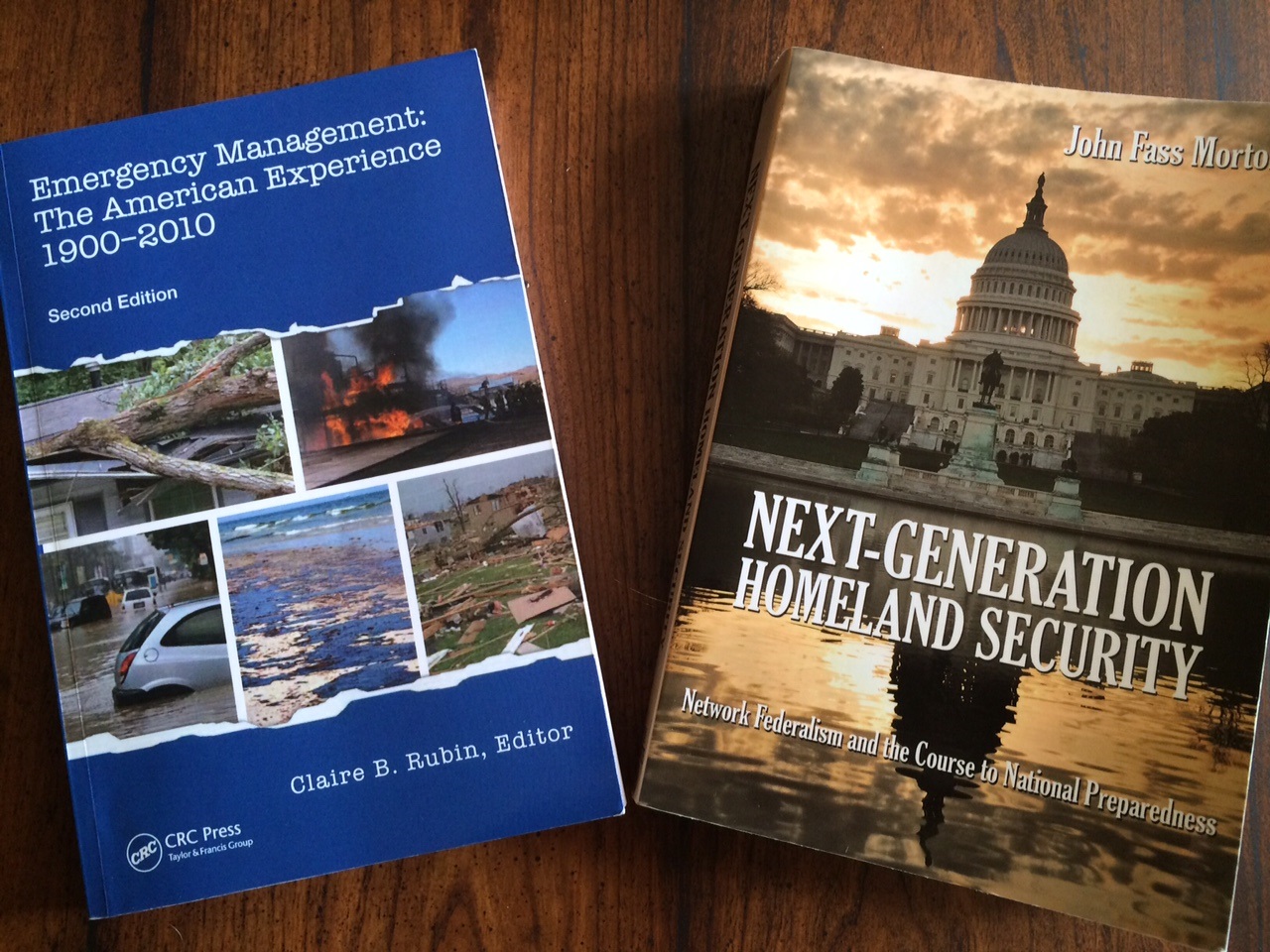
Any examination of this history of emergency management shows that politics seem to shape the direction of what we do as much as significant disasters do.  If you are interested in reading up on this, there are two great sources I’d recommend – Emergency Management: The American Experience 1900-2010 (Rubin. 2012.) provides good summaries of benchmark disasters and legislation through the years; and Next-Generation Homeland Security: Network Federalism and the Course to National Preparedness (Morton. 2012.) provides an in-depth look at this history with detailed references to the administrations, agencies, and people involved.

Rubin and Morton References

Rubin and Morton References

While we have certainly seen an overall positive trend of progress in emergency management (which is heavily influenced and sometimes dictated by federal policy), this has come despite some political actions which have either slowed progress or sometimes fully did away with positive and effective programs.  Having major changes in policy and programs every few years has become unsustainable for our practice, especially at the local level where EM/HS programs are often coordinated by one person.  Change isn’t always bad, but changes should be put in place only after being thought-through and reviewed by professionals to ensure they are effective and sustainable – not just politically motivated.  FEMA has been doing a great job in the last several years by providing public comment periods on new and major changes to guidance.  I hope this continues.

© 2015 – Timothy Riecker

Emergency Preparedness Solutions, LLC
WWW.EPSLLC.BIZ 

H7N9 Bird Flu Confirmed in Canada

In another bit of news regarding bird flu (aka avian influenza), the H7N9 strain of the virus has infected a citizen of British Columbia who recently traveled to China.  This release comes just a few days after H5N1 had been confirmed in a duck in northern Washington.  Certainly coincidence, but the discovery of the presence of both strains in North America – both for the first time – is daunting.

© 2015 – Timothy Riecker

Emergency Preparedness Solutions, LLC

www.epsllc.biz

Planning for a Mass Fatality Incident

Planning for a mass fatality incident can be almost as complex as responding to such an incident.  Mass fatalities can arise from transportation incidents, pandemics, mud slides, mass shooting, or other sudden incidents.  Thankfully mass fatality incidents do not occur often, but due to the impacts and complexity of managing such incidents every jurisdiction should have a plan in place to address them.

A mass fatality incident management plan should be an annex to a comprehensive emergency management plan.  Just as with any deliberate emergency planning effort (ref CPG 101), we start by assembling a planning team.  This planning team should represent all relevant stakeholders from across the community.  Beyond your usual public safety agencies, the team should also include the coroner or medical examiner, public health, public works, hospitals, social services agencies, the American Red Cross, funeral directors, and cemetarians.  It is also important to consider the cultural and/or spiritual requirements of how the deceased are handled so community leaders from these groups should also be included in your planning process.

Your plan should acknowledge the hazards in your community which can lead to a mass fatality incident.  These should already have been identified through your hazard analysis/THIRA.  If you have not conducted a THIRA, your planning team should discuss the impacts of such an event through a briefly outlined credible worst-case scenario then identify what capabilities are needed to address these impacts.

Assisting agencies may have some slightly different roles in the management of a mass fatality incident than they would in other incident responses.  These differences should be identified in the mass fatality incident response plan.  It should also be recognized that the causal nature of the incident is most likely to drive who will be in charge of such an incident.  Typically there are other matters which must be mitigated to save lives, protect property, and stabilize the incident which will determine who is in charge.  Because it is a mass fatality incident the coroner or medical examiner will be managing a significant portion of the incident and may also be driving policy based upon their legal responsibilities, but they may not be in command, although they may be likely to be part of a unified command.

While the coroner or medical examiner will be handling the deceased, it must absolutely be remembered that the living must also be cared for.  First and foremost are the immediate survivors, if any, of the incident who will require emergency medical care.  Depending on the nature of the incident, others may need to be treated for exposure.  Mental health care is a much more prominent issue in a mass fatality than perhaps any other incident – and the need for mental health care applies to everyone working the incident, families and friends of victims and survivors, and the community at large.

A common venue in mass fatality incidents for providing mental health assistance to families and friends of victims and survivors is a Family Assistance Center (FAC).  The Aviation Disaster Family Assistance Act of 1996 requires family assistance centers to be established for major transportation incidents (the joint responsibility of the NTSB and the American Red Cross) but these centers have been used for other mass fatality incidents as well.  In additional to crisis mental health counseling, a variety of other services can also be provided at a FAC.  A FAC should be established very quickly and it should be recognized that surviving victims may be stranded in the area and that family and friends will flock to the area – many of which may have little support structure or plans for essentials such as lodging.  A FAC is also an ideal location for authorities to obtain information from survivors about the missing or deceased which will help with future identification.  FACs are often located in hotels where large conference facilities, lodging, food, and other services can be obtained.

Another facility common to a mass fatality incident is a temporary morgue.  Temporary morgues are established either as a matter of operational convenience (rather than having to transport remains to the jurisdiction’s usual morgue site) or because the usual morgue site is too small to accommodate a larger operation.  Usually in conjunction with a temporary morgue is the need for cold storage for remains.  This is most often accomplished via refrigerated trucks/containers.  The incident morgue is obviously a secure location, with only authorized personnel being allowed access.

The amount of logistical planning required to establish and support facilities such as a family assistance center and temporary morgue lend themselves greatly to pre-planning efforts, including MOUs, site-specific standard operating procedures, mobile caches of disaster supplies, and exercises to test the standard operating procedures for setting up and running such facilities.  There are a variety of resources available to assist you with assembling your mass fatality incident response plan from LLIS, the federal Disaster Mortuary Response Team (DMoRT), state health departments, state emergency management agencies, and funeral home director’s associations.  The National Association of County and City Health Officials also has information which can assist you.

Take the time to create a mass fatality incident management plan, train personnel on the plan, and exercise it regularly.  Mass fatalities represent some of the most complex incidents I’ve ever been involved in and are very multifaceted.  As always, if your jurisdiction needs assistance in any preparedness efforts, Emergency Preparedness Solutions, LLC is here to help!

© 2014 Timothy Riecker