Water System Preparedness

For at least the past eight years or so, I’ve kept tabs on what the Environmental Protection Agency (EPA) has been doing for emergency preparedness for water systems.  Their efforts, spearheaded from their Water Security Division, include information on comprehensive emergency management activities – mitigation and resilience, surveillance and response, preparedness, and more.  Their website offers a plethora of resources, not only for water utilities and systems operators, but for others as well.  These resources include tools and guidance for conducting risk assessments, creating emergency plans, building resilience, developing a training and exercise plan, and conducting exercises.  These resources and tools all help to de-mystify emergency management systems and help to build a bridge into the emergency management world.  While they provide information on certain hazards, such as flooding or criminal activity, their approach, overall is all-hazards.  The EPA includes links to ICS and other FEMA training, as well as other agencies, and encourages water systems to interact with other agencies at the local, state, and federal level.

Back in November of last year, I gave a review of the TEEX course MGT: 342 Strategic Overview of Disaster Management for Water and Wastewater Utilities.  Those who work with or for water utilities would certainly benefit from attending this training and reviewing the EPA’s Water Security Division website.  Water is an important component of our Critical Infrastructure, with dependencies cascading across all other sectors.  These resources strengthen and support our continued preparedness within these sector, while also adding to whole community preparedness.

The EPA Water Security Division provides a quarterly e-newsletter, to which you can subscribe to stay abreast of their tools, resources, and information.

© 2016 – Timothy M. Riecker, CEDP

Emergency Preparedness Solutions, LLC Your Partner in Preparedness

Incident Management Synchronization

I wrote most recently on Building a System of Response, focusing on the preparedness perspective of bringing stakeholders together to better anticipate each other’s priorities and objectives through collaborative planning, training, and exercising.  Incident synchronization is the step beyond having a system of response.  It’s the implementation where we make the system work.  Effective incident synchronization, however, is not as simple as building a good system of response.  There are a number of factors at play.

Incident Timeline

Every incident has its own timeline.  There are parts of this timeline that we can control, and parts that we can only respond to.  Most incidents occur with little or no notice, which already puts us in the passenger seat, regardless of our level of preparedness.  There is a period of time where we must play catch-up.  This initial response MUST be an early focus of incident management synchronization.  The success of our initial response will set a tone for the rest of the incident.

Looking at the incident timeline as a whole, we find that most incidents we deal with have a focus on response, with little need for intensive recovery activity.  Major incidents may have a response of a few hours or days, with recovery lasting months or even years.  The impacts of the incident largely determine the overall timeline.  The activities within the timeline, however, are determined by us.

Incident Priorities

Our response and recovery actions have certain timelines associated with them.  In response, our timelines are largely dictated by the three priorities of:

  1. Life Safety
  2. Incident Stabilization
  3. Property Conservation

These priorities should be addressed in order – that is, our life safety activities tend to go before incident stabilization and property conservation, although we do often have some overlap of activities associated with these priorities, especially where it can make sense to prevent further life safety issues.  These priorities, particularly life safety, are reflected in our initial response.

Depending on the nature and impacts of the incident, other priorities may be introduced by various stakeholders as we go into an extended response.  The extended response brings about a measure of bureaucracy, as responders enter non-emergency activities and non-traditional responders arrive to take part in matters related to their areas of responsibility.  These non-emergency activities and areas of responsibility may be associated with laws and regulation, plans, organizational charter, executive direction, or simply managing expectations. Of all of these, plans, particularly interagency plans, stand the best chance of respecting a system of response, aiding in a synchronization of incident management.  This extended response is often associated with incidents of Type 3 or larger.  Effective incident management synchronization during the extended response is critical. 

The Transition to Recovery

While politicians like to make declarations about the end of response and the beginning of recovery, these lines are rarely, if ever, so solid and defined.  On even the simplest of incidents – a motor vehicle accident – the incident commander will call for a tow truck early in the response activity.  In the microcosm of the small-scale Type 5 incident, this is a recovery activity.  Clearly then, when extending these concepts to a larger incident, we also initiate a number of short and long-term recovery activities within our response phase.

Recovery tends to bring in a number of agencies and organizations with little concern about response, but rather with a focus on getting people, organizations, and infrastructure back to where they were pre-incident, if not better.  We look at capabilities such as infrastructure systems, economic recovery, health and social services, housing, and natural and cultural resources.  We are addressing human needs, continuity of operations, restoration of infrastructure, social stabilization, and environmental remediation.  Clearly there are a variety of organizations and priorities at play.  While many of these activities, for a time, will run parallel to response, there are intersections, and recovery will continue well past the response phase.  Incident management synchronization must account for the integration of and transition to recovery. 

Accomplishing Incident Management Synchronization

Good preparedness leads to good implementation.  If we have built an effective system of response (and recovery), this lays an essential foundation for our success in incident management synchronization.  A big factor of our plans being effective is if they can actually be implemented.  Some good reading on operational emergency plans here.  Frameworks and conceptual plans offer a good start, but an effective plan should walk you through key activities.  We also need to recognize that our system of response is actually a system of systems.

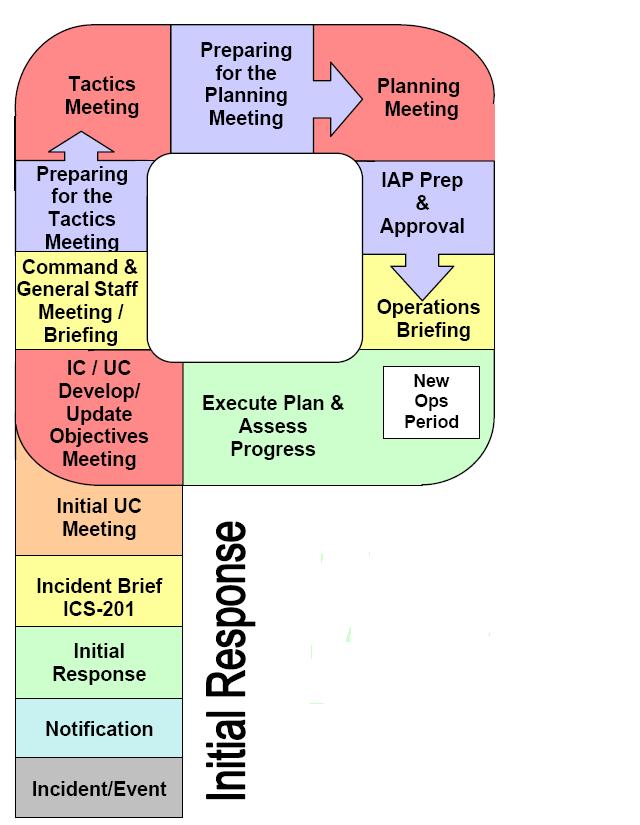
Implementation of plans and synchronization of incident management is strongly supported by an incident management system, such as the Incident Command System (ICS).  ICS supports short term and long term incidents.  ICS embraces a planning process, which is summarized visually by the Planning P.  The planning process provides a system for developing incident action plans for the next operational period.  When performed properly, the planning process should be informed by all stakeholders, integrating their priorities, objectives, and activities into one consolidated plan.  Their objectives are vetted by the incident commander (or unified command, if used), which helps to ensure coordination, synchronization, and support throughout the timeline of the incident.

planning P for Planning

Despite this standard of incident management, there are still some organizations and individuals that work in disaster recovery that view ICS and concepts such as the planning process as too response-oriented and refuse to use it.  Looking back on the need to integrate recovery activities with response early in the incident, I find this myopic perspective simply foolish and a significant contributor to the disconnect between response and recovery.  I certainly acknowledge that ICS is foundationally very response-oriented, but just as it was adapted from wild-fire response, ICS can (and has been) adapted into recovery, with the foundational principles of incident management continuing to hold true.

Outside of ICS, incident management synchronization will only be successful with good communication among and between all stakeholders.  Effective communication fosters all measure of effective incident management.  Hopefully preparedness measures helped ensure that the organizations and perhaps the personnel involved were familiar with each other, but if not, communication can help overcome that gap.

To further reinforce the connection and need for synchronicity between response and recovery, I reflect again upon preparedness measures.  Short-term recovery activities should be anticipated and planned for alongside and integrated with response.  The full transition to long-term recovery should also be planned, acknowledging that the transition must be phased.  Further, key staff must be trained in these plans and the plans should be exercised at every opportunity.

As always, thanks for reading.  I’m interested in your perspectives, thoughts, and experiences with incident management synchronization.

© Timothy Riecker, CEDP

Emergency Preparedness Solutions, LLC – Your Partner in Preparedness


Building a System of Response

On even relatively simple incidents, multiple agencies respond, each with their own priorities, objectives, and authorities.  Even on these small and fairly routine incidents, agencies will complain about one another, typically from a lack of understanding of their role and priorities at an incident scene.  On-scene conflict between police and fire departments is almost cliché, but if you’ve been in this business for a while, you’ve certainly seen it occur.

The number of agencies and interests often expands with great leaps and bounds as the size, duration, and complexity of an incident grows.  While we have incident management systems (such as the incident command system or ICS) which help us to organize and manage the multitude of resources and interests involved during an incident, it’s critical that we have a better understanding and accountability of these agencies and interests before a complex incident occurs.  How can this best be done?

Management Level

Establishing this mutual understanding and accountability is the foundation of a system of response.  From the broadest levels, this is established in the National Response Framework, which is a national-level document describing how the US Federal government organizes to response to large incidents, but also identifies, in general terms, the roles and responsibilities of state, local, tribal, private, nonprofit, faith-based, and community stakeholders; along with how they interrelate during a response.  In the US, states have their own emergency operations plans, which further narrow this perspective within their state, addressing their own unique hazards, resources, laws, and ways of operating.  County and local governments, individual agencies, organizations, and others can and often times do have their own plans with a continually refined focus.

It is through the creation and ongoing maintenance of these planning documents where our system of response is first built.  Dialogue and understanding among the stakeholders are essential.  We must learn who are partners are in emergency response (and mitigation, recovery, prevention, and protection, for that matter) and what their interests and objectives are.  Sometimes those partners are asked to participate, other times they simply arrive on scene, leaving local responders and the person in charge feeling insecure and frustrated.  In your planning efforts, try to anticipate who might be involved in a critical incident so you can better anticipate those needs.

Responder Level

To further this understanding, especially with those who may find themselves working directly with responders of other agencies, it is important to train and exercise together.  Joint training and exercises give responders an opportunity to navigate course and exercise objectives together, leveraging their own knowledge, experience, and capabilities along with those of others; increasing the value of the learning experience as well as their aptitude for joint operations.

Many training courses are well suited for mixed audiences – from the management and planning level to the tactical level.  Incident command system courses, which all responders should take to an appropriate level, are also ideal for this, especially since they should encourage discussion about operational priorities, objectives, and strategies.  Additionally, courses that are heavy in scenario-based training can greatly maximize this synergy, since they are a combination of training and structured exercises.  Courses that use simulation tables are excellent for cross-discipline integration.

Joint training and exercises might not always be practical, especially for those new to their field of practice.  Acknowledging that, consider including information on the other disciplines within the basic or academy-level training that is conducted.  A brief amount of time spent on the legal authorities, priorities, and operational objectives of partner disciplines can be valuable to creating understanding on a complex incident.

Keep it Going

As with all preparedness efforts, ‘one and done’ is not a mantra you want to follow.  To be effective, contemporary, and impactful; you have to build a legacy program.  As the program continues, strive to constantly improve.  Don’t only keep plans up to date, but create procedures on integration that lead to an effective system of response.  Use training to support these plans and procedures and use exercises as both an opportunity for practice as well as an opportunity to identify strengths and areas for improvement within the plans and procedures.  Joint exercises will help identify areas that need to be addressed, such as interoperable communications, conflicting protocols, and competing priorities.  It’s better to identify and address these matters now than during a critical incident.

© 2016 – Timothy Riecker, CEDP

Emergency Preparedness Solutions, LLC Your Partner in Preparedness

Using Departmental Operations Centers for Incident Management Success

Increasingly, government agencies and departments are identifying the benefits of establishing and activating departmental operations centers (DOCs) to help manage their responses to incidents.  At the Vermont Vigilant Guard 2016 exercise, which concluded last week, I had some opportunity to discuss the benefits of DOCs, particularly with an agency who used theirs for the first time in this exercise.

For most agencies, a DOC can relieve agency representatives in an EOC from also having to manage and track their agency’s response activity.  In an EOC, an agency representative is largely a conduit for communication and they provide knowledge of their agency and their agency’s capabilities as they contribute to the greater discussions within the EOC.  According to NIMS/ICS, an agency representative should have some decision-making capability for their agency, although political and practical realities often dictate otherwise.  The overall scope of activity for an agency representative in an EOC largely precludes them from also managing the details of their agency’s response, particularly if that response is even moderately complex.

A DOC is the ideal location from which an agency can oversee and coordinate their own response to an incident.  They can deploy and track resources, address internal logistics matters, and coordinate external logistics matters back through their agency representative at the EOC.  DOCs are also an excellent application for large agencies, which may have a variety of technical functions organized throughout, such as a health department or transportation department.  Pulling together representatives from each organizational element within the agency to collectively troubleshoot, problem solve, and share resources, is excellent use of a DOC.  In a way, this application of a DOC could be considered similar to a multi-agency coordination center (MACC).

Does a DOC need to mirror NIMS/ICS (or the new Center Management System) standards?  While there is no set standard for organizing and managing a DOC, there are a lot of applications of ICS that can certainly be applied.  If you look at the main activities of your DOC, you will see where opportunities for integration of ICS principles exist.  Consider that a DOC should have and maintain good situational awareness.  While much of this can be provided by the EOC, the EOC may (should) be looking for some specific information from your agency.  A situation unit within your DOC would certainly be helpful.  Likewise, DOCs often address tactical or near-tactical application, by deploying and directing resources from throughout their agency.  Having a resource unit within your DOC will help tremendously in the tracking of these resources.  Depending on the size and scope, it may be prudent for your DOC to establish an incident action plan (IAP) of its own.

Logistics, mentioned earlier, may be another need within a DOC.  Certainly an element of finance is important for the approval of procurements and tracking of costs within the agency related to the incident.  If resources are being deployed, someone should be in charge of operations.  Lastly, any organization needs to maintain someone in charge.  A DOC Manager would be the ideal generic term for this position.

What are the draw backs of establishing a DOC?  First of all, it’s an additional layer of incident management.  While possibly necessary based on factors discussed earlier, adding layers of incident management can make incident management more complex, especially if roles of each layer and function are not well defined.  The best way to address this is pre-planning!  Staffing can also be a significant concern.  Many agencies may be too small to warrant, much less have staff available, for a DOC.  If such is the case, just as in other applications of ICS, you should be able to collapse down to a manageable size.

An often seen pitfall of DOCs is that they can quickly devolve into a management by committee type of structure; particularly with larger agencies where senior staff, who are used to regular meetings with each other, are now representing their functional interests within the DOC.  I’ve seen this result in what is essentially one endless meeting, interrupted by phone calls and emails which introduce new problems and perpetuate more discussion.  Strong leadership is absolutely required to ensure that a group such as this stays focused and on task, resolving issues on a timely basis.

Overall, the use of Departmental Operations Centers is a smart practice.  Work internally to plan their use, scoping out when and how it will be applied, where it will be located, the organization to be used, and how it is integrated into the overall incident management effort.  Once plans are developed and appropriate training is performed, exercise the plan to identify areas for improvement, turning those into corrective actions, and implementing them for continued success.

© 2016 – Timothy Riecker, CEDP

Emergency Preparedness Solutions, LLC – Your Partner in Preparedness
Five Guidelines for Creating Effective Disaster Exercise Injects

While there is a lot of important and necessary planning that takes place before the development of exercise injects can even be considered, injects themselves are where the proverbial rubber meets the road.  How we craft those injects can often times make or break the conduct of the exercise.  Injects provide context, as if the events of the exercise were occurring in real life.  While we try to avoid delivering injects that directly prompt player responses, injects will often provide information which will lead players to react to the information provided.  Here are five guidelines to help you develop effective exercise injects:

  1. Injects must be purposeful and each one must relate back to one or more exercise objectives. Far too often we see injects that have no real bearing on the objectives of the exercise.  These are simply distractions and lead to busy work.  Keep things focused.  Just a few well-crafted injects can engage a number of players in active discussion or activity.
  2. Realistic injects are a must. While there will always be a grumble from some people claiming that something would ‘never happen that way’, due diligence must go into ensuring that injects are as realistic and grounded as possible.
  3. Be aware of who an inject would actually originate from. A common mistake I see is injects being scripted to originate from inappropriate sources.  This distracts from reality.  Also, injects should never originate from a player.
  4. Be flexible and aware. Sometimes players accomplish what they need to without an inject.  In that event, there may not be a need to use that inject.  Similarly, players may not respond to an inject as expected, so further action on the part of the Facilitators/Controllers/Simcell may be needed.
  5. Always have backups! As you build your Master Scenario Events List (MSEL), maintain a side list of contingency injects that can be used to speed up or slow down the exercise, or to address occurrences where players did not respond as expected.

Thoughts and ideas on these and other guidelines are always welcome!

© 2016 – Timothy Riecker, CEDP

Emergency Preparedness Solutions, LLC Your Partner in Preparedness!

2016 National Preparedness Report Released

The fifth National Preparedness Report has been released by FEMA.  The National Preparedness Report is based upon, as the report states, input of more than 450 data sources and 190 stakeholders, including 66 non-federal organizations (which would account for state preparedness report submissions and information from Urban Area Security Initiative regions).  The report is intended as a summary of where the nation stands in regard to each of the 32 Core Capabilities outlined in the National Preparedness Goal.

As mentioned, this is the fifth National Preparedness Report to hit the streets.  While they have some value and demonstrate that the data collection that is done is actually collated, I feel that through the years they are offering less meat and more potatoes.  I appreciate the highlighting of best practices for each mission area, but, to me, there is a missed opportunity if a report is simply providing data and not recommendations.  While it’s understood that the goal of the National Preparedness Report is not to provide recommendations (it would also take longer to publish the report, and the people pulling the data together do not likely have the expertise to create recommendations), I’d like to see FEMA (and stakeholders) have follow up efforts to provide recommendations in each mission area and not miss this valuable opportunity to then apply the findings and look forward.

Below, I’ve included their overall findings with a bit of my own commentary.  Overall, I will say that there is nothing eye opening in this report for anyone who pays attention.  It’s pretty easy to guess those Core Capabilities which are at the top and those which are at the bottom.

  • Planning; Public Health, Healthcare, and Emergency Medical Services; and Risk and Disaster Resilience Assessment are the three Core Capabilities in which the Nation has developed acceptable levels of performance for critical tasks, but that face performance declines if not maintained and updated to address emerging challenges.
    • My commentary: BULLSHIT.  If these Core Capabilities are at ‘acceptable levels’, then our standards must be pretty low.  Planning is the one that disturbs me most.  We continue to see plenty of poor plans that are not realistic, can’t be operationalized, and are created to meet requirements (which are typically met by formatting and buzzwords).  Have we improved?  Sure.  But I wouldn’t say we are at ‘acceptable levels’.  As for Public Health, Healthcare, and Emergency Medical Services, we are struggling in certain areas to simply keep our heads above water.  While we are fairly solid in some areas of public health, one only needs to look at the Ebola incident to view how fragile our state of readiness is.  The findings for Planning and Public Health, to me, are nothing but shameful pandering and we need to get realistic about where we are at and the challenges we face.  Gold stars won’t stand up to the next disaster.  As for Risk and Disaster Resilience Assessment I have admittedly less experience personally.  I do know that we have some pretty incredible tools available that can help us determine impacts of various hazards for any given area under a variety of conditions, which is an amazing application of technology.  My concerns here are that there are still many who don’t know about these tools, don’t use them, and/or don’t follow the findings of information from these tools in their hazard mitigation actions.
  • Cybersecurity, Economic Recovery, Housing, and Infrastructure Systems remain national areas for improvement. Two additional Core Capabilities – Natural and Cultural Resources, and Supply Chain Integrity and Security – emerged as new national areas for improvement.
    • My commentary: NO KIDDING. While we have made a great deal of progress on Cybersecurity, we are still far behind the criminal element in most respects.  It also needs to be fully recognized in the National Preparedness Goal that Cybersecurity is a Core Capability common to all five mission areas.  Economic Recovery will always be a challenge, as every community impacted by an incident has a certain way it heals, essentially along the lines of Maslow’s Hierarchy.  A strong local economy is important to this healing, ensuring that the community has access to the resources it needs to rebuild and a return to normalcy.  While I’m sure studies have been done, we need to examine more closely how the economic recovery process evolves after a disaster to identify how it can be best supported.  Housing is the absolutely most challenging Core Capability in the National Preparedness Goal.  While I don’t have a solution for this, I do know that our current approaches, philosophies, and ways of thinking haven’t moved us an inch toward the finish line on this one.  We need to change our current way of thinking to be successful.  As for Infrastructure Systems, I could go on for days about this.  I’ve written previously, several times, (as have many others) on the critically fragile state of our infrastructure.  It’s no big secret.
  • States and territories continue to be more prepared to achieve their targets for Response Core Capabilities, while they are least prepared to meet their targets in the Recovery Mission Area.
    • This is another NO KIDDING. While we must always have a greater focus on Response, as that’s where lives are saved and the immediate danger is addressed, we can’t lose sight of Recovery.  Some recovery activities are more clear cut than others, and FEMA often muddies the waters more by inadvertently intimidating state and local governments when it comes to disaster recovery, as the focus becomes centered more on reimbursable activities vs doing what needs to be done.  The report included some interesting findings (take a look in the Recovery Mission Area drop down on the web site) on ‘mixed trends in exercising recovery capabilities’.  Again, this is nothing earth shattering, but it’s nice to see the matter addressed.  Yes, we clearly need to exercise Recovery Mission Area Core Capabilities better and more often.

These reports are always worth looking through, even though much of the information is generally known by those of us in the profession.  There are always little nuggets of learning available, and data from the report may be used to support your own endeavors for additional funding or resources for your own program.

As always, I’m interested in your insights and thoughts on this post and the National Preparedness Report.

© 2016 – Timothy Riecker, CEDP

Emergency Preparedness Solutions, LLC – Your Partner in Preparedness


Taking Another Look at Mass Casualty Incidents

In case you missed it, the NTSB issued their findings and recommendations relative to the derailment of Amtrak 188 in the City of Philadelphia last May, which resulted in the loss of eight lives and injuries to over 200 other passengers.

The NTSB surmised that the engineer was distracted by reports over Amtrak’s radio of a nearby train having rocks thrown at it, which is apparently a common occurrence on a certain stretch of tracks through Philadelphia.  His distraction resulted in him speeding up the train, rather than slowing it prior to heading into a curve.  Taking the curve at high speed led directly to derailment of the train.  It has been pointed out that the presence of an automatic Positive Train Control system, not installed on many trains, would have slowed the train and likely prevented the derailment.  A rail industry union consortium indicated that the presence of two engineers on the train may have also mitigated this incident.

What I found most interesting in the report was that after listing findings and recommendations related to the derailment itself, the NTSB report identified issues beyond the crash.  The report states that

“…as a result of victims being transported to hospitals without coordination, some hospitals were over utilized while others were significantly underutilized during the response to the derailment.  The NTSB further found that that current Philadelphia Police Department, Philadelphia Fire Department, and Philadelphia Office of Emergency Management policies and procedures regarding transportation of patients in a mass casualty incident need to be better coordinated.”

Why is the NTSB providing recommendations on how mass casualty incidents are handled?  These recommendations are, in fact, fully within the scope of their mission statement as they address, ultimately, how victims are cared for.  The NTSB has also brought us best practices that extend beyond crashes, such as Family Assistance Centers.

The recommendations the NTSB provides in this report are spot on.  Mass casualty incidents MUST be coordinated.  Triage, treatment, and transport.  We’ve all heard of these three key activities.  Yes, it’s excruciatingly difficult to not ‘Scoop and Run’ when we encounter an injured victim, but let’s consider a few reasons why we shouldn’t:

  1. Patients with certain injuries, such as those to the cervical spine, are not being stabilized, and could have their injury worsened.
  2. A patient could ‘crash’ from a multitude of causes, which require the resources of an ambulance and paramedic to address, absent being in a hospital.
  3. Scoop and Run violates the concept of triage, which is intended to provide care and transport for the most critically injured first.
  4. The emergency personnel and vehicles involved in Scoop and Run may be otherwise needed at the scene.
  5. Depending on the incident, victims may be contaminated. Scoop and Run can endanger personnel who are not aware of this.
  6. Scoop and Run circumvents patient tracking and accountability, which is important for on-scene operations, liability and insurance, post-incident medical monitoring, and investigation.
  7. Scoop and Run, as the NTSB report pointed out directly, doesn’t account for spreading patients among receiving hospitals, meaning that some patients can end up at hospitals unequipped for their type of injury as well as overcrowding of hospitals.

While the City of Philadelphia did a great job overall, this gave them cause to take another look at their mass casualty plans and procedures; resulting in Philadelphia Office of Emergency Management asking for better coordination of the multiple entities involved in a mass casualty incident.  While this incident provided some great lessons learned for the City of Philadelphia, it also provides lessons learned for all of us.  It’s a good opportunity to convene your mass casualty planning group and give a review of your plan.  Any jurisdiction can be susceptible to a mass casualty incident.

In need of a structured plan review, planning, training, or exercises involving mass casualty incidents?  Emergency Preparedness Solutions can help!  Contact us now!

© 2016 – Timothy Riecker, CEDP

Emergency Preparedness Solutions, LLCYour Partner in Preparedness!

Exercising the Recovery Mission Area

It doesn’t happen often, but when it does, I get pretty excited about it – I got a blog request!  Last week, Darin, a LinkedIn connection, messaged me with a request to post my thoughts on exercising the recovery phase (or mission area) of emergency management.  His idea, as he expressed it to me, came from discussion at a Public Health Preparedness conference he was attending, where they were discussing ESF 8 (Public Health and Medical Services) continuity of operations and recovery exercises.  Challenge accepted!

When it comes to Recovery exercises, my first thought is that they are horribly underutilized.  We conduct a lot of exercises in the Response mission area, but it’s a rare occasion that we even mention Recovery.  The reasoning here is pretty easy – Response is sexy.  It’s the lights and sirens, saving lives, put out the fire, pull people from the wreckage kind of stuff that makes a big impact.  Recovery is often viewed as slow, tedious, bureaucratic, engineering kind of stuff.  Well… yeah… but there is a lot more to it.  Since when we plan exercises, one of the first things we do is to identify what Core Capabilities will be tested, let’s look at the Core Capabilities of the Recovery Mission Area.  Within each, I’ll mention some ideas you can incorporate into exercises.

The Big Three – Planning, Operational Coordination, and Public Information and Warning.  These Core Capabilities are found in every mission area and are sometimes applied differently.

  • Planning – Yeah, we should have recovery plans. I would argue that we have entered the recovery phase when all or most of the first two incident management priorities have been addressed – Life Safety and Incident Stabilization.  Sometimes these are resolved quickly, sometimes they take some time.  There are some fairly complex issues to be addressed in the recovery phase (many of which we will identify through the Core Capabilities), and we don’t do them often, therefore we should most certainly plan for them.  Remember, we exercise plans and capabilities – therefore our plans (and policies and procedures) are a significant focus when it comes to Recovery exercises.    This Core Capability is where continuity of operations plans will also fall.  Can your organization survive the lasting impacts of a disaster?
  • Operational Coordination – Recovery activities often involve organizations that had little to no activity during the Response phase. Most of these organizations are non-traditional responders who don’t usually operate under more strict command and control models, such as ICS, but in the Recovery phase of a disaster, I certainly advocate that they do.  Many of these agencies, typically the human services types of organizations, are very good at coordination and cooperation, as their daily priorities dictate that working with others is how needs are addressed.  The big challenge we often see here, though, is the introduction of some other organizations – typically those with regulatory responsibilities.  Regulation usually requires bureaucracy.  Bureaucracy usually requires time – lots of time – especially when exceptions are requested.  It’s really important to consider all stakeholders when planning an exercise to ensure that you get a chance to see how they interact, what the information flow and chain of authority looks like, what benefits they bring, and how they can work together in a timely fashion for the common good.
  • Public Information and Warning – We often take for granted the role of public information and warning in the Recovery phase. There are many benefits to keeping external stakeholders informed of what’s going on during Recovery.  Consider elected officials, business and industry, and special interest groups, along with the general public.  Your PIO and possibly your JIC should be just as involved in Recovery phase exercises as they are in those for the Response phase.

Aside from the ‘big three’, the Recovery mission area shares a Core Capability with the Response mission area – Infrastructure Systems.  Long-term restoration and rebuilding of infrastructure can lead to lengthy discussions in a Recovery-focused workshop or tabletop exercise.  What are the priorities for rebuilding?  Who will do it?  How will it be funded?  What are the completion timelines?  Will it be rebuilt the same or differently?  What are the impacts of doing it differently?  Who is impacted by this?  What do we do while we are waiting for it to be rebuilt?  Who makes decisions?  All important things to consider.

The first unique Core Capability in the Recovery mission area is Economic Recovery.  I was recently asked to present at a conference for a niche professional association comprised of professionals found in government, private sector, and non-profits.  While we will be covering topics in Hazard Mitigation and Preparedness, the biggest focus will fall within Economic Recovery.  Economic Recovery involves businesses reopening and people getting back to work to serve customers, make money, and become customers themselves.  After a disaster, it is absolutely vital for a community to get back on its feet, and the center of that is the local economy.  While many disaster impacts may be a relative drop in the bucket for larger companies, smaller businesses may have a hard time recovering – the central pieces of this are infrastructure restoration (see previous paragraph) and cash flow.  The SBA, USDA, and even IRS have mechanisms to assist with cash flow issues.  And don’t forget insurance!  Bring these and other stakeholders to the table to discuss economic recovery.  Consider priorities and mechanisms that must be in place to meet needs to support these priorities.  Your local chamber of commerce and other business associations will certainly want to be part of these exercises.  Does your jurisdiction have a business operations center (BOC)?  If not, consider it.  If you do, exercise it!

Health and Social Services.  This is the heart of all matters related to ESF 8 (Public Health and Medical Services), which Darin mentioned.  While this Core Capability is an extension of the Response mission area Core Capability of Public Health, Healthcare, and Emergency Medical Services; it is also so much more.  ESF 8 activity after disasters can last months or even years, particularly with ongoing issues such as medical monitoring and psychological impacts.  Eventually many of these services are absorbed into the system of regular service providers, but for a time the circumstances of the disaster may require some special coordination or monitoring.  The coordination needed involves an amalgamation of organizations at all levels of government, not for profits, and the private sector.  This can involve ongoing coordination with insurance companies, general practitioners and specialists; and must address the needs of everyone fairly and consistently, regardless of any differences, including their own financial resources or insurance coverage.  Tracking data related to the care and services provided is often important, but consideration must be given to HIPAA and other privacy laws.  Exercises can benefit from scenarios, such as exposures to radiological, biological, or chemical sources, which will drive discussion on the types of services to be provided, who will provide them, at whose cost, and for how long.  Many of these discussions should include topics of how to avoid social stigmatization of clients, sharing information between organizations, and the full range of social services that individuals and families may require.

Housing is typically the hardest nut to crack in all of disaster recovery.  Relative to need, there is little government owned housing stock available.  What is available may require waiting lists and relocation to access.  While many home owners are insured, we know that it takes some time for home owners to receive payment from insurance companies, and insurance is rarely at 100% coverage for losses.  Those that don’t own their own homes are often the left with the most dire situations.  While ‘FEMA trailers’ have provided some medium-term solutions, there are many issues to address.  I posit that plans at all levels are inadequate to address housing needs after a disaster.  If you have a plan, get a good exercise team to write a great scenario to test it.  If you don’t have a plan, conducting a workshop to identify and address major planning issues is the way to go.  A housing exercise is probably going to be one of the more eye opening yet depressing exercises you’ve ever done.

Lastly is the Core Capability of Natural and Cultural Resources, which focuses on the recovery of libraries and museums, documents and art, as well as helping to restore our own environment after a disaster.  Activities can range from restoring a historical landmark to major engineering projects to restore a wetland.  These activities can involve a great deal of technical expertise as well as regulation.  FEMA, the EPA, and the National Parks Service are often big players in these types of activities.

As for what types of exercises to conduct, that’s largely dependent upon the status of your plans and if you have conducted exercises on these plans before.  I always suggest starting with discussion-based exercises.  We often forget about seminars, which are more about conveying information than obtaining feedback, but are still valuable for discussing initiatives and new plans.  Workshops not only support the planning process to develop plans, they can also serve to facilitate a detailed review of a plan in its final draft stages.  Most Recovery exercises I have experience with have been tabletop exercises, which use a scenario to provide context to discussion questions for a group of stakeholders.  This is a great way to exercise decision making and to talk through the key tasks associated with plans.  Disaster recovery involves a lot of policy-level decision making, which is ideal for a tabletop.

Operations-based exercises for disaster recovery are found much less often.  Drills can certainly be conducted to test focused aspects of plans and procedures.  Drills in Recovery can help identify strengths and weaknesses of our processes, both for ourselves and for those we are trying to serve.  Functional exercises are broader and more encompassing than drills.  Much can be gained from a Recovery mission area functional exercise, but make sure that it’s grounded in reality.  Most jurisdictions don’t have an EOC activated for Recovery mission area activities. If you don’t, don’t try to run an exercise within that environment.  Some functions, however, may be run, at least for a time, from some sort of operations/coordination center, such as a health operations center (HOC).  With a good scenario focusing on addressing longer-term issues in the aftermath of a response, they can be done successfully.  Be sure to develop a pretty solid ‘ground truth’, however, to support the exercise, as much of Recovery is dependent upon what was done in Response, so players will need this context.  With a bit more complication, a functional exercise could be run virtually, with people participating from their own regular work stations as they often do during Recovery operations.  Testing Recovery plans in full scale exercises is significantly challenging based on the array and type of activities.  Because of the focus of activities, continuity of operations plans are likely among the most suited for full scale Recovery mission area exercises.

I’m curious to hear about your experiences exercising Recovery mission area plans and capabilities.  What ideas do you have?  What best practices have you found?

As always, thanks for reading!

© 2016 – Timothy Riecker, CEDP

Emergency Preparedness Solutions, LLC – Your Partner in Preparedness!

Course Review – RDPC Isolation and Quarantine

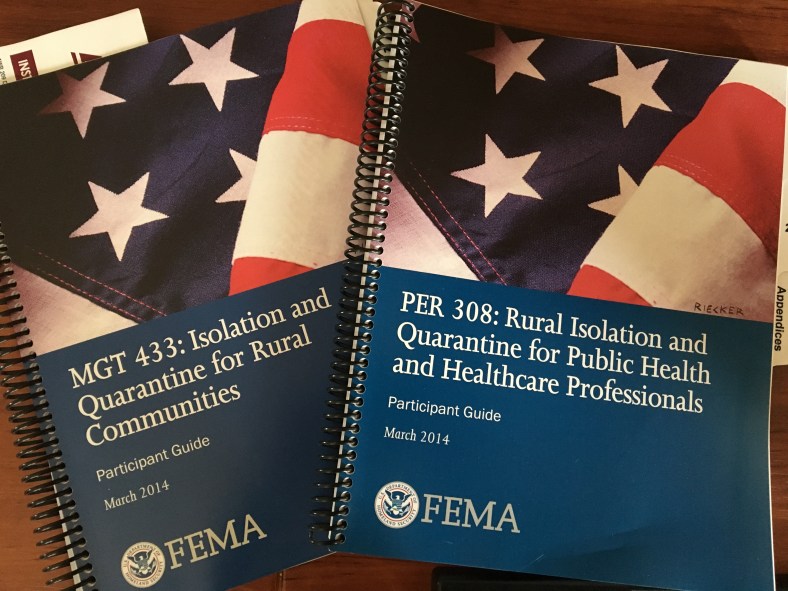
IQLast week I had the opportunity to take two courses sponsored by the Rural Domestic Preparedness Consortium (RDPC), MGT 433: Isolation and Quarantine for Rural Communities and PER 308: Rural Isolation and Quarantine for Public Health and Healthcare Professionals.  These courses together were completed in one day.

First came MGT 433.  This course covered a variety of topics associated with isolation and quarantine, including:

  • Case studies
  • Legal and ethical issues
  • Agencies and entities involved
  • Planning priorities
  • Resources

While the course is intended for rural audiences, which my home area generally is, the issues and considerations associated with isolation and quarantine are still largely the same for more densely populated areas.  While weaving through the various course topics, they mostly all related back to understanding the reasoning behind the use of isolation and/or quarantine as tools to limit the spread of certain communicable diseases and the planning and implementation associated with these activities.  The course did elevate my rather foundational knowledge of isolation and quarantine, and provided some great references for future application.

The second course, PER 308, didn’t really provide much more information than the previous course did, although it allowed an opportunity for a greater degree of analysis and discussion through a guided tabletop exercise.  The tabletop information from the participant manual was supplemented with several video segments which were produced with reasonable quality and help set the stage for many of the issues one would expect from dealing with an isolation/quarantine event.

Both courses were pretty solid, with only a few little tweaks or updates which I provided feedback on to the instructor.  As with most RDPC courses, those from larger agencies and more populated areas shouldn’t be dissuaded from participating – the foundational concepts they present are applicable to any area, rural or otherwise.

The instructor was very personable, professional, and knowledgeable of the course content.  While he didn’t have a public health background, which surprised me given the course topics, he clearly has a great cooperative public safety background.  I’ve found that the RDPC tends to prefer sending only one instructor to teach a course, along with an assistant to handle administrative matters.  While it’s certainly viable to handle the course alone, it’s challenging for both the instructor and the audience.

All in all, these are good courses, and I do recommend you keep a look out for them in your area.  Both courses are excellent for furthering your understanding of isolation and quarantine, when to use them, how to use them, and who to involve.  They are particularly good courses for public safety leadership and public health leadership and preparedness staff.

© 2016 – Timothy Riecker, CEDP

Emergency Preparedness Solutions, LLCYour Partner in Preparedness

7 Emergency Management Priorities for the Next Administration

Heritage.org recently published a piece outlining the top four homeland security priorities for the next administration, which can be found here.  It’s a thought provoking article that certainly identifies some important issues.  In the same spirit, I’d like to offer what I think are the emergency management priorities for the next administration.

1) Support an Effective FEMA Organizational Model

The Heritage.org model pointed out several issues with the DHS organization that need to be addressed sooner rather than later.  I’d like to add some FEMA-specific items to their suggestions, regardless of if FEMA is kept within DHS or not (honestly, I think that ship has sailed and FEMA is there to stay).

In building a bit of background for this article, I took a look at FEMA’s current strategic plan, knowing that the document already identifies some of their priorities.  Within in that list of priorities, they mention mission and program delivery, becoming an expeditionary organization, posturing and building capability for catastrophic disasters, and strengthening their organizational foundation.  To me, these four all directly relate to their organizational model.

Along with having a strong central administration of programs, FEMA needs to have agility in their program delivery.  This is best accomplished through the FEMA regional offices, which act as an extension of the ‘central administration’ by coordinating directly with states and neighboring regions to apply those programs in the best possible manner within the guidelines of the program.  While this is currently performed, it is not performed to the greatest extent possible.  John Fass Morton provides some great perspective on this approach in his book ‘Next-Generation Homeland Security’.  Info on the book can be found here.

2) Bolster Risk Reduction Programs

I write often about preparedness, as that has always been a focus of my career.  Risk reduction, however, is essential to eliminating or reducing the impacts of hazards on communities.  Risk reduction includes all aspects of hazard mitigation and resilience, which are ideally applied at the local level but supported by state and federal programs, policies, and resources.

While the National Weather Service has implemented and promoted the StormReady program, which encourages community resilience, the best program we have ever had in our field is Project Impact.  I’d love to see a revival of Project Impact (call it that or something else – I don’t really care), incorporating the concepts of StormReady as well as other best practices in risk reduction.  A big part of this program MUST be incentivization, especially access to funds that can be applied for in the present for hazard mitigation activities.

3) Build a Better Cybersecurity Program

This item was added to the list by a colleague of mine.  It’s also found on the Heritage.org list.  It must be pretty important, then.

Yes, there are a LOT of initiatives right now involving cybersecurity, but I think there can be more.  Jon, the same colleague who suggested this for my list has also stated repeatedly that cybersecurity is really a Core Capability that cuts across all mission areas – Prevention, Protection, Response, Mitigation, and Recovery.  The recent update of the National Preparedness Goal suggests this, but sadly doesn’t commit.

What do we need in regard to cybersecurity?  First of all, we need to demystify it.  There are plenty of people out there who have just enough tech savvy to turn on their computer, send some email, and post to Facebook.  While that may work for them, they are likely intimidated by talk of cybersecurity, hackers, and the like.  We need to continue programs in plain speak that will help to inform the average consumer about how to protect themselves.

Better coordination with the private sector will pay off heavily when it comes to cybersecurity.  Not only is the private sector generally better at it, they also have a tendency to attract experts through better incentives than the government can offer, such as higher pay.  Cybersecurity also impacts everyone.  We’ve seen attacks of all types of systems.  The only way to stop a common enemy is to work together.  Let’s think of it as a virtual whole-community approach.

4) Prepare for Complex Coordinated Attack

Another of Jon’s suggestions.  While terrorism is often quickly shoved into the category of homeland security, there is a lot that emergency management can assist with.  These types of attacks (think Mumbai or Paris) have a significant impact on a community.  They require a multi-faceted approach to all mission areas – again, Prevention, Protection, Response, Mitigation, and Recovery.  While law enforcement is clearly a lead, they must be strongly supported by emergency management as part of a whole-community approach to be successful. Preparedness across all these mission areas must be defined and supported by federal programs.

5) Infrastructure Maintenance

We have roads, bridges, rail, pipes, and other infrastructure that MUST be maintained.  Maintenance (or replacement) will not only prevent failure of the infrastructure as a disaster itself, but will also make it more resilient to impacts from other disasters.  Yes, these are projects with huge price tags, but what alternative do we have?

6) Continuity of Existing Model Programs

There are few things more infuriating than a new administration wiping the slate clean of all predecessor programs to make room for their own.  While every administration is entitled to make their own mark, getting rid of what has been proven to work is not the way to do that.  Eliminating or replacing programs has a significant impact all the way down the line, from the federal program administrators, to the state program people, to the local emergency managers who are often understaffed and underfunded to begin with.

Changing gears is not as simple as using a different form tomorrow, it requires research and training on the new program and costs time to re-tool.  While I would never say there is nothing new under the emergency management sun, as I believe we are still innovating, I’m pretty skeptical of some new appointee walking into their job and making wholesale changes.  While improvements can certainly be made, summary execution of successful programs does no one any good.  Let’s not make change simply for the sake of change.

Related to this, I fully support the efforts of FEMA in the last few years to gain comprehensive input on changes to documents and doctrine through the formation of committees and public comment periods.  This approach works!

7) Pull Together Preparedness Programs

NIMS, HSEEP, NPG, THIRA, etc… While each of these programs have their own purpose and goals, more  can be done to bring them together.  I’m not suggesting a merger of programs – that would simply make a huge mess.  What I’m suggesting is to find the connections between the programs, where one leads to another or informs another, and highlight those.  Things like better application of the Core Capabilities within HSEEP exercises to have a more effective evaluation of NIMS capabilities (I suggested this while being interviewed for a GAO report), or referencing the THIRA when building a multi-year training and exercise plan.  While some jurisdictions may already do this, these are best practices that should be embraced, promoted, and indoctrinated.  These links typically don’t add work, in fact they capitalize on work already done, allowing one project/program/process to be informed or supported by another, creating efficiencies and supporting a synchronization of efforts and outcomes.

There is my list of seven.  What are your thoughts on the list?  There are certainly plenty of other ideas out there.  If you had the ear of the next President, what would you suggest be their administration’s emergency management priorities?

© 2016 – Timothy Riecker

Emergency Preparedness Solutions, LLCYour Partner in Preparedness