Gauging Return on Investment in Preparedness: Exercises

In this last article of the Return on Investment series, I’ll be discussing the investments and benefits of preparedness exercises to help organizations determine their return on investment – or ROI.  The series has followed the model of the five POETE elements (Planning, Organizing, Equipping, Training, Exercising).  The inspiration for the series was a piece I wrote called Measuring Return on Investment in Emergency Management and Homeland Security: Improving State Preparedness Reports.  If you haven’t had the opportunity to review the earlier articles in the series, they are linked below:

Planning

Organizing

Equipping

Training

We conduct preparedness exercises for two main reasons: 1) to test plans and procedures, and 2) to provide people with an opportunity to practice their roles and responsibilities.  Exercises can be stand-alone activities or integrated into training and education through scenario-based learning. In the US we use the Homeland Security Exercise and Evaluation Program (HSEEP) as our model for both the macro and micro levels of exercise management.  If you are interested in an in-depth look on HSEEP and its components, you can check out an earlier series I did called Managing an Exercise Program.

As with most major activities we do, exercise-related tasks can be divided out into program management (the macro level) and project management (the micro level).  Since we usually examine ROI for individual activities, we will focus on the micro level of exercises, that is the project management piece, or individual exercises, to identify specific costs (investments) and benefits.

Conducting an exercise takes a fair amount of preparation.  The more complex the exercise, the greater period of time it should take to prepare.  Complexity of an exercise is measured by a few different factors – the number of participants involved, the span of time for the exercise, the complexity of the tasks/plans being exercised, and the number of locations being exercised.  Most of us who have been involved in emergency management and homeland security for a while have seen the full gamut of exercises – from discussion-based exercises like table top exercises, workshops, and seminars; to operations-based exercises like drills, functional, and full-scale exercises.  Often we view functional and full scale exercises as being the most complex, however I’ve been involved in table top exercises and workshops which have involved significant efforts.

Up front, the most significant investment any organization can make in an exercise is personnel time.  All exercise efforts will have a lead planner, and most will be supported by a planning team.  If the exercise involves only one organization, that planning team will typically involve only internal people, while multi-organizational exercises should involve some measure of representation from every organization, either directly or indirectly.  Planning an exercise requires a great attention to detail, drafting and editing of documents, and arranging of logistical matters.  Experience helps, so those who do this less often will typically require more time to do it.  This is why many organizations hire consultants (like me!) to help them with exercises.

During the planning phase for the exercise, you may have some associated costs, such as meeting space, food, and travel for planning meetings.  You may also have these costs for the exercise itself which should be identified during the planning phase.  It is also important to identify any costs associated with audio-visual equipment, communications equipment (including internet connectivity), and even things as simple as name badges and signage.

For the exercise itself, personnel costs are still significant.  You must not only consider the time of all participants (as well as potential travel costs), but also the time of your exercise management staff – an exercise director, controllers, evaluators, and possibly staff for a simulation cell.  Again, experience helps to support a successful exercise, so if you don’t have the depth of experience in your organization, consider hiring consultants for the conduct and evaluation of the exercise as well.  Either way, exercises can be significant investments.

Once the exercise is complete, the activity isn’t over – and neither are the costs.  The evaluation team needs to draft the after action report (AAR), and conduct an AAR meeting with the planning team and principal participants to ensure that everything was captured accurately.  Once the AAR is finalized, action items identified in the AAR are assigned to responsible parties to address improvements.  These improvements are generally not considered part of the cost of the exercise itself, but rather part of your general preparedness costs (these will all fall within the POETE elements).

While exercises come at no insignificant cost, the benefits are tremendous – if the exercise is done properly.  A well designed, conducted, and evaluated exercise provides better outcomes and benefits.  The AAR should reflect not only best practices that should be continued, but also areas for improvement which should be addressed to enhance preparedness.  Any of these, as mentioned in the last paragraph, can fall within the five POETE elements – Planning, Organizing, Equipping, Training, and Exercising.  While each of these certainly have costs associated with them, the benefit from the exercise was identification and documentation of need.  Perhaps you are exercising a new active shooter response plan and through the exercise realize that a certain procedure was based on poor assumptions – if this plan was put in place without being exercised, the outcomes in a real life event could have been catastrophic.  It’s better to identify these issues through an exercise so they can be addressed with much less cost.

As I mentioned earlier, another reason to exercise is to provide participants with an opportunity to practice plans, procedures, or skills in a safe and structured environment.  While there is a great deal of routine to what we do in emergency management, homeland security, and public safety, there are certainly activities that we don’t do very often, resulting in degradation of skill over time.  Many of these activities, though, are absolutely critical when needed, which means that we must give practitioners ample opportunity to practice and apply what they have learned through training.  The benefits of this, depending on the activity, can include increased efficiency (time), reductions in injury and loss of life, and proper use of equipment and protocols.  Additionally, there are benefits to getting people to work together in these activities, especially for those who don’t usually work together.  Emergency management, after all, is about collaboration.

Because of the wide range of things we exercise, it’s up to you to examine what your investments and benefits might be.  At EPS, we can help you with designing, conducting, and evaluating exercises; identifying potential costs and benefits of an exercise; and other preparedness activities.  We’re happy to help!

Feedback from this return on investment series of posts has been very positive, which I greatly appreciate.  We also got some good dialogue across all mediums including the blog home page (www.triecker.wordpress.com) and various LinkedIn discussion groups – some of which provided some excellent additional ideas on how to better capture information on investments and benefits.  The challenge remains to not only identify these, but to convert them into meaningful information for decision makers, which usually involves currency values.  Thank you, as always, for your time and attention.

© 2015 – Timothy Riecker

Emergency Preparedness Solutions, LLC

Gauging Return on Investment in Preparedness: Planning

Inspired a bit by my previous post Measuring Return on Investment in Emergency Management and Homeland Security: Improving State Preparedness Reports, I’ve decided upon writing a series of posts picking apart our primary activities in emergency management and homeland security preparedness to identify ways to gauge our Return on Investment (ROI).  To encapsulate our primary activities, I’m using the five POETE capability elements:

  • Planning
  • Organizing
  • Equipping
  • Training
  • Exercises

Most preparedness activities within emergency management and homeland security fall within one or more of the POETE capability elements.  The capability element of Planning is the foundational activity on which all preparedness is built and will be the topic of this post.  Here’s what I’m covering:

  • What is Return on Investment?
  • What planning efforts are involved in preparedness?
  • What organizational investments are involved in Planning?
  • Does the planning effort comply with applicable standards?
  • Can the plan be implemented?
  • What will exercises tell you?
  • Is there a need to maintain plans?

Return on Investment, or ROI, is a business term used to identify the profitability of certain investments or actions.  While preparedness is certainly done to protect against losses, for public and private sector alike, we generally don’t see preparedness activities as generating revenue.  However, when most entities INVEST time, money, and other resources into preparedness activities, they often want a reasonable assurance that their investment has paid off.  How do we gauge ROI for planning efforts?

First off, what planning efforts might we see in public or private organizations?  Obviously emergency and disaster plans are the big ones.  These plans are designed to identify key processes, such as alert and notification, response organization and incident management, and others which are intended to save lives and protect property.  These plans are likely to have annexes and appendices which address uniqueness of certain hazards, response circumstances, and support activities.  Continuity plans – usually business continuity or government continuity – identify how the organization will survive as an entity in the face of disaster.  Planning activities also involve the creation, review, and maintenance of policies and procedures.  We also create plans for hazard mitigation, long term recovery, specific events, and other needs.

What investments are involved in planning activities?  Organizations can and should allocate staff time and physical space and infrastructure to planning efforts.  The dedication of staff (full or part time) and/or consultants is often required, especially when planning efforts are viewed as a continual process and a critical part of preparedness.  The organization itself must make a commitment to the planning effort.  This commitment isn’t just in concept, but also practical involvement of staff throughout the organization, access to information, and even an involvement of third parties.

Certainly a first step in assessing return on investment of planning is to evaluate compliance with applicable rules, regulations, and guidelines.  These requirements can be hard (legally binding) or soft (general guidance) and can differ from industry to industry, nation to nation, and state to state.  Here in the US, FEMA provides guidance on emergency planning through Comprehensive Preparedness Guide (CPG) 101.  Some states may have requirements for emergency planning, such as New York State’s Executive Law Article 2-bNFPA 1600: The Standard on Disaster/Emergency Management and Business Continuity Programs is often referenced by public and private entities alike, while the International Standards Organization (ISO), has many industry-specific requirements for emergency planning.  If grant funding is being used for the planning effort, the grant may also have specific requirements.  Regardless of what the requirements are, planning efforts, plans, and associated documents should be audited to ensure that requirements are met.

Compliance, however, isn’t necessarily indicative of a good planning effort.  I’ve seen many plans which may meet requirements but the content itself was severely lacking.  Far too often planners get caught up in the world of checking boxes and fail to consider implementation.  If a plan cannot be implemented, it is useless to the organization.  Many plans exist now that meet applicable requirements but are still yet vacant of any meaningful direction or guidance in the event of an emergency.  These types of ‘plans’ are really better seen as policy documents.  A plan should identify what will be done, when, how, and by who.  If your ‘plan’ simply contains a statement on the requirement to use NIMS/ICS, but doesn’t provide detail on who will be in charge of what, when, and how; it is a policy document, not a plan.  Plans and their associated documents (i.e. procedures, guidelines, and job aids) need to chase down the lifespan of each critical step, especially early in a response.  They must identify who is responsible to make key decisions, who will be notified (how and by who), and who will take what actions.  A logical review of planning documents by the planning committee or perhaps even a third party is another good means of assessing your return on investment.

Does the plan work?  This is, perhaps, the ultimate factor in determining return on investment.  Usually our best means for identifying if a plan works is to exercise it.  Exercises provide a controlled and focused environment for testing plans or components of plans.  They will also help us in identifying if the plan can truly be implemented.  I’ve written a lot on exercises: articles can be found here.  (I also anticipate writing about assessing ROI for exercises as part of this series).  Generally, an incremental exercise program is usually recommended, beginning with discussion-based exercises – such as table tops and workshops – and progressing to operations-based (hands on) exercises.  A well written and honestly evaluated exercise will go a long way toward identifying the return on investment of your planning efforts.

Are we there yet?  Nope.  Planning, like all other preparedness efforts, requires maintenance.  If you create a plan then walk away, even if it’s a good plan, your plan’s value will diminish over time – and we’re talking months, not decades.  Think about how often something changes in your organization.  Staffing.  Equipment.  Technology.  Procedures.  Insurance policies.  All of these things, and more, influence your plans in some way.  Over time these changes not only occur, but also compound and move the present reality of your organization further from the assumptions of your planning efforts.  This is why plans must be maintained and updated on a regular basis.

Is there some mathematical formula for identifying the return on investment of preparedness efforts?  Given all the factors involved and their fluidity, I don’t think so.  It’s not cut and dry like a traditional business investment.  As you can see, though, there are a number of steps we can take to assess the utility of our investment.  I’ve seen organizations pay a lot for bad plans, and others pay much less for great plans.  Not only do organizations need to ensure that their planners know what they are doing, but the organization itself needs to have a commitment to success.  Without it, the planning effort is doomed to fail.

As always, feedback is appreciated.  What are your thoughts on assessing the return on investment of planning efforts?  What do you think is a good measure?

Does your organization need a new plan or need to update a plan?  Do you need help with the planning process or evaluating your organization’s preparedness?  How about exercises?  Emergency Preparedness Solutions can help!  Email to consultants@epsllc.biz or visit www.epsllc.biz.

© 2015 – Timothy Riecker

Emergency Preparedness Solutions, LLC

WWW.EPSLLC.BIZ

The Need for More Scenario-Based Learning

Think back through all the courses you’ve taken.  It’s a lot – I know.  What ones stand out the most?  I’m willing to be they are the ones that were the most engaging.  Not only did you enjoy them, but you learned a lot from them and still remember quite a bit of it.

It’s no secret that training adults can be challenging.  Training professionals in emergency services is certainly no different.  The challenges are even greater as the number of required training courses continually increase, requiring more and more ass-in-chair time every year for responders and other professions.  A great deal of training programs we see out there still seem to be holding out for the sake of traditional delivery styles, much to the detriment of our learners.  Why?  Designing traditional lecture-based learning is easy to do!  Figure out what people need to learn, develop content, slap together some PowerPoint, and voila!  Hell, even I’m guilty.

The fact of the matter is that we all know this is wrong.  Yes, it’s easy to do on our end, but the value and impact of the learning is pretty low.  People don’t want to be lectured to for hours on end.  We know that learning is most effective when we mix things up and when we increase interaction.  One of the best ways of engaging learners effectively is through scenario-based learning.

Now I’m not just talking about using a scenario at the end of the course to see if people can apply what they’ve learned over the past two days.  Yes, scenarios can be used as a test of sorts, but they are most effective for actual learning.  So when should you use scenarios?  Why not start the course with one?  It immediately gets people thinking, which is a good thing especially with an 8 am start time to the course.   If you use a lot of scenarios in a course, can they all be related?  Sure.  Maybe.  Maybe not.  It all depends on what the purpose of the scenario is.  In training responders, threading a common scenario through a course is usually helpful.  Scenarios can get complicated when we need to establish a common understanding of what is going on, where it is, what resources are available, etc.  As such, it helps to use the same foundational scenario throughout the course (or at least regularly revisit it), and continue to introduce new problems or a different focus based upon the path of the training.  Using a common foundational scenario saves time so you don’t have to start anew introducing all new information each time and it keeps learners comfortable.  That said, it may occasionally be valuable to change things up a bit.

Do you need to use HSEEP to develop course scenarios?  No.  While these aren’t exercises in the strictest sense, we can benefit considerably from many of the principles and concepts of HSEEP.  Develop what you need to give learners the information they need to participate and the information you and/or other instructors need to properly facilitate and evaluate.

Adult learners like to be challenged.  Lecturing them for hours on end will only challenge their ability to not fall asleep – which may only be accomplished by their challenge for a new high score on the new app they just put on their phone.  The best way to challenge adult learners is to give them problems to solve.  A well written scenario will help introduce these problems in a framework which is both familiar and challenging to them.  Depending on how the scenario is provided, such as a compelling background story or use of video, learners will establish an emotional connection to the scenario which prompts a visceral desire to solve these problems.  Even one scenario is powerful and can prompt a lot of interaction.  It can prompt individual responses to questions, group discussions, and group collaborations.

Finally, don’t forget to evaluate both your learners and the scenario itself.  At the conclusion of each scenario conduct a hotwash and feedback session with learners to discuss what they accomplished and possible areas for improvement.  Also be sure to gain feedback from them and other instructors on how well the scenario worked and what can be improved upon.

Just like any other aspect of instructional design, the integration of scenarios can be time consuming but it’s an investment that will pay off.  To capitalize on the value of your scenarios, make sure the activities and expected outcomes of each scenario are associated with the learning objectives of the course and engage learners to the proper degree (i.e. the proper level of Bloom’s Taxonomy).  Yes, scenarios also take a fair amount of class time to execute.  That time needs to be well accounted for in your instructional design and course planning.  However, if properly designed, learners can learn just as much content if not more through interactive scenarios as compared to lecture-based training.

What types of scenarios have you integrated into courses?  How did learners respond to them?  How can we do a better job of integrating more scenario-based learning into our courses?

Need help designing scenario-based learning?  Let EPS help!

© 2015 – Timothy Riecker

Emergency Preparedness Solutions, LLC

WWW.EPSLLC.BIZ

Exercising Foundational Skills with Unorthodox Scenarios

Does the scenario of an exercise activity really matter?  Can we use a zombie scenario to exercise evacuation and sheltering?  Can we use a holiday food distribution to the needy to practice our POD (point of distribution) plan?  Do scenarios always have to be realistic or related to our jurisdiction’s hazards?

I’m a foodie.  As such I find myself occasionally watching shows like Cutthroat Kitchen and Chopped.  These are fun shows that strike a balance of cooking with game shows, including the cash prize in the end.  The competitors are legitimate cooks, some trained in culinary schools, some successful in their careers and earning the title of ‘chef’.  The competitors are given, on the spot, either a dish to create (Cutthroat Kitchen) or a box full of ingredients which must all be incorporated into a dish (Chopped), using a kitchen and pantry generally unfamiliar to them, within a relatively short amount of time – and make it better than their competitors.  Is competing on these shows anything like running a professional kitchen?  Hell no.  Does it make them better cooks?  From interviews I’ve heard, the answer is yes.

Can we recreate this in emergency management?  Of course we can, and we should.  How would this help emergency managers and other public safety professionals?  Recall that within the exercise design component of the HSEEP process the Core Capabilities to be focused on and the objectives to be tested are selected prior to determining the scenario.  This tells us that the activities to be performed are more important than the scenario in which they will be performed.  In these cooking competitions, the participants must fall back on their foundational skills to be successful.  It’s those foundational skills and the activities which they foster that we evaluate in our exercises.

Certainly a scenario has some importance.  It provides context, allowing the participants to get their head into what they are doing.  A scenario can be different, even a bit silly or fantastical (alien invasion, anyone?), but it still has to correlate to the objectives of the exercise; i.e. there must be a compelling reason to perform mass prophylaxis or to evacuate an area.  That said, the scenario is simply a vehicle to get our participants to perform what we intend to test.  Don’t we always tell our participants to not fight the scenario?  Well if it’s something they’ve never before experienced, they have little ground to stand on.

Another benefit to using an unfamiliar or alternate scenario is getting participants to break from the routine and face unexpected and new challenges.  What if digital communications fail?  What if they have to relocate to an alternate EOC? What if that alternate facility is likewise compromised?  Consider using the scenario to remove a critical resource from use.  How will the participants overcome this new problem?  In Cutthroat Kitchen, participants are faced with unseemly injects to their food preparation, such as replacing all cooking utensils with a Swiss Army knife or only being able to cook using a microwave.  Some of your participants may balk at such occurrences, but emergency management is about managing the unknown, the unfortunate, and the unexpected.

Regardless of the measure of reality we choose to base our exercises on, the scenarios we develop are really another level of fiction to help facilitate exercise participation.  Yes, often times we want to test hazard specific plans (a zombie apocalypse exercise can not replace the need of a hurricane exercise), but if the scenario itself doesn’t matter, consider using something ‘outside the box’.  Routine makes us complacent and complacency is very dangerous in emergency management.  We must always expect the unexpected and continually have the mindset to improvise, adapt, and overcome.

© 2014 – Timothy Riecker

Business Continuity – Telework Capabilities and Policies

This month’s issue of Homeland Security Today (volume 11, number 3 – April/May 2014) features, along with a variety of other excellent articles, an article titled Virtual Crisis Response by David Smith.  Right up front they provide a thought-provoking factoid… The Congressional Budget Office estimates that the five-year cost of implementing telework throughout the federal government is about $30 million, which is less than the cost of a single day of shutting down federal offices in the DC area due to a snow storm.

SHX1877.TIFFolks, this is 2014.  We have the capability to telework off of nearly any device you could imagine and for a very low-cost.  Like most, I have access to both work and personal email and files from anywhere… from my own laptop, from my smart phone, or from any other internet connected device.  I have this capability as a small business owner using tools that we set up ourselves.  I’ve worked for large corporations and state agencies that also have that capability, and even more with VPN and other tools available.  When speaking with people who work for other companies or government agencies, however, I’m astounded by the lack of interest in allowing telework.  I’m going to refrain from outlining the virtues of telework as a regular operation (don’t get me wrong, there are drawbacks as well), but telework does provide for a means of maintaining continuous business and government operations which many businesses and governments seem to be dismissing.

There are quite a few businesses and governments who maintain remotely accessible email and data as a means of enabling the conduct of business while traveling or working from an alternate site as a normal course of business – thankfully.  Many of these entities, however, due to a lack of trust in their employees, union issues, or simply an inability to adapt do not allow employees to telework.  This may have discouraged employees from even attempting to connect to these services from home, where they may likely be if some event – flood, snow storm, or otherwise – prevented them from going to work.  Maybe you do have the capabilities but generally don’t allow telework.  So how can you be sure that it will work in the event of a disaster?  The answer is simple… you have to test it.

The Homeland Security Today article provides some info on the tech stuff you need to ensure a viable network.  Follow their lead and talk to your tech people – either indigenous or consultants.  I’m not a tech guy, so I won’t even attempt to give that kind of information.  What I will tell you is that you need a business continuity telework policy along with plans and protocols to support it.  These plans need to identify the same critical business functions you identified in your base business continuity plan and address how they can be maintained remotely.  Just like any other plan we put in place, we need to train people to it and test it (exercise it).  How do we exercise it?  For starters, tell everyone (or at least key continuity staff) they don’t have to come into the office on Friday.  No, they don’t get the day off – they have to work from home, but this is a test to make sure it is possible.  Be sure to buy your help desk people something nice that day because they will be busy!  There will be plenty of connection problems.  Properly designed job aids will help facilitate this on the user end, but tech people will be needed to trouble shoot.  Of course before you even get into this you will have to make sure that everyone has the capability to connect from home.  Do they have high-speed internet at home?  Do they have an appropriate device for connecting and working through the day?

Next, once you have everyone on the network, consider how you will communicate.  Teleconference?  Video conference?  Remember that these people don’t have their work desk phones.  What information needs to be exchanged?  What is everyone’s role and can they perform it remotely?  Can they gain access to all the data and files they need?  Test the viability of the network, too… is your server in your office?  What happens if you lose power to your office?  Understand that some employees may experience utility outages during a disaster which may prevent some employees from accessing the network, but the goal is to get as many people on as possible to maintain critical business operations.  Given this, your plan should address how you will maintain critical operations in the absence of some employees – even remotely.

Just like any other exercise, put together an after action report, and not just from the perspective of the IT folks either.  Be sure to solicit input from the employees as well.  What were your lessons learned and what improvements need to be made?  Lastly, don’t just exercise this once.  Do this at least a couple of times each year.  Not only does this give you ongoing feedback of the plan, but it also helps to make sure employees can continue to connect remotely (especially new employees), and also helps to ensure that technology upgrades don’t interfere with remote access.

Do you have telework protocols integrated into your business continuity plan?  Have you exercised them?


© 2014 Timothy Riecker


Kansas City Changing the Paradigm In Shooter Responses

Despite some discussions going back to late last year about changing they way we respond to mass shootings, I’ve not heard of any major municipalities actually make these changes – until now.  Responders in Kansas City, MO (KCM) have exercised their new plan regarding early insertion of EMS personnel into an active shooter scenario.  The exercise appears to be very early stage, using it as a learning experience from which to further develop plans.  (another great use of exercises!)

I commented on the discussed changes back in January and I still have the same concerns today that I did then.  I had posted some discussion threads similar to my blog post onto LinkedIn discussion boards which prompted some very spirited discussion.  Most people agreed that getting EMS into an active shooter area early can save lives, but it needs to be done the right way.  KCM seems to be going in the right direction by developing plans and protocols jointly with law enforcement and working out the kinks and questions via drills and other exercises.  Carrying the preparedness cycle further, I’m sure they will work toward training and equipping EMTs appropriately for such a situation.  Constant practice of these protocols by all parties will be very important.  Responder safety needs to be the utmost concern.  While there have been incidents to the contrary, we as responders and we as a society are not used to EMTs and firefighters being shot at, much less killed in action by an aggressor.  Certainly the first EMT fatality in an incident such with an early insertion protocol will result in the protocol being aggressively questioned – as it should.  I just hope that those doing the questioning keep the appropriate context.

Just as there is no easy answer on how to stop mass shootings, there are no easy answers on how best to respond to them.  I’m hoping KCM is willing to share their worked out plan and protocols with the responder community so we can learn from them.  Such sharing will be very important to the evolution of responses to these types of incidents.

© 2014 Timothy Riecker

A Disasterous Trend: Cuts in Preparedness Funding

This post was initially inspired by an article from CBS News on funding cuts to disaster preparedness programs.  These cuts go further and deeper than the current sequester cuts we are now seeing.  These cuts are a dangerous and disastrous trend.  To quote the article…

“In fiscal year 2010, Congress appropriated $3.05 billion to FEMA for preparedness grants designed to strengthen “our nation’s ability to prevent, protect, respond to, and recover from terrorist attacks, major disasters and other emergencies, …. In fiscal year 2012, that appropriation was less than half that figure – $1.35 billion. The same trend could be seen in FEMA pre-disaster mitigation grants, which fell from $100 million in 2010 to $35.5 million two years later.”

Have all the terrorists gone away?  Has Mother Nature stopped having temper tantrums?  Have stupid people stopped doing stupid things?  I don’t think so!  So why the cuts?

Let’s put some things in perspective… On one hand, we do need to have a bit of fiscal prudence and restraint.  GAO reports have repeatedly shown that many state and local governments are simply not spending down the grant funds they have been allocated.  DHS grants are backed up several grant years with unspent funds.  That said, as we peel back the layers of the onion, there are certain facts that need to be mentioned.  Why aren’t they spending the money they have been given?  First, grant periods have generally been too short.  The most significant reason for this is the inefficiency of bureaucracy we live in.  Follow this trail… The federal fiscal year begins October 1st.  The budget gets passed at some undermined point around that.  DHS, along with all the other agencies, get their allocations.  They then need time to formulate their grant guidance for the funds going to states and locals.  By the time states see this grant guidance and their respective allocations it’s usually close to the end of the second quarter of the federal fiscal year.  States then have to formulate their own grant guidance as they pass through funds to locals.  All this bureaucracy delays the grant year about six months.  Recognizing that nothing could be done about the bureaucracy, DHS finally extended grant years only recently, giving folks a more reasonable amount of time to spend the money.

Another reason why grant funds are slow to spend is that in most cases the grantees don’t actually ask for the money, therefore they don’t have a budget prepared beforehand.  DHS distributes funds based upon a formula.  While an application exists, it’s nothing more than an afterthought and formality.  That leaves states and locals with a pile of cash and no plan on how to spend it.  Here lies the beginning of the breakdown in accountability.  Now most folks will say that it’s easy to spend money.  In government, not so much.  Especially when you consider a few factors: 1) every level of government has spending rules (accountability is a good thing, but that can get in the way of efficiency when RFPs have to be issued for darn near everything); 2) a great deal of equipment was purchased in the big push of funds immediately surrounding 9/11 – what else do we need?; and 3) grants are restricting what funds can be spent on (i.e. there are limits on personnel (salary) expenses, and the purchase of disposables and maintenance costs of equipment – which are of particular importance for exercises).

So governments don’t have a lot of time to spend the money and face a few obstacles in getting the money spent.  But how is this a factor of cuts?  One reason for these cuts is that Congress is seeing that states and locals have a lot of money left over going back several grant years.  Failing to realize the whys and wherefores of it all, they are simply giving less money (because, to them, it’s not needed – but nothing could be further from the truth!).  They are also looking to reduce spending overall, as the article cites, and that’s a hit that will impact nearly everyone.

Taking a look at the grantees, however, there are a few criticisms.  Better and more proactive fiscal planning needs to be implemented.  Costs should be forecasted out several years to better anticipate needs.  They may, sadly, have to trim programs and streamline operations (although most emergency management programs certainly are not living in the lap of luxury).  They also need to be more creative with the declining funds they receive, especially through partnerships and regionalization.  An area doesn’t need to be regarded as a UASI or Catastrophic Planning Zone to work cooperatively as a region, which should include some pooling of funds for collective projects.

What can be approached regionally?  Most preparedness efforts fit well into that category: planning, training, and exercising.  Think about it, you work with your neighbors all the time and disasters don’t seem to stop at the county line, so why not make your cooperation more effective and efficient?  In the absence of regional catastrophic planning, which most areas don’t need to do, consider planning for some credible worst case scenarios and cascading impacts such as flooding and mass care.  Obviously regional mutual aid planning is essential.  How about working with your public health partners?  What about the private sector – how can you strengthen your relationships with them?  Regional planning conferences are a good start!  Regionalized training is obviously a no-brainer and regional exercises are essential making sure that the planning and training are effective and to give folks an opportunity to practice what they have learned.  Lastly, speaking as someone who has experience working for government and as a consultant, in many cases it’s actually more cost-effective and easier to coordinate regional preparedness activities by hiring a consulting firm, some of which have proven experience and expertise in working with the multiple stakeholders that a regional effort would include.

As we face reduced funding, we have to be more creative, cooperative, and communicate specific needs on a regular basis up the chain of government.  If you are with county or local government, let the state know what your needs are.  And don’t just tell them once – be sure to repeat yourself – not in an annoying wintertime house fly kind of way, but when the appropriate opportunity presents itself.  Make sure that you show justification for your needs through after action reports and documented strategies and plans.  Ask the State to take these needs up to federal partners – and when you have the opportunity to speak with these federal partners directly, take advantage of it; be they representatives of FEMA or your local representative of Congress or US Senator.  Remember to be specific and cite the need.  Don’t complain but be direct.  With funding that emergency management programs simply receive without asking being on the decline, we need to be proactive about receiving funds.

Emergency management and, to a greater degree homeland security, have been fortunate to have a good deal of funding over the last decade.  There has been so much money, though, with such short time lines, that things haven’t been done as well as they should have.  Now is the time to re-tool and reexamine how we do business.  Conduct needs assessments to determine what should be focused on and build upon community partnerships.  Consider what the community as a whole – the citizens – are willing to help in preparedness; as well as the private sector.  Whole-community partnerships have perhaps never been so important as they are now.

Managing an Exercise Program – Part 8: Preparing Support, Personnel, & Logistical Requirements

This post is part of a 10-part series on Managing an Exercise Program. In this series I provide some of my own lessons learned in the program and project management aspects of managing, designing, conducting, and evaluating Homeland Security Exercise and Evaluation Program (HSEEP) exercises. Your feedback is appreciated!

Managing an Exercise Program – Part 1

Managing an Exercise Program – Part 2: Develop a Preparedness Strategy

Managing an Exercise Program – Part 3: Identify Program Resources and Funding

Managing an Exercise Program – Part 4: Conduct an Annual Training & Exercise Planning Workshop.

Managing an Exercise Program – Part 5: Securing Project Funding

Managing an Exercise Program – Part 6: Conducting Exercise Planning Conferences

Managing an Exercise Program – Part 7: Develop Exercise Documentation

Managing an Exercise Program – Part 8: Preparing Support, Personnel, & Logistical Requirements

Managing an Exercise Program – Part 9: Conducting an Exercise

Managing an Exercise Program – Part 10: Evaluation and Improvement Planning

As I forge ahead in this series on Managing an Exercise Program (thank you all for reading!!), I expect the revised Homeland Security Exercise and Evaluation Program (HSEEP) foundation document to be released soon from the US Department of Homeland Security (DHS).  Once that document is released, I’ll be sure to include a summary update in my blog.  Having been a reviewer of the draft document about a year ago, I don’t expect a lot of changes, but what does change will have some bits of significance on how we do business in the design, conduct, and evaluation of preparedness exercises.

This installment of Managing an Exercise Program gets us two steps away from actually conducting the exercise.  As you can see, putting an exercise together is no small feat.  I find that this particular step: Preparing Support, Personnel, and Logistical Requirements, is the one most often glossed over in documents and training.  As an example, HSEEP Volume I dedicates only one paragraph to exercise logistical support.  As Volume I states in its single paragraph, logistical elements ‘can make the difference between a smooth, seamless exercise and one that is confusing and ineffective.’  Let’s break down our considerations:

The location of the exercise is of significant concern.  Often times we are examining facilities, but some exercises are conducted outdoors with no use of facilities at all.  If outdoors, you still need to ensure the proper environment and support services, such as restrooms, being available.  If your exercise requires water for fire suppression, then proximity to hydrants is essential, unless you are looking to incorporate tanker operations into your exercise.  We’re looking for a location that is minimally disruptive to the surrounding area, including traffic and ensuring citizen safety.  Consider the need for public messaging, such as static displays, variable message signs (you can get these from your public works connections), and media releases to inform the public of the exercise.  Doing so will help satisfy their curiosity, will give you some positive media exposure, and will help you minimize disruption.  As an example, I’ll cite an urban search and rescue (USAR) component of the Vigilant Guard New York exercise which I led.

Working with local officials, our USAR specialist and a representative of the New York National Guard exercise team were able to select an appropriate cite for their activities.  Set up was extensive, involving multiple loads of building demolition debris and a few cars to be hauled in and specifically placed with the use of heavy equipment.  On one side of this lot were a number of three-story apartment buildings, which we sought to minimize impact to.  All hauling and set up operations took place during the day while exercise activities, which were 24 hour operations for several days, were minimized during the night.  USAR folks come with a lot of equipment… and I’m not just talking a few boxes of stuff, either.  Many have tractor trailers and cargo containers to transport their gear.  They set up tents where they can unload and unpack much of their gear and provide areas for briefing and down time for personnel.  This exercise brought in first responder and National Guard USAR assets from around the state, other states, and Canada.  An eating area needed to be on site as well as sanitation.  Obviously all these areas needed to be well out-of-the-way of operational areas of the exercise to ensure safety and allow room for the rescue activities.  Portable diesel-generated light towers were set up to support night-time operations.  A media time was scheduled to allow media to catch some of the action during the week as well.  Since some teams were only coming in to exercise for a day, a schedule needed to be established to ensure that they could be accommodated and a traffic plan had to be established to get them to the site.  The exercise, which included multiple venues, covered a period of time which included Election Day.  With caravans of first responder and National Guard equipment rolling through the area during this time period, we were sure to schedule movements off rush hour and I even had a conversation with the County Board of Elections.  In this conversation I briefed them on the locations and activity of the exercise to ensure that it didn’t interfere with their polling locations and provided them with my cell number which I told them to call if there was even the slightest hint of a problem or complaint.

Indoor exercises require the same measure of preparation.  You have to ensure that the spaces you use are safe and large enough to accommodate participants.  You may have a need for one or more break out rooms or meeting rooms, both for exercise management staff and for players.  Unless players are responsible for setting everything up themselves, ensure that power, internet, and telephonic communications are available for them… and can support their needs.  Back to Vigilant Guard, the EOC component of the exercise was significant.  Based on anticipated use, we actually brought in state emergency management capability for satellite digital communications to support the simcell with internet with phone so we wouldn’t draw on and degrade the in-house capability for players in the EOC.  Similar to an outdoor venue, you need to pay heed to needs for parking, restrooms, and food service.  It’s also a good media opportunity, so be sure to schedule that well in advance with the media and some VIPs.

In regard to personnel, we’ve touched upon the need for controllers, evaluators, and simulators in previous posts, mostly in regard to planning these needs and ensuring that they are covered with the necessary documents to help with their tasks, such as exercise evaluation guides (EEGs), controller/ evaluator plan, master scenario events list (MSEL), and Exercise Plan.  Identify the exercise leadership early – the exercise director, simcell and MSEL managers, and lead controller and evaluator.  These individuals, and the supporting staff for them, including simulators, controllers, and evaluators, are likely to come from your exercise planning team.  Some may have experience in these tasks, while others may not… something to keep in mind for development of the documents as well as the briefings you conduct for them just prior to the start of the exercise (that’ll be the next part of this series).  Don’t just assign folks randomly to positions, draw on their experience.  If someone has a strong EMS background, assign them to be controllers, simulators, or evaluators for that area of practice.  Be sure that your simulators also have some local experience as well if you are conducting this exercise for an area outside your own.  Local flavor brings realism and context to an exercise for the players.  Consider radios for controllers and evaluators, especially in large exercise areas.  This will allow the exercise director to speak with them and for them to interact with the simcell, letting them know if they need to speed up or slow down.  Also consider providing the exercise director with an assistant on large exercises.  Often times I’ve found the need for someone to aid me directly in resolving problems, gathering people, and handling miscellaneous tasks that are too much for any one person to handle.  It’s also a great learning experience for someone who wants to advance.

Overall, be sure to plan early for all logistical, support, and personnel needs.  Plan early for food contracts, ensure that all participants have the necessary supplies to conduct their jobs.  Plan ahead for safety as well, ensuring a safe work environment proactively and a good plan and personnel who can react to situations should they arise.  Be ready on-the-fly for changes and little or no-notice occurrences, as they almost always happen!  Make sure the players have everything they need for the exercise – if not, that lack of preparedness will be what they remember.

What experiences or ideas do you have with supporting an exercise?

Emergency Management and Considerations for Visiting Populations

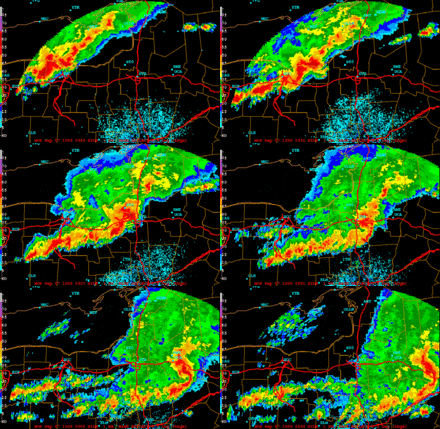
Radar loop, Labor Day 1998 Upstate New York.  This storm impacted the New York State Fair.

Radar loop, Labor Day 1998 Upstate New York. This storm impacted the New York State Fair.

The inspiration for this blog was a paper posted to LLIS by Dr. Susanne Becken, Professor of Sustainable Tourism at Griffith University (Australia) and Lincoln University (New Zealand).  The paper is titled The Christchurch Earthquake and the Visitor Sector, which is also available from this link if you don’t have LLIS access.

Dr. Becken highlights the Christchurch earthquake of February 22, 2011, which killed 185 people from more than 20 nations, 80 of which were listed as visiting, rather than residing in, Christchurch.  She states that as a result of this M 7.1 earthquake infrastructure was badly damaged, accommodation capacity was reduced by half, and the number of international visitors dropped by almost 30 percent in the aftermath.  Dr. Becken identifies many of the challenges visitors had, including loss of travel documentation and other important items, and the value of the tourism industry in the area to assist response efforts (such as providing lodging for displaced citizens as well as responders from out of the area).

This paper brings to mind the vast amounts of visitors and transient populations that are found in many communities across the nation.  When visiting an attraction such as an amusement park, where tens of thousands of people congregate on any given summer day, take a look around.  Many of the amusement parks I know of are in fairly rural areas.  These towns are likely to have small volunteer fire departments and may not even have their own police services, instead relying on a county Sheriff’s Department or State Police.  How about a small city that has popular attractions at certain times of the year, such as horse tracks or other sporting events?  These events will also draw tens of thousands of people from near and far, staying in hotels, motels, and campgrounds.  Sure, these small cities might have a 24-hour staffed fire department, and probably even a small police force.  But how prepared are these types of areas for an incident that can cause mass casualties and fatalities?

Incidents such as this underscore the need for our preparedness to be through and needs-based.  As part of our Threat and Hazard Identification and Assessment (THIRA), which is the latest evolution of the traditional hazard analysis (see CPG-201), we must be sure to recognize visitors and transient populations and the events that bring them to our areas.  We should consider tourist attractions, field days, concerts and performances, large conventions, sporting events, and even college populations.  The potential impacts, in the event of a disaster, are certainly greater with these populations given that they are likely to be unfamiliar with the area, don’t reside locally and probably have no local contacts, and aren’t familiar with the threats.  Given the nature of the event they are attending, they may very well be consuming alcohol, as well.  All this makes for a rather fragile and dependent population in the event of disaster.

Planning on the macro (community) level should consider the specifics mentioned above.  With this information you can estimate the resources needed for certain scenarios (this is part of your THIRA), which will lead you determine gaps which you then plan to address.  Take some time to examine the demographics of the visiting populations.  These demographics will help determine their level of need in the event of a disaster and some areas of support you may need to provide.  Your local chamber of commerce and/or tourism authority can be an important planning partner for this information and other purposes.  Certainly consider the nature of the events and the age range of the attendees.  Are there language or cultural issues that should be prepared for?  Much of this specific information can be obtained event by event, looking at the micro (event-specific) level of planning for these events.  In New York State, a mass gathering permit is supposed to be issued for any event estimating attendance over a certain number.  The primary purpose of these permits is to ensure that officials are aware of the event and that potable water and sanitation is appropriately available, as well as other caveats.  Most states have a similar type of permitting requirement.  Become familiar with it and use it to your advantage.

In any of these events, how will you handle alert and notification in the event of a disaster?  You may have sirens in place, but would a visitor know what it means?  Given that such a high percentage of people have cell phones, use of area blast messaging may be an appropriate consideration.

A lesson learned from airline crashes can and should be brought into your planning: family assistance centers.  Family assistance centers were brought about in the aftermath of the crash of TWA Flight 800, realizing the importance of providing support and information to the families and loved ones of victims.  This concept has been applied as a standard to other mass fatality incidents since then and has proven to be beneficial to all parties.

Be sure to conduct preparedness exercises on these plans, and include members of your local hospitality and tourism industry as they will certainly be involved in some aspect of the greater response should an incident occur.

Sometimes local communities view visiting populations as a hassle, particularly when they don’t have the care for the host community that the locals do.  These populations are usually important to the economy of the local area and, depending in the event, will be back year after year.  No matter what your take is on that argument, you must consider the safety of any visitors or tourists as if they were your own citizens.  Be prepared through regular planning, training, and exercising activities and be sure to include your local chamber of commerce, tourism and hospitality industry as they are not only stakeholders, but they have a great deal of support and information to provide.  Most importantly, remember that all good preparedness efforts begin with a solid needs assessment.  Conduct a THIRA for your community, you might be surprised with what you discover!

What experiences do you have with planning for visiting populations?