Managing an Exercise Program – Part 7: Develop Exercise Documentation

This post is part of a 10-part series on Managing an Exercise Program. In this series I provide some of my own lessons learned in the program and project management aspects of managing, designing, conducting, and evaluating Homeland Security Exercise and Evaluation Program (HSEEP) exercises. Your feedback is appreciated!

Managing an Exercise Program – Part 1

Managing an Exercise Program – Part 2: Develop a Preparedness Strategy

Managing an Exercise Program – Part 3: Identify Program Resources and Funding

Managing an Exercise Program – Part 4: Conduct an Annual Training & Exercise Planning Workshop.

Managing an Exercise Program – Part 5: Securing Project Funding

Managing an Exercise Program – Part 6: Conducting Exercise Planning Conferences

Managing an Exercise Program – Part 7: Develop Exercise Documentation

Managing an Exercise Program – Part 8: Preparing Support, Personnel, & Logistical Requirements

Managing an Exercise Program – Part 9: Conducting an Exercise

Managing an Exercise Program – Part 10: Evaluation and Improvement Planning


First I’d like to say that this series of exercise articles has gotten a fair amount of traffic, which I’m quite grateful for.  I’m hopeful that my thoughts and ideas have been able to help those who are looking for experienced insight into emergency management and homeland security exercises.  Certainly if you have anything that you’d like to contribute or have any questions, please post a comment.

We can’t avoid paperwork – ever.  Documentation in exercises, just like in the incident command system (ICS), is a necessity.  Don’t see it as a burden, though, instead view these documents as outcomes of the planning and decision-making process of exercise design.  Just like an incident action plan (IAP) is the result of the planning process in ICS, the primary documents used in exercises (Exercise Plans, Control and Evaluation Plans, Exercise Evaluation Guides, Situation Manual, and Master Scenario Events List) are outcomes of the processes of exercise design.  The graphic below is from HSEEP Volume 2 and provides a quick reference of each document I just listed.  As you will see, each document meets a specific need and is intended for a specific audience.  I will outline some of my tips on each document (except the presentation) below.

Primary HSEEP Documents

Primary HSEEP Documents

Exercise Evaluation Guides (EEGs)  The National Exercise Program provides a variety of EEG templates on their website.  These are an excellent start for your exercise.  Remember that these can and should be customized for your exercise!  While we use capabilities-based exercise planning concepts, and the capabilities are standardized, both the capacity available to anyone in each capability and the means by which a capability is implemented is going to very broadly across the country.  Bottom line: we don’t all do things the same way and we may not be evaluating an entire capability as it’s commonly defined.  EEGs need to be focused on evaluating objectives within given capabilities.  This means that exercise objectives need to be very well-developed to ensure that we are 1) designing an exercise effectively, and 2) evaluating that exercise appropriately.  If we fail in any of these steps (objective development, exercise design, exercise evaluation) we are simply wasting our time.  If need be, draw in your subject matter experts (likely the folks who will be evaluating these areas of the exercise) and get their input on the development of the EEG.  Also consider what the purpose of the EEG is: it helps guide the evaluator in providing constructive commentary on each exercise objective, which will ultimately contribute toward the After Action Report (AAR).

Situation Manual (SitMan)  A SitMan, as stated in the chart above, is used only in discussion-based exercises and is available to all participants.  It should include all information participants need to know to effectively play their role in the exercise.   The most important aspect of this is context and background of the scenario.  Without a well-developed scenario, players have a difficult time getting their ‘head in the game’.  The SitMan will also outline the exercise structure and rules of play, which can vary widely between exercise types (i.e. seminar, workshop, or table top).  Having a good understanding of this information will help players to know what is expected of them.  Be sure to have this (and all) documents reviewed for readability – your focus should be on the audience!  Under most circumstances, the SitMan can be distributed to participants ahead of time.

Controller/Evaluator Plan/Handbook  This document is very audience-focused and as such should very clearly outline the expectations you have of the controllers and evaluators.  It should fully describe their positions, schedules, locations, and scope, as well as expectations.

Exercise Plan (ExPlan)  The ExPlan is often times the core document that everyone wants a copy of – and largely everyone should have access to.  Consider the ExPlan just like the IAP of an incident.  It fully describes what is taking place, where, when, how, and who is involved.  This document will be as complex as your exercise.  For exercises involving multiple venues, each venue should have its own sub-section in the ExPlan describing all the details of what is happening there.

Master Scenario Events List (MSEL)  The MSEL is the script of the exercise.  It should capture everything that is scheduled to occur – from StartEx to EndEx and everything in between.  The bulk of the document is injects, which should be written in detail and carefully reviewed and edited for content and accuracy.  Contingency or back-up injects should also be included but specially indicated as such.  Simulators should keep track of the actual time an inject was performed and what the response was, if any.  This data can be important for both in-exercise follow-up as well as post-exercise evaluation.

Other Documents  Don’t get stuck within the confines of what’s defined by HSEEP.  If you find that you need something else, create it and use it.  I’ve found on several exercises that a very detailed scenario, perhaps even including simulated situation reports and incident action plans is needed.  We’ve come to regard this document as a Ground Truth.  The information in a ground truth doesn’t necessarily need to go to everyone (thus not including it in the ExPlan), especially if the exercise will cover multiple operational periods/shift changes, as the ground truth information is largely only relevant to the starting players.

What tips or experiences do you have with exercise documents?  What other documents have you formulated to meet needs?

Thanks for reading, and be on the look out for Managing an Exercise Program – Part 8: Prepare Support Personnel and Logistical Requirements


Managing an Exercise Program – Part 6: Conducting Exercise Planning Conferences

This post is part of a 10-part series on Managing an Exercise Program. In this series I provide some of my own lessons learned in the program and project management aspects of managing, designing, conducting, and evaluating Homeland Security Exercise and Evaluation Program (HSEEP) exercises. Your feedback is appreciated!

Managing an Exercise Program – Part 1

Managing an Exercise Program – Part 2: Develop a Preparedness Strategy

Managing an Exercise Program – Part 3: Identify Program Resources and Funding

Managing an Exercise Program – Part 4: Conduct an Annual Training & Exercise Planning Workshop.

Managing an Exercise Program – Part 5: Securing Project Funding

Managing an Exercise Program – Part 6: Conducting Exercise Planning Conferences

Managing an Exercise Program – Part 7: Develop Exercise Documentation

Managing an Exercise Program – Part 8: Preparing Support, Personnel, & Logistical Requirements

Managing an Exercise Program – Part 9: Conducting an Exercise

Managing an Exercise Program – Part 10: Evaluation and Improvement Planning

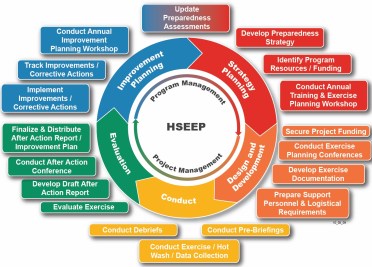
Conducting exercise planning conferences is one of my favorite parts of exercise project management (note that in these phases, we transitioned in the previous step from program management to project management – although in the big picture we are still managing our exercise program and the projects within it).

Timothy Riecker

HSEEP Cycle

You will notice that the HSEEP cycle doesn’t provide specific steps for gaining buy-in for your exercise or organizing your planning team.  These are identified in HSEEP Volume II, which you should be using as a reference.  I mentioned getting buy-in for the general concept of your exercise in Part 5 as part of building your business case for obtaining funding.  Obviously securing buy-in is extremely important as you won’t be able to move forward with the exercise initiative without the blessing of not only your executives but those of any partnering agencies or organizations.  Speaking of executives, you will want to ensure that they are provided with regular briefings (either orally or in writing – whichever is most appropriate) throughout the design phase.  It’s important to ensure their continued support, especially as the exercise is fleshed out and the commitment of their agency resources is solidified.

I won’t spend a lot of time discussing the membership of the planning team as I have given plenty of lip service in earlier posts in this series to ensuring that you surround yourself with the right people and make the right connections and partnership with other agencies.  Organization of the planning team is very important, however.  A smaller team rather than a larger one is easier to manage and coordinate – especially for your core team.  I’ve seen great success personally in two tiers of planning teams.  The first is a core team – these are the folks who do most of the work and make most of the decisions – thus they come from the most significantly involved stakeholders.  You want people know exercises and generally have experience in planning them.  The second tier planning team consists of everyone else.  There may be a number of entities who want to participate in the exercise but will have limited participation (such as most individual agencies participating in a table top exercise or in a functional exercise in your EOC).  The input of these agencies is important, as they will provide their own exercise objectives and other ideas, but their planning role is generally limited to their own participation rather than that of multiple agencies.  Not every agency needs to be represented in the planning team directly.  In the even of several fire departments, for example, being represented in a larger-scope exercise, perhaps the department which you expect to have the most participation could represent the interests of the others.  It’s important, however, to not forget that these other agencies are participating.  Many of these folks will need to be guided through the exercise planning process and provided with some assistance to ensure that they meet the deliverables due to you (such as templates for exercise objectives).  You may even want to consider some small seminars on HSEEP, specifically the exercise planning and design process.  Lastly, the individuals themselves should be folks who are not playing in the exercise.  I’m generally not a fan of the ‘trusted agent’ concept, unless you have little choice to do so.

HSEEP recommends an organization similar to an ICS-based model for your planning team.  That is, certain agencies (and their representatives) would be part of ‘command’, others would be part of operations, logistics, safety, public information, planning, etc.  Personally I’m not a fan of using a fairly rigid structure like this for exercise planning.  I find that too often, certain agencies will need to migrate from function to function.  Also, from my experience, the agencies who would be part of ‘command’ are usually also the ‘planning’ group (these agencies are usually the core, or first tier planning team).  That said, it does make sense to keep these functions in mind as they do provide for sound project/event management principles.  Going along with this, some agencies may even provide certain individuals in addition to their primary representatives to assist with some of these functions.  Examples would include information officers to put together media releases about the exercise for the public, or logistics folks to help take care of facility and other support needs, and certainly IT folks to help take care of those needs.  We’ll talk about support and logistical requirements more in Part 8 of this series.

Once you have your team assembled, it’s time to begin meetings.  For the sake of discussion, we’ll use the planning of a large multi-agency multi-jurisdiction functional or full-scale exercise as an example.  An exercise of this scope will necessitate the application of all the concepts available within the HSEEP model and thus provide opportunity for us to include them in this discussion.  I’m not going to cover all the details of the meetings, as these are covered in HSEEP Volume II as well as the toolkit, but I will provide my tips for each based upon experience and best practices.  Be sure to get invites out early to identified agencies and specifically identify the type of person you are looking for.  It should be someone very familiar with agency operations, who can fully represent (within reason) the agency and commit resources, who hopefully knows a bit about exercises and emergency management, and who will not be engaged as a player in the exercise.  They will also need to commit to a number of meetings and conference calls as well as some office work time, and may be asked to work as a simulator, controller, or evaluator during the exercise.   Be mindful of good meeting practices like the use of agendas and facilitation of discussion.  Also, be sure to follow-up with everyone after the meeting.

Note that between all of these meetings and conferences, there will be ongoing communication both with the core planning group as well as the full planning group.  These will include conference calls, e-mail exchanges, and smaller face to face meetings as needed.

Concept and Objectives Meeting

The Concept and Objectives Meeting (C&O meeting) is the first formal meeting of the full exercise planning team.  Prior to this meeting, you may pull together the core planning group to establish a planning timeline as well as prepare a presentation of the general concept of the exercise – remember, this is the first time that many of the folks in the meeting will have heard of this exercise.

HSEEP Volume II provides agenda items for this meeting.  Generally, you are providing an overview of the initial exercise concept to the group, gathering ideas on this and reaching consensus.  Volume II indicates that consensus should also be reached on objectives.  While I think some of the broader objectives can be agreed upon at this meeting, I don’t think it will be possible for objectives from all participating agencies to be obtained with a large planning group.  Take the opportunity, however, to discuss what you are looking for, provide sample objectives, and guidance on how to write exercise objectives.  Set a deadline for participants to get these back to you.  A few days should be reasonable.  Lastly, at the C&O meeting, the group may identify other agencies who might be interested in participating.  These agencies should be approached soon after this meeting and invited to the Initial Planning Conference.

Initial Planning Conference

The Initial Planning Conference (IPC) is certainly where exercise participants and objectives should be settled.  You really want to minimize changes after this meeting as the impact they can have on exercise planning and design will be amplified.  The IPC is where the foundational concepts of the exercise will be fleshed out, including venues, duration, political sensitivities, the scenario, and other details.  This meeting largely consists of presentations by the core planners and discussion and consensus by the larger group.  It’s important to get these details solidified with every participant, as stragglers can cause a great delay in progress.  Read-ahead materials are important for all these meetings.  Certain assignments will be given to people and agencies to secure resources and to identify specific roles, including the leadership for exercise control, evaluation, simcell, and others that may be needed – as well as the documentation that goes with them, such as an evaluation plan.  As needs are identified, they should be logged and assigned.  Here’s where you engage participants in starting to address logistical and support needs.

Mid-term Planning Conference

MPCs are usually only used during larger, more complex exercises.  Don’t let that fool you, though – there is probably not only a need to meet, but a lot of work to get done as well.  Schedule it ahead of time, but cancel if you don’t need it.  Since it’s optional, there is really no specific guidance, other than ensuring to go into it with defined purpose, an agenda, read-ahead materials (such as drafts of exercise documentation), etc.  As HSEEP Volume II mentions, it’s usually a working meeting designed to get pen to paper and hammer out details.  Volume II also suggests that this is a good opportunity to walk through exercise venues to make sure they are suitable and to discuss layout and support needs.  This is also a good time to lock down the location, set up, and support needs of a simcell and to identify simulators.

Master Scenario Events List (MSEL) Conference

The focus of the MSEL conference is the development of the MSEL.  The Master Scenario Events List is the detailed timeline of the exercise, identifying everything from the start and end times to detailing every inject and expected player action.  While the writing of the MSEL (mostly injects) is often times work that falls to the core planning group (and often times consultants), the MSEL conference is used to pull participating agencies together to draft injects for their agency or function.  Here is where they bring their objectives to life, providing the outlines for injects (which will likely be refined later by the core planning group) to drive play for their agency to accomplish the objectives of their participation in the exercise.  The MSEL conference is really a workshop.  You can break out like-agencies into table groups where they can brainstorm and outline injects, as well as identify any issues to be aware of.  The best way of doing this is to assign a facilitator (usually a member of the core planning group) to each table to get them motivated, keep them on task, and to document progress.  Pay special attention to the outcomes as they may cause need to alter earlier preparations such as venue needs.  More on the MSEL in Part 7 of this series.

Final Planning Conference

The Final Planning Conference (FPC) is just that – final!  This is an informative meeting where everything is reviewed and agreed upon to be finalized.  Any outlying issues must be resolved here.  Participants should have reviewed all documents ahead of time so they can ask questions and provide their approval.  This conference should take care of any last-minute issues.

What have you learned from your experienced with exercise planning meetings?  I’d like to hear about your experiences and ideas!

Look out for Managing an Exercise Program – Part 7: Developing Exercise Documentation.


Managing an Exercise Program – Part 5: Securing Project Funding

This post is part of a 10-part series on Managing an Exercise Program. In this series I provide some of my own lessons learned in the program and project management aspects of managing, designing, conducting, and evaluating Homeland Security Exercise and Evaluation Program (HSEEP) exercises. Your feedback is appreciated!

Managing an Exercise Program – Part 1

Managing an Exercise Program – Part 2: Develop a Preparedness Strategy

Managing an Exercise Program – Part 3: Identify Program Resources and Funding

Managing an Exercise Program – Part 4: Conduct an Annual Training & Exercise Planning Workshop.

Managing an Exercise Program – Part 5: Securing Project Funding

Managing an Exercise Program – Part 6: Conducting Exercise Planning Conferences

Managing an Exercise Program – Part 7: Develop Exercise Documentation

Managing an Exercise Program – Part 8: Preparing Support, Personnel, & Logistical Requirements

Managing an Exercise Program – Part 9: Conducting an Exercise

Managing an Exercise Program – Part 10: Evaluation and Improvement Planning

Timothy Riecker

HSEEP Cycle

Nothing moves without funding – nothing.  Without funding, good ideas are nothing more than that – ideas.  I’ve seen many ideas and initiatives die before they even made it to the proverbial chopping block, simply because of a lack of money to support them.  This is the time of year when we see a lot of new ideas.  In public and private sectors alike, our leaders, motivated either by legislative writ or self driven compulsion, give us an annual speech to ring in the new year.  These speeches come with lofty ideas – many of which we never see get off the ground because funding is never allocated.  So where do we get money to conduct exercises?

Timothy RieckerAdmittedly, my expertise lies in government and the funds available to build and sustain emergency management programs – not so much in the private sector and not for profit areas, but I’ll give these a crack.  Public sector funds consist largely of the Homeland Security Grant Program (HSGP).  HSGP funds a myriad of emergency management and homeland security grants including the Emergency Management Performance Grant (EMPG), the Urban Area Security Initiative (UASI), Operation Stone Garden (OPSG), and others, including Citizen Corps which is now no longer a separate grant program, but instead an optional allocation which states may choose to provide.  Generally, exercises, and the expenses associated with all steps of the exercise program and project, are allowable expenses for all these grant programs.

How do you get these funds?  Well, the bad news is that if you don’t already receive them, you probably can’t.  There are some allocations, like Citizen Corps, which may be granted to jurisdictions by the state, but with this example you need to build a local Citizen Corps program and exercise only that program with any dollars you receive.  If you do receive some of these HSGP funds, the challenge is in reallocation of dollars that are probably needed elsewhere, and budget increases are probably out of the question.  So here’s where we have to get creative.  Reach out to the folks who were involved in your TEPW – all those agencies and organizations.  Try to gain consensus on the need for an exercise (or building-block series of them).  Most or all of these agencies may have an interest if you had a successful TEPW and managed to combine some exercise initiatives.  Don’t forget your private sector partners, either – especially if they are members of your Local Emergency Planning Committee (LEPC), as they may take special interest in preparedness.  Be sure to have a plan and make a business case.  The TEPW that you just conducted (see the previous post in this series) provides you with an excellent statement of need and a plan to address it.  You may have additional supporting documentation like after action reports, which can help add some context to your need for exercise funding.  Build a budget and know how much to ask for.  If each agency and organization can contribute a portion, that will all add up fairly quickly.  Don’t forget the possibility of sponsorships, as well.  I once managed to secure lunches to be provided for all exercise participants (about 150 of them!) in exchange for a medical supply vendor setting up in a near-venue area and giving a presentation during lunch, including the opportunity for folks to try out some of their equipment.

In the private sector, fighting for budget can be tough – especially when it’s not tied to a profit center.  My advice here (and again I have limited experience in this area, so if you have any ideas, please post them!) is, similar to the public sector, 1) make a good business case for it (i.e. improved safety, response coordination, and decreased down time all minimize the loss of revenue), 2) have a plan, and 3) if you are just starting an exercise program – start small.  Let the executives see the potential that can be gained from larger investments in your program.  Similarly, if you can partner with a local public safety exercise, be sure to invite your executives to see how it goes and be ready to explain the benefits to your company.

As for not for profits, largely it’s a combination of the public and private sector tips.  Also, consider seeking grants from foundations for the specific purpose of preparedness.  Don’t just limit yourself to local foundations, either.  Their may be companies that specialize in first responder or emergency equipment that may have a foundation.  I would guess that their foundations would have a particular interest in preparedness activities.

Overall, be sure to plan early.  Don’t expect to seek funding for an exercise that you have planned for a couple of months down the road.  It may take as long as a year to get your financial ducks in a row.

As always, if anyone has any additional thoughts or ideas, I’d love to see them!

Coming soon… Managing an Exercise Program – Part 6: Conducting Exercise Planning Conferences.  It’s more than just meetings!

Managing an Exercise Program – Part 4: Conduct an Annual Training & Exercise Planning Workshop

This post is part of a 10-part series on Managing an Exercise Program. In this series I provide some of my own lessons learned in the program and project management aspects of managing, designing, conducting, and evaluating Homeland Security Exercise and Evaluation Program (HSEEP) exercises. Your feedback is appreciated!

Managing an Exercise Program – Part 1

Managing an Exercise Program – Part 2: Develop a Preparedness Strategy

Managing an Exercise Program – Part 3: Identify Program Resources and Funding

Managing an Exercise Program – Part 4: Conduct an Annual Training & Exercise Planning Workshop.

Managing an Exercise Program – Part 5: Securing Project Funding

Managing an Exercise Program – Part 6: Conducting Exercise Planning Conferences

Managing an Exercise Program – Part 7: Develop Exercise Documentation

Managing an Exercise Program – Part 8: Preparing Support, Personnel, & Logistical Requirements

Managing an Exercise Program – Part 9: Conducting an Exercise

Managing an Exercise Program – Part 10: Evaluation and Improvement Planning

Timothy Riecker

HSEEP Cycle

As HSEEP Volume 1 states, “The basis of effective exercise program management is a Multi-Year Training and Exercise Plan.”  The MYTEP is the product of a Training and Exercise Planning Workshop (TEPW), a collaborative which should be conducted annually to update the plan (and the collaborating partners!) with any changes in preparedness priorities, funding, or other influential factors.  I really can’t underscore the importance of the TEPW and MYTEP enough – they truly are the backbone of an effective exercise program.

First the TEPW needs to be scheduled and attendees invited.  This workshop should include not only your core planning team (discussed a bit in part 3), but should also expand to others within the sphere if influence and coordination.  States should invite relevant state agencies, a representation of counties (as it would be unwieldy to invite all of them), key cities and/or Urban Area Security Initiative groups, key Federal partners (like FEMA, EPA, DOE, USCG), as well as major not for profits or VOADS, and critical infrastructure private sector folks or authorities like utility or rail companies or regional transit authorities.  Counties should invite key county and state agencies, a representation of local governments, representatives of key groups like the county fire chief’s association, not for profits or VOADs, and those critical infrastructure folks within the county – including school districts and colleges.  Cities, towns, and villages should all follow suite similarly.  Not for profits and private sector folks need to ensure that they are invited to the table of the meetings of others (are you part of a local emergency planning committee – LEPC???) – and for conducting their own TEPWs (not required, but a good idea) need to consider where their primary operations take place and who they have significant relationships with relative to preparedness.  In the end it can be quite a crowd.  You want to be certain that the invites go to the right people (i.e. the exercise program managers, if they have them, or the emergency managers for these entities).  Stress that this is a workshop – where work gets done – so they can’t just send someone to ‘hold a seat’.  It needs to be someone who can represent the organization and its interests in the area of preparedness.  The invite should also state what key information they should be prepared with and prepared to discuss, like major preparedness training and exercise initiatives.

The HSEEP website provides some detailed guidance on TEPWs, a sample agenda, and even a draft invite letter and presentation on its resources website.  You’ll notice that the agenda is a VERY full day.  Don’t try to cut any corners – and I would even encourage a working lunch.  It’s frustrating to hold people longer than planned and even more frustrating to spend a full day in a workshop and not accomplish what you set out to do.  During the workshop, participants should review priority preparedness capabilities and coordinate exercise and training activities that can improve and validate those capabilities. As a result of the workshop, the Multi-Year Training and Exercise Plan outlines a multi-year schedule and milestones for execution of specific training and exercise activities.  Just as importantly, the TEPW helps to deconflict any exercise issues that may exist between these partners, like avoiding scheduling major exercises too closely to each other.  As part of this process, be sure to discuss major areas for improvement discovered from After Action Reports of earlier exercises – the implemented improvements should be tested.

During the TEPW, you will start to populate an exercise calendar.  Some partners will have dates set, others may only be able to narrow it down to a month or calendar quarter.  Around these exercise activities and their known major objectives, training programs can be identified and roughly scheduled as well.  This is the beginning of your MYTEP.

Conducting a TEPW and formulating a MYTEP is not only the first step toward HSEEP compliance, it is also the foundation of your program.  Through the TEPW, your organization and its partners will identify training and exercise requirements, goals, and benchmarks; ideally forecasted out three to five years.  You start with regulatory and other legal requirements, include grant and funding deliverables, and initiatives driven by the organizational mission and emergency management functions.  If the organization has a goal of revising a certain emergency plan by the end of the calendar year, then it would be a good idea to include an exercise testing that plan.  Through the process of the TEPW, you will identify what level of exercise is appropriate: ranging from a seminar to a full-scale exercise; and opportunities to capitalize on different exercise initiatives, merging exercises and leveraging combined efforts and funding – especially between different agencies and organizations.  Finally, you should identify training opportunities to ensure that personnel have the tools they need to function properly.

A TEPW can be complex and fast-paced.  There can be a lot of attendees all needing to get their information out.  The preparedness of the facilitator and attendees is absolutely critical to the success of the TEPW and the quality of the MYTEP.  If you’ve never done one, reach out to someone who has to help you along – including me.

Happy New Year to all and be on the look out for Managing an Exercise Program – Part 5: Securing Project Funding.

Managing an Exercise Program – Part 3: Identifying Program Resources and Funding

This post is part of a 10-part series on Managing an Exercise Program. In this series I provide some of my own lessons learned in the program and project management aspects of managing, designing, conducting, and evaluating Homeland Security Exercise and Evaluation Program (HSEEP) exercises. Your feedback is appreciated!

Managing an Exercise Program – Part 1

Managing an Exercise Program – Part 2: Develop a Preparedness Strategy

Managing an Exercise Program – Part 3: Identify Program Resources and Funding

Managing an Exercise Program – Part 4: Conduct an Annual Training & Exercise Planning Workshop.

Managing an Exercise Program – Part 5: Securing Project Funding

Managing an Exercise Program – Part 6: Conducting Exercise Planning Conferences

Managing an Exercise Program – Part 7: Develop Exercise Documentation

Managing an Exercise Program – Part 8: Preparing Support, Personnel, & Logistical Requirements

Managing an Exercise Program – Part 9: Conducting an Exercise

Managing an Exercise Program – Part 10: Evaluation and Improvement Planning


Exercises can be very resource intensive, have no doubt about that.  Generally speaking, the more you invest in them, though, the more you get out of them.  Certainly discussion-based exercises are usually not as expensive as operations-based exercises.  For all exercise types, however, the largest costs are in the design (staff or consultant time, as well as meeting time), and conduct (again, staff or consultant time, plus the time of the participants).  What resources do you need for your exercise program as a whole?  How do you get them?

First of all, let’s discuss human resources.  In Managing an Exercise Program – Part 1, I discussed the importance of having an exercise program manager and what some of the qualifications should be for that person.  A program manager is probably the most important human resource you could have for exercises, but certainly this person can’t do it alone.  A good exercise program is able to leverage the experience, support, and ideas of others – both within and outside.  The exercise program manager needs to be a great networker, able to draw people from various agencies into a mutually beneficial partnership.  Some of these agencies will come and go, but some will be strong, permanent partners.  Each partner agency, including your own, should be contributing to the efforts of the group – not only with ideas, but with people to serve as controllers, evaluators, planning team members, etc., physical resources suitable for whatever types of exercises you conduct, and perhaps even funding.

In March of 2008, I founded and co-chaired the New York State Exercise Coordination Committee, composed of several state agencies, departments, authorities, and the Red Cross.  Meeting regularly and communicating often, we were able to pool our resources not only for each individual exercise, but for exercise program management as a whole throughout New York State.  We formulated consistent policies and practices, allocated Homeland Security funds state-wide for exercises and corrective actions, and developed and delivered exercise-related workshops and training courses.  We became the core group for the Training & Exercise Planning Workshop (more on this in the next part) and applied for and coordinated funding requests to FEMA for the Regional Exercise Support Program (RESP), which provided contractor resources to state and local exercise initiatives.  We were not only able to help each other, but we were able to benefit the state as a whole.  This model can be applied to other states; county and local governments; and consortia of public, private, and not for profit groups.

Keep in mind that the HSEEP cycle is just that, a cycle.  You will constantly be revisiting each of these steps – sometimes out-of-order – including determining needs and sourcing of resources.

HSEEP Cycle

HSEEP Cycle

What resources do you think you will need to manage your program?

Be on the lookout for Managing an Exercise Program – Part 4: Conducting an Annual Training & Exercise Planning Workshop.

Managing An Exercise Program – Part 2: Developing the Preparedness Strategy

This post is part of a 10-part series on Managing an Exercise Program. In this series I provide some of my own lessons learned in the program and project management aspects of managing, designing, conducting, and evaluating Homeland Security Exercise and Evaluation Program (HSEEP) exercises. Your feedback is appreciated!

Managing an Exercise Program – Part 1

Managing an Exercise Program – Part 2: Develop a Preparedness Strategy

Managing an Exercise Program – Part 3: Identify Program Resources and Funding

Managing an Exercise Program – Part 4: Conduct an Annual Training & Exercise Planning Workshop.

Managing an Exercise Program – Part 5: Securing Project Funding

Managing an Exercise Program – Part 6: Conducting Exercise Planning Conferences

Managing an Exercise Program – Part 7: Develop Exercise Documentation

Managing an Exercise Program – Part 8: Preparing Support, Personnel, & Logistical Requirements

Managing an Exercise Program – Part 9: Conducting an Exercise

Managing an Exercise Program – Part 10: Evaluation and Improvement Planning


In my last post, I outlined the initial needs of managing a preparedness exercise program, including sources of information for a preparedness assessment.  Recognized as a best practice, I’m following the model of the Homeland Security Exercise and Evaluation Program (HSEEP).  The next step of program management is developing a preparedness strategy.

HSEEP Cycle

HSEEP Cycle

The development of a preparedness strategy is an activity that will involve the highest levels of your organization.  Drawing upon the data collected in the last step (the preparedness assessment), the preparedness strategy will address overcoming the identified gaps in your preparedness.  The mnemonic to remember here is POETE or Planning, Organization, Equipment, Training, and Exercises.  The gaps you identified in your assessment should fall into one of these categories.

Once you have catalogued your gaps, you must develop strategies to overcome each gap.  Here are some helpful hints in strategic planning:

1) Define the gap and identify the underlying cause(s).

2) Create objectives to overcome each gap.  Remember that objectives must be SMART (Specific, Measurable, Attainable, Realistic, and Time-oriented).

3) Establish priorities.  Some gaps may have a higher priority to accomplish based on the vulnerability they pose, legal or regulatory requirements, or other matters.  Additionally, some objectives may need to be accomplished prior to others for many of the same reasons, as well as practical flow of processes.

4) Assign required actions – identify specific actions required to accomplish each objective (there may be several).  Identify who will be responsible for each action and who will be responsible for supporting their work.  Establish a realistic deadline.  NOTE: some gaps may take a long time (years) to overcome.  As such, do the best you can to outline objectives and keep in mind that strategic plans are ‘living documents’.  Early on, you may not be assigning tasks to overcoming certain gaps, but someone will be responsible for monitoring related issues.

5) Marry needed resources to each action item established above.  This may be personnel, funding, facilities, etc.

6) As work is being done to accomplish these tasks, continual monitoring and assessment is necessary to ensure that everyone is staying on track and that the strategic plan continues to reflect the direction and priorities of today.

There are many references out there for strategic planning.  With a bit of insight you can translate this guidance into something useful for these purposes.  The end goal of this step is to have a document in hand that identifies what your organization needs to accomplish to be better prepared.  From this, you will soon develop exercise goals which will be the cornerstone of your exercise program.

What successes have you found from your strategic planning experience?

Coming soon – Managing an Exercise Program Part 3: Identifying Program Resources and Funding.

Managing an Exercise Program – Part 1

This post is part of a 10-part series on Managing an Exercise Program. In this series I provide some of my own lessons learned in the program and project management aspects of managing, designing, conducting, and evaluating Homeland Security Exercise and Evaluation Program (HSEEP) exercises. Your feedback is appreciated!

Managing an Exercise Program – Part 1

Managing an Exercise Program – Part 2: Develop a Preparedness Strategy

Managing an Exercise Program – Part 3: Identify Program Resources and Funding

Managing an Exercise Program – Part 4: Conduct an Annual Training & Exercise Planning Workshop.

Managing an Exercise Program – Part 5: Securing Project Funding

Managing an Exercise Program – Part 6: Conducting Exercise Planning Conferences

Managing an Exercise Program – Part 7: Develop Exercise Documentation

Managing an Exercise Program – Part 8: Preparing Support, Personnel, & Logistical Requirements

Managing an Exercise Program – Part 9: Conducting an Exercise

Managing an Exercise Program – Part 10: Evaluation and Improvement Planning


From inception to improvement planning, I think preparedness exercises provide great value to the jurisdictions, companies, and organizations that do them.  From a seminar to a full-scale exercise, there is much to be learned by participants as well as the strengths and areas for improvement identified from emergency plans.  I’ve been inspired to write a series of blog posts on each of the phases within the Homeland Security Exercise Evaluation Program (HSEEP) cycle.  The cycle, shown below, encompasses not just the steps in executing an exercise (project management), it includes exercise program management as well, which I think is often neglected.  Doings exercises is great, but to ensure continuity, quality, and continuous improvement, any entity that does exercises should have an exercise program.  Having a structured exercise program will ensure that your organization capitalizes on your exercise investments to the greatest degree possible.  Just like any other functional program, it needs to be managed.

HSEEP Cycle

Each blog post will give some insight and lessons learned from my own experiences with exercises large and small and I will reflect on exercise program management responsibilities throughout the cycle.  For more in-depth information on exercise program management, I refer you to HSEEP Volume I.  I will also have an update on this HSEEP volume in the near future as DHS will soon release a revision.

The first thing I want to cover is exercise program management as a general concept.  As stated in HSEEP Volume I, “Exercise program management is directed toward achieving the objectives established during the multi-year planning process…”.  As an exercise program grows, so should the responsibilities of managing it.  Most organizations don’t need a full-time exercise program manager, but they will require someone with the flexibility to vary how much time they spend on the exercise program.  The planning and conduct of an exercise can take up a considerable amount of time, and the program manager needs to shepherd this process.  In small organizations, the exercise program manager may be one of the few people involved in these activities as well.

Obviously the person in charge of an exercise program needs to be knowledgeable and experienced in exercises.  As with the oversight of any program, you need to have the right person in place.  Some caution should be used here, however – there are plenty of folks with LOTS of exercise experience… BUT the vast majority of experience out there is as a player.  Players, as a general rule, don’t experience all the machinations behind putting an exercise together.  Someone may have been a player in the largest exercise known to human kind, but that doesn’t make them adept at exercises.  There is plenty of training out there addressing various areas of exercises: the HSEEP training course, Exercise Design, Exercise Evaluation, and others.  These are great – but the world is full of ‘trained’ people.  Do they have the experience to do the job?  It doesn’t take a lot of experience, in fact, in my opinion, a little experience can go a long way – especially if it’s the right experience and they were taught the right way to do it from someone with a lot of experience.  I’ve fully immersed interns in many of the areas of exercise program management and would be fully confident in their ability to run a program for an organization.

As mentioned above, exercise program management centers on the multi-year training and exercise plan (MYTEP), which makes sense as this document will outline requirements, goals, and benchmarks for the program.  Building this plan is not the first, though.  We know that before we can write a plan, we need to do an analysis or an assessment of where we stand.  This is why the first step in the HSEEP cycle (above) is Updating Preparedness Assessments.  As much of a fan as I am of the HSEEP documents, they do fall rather short on providing guidance relative to this step.  It can be broken down easily enough, though.

A preparedness assessment, to me, would identify where we stand and where we want to be in terms of preparedness.  The resultant gap would then feed the second step in the HSEEP cycle – developing a preparedness strategy.  Let’s define preparedness: traditionally, it involves planning, training, and exercising; we can build from this to give us the data we need.  An absolute priority is identifying and assessing risk.  Hopefully your jurisdiction has a recent hazard analysis or THIRA, or your company or organization has a recent business impact analysis (BIA).  Having a recent hazard analysis done will identify the threats you need to be prepared for.  If you don’t have a recent one of these, I would suggest that you are way ahead of yourself with exercises and need to take a step back in emergency management to do one of these and build a plan.  Based upon the results of your hazard analysis, do you have the necessary plans (and are they up to date?) to address the hazards?

The second assessment should be a capabilities assessment.  You can reference FEMA‘s list of core capabilities to ensure that you are examining everything you need to.  Keep in mind that not everyone needs to have every capability.  You may not have a need for certain capabilities or it may not be feasible for you to have it based upon costs – so long as you can obtain that capability from someone else in times of disaster.  However, there are certain capabilities, based upon your hazards, that you want to ensure that you have.  If you don’t have them, they need to be developed.  That’s a gap.

A third assessment, related to the second, would be to identify needs to develop personnel capabilities – specifically through the means of training.  Yep, a Training Needs Assessment.  I’ve blogged previously about this.  Your identified needs become another gap to include in your preparedness assessment.

Lastly, you should do an assessment of exercises and real life events to date.  While you are just starting to formalize your exercise program, I still think an assessment of exercise progress to date is important.  While you may not have had a formal program, you have likely done some exercises or at least participated in someone else’s.  What plans have been tested with these exercises?  How long ago were they conducted?  Do you have After Action Reports?  (Read my article in Emergency Management Magazine on the importance of AARs and implementing corrective actions).  How about lessons learned and after action reports from actual incidents?  What gaps from these still need to be addressed?

All of this data and these documents can be pulled together and referenced in a simple, cohesive document outlining your preparedness needs.  It seems like a lot of work, but without identifying our needs, we can’t move forward with an effective exercise program.

What are your thoughts on identifying preparedness needs?  Is there anything I’ve missed?

Thanks for reading and be on the lookout for part two of Managing an Exercise Program where I will outline the development of a preparedness strategy.


The Monster Mash – What’s with the Zombie Thing in Emergency Management?

In May of 2011 the Centers for Disease Control (CDC) unleashed its Zombie Preparedness campaign upon the world.  This campaign took off like a flesh-eating monster, encouraging preparedness throughout the nation and prompting similar campaigns in other countries.  My guess is that the CDC took a creative prompt from the current pop culture zombie craze (mostly fueled by AMC’s The Walking Dead series – yep, I’m a big fan – note: season 3 starts on October 14th) as well as from the common sense, yet tongue-in-cheek group known in Zombie Squad.  Zombie Squad, whose website says they have been around since 2003.  ZS (as they are known) “… is an elite zombie suppression task force ready to defend your neighborhood from the shambling hordes of the walking dead.” “When the zombie removal business is slow we focus our efforts towards educating ourselves and our community about the importance of disaster preparation.”

So how does this all make sense?  Actually, it fits very well.  Contrary to the other monster fad currently sweeping the globe – vampires – which seems to be intent on teenage-level love stories, this zombie business is serious, really.  The Walking Dead has spurred many conversations in on-line discussion boards and in my own home about people functioning and surviving when society has crumbled around them.  Zombieism is also a disease, so all the concepts that go with a major disease, such as transmission prevention, isolation and quarantine, treatment, vaccination, etc. all apply.

From a preparedness angle, the zombie concept works well. On the CDC website, their director, Dr. Ali Khan explains “If you are generally well equipped to deal with a zombie apocalypse you will be prepared for a hurricane, pandemic, earthquake, or terrorist attack.”  They then further encourage people to get a kit, make a plan, and be prepared.  It’s great that we’re all using the same message!  The Zombie Squad website also encourages the same.

Now how about from the prospective of emergency response and emergency management folks?  Surely, we can’t be swayed by this pop culture silliness as well?  We sure can – and I think it’s great!  For many of the same reasons explained earlier, we can draw many similarities between a zombie attack and an actual incident.  Sure, we take some liberties and we have a little fun with it, but why can’t we?  A successful exercise is one that tests our objectives, is it not?  Drawing the scenario similar to a pandemic or hazardous materials type of incident, agencies are testing objectives related to mass casualties, mass fatality management, isolation and quarantine, public messaging, incident command, crowd control, looting, disease prevention, points of distribution, etc.  So many times I had heard from those who taught me ‘the art of exercises’, that the scenario really doesn’t matter, it’s all about the objectives.  Sure, in the past we’ve always given consideration to the scenario being realistic so that the participants buy into it, but I think many can totally get into the zombie thing.  This local exercise is using the zombie theme later this month (they are even giving prizes for things such as ‘best zombie walk’ to encourage volunteers to come for this, and yes, they are holding a ‘Thriller’ dance!), and you’ve probably seen articles on National Guard and Department of Defense units using a zombie attack as their scenario.

Bottom line, it’s fun, it’s effective, and it’s a graveyard smash!

Using Layered Exercises to Add Value to an Exercise Initiative

Over the last several years, I have had the opportunity, and the pleasure, to lead and participate in some very significant exercises. For some of these larger exercises (mostly functional) we were more interested in testing objectives associated with activities which would occur 72 or 96 hours into the incident (i.e. well after the initial response phase). I’ve made the mistake of scripting (assuming) what would be accomplished in those first few operational periods in an effort to set up the players sufficiently for play starting a few days into the incident. Despite my experience, the input of others, and some dedicated writing it would be rather heavily criticized (i.e. “We would never do that!”). The end result was not only some disgruntled participants, but also skewed results. What we needed was the players to write that part of the exercise for us.

So that’s exactly what they did – or rather, they told us what to write. We accomplished this by conducting a table top exercise with the agencies who would be most heavily involved in the response for those first several operational periods. Through careful structure and injects we were able to walk away with the data we needed to create an Incident Action Plan and a detailed briefing which could be provided to the players for the functional component of the exercise. We had to allow ourselves a few weeks between the TTX and the FE to create a detailed and workable IAP (all based on the actions of the agencies at the TTX) along with the supporting information and materials they needed to help get up to speed – this document we called a ‘Ground Truth’. This methodology resulted in a far better functional exercise, allowed us to bring in first responder agencies for the table top exercise (who where actually happy getting to discuss a response beyond the first operational period), and got us a lot of bang for our buck.

The planning of these types of undertakings is a bit more complicated than just planning one exercise. First of all, you truly are planning two exercises at the same time. While obviously the functional exercise is the most complex, don’t leave planning for the TTX until the last minute as so much actually hinges on the outcome of the TTX. That said, there is still plenty of work that can be done to prepare for the fuctional exercise before the TTX occurs. Much of the MSEL can be developed, but it will need some tweaking based on the information that comes out of the TTX. Be sure to have plenty of evaluators and note takers (I know – this isn’t an official HSEEP function) on hand at the TTX to capture their discussion and actions.

I’ve led a few ‘layered’ exercises such as this and will be evaluating another at the end of this month. I’d encourage you to consider the potential value in this approach for your next exercise.