7 Emergency Management Priorities for the Next Administration

Heritage.org recently published a piece outlining the top four homeland security priorities for the next administration, which can be found here.  It’s a thought provoking article that certainly identifies some important issues.  In the same spirit, I’d like to offer what I think are the emergency management priorities for the next administration.

1) Support an Effective FEMA Organizational Model

The Heritage.org model pointed out several issues with the DHS organization that need to be addressed sooner rather than later.  I’d like to add some FEMA-specific items to their suggestions, regardless of if FEMA is kept within DHS or not (honestly, I think that ship has sailed and FEMA is there to stay).

In building a bit of background for this article, I took a look at FEMA’s current strategic plan, knowing that the document already identifies some of their priorities.  Within in that list of priorities, they mention mission and program delivery, becoming an expeditionary organization, posturing and building capability for catastrophic disasters, and strengthening their organizational foundation.  To me, these four all directly relate to their organizational model.

Along with having a strong central administration of programs, FEMA needs to have agility in their program delivery.  This is best accomplished through the FEMA regional offices, which act as an extension of the ‘central administration’ by coordinating directly with states and neighboring regions to apply those programs in the best possible manner within the guidelines of the program.  While this is currently performed, it is not performed to the greatest extent possible.  John Fass Morton provides some great perspective on this approach in his book ‘Next-Generation Homeland Security’.  Info on the book can be found here.

2) Bolster Risk Reduction Programs

I write often about preparedness, as that has always been a focus of my career.  Risk reduction, however, is essential to eliminating or reducing the impacts of hazards on communities.  Risk reduction includes all aspects of hazard mitigation and resilience, which are ideally applied at the local level but supported by state and federal programs, policies, and resources.

While the National Weather Service has implemented and promoted the StormReady program, which encourages community resilience, the best program we have ever had in our field is Project Impact.  I’d love to see a revival of Project Impact (call it that or something else – I don’t really care), incorporating the concepts of StormReady as well as other best practices in risk reduction.  A big part of this program MUST be incentivization, especially access to funds that can be applied for in the present for hazard mitigation activities.

3) Build a Better Cybersecurity Program

This item was added to the list by a colleague of mine.  It’s also found on the Heritage.org list.  It must be pretty important, then.

Yes, there are a LOT of initiatives right now involving cybersecurity, but I think there can be more.  Jon, the same colleague who suggested this for my list has also stated repeatedly that cybersecurity is really a Core Capability that cuts across all mission areas – Prevention, Protection, Response, Mitigation, and Recovery.  The recent update of the National Preparedness Goal suggests this, but sadly doesn’t commit.

What do we need in regard to cybersecurity?  First of all, we need to demystify it.  There are plenty of people out there who have just enough tech savvy to turn on their computer, send some email, and post to Facebook.  While that may work for them, they are likely intimidated by talk of cybersecurity, hackers, and the like.  We need to continue programs in plain speak that will help to inform the average consumer about how to protect themselves.

Better coordination with the private sector will pay off heavily when it comes to cybersecurity.  Not only is the private sector generally better at it, they also have a tendency to attract experts through better incentives than the government can offer, such as higher pay.  Cybersecurity also impacts everyone.  We’ve seen attacks of all types of systems.  The only way to stop a common enemy is to work together.  Let’s think of it as a virtual whole-community approach.

4) Prepare for Complex Coordinated Attack

Another of Jon’s suggestions.  While terrorism is often quickly shoved into the category of homeland security, there is a lot that emergency management can assist with.  These types of attacks (think Mumbai or Paris) have a significant impact on a community.  They require a multi-faceted approach to all mission areas – again, Prevention, Protection, Response, Mitigation, and Recovery.  While law enforcement is clearly a lead, they must be strongly supported by emergency management as part of a whole-community approach to be successful. Preparedness across all these mission areas must be defined and supported by federal programs.

5) Infrastructure Maintenance

We have roads, bridges, rail, pipes, and other infrastructure that MUST be maintained.  Maintenance (or replacement) will not only prevent failure of the infrastructure as a disaster itself, but will also make it more resilient to impacts from other disasters.  Yes, these are projects with huge price tags, but what alternative do we have?

6) Continuity of Existing Model Programs

There are few things more infuriating than a new administration wiping the slate clean of all predecessor programs to make room for their own.  While every administration is entitled to make their own mark, getting rid of what has been proven to work is not the way to do that.  Eliminating or replacing programs has a significant impact all the way down the line, from the federal program administrators, to the state program people, to the local emergency managers who are often understaffed and underfunded to begin with.

Changing gears is not as simple as using a different form tomorrow, it requires research and training on the new program and costs time to re-tool.  While I would never say there is nothing new under the emergency management sun, as I believe we are still innovating, I’m pretty skeptical of some new appointee walking into their job and making wholesale changes.  While improvements can certainly be made, summary execution of successful programs does no one any good.  Let’s not make change simply for the sake of change.

Related to this, I fully support the efforts of FEMA in the last few years to gain comprehensive input on changes to documents and doctrine through the formation of committees and public comment periods.  This approach works!

7) Pull Together Preparedness Programs

NIMS, HSEEP, NPG, THIRA, etc… While each of these programs have their own purpose and goals, more  can be done to bring them together.  I’m not suggesting a merger of programs – that would simply make a huge mess.  What I’m suggesting is to find the connections between the programs, where one leads to another or informs another, and highlight those.  Things like better application of the Core Capabilities within HSEEP exercises to have a more effective evaluation of NIMS capabilities (I suggested this while being interviewed for a GAO report), or referencing the THIRA when building a multi-year training and exercise plan.  While some jurisdictions may already do this, these are best practices that should be embraced, promoted, and indoctrinated.  These links typically don’t add work, in fact they capitalize on work already done, allowing one project/program/process to be informed or supported by another, creating efficiencies and supporting a synchronization of efforts and outcomes.

There is my list of seven.  What are your thoughts on the list?  There are certainly plenty of other ideas out there.  If you had the ear of the next President, what would you suggest be their administration’s emergency management priorities?

© 2016 – Timothy Riecker

Emergency Preparedness Solutions, LLCYour Partner in Preparedness

Don’t Just Take It From Me – There are Issues with ICS Training

The February 2016 edition of the Domestic Preparedness Journal highlighted, among other things, some concerns with ICS training in the United States.  First off, if you aren’t subscribed to the DPJ, you should be.  It’s free and they offer good content, with few extraneous emails beyond the journals.  Check them out at www.domesticpreparedness.com.

The specific article in this issue I’m referencing is Incident Command System: Perishable if Not Practiced, by Stephen Grainer. Mr. Grainer is the Chief of Incident Management Systems for the Virginia Department of Fire Programs.  Steve has a significant depth in ICS and understands all the nuances of preparedness and application.  I first met him when serving on the national NIMS steering committee with him several years back.

The title of the article is a bit deceptive – it’s not just focused on the issue of the training being perishable.  Right up front, Mr. Grainer, who is a longtime supporter and advocate of ICS, outlines a few shortcomings and constraints related to the application of ICS and ICS training.  He states that “little attention has been given to developing the students’ ability to recognize an evolving situation in which more formalized implementation of the ICS should be undertaken”.  This underscores one of my main points on the failings of the ICS curriculum.  We teach people all about what ICS is, but very little of how to use it.

After giving a few case studies that reflect on the shortcomings he highlighted, Mr. Grainer expresses his support for continued training, refresher training (something not currently required), and opportunities to apply ICS in ways that public safety and emergency management don’t do on a regular basis.  He summarizes by stating that not only does training need to continue to address succession and bench depth, but also the need to address how to maintain competencies and address misunderstandings in NIMS/ICS.

Yes, training does need to continue, but it must be the RIGHT training!  We continue doing a disservice by promoting the current ICS courses which fall well short of what needs to be accomplished.  Mr. Grainer’s mention of the need for our training to address better implementation of ICS, particularly beyond the routine, is perhaps a bit understated, but nonetheless present.  Refresher training also needs to be incorporated into a new curriculum, as these skills are absolutely perishable – particularly the aspects of ICS typically reserved for more complex incidents.

In the event you aren’t familiar with my earlier posts on ICS and my crusade for a better curriculum, check out these posts.  As I’ve said before, this isn’t a pick-up kickball game… this is public safety.  We can do better.

Shameless plug:  Assessments, Planning, Training, Exercises.  Emergency Preparedness Solutions does it all.  Contact us to find out how our experience can benefit your jurisdiction’s or organization’s emergency and disaster preparedness.  We are your partner in preparedness.  www.epsllc.biz.

© 2016 – Timothy Riecker

Emergency Preparedness Solutions, LLC

Adjustment of Public Assistance Cost Share per Capita

The following was provided in today’s FEMA Daily Digest Bulletin…

Based on an increase of 0.8 percent in the Consumer Price Index for All Urban Consumers for the 12-month period that ended December 2015, FEMA adjusted the calendar year 2016 statewide per capita indicator for recommending a cost share adjustment for the public assistance program to $137.

FEMA will recommend an increase in the standard 75 percent federal cost share to not more than 90 percent of eligible costs when a disaster is so extraordinary that actual federal obligations under the Stafford Act, excluding administrative costs, meet or exceed $137 per capita of state population. This adjustment applies to all disasters declared on or after January 1, 2016 through December 31, 2016.”

It’s always interesting that there are ‘rules’, yet so much of the declaration process is political.

TR

ICS: Who doesn’t need it?

In a recent discussion thread, someone shared some material for a new program that promotes resiliency for disaster housing.  While the intent of the program is good, there was one thing that struck me – it stated that it was based on the incident command system (ICS).  My question – why?

ICS is a great system.  It’s proven to be effective WHEN APPLIED PROPERLY.  That’s the catch, though, isn’t it?  A great many after action reports (AARs) identify areas for improvement relative to various facets of ICS after incidents, events, and exercises.  The organizations that the AARs are usually focused on are professional response organizations – fire, police, EMS, public works, public health, emergency management, etc.  These are organizations that generally get LOTS OF PRACTICE in applying ICS.  So what’s the problem?

The problem is that most organizations that do use ICS don’t get enough practice in applying ICS beyond smaller incidents.  So if responders, who are using ICS, have difficulty with expanded application despite some practice and more advanced training, how are organizations who don’t use it all expected to be able to remember it much less apply it properly on even the most basic of incidents?  (More on my issues with ICS training here, in case you’ve missed posts over the last year or so.)

So back to the main topic of this post – who doesn’t need ICS training?  I would suggest that those persons and organizations that don’t fit the broad definition of responders DON’T NEED IT.  While this may be blasphemous to some, consider the time and effort wasted on getting people trained to understand ICS who will NEVER USE IT.  “But what if they do need it?” you ask?

I’m challenged to really find that need.  Why does the management of an apartment complex need to know or understand ICS?  I find the thought of that foolish and wasteful.  Sure, they can be a partner in disaster preparedness, response, and recovery.  Does that make them a responder?  No. Will they become part of the ICS organization?  NO!  Is there any reason why they would need to use ICS to manage their own organization?  NO!!! They manage their organization every day through what should be a very effective model for them.  Why the hell do we want to change that?  We need to stop pushing our complex shit on other people who don’t need it.

I’m of two thoughts on this… One, there are people who are so gung-ho over including everyone under the sun into emergency management that they feel compelled to bring them into the profession.  News flash people – if they wanted to be emergency managers, they would.  There is no practical reason for them to be trained in the vast complexities of emergency management.  Two, there are people who don’t really understand the applications of emergency management themselves, and therefore try to make adaptations of the system for every variety of stakeholder out there.  This is something I’ve struggled with very often as people try to adapt ICS to their organization and, in doing so, change the foundational principles of ICS (span of control, terminology, organizational structure, etc.).  Further, every organization thinks they have an INCIDENT COMMANDER.  STOP!!!

ICS is not for everyone.  I’m not being elitist or exclusionary, I’m being practical.  That’s not to say that certain stakeholders shouldn’t at least be familiar with what it is, but still not every stakeholder or partner, and they certainly don’t need to know how to actually apply it.  For many, simply having a point of contact with certain departments or through the 911 center is enough.  Certainly if some have an interest in it they can ask, or take a class either in person or online.  (I would never withhold a training opportunity from anyone.)  This should certainly give them enough to satisfy their curiosity.

Along with my crusade to make better ICS training for responders (even non-traditional ones), I would suggest that we need to do a better job of advising other organizations about how they interact with the system.  Simply throwing ICS training at them DOESN’T WORK.  It creates false expectations and generates more confusion.

So please, fire away with your thoughts.  Who do you think shouldn’t have ICS training?  What would you change about the current ICS training model/requirements? 

Shameless plug time: Need ICS training or training in other areas of emergency management?  How about meaningful and practical emergency plans you can actually implement?  Exercises to test those plans and give staff an opportunity to practice implementing plans?  Emergency Preparedness Solutions can help!  Link to info below!

© 2016 – Timothy Riecker

Emergency Preparedness Solutions, LLC

Failed Attempts to Measure NIMS Compliance – How can we get it right?

Yesterday the US Government Accountability Office (GAO) released a report titled Federal Emergency Management Agency: Strengthening Regional Coordination Could Enhance Preparedness Efforts.  I’ve been waiting for a while for the release of this report as I am proud to have been interviewed for it as a subject matter expert.  It’s the second GAO report on emergency management I’ve been involved in through my career.

The end game of this report shows an emphasis for a stronger role of the FEMA regional offices.  The GAO came to this conclusion through two primary discussions, one on grants management, the other on assessing NIMS implementation efforts.  The discussion on how NIMS implementation has thus far been historically measured shows the failures of that system.

When the National Incident Management System (NIMS) was first created as a nation-wide standard in the US via President Bush’s Homeland Security Presidential Directive (HSPD) 5 in 2003, the NIMS Integration Center (NIC) was established to make this happen.  This was a daunting, but not impossible task, involving development of a standard (lucky much of this already existed through similar systems), the creation of a training plan and curricula (again, much of this already existed), and encouraging something called ‘NIMS implementation’ by every level of government and other stakeholders across the nation.  This last part was the really difficult one.

As identified in the GAO report: “HSPD-5 calls for FEMA to (1) establish a mechanism for ensuring ongoing management and maintenance of the NIMS, including regular consultation with other federal departments and agencies and with state and local governments, and (2) develop standards and guidelines for determining whether a state or local entity has adopted NIMS.”

While there was generally no funding directly allocated to NIMS compliance activities for state and local governments, FEMA/DHS associated NIMS compliance as a required activity to be eligible for many of its grant programs.  (So let’s get this straight… If my jurisdiction is struggling to be compliant with NIMS, you will take away the funds which would help me to do so????)  (the actual act of denying funds is something I heard few rumors about, but none actually confirmed).

NIMS compliance was (and continues to be) a self-certification, with little to no effort at the federal level to actually assess compliance.  Annually, each jurisdiction would complete an online assessment tool called NIMSCAST (the NIMS Compliance Assistant Support Tool).  NIMSCAST ran until 2013.

NIMSCAST was a mix of survey type questions… some yes/no, some with qualified answers, and most simply looking for numbers – usually numbers of people trained in each of the ICS courses.  From FEMA’s NIMS website: “The purpose of the NIMS is to provide a common approach for managing incidents.”  How effective do you think the NIMSCAST survey was at gauging progress toward this?  The answer: not very well.  People are good at being busy but not actually accomplishing anything.  It’s not to say that many jurisdictions didn’t make good faith efforts in complying with the NIMS requirements (and thus were dedicated to accomplishing better incident management), but many were pressured and intimidated, ‘pencil whipping’ certain answers, fearing a loss of federal funding.   Even for those will good faith efforts, churning a bunch of people through training courses does not necessarily mean they will implement the system they are trained in.  Implementation of such a system required INTEGRATION through all realms of preparedness and response.  While NIMSCAST certainly provided some measurable results, particularly in terms of the number of people completing ICS courses, that really doesn’t tell us anything about IMPLEMENTATION.  Are jurisdictions actually using NIMS and, if so, how well?  NIMSCAST was a much a show of being busy while not accomplishing anything as some of the activities it measured.  It’s unfortunate that numbers game lasted almost ten years.

In 2014, the NIC (which now stands for the National Integration Center) incorporated NIMS compliance questions into the Unified Reporting Tool (URT), including about a dozen questions into every state’s THIRA and State Preparedness Report submission.  Jurisdictions below states (unless they are Urban Area Security Initiative grant recipients) no longer need to provide any type of certification about their NIMS compliance (unless required by the state).  The questions asked in the URT, which simply check for a NIMS pulse, are even less effective at measuring any type of compliance than NIMSCAST was.

While I am certainly being critical of these efforts, I have and continue to acknowledge how difficult this particular task is.  But there must be a more effective way.  Falling back to my roots in curriculum development, we must identify how we will evaluate learning early in the design process.  The same principal applies here.  If the goal of NIMS is to “provide a common approach to managing incidents”, then how do we measure that?  The only acceptable methodology toward measuring NIMS compliance is one that actually identifies if NIMS has been integrated and implemented.  How do we do that?

The GAO report recommends the evaluation of after action reports (AARs) from incidents, events, and exercises as the ideal methodology for assessing NIMS compliance.  It’s a good idea.  Really, it is.  Did I mention that they interviewed me?

AARs (at least those well written) provide the kinds of information we are looking for.  Does it easily correlate into numbers and metrics?  No.  That’s one of the biggest challenges with using AARs, which are full of narrative.  Another barrier to consider is how AARs are written.  The HSEEP standard for AARs is to focus on core capabilities.  The issue: there is no NIMS core capability.  Reason being that NIMS/ICS encompasses a number of key activities that we accomplish during an incident.  The GAO identified the core capabilities of operational coordination, operational communication, and public information and warning to be the three that have the most association to NIMS activities.

The GAO recommends the assessment of NIMS compliance is best situated with FEMA’s regional offices.  This same recommendation comes from John Fass Morton who authored Next-Generation Homeland Security (follow the link for my review of this book).  Given the depth of analysis these assessments would take to review AAR narratives, the people who are doing these assessments absolutely must have some public safety and/or emergency management experience.  To better enable this measurement (which will help states and local jurisdictions, by the way), there may need to be some modification to the core capabilities and how we write AARs to help us better draw out some of the specific NIMS-related activities.  This, of course, would require several areas within FEMA/DHS to work together… which is something they are becoming better at, so I have faith.

There is plenty of additional discussion to be had regarding the details of all this, but its best we not get ahead of ourselves.  Let’s actually see what will be done to improve how NIMS implementation is assessed.  And don’t forget the crusade to improve ICS training!

What are your thoughts on how best to measure NIMS implementation?  Do you think the evaluation of AARs can assist in this?  At what level do you think this should be done – State, FEMA Regional, or FEMA HQ?

As always, thanks for reading!

© 2016 – Timothy Riecker

Emergency Management: Coordinating a System of Systems

Emergency management, by nature, is at the nexus of a number of other practices and professions, focusing them on solving the problems of emergencies and disasters.  It’s like a Venn diagram, with many entities, including emergency management, having some overlapping interests and responsibilities, but each of them having an overlap in the center of the diagram, the place where coordination of emergency management resides. That’s what makes the profession of emergency management fairly complex – we are not only addressing needs inherent in our own profession, we are often times doing it through the application of the capabilities of others.  It’s like being the conductor of an orchestra or a show runner for a television show. It doesn’t necessarily put emergency management ‘in charge’, but they do become the coordination point for the capabilities needed.

Presentation1


This high degree of coordination depends on the functioning and often integration of a variety of systems.  What is a ‘system’?  Merriam-Webster offers that a system is a “regularly interacting or interdependent group of items forming a unified whole.”  Each agency and organization that participates in emergency management has its own systems.  I’d suggest that these broadly include policies, plans, procedures, and the people and technologies that facilitate them – and not just in response, but across all phases or mission areas.  Like the Venn diagram, many of these systems interact to (hopefully) facilitate emergency management.

There are systems we have in many nations that are used to facilitate components of emergency management, such as the National Incident Management System (NIMS), the Incident Command System (ICS) (or other incident management systems), and Multi-Agency Coordination Systems (MACS).  These systems have broad reach, working to provide some standardization and common ground through which we can manage incidents by coordinating multiple organizations and each of their systems.  As you can find indicated in the NIMS doctrine, though, NIMS (and the other systems mentioned) is not a plan.  While NIMS provides us with an operational model and some guidance, we need plans.

Emergency Operations Plans (EOPs) help us accomplish a coordination of systems for response, particularly when written to encompass all agencies and organizations, all hazards, and all capabilities.  Likewise, Hazard Mitigation Plans do the same for mitigation activities and priorities.  Many jurisdictions have smartly written disaster recovery plans to address matters post-response.  We also have training and exercise plans which help address some preparedness measures (although generally not well enough).  While each of these plans helps to coordinate a number of systems, themselves becoming systems of systems, we are still left with several plans which also need to be coordinated as we know from experience that the lines between these activities are, at best, grey and fuzzy (and not in the cuddly kitten kind of way).

The best approach to coordinating each of these plans is to create a higher level plan.  This would be a comprehensive emergency management plan (CEMP).  Those of you from New York State (and other areas) are familiar with this concept as it is required by law.  However, I’ve come to realize that how the law is often implemented simply doesn’t work. Most CEMPs I’ve seen try to create an operational plan (i.e. an EOP) within the CEMP, and do very little to actually address or coordinate other planning areas, such as the hazard mitigation plan, recovery plans, or preparedness plans.

To be successful, we MUST have each of those component plans in place to address the needs they set out to do so.  Otherwise, we simply don’t have plans that are implementation-ready at an operational level.  Still, there is a synchronicity that must be accomplished between these plans (for those of you who have experienced the awkward transition between response and recovery, you know why).  The CEMP should serve as an umbrella plan, identifying and coordinating the goals, capabilities, and resources of each of the component plans.  While a CEMP is generally not operational, it does help identify, mostly from a policy perspective, what planning components must come into play and when and how they interrelate to each other.  A CEMP should be the plan that all others are built from.

Presentation2

I’m curious about how many follow this model and the success (or difficulty) you have found with it.

As always, if you are looking for an experienced consulting firm to assist in preparing plans or any other preparedness activities, Emergency Preparedness Solutions is here to help!

© 2016 – Timothy Riecker

Emergency Preparedness Solutions, LLC

H.R. 4397 – The Rail Safety Act

A few days ago I came across a notice of the introduction of HR 4397, aka the Rail Safety Act.  Text of the bill can be found here: https://www.govtrack.us/congress/bills/114/hr4397/text.  This bill was introduced by Rep. Ron Kind (D-WI) and had been assigned to House Committee on Transportation and Infrastructure on January 28th.  The essence of the bill… “To direct the Administrator of the Federal Emergency Management Agency to provide for caches of emergency response equipment to be used in the event of an accident involving rail tank cars transporting hazardous material, crude oil, or flammable liquids.”

If you follow the link provided above, you will get the full text of the bill, which honestly doesn’t tell much more.  I’m rather ambivalent about things like this.  We have a history of pre-positioning equipment and supplies for a variety of disasters.  Organizations such as the American Red Cross function this way, as do various agencies of the US federal government.  In 1999 the National Pharmaceutical Stockpile (NPS) was expanded to preposition medical supplies around the nation as a preparedness effort for a biological or chemical attack.  This program expanded in 2003 and became the Strategic National Stockpile (SNS).  In 2006, FEMA/DHS developed a program to pre-position disaster supplies (mostly mass care types of supplies) in certain disaster prone areas around the nation.  While we also have a variety of specialized teams, that’s a slightly different matter.

One key struggle of prepositioning supplies and equipment largely boils down to who will be responsible for them.  Supplies and equipment need to be secured and maintained.  This requires some regularity of check in to ensure they are ready to be deployed at a moment’s notice.  Each location needs a deployment plan, identifying how these assets will be deployed.  As part of this planning, there must be a trigger mechanism for requesting these supplies.  The supplies must deploy and reach their destination in such a time frame to be effective.  Of course upon arrival of the cache, responders must be familiar with what is there, take time to unpack it and inspect it, and be readily able to use it (therefore they must be pre-trained in the use of the equipment).  So who will be responsible for these caches?  State governments?  Local governments?  Rail carriers?  First responders?

Hazardous materials response is one of the most highly regulated aspects of public safety.  It is governed in the US by the Occupational Health and Safety Administration (OSHA) regulation 1910.120.  There is a strong emphasis on preparedness and protocol.  Only individuals trained to certain levels can conduct certain actions in a hazardous materials response.  Most responders, due to the fairly low ranking hazard of a major hazardous material release in their jurisdiction, do not have the degree of training needed to utilize some of what I expect would be in a cache of supplies as ordered by the Rail Safety Act.  That said, every jurisdiction in the US has access to a hazardous materials team – either from a nearby jurisdiction or from the state.  These teams have the specialized training and equipment needed to address a hazmat incident.  Now that we’ve gotten to that, what, exactly, is the need that the Rail Safety Act is addressing?

Sure, these caches of supplies may provide more of whatever is needed, but there are a few issues here.  First of all, it will take people to examine what is being delivered, to unpack it, and to ready it for deployment.  Often, the biggest issue on a response such as this is a lack of trained personnel.  Second, will the materials being provided by the cache be interoperable with what the hazmat team is using?  While we have gotten better at standardizing equipment, there are still many issues out there.  Tab A requires Slot A.  Slot B simply won’t work.

I suppose what I’m really interested in here is a definition of need.  Has there been any type of needs assessment or feasibility study conducted for this?  I’m doubtful.  Most bills are generally introduced at a whim by well-intentioned but ill-informed politicians.  The last thing we need is another requirement to work within that does us little good – even if it is to be funded by the rail carriers.

I’m curious if anyone out there happens to know about this bill or any need supporting it.

© 2016 – Timothy Riecker

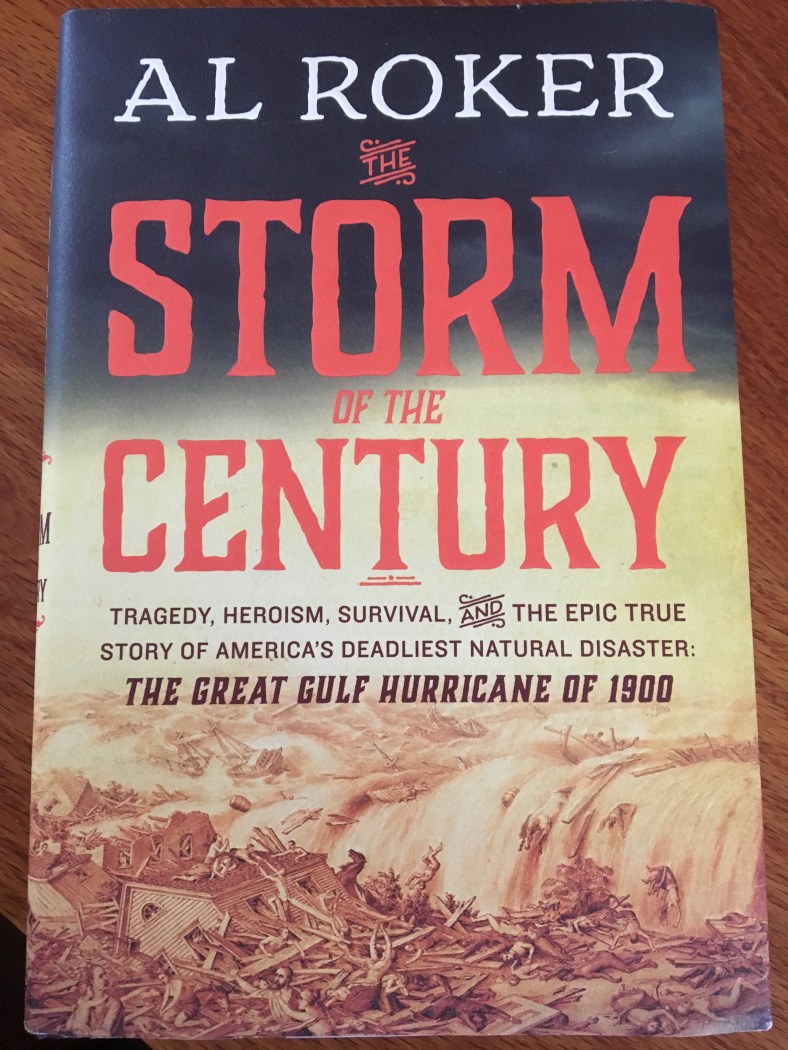
Book Review – The Storm of the Century by Al Roker

Yep, THE Al Roker.  The weather guy.  Fellow SUNY Oswego alum.  Smart, funny, the kind of guy you want to have over for poker night.

Roker has actually written a few books, covering cooking, murder mysteries, family, and weight loss.  The Storm of the Century was released late last year and offers a compelling historical review of the Gulf Hurricane of 1900 that destroyed Galveston, Texas.

IMG_1473

Admittedly, the book was not what I expected.  I anticipated a book that had more structure and was a bit more proper and history-bookish.  While I was pleasantly surprised by the book’s more narrative approach, switching gears mentally took me a while, which is I think why I had a hard time with the first few chapters.  That’s on me, though, and not a reflection on the book itself.

The book is set up almost like a work of fiction, setting the stage of the time and place of our environment and introducing and developing the main characters.  Don’t be fooled, though – this is no work of fiction.  The events described in the book are real, as were the stories of the people.  Roker emphasizes this at the end of book, as he details both formally through a bibliography and informally through narrative, the sources of his information, which include newspapers, scholarly works, historical accounts, and documented eye witness reports.

The book follows the lives of several individuals and families, with the primary focus on Isaac and Joseph Cline, who worked for what became the National Weather Service.  Roker mixes in a number of other personalities from Galveston and other areas.  Notables, such as Clara Barton, Joseph Pulitzer, and William Randolph Hearst also figure into the events of this devastating hurricane.  Roker provides insight on the state of politics and society in the post-Civil War United States, external political relations, and certain beliefs of those in meteorological science at the time, including the Jesuit priests of Cuba.

Roker details the interesting history of the National Weather Service, with its roots in the US Army Signal Corps, as well as some of the science and instrumentation of meteorology.  It’s interesting to see how much we have advanced in the science, yet how much still reflects back on what was done almost 120 years ago.

In the end, the events surrounding The Storm of the Century create a story of human error, tragedy, and perseverance.  In the practices of emergency management we must always keep in mind the human element.  Ultimately, that’s why emergency management exists.  While our focus might be on critical infrastructure, NIMS, or the current organization of FEMA, the reason why must ALWAYS reflect on people and our need to protect them from the impacts of disasters.  The Storm of the Century does just this, putting society front and center.

The Storm of the Century is overall a good read and accessible to many audiences including disaster and meteorology buffs, social scientists, and even those interested in US history.  The book is a great read for colleges and high schools alike, offering insights on society, politics, and science.  And hey, mine is even autographed.  Thanks Al!

IMG_1474

© 2016 – Timothy Riecker

A Disasterous Trend: Cuts in Preparedness Funding

This post was initially inspired by an article from CBS News on funding cuts to disaster preparedness programs.  These cuts go further and deeper than the current sequester cuts we are now seeing.  These cuts are a dangerous and disastrous trend.  To quote the article…

“In fiscal year 2010, Congress appropriated $3.05 billion to FEMA for preparedness grants designed to strengthen “our nation’s ability to prevent, protect, respond to, and recover from terrorist attacks, major disasters and other emergencies, …. In fiscal year 2012, that appropriation was less than half that figure – $1.35 billion. The same trend could be seen in FEMA pre-disaster mitigation grants, which fell from $100 million in 2010 to $35.5 million two years later.”

Have all the terrorists gone away?  Has Mother Nature stopped having temper tantrums?  Have stupid people stopped doing stupid things?  I don’t think so!  So why the cuts?

Let’s put some things in perspective… On one hand, we do need to have a bit of fiscal prudence and restraint.  GAO reports have repeatedly shown that many state and local governments are simply not spending down the grant funds they have been allocated.  DHS grants are backed up several grant years with unspent funds.  That said, as we peel back the layers of the onion, there are certain facts that need to be mentioned.  Why aren’t they spending the money they have been given?  First, grant periods have generally been too short.  The most significant reason for this is the inefficiency of bureaucracy we live in.  Follow this trail… The federal fiscal year begins October 1st.  The budget gets passed at some undermined point around that.  DHS, along with all the other agencies, get their allocations.  They then need time to formulate their grant guidance for the funds going to states and locals.  By the time states see this grant guidance and their respective allocations it’s usually close to the end of the second quarter of the federal fiscal year.  States then have to formulate their own grant guidance as they pass through funds to locals.  All this bureaucracy delays the grant year about six months.  Recognizing that nothing could be done about the bureaucracy, DHS finally extended grant years only recently, giving folks a more reasonable amount of time to spend the money.

Another reason why grant funds are slow to spend is that in most cases the grantees don’t actually ask for the money, therefore they don’t have a budget prepared beforehand.  DHS distributes funds based upon a formula.  While an application exists, it’s nothing more than an afterthought and formality.  That leaves states and locals with a pile of cash and no plan on how to spend it.  Here lies the beginning of the breakdown in accountability.  Now most folks will say that it’s easy to spend money.  In government, not so much.  Especially when you consider a few factors: 1) every level of government has spending rules (accountability is a good thing, but that can get in the way of efficiency when RFPs have to be issued for darn near everything); 2) a great deal of equipment was purchased in the big push of funds immediately surrounding 9/11 – what else do we need?; and 3) grants are restricting what funds can be spent on (i.e. there are limits on personnel (salary) expenses, and the purchase of disposables and maintenance costs of equipment – which are of particular importance for exercises).

So governments don’t have a lot of time to spend the money and face a few obstacles in getting the money spent.  But how is this a factor of cuts?  One reason for these cuts is that Congress is seeing that states and locals have a lot of money left over going back several grant years.  Failing to realize the whys and wherefores of it all, they are simply giving less money (because, to them, it’s not needed – but nothing could be further from the truth!).  They are also looking to reduce spending overall, as the article cites, and that’s a hit that will impact nearly everyone.

Taking a look at the grantees, however, there are a few criticisms.  Better and more proactive fiscal planning needs to be implemented.  Costs should be forecasted out several years to better anticipate needs.  They may, sadly, have to trim programs and streamline operations (although most emergency management programs certainly are not living in the lap of luxury).  They also need to be more creative with the declining funds they receive, especially through partnerships and regionalization.  An area doesn’t need to be regarded as a UASI or Catastrophic Planning Zone to work cooperatively as a region, which should include some pooling of funds for collective projects.

What can be approached regionally?  Most preparedness efforts fit well into that category: planning, training, and exercising.  Think about it, you work with your neighbors all the time and disasters don’t seem to stop at the county line, so why not make your cooperation more effective and efficient?  In the absence of regional catastrophic planning, which most areas don’t need to do, consider planning for some credible worst case scenarios and cascading impacts such as flooding and mass care.  Obviously regional mutual aid planning is essential.  How about working with your public health partners?  What about the private sector – how can you strengthen your relationships with them?  Regional planning conferences are a good start!  Regionalized training is obviously a no-brainer and regional exercises are essential making sure that the planning and training are effective and to give folks an opportunity to practice what they have learned.  Lastly, speaking as someone who has experience working for government and as a consultant, in many cases it’s actually more cost-effective and easier to coordinate regional preparedness activities by hiring a consulting firm, some of which have proven experience and expertise in working with the multiple stakeholders that a regional effort would include.

As we face reduced funding, we have to be more creative, cooperative, and communicate specific needs on a regular basis up the chain of government.  If you are with county or local government, let the state know what your needs are.  And don’t just tell them once – be sure to repeat yourself – not in an annoying wintertime house fly kind of way, but when the appropriate opportunity presents itself.  Make sure that you show justification for your needs through after action reports and documented strategies and plans.  Ask the State to take these needs up to federal partners – and when you have the opportunity to speak with these federal partners directly, take advantage of it; be they representatives of FEMA or your local representative of Congress or US Senator.  Remember to be specific and cite the need.  Don’t complain but be direct.  With funding that emergency management programs simply receive without asking being on the decline, we need to be proactive about receiving funds.

Emergency management and, to a greater degree homeland security, have been fortunate to have a good deal of funding over the last decade.  There has been so much money, though, with such short time lines, that things haven’t been done as well as they should have.  Now is the time to re-tool and reexamine how we do business.  Conduct needs assessments to determine what should be focused on and build upon community partnerships.  Consider what the community as a whole – the citizens – are willing to help in preparedness; as well as the private sector.  Whole-community partnerships have perhaps never been so important as they are now.

New York Recovery By the Numbers: Hurricane Sandy

New York Recovery By the Numbers

Release date: February 22, 2013.

Release Number: NR-177.

NEW YORK — Disaster assistance to New York survivors of Hurricane Sandy:
•$2.4 billion in National Flood Insurance Program payments made to policy holders
•Nearly $909.9 million in FEMA grants approved for individuals and households•$788.5 million for housing assistance
•$121.4 million for other needs

•$1.07 billion in SBA disaster loans approved for homeowners, renters and businesses
•$669 million approved in FEMA Public Assistance grants to communities and some nonprofit organizations that serve the public
•5.3 million cubic yards of debris removed (95 percent)
•268,290 people contacted FEMA for help or information
•179,516 housing inspections completed
•160,131 visits to Disaster Recovery Centers
•More than 500 voluntary agencies involved in recovery
•25 languages used to communicate assistance information to survivors