From HSToday
Tag Federal Emergency Management Agency
Managing an Exercise Program – Part 8: Preparing Support, Personnel, & Logistical Requirements
This post is part of a 10-part series on Managing an Exercise Program. In this series I provide some of my own lessons learned in the program and project management aspects of managing, designing, conducting, and evaluating Homeland Security Exercise and Evaluation Program (HSEEP) exercises. Your feedback is appreciated!
Managing an Exercise Program – Part 1
Managing an Exercise Program – Part 2: Develop a Preparedness Strategy
Managing an Exercise Program – Part 3: Identify Program Resources and Funding
Managing an Exercise Program – Part 4: Conduct an Annual Training & Exercise Planning Workshop.
Managing an Exercise Program – Part 5: Securing Project Funding
Managing an Exercise Program – Part 6: Conducting Exercise Planning Conferences
Managing an Exercise Program – Part 7: Develop Exercise Documentation
Managing an Exercise Program – Part 8: Preparing Support, Personnel, & Logistical Requirements
Managing an Exercise Program – Part 9: Conducting an Exercise
Managing an Exercise Program – Part 10: Evaluation and Improvement Planning
As I forge ahead in this series on Managing an Exercise Program (thank you all for reading!!), I expect the revised Homeland Security Exercise and Evaluation Program (HSEEP) foundation document to be released soon from the US Department of Homeland Security (DHS). Once that document is released, I’ll be sure to include a summary update in my blog. Having been a reviewer of the draft document about a year ago, I don’t expect a lot of changes, but what does change will have some bits of significance on how we do business in the design, conduct, and evaluation of preparedness exercises.
This installment of Managing an Exercise Program gets us two steps away from actually conducting the exercise. As you can see, putting an exercise together is no small feat. I find that this particular step: Preparing Support, Personnel, and Logistical Requirements, is the one most often glossed over in documents and training. As an example, HSEEP Volume I dedicates only one paragraph to exercise logistical support. As Volume I states in its single paragraph, logistical elements ‘can make the difference between a smooth, seamless exercise and one that is confusing and ineffective.’ Let’s break down our considerations:
The location of the exercise is of significant concern. Often times we are examining facilities, but some exercises are conducted outdoors with no use of facilities at all. If outdoors, you still need to ensure the proper environment and support services, such as restrooms, being available. If your exercise requires water for fire suppression, then proximity to hydrants is essential, unless you are looking to incorporate tanker operations into your exercise. We’re looking for a location that is minimally disruptive to the surrounding area, including traffic and ensuring citizen safety. Consider the need for public messaging, such as static displays, variable message signs (you can get these from your public works connections), and media releases to inform the public of the exercise. Doing so will help satisfy their curiosity, will give you some positive media exposure, and will help you minimize disruption. As an example, I’ll cite an urban search and rescue (USAR) component of the Vigilant Guard New York exercise which I led.
Working with local officials, our USAR specialist and a representative of the New York National Guard exercise team were able to select an appropriate cite for their activities. Set up was extensive, involving multiple loads of building demolition debris and a few cars to be hauled in and specifically placed with the use of heavy equipment. On one side of this lot were a number of three-story apartment buildings, which we sought to minimize impact to. All hauling and set up operations took place during the day while exercise activities, which were 24 hour operations for several days, were minimized during the night. USAR folks come with a lot of equipment… and I’m not just talking a few boxes of stuff, either. Many have tractor trailers and cargo containers to transport their gear. They set up tents where they can unload and unpack much of their gear and provide areas for briefing and down time for personnel. This exercise brought in first responder and National Guard USAR assets from around the state, other states, and Canada. An eating area needed to be on site as well as sanitation. Obviously all these areas needed to be well out-of-the-way of operational areas of the exercise to ensure safety and allow room for the rescue activities. Portable diesel-generated light towers were set up to support night-time operations. A media time was scheduled to allow media to catch some of the action during the week as well. Since some teams were only coming in to exercise for a day, a schedule needed to be established to ensure that they could be accommodated and a traffic plan had to be established to get them to the site. The exercise, which included multiple venues, covered a period of time which included Election Day. With caravans of first responder and National Guard equipment rolling through the area during this time period, we were sure to schedule movements off rush hour and I even had a conversation with the County Board of Elections. In this conversation I briefed them on the locations and activity of the exercise to ensure that it didn’t interfere with their polling locations and provided them with my cell number which I told them to call if there was even the slightest hint of a problem or complaint.
Indoor exercises require the same measure of preparation. You have to ensure that the spaces you use are safe and large enough to accommodate participants. You may have a need for one or more break out rooms or meeting rooms, both for exercise management staff and for players. Unless players are responsible for setting everything up themselves, ensure that power, internet, and telephonic communications are available for them… and can support their needs. Back to Vigilant Guard, the EOC component of the exercise was significant. Based on anticipated use, we actually brought in state emergency management capability for satellite digital communications to support the simcell with internet with phone so we wouldn’t draw on and degrade the in-house capability for players in the EOC. Similar to an outdoor venue, you need to pay heed to needs for parking, restrooms, and food service. It’s also a good media opportunity, so be sure to schedule that well in advance with the media and some VIPs.
In regard to personnel, we’ve touched upon the need for controllers, evaluators, and simulators in previous posts, mostly in regard to planning these needs and ensuring that they are covered with the necessary documents to help with their tasks, such as exercise evaluation guides (EEGs), controller/ evaluator plan, master scenario events list (MSEL), and Exercise Plan. Identify the exercise leadership early – the exercise director, simcell and MSEL managers, and lead controller and evaluator. These individuals, and the supporting staff for them, including simulators, controllers, and evaluators, are likely to come from your exercise planning team. Some may have experience in these tasks, while others may not… something to keep in mind for development of the documents as well as the briefings you conduct for them just prior to the start of the exercise (that’ll be the next part of this series). Don’t just assign folks randomly to positions, draw on their experience. If someone has a strong EMS background, assign them to be controllers, simulators, or evaluators for that area of practice. Be sure that your simulators also have some local experience as well if you are conducting this exercise for an area outside your own. Local flavor brings realism and context to an exercise for the players. Consider radios for controllers and evaluators, especially in large exercise areas. This will allow the exercise director to speak with them and for them to interact with the simcell, letting them know if they need to speed up or slow down. Also consider providing the exercise director with an assistant on large exercises. Often times I’ve found the need for someone to aid me directly in resolving problems, gathering people, and handling miscellaneous tasks that are too much for any one person to handle. It’s also a great learning experience for someone who wants to advance.
Overall, be sure to plan early for all logistical, support, and personnel needs. Plan early for food contracts, ensure that all participants have the necessary supplies to conduct their jobs. Plan ahead for safety as well, ensuring a safe work environment proactively and a good plan and personnel who can react to situations should they arise. Be ready on-the-fly for changes and little or no-notice occurrences, as they almost always happen! Make sure the players have everything they need for the exercise – if not, that lack of preparedness will be what they remember.
What experiences or ideas do you have with supporting an exercise?
EM for Colleges and Universities – Resources
As a follow up to yesterday’s post on Collegiate Emergency Management, here’s a bunch of resources for colleges and universities courtesy of FEMA. This information brought to my attention by the folks at All Hands Consulting via Twitter @AllHandsDotNet.
Homeland Security Today: Sequester Would Furlough TSA Screeners, Cut Disaster Relief Funds, Report Says
Dear Congress,
Please get your act together.
Thanks!
Your employers
Safeguarding our Electrical Grid – Reblog
More thoughts on the vulnerabilities of our electrical grid. Great post.

Popular Science (28 January 2013) has an interesting article on “How To Save The Electrical Grid.”
Power use has skyrocketed with home appliances, TVs, and computers, causing a significant increase in demand and “pushing electricity through lines that were never intended to handle such high loads.”
Our electrical infrastructure is aging with transformers “now more than 40 years old on average and 70% of transmission lines are at least 25 years old” while at the same time over the last three decades average U.S. household power consumption has tripled!
The result is that the U.S. experiences over 100 mass outages a year to our electrical systems from storms, tornados, wildfires and other disasters.
According to the Congressional Research Service, “cost estimates from storm-related outages to the U.S. economy at between $20 billion and $55 billion annually.”
For example, in Hurricane Sandy 8 millions homes in 21 states lost power, and…
View original post 350 more words
Managing an Exercise Program – Part 5: Securing Project Funding
This post is part of a 10-part series on Managing an Exercise Program. In this series I provide some of my own lessons learned in the program and project management aspects of managing, designing, conducting, and evaluating Homeland Security Exercise and Evaluation Program (HSEEP) exercises. Your feedback is appreciated!
Managing an Exercise Program – Part 1
Managing an Exercise Program – Part 2: Develop a Preparedness Strategy
Managing an Exercise Program – Part 3: Identify Program Resources and Funding
Managing an Exercise Program – Part 4: Conduct an Annual Training & Exercise Planning Workshop.
Managing an Exercise Program – Part 5: Securing Project Funding
Managing an Exercise Program – Part 6: Conducting Exercise Planning Conferences
Managing an Exercise Program – Part 7: Develop Exercise Documentation
Managing an Exercise Program – Part 8: Preparing Support, Personnel, & Logistical Requirements
Managing an Exercise Program – Part 9: Conducting an Exercise
Managing an Exercise Program – Part 10: Evaluation and Improvement Planning

HSEEP Cycle
Nothing moves without funding – nothing. Without funding, good ideas are nothing more than that – ideas. I’ve seen many ideas and initiatives die before they even made it to the proverbial chopping block, simply because of a lack of money to support them. This is the time of year when we see a lot of new ideas. In public and private sectors alike, our leaders, motivated either by legislative writ or self driven compulsion, give us an annual speech to ring in the new year. These speeches come with lofty ideas – many of which we never see get off the ground because funding is never allocated. So where do we get money to conduct exercises?
 Admittedly, my expertise lies in government and the funds available to build and sustain emergency management programs – not so much in the private sector and not for profit areas, but I’ll give these a crack. Public sector funds consist largely of the Homeland Security Grant Program (HSGP). HSGP funds a myriad of emergency management and homeland security grants including the Emergency Management Performance Grant (EMPG), the Urban Area Security Initiative (UASI), Operation Stone Garden (OPSG), and others, including Citizen Corps which is now no longer a separate grant program, but instead an optional allocation which states may choose to provide. Generally, exercises, and the expenses associated with all steps of the exercise program and project, are allowable expenses for all these grant programs.
How do you get these funds? Well, the bad news is that if you don’t already receive them, you probably can’t. There are some allocations, like Citizen Corps, which may be granted to jurisdictions by the state, but with this example you need to build a local Citizen Corps program and exercise only that program with any dollars you receive. If you do receive some of these HSGP funds, the challenge is in reallocation of dollars that are probably needed elsewhere, and budget increases are probably out of the question. So here’s where we have to get creative. Reach out to the folks who were involved in your TEPW – all those agencies and organizations. Try to gain consensus on the need for an exercise (or building-block series of them). Most or all of these agencies may have an interest if you had a successful TEPW and managed to combine some exercise initiatives. Don’t forget your private sector partners, either – especially if they are members of your Local Emergency Planning Committee (LEPC), as they may take special interest in preparedness. Be sure to have a plan and make a business case. The TEPW that you just conducted (see the previous post in this series) provides you with an excellent statement of need and a plan to address it. You may have additional supporting documentation like after action reports, which can help add some context to your need for exercise funding. Build a budget and know how much to ask for. If each agency and organization can contribute a portion, that will all add up fairly quickly. Don’t forget the possibility of sponsorships, as well. I once managed to secure lunches to be provided for all exercise participants (about 150 of them!) in exchange for a medical supply vendor setting up in a near-venue area and giving a presentation during lunch, including the opportunity for folks to try out some of their equipment.
In the private sector, fighting for budget can be tough – especially when it’s not tied to a profit center. My advice here (and again I have limited experience in this area, so if you have any ideas, please post them!) is, similar to the public sector, 1) make a good business case for it (i.e. improved safety, response coordination, and decreased down time all minimize the loss of revenue), 2) have a plan, and 3) if you are just starting an exercise program – start small. Let the executives see the potential that can be gained from larger investments in your program. Similarly, if you can partner with a local public safety exercise, be sure to invite your executives to see how it goes and be ready to explain the benefits to your company.
As for not for profits, largely it’s a combination of the public and private sector tips. Also, consider seeking grants from foundations for the specific purpose of preparedness. Don’t just limit yourself to local foundations, either. Their may be companies that specialize in first responder or emergency equipment that may have a foundation. I would guess that their foundations would have a particular interest in preparedness activities.
Overall, be sure to plan early. Don’t expect to seek funding for an exercise that you have planned for a couple of months down the road. It may take as long as a year to get your financial ducks in a row.
As always, if anyone has any additional thoughts or ideas, I’d love to see them!
Coming soon… Managing an Exercise Program – Part 6: Conducting Exercise Planning Conferences. It’s more than just meetings!
Homeland Security Priorities Needed – Any Ideas?
Homeland Security Today recently published an article citing the Congressional Research Service‘s study regarding DHS‘ failure to align and prioritize its variety of mission areas. The results of this study shouldn’t be a surprise to anyone. The massive quantity of DHS programs, including both those at the federal level as well as those pushed down to state and local governments is mind-boggling. If you aren’t familiar with the size and complexity of DHS, see my post on the 10 year anniversary of DHS.
I won’t tackle at length the issues associated with combining 22 agencies as I did in that post, but consider the number of agency missions, directives, and requirements that DHS must have as a result of that merger. It’s no wonder they can’t keep track of their own business! A monster has been created, and with it a huge bureaucracy intended to manage it – but, alas, it’s impossible to manage such a beast! Does Janet Napolitano even know all the programs and mission areas within the agency? Doubtful. And that’s no slight to her, it’s too big for anyone to commit to memory. In an effort to reduce bureaucracy and streamline services and missions, they have, in fact, done the opposite. Essentially, DHS is over-diversified.
As the HSToday article points out, DHS published a strategic plan last year, but that plan fails to give any priority to their array of missions. It also fails to provide a cohesive strategy to the entire federal homeland security amalgamation. This certainly is not what an agency strategic plan should do, but federal and national level strategies should be created. DHS does require states to formulate and maintain State Homeland Security Strategies – so why can’t they do the same?
There have been a number of articles and blogs in the last few days citing the fact that ‘homeland security’ as a term, has a very loose and amorphous definition. This is a clear signal that clarification is needed on many fronts. I believe that part of that clarification is that homeland security is a concept, not a mission area. There may certainly be a need for a coordinating agency to address mission areas related to the concept of homeland security, but that agency is not DHS as we now see it. What needs to be done? As a trainer, I say a needs assessment is a good start. The writing is on the wall, now let’s do something about it.
Today is the Day Before
I subscribe to disaster recovery e-mails from a company called Agility Recovery, whose primary focus is IT disaster recovery but they recognize the value of a comprehensive approach. They have great marketing and outreach, including regular webinars on various emergency management topics.
This week’s ‘Disaster Recovery Tip’ from Agility made me aware of a new campaign by FEMA (and I must say, FEMA’s campaigns have gotten MUCH better over the last few years – Kudos to FEMA!!!). This one is entitled ‘The Day Before’, and reminds us that we never know what will happen tomorrow, so we should always be prepared. Link to the video below.
Managing an Exercise Program – Part 4: Conduct an Annual Training & Exercise Planning Workshop
This post is part of a 10-part series on Managing an Exercise Program. In this series I provide some of my own lessons learned in the program and project management aspects of managing, designing, conducting, and evaluating Homeland Security Exercise and Evaluation Program (HSEEP) exercises. Your feedback is appreciated!
Managing an Exercise Program – Part 1
Managing an Exercise Program – Part 2: Develop a Preparedness Strategy
Managing an Exercise Program – Part 3: Identify Program Resources and Funding
Managing an Exercise Program – Part 4: Conduct an Annual Training & Exercise Planning Workshop.
Managing an Exercise Program – Part 5: Securing Project Funding
Managing an Exercise Program – Part 6: Conducting Exercise Planning Conferences
Managing an Exercise Program – Part 7: Develop Exercise Documentation
Managing an Exercise Program – Part 8: Preparing Support, Personnel, & Logistical Requirements
Managing an Exercise Program – Part 9: Conducting an Exercise
Managing an Exercise Program – Part 10: Evaluation and Improvement Planning
HSEEP Cycle
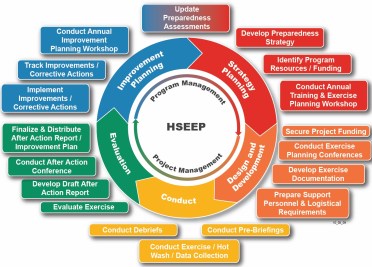
As HSEEP Volume 1 states, “The basis of effective exercise program management is a Multi-Year Training and Exercise Plan.” The MYTEP is the product of a Training and Exercise Planning Workshop (TEPW), a collaborative which should be conducted annually to update the plan (and the collaborating partners!) with any changes in preparedness priorities, funding, or other influential factors. I really can’t underscore the importance of the TEPW and MYTEP enough – they truly are the backbone of an effective exercise program.
First the TEPW needs to be scheduled and attendees invited. This workshop should include not only your core planning team (discussed a bit in part 3), but should also expand to others within the sphere if influence and coordination. States should invite relevant state agencies, a representation of counties (as it would be unwieldy to invite all of them), key cities and/or Urban Area Security Initiative groups, key Federal partners (like FEMA, EPA, DOE, USCG), as well as major not for profits or VOADS, and critical infrastructure private sector folks or authorities like utility or rail companies or regional transit authorities. Counties should invite key county and state agencies, a representation of local governments, representatives of key groups like the county fire chief’s association, not for profits or VOADs, and those critical infrastructure folks within the county – including school districts and colleges. Cities, towns, and villages should all follow suite similarly. Not for profits and private sector folks need to ensure that they are invited to the table of the meetings of others (are you part of a local emergency planning committee – LEPC???) – and for conducting their own TEPWs (not required, but a good idea) need to consider where their primary operations take place and who they have significant relationships with relative to preparedness. In the end it can be quite a crowd. You want to be certain that the invites go to the right people (i.e. the exercise program managers, if they have them, or the emergency managers for these entities). Stress that this is a workshop – where work gets done – so they can’t just send someone to ‘hold a seat’. It needs to be someone who can represent the organization and its interests in the area of preparedness. The invite should also state what key information they should be prepared with and prepared to discuss, like major preparedness training and exercise initiatives.
The HSEEP website provides some detailed guidance on TEPWs, a sample agenda, and even a draft invite letter and presentation on its resources website. You’ll notice that the agenda is a VERY full day. Don’t try to cut any corners – and I would even encourage a working lunch. It’s frustrating to hold people longer than planned and even more frustrating to spend a full day in a workshop and not accomplish what you set out to do. During the workshop, participants should review priority preparedness capabilities and coordinate exercise and training activities that can improve and validate those capabilities. As a result of the workshop, the Multi-Year Training and Exercise Plan outlines a multi-year schedule and milestones for execution of specific training and exercise activities. Just as importantly, the TEPW helps to deconflict any exercise issues that may exist between these partners, like avoiding scheduling major exercises too closely to each other. As part of this process, be sure to discuss major areas for improvement discovered from After Action Reports of earlier exercises – the implemented improvements should be tested.
During the TEPW, you will start to populate an exercise calendar. Some partners will have dates set, others may only be able to narrow it down to a month or calendar quarter. Around these exercise activities and their known major objectives, training programs can be identified and roughly scheduled as well. This is the beginning of your MYTEP.
Conducting a TEPW and formulating a MYTEP is not only the first step toward HSEEP compliance, it is also the foundation of your program. Through the TEPW, your organization and its partners will identify training and exercise requirements, goals, and benchmarks; ideally forecasted out three to five years. You start with regulatory and other legal requirements, include grant and funding deliverables, and initiatives driven by the organizational mission and emergency management functions. If the organization has a goal of revising a certain emergency plan by the end of the calendar year, then it would be a good idea to include an exercise testing that plan. Through the process of the TEPW, you will identify what level of exercise is appropriate: ranging from a seminar to a full-scale exercise; and opportunities to capitalize on different exercise initiatives, merging exercises and leveraging combined efforts and funding – especially between different agencies and organizations. Finally, you should identify training opportunities to ensure that personnel have the tools they need to function properly.
A TEPW can be complex and fast-paced. There can be a lot of attendees all needing to get their information out. The preparedness of the facilitator and attendees is absolutely critical to the success of the TEPW and the quality of the MYTEP. If you’ve never done one, reach out to someone who has to help you along – including me.
Happy New Year to all and be on the look out for Managing an Exercise Program – Part 5: Securing Project Funding.
Managing an Exercise Program – Part 3: Identifying Program Resources and Funding
This post is part of a 10-part series on Managing an Exercise Program. In this series I provide some of my own lessons learned in the program and project management aspects of managing, designing, conducting, and evaluating Homeland Security Exercise and Evaluation Program (HSEEP) exercises. Your feedback is appreciated!
Managing an Exercise Program – Part 1
Managing an Exercise Program – Part 2: Develop a Preparedness Strategy
Managing an Exercise Program – Part 3: Identify Program Resources and Funding
Managing an Exercise Program – Part 4: Conduct an Annual Training & Exercise Planning Workshop.
Managing an Exercise Program – Part 5: Securing Project Funding
Managing an Exercise Program – Part 6: Conducting Exercise Planning Conferences
Managing an Exercise Program – Part 7: Develop Exercise Documentation
Managing an Exercise Program – Part 8: Preparing Support, Personnel, & Logistical Requirements
Managing an Exercise Program – Part 9: Conducting an Exercise
Managing an Exercise Program – Part 10: Evaluation and Improvement Planning
Exercises can be very resource intensive, have no doubt about that. Generally speaking, the more you invest in them, though, the more you get out of them. Certainly discussion-based exercises are usually not as expensive as operations-based exercises. For all exercise types, however, the largest costs are in the design (staff or consultant time, as well as meeting time), and conduct (again, staff or consultant time, plus the time of the participants). What resources do you need for your exercise program as a whole? How do you get them?
First of all, let’s discuss human resources. In Managing an Exercise Program – Part 1, I discussed the importance of having an exercise program manager and what some of the qualifications should be for that person. A program manager is probably the most important human resource you could have for exercises, but certainly this person can’t do it alone. A good exercise program is able to leverage the experience, support, and ideas of others – both within and outside. The exercise program manager needs to be a great networker, able to draw people from various agencies into a mutually beneficial partnership. Some of these agencies will come and go, but some will be strong, permanent partners. Each partner agency, including your own, should be contributing to the efforts of the group – not only with ideas, but with people to serve as controllers, evaluators, planning team members, etc., physical resources suitable for whatever types of exercises you conduct, and perhaps even funding.
In March of 2008, I founded and co-chaired the New York State Exercise Coordination Committee, composed of several state agencies, departments, authorities, and the Red Cross. Meeting regularly and communicating often, we were able to pool our resources not only for each individual exercise, but for exercise program management as a whole throughout New York State. We formulated consistent policies and practices, allocated Homeland Security funds state-wide for exercises and corrective actions, and developed and delivered exercise-related workshops and training courses. We became the core group for the Training & Exercise Planning Workshop (more on this in the next part) and applied for and coordinated funding requests to FEMA for the Regional Exercise Support Program (RESP), which provided contractor resources to state and local exercise initiatives. We were not only able to help each other, but we were able to benefit the state as a whole. This model can be applied to other states; county and local governments; and consortia of public, private, and not for profit groups.
Keep in mind that the HSEEP cycle is just that, a cycle. You will constantly be revisiting each of these steps – sometimes out-of-order – including determining needs and sourcing of resources.
HSEEP Cycle
What resources do you think you will need to manage your program?
Be on the lookout for Managing an Exercise Program – Part 4: Conducting an Annual Training & Exercise Planning Workshop.
 The Contrarian Emergency Manager