Pre-Disaster Recovery Planning Guidance

So much of preparedness focuses on the Response mission area, which is necessary, given the need to protect life and property in the immediate aftermath of a disaster; but we should never leave disaster recovery by the way side.  I’ve blogged in the past about the significant lack of Recovery mission area exercises we typically see, but we shouldn’t forget that the foundation of preparedness is planning.  How does your pre-disaster recovery plan look?

If jurisdictions have a pre-disaster recovery plan at all (and I mean beyond two paragraphs in their comprehensive emergency management plan), it’s typically focused on debris management.  This isn’t without good cause.  Debris management is incredibly complex, has a lot of benchmarks to follow in terms of best practices, and must include all of FEMA’s requirements, which largely stem from lessons learned in debris management.  Having a debris management plan in place can also qualify a jurisdiction to receive a higher percentage of reimbursement.  That said, debris management isn’t the only aspect of recovery that must be planned for.

FEMA recently released the Pre-Disaster Recovery Planning Guide for State Governments (November 2016).  I’ll admit, the first thing I looked for in the document were references to CPG-101, which is FEMA’s established standard for planning.  I was thrilled to find that it’s not only mentioned, but much of the document is based upon CPG-101.  Found in the document’s early narrative are topics such as the importance of aligning disaster recovery with hazard mitigation, as well as aligning disaster recovery with response.  These are two important factors which make disaster recovery even more complex, as disaster recovery is clearly not only an end state itself, but also a bridge between response and mitigation.

The document also outlines the differences and similarities between pre-disaster recovery planning and post-disaster recovery planning.  Another important distinction.  Many give the excuse of not having a vigorous pre-disaster recovery plan because there are too many unknown variables to anticipate and plan for.  I usually throw my bullshit flag on this statement.  While there is some truth to the statement, it’s also a convenient excuse.  For the same reasons why we create emergency operations plans before a disaster ever strikes, we must develop recovery plans before a disaster strikes.  While there are unknowns, there are also many solid assumptions we can make for the foundation of our planning.  We can identify key activities, assign responsibility, and work toward identifying gaps and building capability and capacity.  Once a disaster does occur, we then pull people out of the response to begin drawing up more specific plans for disaster recovery, hopefully capitalizing on our pre-disaster planning efforts.

Much of the document is a breakdown of CPG-101 planning steps in the context of disaster recovery.  They give some great examples and references throughout the document.  From my quick review, this is a pretty solid document.  While the intended audience is state government, I see easy applicability of this document to most, if not all, local governments – so long as it’s approached with a scaled perspective.

I’m very pleased that FEMA continues to tie preparedness standards together, doing away with decades long practices of response-oriented preparedness tasks being handled one way, while the tasks of other mission areas are handled very differently.  Across the whole spectrum of preparedness, in consideration of every mission area and each of the POETE elements, we need to start identifying critical intersections which will help us capitalize on efforts.  We need to do away with the isolation and siloing of these, and begin working more collaboratively.  From this, we will see greater success.

Consume and ponder.  Feedback is always appreciated.

© 2017 – Timothy Riecker, CEDP

Emergency Preparedness Solutions, LLC

In a POETE State of Mind

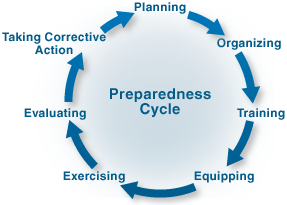
One of the searches that has most often brought people to my blog over the last couple of years has been POETE.  In case you forgot, POETE stands for Planning, Organizing, Equipping, Training, and Exercising.  If you conduct an internet search for POETE, there are very few relevant results.  Along with a few of my blog posts, there are a couple of articles published by others, and a few FEMA documents that include obscure references to POETE.  Sadly, there is nothing available that provides (official) guidance, much less doctrine.

Why is it that such a great tool has so few tangible references?  Unfortunately, I don’t have an answer to that.  I hope that will soon change.

POETE was most widely indoctrinated several years ago as an analysis step within the State Preparedness Reports (SPRs), which are annual submissions completed by every state, UASI (Urban Area Security Initiative-funded program), and territory.  Note: The SPR templates and guidance are generally not publicly posted, as they are sent directly to the points of contact for each jurisdiction – thus they generally don’t come up in internet search results.

The SPR is a step beyond the THIRA (Threat and Hazard Identification and Risk Analysis), which is a very in-depth hazard analysis.  The SPR examines each jurisdiction’s level of preparedness for hazards, referencing the 32 Core Capabilities.  Each Core Capability is then analyzed through the lens of POETE.

As a conceptual example, let’s use the Operational Communications Core Capability.  The POETE analysis will examine the jurisdiction’s preparedness by examining:

  • Planning (are plans adequate? Have they been tested?  What improvements need to be made?);
  • Organizing (are there organizational barriers to success? What human operational communications resources are available?  Are there gaps?  Have teams been exercised? What improvements need to be made?);
  • Equipment (does the jurisdiction have equipment necessary for operational communications? What needs are there relative to the resource management cycle?);
  • Training (what training has been provided? What training gaps exist?  When/how will they be addressed?);
  • Exercises (what exercises have been conducted that include the operational communications Core Capability? What were the findings of the AAR/IPs?  What future exercises are scheduled that include this Core Capability?).

Along with answering a few questions on each element, jurisdictions are asked to rate their status for each POETE element for each Core Capability.  If they look at their reports submitted historically, they can see the measure of progress (or lack thereof) with each.  They also have a tracking of identified action items to help them improve their measure of preparedness.

While this analysis can be quite tedious, it’s extremely insightful and informative.  Often, stakeholders have conceptual ideas about the state of preparedness for each Core Capability, but absent conducting this type of in-depth analysis, they rarely see the details, much less have them written down.  Documenting these helps with recognition, awareness, tasking, tracking, and accountability.  It’s a valuable activity that I would encourage all jurisdictions and organizations to conduct.

What else can POETE be applied to?  In the past few years, POETE is being included in DHS preparedness grants.  They often want applicants to identify key tasks within the POETE structure, and awardees to chart progress along the same lines.

I’ve advocated in the past to use the POETE structure in improvement plans, which are a step beyond after action reports from exercises, events, and even incidents.  Having key activities identified across each POETE element for the Core Capabilities analyzed is extremely helpful, and ensures that issues are being identified comprehensively.

Using the POETE concept across all preparedness efforts helps to tie them together.  By documenting each element for each Core Capability, you will have full visibility and reference to your current status and what needs to be improved upon.  It helps drive accountability, a comprehensive approach, and reduces duplication of efforts – especially in larger organizations.  While implementing such a program will take some investment up front to begin to identify, organize, and chart progress and establish an organizational system to do so, I feel it’s an investment that will pay off.

I’m hopeful that the use of POETE continues to see adoption across all of emergency management and homeland security, and that it is further reinforced as a standard through DHS, FEMA, NFPA, and other organizations which hold sway for settings standards and/or requirements.

How does your organization, agency, or jurisdiction use POETE?

© 2017 – Timothy M Riecker, CEDP

Emergency Preparedness Solutions, LLC

2017 HSEEP Course Information

Emergency Preparedness Solutions is regularly looking for Homeland Security Exercise and Evaluation Program (HSEEP) trained personnel to help us design, conduct, and evaluate exercises.  The following training bulletin from FEMA’s Emergency Management Institute provides updated information on the course offerings and application process.  Below the training bulletin is a listing of the webinar-based offerings of HSEEP (K0146).

Training Bulletin

Course:  K/L0146 – Homeland Security Exercise Evaluation Program

 (HSEEP): Basic Course

Emmitsburg, MD — You are subscribed to EMI News for FEMA. The following information has recently been updated, and is now available on http://training.fema.gov/EMI/

1263 – REVISED – Training Bulletin – K-L0146 – updated – Jan 12, 2017

The K/L0146 HSEEP is an intermediate-level course that provides a comprehensive overview of exercise design along with practical skill development in accordance with the HSEEP Doctrine.  The course uses activities that will give participants an opportunity to interact with many of the templates and other materials that are provided by the National Exercise Division to ensure exercises are conducted in a consistent manner.  Upon completion of this course, participants will gain a better understanding of what constitutes a HSEEP consistent exercise.

Read more in Training Bulletin 1263.


Course Start End
K0146: Homeland Security Exercise and Evaluation Program (HSEEP) Training Course
(M,T,W,R 1:00-5:00 p.m. EST)
4/10/2017 4/13/2017
K0146: Homeland Security Exercise and Evaluation Program (HSEEP) Training Course
(M,T,W,R 1:00-5:00 p.m. EST)
5/8/2017 5/11/2017
K0146: Homeland Security Exercise and Evaluation Program (HSEEP) Training Course
(M,T,W,R 1:00-5:00 p.m. EST)
6/5/2017 6/8/2017
K0146: Homeland Security Exercise and Evaluation Program (HSEEP) Training Course
(M,T,W,R 1:00-5:00 p.m. EST)
7/10/2017 7/13/2017
K0146: Homeland Security Exercise and Evaluation Program (HSEEP) Training Course
(M,T,W,R 1:00-5:00 p.m. EST)
8/7/2017 8/10/2017
K0146: Homeland Security Exercise and Evaluation Program (HSEEP) Training Course
(M,T,W,R 1:00-5:00 p.m. EST)
9/18/2017 9/21/2017
K0146: Homeland Security Exercise and Evaluation Program (HSEEP) Training Course
(M,T,W,R 1:00-5:00 p.m. EST)
3/13/2017 3/16/2017
K0146: Homeland Security Exercise and Evaluation Program (HSEEP) Training Course
(M,T,W,R 1:00-5:00 p.m. EST)
2/6/2017 2/9/2017


New and Timely Cyber Security Information

October is National Cyber Security Awareness Month.  With it, the DHS Private Sector Office has provided a number of resources to help organizations get involved in cyber security awareness.  These include weekly themes, such as Stop. Think. Connect., information on a weekly Twitter Chat series, and other information.

Perhaps released intentionally during National Cyber Security Awareness Month is the call for public comment on the National Cyber Incident Response Plan.  From their website, DHS’ National Protection and Programs Directorate and FEMA’s National Integration Center are leading the development of this document in coordination with the US Department of Justice, the Secretary of Defense, and other partners.  This plan is intended to provide a nation-wide approach to cyber incidents, incorporating roles for the private sector and all levels of government (TR – similar to the National Planning Frameworks, which this document rather heavily references).  The National Engagement Period ends on October 31, so be sure to review the document and provide feedback.  There are also a series of webinars referenced on the website.

In my initial and very cursory review of the plan, I was pleased to see the references to the National Preparedness Goal and National Planning Frameworks.  I’ve mentioned before that we need to strive to align and integrate all preparedness efforts along these lines and I’m thrilled to see it happening.  It’s even more encouraging to see this occurring with something that could be considered a bit fringe to traditional emergency management.  The plan directly references a number of Core Capabilities.  They take an interesting approach with this.  Instead of identifying which Core Capabilities the plan organizes under, they instead align certain Core Capabilities within what they call Lines of Effort.  These Lines of Effort include Threat Response, Asset Response, and Intelligence Support.  For each Core Capability they define the Core Capability, a la the National Preparedness Goal, and describe how that Core Capability applies to Line of Effort, along with listing associated critical tasks. (inserted is Table 2 from the plan which shows this alignment)

cyber-cc-by-loe

What I find even more interesting is the array of Core Capabilities they identified for their Lines of Effort.  While this plan is oriented toward response, the Core Capabilities they identify come from the Mission Areas of Prevention, Protection, Response, and Mitigation, along with including the three common Core Capabilities.  This further reinforces the thought that the Cyber Security Core Capability should also be included as a common Core Capability.  This is an interesting document which I look forward to reviewing in more detail.

© 2016 – Timothy Riecker, CEDP

Emergency Preparedness Solutions, LLCYour Partner in Preparedness


Planning for Preparedness

Yes, planning is part of preparedness, but organizations must also have a plan for preparedness.  Why?  Preparedness breaks down into five key elements  – remember the POETE mnemonic – Planning, Organizing, Equipping, Training, and Exercising.  I’m also in favor of including assessment as a preparedness element.  Needless to say, we do a lot when it comes to preparedness.  Each of these elements alone involves significant activity, and together there are opportunities for activities to be synchronized for maximum benefit.  In smaller organizations, these elements may be addressed by one or two people, which itself can be challenging as these are the same people running the organization and addressing myriad other tasks.  In larger organizations each element alone may be addressed by a number of people, which also provides a complication of synchronizing tasks for maximum benefit.  Either way, as with all project and program management, without a plan of action, we may forget critical tasks or do things out of order.

By establishing a preparedness plan, we can address many of these issues.  The plan can be as detailed as necessary, but should at least identify and address requirements (internally and externally imposed) as well as benchmarks to success.  But what do we plan for?

Assessment – Yes, I’m including this as an element.  Assessment is something we should constantly be doing.  Just as we strive to maintain situational awareness throughout an incident, we have to be aware of and assess factors that influence our state of readiness.  There are a variety of assessments that we do already and others that can be done as they relate to the other five elements.  In fact, assessments will inform our preparedness plan, helping us to identify where we are and where we need to be.  We can review after action reports from incidents, events, and exercises to determine what improvements must be made.  We can research best practices and examine funding requirements, legal requirements, and standards such as EMAP or NFPA 1600 which can broadly influence our programs.  We assess current plans to identify what our gaps are and what plans need to be revisited.  We can assess our organization to determine if staffing is maximized and that policy, procedure, and protocol support an agile organization.  The status of equipment can be assessed to determine what is operational and ready to deploy.  We can conduct a training needs assessment to identify what training is needed; and lastly, we can assess opportunities to exercise.  Not only should our assessments inform what needs to be accomplished for each of the POETE elements, but regular assessment check ins and activities should be identified, nay planned for, within our preparedness plan.  Consider what else can inform our preparedness plan.  A recent hazard analysis, THIRA, or state preparedness report (SPR) can feed a lot of information into a preparedness plan – especially the state preparedness report, as it is specifically structured to identify POETE gaps.

Planning – We should always examine what we have.  If plan reviews aren’t scheduled, they often fall to the wayside.  Plan review teams should be identified for each plan, and a review schedule or cycle established.  Benchmark activities for plan review activities should also be identified.  The need for new plans should also be highlighted.  Based on standards, requirements, best practices, or other need, what plans do you organization need to assemble in the next year or two?  Again, identify benchmarks for these.

Organization – Assessments of your organization, either as direct efforts or as part of after action reports or strategic plans can identify what needs to be accomplished organizationally.  Maybe it’s a reorganization, an increase in staffing levels, an impending change in administration, expected attrition, union matters, or something else that needs to be addressed.  As with many other things, some matters or organization are simple, while others are very difficult to navigate.  Without a plan of action, it’s easy to allow things to fall to the wayside.  What changes need to be made?  Who is responsible for implementing them?  Who else needs to be involved? What’s a reasonable timeline for making these changes happen?

Equipping – Many logisticians are great at keeping accurate records and maintenance plans.  This measure of detail isn’t likely needed for your preparedness plan, but you still should be documenting the big picture.  What benchmarks need to be established and followed?  Are there any large expenditures expected for equipment such as a communications vehicle?  Is there an impending conversion of equipment to comply with a new standard?  Are there any gaps in resource management that need to be addressed?

Training – Informed by a training needs assessment, a training plan can be developed.  A training plan should identify foundational training that everyone needs as well as training needed for people functioning at certain levels or positions.  Ideally, you are addressing needs through training programs that already exist, either internally or externally, but there may be a need to develop new training programs.  A training plan should identify what training is needed, for who, and to what level (i.e. to steal from the hazmat world – Awareness? Operations? Technician?).  The plan should identify who will coordinate the training, how often the training will be made available, and how new training will be developed.

Exercises – We have a standard of practice for identifying exercises into the future – it’s called the multi-year training and exercise plan (MYTEP).  While it’s supposed to include training (or at least training related to the identified exercises), training often falls to the wayside during the training and exercise planning workshop (TEPW).  The outcomes of the TEPW can be integrated into your preparedness plan, allowing for an opportunity to synchronize needs and activities across each element.

Just as we do with most of our planning efforts, I would suggest forming a planning team to shepherd your preparedness plan, comprised of stakeholders of each of the elements.  I envision this as a group that should be in regular communication about preparedness efforts, with periodic check-ins on the preparedness plan.  This engagement should lead to synchronization of efforts.  Identify what activities are related and how.  Has a new plan been developed?  Then people need to be trained on it and the plan should be exercised.  Has new equipment been procured?  Then people should be trained in its use and plans should account for the new or increased capability.

Like any effort, endorsement from leadership is necessary, especially when multiple stakeholders need to be brought together and working together.  Many emergency management and homeland security organizations have positions responsible for preparedness, often at the deputy director level.  The formation and maintenance of a comprehensive preparedness plan should be a foundation of their efforts to manage preparedness and forecast and synchronize efforts.

Does your organization have a plan for preparedness beyond just a multi-year training and exercise plan?  What elements do you tie in?  Do you find it to be a successful endeavor?

Do you need assistance in developing a preparedness plan?  Contact us!

© 2016 – Timothy Riecker

Emergency Preparedness Solutions, LLCYour Partner in Preparedness

ICS: Let’s Keep Talking

I find it interesting that a topic so seemingly mundane – that of the incident command system (ICS) has seen an increase of discussion lately.  The NIMS Refresh seems to have fueled some of that, but other writings and conversations have also been taking place.  While I’ve certainly been critical of the national ICS training program in several of my writings, there have been other thoughts posted on ICS, some you absolutely must take a look at:

Are We Overthinking ICS?  This article, posted by noted emergency management consultant Lucien Canton has some great thoughts on the proposed NIMS Refresh.  He brings up an excellent point about the disappearance of Multi-Agency Coordination Systems (MACS) – something I had myself completely missed in my review.  A must read.

ICS and ESF: An Unhappy Marriage?  Another article by Lu Canton.  This piece gives a concise review of the differences between ICS and FEMA’s Emergency Support Function (ESF) structure and gives some ideas on how the two can be brought together.  I’ve seen the things Lu suggests in action, and I promise you, they can work.

Where Incident Management Unravels.  This article by Charles Bailey in the August edition of the Domestic Preparedness Journal took me on a wild ride, for which I’ll have some extended commentary here… I’ve read and reread this article several times, each time having different reactions and responses.  Through my first read, I saw this piece as being highly critical of ICS. Then I read it again, and I began to understand.  While I don’t agree with all Chief Bailey’s points, I respect everything he is saying and absolutely appreciate the thoughts and ideas this article offers.  I’ll leave you to read the article for yourself and form you own opinions.  The bottom line is the importance of early efforts to gain control over the chaos of the incident.  NIMS/ICS doesn’t provide us with all the answers for how to do that – something that I think needs to be reflected in better instruction of the principles of ICS.  Chief Bailey mentions toward the end of his piece the need to create ‘nimble response paradigms’ for initial response – a concept I fully agree with.  I also think that Chief Cynthia Renaud has some incredible insights on this matter in her Edge of Chaos paper.

I’m excited about the volume of discussion over NIMS and ICS lately.  It’s the system we rely on to manage incidents, coordinate resources, and ultimately save lives.  It’s kind of a big deal.  It should be good, and we should do it right.  While it’s the best we currently have, that doesn’t mean the system is perfect, nor will it ever likely be.  Similarly, the human elements involved in training, interpretation, and implementation of the system means that we will rarely do things ‘by the book’, but we are never handed disasters ‘by the book’, either, which emphasizes the number of variables involved in incident management.  The system must continue to evolve to be effective and to reflect our new and changing ideas on incident management.  We need to regularly examine the system critically and as realists and implement positive changes.  That said, change needs to be carefully administered.  We can’t make change for the sake of change, and we must be mindful that constant change will itself create chaos.

Have you read any other great articles on ICS lately?  What thoughts do you have on ICS, ICS training, and the need for ICS to evolve?  What’s missing?

© Timothy Riecker, CEDP

Emergency Preparedness Solutions, LLCYour Partner in Preparedness

Do you Really Know Unified Command?

Despite how much incident command system (ICS) instructors try to hammer this one home, there still remains some measure of confusion about what the concept of unified command really is. I regularly review documents or sit in meetings where unified command is improperly defined, applied, and discussed.  There are many who espouse that they use unified command instead of ICS.  Unified command is, in fact, an application of ICS, just like many other concepts within the system.  It is not a different system. When unified command is used, all other concepts within ICS remain the same.

From the National Incident Management System (2008) document, unified command is defined as follows: In incidents involving multiple jurisdictions, a single jurisdiction with multiagency involvement, or multiple jurisdictions with multiagency involvement, Unified Command allows agencies with different legal, geographic, and functional authorities and responsibilities to work together effectively without affecting individual agency authority, responsibility, or accountability.

Once we can gain an understanding of what unified command is, implementation of unified command is where the greatest misconceptions lie.  People often think that unified command is applied with a concept best described as ‘We use unified command, but the Fire Chief is in charge.’.  Nope.  That’s not it.  That’s simply an application of single command, with deputies coming from other agencies.  Unified command is truly unified.  The participants in unified command operate at the same level of authority.  Obviously standards of professionalism and legal authority should hold true, ensuring that none are issuing orders contrary to those of their counterparts, and often there is deference to the member of unified command who may have certain jurisdiction or subject matter expertise as it applies to a particular matter, but decisions and made and applied jointly.  The unified command, therefore, acts and speaks as a single entity.

Given the factors described above, as well as the need to properly synchronize incident management (see my recent article on this topic, here), unified command is absolutely something that should be prepared for.  Because of the nuances of its application, planning for unified command is helpful.  While the application of unified command is generally optional, some regulations and policies may require its use under certain circumstances. Be it required or not, plans establish a course of action for stakeholders to follow and can be strongly supported by procedures.  Plans should at least acknowledge that unified command may be an option for certain incidents, and may need to identify who makes the decision to implement unified command.  I’ve seen some plans require unified command for certain incidents, which I’m not crazy about.  Unified command, as mentioned, is just one more application of ICS.  Given the right circumstances, a single command may be the best option.  That said, if something isn’t included in a plan, even as an option, it may not even be considered during an incident.  Unified command should always at least be an option.

As an example of unified command application, the United States Coast Guard (USCG) commonly encourages and participates in unified command for many of their incidents, often pulling together, at a minimum, the USCG, a local or state government representative, and a representative of the responsible party (owner and/or operator).  They do this because it makes sense.  While the USCG has legal authority over navigable waterways and a response requirement within those waterways, incidents can also impact the shorelines, which are generally the responsibility of state and local governments.  State and local governments may also be providing a great deal of resources to assist in the incident.  International laws require that responsible parties do, in fact, take responsibility (usually financially) for incidents caused by or involving their vessels, which makes them a significant (although sometimes reluctant) stakeholder.

Further preparedness measures are needed for practitioners to become proficient in the application of unified command.  The inclusion of the option in plans alone isn’t enough.  It should be trained, so people understand what it is and how best to apply it.  The concept of unified command is incorporated into every level of the ICS national training curriculum.  Sadly, the common misconceptions associated with unified command tell me that we aren’t communicating well enough what unified command actually is.  Beyond training, the best opportunity to reinforce the application of unified command is exercises.  Exercises obviously offer an opportunity for a no-fault environment which allow for informal feedback and formal evaluation, which should both inform potential improvements. Unified command certainly should be practiced to be successful.  The reason it’s so successful with USCG applications is because their people train and exercise heavily in ICS concepts, including unified command.  They also enter a unified command environment with an eye toward coaching other participants who may not be so familiar with it and how it works.

There are a number of keys to success for unified command.  Chief among them are an understanding of what it is and what is expected and an ability to work as a team.  Working well as a team involves essential elements such as communication, coordination, and checking your ego at the door. Rarely is unified command successful when someone is trying to strong-arm the matter.  A successful unified command requires discussions to identify the priorities that each agency or jurisdiction has, and determining how to properly plan, shape, and synchronize the response efforts to ensure that each of these is handled appropriately.  Clearly, some measure of negotiation must regularly take place.

People often ask who should be part of the unified command.  The membership of unified command should remain fairly exclusive.  Representatives should only come from those agencies or jurisdictions that are significant stakeholders within the incident (i.e. they have responsibility or authority for major components of the response).   Just because an agency or jurisdiction is providing resources or support to an incident does not mean they should be part of the unified command.  Unified command functions best when it is small.  If your unified command effort is exceeding five or six people, you are entering the land of management by committee, and that should be avoided.  While some claim that there are a multitude of interests that should be represented in the management of an incident, I would suggest establishing a multi-agency coordination group, which is a policy-level body who can guide the incident command/unified command from that level.  The goal is to have only essential agencies working at the command level.

As I continue the crusade of improving ICS training, we will need to ensure that the concept of unified command gets some special attention to ensure better understanding of what it is and how it works.

I’m interested to hear your thoughts and practices on how you prepare for and implement unified command within your jurisdiction or organization.

© 2016 – Timothy Riecker, CEDP

Emergency Preparedness Solutions, LLCYour Partner in Preparedness


Five Guidelines for Creating Effective Disaster Exercise Injects

While there is a lot of important and necessary planning that takes place before the development of exercise injects can even be considered, injects themselves are where the proverbial rubber meets the road.  How we craft those injects can often times make or break the conduct of the exercise.  Injects provide context, as if the events of the exercise were occurring in real life.  While we try to avoid delivering injects that directly prompt player responses, injects will often provide information which will lead players to react to the information provided.  Here are five guidelines to help you develop effective exercise injects:

  1. Injects must be purposeful and each one must relate back to one or more exercise objectives. Far too often we see injects that have no real bearing on the objectives of the exercise.  These are simply distractions and lead to busy work.  Keep things focused.  Just a few well-crafted injects can engage a number of players in active discussion or activity.
  2. Realistic injects are a must. While there will always be a grumble from some people claiming that something would ‘never happen that way’, due diligence must go into ensuring that injects are as realistic and grounded as possible.
  3. Be aware of who an inject would actually originate from. A common mistake I see is injects being scripted to originate from inappropriate sources.  This distracts from reality.  Also, injects should never originate from a player.
  4. Be flexible and aware. Sometimes players accomplish what they need to without an inject.  In that event, there may not be a need to use that inject.  Similarly, players may not respond to an inject as expected, so further action on the part of the Facilitators/Controllers/Simcell may be needed.
  5. Always have backups! As you build your Master Scenario Events List (MSEL), maintain a side list of contingency injects that can be used to speed up or slow down the exercise, or to address occurrences where players did not respond as expected.

Thoughts and ideas on these and other guidelines are always welcome!

© 2016 – Timothy Riecker, CEDP

Emergency Preparedness Solutions, LLC Your Partner in Preparedness!

ICS Training (Still) Sucks… One Year Later

Just over a year ago, I posted my article Incident Command Training Sucks, which to date has been viewed almost 2000 times on the WordPress blog platform, alone.  Since then, I’ve written several more times on the necessity to change the foundational ICS training curriculum in the US to programs that are focused on application of ICS in initial and transitional response instead of just theory and vague instruction.  I am greatly appreciative of all the support these articles have received and the extra effort so many have taken to forward my blog on to the attention of others.  These posts have led to some great dialogue among some incredible professionals about the need to update ICS training.  Sadly, there is no indication of action in this direction.

A recent reader mentioned that it often ‘takes guts to speak the truth’.  It’s a comment I appreciate, but I think the big issue is often complacency.  We settle for something because we don’t have an alternative.  Also, I’ve found that people are reluctant to speak out against the current training programs because there are so many good instructors or because the system, foundationally, is sound.  My criticisms are not directed at instructors or the system itself – both of which I overwhelmingly believe in.  I’m also not being critical of those who have participated in the creation of the current curriculum or those who are the ‘keepers’ of the curriculum.

Much of the existing curriculum has been inherited, modified from its roots in wildfire incident management, where it has served well.  While adjustments and updates have been made through the years, it’s time we take a step away and examine the NEED for training.  Assessment is, after all, the first step of the ADDIE model of instructional design.  Let’s figure out what is needed and start with a clean slate in designing a NEW curriculum, instead of making adjustments to what exists (which clearly doesn’t meet the need).

Another reader commented that ‘The traditional ICS courses seem to expect the IC to just waive their hands and magically the entire ICS structure just would build beneath them’.  It is phrases we find in the courses such as ‘establish command’ or ‘develop your organization’ that are taken for granted and offer little supporting content or guides to application.  The actions that these simple phrases point to can be vastly complicated.  This is much of the point of Chief Cynthia Renaud’s article ‘The Missing Piece of NIMS: Teaching Incident Commanders to Function on the Edge of Chaos’.  We need to train to application and performance – and I’m not talking about formal incident management teams, I’m talking about the responders in your communities.  The training programs for incident management teams are great, but not everyone has the time or ability to attend these.

I’m hoping that my articles continue to draw attention to this need.  Perhaps the changes that come as a result of the final NIMS refresh will prompt this; hopefully beyond just a simple update to the curriculum giving us a real, needs-based rewrite.  As I’ve mentioned before, this is public safety, not a pick-up game of kickball.  We can do better.

© 2016 – Timothy Riecker, CEDP

Emergency Preparedness Solutions, LLCYour Partner in Preparedness

How Prepared are US Households?

Within the 2013 American Housing Survey, the United States Census Bureau asked US residents how prepared they were for disasters.  They assembled a great infographic on their findings, which can be found here.  Thanks to Jason S for posting this on LinkedIn last week! (commentary below)

Measuring America: How Ready Are We?

I find many of the numbers to be interesting, and am quite honestly skeptical of several of them.  I’m sure the methodology of the Census Bureau’s survey is sound, but I question some of the results based upon my own interactions with the public regarding preparedness.  I’d be interested in seeing the questions.  I did a bit of digging around and found the Census website for the American Housing Survey, which is located here.  There are a variety of data tables available, including breakdowns related to these preparedness questions, but nothing that I can find that specifically provides the questions.  From what I’ve seen, it appears the survey was only conducted in major metropolitan areas around the US.

Emergency Water Supply: 54.3% of households state that they have at least three gallons of water for each person in the household.  This number seems high to me.  I’m left wondering if some people may have thought this included tap water?

Non-Perishable Emergency Food: 82% of households said they have enough non-perishable food to sustain their family for three days.  Have you looked in your pantry lately?  I fully agree with this number.  You may not be able to make full meals or have them be nutritionally balanced, but I do believe that most pantries can provide adequate sustenance for a family for three days.

Prepared Emergency Evacuation Kit: 51.5% of households say they have one.  Really?  I’m not convinced.

Emergency Meeting Location: 37.4% of households say they have an identified emergency meeting location.  While the number still might be a little high, I think it’s within a realistic range.

Communication Plan: 33% of households say they have a communication plan which includes a contingency for the disruption of cell service.  Same as the previous item, perhaps a little high, but I think it’s in the ballpark.

Evacuation Vehicles: 88.6% of households say they have a vehicle or vehicles able to carry all household members, pets, and supplies up to 50 miles away.  I did a bit of digging around, and this number seems accurate, as about 90% of US households have vehicles.  I’m a bit surprised about how high the number is considering that this survey canvassed major metropolitan areas, though.

Evacuation Funds: 69.8% of households said they have access to up to $2000 in the event of evacuation.  In all, between cash and credit, I can believe this number.  They may have to get out of the disaster area, however, to access funds electronically.

House or Building Number Clearly Visible: 77.5% of households said they have this.  Having worked as a firefighter and EMT for many years, I’d agree that somewhere between 2/3 to ¾ of building numbers are visible.

Generator Present: 18.3% of households say they have a generator present.  All in all a sound number, I believe, but perhaps a bit high for urban areas.

Access to Financial Information: 76.8% of households say they have access to their financial information.  This is a question I’d like to see the wording on, but aside from taking time to dig through old bills, I’m skeptical.  Emergency Financial First Aid Kits are a great idea and should be maintained regularly.

I’m hopeful that many of these numbers are reflections of reality, but even if they are we have a long way to go.  One of the best resources out there is WWW.READY.GOV.  Everyone should check it out and make some progress toward individual and family preparedness.  First responders and emergency managers – this means you, too!

What are your thoughts on these statistics?  Those of you in other nations – what kind of preparedness data have you seen for your country?

Stay safe!

© 2016 – Timothy Riecker, CEDP

Emergency Preparedness Solutions, LLCYour Partner in Preparedness