Emergency Management: Coordinating a System of Systems

Emergency management, by nature, is at the nexus of a number of other practices and professions, focusing them on solving the problems of emergencies and disasters.  It’s like a Venn diagram, with many entities, including emergency management, having some overlapping interests and responsibilities, but each of them having an overlap in the center of the diagram, the place where coordination of emergency management resides. That’s what makes the profession of emergency management fairly complex – we are not only addressing needs inherent in our own profession, we are often times doing it through the application of the capabilities of others.  It’s like being the conductor of an orchestra or a show runner for a television show. It doesn’t necessarily put emergency management ‘in charge’, but they do become the coordination point for the capabilities needed.

Presentation1


This high degree of coordination depends on the functioning and often integration of a variety of systems.  What is a ‘system’?  Merriam-Webster offers that a system is a “regularly interacting or interdependent group of items forming a unified whole.”  Each agency and organization that participates in emergency management has its own systems.  I’d suggest that these broadly include policies, plans, procedures, and the people and technologies that facilitate them – and not just in response, but across all phases or mission areas.  Like the Venn diagram, many of these systems interact to (hopefully) facilitate emergency management.

There are systems we have in many nations that are used to facilitate components of emergency management, such as the National Incident Management System (NIMS), the Incident Command System (ICS) (or other incident management systems), and Multi-Agency Coordination Systems (MACS).  These systems have broad reach, working to provide some standardization and common ground through which we can manage incidents by coordinating multiple organizations and each of their systems.  As you can find indicated in the NIMS doctrine, though, NIMS (and the other systems mentioned) is not a plan.  While NIMS provides us with an operational model and some guidance, we need plans.

Emergency Operations Plans (EOPs) help us accomplish a coordination of systems for response, particularly when written to encompass all agencies and organizations, all hazards, and all capabilities.  Likewise, Hazard Mitigation Plans do the same for mitigation activities and priorities.  Many jurisdictions have smartly written disaster recovery plans to address matters post-response.  We also have training and exercise plans which help address some preparedness measures (although generally not well enough).  While each of these plans helps to coordinate a number of systems, themselves becoming systems of systems, we are still left with several plans which also need to be coordinated as we know from experience that the lines between these activities are, at best, grey and fuzzy (and not in the cuddly kitten kind of way).

The best approach to coordinating each of these plans is to create a higher level plan.  This would be a comprehensive emergency management plan (CEMP).  Those of you from New York State (and other areas) are familiar with this concept as it is required by law.  However, I’ve come to realize that how the law is often implemented simply doesn’t work. Most CEMPs I’ve seen try to create an operational plan (i.e. an EOP) within the CEMP, and do very little to actually address or coordinate other planning areas, such as the hazard mitigation plan, recovery plans, or preparedness plans.

To be successful, we MUST have each of those component plans in place to address the needs they set out to do so.  Otherwise, we simply don’t have plans that are implementation-ready at an operational level.  Still, there is a synchronicity that must be accomplished between these plans (for those of you who have experienced the awkward transition between response and recovery, you know why).  The CEMP should serve as an umbrella plan, identifying and coordinating the goals, capabilities, and resources of each of the component plans.  While a CEMP is generally not operational, it does help identify, mostly from a policy perspective, what planning components must come into play and when and how they interrelate to each other.  A CEMP should be the plan that all others are built from.

Presentation2

I’m curious about how many follow this model and the success (or difficulty) you have found with it.

As always, if you are looking for an experienced consulting firm to assist in preparing plans or any other preparedness activities, Emergency Preparedness Solutions is here to help!

© 2016 – Timothy Riecker
Emergency Preparedness Solutions, LLC

H.R. 4397 – The Rail Safety Act

A few days ago I came across a notice of the introduction of HR 4397, aka the Rail Safety Act.  Text of the bill can be found here: https://www.govtrack.us/congress/bills/114/hr4397/text.  This bill was introduced by Rep. Ron Kind (D-WI) and had been assigned to House Committee on Transportation and Infrastructure on January 28th.  The essence of the bill… “To direct the Administrator of the Federal Emergency Management Agency to provide for caches of emergency response equipment to be used in the event of an accident involving rail tank cars transporting hazardous material, crude oil, or flammable liquids.”

If you follow the link provided above, you will get the full text of the bill, which honestly doesn’t tell much more.  I’m rather ambivalent about things like this.  We have a history of pre-positioning equipment and supplies for a variety of disasters.  Organizations such as the American Red Cross function this way, as do various agencies of the US federal government.  In 1999 the National Pharmaceutical Stockpile (NPS) was expanded to preposition medical supplies around the nation as a preparedness effort for a biological or chemical attack.  This program expanded in 2003 and became the Strategic National Stockpile (SNS).  In 2006, FEMA/DHS developed a program to pre-position disaster supplies (mostly mass care types of supplies) in certain disaster prone areas around the nation.  While we also have a variety of specialized teams, that’s a slightly different matter.

One key struggle of prepositioning supplies and equipment largely boils down to who will be responsible for them.  Supplies and equipment need to be secured and maintained.  This requires some regularity of check in to ensure they are ready to be deployed at a moment’s notice.  Each location needs a deployment plan, identifying how these assets will be deployed.  As part of this planning, there must be a trigger mechanism for requesting these supplies.  The supplies must deploy and reach their destination in such a time frame to be effective.  Of course upon arrival of the cache, responders must be familiar with what is there, take time to unpack it and inspect it, and be readily able to use it (therefore they must be pre-trained in the use of the equipment).  So who will be responsible for these caches?  State governments?  Local governments?  Rail carriers?  First responders?

Hazardous materials response is one of the most highly regulated aspects of public safety.  It is governed in the US by the Occupational Health and Safety Administration (OSHA) regulation 1910.120.  There is a strong emphasis on preparedness and protocol.  Only individuals trained to certain levels can conduct certain actions in a hazardous materials response.  Most responders, due to the fairly low ranking hazard of a major hazardous material release in their jurisdiction, do not have the degree of training needed to utilize some of what I expect would be in a cache of supplies as ordered by the Rail Safety Act.  That said, every jurisdiction in the US has access to a hazardous materials team – either from a nearby jurisdiction or from the state.  These teams have the specialized training and equipment needed to address a hazmat incident.  Now that we’ve gotten to that, what, exactly, is the need that the Rail Safety Act is addressing?

Sure, these caches of supplies may provide more of whatever is needed, but there are a few issues here.  First of all, it will take people to examine what is being delivered, to unpack it, and to ready it for deployment.  Often, the biggest issue on a response such as this is a lack of trained personnel.  Second, will the materials being provided by the cache be interoperable with what the hazmat team is using?  While we have gotten better at standardizing equipment, there are still many issues out there.  Tab A requires Slot A.  Slot B simply won’t work.

I suppose what I’m really interested in here is a definition of need.  Has there been any type of needs assessment or feasibility study conducted for this?  I’m doubtful.  Most bills are generally introduced at a whim by well-intentioned but ill-informed politicians.  The last thing we need is another requirement to work within that does us little good – even if it is to be funded by the rail carriers.

I’m curious if anyone out there happens to know about this bill or any need supporting it.

© 2016 – Timothy Riecker

Book Review – The Storm of the Century by Al Roker

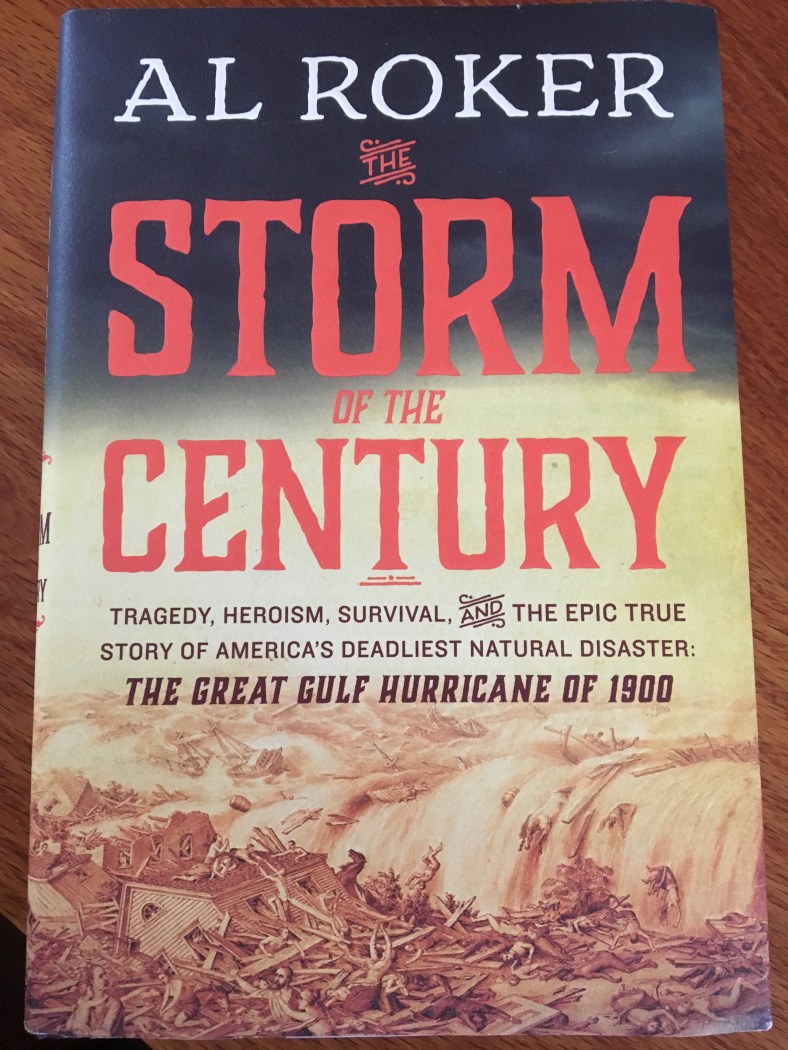
Yep, THE Al Roker.  The weather guy.  Fellow SUNY Oswego alum.  Smart, funny, the kind of guy you want to have over for poker night.

Roker has actually written a few books, covering cooking, murder mysteries, family, and weight loss.  The Storm of the Century was released late last year and offers a compelling historical review of the Gulf Hurricane of 1900 that destroyed Galveston, Texas.

IMG_1473

Admittedly, the book was not what I expected.  I anticipated a book that had more structure and was a bit more proper and history-bookish.  While I was pleasantly surprised by the book’s more narrative approach, switching gears mentally took me a while, which is I think why I had a hard time with the first few chapters.  That’s on me, though, and not a reflection on the book itself.

The book is set up almost like a work of fiction, setting the stage of the time and place of our environment and introducing and developing the main characters.  Don’t be fooled, though – this is no work of fiction.  The events described in the book are real, as were the stories of the people.  Roker emphasizes this at the end of book, as he details both formally through a bibliography and informally through narrative, the sources of his information, which include newspapers, scholarly works, historical accounts, and documented eye witness reports.

The book follows the lives of several individuals and families, with the primary focus on Isaac and Joseph Cline, who worked for what became the National Weather Service.  Roker mixes in a number of other personalities from Galveston and other areas.  Notables, such as Clara Barton, Joseph Pulitzer, and William Randolph Hearst also figure into the events of this devastating hurricane.  Roker provides insight on the state of politics and society in the post-Civil War United States, external political relations, and certain beliefs of those in meteorological science at the time, including the Jesuit priests of Cuba.

Roker details the interesting history of the National Weather Service, with its roots in the US Army Signal Corps, as well as some of the science and instrumentation of meteorology.  It’s interesting to see how much we have advanced in the science, yet how much still reflects back on what was done almost 120 years ago.

In the end, the events surrounding The Storm of the Century create a story of human error, tragedy, and perseverance.  In the practices of emergency management we must always keep in mind the human element.  Ultimately, that’s why emergency management exists.  While our focus might be on critical infrastructure, NIMS, or the current organization of FEMA, the reason why must ALWAYS reflect on people and our need to protect them from the impacts of disasters.  The Storm of the Century does just this, putting society front and center.

The Storm of the Century is overall a good read and accessible to many audiences including disaster and meteorology buffs, social scientists, and even those interested in US history.  The book is a great read for colleges and high schools alike, offering insights on society, politics, and science.  And hey, mine is even autographed.  Thanks Al!

IMG_1474

© 2016 – Timothy Riecker

Updating ICS Training: Identification of Core Competencies

The crusade continues.  ICS training still sucks.  Let’s get enough attention on the subject to get it changed and make it more effective.

If you are a new reader of my blog, or you happened to miss it, check out this post from last June which should give you some context: Incident Command System Training Sucks.

As mentioned in earlier posts on the topic, the ICS-100 and ICS-200 courses are largely OK as they current exist.  Although they could benefit from a bit of refinement, they accomplish their intent.  The ICS-300 course is where we rapidly fall apart, though.  Much of the ICS-300 is focused on the PLANNING PROCESS, which is extremely important (I’ve worked a lot as an ICS Planning Section Chief), however, there is knowledge that course participants (chief and supervisor level responders) need to know well before diving into the planning process.

First responders and other associated emergency management partners do a great job EVERY DAY of successfully responding to and resolving incidents.  The vast majority of these incidents are fairly routine and of short duration.  In NIMS lingo we refer to these as Type IV and Type V incidents.  The lack of complexity doesn’t require a large organization, and most of that organization is dedicated to getting the job done (operations).  More complex incidents – those that take longer to resolve (perhaps days) and require a lot more resources, often ones we usually don’t deal with regularly – are referred to as Type III incidents.  Type III incidents, such as regional flooding or most tornados, are localized disasters.  I like to think of Type III incidents as GATEWAY INCIDENTS.  Certainly far more complex than the average motor vehicle accident, yet not hurricane-level.  The knowledge, skills, and abilities applied in a Type III, however, can be directly applied to Type II and Type I incidents (the big ones).

It’s not to say that what is done in a car accident, conceptually, isn’t done for a hurricane, but there is so much more to address.  While the planning process certainly facilitates a proactive and ongoing management of the incident, there are other things to first be applied.  With all that said, in any re-writing and restructuring of the ICS curriculum, we need to consider what the CORE COMPETENCIES of incident management are.

What are core competencies?  One of the most comprehensive descriptions I found of core competencies comes from the University of Nebraska – Lincoln, which I summarized below.  While their description is largely for a standing organization (theirs), these concepts easily apply to an ad-hoc organization such as those we establish for incident management.

Competency: The combination of observable and measurable knowledge, skills, abilities and personal attributes that contribute to enhanced employee performance and ultimately result in organizational success. To understand competencies, it is important to define the various components of competencies.

  • Knowledge is the cognizance of facts, truths and principles gained from formal training and/or experience. Application and sharing of one’s knowledge base is critical to individual and organizational success.
  • A skill is a developed proficiency or dexterity in mental operations or physical processes that is often acquired through specialized training; the execution of these skills results in successful performance.
  • Ability is the power or aptitude to perform physical or mental activities that are often affiliated with a particular profession or trade such as computer programming, plumbing, calculus, and so forth. Although organizations may be adept at measuring results, skills and knowledge regarding one’s performance, they are often remiss in recognizing employees’ abilities or aptitudes, especially those outside of the traditional job design.

When utilizing competencies, it is important to keep the following in mind:

  • Competencies do not establish baseline performance levels
  • Competencies support and facilitate an organization’s mission 
  • Competencies reflect the organization’s strategy; that is, they are aligned to short- and long-term missions and goals.
  • Competencies focus on how results are achieved rather than merely the end result. 
  • Competencies close skill gaps within the organization.
  • Competency data can be used for employee development, compensation, promotion, training and new hire selection decisions.

So what are the CORE COMPETENCIES OF INCIDENT MANAGEMENT?  What are the knowledge, skills, and abilities (KSAs) that drive organizational success in managing and resolving an incident?  Particularly for this application, we need to focus on WHAT CAN BE TRAINED.  I would offer that knowledge can be imparted through training, and skills can be learned and honed through training and exercises; but abilities are innate, therefore we can’t weigh them too heavily when considering core competencies for training purposes.

All in all, the current ICS curriculum, although in need of severe restructuring, seems to cover the knowledge component pretty well – at least in terms of ICS ‘doctrine’.  More knowledge needs to be imparted, however, in areas that are tangential to the ICS doctrine, such as emergency management systems, management of people in the midst of chaos, and other topics.  The application of knowledge is where skill comes in. That is where we see a significant shortfall in the current ICS curriculum.  We need to introduce more SCENARIO-BASED LEARNING to really impart skill-based competencies and get participants functioning at the appropriate level of Bloom’s Taxonomy.

Aside from the key concepts of ICS (span of control, transfer of command, etc.), what core competencies do you feel need to be trained to for the average management/supervisor level responder (not an IMT member)?  What knowledge and skills do you feel they need to gain from training?  What do we need a new ICS curriculum to address?

(hint: this is the interactive part!  Feedback and comments welcome!)

As always, thanks to my fellow crusaders for reading.

© 2016 – Timothy Riecker

Emergency Preparedness Solutions, LLC

FEMA Publishes New Public Assistance Program and Policy Guide

Received in my ‘FEMA Daily Digest’ email this morning was FEMA’s announcement of a new Public Assistance Program and Policy Guide. After a quick review, it appears to be an excellent, comprehensive resource.

From their email…

“FEMA published the “Public Assistance Program and Policy Guide” that combines all existing policies into a self-contained, simple, adaptable, and searchable publication. The new “Public Assistance Program and Policy Guide” will replace all existing Public Assistance (PA) publications as well as the 9500 series policies. The consolidation of PA policies and guidance documents into a single publication will eliminate duplication and perceived inconsistency among the different documents and policies.

The “Public Assistance Program and Policy Guide” will be effective for disasters declared on or after January 1, 2016. Disasters that were declared prior to January 1, 2016 will still follow the 9500 series policies, which were in effect at the time of the disaster being declared. There are no substantive policy changes in the new guide.

The Public Assistance program anticipates that the Guide will be updated annually.

In the last ten years, the FEMA Public Assistance program averaged $4.7 billion in disaster assistance annually, making it the agency’s largest grant program. The Public Assistance program provides financial assistance to state, local, tribal, and territorial governments and certain private non-profits to aid their recovery following a disaster or emergency.

-TR

So Your AAR Says Bad Things… Now What?

There it is.  Your recently delivered after action report (AAR).  Uncomfortably sitting across the room from you.  You eye it like Tom Hanks looking at Wilson for the first time.

Wilson

Wilson!!!

You know what’s in it.  It says bad things.  Things you don’t like.  Things your boss really doesn’t like.  But what will you do?

First, let’s assume that, despite you being unhappy with the areas for improvement identified in the AAR, they are fair representations.  What will you do with the dreaded information now that you have it?  Your AAR may have come with a corrective action plan (CAP), but this is only guidance that still needs to be reviewed and acted upon.

First, each identified area for improvement should be prioritized.  After all, if everything is important, then nothing is important.  Even if the areas for improvement and/or corrective actions are already identified in the AAR (particularly if done by a third party or if the AAR is representative of a multi-agency exercise) you should review this prioritization with your own organization’s stakeholders.  This means pulling together a committee (sorry for cursing!) comprised of key areas within your organization.  This may even mean people from areas that may not have participated, such as information technology, as I’m betting there was something in the exercise about computer systems, programs, internet connection, data access, data continuity, etc.  Don’t forget the finance people, either… some fixes aren’t cheap!

Once everyone has had an opportunity to review the AAR, each identified area for improvement should prioritized, at least to the degrees of high, medium, and low; with a secondary filtering of short-term vs long-term projects.  While some may be relatively quick fixes, others can take months, if not years, to accomplish.  Activities should also be identified that are dependent upon others which may need to be completed first (i.e. a procedure needs to be written before it can be trained on).

That’s probably enough for one meeting.  But the people you gathered aren’t cut loose yet… in fact they are pretty much locked in, so you need to be sure that the people you bring together for this corrective action group have the knowledge, ability, and authority to commit resources within their respective areas of responsibility.  Now that activities have been prioritized, it’s time to assign them… this is why involvement of your boss (if you aren’t the boss) is so important.

Some individuals within your organization will be able to act on their own to make the corrective actions that are needed – while others will need to work together to make these happen.  Consider that there may be more activities than just those identified in the AAR.  For example, the AAR may identify a need for a resource management plan.  That’s good, but we all know you can’t just build a plan and expect it to be ready for action.

For those who are regular readers of my blog, you know I’m a big fan of the POETE elements.  (More on POETE here).  What is POETE?  POETE is an acronym that stands for:

  • Planning
  • Organizing
  • Equipping
  • Training
  • Exercising

What is the value of POETE and what does it all mean?  POETE is a great reminder of the key activities we need to do to enhance our preparedness.  Given that, when we look at an identified need for improvement, we need to consider how to properly address it.  So start at the top:

  • What plans, policies, and procedures are needed to implement and support this corrective action?
  • What organizational impact will occur? Do we need to change our organization in any way?  Do we need to form any special teams or committees to best implement this corrective action?
  • What equipment or systems are needed to support the corrective action?
  • What do people need to be trained in to support the corrective action? Do we need to train them in the plan, about a new policy or procedure?  Do they need training on organizational changes?  How about training in the use of equipment or systems?
  • Lastly, once you’ve made a corrective action, it’s a good idea to test it. Exercises are the best way to accomplish this.

There are obviously other considerations depending on the specific corrective actions and the circumstances of your organization.  Funding is often times one of the most significant.  If you need to obtain funding to make corrective actions, the AAR is one of the best documented investment justifications you can get.

From a project management perspective, the committee should regularly reconvene as a matter of checking in to see how the corrective actions are going.  On a continuing basis, the progress of corrections should be tracked (spreadsheets are great for this), along with who has been tasked with addressing it, timelines for completion, related finances, progress notes, etc.  Otherwise, in our otherwise busy days, these things get lost in the shuffle.

From a program management perspective, this is a process that should be engrained culturally into your organization.  Ideally, one person should be responsible in your organization for coordinating and tracking this corrective action process.  As additional exercises are conducted and actual incidents and events occur, corrective actions from these will be brought into the mix.  It is all too often that organizations complain of seeing the same remarks on every AAR or from experiencing the same issues for every response.  BREAK THE CYCLE!  Establishing a corrective action program for your organization will go a long way toward making these chronic issues go away.

By the way, the same concept can be applied to multi-organizational/agency efforts at any level – local, county, state, federal, regional, etc.  Since we respond jointly, there are great benefits to joint preparedness efforts.  We will likely find that even that we have our own house in order, working with someone else is a very different experience and will require a whole new list of corrective actions as we identify areas for improvement.  This process works great with multi-agency committees.

The bottom line – the biggest reason why we exercise is to test our capabilities.  When we test them, we find faults.  Those faults need to be corrected.  Capitalize on the investment you made in your exercise effort to address those identified deficiencies and improve your capabilities.

What ideas do you have for addressing corrective actions?

Need help with preparedness activities?  Be Proactive and Be Prepared™ – Reach out to Emergency Preparedness Solutions!  We’re always happy to help.

Thanks for reading!

© 2015 – Timothy Riecker

Emergency Preparedness Solutions, LLC

National Preparedness Goal: Second Edition Just Released

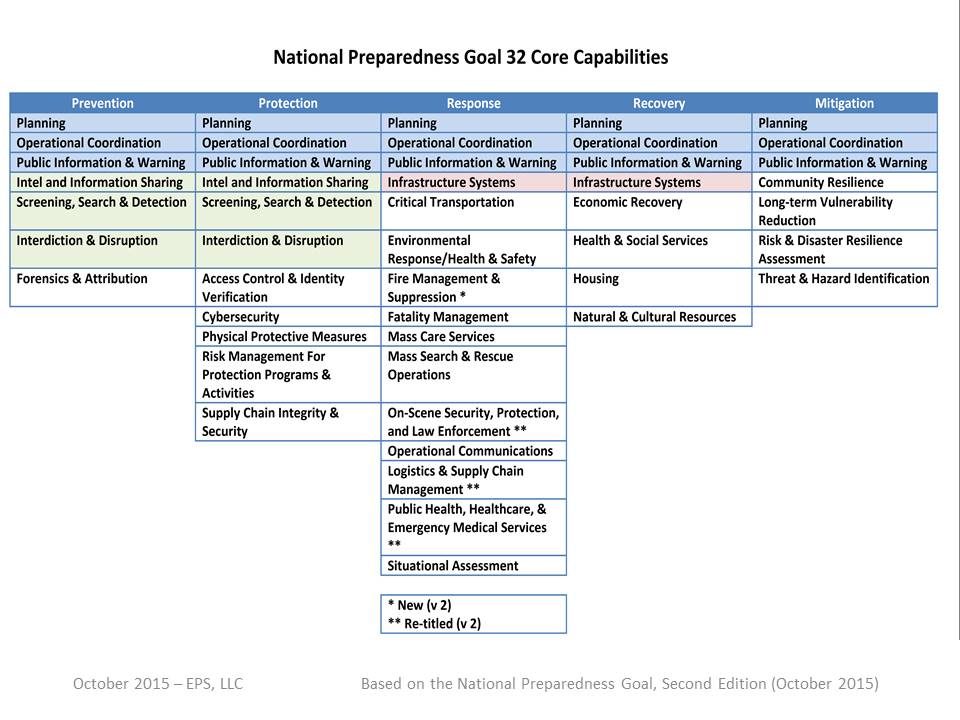
Today FEMA released the second edition of the National Preparedness Goal.  This document, which only has a few substantive changes from the original, provides a vision for preparedness across the nation.  It is best known for identifying the five mission areas of Prevention, Protection, Mitigation, Response, and Recovery; along with the Core Capabilities.  Many thanks to my colleague Jon who brought this release to my attention.  The updated National Preparedness Goal and associated documents can be found here.

There are not many changes in this update, and the changes that are included should be of little surprise if you reviewed the draft released for public comment several months back.  Up front, the update provides some editorial clarification on the definitions and relationships between the federal government and tribes as well as US territories.  It also provides more emphasis on the concept of whole community and the special populations within the whole community which may require additional protections and actions.

Perhaps the most significant changes are reflected in the Core Capabilities, of which there are now 32.  In the preamble to the Core Capabilities which discusses the concept of Risk, it is interesting to note that the Core Capability of Cybersecurity was specifically highlighted as having applicability across all Mission Areas – a concept which I fully agree with.  I’m left wondering, then, why it was not re-defined as a common Core Capability.

NPG 32 Core Capabilities

NPG 32 Core Capabilities

Other changes to the Core Capabilities include the renaming of the On-Scene Security and Protection Core Capability to On-Scene Security, Protection, and Law Enforcement; and the Public Health and Medical Services Core Capability to Public Health, Healthcare, and Emergency Medical Services.  Additionally, the Public and Private Services and Resources Core Capability was renamed to Logistics and Supply Chain Management, which seems to provide better recognition of the intent of that Core Capability.  Finally, a new Core Capability was added – Fire Management and Suppression.

Three of these changes seems to revolve around a stronger recognition and inclusion of the traditional first responder services of Law Enforcement, Fire Service, and Emergency Medical Services; all of which seemed to get lost in the bigger picture of the earlier capability discussions.  I’m hopeful these changes will help bring these services to the table in more communities when capabilities are discussed.  I’m a firm believer that the Core Capabilities provide a consistent, scalable, foundation for discussion of preparedness for every community.

© 2015 – Timothy Riecker

Emergency Preparedness Solutions, LLC

WWW.EPSLLC.BIZ 

LLIS is Back!

Great news from FEMA early this morning – the Lessons Learned Information Sharing (LLIS) resource is back.  Quite a while ago they pulled down the LLIS site and have (very slowly) worked to transition the data and management responsibilities to the Naval Postgraduate School’s Homeland Security Digital Library.  Information from the FEMA release below.

-TR

~

We are pleased to announce that Federal Emergency Management Agency’s Lessons Learned Information Sharing (LLIS) program has completed the consolidation of content previously available on LLIS.gov with the Naval Postgraduate School’s Homeland Security Digital Library (HSDL). As part of the consolidation effort, nearly 23,000 documents were transferred to the HSDL document library. We believe this consolidation will improve the whole community’s access to valuable information. Some of our most recent LLIS products, including Threat/Hazard and Core Capability Trend Analyses, Grant Case Studies, and Lessons Learned and Innovative Practices can be found on FEMA.gov or by visiting HSDL.org.

The content transferred to HSDL will maintain a similar level of accessibility as LLIS.gov. Documents that required a username and password to view on LLIS.gov will also require a username and password on HSDL.org. While your LLIS.gov log-in credentials do not transfer, you can easily create a new HSDL account by visiting the HSDL login page. Please note that some content is available without a password. To search for publicly available documents visit HSDL.org and use the search bar function on the homepage.

If you have additional questions, we encourage you to review our Frequently Asked Questions document. You can also email us at FEMA-lessonslearned@fema.dhs.gov.

Thank you for your patience during this transition. Stay updated on all LLIS program news by signing up for the LLIS newsletter.

FEMA Seeking Comment on Preliminary Damage Assessment Manual

Released last week, FEMA is seeking comment from emergency managers on the draft FEMA Damage Assessment Operating Manual.  The manual establishes (much needed!) national damage assessment standards developed from historic lessons learned and best practices already in use by local, state, tribal, territorial, and federal emergency management agencies.

The draft manual and comment matrix are posted in the FEMA Library.  FEMA asks that comments be submitted no later than November 14, 2015 to Mr. Ryan Buras, Senior Program Advisor at PDAmanual@fema.dhs.gov.

Emergency managers – Be Heard!

-TR

ICS Training Sucks… So Let’s Fix It

A great many of you are familiar with the piece I wrote in June called Incident Command System Training Sucks.  In it, I identify that the foundational ICS courses (ICS-100 through ICS-400 – but especially ICS-300 and ICS-400) simply do not provide the skills training that emergency managers across all disciplines require to utilize the system efficiently, effectively, and comfortably.  ICS Training Sucks turned out to be a popular piece which had a great deal of support from the first responder and emergency management community – which I am very grateful for.  The amount of comments and feedback was indicative to me that I was on the right track and that I need to revisit the topic and explore more.

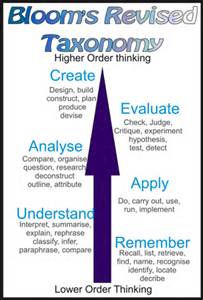
At the center of my argument stands Bloom’s Taxonomy.  Bloom’s is a learning hierarchy which helps to identify the depth of instruction and learning.  Here is Bloom’s Revised Taxonomy.  We’ll be referencing it a bit in the examples I provide.

Bloom's Revised Taxonomy

Bloom’s Revised Taxonomy

Take a moment to read through the descriptions of each of the ‘orders of thinking’ in Bloom’s.  Go ahead, I’ll wait…

Done?  Good.  Most would agree that courses such as ICS-300 and ICS-400 should attempt to convey learning at the Apply level, correct?  Unfortunately, that perception, while wildly popular, is wrong.  Most of the learning objectives of the two courses (objectives are our reference points for this) are at the Understand and Remember levels.  Yeah, I was a bit surprised, too.

In ICS Training Sucks, I provided a greater detail of the background analysis (it summarized the narrative of a Master’s research paper I wrote), so if you want more, simply go back and check it out.  While I make a few broad recommendations in that piece, there has been a need to examine our path to fixing this more closely.

In the development of curriculum, there exist several models.  The most commonly used model is the ADDIE model, which stands for Analysis, Design, Development, Implementation, and Evaluation.  The first step, Analysis, is really the most important, although often the most ignored or cut short.  People think they know what the need is, but often don’t really understand it.  If you are interested, I’ve written a piece on the topic of Analysis for Training Magazine last year.

Even though we are suggesting a re-write of the ICS curriculum, or parts thereof, Analysis is extremely important.  The roots of the current curriculum we use goes back to circa 1970s wildfire ICS courses.  These are good courses, and while I’m not sure if they fully met the need then (although they did advance us quite a bit), their evolved versions certainly DO NOT now.  There is no sense in repackaging the same product, so let’s first figure out what people need to know to do their jobs effectively.  Essentially, this leads us to identifying a list of key core competencies in ICS.  Core competencies will define the level of competence needed in a particular job or activity.  We can easily use the levels of Bloom’s as our reference point to establish common definitions for the levels of competence.  What am I talking about?

Let’s pick one key activity in ICS to examine.  Resource Management is a great example as it shows the disparity between what exists and where we need to be.  Resource Management is discussed in Unit 6 of the ICS-300 course.  I think most would agree that we expect most every jurisdiction to be able to implement sound resource management practices.  Implement is the key word.  Implementation is indicative of the Apply level of Bloom’s Taxonomy.  When looking at unit objectives in the ICS-300 course for unit 6, the key words are identify and describe.  Identify is indicative of the Remember level of Bloom’s Taxonomy, while describe is indicative of the Understand level.  Both fall short of application.  While we aren’t looking for this curriculum to create incident management teams, we still expect most jurisdictions to be able to manage resources, which is certainly a core competency of incident management.

I think the NIMS doctrine provides a good starting point for identifying core competencies.  In an effective study, there may be other competencies identified – perhaps topics such as leadership, that may not necessarily be found in a revised ICS curricula, but can be obtained through other training courses.  This could lead to an important differentiation between core competencies (those that MUST be included in ICS training) and associated competencies which can be sourced elsewhere.

Further, we can capitalize on what we have learned through implementation of the current ICS curriculum and previous iterations.  We know that multidisciplinary training is most effective since larger incidents are multidisciplinary.  We also know that training must be interactive and maximize hands-on time.  The past few updates to the ICS courses have done a great job of encouraging this, but we need more.

Making more detailed recommendations on fixing ICS training will take time and effort, as a solid Analysis must first be done.  Once core competencies can be identified and defined, then a strategy for revamping ICS training can be developed.  As mentioned in ICS Training Sucks, this approach should be multi-faceted, using both new and (good) existing courses to support it. Let’s not be bound by what currently exists.  We don’t necessarily have to create a ‘new’ ICS-300 or ICS-400 course.  Let’s create courses within a broader program that meets the needs of the emergency management community.  They may no longer be called ICS-300 and ICS-400.  Perhaps these two will be replaced by four smaller courses?  Who knows where this path will take us? The bottom line is that we need to be responsive to the needs of the learners, not bound by “the way we’ve always done it.”

As always, feedback is appreciated.  Perhaps there exists an institution that has the desire and funding to pursue this further?  I’m fully onboard!

© 2015 – Timothy Riecker

Emergency Preparedness Solutions, LLC

WWW.EPSLLC.BIZ