Preparedness is a Marathon

Logo of the 2014 Utica Boilermaker

Logo of the 2014 Utica Boilermaker

Today marked the 37th running of the Boilermaker, a 15k road race hosted by the City of Utica (New York) for over 17,000 runners from around the world.  The race is a matter of pride for area residents, even those who do not run.

I considered this morning that there are many similarities between a marathon (yes, I’m aware the Boilermaker is in fact not a marathon at just over a third the distance of an actual marathon – work with me on this one) and what an organization, specifically a jurisdiction, must endure for preparedness.

First, preparedness is not a one-off activity, rather it is a culmination of activities.  While the Boilermaker highlights its 15k road race, they have a number of very successful related events including a 5k road race, a three-mile walk, a wheelchair race, and a health and fitness expo.

Preparedness has an ebb and flow of activities just as a marathon has a variety of stretches, turns, and hills.  Both marathons and preparedness should have a high degree of community engagement.  The Boilermaker has a variety of corporate and local business sponsors, engages all services of the City of Utica and many assisting/mutual aid agencies, has a high degree of media coordination, and sees hundreds of volunteers aiding in everything from registration, pre- and post- race clean up, to providing water to athletes along the course.  Our preparedness efforts should also follow this model of whole community engagement.

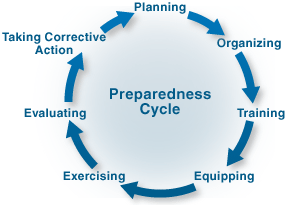
The most significant difference, however, is that marathons have an end while preparedness is cyclical.

The Preparedness Cycle - FEMA

The Preparedness Cycle – FEMA

The Preparedness Cycle must be worked on all the time and does not end.  To keep morale high and to keep the whole community interested remember to celebrate the accomplishment of each activity just as runners and the community celebrate the completion of their race.  That said, Utica is already preparing for next year’s race.

Congratulations to all of this year’s runners, and congratulations to jurisdictions and organizations beginning their marathon of preparedness.

© 2014 Timothy Riecker

Kansas City Changing the Paradigm In Shooter Responses

Despite some discussions going back to late last year about changing they way we respond to mass shootings, I’ve not heard of any major municipalities actually make these changes – until now.  Responders in Kansas City, MO (KCM) have exercised their new plan regarding early insertion of EMS personnel into an active shooter scenario.  The exercise appears to be very early stage, using it as a learning experience from which to further develop plans.  (another great use of exercises!)

I commented on the discussed changes back in January and I still have the same concerns today that I did then.  I had posted some discussion threads similar to my blog post onto LinkedIn discussion boards which prompted some very spirited discussion.  Most people agreed that getting EMS into an active shooter area early can save lives, but it needs to be done the right way.  KCM seems to be going in the right direction by developing plans and protocols jointly with law enforcement and working out the kinks and questions via drills and other exercises.  Carrying the preparedness cycle further, I’m sure they will work toward training and equipping EMTs appropriately for such a situation.  Constant practice of these protocols by all parties will be very important.  Responder safety needs to be the utmost concern.  While there have been incidents to the contrary, we as responders and we as a society are not used to EMTs and firefighters being shot at, much less killed in action by an aggressor.  Certainly the first EMT fatality in an incident such with an early insertion protocol will result in the protocol being aggressively questioned – as it should.  I just hope that those doing the questioning keep the appropriate context.

Just as there is no easy answer on how to stop mass shootings, there are no easy answers on how best to respond to them.  I’m hoping KCM is willing to share their worked out plan and protocols with the responder community so we can learn from them.  Such sharing will be very important to the evolution of responses to these types of incidents.

© 2014 Timothy Riecker

FEMA National Preparedness System Updates

This afternoon EMForum.org hosted Donald ‘Doc’ Lumpkins, the Director of the National Integration Center from the National Preparedness Directorate. Doc had some great information on their current and near future activities regarding updates to the National Incident Management System (NIMS) and new Comprehensive Preparedness Guides (CPGs) expected to be released this year.  This is great news as we are always seeking additional national guidance and revisions which help us to maintain standards of practice.

Regarding NIMS, the guiding document has not been revised since 2008.  Doc specifically mentioned updates to NIMS to include:

  • the National Preparedness Goal and the National Preparedness System
  • Expanding NIMS across all five mission areas (Prevention, Protection, Mitigation, Response, and Recovery)
  • Encouraging whole community engagement and understanding
  • Continued emphasis that NIMS is more than just the Incident Command System (ICS)
  • Integrating incident support structures (such as EOCs – more on EOCs later)
  • Integrating situational awareness content
  • Incorporating lessons learned from exercises and real world events (Doc mentioned his office’s activity of culling through LLIS.gov to gain much of this information)
  • Including stakeholder feedback in the revision efforts
  • NIMS update activities will be conducted through the summer with an expected release of a new document this fall

As a significant component of the NIMS update, there will also be continued efforts to update the resource typing list.  Priority will be given to resources which are often requested.

The next topic of discussion was the Comprehensive Preparedness Guides (CPGs).  I was very excited to see a list of likely and potential CPGs either currently under development or expected to be developed soon.  These included:

  • Updating CPG 101
  • A CPG for Strategic Planning (This should shape out to be excellent guidance and essentially serves as a ‘catch all’ for many of the strategic planning tasks we do in emergency management)
  • Incident Action Planning (Doc said this will not be anything new or a replacement of best practices such as the Planning P.  Rather this document will serve to capture these best practices and ensure currency and critical linkages)
  • Planning for mass casualty incidents
  • Social media (a critical aspect of emergency management that is still changing regularly, and I don’t yet feel that we have a firm grasp on it and how to best use it.)
  • Access/Re-Entry to disaster sites
  • Improvised Explosive Devices (crafting hazard-specific annexes)
  • EOC guidelines (I’m hoping this document, while outlining best practices, provides flexibility for different management models of EOCs)
  • Search and rescue management

I’ve come to greatly appreciate that the National Preparedness System is a blanket thrown over the five mission areas, recognizing that each mission area (again – Prevention, Protection, Mitigation, Response, and Recovery) must be prepared for at every level of government to achieve the greatest measure of effectiveness.  There are many critical linkages within preparedness that are found within each or at least most mission areas and the continued efforts of the National Preparedness Directorate seem to be going in a good direction and incorporating the right people and information in their efforts.  Within this frame of thought, Doc mentioned that all of these efforts will utilize subject matter experts from across the country, with many drafts having public comment periods.  Be on the look out for these (I’ll post them as I see them) and be sure to review and comment on them.

As a final note, this was the last broadcast for EMForum.  After 17 years they are shutting down their program.  There has been no mention as to why they are shutting down.  While I’ve not attended every webinar, I do catch a few each year when the topic and/or speaker interest me.  The loss of EMForum is a loss to emergency management and the spirit of sharing information we have.  Through EMForum, there have been many great webinars, such as this one, where new programs and best practices are shared.  I’m hopeful the function that EMForum has served in facilitating this soon replaced so we can continue to stay up to date on what is transpiring.

©2014 Timothy Riecker

Was the Sewol Korea’s Katrina?

By now everyone is familiar with the South Korean disaster this past April – the sinking of the MV Sewol and the loss of almost 300 passengers, most of which were high school students, and to date, two divers involved in the recovery of the bodies.  The vessel was carrying almost 4000 tons of cargo – over 4 times its rated limit.  The morning of its fateful trip, the top-heavy Sewol took on water and capsized.  A lack of leadership on the vessel resulting in confusion, trapping hundreds in a watery grave.  This would be a horrific disaster for any nation to face.

Through the years we’ve seen numerous ferry boat disasters around the world, most of which are off the shores of developing nations – those with few if any safety standards and a lack of regulatory and enforcement agencies.  Rarely, however, do we see ferry boat disasters occurring in developed nations.  In many regards we consider South Korea our peer and sometimes even an innovator, especially in the areas of technology and engineering.  It seems, however, that regulation has not kept up with innovation.  South Korea’s response efforts have also been criticized.

In 2005, the United States suffered the impacts of Hurricane Katrina on the Gulf Coast.  Over 1800 people lost their lives.  The disaster within the disaster was how poorly our emergency management system worked.  Their were failures at higher levels of Federal and State government, resulting in response delays and poor coordination and delivery of resources.  FEMA was blamed for most of these failures.  People were fired or asked to resign and new plans were created and implemented – most of which at the behest of legislators.

Now in South Korea in the wake of the ferry tragedy, their federal government is on the verge of launching a new national safety agency, meant to usurp responsibilities from various other federal agencies including the Ministry of Security and Public Administration, the National Emergency Management Agency, the Ministry of Oceans and Fisheries, and the Coast Guard.  Change is clearly needed, but will a new organization bring about the changes needed to protect the citizens of South Korea?

We tend to see a great deal of change when tragedies such as this occur.  Obviously changes need to be made, but few accept responsibility.  Changes also seem to be made to give the illusion of progress, with no real plans set in place to address the underlying issues that exist.  It seems people feel that change itself will provide the fixes which are needed.  We’ve seen reorganizations put in place at FEMA on several occasions, intended to streamline or address dysfunctionality.  We’ve seen the same happen with the American Red Cross – who seems to alternate between two different organizational models with each decade.  Just recently the Secretary of the Veterans Affairs Administration resided amidst their scandal – activities which have taken place quite a distance from his post, activities which you hear little responsibility taken by the individual hospital administrators where it truly lies.

It’s not to say that all organizational change is unnecessary.  Organizations are organic, living, breathing entities – not static creations.  They must evolve and adapt to continue being successful.  That doesn’t mean, however, that every occurrence of negative press necessitates an organizational change.  Organizational changes are expensive in time, money, and the anxiety of employees.  They stall out progress of the organization until rebuilding is complete, then progress resumes slowly as the kinks are worked out.  Many think a plan for reorganization is simply drawing a new organization chart and that its implementation, after the firing of a few people and handing out new titles to others can be implemented overnight.  This, clearly, is fundamentally wrong.  Consider that even small businesses put a great deal of time into creating business plans which outline the resources, organization, and strategy of a new company.

I would challenge that it’s the people and the culture of these agencies that need to change.  Certainly they need new or different approaches to problems, some adjustments in their chain of command, and the tools to do their jobs better.  A radical reorganization should only take place if it’s completely necessary.  Consider what the creation of DHS has done for us – yes, their have been some improvements in prevention, preparedness and response; but at what cost?  A massive umbrella agency with coordination and leadership problems of its own.  DHS didn’t escape Katrina unscathed either due to its position between the FEMA Administrator and the President.

It seems that reorganization is the easy knee-jerk answer to problems.  Let’s slow down a bit, assess the failures and their causes, and address the internal problems first.  Without doing so, new agencies and new titles will carry the same problems.

© Timothy Riecker 2014

FEMA Public Assistance Thresholds aka Do Your Research

I just received my April edition (number 627) of the Natural Hazards Observer (NHO), a bi-monthly publication of the Natural Hazards Center of the University of Colorado at Boulder. As of my posting of this article, they have not yet posted the April edition on their website, but they are likely to do so shortly.  My desire with this particular post is to encourage a thorough analysis of the topic at hand rather than an extremely narrow perspective as was published in the NHO.

First, I feel a need to mention that The Natural Hazards Observer and I have a tenuous on again, off again relationship. I’ve become rather disenchanted with their articles in the past; occasionally disagreeing completely with authors’ premise and approach (not that everyone is necessarily agreeable to mine). I’ve even written the NHO about the fact that a University center whose goal is to research disasters has presented articles that, to me, come across at times as unprofessional and not well thought out. I’m not really knocking the NHO nor is my intent to pick a fight, rather I’ve been trying to be constructive with them.  Given their foundation, I think their readers expect a more scholarly approach. While there is certainly plenty of good information to find in the NHO, some seems questionable. One of their tag lines is ‘Disaster Research News You Can Use’. I often find that their articles have little to do with research, such as the one I cite below, and are really more of a media regurgitation. There are other, more appropriate forums for that – like blogging – rather than a publication that advertises research.

That said, my particular beef with this edition is the first article, titled ‘All’s Not Fair: Illinois Battles Over Being Too Big To Feel FEMA’s Love’. I encourage you to read the article for yourself and form your own impressions. To sum up the general idea of the article, folks in Illinois are questioning FEMA’s Public Assistance (PA) program thresholds for disaster recovery. Specifically, they take issue with these thresholds being based on per-capita amounts. They argue that larger, more populous, states are discriminated against (their words); and further stating that a larger population doesn’t necessarily equate to a state’s ability to self-fund disaster recovery efforts.

Public Assistance (PA), by the way, is focused on recovering public infrastructure (roads, bridges, public buildings, etc.), whereas Individual Assistance (IA) provides direct assistance to individuals to help cover uninsured losses.

When first reading this, two particular issues stood out to me. 1) They don’t mention the fact that FEMA will also examine a county’s per-capita damages for potential declarations, and 2) High populated states quite frequently receive disaster declarations.

The Texas Department of Public Safety has a great document which summarizes the state and county thresholds for 2014. The NHO article makes no mention of the county threshold, which is where most PA declarations are decreed – for a county or counties, rather than the entire state. While the county threshold is higher, it would generally be easier for a localized disaster to be declared (PA) than the entire state, which is mostly unaffected.

As for state declarations, FEMA provides a great summary by state of major declarations (this is the specific number to look at in this case), emergency declarations, and fire management declarations. By scanning down the list, you’ll see that states like Texas, Florida, California, New York, and Louisiana are among the top contenders for declarations. Other large and more populous states, such as Illinois, are not far behind them. This pretty much blows a hole in the premise that larger, more populated states are ‘discriminated against’. Having been in this business for a while, I know that sometimes you win (the request for a declaration) and sometimes you lose. It makes a significant argument for states to have disaster reserve funds.

All that aside; are there issues of fairness in this traditional per-capita assessment of damages within the disaster declaration process? There may certainly be. The assumption of the current process is that a more populous state has a greater tax base from which to draw funds for disaster relief. This assumption, at a glance, makes sense, but may not be the most fair way of determining if a state warrants assistance.  The most significant arguments against this seem to be 1) A lower relative mean income as compared to other states translates into a lower tax base, and 2) Is the tax base even a fair measure of need/capability for a state?

An interesting read on this is a GAO report from 2012. It seems to me, a guy who is not a FEMA disaster recovery expert – but I’ve been around the block a few times – that there are some issues of fairness and perhaps better ways to assess a state’s true need for Federal assistance. A fair discussion of this topic, however, requires having a 360 degree perspective of all the issues involved. Perhaps it’s a good topic for a research journal?

Are you Planning for All Hazards?

Image

While I’m amazed by the number of jurisdictions and businesses that don’t have any emergency plans at all, I’m almost nearly amazed by those who only have isolated, single hazard plans. I’ve seen plenty of entities with only fire plans or flood plans.

How does this happen? Many small towns may ask their local fire chief to write an emergency plan for the town – this plan often times outlines the fire response structure but ignores other hazards. Sometimes this myopic view of planning takes place because of a focus or near panic over one particular hazard. These situations are generally not the fault of the people who wrote them. Just because someone is in public safety doesn’t mean they know every facet of it. Emergency planning is as much of a niche as pump operations in the fire service or special tactics in law enforcement. It requires a certain set of knowledge, skills, and experience to be successful and effective.

While it’s logical that a larger jurisdiction will have a more complex emergency plan than a smaller jurisdiction, there are still foundational elements that are common to all. Perhaps the most critical of these is the necessity to plan for all hazards. All hazards planning, if you’re not familiar with the concept, is a process beginning with the identification of the hazards which can impact a community, the impacts associated with each hazard (also known as vulnerability), and the probability of each hazard impacting the community (also known as risk). This is called a Hazard Vulnerability Analysis (HVA). By rating the vulnerability and risk factors for each hazard, a fairly simple algorithm can be used to provide an overall ranking for each hazard. Additional information, such as the availability of resources to respond to each hazard can be included as well.

Obviously there is a lot of context that needs to go into such an assessment, which is best conducted by a planning team to gain the most amount of input. Comprehensive Preparedness Guide (CPG) 101, published by FEMA/DHS, provides much more information on the planning process as a whole. Historical disaster information should be referenced, but not to the extent of outweighing other inputs. Fluctuations over time in population, topography and development, and climate change are all leading to, as the investment world states it, historical information not necessarily being indicative of future performance.

Scientific data should also be examined, such as flood maps and wild fire risk. Communities should be sure to reference information on hazardous materials, which is required reporting by industry per the Emergency Planning and Community Right to Know Act of 1986 (also known as SARA Title III). Once you have identified and ranked all the hazards, you know what ones to focus on. Perhaps it is the top 8, or maybe the top 12 that indicate a high enough vulnerability and/or high enough risk to incorporate into your planning efforts. Once these are identified, you continue through the CPG 101 planning process to create a comprehensive plan. A comprehensive plan incorporates all elements needed to address the responses to these incidents. Given that the majority of responses are largely similar, regardless of the hazard, one concept of operations will address this in the plan. Separate plans, written as annexes or appendices, then can be created for hazards with very specific issues, such as a pandemic, or to address specific functions, such as evacuation and sheltering.

Is it possible to anticipate every disaster that could possible impact your community? Can your community possibly predict being trampled by a giant man of marshmallow or having busses tossed aside by fire breathing dinosaurs from Japan? No? Then don’t spend much time on these things. Be realistic. That said, a Comprehensive Emergency Management Plan (CEMP) – which is a plan that considers all hazards, all resources, and the whole community – can even help account for hazards you didn’t identify. Do you think Chelyabinsk, Russia had a plan for meteor strikes? Not likely. However, consider how the components of a CEMP could have addressed critical areas of response: mass casualty, search and rescue, debris management, sheltering.

I recall a number of years ago, prior to the 2013 occurrence in Chelyabinsk, where there was a bit of media frenzy over near earth objects (NEOs) such as meteors. The public information officer (PIO) for the state’s emergency management agency received a call from a media outlet inquiring if the state had a plan for meteor strike. The PIO answered ‘yes’, qualifying that with a statement about the value of comprehensive planning. Was there a specific plan for meteor strikes? No. The likelihood is so slim that it’s not worth putting effort toward (although I’m sure someone has). Does the CEMP cover all the necessary response components? Absolutely.

Author’s note: Unfortunately I don’t recall where I got the picture from, so I’m unable to give proper credit. If anyone knows or claims it, I’ll gladly give credit or pull it down.


A Disasterous Trend: Cuts in Preparedness Funding

This post was initially inspired by an article from CBS News on funding cuts to disaster preparedness programs.  These cuts go further and deeper than the current sequester cuts we are now seeing.  These cuts are a dangerous and disastrous trend.  To quote the article…

“In fiscal year 2010, Congress appropriated $3.05 billion to FEMA for preparedness grants designed to strengthen “our nation’s ability to prevent, protect, respond to, and recover from terrorist attacks, major disasters and other emergencies, …. In fiscal year 2012, that appropriation was less than half that figure – $1.35 billion. The same trend could be seen in FEMA pre-disaster mitigation grants, which fell from $100 million in 2010 to $35.5 million two years later.”

Have all the terrorists gone away?  Has Mother Nature stopped having temper tantrums?  Have stupid people stopped doing stupid things?  I don’t think so!  So why the cuts?

Let’s put some things in perspective… On one hand, we do need to have a bit of fiscal prudence and restraint.  GAO reports have repeatedly shown that many state and local governments are simply not spending down the grant funds they have been allocated.  DHS grants are backed up several grant years with unspent funds.  That said, as we peel back the layers of the onion, there are certain facts that need to be mentioned.  Why aren’t they spending the money they have been given?  First, grant periods have generally been too short.  The most significant reason for this is the inefficiency of bureaucracy we live in.  Follow this trail… The federal fiscal year begins October 1st.  The budget gets passed at some undermined point around that.  DHS, along with all the other agencies, get their allocations.  They then need time to formulate their grant guidance for the funds going to states and locals.  By the time states see this grant guidance and their respective allocations it’s usually close to the end of the second quarter of the federal fiscal year.  States then have to formulate their own grant guidance as they pass through funds to locals.  All this bureaucracy delays the grant year about six months.  Recognizing that nothing could be done about the bureaucracy, DHS finally extended grant years only recently, giving folks a more reasonable amount of time to spend the money.

Another reason why grant funds are slow to spend is that in most cases the grantees don’t actually ask for the money, therefore they don’t have a budget prepared beforehand.  DHS distributes funds based upon a formula.  While an application exists, it’s nothing more than an afterthought and formality.  That leaves states and locals with a pile of cash and no plan on how to spend it.  Here lies the beginning of the breakdown in accountability.  Now most folks will say that it’s easy to spend money.  In government, not so much.  Especially when you consider a few factors: 1) every level of government has spending rules (accountability is a good thing, but that can get in the way of efficiency when RFPs have to be issued for darn near everything); 2) a great deal of equipment was purchased in the big push of funds immediately surrounding 9/11 – what else do we need?; and 3) grants are restricting what funds can be spent on (i.e. there are limits on personnel (salary) expenses, and the purchase of disposables and maintenance costs of equipment – which are of particular importance for exercises).

So governments don’t have a lot of time to spend the money and face a few obstacles in getting the money spent.  But how is this a factor of cuts?  One reason for these cuts is that Congress is seeing that states and locals have a lot of money left over going back several grant years.  Failing to realize the whys and wherefores of it all, they are simply giving less money (because, to them, it’s not needed – but nothing could be further from the truth!).  They are also looking to reduce spending overall, as the article cites, and that’s a hit that will impact nearly everyone.

Taking a look at the grantees, however, there are a few criticisms.  Better and more proactive fiscal planning needs to be implemented.  Costs should be forecasted out several years to better anticipate needs.  They may, sadly, have to trim programs and streamline operations (although most emergency management programs certainly are not living in the lap of luxury).  They also need to be more creative with the declining funds they receive, especially through partnerships and regionalization.  An area doesn’t need to be regarded as a UASI or Catastrophic Planning Zone to work cooperatively as a region, which should include some pooling of funds for collective projects.

What can be approached regionally?  Most preparedness efforts fit well into that category: planning, training, and exercising.  Think about it, you work with your neighbors all the time and disasters don’t seem to stop at the county line, so why not make your cooperation more effective and efficient?  In the absence of regional catastrophic planning, which most areas don’t need to do, consider planning for some credible worst case scenarios and cascading impacts such as flooding and mass care.  Obviously regional mutual aid planning is essential.  How about working with your public health partners?  What about the private sector – how can you strengthen your relationships with them?  Regional planning conferences are a good start!  Regionalized training is obviously a no-brainer and regional exercises are essential making sure that the planning and training are effective and to give folks an opportunity to practice what they have learned.  Lastly, speaking as someone who has experience working for government and as a consultant, in many cases it’s actually more cost-effective and easier to coordinate regional preparedness activities by hiring a consulting firm, some of which have proven experience and expertise in working with the multiple stakeholders that a regional effort would include.

As we face reduced funding, we have to be more creative, cooperative, and communicate specific needs on a regular basis up the chain of government.  If you are with county or local government, let the state know what your needs are.  And don’t just tell them once – be sure to repeat yourself – not in an annoying wintertime house fly kind of way, but when the appropriate opportunity presents itself.  Make sure that you show justification for your needs through after action reports and documented strategies and plans.  Ask the State to take these needs up to federal partners – and when you have the opportunity to speak with these federal partners directly, take advantage of it; be they representatives of FEMA or your local representative of Congress or US Senator.  Remember to be specific and cite the need.  Don’t complain but be direct.  With funding that emergency management programs simply receive without asking being on the decline, we need to be proactive about receiving funds.

Emergency management and, to a greater degree homeland security, have been fortunate to have a good deal of funding over the last decade.  There has been so much money, though, with such short time lines, that things haven’t been done as well as they should have.  Now is the time to re-tool and reexamine how we do business.  Conduct needs assessments to determine what should be focused on and build upon community partnerships.  Consider what the community as a whole – the citizens – are willing to help in preparedness; as well as the private sector.  Whole-community partnerships have perhaps never been so important as they are now.

New York Recovery By the Numbers: Hurricane Sandy

New York Recovery By the Numbers

Release date: February 22, 2013.

Release Number: NR-177.

NEW YORK — Disaster assistance to New York survivors of Hurricane Sandy:
•$2.4 billion in National Flood Insurance Program payments made to policy holders
•Nearly $909.9 million in FEMA grants approved for individuals and households•$788.5 million for housing assistance
•$121.4 million for other needs

•$1.07 billion in SBA disaster loans approved for homeowners, renters and businesses
•$669 million approved in FEMA Public Assistance grants to communities and some nonprofit organizations that serve the public
•5.3 million cubic yards of debris removed (95 percent)
•268,290 people contacted FEMA for help or information
•179,516 housing inspections completed
•160,131 visits to Disaster Recovery Centers
•More than 500 voluntary agencies involved in recovery
•25 languages used to communicate assistance information to survivors