FEMA’s First Lessons Learned From COVID-19

FEMA recently released the Pandemic Response to Coronavirus Disease 2019 (COVID-19): Initial Assessment Report (January – September 2020). The report has many elements of a traditional after-action report. The authors reinforce that the report only evaluates FEMA’s response, not those of other agencies or entities. That said, emergency management, by nature is collaborative and FEMA’s interactions with other agencies and entities are cited as necessary. The report covers five primary areas of evaluation:

  1. Coordinating Structures and Policy
  2. Resources
  3. Supporting State, Local, Tribal, and Territorial (SLTT) Partners
  4. Preparedness and Information Analysis
  5. Organizational Resilience

Also, with similarity to a traditional after-action report, this report provides a table of key findings and recommendations as Appendix A.

Here are some of my primary observations:

Following the executive summary is a the COVID-19 Pandemic Overview, which is a well-constructed piece providing a combined narrative timeline and topical highlights, providing information and context to the pandemic and the response, as well as some of the complexities encountered. While the report does well to acknowledge the myriad disasters that SLTT partners and federal agencies responded to over 2020, I find it shameful that they very obviously ignore the societal impacts of the US political climate (related to the pandemic and otherwise) as well as events surrounding the BLM movement. I firmly believe this report should fully acknowledge these factors and could have done so without itself making a political statement. These were important, impactful, and far-reaching, certainly influencing the operating environment, public information, and other very real facets of the response. I feel that the exclusion of these factors leaves this report incomplete.

Relative to the Coordinating Structures and Policy section, FEMA reinforces many, many times that they were put into a leadership position for this disaster that was unexpected and perhaps led to some coordination problems. I feel FEMA should always be a lead or co-lead agency for the federal response for large disasters regardless of the hazard. While a pandemic is certainly a public health hazard, FEMA has practiced experience in federal coordination to major disasters, mobilization of resources and logistical support, SLTT coordination, and overall incident management. The Unified Coordination Group is a sound application in situations where other federal agencies share significant authority. The kinks should be worked out of this, with the National Response Framework updated to reflect such.

Also mentioned within this section is the creation of a White House Task Force which was intended to make executive decisions of the highest level. This is not unprecedented and should certainly be expected for other large-scale disasters in the future. I feel, however, that removing the FEMA Administrator from having a direct line of communication with the White House during ‘peace time’ has significant impact on FEMA leadership’s ability to integrate. Positioning FEMA subordinate to the Secretary of Homeland Security is akin to putting a police officer in charge of a pool and keeping the lifeguard in the breakroom. Sure, the police officer can do a lot, but there are specific skills needed which necessitate that the lifeguard has a constant presence at the pool rather than only being called in when something gets bad enough. 

FEMA makes a point about inheriting eight task forces created by HHS which then needed to be integrated into the NRCC organization. These task forces had some overlap with the existing NRCC and ESF structure, resulting in duplications of effort and coordination problems. While FEMA says they were able to overcome this over time, it is obviously something that, given the National Response Framework, should have not happened in the first place. FEMA’s recommendations associated with this matter do not once cite the National Response Framework and instead point the finger at NIMS/ICS use, fully ignoring that the foundation of preparedness is planning. Either HHS made these task forces up on the fly or had a plan in place that accounted for their creation. Either way, it’s the National Response Framework that was ignored. NIMS/ICS helps support plan implementation.

The next section on resource management demonstrates that FEMA learned a lot about some intricacies of resource management they may have not previously encountered. With the full mobilization of resources across the nation for the pandemic, along with targeted mobilizations for other disasters, the system was considerably stressed. FEMA adapted their systems and processes, and in some cases developed new methodologies to address resource management needs. One key finding identified was a need to better integrate private sector partners, which isn’t surprising. I think we often take for granted the resources and systems needed to properly coordinate with the private sector on a large scale during a disaster. One of the largest disasters within this disaster was that of failed supply chains. Granted, the need was unprecedented, but we certainly need to bolster our preparedness in this area.

To help address supply chain issues, novel solutions such as Project Airbridge and specific applications of the Defense Production Act were used. The best practices from these strategies must be memorialized in the form of a national plan for massive resource mobilizations.

SLTT support for the time period of the report was largely successful, which isn’t a surprise since it’s fundamentally what FEMA does as the main coordination point between SLTT partners and federal agencies. Significant mobilizations of direct federal support to SLTT partners took place. The pandemic has provided the best proof of concept of the FEMA Integration Teams (FIT) since their development in 2017. With established relationships with SLTT partners and knowledge of needs of the federal system, they provided support, liaised, and were key to shared situational awareness. I appreciate that one of the recommendations in this section was development of a better concept of operations to address the roles and responsibilities of FIT and IMATs.

One item not directly addressed in this section was that in emergency management we have a great culture of sharing resources and people. Sharing was pretty limited in the pandemic since everyone was impacted and everyone needed resources. This caused an even greater demand on FEMA’s resources since SLTT partners largely weren’t able to support each other as they often do during disasters.

The section on preparedness and information analysis was interesting, especially on the information analysis side. The preparedness findings weren’t really much of a surprise, including not anticipating supply chain issues or SLTT needs. What this boils down to is a lack of effective plans for nation-wide disasters. On the information side, the key findings really boil down to not only improved defining of data sets and essential elements of information relative to specific needs, audiences, functions, capabilities, and lines of effort. It appears a lot was learned about not only the information needed, but also how to best utilize that information. Analytics makes data meaningful and supports better situational awareness and common operating picture.

The last section on FEMA’s organizational resilience is a good look at some of the inner workings and needs of FEMA as an agency and how they endured the pandemic and the varied demands on the agency. FEMA has always had a great culture of most employees having a disaster job which they are prepared to move into upon notice. They learned about some of the implications associated with this disaster, such as issues with engaging such a large portion of their employees in long-term deployments, public health protection, and mental health matters.

Ultimately, despite my disagreement with a couple of recommendations and leaving out some very important factors, the report is honest and, if the corrective actions are implemented, will support a stronger FEMA in the future. I’m hopeful we see a lot of these AAR types of documents across federal agencies, state agencies, local governments, the private sector, etc. EVERYONE learned from this pandemic, and continues to learn. That said, while the efforts of individual entities hold a lot of value, there also needs to be a broader, more collective examination of ‘our’ response to this disaster. This would be a monumental first task for a National Disaster Safety Board, would it not? 

© 2021 Timothy Riecker, CEDP
The Contrarian Emergency Manager™

Emergency Preparedness Solutions, LLC®

New EOC Toolkit Documents

FEMA announced the release of five EOC Toolkit documents on their website. In downloading these documents, I’m actually finding six documents, all with file dates of January 8, 2021. What’s there:

  • Tips for Healthcare Professionals: Coping with Stress and Compassion Fatigue
  • Tips for Disaster Responders: Preventing and Managing Stress
  • An Exercise for Creating Position Task Books from EOC Skillsets
    • Exercise Cards for the above referenced exercise (probably why they indicate only five documents, though this is a separate download)
  • EOC Financial Tools Reference Fact Sheet
  • EOC Operations Period Briefing Template

A quick review:

Coupling together the Tips for Healthcare Professionals and Tips for Disaster Responders as they both deal with workplace stress; these are really good documents that provide information, tools, and resources for recognizing and managing stress. Both are developed by the HHS Substance Abuse and Mental Health Services Administration. What I’d like to see, though, are documents actually developed for EOCs. It might seem a bit petty, while nearly 100% of the information in these documents is applicable to an EOC environment, this is yet another example of emergency management needing to borrow best practices from others and not getting something of our own. A simple change in the title and focusing the scope of the documents can go a long way. I would hope that FEMA and the National Integration Center would be supporting emergency management a bit more by at least giving us things that are intentionally developed for us.

I’m also coupling together the two documents of the EOC Skillsets Exercise instructions and cards; the purpose of the exercise is to create position task books (PTBs) from the list of EOC Skillsets. The exercise is used to help familiarize participants with the EOC Skillsets and to give leaders a practical, scenario-based experience in building position qualifications based on an organization’s needs and resources. I’ll be honest that I have some mixed feelings about this. I’m not sure of the real value of this exercise. Sure it’s nice to teach people new things and an exercise like this can be useful for getting buy-in on the qualifications certain positions should have, but the EOC Skillset Guide already gives us alignment of the EOC Skillsets for each of the primary EOC positions for the common, NIMS-identified EOC model organizations. That said, if your EOC has an organizational deviation from these models, the exercise could be helpful.

The EOC Financial Tools Reference Fact Sheet is a pretty good overview and list of resources for incident financial management, including guidelines and practices for reimbursement. A solid document. I think the document could be expanded upon by some experienced Finance/Admin Section Chiefs, Public Assistance SMEs, and Individual Assistance SMEs – to not only provide additional information, guidance, and tools, but also to address the continuum of financial management and reimbursement that starts with preparedness and goes through response then into disaster recovery, with the ultimate goal of maximizing reimbursement for eligible expenses.

Lastly, the EOC Operations Period Briefing Template. The document provides the pretty standard guidance for an Ops Period Briefing seen in ICS-related publications and introduces a couple of topics that are important to EOCs which are typically not found in field-level applications. That said, this is called a template. It’s laid out as a template. The instructions even say that the template is customizable. They give you the document as a PDF. <shrug>

Wrapping this up, these are documents that really can help EOCs and EOC personnel, but we see some shortfalls because of simple lack of thought, perspective, and utility. Continuous improvement, however, should always be a goal, and we need to start somewhere. I’m hoping these, and other documents will evolve as needs and opportunities are identified.

© 2021 Timothy Riecker, CEDP

The Contrarian Emergency Manager™

Emergency Preparedness Solutions, LLC®

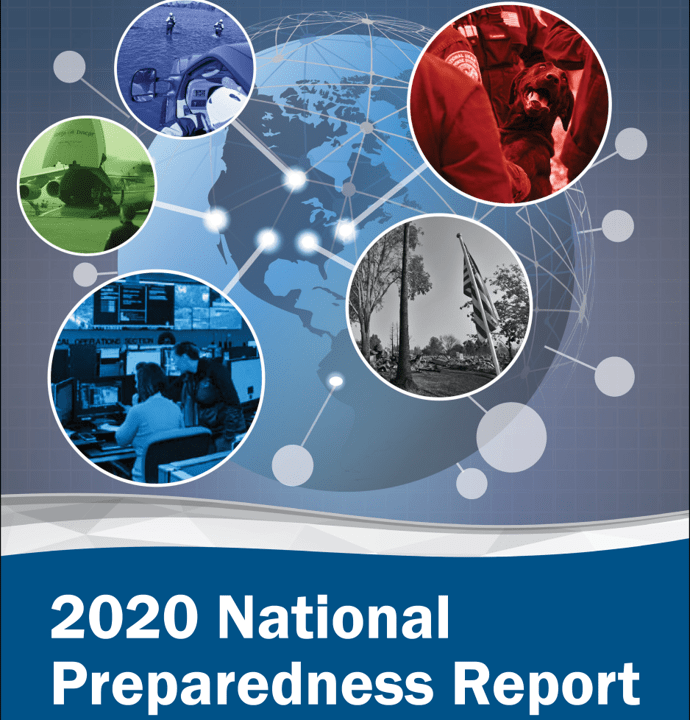
FEMA’s 2020 National Preparedness Report – A Review

It seems an annual tradition for me to be reviewing the National Preparedness Report. I’ve endeavored to provide constructive criticism of these documents, which are compilations of data from state and federal agencies, national-level responses, and other sources.

This year’s National Preparedness Report emphasizes that it is based on data from the 2019 calendar year. In looking back on past reports (note: they are no longer on the FEMA site – I was able to find them in the Homeland Security Digital Library) this has been the past practice. Perhaps I never realized it before, but a report talking about data from practically a full year ago seems to hold even less relevance. That means that enacting changes on a national level based on this data may not even begin to occur until two years have passed. Even taking into consideration that states and UASIs are compiling their reports early in a year for the previous year, it still seems a long time to wait for the national level report. This extent of lag is further emphasized by the document’s foreword, written by the FEMA Administrator, which makes many references to COVID-19 and how much different next year’s report will be, while not really speaking at all about the current report. This speaks a lot to how much we, as a practice, are attracted by the shiny objects dangled in front of us, seemingly ignoring all else.

My first pass of the 2020 report brought two primary impressions: 1) The instructive content of the document is some of the best I’ve seen out of FEMA, and 2) There is a considerable lack of data, with a low value for much of what they have included.

In regard to my first impression, the discussion of concepts such as risk (including emerging risk and systemic risk), capabilities, cascading impacts, community lifelines, public-private partnerships, and vulnerable populations has the perfect level of depth and detail. Not only do they discuss each of these concepts, but they also identify how they each connect to each other. This is EXACTLY the kind of consolidation of information we have needed for a long time. This lends itself to truly integrated preparedness and the kinds of information I’ve mentioned many times as being needed, including in the next version of CPG-101. I’m truly impressed with this content, the examples they provide, and how they demonstrate the interconnectedness of it all. I’ll certainly be using this document as a great source of this consolidated information. Now that I’ve extolled my love and adoration for that content, I’m left wondering why it’s in the National Preparedness Report. It’s great content for instructional material and doctrinal material on integrated preparedness, but it really has no place, at least to this extent of detail in the National Preparedness Report. Aside from the few examples they use, there isn’t much value in this format as a report.

This brings me to my next early observation: that of very little actual data contained in the report. Given the extent to which states, territories, UASIs, and other stakeholders provide data to FEMA each year by way of their Threat and Hazard Identification and Risk Assessments (THIRAs) and Stakeholder Preparedness Reviews (SPRs), along with various other sources of data, this document doesn’t contain a fraction of what is being reported. There are two map products contained in the entire report, one showing the number of federal disaster declarations for the year, the other showing low-income housing availability across the nation. Given the wide array of information provided by state and UASI, and compiled by FEMA region, surely there must be some really insightful trends and other analysis to provide. There are a few other data sets included in the report showing either raw numbers or percentages – nothing I would really consider analytics. Much of the data is also presented as a snapshot in time, without any comparison to previous years.

Any attempt to view this document as a timely, meaningful, and relevant report on the current state of preparedness in the nation, much less an examination of preparedness over time, is simply an exercise in frustration. The previous year’s report at least had a section titled ‘findings’, even though any real analysis of data there was largely non-existent. This year’s report doesn’t even feign providing a section on findings. To draw on one consistently frustrating example, I’ll use the Core Capability of housing. While this report dances around doctrine and concepts, and even has a section on housing, it’s not addressing why so little preparedness funding or even moderate effort is directed toward addressing the issue of emergency housing, which has arguably been the biggest preparedness gap for time eternal in every state of the nation. Looking broadly at all Core Capabilities, this year’s report provides a chart similar to what we’ve seen in previous years’ reports, identifying how much preparedness funding has gone toward each Core Capability. In relative numbers, very little has changed; even though we know that issues like housing, long-term vulnerability reduction, infrastructure systems, and supply chains have huge gaps. All these reports are telling me is that we’re doing the same things over and over again with little meaningful change.

So there it is… while I really am thoroughly impressed with some of the content of the report, much of that content really doesn’t have a place in this report (at least to such an extent), and for what little data is provided in the report, most of it has very little value. The introduction to the document states that “this year’s report is the product of rigorous research, analysis, and input from stakeholders”. To be blunt, I call bullshit on this statement. I expect a report to have data and various analysis of that data, not only telling us what is, but examining why it is. We aren’t getting that. The National Preparedness Report is an annual requirement per the Post Katrina Emergency Management Reform Act. I challenge that FEMA is not meeting the intent of that law with the reports they have been providing. How can we be expected, as a nation, to improve our state of readiness when we aren’t provided with the data needed to support and justify those improvements?

© 2020 Timothy Riecker, CEDP

Emergency Preparedness Solutions, LLC®

EOC Toolkit: National Comment Period

Yesterday FEMA’s National Integration Center distributed notice of a national engagement period on two new Emergency Operations Center (EOC) related documents: EOC References and Resources Tool and the EOC How-To Quick Reference Guide. This seems to be the initiation of an EOC Toolkit, which I conceptually think is a great idea. My first impression of these documents is that they both have good information and are logically organized. The documents are good, but I’m also not particularly impressed by them.

First up is the EOC References and Resources Tool. The document indicates that the audience is ‘EOC leaders and staff’, and the intent is to provide them with ‘a set of best practices, checklists, references, links, and essential guidance related to EOC operations and administration’. This is a two-page document, seemingly formatted for printing (It’s a PDF), but mostly useless in print form as it has an abundance of internet links to sites and documents which provide much more information. The document itself isn’t really a ‘tool’, per se. It doesn’t have, on its own, any intrinsic utility other than referring you to other sources of information. While the description indicates that this document has checklists, it does not, though several of the documents linked from this document do have checklists. The center of the first page provides a link to the EOC Toolkit website, but it’s not particularly highlighted. To be honest, I think this document should, in essence, be the format and content of the EOC Toolkit site.

The second document is the EOC How-To Quick Reference Guide. This is an 80 page document. I’m not sure I’ve ever seen anything labeled a ‘quick reference guide’ be that long. If anything, the EOC References and Resources Tool document (discussed previous) is really the ‘quick reference guide’, while this document is more of a ‘tool’. There is solid information in this document, nothing that from a quick review I have any quarrel with. The content areas are fairly comprehensive, giving information on hazard, vulnerability, and capability assessment; EOC site selection; EOC capabilities and physical design; information management; and preparedness. That said, it doesn’t give you much content within any of the topic areas. It almost feels like a literature review.

As with the other document, this document is formatted for printing, but is full of hyperlinks to sites that expand greatly on the information provided. So it’s not really anything I would recommend printing and putting in a binder. Electronically, it does make it a good compendium of resources, but with how rapidly things change and the frequency of new sources of good information becoming available, I think this document is also best organized as a website that can be updated in real time as new information comes available. As soon as one link changes, the document becomes obsolete. That said, the resources they link to are all good and worthwhile. An attachment to this document provides a fairly comprehensive EOC self-assessment tool; though the tool doesn’t really address partially or fully virtual EOC operations and remote access; and while it goes to an extent of detail asking about certain things (such as a helicopter landing pad), it completely misses some functional things (such as dry erase boards) and is far from comprehensive in the realm of security.

As with most national comment periods, the NIC has provided the documents (though without numbered lines) and a comment form. These, along with information on webinars they are conducting, are posted here: https://www.fema.gov/media-collection/emergency-operations-center-eoc-toolkit-how-quick-reference-references-and-tools.

All in all, I feel like these documents hit the outer ring of a dart board. They are fine, but not really close to the bullseye. It seems these were assembled by a NIC employee or consultant who has spent little to no time in an EOC, much less having any role in the design or preparedness activities for an EOC. As I mentioned earlier, they feel a lot like a literature review – providing a summary of sources but themselves providing very little information. Not that that’s a bad thing – but I’d rather see this in a website format.

What are your thoughts on the documents? 

© 2020 Timothy Riecker, CEDP

Emergency Preparedness Solutions, LLC®

Keeping the C in CERT

I’m a big fan of Community Emergency Response Teams (CERT). For several years I was, in addition to other duties, New York State’s CERT program coordinator. I had interactions with most CERT programs in the state, conducted many CERT train-the-trainer courses, and managed federal CERT and Citizen Corps grant programs. CERT programs, when properly organized, managed, and maintained hold incredible value to their communities.

For those not fully aware of what CERT is, it is a construct that arose from high earthquake hazard communities in California a few decades ago. It is founded on the recognition that the true first responders to a disaster are in fact community members who will tend to themselves, their families, and their neighbors. The core CERT training provides information and skills practice on team organization, first aid, light search and rescue, hazard recognition, and more. Fundamentally, CERT organizations will self-activate in the event of a sudden disaster to care for those immediately around them. CERT programs have evolved in a positive fashion through the years, spreading around the nation and the world. Ideally, they should be formed with a linkage to local emergency responders, and can be leveraged to support community preparedness and mitigation efforts as well. CERT programs are organized around the needs of their communities, with their operational protocols and training rooted in that local need. The C in CERT is for COMMUNITY.

For many years, FEMA has been developing the National Qualification System (NQS), which supports resource typing as a key component of the National Incident Management System (NIMS). The primary purpose of the NQS is to establish standards for positions and functions utilized in emergency management, with the greatest benefit being the requesting, processing, deployment, and utilization of resources to disaster areas. These efforts strongly support effective resource management by providing consistent definitions of capability for various kinds and types of resources, backed up by a means for resources to track and even certify progress toward meeting those qualifications.

Yesterday, FEMA released a NIMS Alert for NQS information for several CERT positions. To be honest, this frustrates the hell out of me. CERT is a community-level resource. Not one that is intended to be deployed. Yes, FEMA has called for and deployed CERT personnel in the past, but this is not a consistent practice, has not happened often, and as far as I know was deemed a less than effective utilization. The draft position task books provided by the NQS for comment for CERT indicate roles in support of the CERTs in the jurisdictions in which they are being deployed. While some jurisdictions have prepared CERT members for roles beyond the core tasks associated with CERT, such as EOC support or field data collection, CERT is not fundamentally expected to be a long-term function in the aftermath of a disaster, so to be deploying personnel to support sustained ‘normal’ CERT operations is largely a misutilization and clearly a misunderstanding of what CERT is fundamentally about, especially when most external resources requests occur days or even weeks after a disaster.

CERT members and CERT programs are and should be focused on their own neighborhoods and communities. As individuals and as organizations they are generally not trained, equipped, or otherwise prepared to be deployable resources. They are also not being deployed to a disaster in a professional capacity, many of which have their own NQS documents. While it may sound like a great opportunity for people who want to make a difference, there are a lot of pitfalls – many of which I saw when FEMA requested CERT volunteers from around the nation to deploy for Gulf coast hurricanes about 15 years ago.

The NQS documents identify several trainings in addition to the Basic CERT course, most of which are FEMA Independent Study courses which only provide a general baseline of knowledge; and none of which specifically address issues associated with actually deploying to a disaster area. If CERT personnel wish to be deployable resources, they should do so through organizations such as the Red Cross, Team Rubicon, World Central Kitchen, or the myriad faith-based groups who are established and reputed providers of various disaster-essential services. These are entities that are also organizationally capable of managing personnel and the logistical and procedural requirements of a deployment, of which there are many. These organizations train and prepare personnel for deployments, have experienced personnel that manage and coordinate deployments, they ensure they are managed and cared for on site, they support supply chains, and are experienced in addressing liability matters.

The bottom line here is that we are expecting too much from people signed up to support a disaster response in or even near their own communities, but not to be deployed around the country. I’m sure I’ll get some responses from people espousing some specific successes in deploying CERT personnel outside their jurisdiction, of which I’m sure there are; however that is the exception and not the rule. It’s not what CERT is or ever was intended to be. I’m a big fan and supporter of CERT, and believe in the extraordinary abilities of trained, organized volunteers, but I strongly feel that CERT is not a deployable asset. Personnel who are interested in such endeavors should be steered towards organizations that have the expertise in doing so.

Your thoughts, of course, are welcome.

© 2020 Timothy Riecker, CEDP

Emergency Preparedness Solutions, LLC®

A National Disaster Safety Board

You’ve heard of the National Transportation Safety Board (NTSB), right? If not, the nitty gritty of it is that they are an independent federal accident investigation agency. They determine probable cause of the full range of major transportation incidents, typically putting forward safety recommendations. They are granted some specific authorities related to these investigations, such as being the lead federal agency to investigate them (absent criminal aspects) and they maintain a schedule of deployment-ready teams for this purpose.  They can conduct investigative hearings (ever see the film Sully?) and publish public reports on these matters. Overall, I’ve had positive interactions with NTSB representatives and have found their work to be highly effective.

While certainly related to emergency management, the main purpose for my quick review of the NTSB in this post is to provide a starting point of understanding for Congressional legislation urging the formation of a National Disaster Safety Board (NDSB). The draft bill for discussion can be found here. This bill has been put forth with bi-partisan sponsors in both the US Senate and the House of Representatives.

The purpose of the NDSB, per this bill, is:

  1. To reduce future losses by learning from incidents, including underlying factors.
  2. Provide lessons learned on a national scale.
  3. Review, analyze, and recommend without placing blame.
  4. Identify and make recommendations to address systemic causes of incidents and loss from incidents.
  5. Prioritize efforts that focus on life safety and injury prevention, especially in regard to disproportionately impacted communities.

To execute this mission, the bill provides that the NDSB will have the authority to review incidents with 10 or more fatalities; may self-determine the need for board review of an incident; and shall have the full ability to investigate, review, and report on incidents.

The bill directs the NDSB to coordinate with all levels of government to identify and adopt standard methods of measuring impacts of disasters to provide for consistent trend analysis and comparisons, and to ensure that these standards are uniformly applied. The bill requires the NDSB to coordinate with all levels of government in their investigations during incident responses, and to participate in the incident command system for coordination of efforts as well as investigative purposes. Affected authorities shall have an opportunity to review the NDSB report 30 days prior to publication.

The NDSB will be comprised of seven board members, selected by the President from a slate of candidates provided by both houses of Congress, with no more than four board members having affiliation with the same political party, and with all members having technical and/or professional qualifications in emergency management, fire management, EMS, public health, engineering, or social and behavioral sciences.

There is a lot of other legalese and detail in the bill, but I’m happy to find that the language supports coordination among and with federal agencies, including FEMA, NIST, NTSB, and others; and also has an emphasis on investigating impacts to disproportionately impacted communities. The bill also charges the NDSB with conducting special studies as they see fit and providing technical support for the implementation of recommendations.

I’m thrilled with this effort and I’m hopeful the bill progresses to law. We have had a history of outstanding research from academic institutions and after action reports from government entities, which should all still continue, but it’s incredibly substantial that the NDSB will establish standards and consistency in how we examine disasters over time. We’ve seen how impactful the NTSB has been since its inception in 1967, and I feel the NDSB could have an even greater impact examining a broader spectrum of disasters. This is an effort which has been long encouraged by various emergency management related groups. The NDSB, I suspect, will also support a stronger and more defined FEMA, as well as strengthening all aspects of emergency management at all levels.

What thoughts do you have on the NDSB? What do you hope will come of it?

© 2020 Timothy Riecker, CEDP

Emergency Preparedness Solutions, LLC

What Makes an Emergency Manager?

Over the weekend I posted a question on Twitter that prompted a fair amount of discussion with my EM colleagues. What I asked:

Does simply working in emergency management make you an emergency manager? (Even with my ego) it took several years of working in the field before I was comfortable calling myself an emergency manager.

The resulting discussion brought up considerations of time on the job, job responsibilities and titles, education, professional certifications, standards, and other relevant topics. I fully admitted to my own biases, initially directed toward myself and my own career trajectory, but that I honestly have a tendency to carry over to others who might be new to an emergency management job; certainly, with no intent to belittle anyone or gatekeep the profession. The discussions over the weekend on Twitter led me to realize that part of my bias came from what roles I performed early in my career. My primary being a training technician, helping to prepare for and conduct training courses – certainly not managing the program until a few years later. Similarly, early in my career, any emergency deployments or taskings were at the ‘doer’ level, not anywhere near the actual supervision or management responsibilities that came a few years into my career. All of this was appropriate for early in my career. Certainly, I felt that I worked in the field of emergency management, but not that I was a true emergency manager. Not until I was given responsibility and authority, both in my primary job and emergency assignments, that I felt that I was an emergency manager.

I’d also suggest that I was influenced by my own impressions of many of the people I worked with and worked for. I was fortunate enough to learn and be mentored by some really incredible emergency managers (both in their primary and emergency roles). I was awed by their knowledge, their talent, and their ability to coordinate some very diverse groups of people and resources into a unity of effort. In my early years I couldn’t yet do that. I had a lot to learn and respect to garner before I felt I could call myself an emergency manager.

Certification is an interesting thing. While there are certifications in many professions, these fall into two significant types: Those that require experience and those that do not. I think they each have their place and are often appropriate to the profession which they are in. Standards are a related yet still different matter, especially since, in emergency management and related professions, there are several ‘certifications’ that can be obtained. The ideal is to have a standard in the profession. I think standards are something to be explored further, and I give a shoutout to friend and colleague Ashley Morris (@missashes92) who has a lot of thoughts about where standardization should go in emergency management. Personally, I think one standard of practice should be internships or mentorships. These are required by certain professions and I think that, when structured well, they are a great way to gain the proper kind of experience necessary.

Education was another topic that has relevance but also a lot of nuance, as it also has ties to job duties, certification, and standards. I don’t feel that someone having a degree at any level can simply call themselves an emergency manager. There is a lot of consideration for what degrees are applicable, and that’s a challenge given how broad emergency management is. Despite so many of us beating the drum that emergency management is not just response, we still see so many emergency management job postings listing experience requirements as a first responder. It’s a challenge for us to identify as a unique profession when so many jurisdictions simply appoint a police officer or fire fighter to an emergency management job because it’s “close enough” (given no other screening or qualifications). We all know emergency management is so much broader than response applications yet, as a profession, we tolerate that crap. Emergency management has so many niche functions within, many of which are supported by their own unique education standards: engineers, finance and grants, technology, communications, public and/or business administration/management, instructional design, human services, public health, and so much more. Think about all the business units within a large emergency management agency, or a ‘day in the life’ of a one-person emergency management shop. Recovery, mitigation, preparedness, response, grants, volunteer management, community engagement, interagency coordination, logistics, etc. None of that is one skillset. Yet many education programs in emergency management will just talk history and theory. Others will focus on response. Few seem to do it right, giving a good, comprehensive picture of it all. Depending on where they will work, some practitioners need to know about a lot of different things, while in others they can specialize.

Is someone who just does grants management any less of an emergency manager than someone who only does mitigation or someone who only does training? To even put a bit more of a curve on this, how about someone who is an academic, or a researcher, or a consultant? What boxes need to be checked to be labeled as an emergency manager?

The discussion on Twitter to my one question lasted a couple of days, with a lot of really interesting thoughts and insight. Everyone that contributed had very valid perspectives, and it seemed that many agreed that there is no simple answer.

As always, I’m interested in the thoughts of my readers. What do you think is makes an emergency manager?

©2020 Timothy Riecker, CEDP

Emergency Preparedness Solutions, LLC®

Failures in Preparedness

In May the GAO released a report titled “National Preparedness: Additional Actions Needed to Address Gaps in the Nation’s Emergency Management Capabilities”. I encourage everyone to read the report for themselves and also reflect on my commentary from several years of National Preparedness Reports. I’ll summarize all this though… it doesn’t look good. The National Preparedness Reports really tell us little about the state of preparedness across the nation, and this is reinforced by the GAO report as they state “FEMA is taking steps to strengthen the national preparedness system, but has yet to determine what steps are needed to address the nation’s capability gaps across all levels of government”.

First of all, let me be clear about where the responsibility of preparedness lies – EVERYONE. Whole community preparedness is actually a thing. It’s not FEMA’s job to ensure we are prepared. As also made evident in the GAO report (for those who haven’t worked with federal preparedness grants), most preparedness grants are pretty open, and as such, the federal government can’t force everyone to address the most critical capability gaps. Why wouldn’t jurisdictions want to address the most critical capability gaps, though? Here are some of the big reasons:

  • Most or all funding may be used to sustain the employment of emergency management staff, without whom there would be no EM program in that jurisdiction
  • The jurisdiction has prioritized sustaining other core capabilities which they feel are more important
  • The jurisdiction has decided that certain core capabilities are not for them to address (deferring instead to state or federal governments)
  • Shoring up gaps is hard
  • Response is sexier

The GAO report provided some data to support where priorities lie. First, let’s take a look at spending priorities by grant recipients:

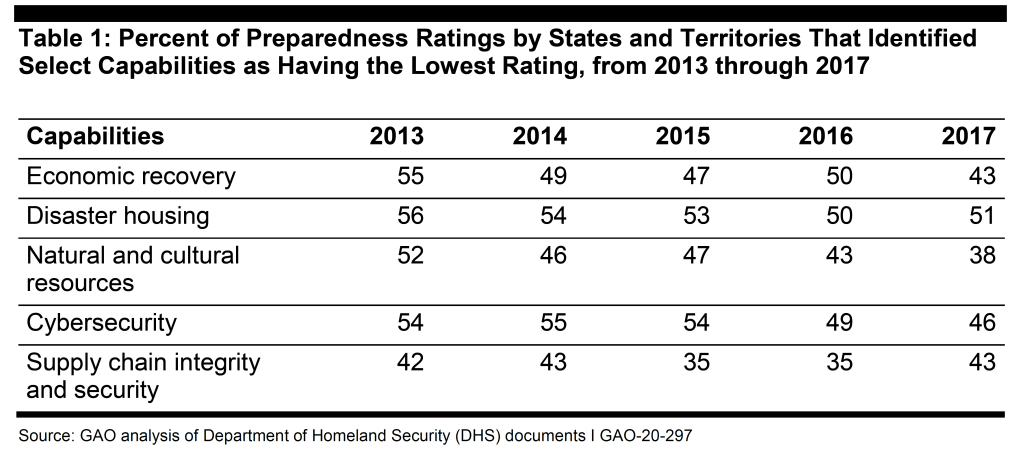
While crosscutting capabilities (Operational Coordination, Planning, and Public Information and Warning) were consistently the largest expenditures, I would surmise that Operational Coordination was the largest of the three, followed by Planning, with Public Information and Warning coming in last. And I’m pretty confident that while these are cross cutting, these mostly lied within the Response Mission Area. Assuming my predictions are correct, there is fundamentally nothing wrong with this. It offers a lot of bang for the buck, and I’ve certainly spoken pretty consistently about how bad we are at things like Operational Coordination and Planning (despite some opinions to the contrary). Jumping to the end of the book, notice that Recovery mission area spending accounts for 1% of the total. This seems like a poor choice considering that three of the five lowest rated capabilities are in the Recovery mission area. Check out this table also provided in the GAO report:

Through at least a few of these years, Cybersecurity has been flagged as a priority by DHS/FEMA, yet clearly, we’ve not made any progress on that front. Our preparedness for Housing recovery has always been abysmal, yet we haven’t made any progress on that either. I suspect that those are two areas, specifically, that many jurisdictions feel are the responsibility of state and federal government.

Back in March of 2011, the GAO recommended that FEMA complete a national preparedness assessment of capability gaps at each level of government based on tiered, capability-specific performance objectives to enable prioritization of grant funding. This recommendation has not yet been implemented. While not entirely the fault of FEMA, we do need to reimagine that national preparedness system. While the current system is sound in concept, implementation falls considerably short.

First, we do need a better means of measuring preparedness. It’s difficult – I fully acknowledge that. And for as objective as we try to make it, there is a vast amount of subjectivity to it. I do know that in the end, I shouldn’t find myself shaking my head or even laughing at the findings identified in the National Preparedness Report, though, knowing that some of the information there can’t possibly be accurate.

I don’t have all the answers on how we should measure preparedness, but I know this… it’s different for different levels of government. A few thoughts:

  • While preparedness is a shared responsibility, I don’t expect a small town to definitively have the answers for disaster housing or cybersecurity. We need to acknowledge that some jurisdictions simply don’t have the resources to make independent progress on certain capabilities. Does this mean they have no responsibility for it – no. Absolutely not. But the current structure of the THIRA, while allowing for some flexibility, doesn’t directly account for a shared responsibility.
  • Further, while every jurisdiction completing a THIRA is identifying their own capability targets, I’d like to see benchmarks established for them to strive for. This provides jurisdictions with both internal and external definitions of success. It also allows them an out, to a certain extent, on certain core capabilities that have a shared responsibility. Even a small town can make some progress on preparedness for disaster housing, such as site selection, estimating needs, and identifying code requirements (pro tip… these are required elements of hazard mitigation plans).
  • Lastly, we need to recognize that it’s difficult to measure things when they aren’t the same or aren’t being measured the same. Sure, we can provide a defined core capability, but when everyone has different perspective on and expectation of that core capability and how it should be measured, we aren’t getting answers we can really compare. Everyone knows what a house is, but there is a considerable difference between a double wide and a McMansion. Nothing wrong with either of them, but the differences give us very different base lines to work from. Further, if we need to identify how big a house is and someone measures the length and width of the building, someone else measures the livable square footage of a different building, and a third person measures the number of floors of yet another house, we may have all have correct answers, but we can’t really compare any of them. We need to figure out how to allow jurisdictions to contextualize their own needs, but still be playing the same game.

In regard to implementation, funding is obviously a big piece. Thoughts on this:

  • I think states and UASIs need to take a lot of the burden. While I certainly agree that considerable funding needs to be allocated to personnel, this needs to be balanced with sustaining certain higher tier capabilities and closing critical gaps. Easier said than done, but much of this begins with grant language and recognition that one grant may not fit all the needs.
  • FEMA has long been issuing various preparedness grants to support targeted needs and should not only continue to do so, but expand on this program. Targeted grants should be much stricter in establishing expectations for what will be accomplished with the grant funds.
  • Collaboration is also important. Shared responsibility, whole community, etc. Many grants have suggested or recommended collaboration through the years, but rarely has it been actually required. Certain capabilities lend themselves to better development potential when we see the realization of collaboration, to include the private sector, NGOs, and the federal government. Let’s require more of it.
  • Instead of spreading money far and wide, let’s establish specific communities of practice to essentially act as model programs. For a certain priority, allocate funds for a grant opportunity with enough to fund 3-5 initiatives in the nation. Give 2-3 years for these programs to identify and test solutions. These should be rigorously documented so as to analyze information and potentially duplicate, so I suggest that academic institutions also be involved as part of the collaborative effort (see the previous bullet). Once each of the grantees has completed their projects, host a symposium to compare and contrast, and identify best practices. Final recommendations can be used to benchmark other programs around the nation. Once we have a model, then future funding can be allocated to support implementation of that model in other areas around the nation. Having worked with the National Academies of Sciences, Engineering, and Medicine, they may be an ideal organization to spearhead the research component of such programs.
  • Recognize that preparedness isn’t just long term, it’s perpetual. While certain priorities will change, the goals remain fundamentally the same. We are in this for the long haul and we need to engage with that in mind. Strategies such as the one in the previous bullet point lend themselves to long-term identification of issues, exploration of solutions, and implementation of best practices.
  • Perhaps in summary of all of this, while every jurisdiction has unique needs, grant programs can’t be so open as to allow every grantee to have a wholly unique approach to things. It feels like most grant programs now are simply something thrown at a wall – some of it sticks, some of it falls right off, some might not even make it to the wall, some slowly drips off the wall, and some dries on permanently. We need consistency. Not necessarily uniformity, but if standards are established to provide a foundational 75% solution, with the rest open for local customization, that may be a good way to tackle a lot of problems.

In the end, while FEMA is the implementing agency, the emergency management community needs to work with them to identify how best to measure preparedness across all levels and how we can best implement preparedness programs. Over the past few years, FEMA has been very open in developing programs for the emergency management community and I hope this is a problem they realize they can’t tackle on their own. They need representatives from across the practice to help chart a way ahead. This will ensure that considerations and perspectives from all stakeholder groups are addressed. Preparedness isn’t a FEMA problem, it’s an emergency management problem. Let’s help them help us.

What thoughts do you have on preparedness? How should we measure it? What are the strengths and areas for improvement for funding? Do you have an ideal model in mind?

© 2020 Timothy Riecker, CEDP

Emergency Preparedness Solutions, LLC®

NIMS Guidance – Resource Management Preparedness

Last week FEMA issued a national engagement period for updated NIMS guidance on resource management preparedness. This is the first version of such a document, with most material on the subject matter, to date, being included in the NIMS doctrine and a few other locations. I regularly participate in the national engagement periods and encourage others to do so as I think it’s a great opportunity for practitioners and subject matter experts to provide input.

Some observations:

  1. The footer of the document states that it’s not for public distribution. I’m guessing that was an error.
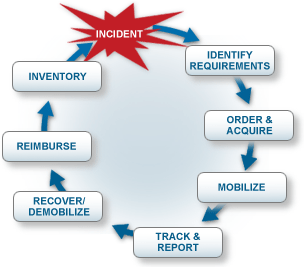
  2. The phrase of ‘resource management preparedness’ rubs me the wrong way. While I understand that there are resource management activities that take place within the preparedness phase of emergency management, we’re not preparing to manage resources. All the activities outlined in the document are actually part of resource management. If they want to put a time stamp on this set of activities, they can refer to them as ‘pre-incident’, but inventorying, typing, etc. are all actually part of the resource management cycle.
  3. I’d prefer to see a comprehensive NIMS Resource Management guide that addresses all aspects of resource management. Considering that resource management is a cycle, let’s actually cover the entire cycle. I think there will be far more value in that. Hopefully that’s eventually where this will go.
  4. The document is too stuck in NIMS. What do I mean by this? It seems that more and more people seem to forget that NIMS is a doctrinal component of incident management. While the document is focused on NIMS, it would have greater value if it addressed pre-incident resource management activities that might not found in the NIMS doctrine (though some are), but are none-the-less best practices in resource management. Many of these practices begin pre-incident.
  • One of the biggest things is resource tracking. Yes, resource tracking is a concept found in NIMS, but it’s not at all addressed here. How many jurisdictions struggle to figure out how to track resources in the middle of an incident (answer: most of them). The best time to figure out the means and methods of tracking resources is before an incident ever occurs. Resource tracking has a fair amount of complexity, involving the identification of what will be tracked, how, and by who; as well as how changes is resource status are communicated. Data visualization and dashboarding is also big. People want to see maps of where major resources are, charts that depict utilization, and summaries of resource status. All things best determined before an incident.
  • Resource inventories should identify operating requirements, such as maintenance and service. This is vaguely referenced in the guidance, but not well. Before any resource is deployed, you damn well better have the ability to operate and support that resource, otherwise it’s nothing more than a really large expensive paperweight. Do you only have one operator for that piece of equipment? That’s a severe limitation. All things to figure out before an incident.
  • How will resource utilization be tracked? This is important for cost controls and FEMA reimbursement. Figure that one out now.
  • What consumables are stockpiled or will be needed? What is the burn rate on those under various scenarios? (We’ve learned a lot about this in the pandemic)
  • What about resource security? When it’s not being used where and how will it be secured? What if the resource is left unattended? I have a great anecdote I often tell about a portable generator used in the aftermath of a devastating snow storm to power the traffic lights at a critical intersection. The maintenance crew doing their rounds found it to be missing, with the chain cut. Luckily the state’s stockpile manager had GPS trackers on all of them. It was located and re-acquired in little time, and the perpetrators charged. This success was due to pre-incident activity.
  • Resource ordering processes must also be established. What are the similarities and differences in the process between mutual aid, rental, leasing, or purchasing? What are your emergency procurement regulations and how are they implemented? How are the various steps in the ordering process assigned and tracked? This is highly complex and needs to be figured out before an incident.
  1. Resource typing. I honestly think this is the biggest push in emergency management that isn’t happening (maybe perhaps second to credentialing). Resource typing has been around for a long time, yet very very few jurisdictions I’ve worked with or otherwise interacted with have done it and done it well. I find that most have either not done it at all, started and gave up, or have done it rather poorly. I’ve been involved in resource typing efforts. It’s tough and tedious. I’ve done it for resources that we’re yet typed at the national level, leaving agencies and jurisdictions to define their own typing scheme. This literally can devolve into some heated discussions, particularly fueled by the volume of rather heavy customization we tend to do with resources as technology evolves, giving resources that may fundamentally appear to have similar capability to in reality be quite different. I’ve also done it for resources that have been typed at the national level. This certainly helps, as you aren’t first having to figure out your own thresholds, but it can still be challenging to pigeon hole resources that, again, may be heavily customized and don’t cleanly fit within a certain pre-defined category. It’s even more frustrating to have developed your own typing scheme in the absence of a national one, only to have national guidance issued a couple years later and needing to go back to those discussions.

I’m not saying resource typing is bad, in fact the benefits, both internally and externally, can be incredibly helpful. That said, it’s a time-consuming effort that, in the broader sense of limited time and other assets available to most emergency managers, is perceived to pay a lesser dividend than other activities such as developing and updating plans, training people on the implementation of those plans, and exercising those plans. It also can be difficult convincing agencies that it should be done. I can’t tell you how many times I get the response of ‘We know what we have’. I know that’s not the point, but that’s how the effort of typing resources is perceived. Even after some explanation of the benefits, most agencies (and I think rightfully so) would rather invest their time and effort into preparedness activities are that are seen as more beneficial. It leaves me wondering… is there a better way?

While it’s good to see information on the topic of early resource management steps being collated into one document, along with some resources and references that I’ve not seen before, this document is missing a lot. I just wrote last night about emergency managers being our own worst enemy. If we are just focused on implementing NIMS, we will absolutely fail. NIMS is not the end all/be all of incident management, but it is fundamentally promoted as such. Yes, the concepts of NIMS are all incredibly important, brought about from lessons learned and identified best practices of incident management through decades of experience. But the documents related to NIMS seem to pick and choose what they will focus on, while leaving out things that are highly critical. Perhaps some of these will be covered in future editions of resource management guidance, but they aren’t doing anyone any favors by omitting them from a document on pre-incident activity. We need to think broader and more comprehensive. We need to do better.

What are your observations on this document? What feedback do you have on my observations?

© 2020 Timothy Riecker, CEDP

Emergency Preparedness Solutions, LLC®

Different Perspectives on Disaster Recovery

It seems a lot of the things we have been dealing with relative to the Coronavirus pandemic have brought us a different perspective, or at least have revealed a perspective that public health and emergency management have been concerned about for a while.  The pandemic given us a more accurate perspective on the impacts of a truly major public health event and the things we need to do to manage it.  We also find ourselves looking ahead to recovery and needing to view that through a different lens as well. 

Most disaster recovery, and in fact the way the Stafford Act is written, reflects physical damage from disasters such as floods, earthquakes, tornadoes, or hurricanes.  We are dealing with debris, damaged infrastructure, displaced masses, and the like.  The pandemic is something completely different.  While we may see shades of some more traditional recovery activity, recovery from the pandemic is giving us a very different way of seeing things. 

Before we get into the details, one of the biggest factors in all this is trying to determine where recovery fits in.  It’s long been a conundrum for people who want to make emergency management an exact science to be able to stick a pin in the exact spot where response ends and recovery begins.  Not only does the lack of that delineation persist for the pandemic, it’s exacerbated.  But that’s not all.  While some recovery activity has already started (more about that in a bit), the big push may not be able to start until society can at least begin to intermingle (though likely with some continued precautions).  Further, true recovery arguably can’t take place until we have a vaccine.  Until we reach that point, recovery efforts are likely to have a stutter, as we start, then have to stop or at least slow down when infection rates increase again, then resume once they subside.  This is simply not a formula we are used to working by. 

I suppose the best way to examine this is to look at it through the Recovery Mission Area Core Capabilities:

  • Planning
  • Operational Coordination
  • Public Information and Warning
  • Infrastructure Systems
  • Economic Recovery
  • Health and Social Services
  • Housing
  • Natural and Cultural Resources

Planning, Operational Coordination, and Public Information and Warning – I’m initially lumping these three together as they are the ‘common’ Core Capabilities and we generally see these in recovery having eventually transitioned over from the response focus.  The challenge with the pandemic is that we see the overlap of response and recovery, in some circumstances, more than we are used to compared to other disasters.  Also, a lot of the recovery we currently see is coming in the form of direct services from the Federal government, with little to no connection to state or local governments.  This is heavily emphasized in matters of Economic Recovery (more on this later).  The overall sense I’m getting is that the fundamentals of these three common Core Capabilities haven’t substantially changed (obviously some of the tasks have), though the experience different jurisdictions are having varies.  Consider that most jurisdictions aren’t used to dealing with prolonged incidents such as this.  In fact, many jurisdictions have decided to no longer operate EOCs (hopefully these were virtual!) as the impacts within their jurisdictions have been minimal and what problems do exist are largely being addressed by an emergency manager supported by a multi-agency coordination group.  Other jurisdictions, obviously, are being hit much harder and their management of this incident has continued to grow as they address the myriad issues that rise up and prepare for what they expect to see next.  There are some of the differences in Operational Coordination. 

Looking a little closer at Planning, this should still be taking place regardless of the volume of work your jurisdiction is experiencing, and even if your jurisdiction doesn’t have a public health department.  There is a lot of planning that still needs to take place to account for recovery, continuity of operations, and contingencies.  This one really permeates the other Core Capabilities the most. 

Lastly within this group, Public Information and Warning.  Absent jurisdictions that are used to dealing with more prolonged responses and recovery, most haven’t had to address a need for persistent public messaging.  While a lot of it is echoing guidance coming from certain authorities like the CDC or state health departments, more localized matters still need to be addressed in terms of what local services are or are not available (or how they now need to be accessed), providing information on planned events, and addressing rumors and mis-information. 

Infrastructure Systems – Restoration of infrastructure is often a big emphasis in most disasters.  Roads, bridges, water and waste water systems, electricity, and other systems are often damaged or destroyed as the result of the disaster of the day.  In the matter of the pandemic, generally the most impact we see in these systems is delays in maintenance because of some decreased capacity among those that are responsible for them.  Perhaps the one significant exception, through from a very different perspective, is internet services.  While internet services weren’t damaged by the pandemic, they were heavily impacted with many organizations directing staff to work from home.  College students are now engaged in classes from home instead of the campus.  Families and friends are connecting more often via video calling. Even on-line gaming has seen a surge with people spending more time at home.  All this changed the dynamic of internet use.  Most businesses are provided with dedicated lines by internet service providers, designed to handle the concentrated surge of internet use demanded by a facility or collection of facilities.  Much of that use has dwindled, shifting to a drastic increase on residential services.  We also see increased demands on either end of this, with attention being drawn to entire areas that have no internet service as well as the need for increased server capacity of companies that host video calling and gaming platforms.  Even organizations and their employees have had to scramble to ensure that employees (and students) have internet access at home, the hardware required to access the internet, and the ability to connect to the organization’s servers and services. 

Another interesting perspective on infrastructure, however, comes from the emphasis on essential services and essential employees that we hear of every day.  While definitions of this have existed for some time, in this disaster alone we have seen that definition change a few times as we realize the connectivity between certain services and organizations.  Some important lessons to be documented and applied to future planning efforts. 

Economic Recovery – For as much as Infrastructure Systems (largely) haven’t been impacted, Economic Recovery has needed to be significantly re-imagined.  With businesses being forced to close and employees being furloughed or laid off, the global economy has taken a significant hit.  This is certainly a prime example, perhaps our first, of how deep a disaster of a global scale can cut us.  As a result, many nations around the planet have been pushing out some sort of economic stimulus, helping those that are unemployed as well as those businesses that are still open yet struggling with decreases in revenue.  The economic hit from the pandemic will take years to recover from and will require some very different ways of solving the problem.  Governments have only so much money to give.  Many jurisdictions are also examining the association between infrastructure and economic recovery in a different light, especially as thought is being put into when and how to re-open our communities and economies. 

As a related side note, we were recently awarded a contract to provide guidance on the reopening of transportation and transit in major cities.  Continued preventative measures as well as human behaviors are going to apply some interesting demands on urban planning, prompting cities to respond appropriately to these changes if they want to see businesses rebound, or even thrive as we move further into recovery. 

Health and Social Services – Rarely does public health lead the way through a major disaster.  Though we realize that just with other disasters where we might like to think that people are in charge, the disaster itself still remains in the driver’s seat and we are really just along for the ride, trying to address problems the best we can. Our health system is stretched, yet we see an interesting irony of hospitals laying off staff, as elective surgeries and other non-emergency services are presently suspended.   Obviously public health will continue to lead the way through our recovery.  Even with others seemingly in charge of other recovery functions, it is public health markers which will become the decision points that dictate our overall recovery.  On the social services side of this Core Capability, we also see a change in dynamics.  While the pandemic doesn’t have the physical impacts of a more traditional disaster, we are also seeing fewer people being displaced overall due to emergency legal protections being put in place to prevent evictions and utility service disconnections from lack of payment.  That said, we are still seeing traditional social service issues related to food, medicine, and mental health exacerbated due to the pandemic, the economic impact from the pandemic, and the mental stresses imposed by the pandemic as a whole, as well as social distancing, deaths, and other factors.  While many social services have traditionally been very hands-on and face-to-face, many of these services have moved to remote models, though others, by necessity, are still physically operating.  Social services recovery, linked to economic recovery as well as psychological matters like PTSD, will persist long after the pandemic.  Recovery plans must be re-imagined to address this.  Public health recovery, similarly, will last long after the pandemic as we need to take an honest look at the gaps in our system and work to address them. 

Housing – As mentioned earlier, there are few displacements (that should be) happening as a result of the pandemic.  Houses haven’t been destroyed as a direct result of the pandemic. Though how long will landlords be able to reasonably wait for back rents to be paid to them?  While those that own large apartment complexes may be able to absorb these losses, landlords with small properties will not.  They are small businesses, with bills to pay and mouths to feed.  While it’s great for tenants to get a reprieve, this also has impacts.  Local economies will likely need to figure out how to address this. 

Natural and Cultural Resources – Similar to infrastructure and housing, our natural resources have seen, overall, limited impact from the pandemic.  In fact, by many reports, many of our natural resources have seen marked and measurable improvement due to decreases in pollution and other impacts of ‘normal’ human activity.  Many cultural resources, on the other hand, have been impacted. I speak not of historical sites, which are often considered in the reconstruction activities associated with disaster recovery, but of museums and performance centers.  Museums, as with any other organization, rely on income to survive.  Many are non-profits, and generally put revenue into improving the facility and its collections, leaving not much of a ‘rainy day’ fund.  Similarly, collections haven’t been damaged, as they might have in another disaster, so there is no insurance claim to cover losses.  Similarly, performance centers, such as the 1930s era theater where I perform improv, haven’t seen revenue in weeks.  Here, we blur the lines between a different perspective on cultural preservation with economic recovery.  Another challenge local economies will have. 

So where does this leave us?  Clearly we are seeing different perspectives of each of these Core Capabilities, requiring us to approach them in ways different than we have in the past.  While the easy solution to many of them is money, an economy globally impacted has little funding to adequately do so.  We also see the interconnectivity of these Core Capabilities.  For many, there is reliance on others to make progress before another can see tangible improvement.  That said, planning is still the crux of it all. We must make deliberate planning efforts to address each of these.  Sure, we can reference current plans, but I argue that most current plans are inadequate, as the problems and the resultant solutions were not anticipated to look like this.  Planning also needs to occur at all levels, and there absolutely must be an emphasis on the first step of the CPG 101 planning process… Form a Team.  Our recovery from a global, national, and community level requires people working together.  We see now, more than ever, how interconnected things are.  This is no time to be insular.  We must consider all stakeholders, including citizens, organizations, and businesses, as part of our planning teams.  And by the way, we’re already behind. 

A couple more items before I close this rather long post.  First of all, consideration should be given to Continuity being added to the Core Capabilities.  Perhaps as a common Core Capability, but at least as one that is included in more than one mission area.  It’s a specific effort that, yes, does include planning (as should any other Core Capability), but has a very specific function and implementations. 

Second (and lastly), you absolutely must be capturing and documenting lessons learned (strengths and areas for improvement).  In fact, don’t wait to hotwash.  If you haven’t already, do one now.  You will do another later.  And likely one or more after that.  The duration of this disaster, and the different focal points and phases of it will constantly shift our attention and cause people to forget what they have learned.  Lessons learned must be captured in phases, allowing us to focus on sets of activities.  Be sure to document your lessons learned, share them far and wide, and set a timeline for implementing improvements.  There is so much to learn from this disaster, but it’s a waste if we ignore it or expect someone else to tell us what to do.   

I hope I delivered in this piece, highlighting the different perspectives of disaster recovery we are dealing with.  Are all disaster recovery activities fully turned on their heads?  Of course not.  We are still able to apply the standards we have been for decades, though some of them do need to be looked at and approached from a different perspective.  I’m very interested in feedback and thoughts. 

Stay safe. 

© 2020 Timothy Riecker, CEDP

Emergency Preparedness Solutions, LLC