Don’t Just Prepare for Disasters Passed

As mentioned in an earlier post, I’ve been reading Rumsfeld’s Rules, a bit of a memoir by former Congressman, Secretary of Defense (twice over), and CEO Donald Rumsfeld.  Much of the book is highlighted by quotes which have influenced him in various stages of his life.  One of his anecdotes references the Maginot Line, a multi-layered defensive system created by the French after World War I along their border with Germany, intended to protect France from any future invasion from Germany.  The Maginot Line would have proven a rather effective defense, had Germany used similar strategies in World War II as they had in World War I.  Obviously the Nazis were quite successful in their invasion of France, quickly conquering and occupying the nation.  The difference was that the Nazis were fighting a new war, whereas France was preparing to fight the last war – which is the quote Rumsfeld references with this anecdote.

What can we learn from this in emergency management and homeland security?  It can’t possibly apply to us, can it?  Obviously we base many of our plans and preparations on disasters of the past.  We have an in-depth trove of information from sources like LLIS which allow us to learn from past disasters.  Much of our hazard analysis is based upon what occurred in the past.  We study past disasters, examining them from inception through recovery, arm-chair quarterbacking all facets of response – from command, to organization, to logistics.  From this we learn what practices to embrace and what needs to be improved upon.  Since we’re quoting, it was Benjamin Franklin who said “Experience the best teacher.”

To the contrary, we have a rather prolific saying in emergency management that no two disasters are alike.  So why all this effort to examine the past?  There is a lot to be learned from the past.  As previously mentioned, we spend a lot of time and effort examining earlier disasters so we can learn from them.  While every disaster is different, there are also many commonalities – all of which we can better prepare for.  The past also puts disasters and their magnitude in context for us.  We can’t be stuck in the past, however.  While the next disaster may have similarities to one passed, there will be differences.  It is our job and our responsibility to predict to the greatest extent of our efforts what the impacts will be of future disasters, as well as the hazards they will stem from.  Yes we must learn from the past, but we must always look to the future.

How do we look into the future?  Reconvene your planning groups and discuss this new context.  Engage members to continually reassess what is changing – in the climate, the geography and landscape, and the new or changed technological hazards in our areas.  We must look beyond our borders both literally and figuratively as I outlined in a previous post, and consider all possibilities.  Use exercises which introduce scenarios new to us instead of those based upon disasters of the past to help us contextualize this and better prepare.

My challenge to you – Take an honest look at your plans, policies, procedures, and training – are you preparing to fight the last war or the next one?

© 2014 Timothy Riecker

Managing an Exercise Program – Part 9: Conducting an Exercise

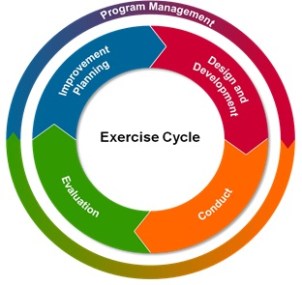
This post is part of a 10-part series on Managing an Exercise Program. In this series I provide some of my own lessons learned in the program and project management aspects of managing, designing, conducting, and evaluating Homeland Security Exercise and Evaluation Program (HSEEP) exercises. Your feedback is appreciated!

Managing an Exercise Program – Part 1

Managing an Exercise Program – Part 2: Develop a Preparedness Strategy

Managing an Exercise Program – Part 3: Identify Program Resources and Funding

Managing an Exercise Program – Part 4: Conduct an Annual Training & Exercise Planning Workshop.

Managing an Exercise Program – Part 5: Securing Project Funding

Managing an Exercise Program – Part 6: Conducting Exercise Planning Conferences

Managing an Exercise Program – Part 7: Develop Exercise Documentation

Managing an Exercise Program – Part 8: Preparing Support, Personnel, & Logistical Requirements

Managing an Exercise Program – Part 9: Conducting an Exercise

Managing an Exercise Program – Part 10: Evaluation and Improvement Planning
Image

Since writing Part 8, the new HSEEP guidance (April 2013) was published. Thankfully this update didn’t dictate wholesale changes in the process we’ve all come to be familiar with. There were some subtle changes, such as changing ‘planning conferences’ to ‘planning meetings’, and stressing the involvement of elected officials in the exercise planning process. Similarly, I’m thankful that certain changes weren’t made – one of which was the proposed elimination of terminology of ‘discussion based exercises’ and ‘operations based exercises’. These general identifiers have become commonplace amongst exercise designers for decades. Upon having the opportunity to review a draft version of the new HSEEP guidance, I was quite opposed to that change.

Obviously conducting the exercise is the most exciting part of the process. It’s where all of your hard work comes together. That said, this is where it can all fall apart if you haven’t prepared property in the first eight parts and if you don’t pay attention to detail. I’m breaking exercise conduct down into four smaller parts: Set up, briefings, play, debrief. Remember that my intent with these postings is not to be fully comprehensive, but to emphasize areas where I have learned or have seen others struggle. In all facets of emergency management we need to continue a culture of sharing if we are to be successful.

Set up

The preparations for your exercise should have been finalized in Part 8 where you addressed logistical requirements. You should know where your exercise venue is, how people will be seated/where they will be working, the location and support for a SimCell (if you’re having one), and even matters such as parking, food, restrooms, and audiovisual equipment. Additionally, set up includes having print material available for all participants. When setting up, consider the flow of people, quite literally from the road to the parking lot, from the parking lot to the facility, into the facility through security, sign in, and to their first location for the exercise (this may be their only destination or it may be a large briefing room). Having conducted exercises in locations not familiar to some participants as well as these exercises being larger than the facility’s parking lot can handle, you must ensure that invitation packages have specific directions on how to get to the parking area and how to get from the parking area to the venue. Be sure that signage is prominently displayed. It may even help to have staff directing people. Be sure to also let them know what manner of identification is required to enter the facility. Again, signage is often necessary to get people from the building entrance to check in location and then to the meeting location. Signage for the refreshment area and restrooms may also be needed.

Have everything set up for people before they arrive. Use table tents, if needed, to help identify seating, and have copies of all necessary materials at their seating location. Materials like SitMans and ExPlans have a lot of content, so it’s nice to have these materials available for the early-comers to being reading through.

Be sure to set up early and test EVERYTHING. Make sure AV equipment and communications equipment are tested.

Briefings

Depending on the type of exercise you are conducting, there can be a number of briefings needed to take place before the exercise begins. Some of these briefings may need to take place well in advance, even a day or more before the exercise, depending on availability of audiences for each of them.

The new HSEEP guidance includes a specific briefing for elected and appointed officials. This is something to usually conduct well in advance of the actual exercise to outline the agenda/timeline of the exercise and what will be expected of them. They will likely want to interface with any media and should know what to say about the exercise. They may also want to ‘kick off’ the exercise at the player briefing.

Controllers, evaluators, and SimCell personnel should receive a briefing to ensure they are familiar with the exercise and their rolls. They all need to know what is expected of them and of the players, how and when to interact with the players, and what may need to be reported to their respective leaders and/or to the exercise director. Evaluators will need to become familiar with their assigned EEGs and what the expectations are for evaluating. Additional time will need to be spent with SimCell personnel to familiarize them with the equipment being used, how the MSEL is structured, and how injects will be delivered. If any actors are being used, they will also need to be briefed on their rolls and what their expectations are. Ensure that everyone is familiar with the safety word in the event of the necessity to immediately stop the exercise.

If observers are expected at the exercise, have a briefing ready for them. I suggest treating them like VIPs when possible (most of them usually are). Don’t just let them walk around to figure things out for themselves. Give them tour guides who can take them throughout the venue and talk about what is happening. Schedule their arrival when possible, and consider having an elected or appointed official there to greet them. Keep in mind that some observers will be very high tier VIPs. Vigilant Guard exercises are often visited by the head of the National Guard Bureau – a four star General. These visits are fantastic and very much emphasize the importance of the exercise, but they can also be a little disruptive. These high-tier VIPs will often come with their own entourage and/or security. They will want a brief tour and will stop often to shake hands and have pictures taken. They may even want a break in the exercise to speak. Try to be aware of these expectations up front if at all possible. If not, just go with the flow and be flexible.

The media is another form of observer. All media should be scheduled. Be sure to make it worth their while, where they can catch some video/picture footage of interesting activities. Maps and wall displays make for great footage as well. Remember operational security! If something is sensitive or classified, it should not be anywhere where it can be seen. The media should also be provided a tour and an opportunity to get a statement from the elected and/or appointed officials. They may also want to interview players. I generally don’t allow this without preparation of the specific player to ensure that the right messages are delivered. Also, be sure to let players know during the player brief that there will be observers and media coming through and what is expected of them.

Lastly, the player briefing. This briefing will introduce players to the purpose of the exercise, the ground rules, the facility, timeline, controllers and evaluators, and expectations. Players should be briefed on how and when to interact with the SimCell if you have one. It should always be reinforced that the exercise is ‘no fault’, and that they, individually, are not being evaluated, rather it is the plans, policies, and procedures they are using that are being evaluated. Lastly, players are briefed on the scenario. Be sure that the ExPlan/SitMan has the detailed scenario for their reference.

Exercise Play

Finally the moment of truth arrives! Remember that the purpose of the exercise is to accomplish the objectives, however, know that you may not accomplish all the objectives in the timeframe you have. Being flexible, and knowing you have to be flexible, are two very important aspects of running an exercise. Regardless of how well we think we’ve written an exercise, the responses to our prompts are entirely up to the players. They may accomplish the objectives faster or slower than you expected. Likewise, they may struggle a bit. This is where good exercise control comes in. Controllers/facilitators should observe the tempo of the exercise. Is everyone engaged? Are they needlessly overwhelmed and frustrated? Are they bored? Are they not following through on activities? All these observations should be reported back to the exercise director and SimCell so the tempo can be moderated.

Be sure to have contingencies in the event that players do or request the unexpected. Additional injects that are held back are always a good idea. You may need them to prompt certain activities in the event that players do not take the initiative to do so. Players may also ask questions or make requests of the SimCell that aren’t expected. While we can’t anticipate every need, we can be prepared for them. Have copies of plans, policies, procedures, and maps available to the SimCell. They may have to take some time to research and come up with an answer then get back to the individual. The SimCell manager should be smart when situations like this arise, however. They should always consider if a potentially inaccurate but reasonable answer is acceptable or if the answer must be completely accurate… or even if the answer is required for exercise play at all. There is no sense having SimCell personnel research an answer if the answer doesn’t much matter within the scope of the exercise.

Multi-day exercises may require the exercise staff to meet at the end of every day for a mini hotwash and to evaluate how the exercise is progressing. Where are the players in respect to where you expected them to be in your design of the exercise? Do you need to retool anything in the MSEL?

On large exercises, it helps for the exercise director to have an aide-de-camp, or assistant. Just like any individual in charge of a large operation, the exercise director is having their attention pulled in many directions and may simply not have the time to address everything, especially in large or multi-venue exercises. Having an assistant is also a great way to train up and coming exercise staff. Certainly consider the use of portable radios to help facilitate communication as well. The exercise director will spend most of their time managing and trouble shooting. They may also have to address some VIP concerns. Be sure to walk around to get a good sense for the exercise as a whole. Are evaluators properly positioned? Are controllers present and visible? Is the SimCell responding to questions adequately? Are players engaged and challenged? Perhaps most importantly, is the boss (the elected/appointed official) happy?

Evaluation is such an important aspect of exercise that I will cover it in its own section – Part 10.

Debriefs

Two significant debriefing activities should take place immediately following the exercise: 1) a player hotwash, 2) an exercise staff debriefing. Players should be led through a facilitated hotwash, reviewing the objectives of the exercise, with evaluators capturing their responses to if/how the objectives were accomplished. Encourage and capture responses both in the positive and the negative: i.e. what did we do well and what do we need to improve upon?

After the player hotwash, a similar process should take place with all exercise staff – controllers, evaluators, and SimCell. I like to not only capture their impressions of if/how objectives were accomplished, but I also like to discuss the conduct of the exercise, again capturing what went well and what needed to be improved upon.

 

Attacks on Electrical Infrastructure

A February 10, 2014 article in Emergency Management Magazine titled Attack on California Electric Grid Called Terrorism brings about some very interesting speculation on an incident that occurred at an electrical substation near San Jose last year.  Unfortunately the article saves some critical information for the end and left me with a poor initial impression (i.e. assuming that the weapons used were assault rifles).  My early impression of the article, particularly having grown up in the country, was that this was the result of ‘Billy-Bob and Joe decided after a bunch of brewskis they were going to shoot up a substation’, as stated by Mark Johnson, recently retired VP of Pacific Gas and Electric. 

Toward the end of the article, the author identifies information associated to the shooting of the transformers, including the removal of 75 lb manhole covers and the cutting of fiber optic lines.  With this and other information revealed in the article, it seems likely this was more than Billy-Bob and Joe.  It’s suggested by the author that this activity could have been a ‘dress rehearsal’ for terrorists.  While I’m no terrorism expert, I offer that it’s not likely to involve any major entities such as Al-Qaeda, who are, unfortunately, must more clandestine than this – just look at how long it took us to find Bin Laden.  My guess is that this was perpetrated by a local, semi-organized, domestic group.  They did some research, but were clearly sloppy and ultimately unsuccessful, if, in fact, their goal was to cause an outage.  Nonetheless, an act such as this should certainly be categorized as terrorism, despite the origin of the perpetrators and their cause. 

This scenario, however, provides some important food for thought.  I’ve posted previously on the vulnerability of our electrical system to both intentional acts as well as natural disasters.  There are some efforts under way to increase the redundancies of our system and to create micro-grids, which would isolate impacts, which are great mitigation strategies.  The occurrence of this intentional act should bring strong consideration to prevention and protection activities to heighten security and resiliency of this infrastructure.  We need to call on our law makers to work with emergency managers, regulators, and the industry itself to require a multi-faceted approach to include protection, prevention, and mitigation efforts. 

Progress with FAA with UAVs

Tuesday morning I attended a panel discussion hosted by the Greater Utica Chamber of Commerce focused on providing information to areas businesses about the FAA‘s selection of the former Griffiss Air Base/Oneida County Airport as one of six sites in the nation to test integration of Unmanned Aerial Vehicles (UAVs) into commercial airspace.  The presentations were excellent, with efforts centered around the NUAIR Alliance, a conglomerate of public, private, and educational entities working toward testing airspace integration technologies and protocols, as well as various uses and applications of UAVs, including those for agriculture, commercial enterprise, and public safety. 

Interestingly enough, as mentioned by the panelists, UAVs, or drones as they are often referred, have been in regular use in other nations for years.  Japan, for example, has been using UAVs for agricultural applications such as spraying crops, for the last 10 years.  France, too, has been using UAVs for various purposes.  Here in the US, we largely face matters of regulation as the barrier to utilizing UAVs for non-military applications.  The FAA, who would enact these regulations, is largely looking at matters of safety related to the integration of UAVs into commercial airspace.  Researching these matters and making recommendations to the FAA through real life application is the goal of NUAIR.  Amongst the partners of the NUAIR Alliance are private firms who wish to use UAV technology for agricultural and commercial applications.  These companies, smartly, are now in on the ground floor of this technology in the United States.

With most drones being relatively inexpensive, this technology is accessible for both small farmers and large companies.  Amazon, the online retain giant, has already expressed interest in using UAVs to deliver packages.  As for public safety applications (I’ve written before about this), the possibilities are practically endless.  Those who have privacy concerns have little ground for blocking development of these life saving tools.  Current privacy laws, up to and including the US Constitution, already address these concerns and provide the foundation for UAV applications in law enforcement.  The new Fox show, Almost Human, which is set in the future, brilliantly displays heavy use of drones to track suspects and serve other law enforcement purposes which are better served with smaller, more agile UAVs rather than the piloted helicopters we use today.  These are faster to deploy and minimize human risk.  Thus far, the show has not displayed any use of UAVs with the capability to use lethal force.  Law enforcement aside, there are numerous other public safety applications.  A recent article about massive boulders crushing a farm house in Italy displayed images and video, reportedly taken by UAVs.  Consider similar technology leveraged for a missing person search or to gather information on the extent of a wild fire or damages from a tornado. 

The future of UAVs is exciting and I’m thrilled for the test grounds to be practically in my own back yard.  I’m looking forward to the first UAV sighting near my property as the NUAIR partners conduct tests.  Technology certainly is exciting!

Alan Weiss’ Weekly Morning Memo

From Dr. Weiss’ weekly e-mail to members…

This week’s focus point: The Boston tragedy demonstrated more than anything the basic goodness in people. Strangers helped others without hesitation. The requests of the authorities were accepted without whining or demands for exceptions. The capacity that we all possess to support, assist, and help others is extraordinary. Sometimes it takes trauma to highlight it, but the potential is there every day. It may be appropriate this week to think about donating time or money to a charity, coaching someone who needs help, or even giving someone a break trying to turn across traffic. We shouldn’t need catastrophe to bring out our true character.

Some great words to consider.

To my readers – sorry for my absence these last few weeks – I’ve been (and continue to be) on a disaster deployment. More to come!

A Disasterous Trend: Cuts in Preparedness Funding

This post was initially inspired by an article from CBS News on funding cuts to disaster preparedness programs.  These cuts go further and deeper than the current sequester cuts we are now seeing.  These cuts are a dangerous and disastrous trend.  To quote the article…

“In fiscal year 2010, Congress appropriated $3.05 billion to FEMA for preparedness grants designed to strengthen “our nation’s ability to prevent, protect, respond to, and recover from terrorist attacks, major disasters and other emergencies, …. In fiscal year 2012, that appropriation was less than half that figure – $1.35 billion. The same trend could be seen in FEMA pre-disaster mitigation grants, which fell from $100 million in 2010 to $35.5 million two years later.”

Have all the terrorists gone away?  Has Mother Nature stopped having temper tantrums?  Have stupid people stopped doing stupid things?  I don’t think so!  So why the cuts?

Let’s put some things in perspective… On one hand, we do need to have a bit of fiscal prudence and restraint.  GAO reports have repeatedly shown that many state and local governments are simply not spending down the grant funds they have been allocated.  DHS grants are backed up several grant years with unspent funds.  That said, as we peel back the layers of the onion, there are certain facts that need to be mentioned.  Why aren’t they spending the money they have been given?  First, grant periods have generally been too short.  The most significant reason for this is the inefficiency of bureaucracy we live in.  Follow this trail… The federal fiscal year begins October 1st.  The budget gets passed at some undermined point around that.  DHS, along with all the other agencies, get their allocations.  They then need time to formulate their grant guidance for the funds going to states and locals.  By the time states see this grant guidance and their respective allocations it’s usually close to the end of the second quarter of the federal fiscal year.  States then have to formulate their own grant guidance as they pass through funds to locals.  All this bureaucracy delays the grant year about six months.  Recognizing that nothing could be done about the bureaucracy, DHS finally extended grant years only recently, giving folks a more reasonable amount of time to spend the money.

Another reason why grant funds are slow to spend is that in most cases the grantees don’t actually ask for the money, therefore they don’t have a budget prepared beforehand.  DHS distributes funds based upon a formula.  While an application exists, it’s nothing more than an afterthought and formality.  That leaves states and locals with a pile of cash and no plan on how to spend it.  Here lies the beginning of the breakdown in accountability.  Now most folks will say that it’s easy to spend money.  In government, not so much.  Especially when you consider a few factors: 1) every level of government has spending rules (accountability is a good thing, but that can get in the way of efficiency when RFPs have to be issued for darn near everything); 2) a great deal of equipment was purchased in the big push of funds immediately surrounding 9/11 – what else do we need?; and 3) grants are restricting what funds can be spent on (i.e. there are limits on personnel (salary) expenses, and the purchase of disposables and maintenance costs of equipment – which are of particular importance for exercises).

So governments don’t have a lot of time to spend the money and face a few obstacles in getting the money spent.  But how is this a factor of cuts?  One reason for these cuts is that Congress is seeing that states and locals have a lot of money left over going back several grant years.  Failing to realize the whys and wherefores of it all, they are simply giving less money (because, to them, it’s not needed – but nothing could be further from the truth!).  They are also looking to reduce spending overall, as the article cites, and that’s a hit that will impact nearly everyone.

Taking a look at the grantees, however, there are a few criticisms.  Better and more proactive fiscal planning needs to be implemented.  Costs should be forecasted out several years to better anticipate needs.  They may, sadly, have to trim programs and streamline operations (although most emergency management programs certainly are not living in the lap of luxury).  They also need to be more creative with the declining funds they receive, especially through partnerships and regionalization.  An area doesn’t need to be regarded as a UASI or Catastrophic Planning Zone to work cooperatively as a region, which should include some pooling of funds for collective projects.

What can be approached regionally?  Most preparedness efforts fit well into that category: planning, training, and exercising.  Think about it, you work with your neighbors all the time and disasters don’t seem to stop at the county line, so why not make your cooperation more effective and efficient?  In the absence of regional catastrophic planning, which most areas don’t need to do, consider planning for some credible worst case scenarios and cascading impacts such as flooding and mass care.  Obviously regional mutual aid planning is essential.  How about working with your public health partners?  What about the private sector – how can you strengthen your relationships with them?  Regional planning conferences are a good start!  Regionalized training is obviously a no-brainer and regional exercises are essential making sure that the planning and training are effective and to give folks an opportunity to practice what they have learned.  Lastly, speaking as someone who has experience working for government and as a consultant, in many cases it’s actually more cost-effective and easier to coordinate regional preparedness activities by hiring a consulting firm, some of which have proven experience and expertise in working with the multiple stakeholders that a regional effort would include.

As we face reduced funding, we have to be more creative, cooperative, and communicate specific needs on a regular basis up the chain of government.  If you are with county or local government, let the state know what your needs are.  And don’t just tell them once – be sure to repeat yourself – not in an annoying wintertime house fly kind of way, but when the appropriate opportunity presents itself.  Make sure that you show justification for your needs through after action reports and documented strategies and plans.  Ask the State to take these needs up to federal partners – and when you have the opportunity to speak with these federal partners directly, take advantage of it; be they representatives of FEMA or your local representative of Congress or US Senator.  Remember to be specific and cite the need.  Don’t complain but be direct.  With funding that emergency management programs simply receive without asking being on the decline, we need to be proactive about receiving funds.

Emergency management and, to a greater degree homeland security, have been fortunate to have a good deal of funding over the last decade.  There has been so much money, though, with such short time lines, that things haven’t been done as well as they should have.  Now is the time to re-tool and reexamine how we do business.  Conduct needs assessments to determine what should be focused on and build upon community partnerships.  Consider what the community as a whole – the citizens – are willing to help in preparedness; as well as the private sector.  Whole-community partnerships have perhaps never been so important as they are now.

The Century Mark

This is my 100th blog post!  To celebrate the occasion I’m going to stray from my regular format to reflect a bit…

I feel quite accomplished by this.  Many bloggers never reach this mark, some have surpassed it – even quicker than I did.  Certainly many have a bigger following than I do, but mine has steadily grown through these months (thank you!).  While I’ve not blogged every day (it’s been about a week since my last post), there were some days when I posted two or even three times.  If you are a regular reader, you know that most of my posts revolve around emergency management and homeland security topics and some discuss training and presentations.  I enjoy sharing what I find and what I have learned.  Sometimes it’s a quick post, linking to an article of interest or reblogging someone else’s post that I found fascinating.  Other times it’s something more in-depth.  I’m proud to be one of WordPress‘s top emergency management bloggers and I’m humbled by the company I keep.

Gold TrophyIn my time, WordPress’s ‘Freshly Pressed’ designation has eluded me, but I’m confident I’ll reach it some day (how is that determined, by the way?  I want to know!!!).  For my readers who aren’t familiar, the high gurus of WordPress select a few posts each day to be highlighted on their Freshly Pressed (commonly ‘FP’) page, which brings in literally hundreds of readers.  It’s a great way for a blog to gain long-term visibility.  It’s pretty much the Oscar of blogging… the Bloggy… is that a thing?  Wait… OK, just looked into that and it actually is!  www.bloggyaward.com.  Who knew?  Obviously not me!

My path to blogging started on May 19th of last year with Reinvention 101.  This first post was about an article in Entrepreneur.com of that same name.  The article reflected on Robert Downey, Jr‘s rise to a greater level of success than he previously had before making some poor choices in life.  In the article, they outline his progress through five important life lessons as he picked himself up, dusted off, and moved on to greater things:

1) Concentrate on getting ahead one step at a time;

2) Don’t be too proud to accept help;

3) Believe that in the end, your talent will enable people to overlook your past mistakes;

4) It’s never too late to develop self-discipline;

5) Don’t be afraid to play in an ensemble.

In my post I mentioned that I had learned these lessons.  Looking back I suppose I was right – I had learned them – but they weren’t all necessarily in practice to the best of my ability at that time.  I don’t think they are now, either, but it’s certainly gotten better, more focused, and more intentional.  Take a look at these lessons for yourself.  I think everyone can apply them to different times in their lives.  Businesses and organizations can apply them as well.  Greater success is ahead – believe it and believe in yourself!

So there you have it – a brief retrospective on my past 99 blog posts.  I greatly appreciate all my readers – the occasional drop-ins, those that wander by for a glance, and those who regularly follow me.  I’m hopeful that I share some quality content, some valid points of view, and some relevant lessons learned.  If you like my blog, please let me know.  Click the little ‘like’ button, follow me, and share posts with others.  I greatly welcome comments, so don’t be afraid to speak up.

Now back to your regularly scheduled program…

Thanks!  Tim Riecker