2016 National Preparedness Report Released

The fifth National Preparedness Report has been released by FEMA.  The National Preparedness Report is based upon, as the report states, input of more than 450 data sources and 190 stakeholders, including 66 non-federal organizations (which would account for state preparedness report submissions and information from Urban Area Security Initiative regions).  The report is intended as a summary of where the nation stands in regard to each of the 32 Core Capabilities outlined in the National Preparedness Goal.

As mentioned, this is the fifth National Preparedness Report to hit the streets.  While they have some value and demonstrate that the data collection that is done is actually collated, I feel that through the years they are offering less meat and more potatoes.  I appreciate the highlighting of best practices for each mission area, but, to me, there is a missed opportunity if a report is simply providing data and not recommendations.  While it’s understood that the goal of the National Preparedness Report is not to provide recommendations (it would also take longer to publish the report, and the people pulling the data together do not likely have the expertise to create recommendations), I’d like to see FEMA (and stakeholders) have follow up efforts to provide recommendations in each mission area and not miss this valuable opportunity to then apply the findings and look forward.

Below, I’ve included their overall findings with a bit of my own commentary.  Overall, I will say that there is nothing eye opening in this report for anyone who pays attention.  It’s pretty easy to guess those Core Capabilities which are at the top and those which are at the bottom.

  • Planning; Public Health, Healthcare, and Emergency Medical Services; and Risk and Disaster Resilience Assessment are the three Core Capabilities in which the Nation has developed acceptable levels of performance for critical tasks, but that face performance declines if not maintained and updated to address emerging challenges.
    • My commentary: BULLSHIT.  If these Core Capabilities are at ‘acceptable levels’, then our standards must be pretty low.  Planning is the one that disturbs me most.  We continue to see plenty of poor plans that are not realistic, can’t be operationalized, and are created to meet requirements (which are typically met by formatting and buzzwords).  Have we improved?  Sure.  But I wouldn’t say we are at ‘acceptable levels’.  As for Public Health, Healthcare, and Emergency Medical Services, we are struggling in certain areas to simply keep our heads above water.  While we are fairly solid in some areas of public health, one only needs to look at the Ebola incident to view how fragile our state of readiness is.  The findings for Planning and Public Health, to me, are nothing but shameful pandering and we need to get realistic about where we are at and the challenges we face.  Gold stars won’t stand up to the next disaster.  As for Risk and Disaster Resilience Assessment I have admittedly less experience personally.  I do know that we have some pretty incredible tools available that can help us determine impacts of various hazards for any given area under a variety of conditions, which is an amazing application of technology.  My concerns here are that there are still many who don’t know about these tools, don’t use them, and/or don’t follow the findings of information from these tools in their hazard mitigation actions.
  • Cybersecurity, Economic Recovery, Housing, and Infrastructure Systems remain national areas for improvement. Two additional Core Capabilities – Natural and Cultural Resources, and Supply Chain Integrity and Security – emerged as new national areas for improvement.
    • My commentary: NO KIDDING. While we have made a great deal of progress on Cybersecurity, we are still far behind the criminal element in most respects.  It also needs to be fully recognized in the National Preparedness Goal that Cybersecurity is a Core Capability common to all five mission areas.  Economic Recovery will always be a challenge, as every community impacted by an incident has a certain way it heals, essentially along the lines of Maslow’s Hierarchy.  A strong local economy is important to this healing, ensuring that the community has access to the resources it needs to rebuild and a return to normalcy.  While I’m sure studies have been done, we need to examine more closely how the economic recovery process evolves after a disaster to identify how it can be best supported.  Housing is the absolutely most challenging Core Capability in the National Preparedness Goal.  While I don’t have a solution for this, I do know that our current approaches, philosophies, and ways of thinking haven’t moved us an inch toward the finish line on this one.  We need to change our current way of thinking to be successful.  As for Infrastructure Systems, I could go on for days about this.  I’ve written previously, several times, (as have many others) on the critically fragile state of our infrastructure.  It’s no big secret.
  • States and territories continue to be more prepared to achieve their targets for Response Core Capabilities, while they are least prepared to meet their targets in the Recovery Mission Area.
    • This is another NO KIDDING. While we must always have a greater focus on Response, as that’s where lives are saved and the immediate danger is addressed, we can’t lose sight of Recovery.  Some recovery activities are more clear cut than others, and FEMA often muddies the waters more by inadvertently intimidating state and local governments when it comes to disaster recovery, as the focus becomes centered more on reimbursable activities vs doing what needs to be done.  The report included some interesting findings (take a look in the Recovery Mission Area drop down on the web site) on ‘mixed trends in exercising recovery capabilities’.  Again, this is nothing earth shattering, but it’s nice to see the matter addressed.  Yes, we clearly need to exercise Recovery Mission Area Core Capabilities better and more often.

These reports are always worth looking through, even though much of the information is generally known by those of us in the profession.  There are always little nuggets of learning available, and data from the report may be used to support your own endeavors for additional funding or resources for your own program.

As always, I’m interested in your insights and thoughts on this post and the National Preparedness Report.

© 2016 – Timothy Riecker, CEDP

Emergency Preparedness Solutions, LLC – Your Partner in Preparedness
 

A Decontamination Game Changer

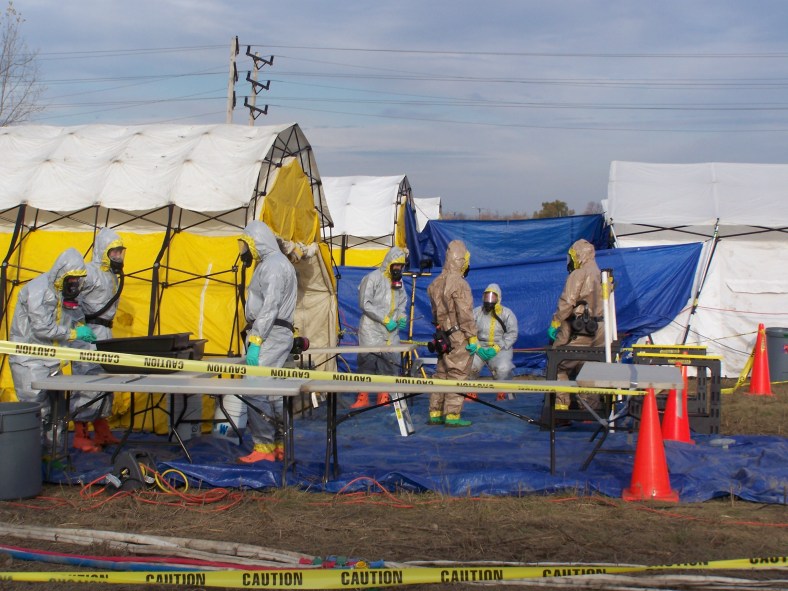
Last week, the way we remove chemical contamination from victims of a terror attack or chemical accident has changed… well, not quite yet, but it should soon.  A partnership between the US Department of Health and Human Services’ (HHS) Office of the Assistant Secretary for Preparedness and Response (ASPR) and the University of Hertfordshire in England and Public Health England found that “…removing clothes removes up to 90 percent of chemical contamination and wiping exposed skin with a paper towel or wipe removes another nine percent of chemical contamination.  After disrobing and wiping with a dry cloth, showering and drying off with a towel or cloth provides additional decontamination, bringing contamination levels down 99.9 percent.”

100_2534

Essentially, what they discovered was that despite recommendations for doing so, victims have often not been required to disrobe for decontamination.  When victims would progress through a decontamination (water spray down), much of the chemical they have been exposed to remains in the clothing and trapped against the skin.  Clearly this is not effective.

I see this new methodology being a significant change to how we decontaminate victims.  As the study hypothesizes, decontamination is much more effective when the chemical is wiped from the body after the victim disrobes.  Following this, they may progress then through a water spray.  This, essentially, adds a step to the typical protocols used in North America, Europe, and other locations.  I’m told the wipe methodology has been used in Japan for some time now.  I also believe that wipes have been in use by the US (and other) military forces for units in the field.

Links of interest:

HHS Press Release on the study.

Implementation of new protocols in the UK and other European nations

Many thanks to my colleague Matt for passing this information on to me.

As with any new procedure, the devil is in the details.  Standards must be established and adopted, supplies and equipment must be identified and obtained, personnel must be trained, and exercises must be conducted to validate.

I’m interested to hear opinions on these findings and recommendations, as well as thoughts on implementation in the US and abroad.

© 2016 – Timothy Riecker, CEDP

Emergency Preparedness Solutions, LLC Your Partner in Preparedness


Several New CyberSecurity Efforts in the News

Over the past few days, there have been media releases about several new cybersecurity initiatives that should have broad reaching benefits.

Timothy Riecker

First, Govtech.com reported on New Jersey’s consolidated fusion center-style approach to cybersecurity.  About a year ago, the New Jersey Cybersecurity and Communications Integration Cell (NJCCIC) was formulated, following the model of the National Cybersecurity Communications Integration Cell (NCCIC).  Co-located with the NJ State Emergency Operations Center and with support from the NJ Office of Homeland Security and Preparedness intelligence resources, the NJCCIC is keeping a watchful eye on cybersecurity matters internal and external to state government and sharing information with the private sector. This is a model effort that will hopefully grow and change based on identified opportunities in both New Jersey as well as other states who have yet to build such a capability.

EDM Digest recently reported on an initiative from the National Governor’s Association to form a multi-state working group, or academy as they are calling it, to create strategies to fight the evolving cybersecurity threat.  States contributing to this effort include Connecticut, Illinois, Louisiana, Nevada, and Oregon.  While not states we would usually think of as being on the forefront of cybersecurity issues, each does have significant business and industry which will hopefully serve as partners and resources in this endeavor.

Lastly, US Representatives Richard Hanna (R-NY) (who represents my district) and Derek Kilmer (D-WA) introduced the Small Business Cybersecurity Act to help American entrepreneurs protect themselves from cybercrimes and create cybersecurity plans that meet their business’ needs.  Co-sponsors of the bill included a range of Representatives of both parties from across the nation.  The release states that three out of every five cyberattacks target small businesses, and with small businesses making up a significant portion of the US economy, it is vital to help protect them.  I couldn’t agree more!  The intent of the bill is to create no-cost legislation to leverage the expertise of Small Business Development Centers (SBDCs) around the nation as an information distribution point for cybersecurity preparedness.  Let’s hope this one passes!  Express support for the bill to your Congressional Representative!

All in all, it’s encouraging to see continued effort toward cybersecurity protection, preparedness, and response.  As with the preparedness efforts we see in emergency management, I hope soon these efforts in cybersecurity will become more unified and closely knit.  While they all technically fall under the President’s Cybersecurity Strategy, we need to ensure connectivity of these efforts to help prevent duplication of effort and minimize holes.  We also want to ensure that access to services and resources that are available are comprehensive and streamlined to the greatest extent.  Let’s keep cybersecurity in mind and continue this work!

© 2016 – Timothy Riecker, CEDP

Training EOC First-Timers

If you’ve worked in an EOC, you’ve certainly seen it.  The deer-in-the-headlights stare of an EOC first-timer.  There is so much to take in and a lot going on.  A room full of work stations with people typing, people on the phone, and others talking to each other.  While all these people might be wearing vests or name badges, some are in a shirt and tie, some lost the tie hours ago, some in a polo shirt, and others are in uniforms.  Walls are covered in screens, some showing the news, some weather, and some with a list of information on shelters or road closures.  Where do I sit?  What do I do?  How do I dial an outside line???

Remember, though, we were all once that first-timer, too.

Lucien Canton, one of the most prolific consultants and bloggers in the field of emergency management, just posted a great article in his regular newsletter titled ‘Just in Time Training: Tips for Orienting EOC Newcomers.’.  In it, he lists some great ideas on how we can better prepare for these inevitable first-timers and help ensure they become productive members of the EOC team quickly.  Check it out.  Oh, and if you aren’t subscribed to his newsletter (you should be!), info can be found here.

– TR

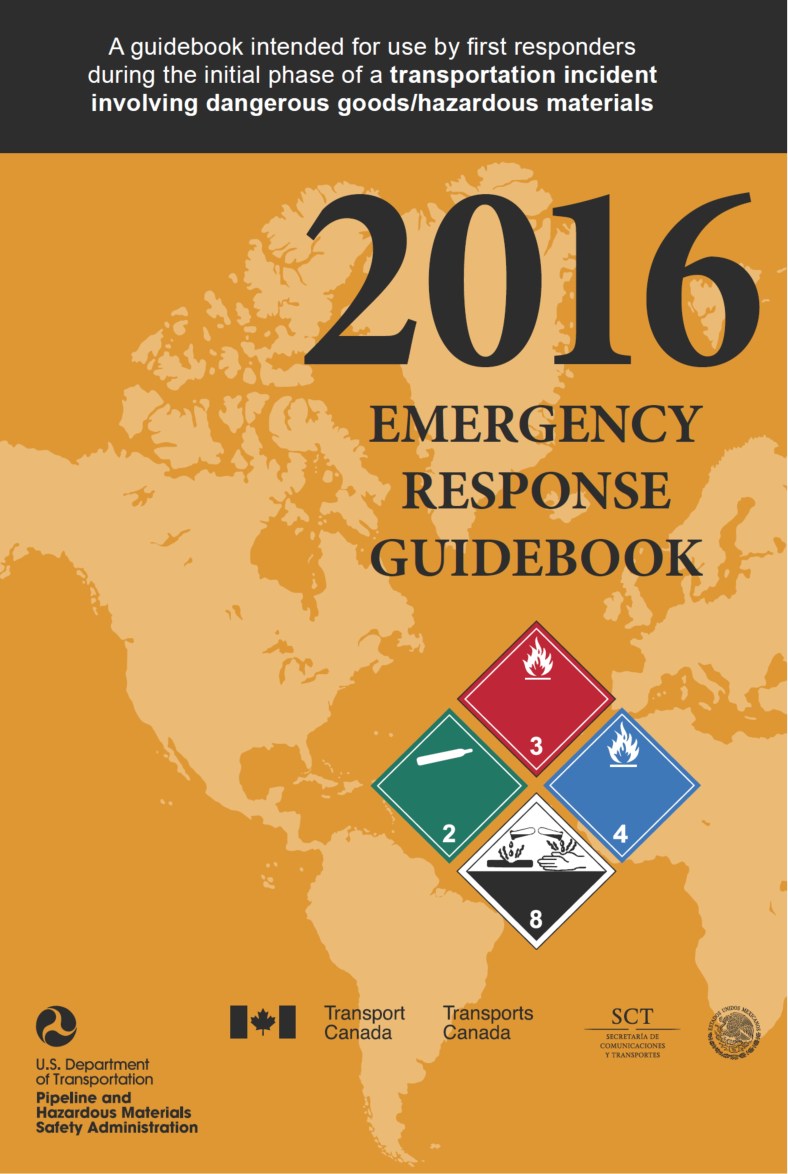
DOT Releases New Emergency Response Guidebook

PHMSA 05-16
Tuesday, April 26, 2016
Contact:  Artealia Gilliard
Tel.: 202-366-4831

DOT Releases New Emergency Response Guidebook

2016 ERG Cover

More Than 1.5 Million Free Copies to First Responders Nationwide

WASHINGTON – The U.S. Department of Transportation’s (USDOT) Pipeline and Hazardous Materials Safety Administration (PHMSA) today released the 2016 Emergency Response Guidebook (ERG2016), providing first responders with an updated go-to manual to help respond to hazardous materials transportation accidents during the critical first minutes.

PHMSA will distribute more than 1.5 million free copies of the guidebook to firefighters, emergency medical technicians and law enforcement officers across the nation.  Emergency first responders will use the ERG2016 to identify specific risks associated with compromised hazardous materials, and the recommended safety measures and procedures they should take to protect themselves and contain the incident as quickly as possible.

“We take the safety of this nation and its emergency responders very seriously,” said U.S. Transportation Secretary Anthony Foxx. “Our goal is to make sure that these first responders have the most current and accurate safety guidelines possible for use during that initial phase of a hazmat incident.”

The ERG contains an indexed list of dangerous goods and the associated 4-digit United Nations identification numbers. The ERG also identifies the general hazards those dangerous goods pose and  recommends safety precautions in remediating a hazmat incident. For example, if emergency first responders arrive at the scene of an overturned tractor trailer displaying a USDOT hazardous material placard, they would use the guidebook to identify the material associated with the placard and how best to respond.

“The ERG is an invaluable tool during the initial stages of any hazmat transportation emergency. Taking the proper action during those critical first minutes impacts the safety of both the first responders and the people they serve,” said PHMSA Administrator Marie Therese Dominguez.

The 2016 version of the ERG includes general revisions, expanded sections and added guide pages for absorbed gases. Updated every four years as a collaborative effort of the USDOT, Transport Canada and Mexico’s Secretariat of Transport and Communications, the ERG2016 is available free to public safety agencies in all states, territories and Native American Tribes through designated state emergency management coordinators’ offices.

PHMSA has also partnered with the National Library of Medicine (NLM) to provide a free Smartphone version of the ERG2016.  NLM also develops and distributes the Wireless Information System for Emergency Responders. The mobile application will be available this spring.

A copy of the new ERG2016 is posted online at: http://phmsa.dot.gov/hazmat/outreach-training/ergPrint copies of ERG2016 are available for sale to the general public through the U.S. Government Printing Office Bookstore athttp://bookstore.gpo.gov and other commercial suppliers.

The mission of the Pipeline and Hazardous Materials Safety Administration is to protect people and the environment by advancing the safe transportation of energy and other hazardous materials that are essential to our daily lives.  PHMSA develops and enforces regulations for the safe operation of the nation’s 2.6 million mile pipeline transportation system and the nearly 1 million daily shipments of hazardous materials by land, sea, and air. Please visit http://phmsa.dot.gov or https://twitter.com/PHMSA_DOT for more information.

Course Review – RDPC Isolation and Quarantine

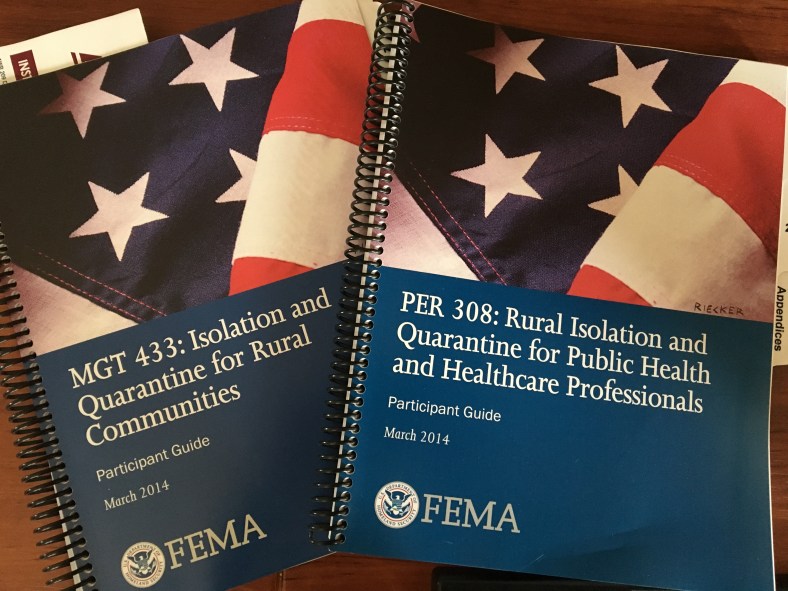
IQLast week I had the opportunity to take two courses sponsored by the Rural Domestic Preparedness Consortium (RDPC), MGT 433: Isolation and Quarantine for Rural Communities and PER 308: Rural Isolation and Quarantine for Public Health and Healthcare Professionals.  These courses together were completed in one day.

First came MGT 433.  This course covered a variety of topics associated with isolation and quarantine, including:

  • Case studies
  • Legal and ethical issues
  • Agencies and entities involved
  • Planning priorities
  • Resources

While the course is intended for rural audiences, which my home area generally is, the issues and considerations associated with isolation and quarantine are still largely the same for more densely populated areas.  While weaving through the various course topics, they mostly all related back to understanding the reasoning behind the use of isolation and/or quarantine as tools to limit the spread of certain communicable diseases and the planning and implementation associated with these activities.  The course did elevate my rather foundational knowledge of isolation and quarantine, and provided some great references for future application.

The second course, PER 308, didn’t really provide much more information than the previous course did, although it allowed an opportunity for a greater degree of analysis and discussion through a guided tabletop exercise.  The tabletop information from the participant manual was supplemented with several video segments which were produced with reasonable quality and help set the stage for many of the issues one would expect from dealing with an isolation/quarantine event.

Both courses were pretty solid, with only a few little tweaks or updates which I provided feedback on to the instructor.  As with most RDPC courses, those from larger agencies and more populated areas shouldn’t be dissuaded from participating – the foundational concepts they present are applicable to any area, rural or otherwise.

The instructor was very personable, professional, and knowledgeable of the course content.  While he didn’t have a public health background, which surprised me given the course topics, he clearly has a great cooperative public safety background.  I’ve found that the RDPC tends to prefer sending only one instructor to teach a course, along with an assistant to handle administrative matters.  While it’s certainly viable to handle the course alone, it’s challenging for both the instructor and the audience.

All in all, these are good courses, and I do recommend you keep a look out for them in your area.  Both courses are excellent for furthering your understanding of isolation and quarantine, when to use them, how to use them, and who to involve.  They are particularly good courses for public safety leadership and public health leadership and preparedness staff.

© 2016 – Timothy Riecker, CEDP

Emergency Preparedness Solutions, LLCYour Partner in Preparedness

The NIMS Refresh – The Good, the Bad, and the Ugly

The current National Incident Management System (NIMS) doctrine document, dated December 2008, has guided NIMS for over seven years.  This iteration, as I recall, wasn’t much of a change from its predecessor (2004), with the most significant updates being some changes to the NIMS components and the inclusion of the concept and arrangement of the Intelligence function within ICS.  We now have a new draft NIMS document which has been posted for a national engagement period.  If you haven’t had a chance to review the document, it can be found here.

While I certainly intend on providing my comments directly to FEMA through their feedback mechanism (which I encourage you all to do), I wanted to provide a bit of an overview of the draft document to my readers, which of course will include some of my opinions on the changes they are proposing.  I remain a huge proponent of NIMS and fully believe in the positive impact it has had, although I have been quite outspoken (and will remain so) about the issues associated with ICS training.

In this NIMS refresh, as they are calling it, there are some significant changes to certain areas while largely maintaining the foundations of the system.  The significant changes include:

  • NIMS has consolidated its five components to three, dropping the components of Preparedness and Ongoing Management and Maintenance.
  • The introduction of the Center Management System (CMS) as part of the restructured Management and Coordination (formerly Command and Management) component
  • Incorporation of the NIMS Intelligence and Investigations Function Guidance

First off, the consolidation of the five NIMS components to three.  While I’m disappointed with the preparedness component being deemphasized, especially with so much preparedness work to always be done, I found many of the concepts of preparedness to be sprinkled throughout the document, including a nod to the National Preparedness Goal (NPG) in the introduction of the draft document.  The NPG should certainly be the guiding document of all preparedness efforts related to emergency management.  While there are some aspects that are NIMS-specific, I’m fairly confident they won’t get lost in the shuffle.  Withdrawing the Ongoing Management and Maintenance component, similarly has seen some of these activities being mentioned elsewhere in the document, although only a few of them, with some of the important elements simply not being apparent.

In my review of the document, I was pleased with the inclusion (albeit small) of the concept of Unity of Effort as a newly introduced guiding principal of NIMS.  Unity of Effort is an concept essential to the success to all components of emergency management and homeland security and certainly in incident management.  This is definitely a positive.

Credentialing – the first major component discussed in the document is Resource Management.  Within Resource Management is the concept of credentialing.  Despite an intent of the document being to emphasize that NIMS isn’t just about ICS, the narrative on credentialing essentially focuses only credentialing through use of a position task book – which is generally only used for ICS positions.  While this is an important element of personnel qualifications, credentialing of personnel within ICS positions is not the only aspect of personnel qualifications.

Based upon the content of the NIMS Intelligence and Investigation function guidance published a few years ago, the NIMS refresh has officially decreed that the Intelligence and Investigations function will reside at the general staff level.  You might recall that the previous version of NIMS allowed for several options, including general staff, command staff, or imbedded within Planning or Operations.  While the flexibility of ICS is one of its greatest benefits, people didn’t seem comfortable with all those options.  It’s not to say those options still can’t be employed for incidents involving much smaller or potential criminal components, as the option of placing a technical specialist in any of those positions is still available.

Next up, the long awaited Center Management System (CMS).  To be honest, I’m not crazy about the name, and I’m not sure we need fully developed separate guidance on operations/coordination centers.  I feel that specific application of ICS concepts to an operations/coordination center should be kept simple and would be an addendum to the ICS portion of the NIMS document.  That said, the NIMS refresh has saw fit to include a whole section on the CMS as part of the revamped Management and Coordination component, so we’ll break down some of the highlights.  It’s important to note that the CMS is expected to be guidance and not a requirement.

While I can live with the introduction of a formal Center Management System, they have chosen to declare the title of the individual in charge of an operations/coordination center a Center Director.  If there is anything that I 100% disagree with in this document, it’s this title.  Let’s step back and look at the principles of ICS, which, thankfully ,the CMS is largely based upon.  From our common organizational terminology, we know that those in charge of facilities (which an operations/coordination center is) are called managers, not directors.  Directors are found at the branch level.  It’s for this reason I have always been in favor of the Center Manager title and will continue to be.

A positive about the CMS narrative is the important mention of a policy group, as a MAC concept, as those providing advice or direction to the Center Director.  Not only is the policy group a reality in many jurisdictions, inclusion of this in the CMS is an excellent compromise to those systems which centered on a policy group and operations group as their EOC organization.

Within discussion of the CMS, the NIMS refresh identifies primary functions or reasons a center might activate.  While they are headed in the right direction, they need their explanations to be a bit more inclusive of other options.  They only make a minor mention of the possibility of an incident actually being run from an operations/coordination center, such as a public health incident, which could be a departmental operations center or some type of a multi-agency operations center.  I just think this needs to be shored up some.  It should also be mentioned that EOCs may take primary responsibility for actions that are decided to be outside the scope of incident command, which may desire to remain focused on incident suppression activities.  Activities such as sheltering/mass care, evacuation, or assessment and evaluation may be run out of an EOC instead of an ICP.

Now on to the CMS organization.  Along with the Center Director, the NIMS refresh has tried to make several other positions distinct from their ICS counterparts (although not all of them).  While I certainly acknowledge that the focus of an operations/coordination center is often different than that of an ICP, I see little reason to change the titles of some of these positons.  I think this has more potential to add to confusion rather than detract from it.  While the command staff (yes, still being called ‘command staff’) positions have remained the same, the following has been identified as the CMS general staff positions:

  • Strategic Operations Section
  • Intelligence/Investigations Section
  • Information and Planning Section
  • Resource and Center Logistics Section
  • Finance/Administration Section

As for some of the specific language within the sections, there are some positives.  Two particular ones are the inclusion of ‘future planning’ within the Information and Planning Section, and the acknowledgement that in most EOCs, the Logistics Section/Resource and Center Logistics Section tends to handle tracking of resources.

There is additional and expanded information on the CMS found in Appendix B.  These show some different organizational arrangements, particularly within the Information and Planning Section and the Resource and Center Logistics Section.  All in all, I think these proposed arrangements are practical and a reflection of reality in most operations/coordination centers.  Well done.

Lastly, Communications and Information Management has included mentions of different reports which may be required, including flash reports, status reports, and situation reports.  This is a good reflection of reality. They have also listed important considerations for elements of essential information (EEI) (I’d love to see this list added to a field operations guide!), which must be constantly monitored for the maintenance of situational awareness, and they have bolstered the incident information portion of this component.  All great positives!  Interesting to note that the term ‘common operating picture’ has been significantly de-emphasized.

After reviewing this document, I’m overall encouraged with the direction NIMS is taking, although I obviously have some reservations.  I’m confident that, over time, the kinks will shake out as they have done with other aspects of NIMS.  I’m looking forward to some of the other changes that will spin off of this central document, such as new planning guidance and training.

As always, I’m interested in your feedback on my ideas as well as your own reactions and analysis of the NIMS refresh.

Thanks for reading!

© 2016 – Timothy Riecker, CEDP

Emergency Preparedness SolutionsYour Partner in Preparedness

DHS Says Low Risk of Destructive Cyberattack

Published in The Hill yesterday, this article states that a DHS intelligence assessment rates a destructive cyberattack on the US energy grid as a low threat.  While I’m not a cybersecurity expert, this just doesn’t sit right with me.  So many other sources are talking about how serious of a threat a cyberattack is, especially the destructive impacts on infrastructure.  It seems pretty short sighted to think that criminal hackers will only enter systems to poke around and look for information.

The article cites that this is from a ‘leaked’ intelligence assessment.  Let’s hope they have their information wrong.

TR

~Edit~

About two hours after posting this, I read an article on Homeland Security Today which blows away the premise of the supposed DHS intelligence assessment.  Worth reading.

TR

“No Battle Plan Survives Contact With the Enemy”

This quote is credited to a German military strategist named Helmuth von Moltke, who served in several wars in the mid-1800s.  He had a certain theory of war, understanding that several strategies must be identified in planning, as it is difficult to ascertain exactly what will happen after first contact with the enemy.  What can we in emergency management learn from this?

First off, we should all recognize that it’s a rare occasion that anything goes according to plan.  That is a reality which we must identify as a foundation of our planning efforts.  These realities are part of our planning assumptions.  In essence, we simply don’t know exactly what will happen, when it will happen, where it will happen, or what the impacts will be.  We also can never be completely certain about the resources we will have available to us to respond.

Based on these planning assumptions, we should not count on our plans working from the moment an incident occurs.  Very simply, there is always some catch up that we need to account for.  Most importantly, we need to gain situational awareness to determine the scope and magnitude of the incident.  Once we have a reasonable degree of situational awareness (often we never know everything we would like to), we can start making decisions as to how we will respond.  These decisions should be guided by our plans.

Our initial response – what we do when we first run in approach, assess, and begin our initial life saving measures – may not have a solid plan, but the foundation of it does follow a certain algorithm.  Many disciplines, especially the traditional first response ones, often underscore the importance of a scene size up.  While this varies a bit based on our respective disciplines and the nature of the incident, the common themes involve seeking answers to the usual questions – who, what, where, when, why, and how.  As we begin to gain answers and process this information, we request and assign resources.  Our initial response is often unorganized.  We don’t know all there is to know about the incident.  We don’t have all of our resources readily available.  Mentally we are overwhelmed with information, trying to process everything quickly.  Eventually, though, we should begin to transition into our planned response, bringing order to the chaos.

While emergency and incident management isn’t war, there are certainly a number of parallels that can be drawn.  While von Moltke’s statement is often cited in our profession, devaluing the plans we create, I think the perspective of those who cite it is wrong.  We should not intend for our plans to be implemented immediately upon occurrence of an incident.  Rather than sticking a square peg into a round hole by trying to immediately apply our plans, our initial response should deliberately guide us to our planned response.

One of the chief elements of our plans is our organization – the incident command system (ICS) or incident management system (IMS).  Our ability to properly implement our plans is predicated on our ability to manage.  In a complex incident, one person cannot handle all the elements and tasks.  Delegation is necessary and ICS/IMS is the organizational model we should be following.  It is through our incident management organization that we manage resources, hopefully in accordance with a plan, which helps us to manage the incident.  The transition to managing the incident instead of responding to the incident can be a difficult one to make, especially for those not experienced with larger incidents.  Much time can be wasted resisting or struggling through this transition.  The transition, however, is a conscious and deliberate effort.  It won’t happen automatically.  It must be managed.

I’ve referenced in previous blog posts Cynthia Renaud’s paper “The Missing Piece of NIMS: Teaching Incident Commanders How to Function on the Edge of Chaos’.  Much of what I’m talking about in terms of managing our ICS/IMS through the transition of initial response into our planned response has also been cited by Chief Renaud.  The bottom line is that we can do better in our core ICS/IMS training to aid our incident managers in making this happen.  Much ICS training seems to have dropped the essential concept of scene size up/assessment, or simply glosses over it.  How can you make decisions about how to manage the incident if you don’t know what’s going on?  It’s also a rare occasion that ICS training has much mention of the planned response.  The focus is on incident action planning, which is certainly needed to guide us through tactical application, but courses often fail to indicate the indispensable reference of emergency plans when identifying objectives and strategies.  This is a clear disconnect in our preparedness efforts and must be fixed.  We can do better.

If you haven’t yet heard of my crusade to improve our current state of ICS training, there are a number of articles I would direct you toward.  Check them out here.

Of course I’m always happy to hear what you think – comments are welcome!

© 2016 – Timothy Riecker, CEDP

Emergency Preparedness Solutions, LLC – Your Partner in Preparedness!

7 Emergency Management Priorities for the Next Administration

Heritage.org recently published a piece outlining the top four homeland security priorities for the next administration, which can be found here.  It’s a thought provoking article that certainly identifies some important issues.  In the same spirit, I’d like to offer what I think are the emergency management priorities for the next administration.

1) Support an Effective FEMA Organizational Model

The Heritage.org model pointed out several issues with the DHS organization that need to be addressed sooner rather than later.  I’d like to add some FEMA-specific items to their suggestions, regardless of if FEMA is kept within DHS or not (honestly, I think that ship has sailed and FEMA is there to stay).

In building a bit of background for this article, I took a look at FEMA’s current strategic plan, knowing that the document already identifies some of their priorities.  Within in that list of priorities, they mention mission and program delivery, becoming an expeditionary organization, posturing and building capability for catastrophic disasters, and strengthening their organizational foundation.  To me, these four all directly relate to their organizational model.

Along with having a strong central administration of programs, FEMA needs to have agility in their program delivery.  This is best accomplished through the FEMA regional offices, which act as an extension of the ‘central administration’ by coordinating directly with states and neighboring regions to apply those programs in the best possible manner within the guidelines of the program.  While this is currently performed, it is not performed to the greatest extent possible.  John Fass Morton provides some great perspective on this approach in his book ‘Next-Generation Homeland Security’.  Info on the book can be found here.

2) Bolster Risk Reduction Programs

I write often about preparedness, as that has always been a focus of my career.  Risk reduction, however, is essential to eliminating or reducing the impacts of hazards on communities.  Risk reduction includes all aspects of hazard mitigation and resilience, which are ideally applied at the local level but supported by state and federal programs, policies, and resources.

While the National Weather Service has implemented and promoted the StormReady program, which encourages community resilience, the best program we have ever had in our field is Project Impact.  I’d love to see a revival of Project Impact (call it that or something else – I don’t really care), incorporating the concepts of StormReady as well as other best practices in risk reduction.  A big part of this program MUST be incentivization, especially access to funds that can be applied for in the present for hazard mitigation activities.

3) Build a Better Cybersecurity Program

This item was added to the list by a colleague of mine.  It’s also found on the Heritage.org list.  It must be pretty important, then.

Yes, there are a LOT of initiatives right now involving cybersecurity, but I think there can be more.  Jon, the same colleague who suggested this for my list has also stated repeatedly that cybersecurity is really a Core Capability that cuts across all mission areas – Prevention, Protection, Response, Mitigation, and Recovery.  The recent update of the National Preparedness Goal suggests this, but sadly doesn’t commit.

What do we need in regard to cybersecurity?  First of all, we need to demystify it.  There are plenty of people out there who have just enough tech savvy to turn on their computer, send some email, and post to Facebook.  While that may work for them, they are likely intimidated by talk of cybersecurity, hackers, and the like.  We need to continue programs in plain speak that will help to inform the average consumer about how to protect themselves.

Better coordination with the private sector will pay off heavily when it comes to cybersecurity.  Not only is the private sector generally better at it, they also have a tendency to attract experts through better incentives than the government can offer, such as higher pay.  Cybersecurity also impacts everyone.  We’ve seen attacks of all types of systems.  The only way to stop a common enemy is to work together.  Let’s think of it as a virtual whole-community approach.

4) Prepare for Complex Coordinated Attack

Another of Jon’s suggestions.  While terrorism is often quickly shoved into the category of homeland security, there is a lot that emergency management can assist with.  These types of attacks (think Mumbai or Paris) have a significant impact on a community.  They require a multi-faceted approach to all mission areas – again, Prevention, Protection, Response, Mitigation, and Recovery.  While law enforcement is clearly a lead, they must be strongly supported by emergency management as part of a whole-community approach to be successful. Preparedness across all these mission areas must be defined and supported by federal programs.

5) Infrastructure Maintenance

We have roads, bridges, rail, pipes, and other infrastructure that MUST be maintained.  Maintenance (or replacement) will not only prevent failure of the infrastructure as a disaster itself, but will also make it more resilient to impacts from other disasters.  Yes, these are projects with huge price tags, but what alternative do we have?

6) Continuity of Existing Model Programs

There are few things more infuriating than a new administration wiping the slate clean of all predecessor programs to make room for their own.  While every administration is entitled to make their own mark, getting rid of what has been proven to work is not the way to do that.  Eliminating or replacing programs has a significant impact all the way down the line, from the federal program administrators, to the state program people, to the local emergency managers who are often understaffed and underfunded to begin with.

Changing gears is not as simple as using a different form tomorrow, it requires research and training on the new program and costs time to re-tool.  While I would never say there is nothing new under the emergency management sun, as I believe we are still innovating, I’m pretty skeptical of some new appointee walking into their job and making wholesale changes.  While improvements can certainly be made, summary execution of successful programs does no one any good.  Let’s not make change simply for the sake of change.

Related to this, I fully support the efforts of FEMA in the last few years to gain comprehensive input on changes to documents and doctrine through the formation of committees and public comment periods.  This approach works!

7) Pull Together Preparedness Programs

NIMS, HSEEP, NPG, THIRA, etc… While each of these programs have their own purpose and goals, more  can be done to bring them together.  I’m not suggesting a merger of programs – that would simply make a huge mess.  What I’m suggesting is to find the connections between the programs, where one leads to another or informs another, and highlight those.  Things like better application of the Core Capabilities within HSEEP exercises to have a more effective evaluation of NIMS capabilities (I suggested this while being interviewed for a GAO report), or referencing the THIRA when building a multi-year training and exercise plan.  While some jurisdictions may already do this, these are best practices that should be embraced, promoted, and indoctrinated.  These links typically don’t add work, in fact they capitalize on work already done, allowing one project/program/process to be informed or supported by another, creating efficiencies and supporting a synchronization of efforts and outcomes.

There is my list of seven.  What are your thoughts on the list?  There are certainly plenty of other ideas out there.  If you had the ear of the next President, what would you suggest be their administration’s emergency management priorities?

© 2016 – Timothy Riecker

Emergency Preparedness Solutions, LLCYour Partner in Preparedness