Revisiting POETE

One of my most popular posts has been my original post on POETE from July 2014. In the 11+ years has passed since that post, I continue leveraging the concept in every way I can. In case you’ve not heard of the concept, I certainly urge you to click the link above and read my original post. Briefly, POETE stands for Planning, Organizing, Equipping, Training, and Exercises. These are collectively known as the elements of preparedness. POETE is more than a checklist to me. It’s a strategic lens for realistically building and sustaining capabilities. Whether you are building a new emergency operations plan, launching a new public health preparedness initiative, or refining multiagency coordination activities, POETE offers a structured way to think through what takes to help ensure these endeavors are implementation-ready.

While I’ve written on these in the past, my continued and diverse application of POETE has broadened my perspective on application, so here are some fresh thoughts.

Assessing – On occasion, I throw an A in front of the acronym for Assessing. While assessments are an early activity of Planning, there are also plenty of stand-alone assessment activities which should be regarded of their own accord. Assessments can and should inform everything else we do in preparedness. Good assessments can provide us with justification for certain activities and investments and can often give us a data-driven approach. Along with many of the risk assessments common across emergency management, like the Threat, Hazard Identification, and Risk Assessment (THIRA), I’d also suggest that (well written) after-action reports (AARs) can also do the job. A well-developed AAR for an incident, event, or exercise can provide objective analysis of observed activities or discussions. When writing an AAR, we should always keep in mind that part of achieving the goal of improvement may involve requests and justifications for funding.

Planning – I’ve written a lot on the topic of emergency planning through the years. Overall, my take on most emergency plans is that they suck. Horribly. They aren’t worth the time, money, or effort invested in writing them. So many people go about it wrong. A true plan needs to be a blueprint for action. Good plans are operationally-focused, guiding decisions and actions. They should not just be theory and policy, as so many are. At best, I’d call something like that a framework, but it’s certainly not a plan.

Organizing – Organizing is largely about structure, roles, and responsibilities, but you can’t even get there without first building relationships and partnerships. Everything we do in emergency management is about relationships. It’s about knowing who has the thing you need – be it a physical resource, specialized knowledge, or specific authority. Last week I wrote a new piece on Community Lifelines. The central activity of doing anything with Community Lifelines is building relationships. Once those relationships are in place, then other activities will follow.

Equipping – I’ve always been very big on tools matching the mission. Equipment in this context means any and all resources available to us. The key aspect of this is alignment. Are the tools we use matching up to our threats, our people, and our procedures? While it’s understandable to have to update procedures to match a new resource, we should be very cautious about the resource dictating procedure. Our resources need to work for us, not the other way around.

Training – I feel like we have been gradually moving away from compliance being the center of the training universe. Yes, there is still plenty of training that is required for various purposes – there should be and there will always be. But I’ve been getting more requests from clients to develop custom training because they realize that little to no training exists to meet their needs. More people are realizing, for example, that ICS training is absolutely not the fit for EOC staff. Similarly, they are realizing that existing EOC training might begin to approach their needs, but the implementation of their specific EOC model really requires customized training. Overall, training needs to be role-based. We need to be training people what we want them to do. We need to give them the knowledge to succeed, not just generalized training for a broad group hoping that people will be able to ascertain what pertains to them and what does not. We also need to realize that, since most training in emergency management is response-oriented, the things they are being trained to do are things they don’t do often and/or don’t do them under pressure. So frequency of training and job aids are essential to their success.

Exercises – The thing I do the highest volume of. Luckily, I love to do them! Exercises are about testing our plans and capabilities before they are tested for real. Pay attention to good exercise design and never forget that the end product is a worthwhile AAR. I still see so many softball AARs out there. AARs that pat people on the back for a job well done while only acknowledging the superficial opportunities to improve – often times because they don’t want to hurt anyone’s feelings. I don’t ever write an AAR for the purpose of offending anyone, but if we don’t expose what doesn’t work, the chances of it ever being addressed are so much lower than if we had documented it.

While we have the acronym of (A)POETE, it’s important to keep in mind that it’s not intended to be a linear process. It’s iterative and constantly in need of attention. Each component is informed by the others. While I generally believe that Planning is still the foundation of preparedness and it should heavily influence all other elements, those other elements can still influence Planning. POETE activities should be used to build our capabilities. These activities help us prepare with purpose, focus, and intent.

© 2025 Tim Riecker, CEDP

Emergency Preparedness Solutions, LLC®

Five Domains of Incident Management

Earlier this summer, RAND, under contract to CDC as part of a five-year project related to examining and assessing incident management practices in public health, developed and released the Incident Management Measurement Toolkit. Overall, I think the tool developed is a solid effort toward standardizing the evaluation of incident management. The tool guides a depth of examination into incident management practices. It can be a bit daunting at a glance, but the methodology of evaluation is generally what I’ve been practicing over the past several years for developing incident and event AARs. I’d also suggest that it’s scalable in application.

I feel it’s important to note that incident management teams involved in non-public health applications were also engaged in the research. The outcomes of the project and the inclusion of non-public health incident management practices in the research indicate to me that this tool can be applied broadly and not limited to public health applications.

Serving as a foundation for the assessment tool and methodology are five Domains of Incident Management that the project team identified. Provided with key activities, these include:

  1. Situational Awareness and Information Sharing – Perception and characterization of incident-related information to identify response needs.
  2. Incident Action and Implementation Planning – Ongoing articulation and communication of decisions in coherent incident action plans.
  3. Resource Management and Mobilization – Deployment of human, physical, and other resources to match ongoing situational awareness, identification of roles, and relevant decisions.
  4. Coordination and Collaboration – Engagement and cooperation between different stakeholders, teams, and departments in managing the incident.
  5. Feedback and Continuous Quality Improvement – The need for ongoing evaluation and refinement of incident management processes.

In consideration of these domains, I think the activities inherent within them are fairly agnostic of the type of incident management system (i.e. ICS) used. I also think these same domains can be applied for recovery operations, again, regardless of the system or organization being utilized; as well as the principal practice at work (public health, emergency management, fire service, law enforcement, etc.).

I’ve been intending to write about these domains for a while, but each time I considered them, something stood out to me as being a bit askew. I finally realized that these really aren’t domains that encompass all of incident management. Rather, these domains are better associated with an incident management system, such as the Incident Command System (ICS). The first three domains are very clearly applied directly to an incident management system, and the fourth is the general concept of multiagency coordination, which is a common concept of incident management systems. The last domain is simply quality management which is certainly integral across various incident management systems.

While I don’t believe my view undermines the tool’s value, it highlights the need for a clearer understanding of its limitations. An incident management system, like ICS, is just one part of incident management and doesn’t cover all related activities. Some tasks in incident management, such as setting priorities, decision-making, troubleshooting, and dealing with political and social issues, are often not directly related to the tactical management systems we use. Additionally, many important aspects fall within leadership that aren’t covered by the NIMS doctrine or the Planning P. Although organizing resources is a central part of incident management, there are many other activities not addressed in a tactical response that may influence tactical applications but are not part of a defined incident management system. While one could argue these activities fit into the five identified domains, I feel this analysis doesn’t provide a complete picture of a complex response. More information would be needed.

That said, I really like this toolkit. I think it provides a structured mechanism for evaluating common practices of incident management systems, which itself can provide a foundation for a more comprehensive assessment of incident management. That comprehensive assessment, beyond the incident management system, is also more anecdotal and often requires persons experienced in asking the right questions and clarifying perspectives and opinions – things that ultimately can’t be done (or at least done easily) with an assessment tool.

So regardless of what the nature of your incident is, consider using the Incident Management Measurement Toolkit as part of your AAR process.

What are your thoughts on the RAND tool? Have you used it? What do you think of the five domains they have identified?

©2024 Timothy Riecker, CEDP

Emergency Preparedness Solutions, LLC®

ICS: Problems and Perceptions

Oddly enough, I’ve recently seen a spate of LinkedIn posts espousing the benefits of the Incident Command System (ICS). Those who have been reading my material for a while know that I’m a big proponent of ICS, though I am highly critical of the sub-par curriculum that we have been using for decades to teach ICS. The outcome is an often poorly understood and implemented system resulting in limited effectiveness.

Yes, ICS is a great tool, if implemented properly. Yet most implementations I see aren’t properly conducted. To further muddy these waters, I see emergency plans everywhere that commit our responders and officials to using ICS – this is, after all, part of the National Incident Management System (NIMS) requirement that many have – yet they don’t use it.

So why isn’t ICS being used properly or even at all? Let’s start with plans. Plans get written and put up on a proverbial shelf – physical or digital. They are often not shared with the stakeholders who should have access to them. Even less frequently are personnel trained in their actual roles as identified and defined in plans. Some of those roles are within the scope of ICS while some are not. The bottom line is that many personnel, at best, are only vaguely familiar with what they should be doing in accordance with plans. So, when an incident occurs, most people don’t think to reference the plan, and they flop around like a fish out of water trying to figure out what to do. They make things up. Sure, they often try their best, assessing what’s going on and finding gaps to fill, but without a structured system in place and in the absence (or lack of referencing) of the guidance that a quality plan should offer, efficiency and effectiveness are severely decreased, and some gaps aren’t even recognized or anticipated.

Next, let’s talk about ICS training. Again, those who have been reading my work for a while have at least some familiarity with my criticism of ICS training. To be blunt, it sucks. Not only does the content of courses not even align with course objectives, the curriculum overall doesn’t teach us enough of HOW to actually use ICS. My opinion: We need to burn the current curriculum to the ground and start over. Course updates aren’t enough. Full rewrites, a complete reimagining of the curriculum and what we want to accomplish with it, needs to take place.

Bad curriculum aside… For some reason people think that ICS training will solve all their problems. Why? One reason I believe is that we’ve oversold it. Part of that is most certainly due to NIMS requirements. Not that I think the requirements, conceptually, are a bad thing, but I think they cause people to think that if it’s the standard that we are all required to learn, it MUST be THE thing that we need to successfully manage the incident. I see people proudly boasting that they’ve completed ICS300 or ICS400. OK, that’s great… but what can you actually do with that? You’ve learned about the system, but not so much of how to actually use it. Further, beyond the truth that ICS training sucks, it’s also not enough to manage an incident. ICS is a tool of incident management. It’s just one component of incident management, NOT the entirety of incident management. Yes, we need to teach people how to use ICS, but we also need to teach the other aspects of incident management.

We also don’t use ICS enough. ICS is a contingency system. It’s not something we generally use every day, at least to a reasonably full extent. Even our first responders only use elements of ICS on a regular basis. While I don’t expect everyone to be well practiced in the nuances and specific applications of ICS, we still need more practice at using more of the system. It’s not the smaller incidents where our failure to properly implement ICS is the concern – it’s the larger incidents. It’s easy to be given a scenario and to draw out on paper what the ICS org chart should look like to manage the scenario. It’s a completely different thing to have the confidence and ego in check to make the call for additional resources – not the tactical ones – but for people to serve across a number of ICS positions. Responders tend to have a lot of reluctance to do so. Add to that the fact that most jurisdictions simply don’t have personnel even remotely qualified to serve in most of those positions. So not only are we lacking the experience in using ICS on larger incidents, we also don’t have experience ‘ramping up’ the organization for a large response. An increase in exercises, of course, is the easy answer, but exercises require time, money, and effort to implement.

One last thing I’ll mention on this topic is about perspective. One of the posts I read recently on LinkedIn espoused all the things that ICS did. While I understand the intent of their statements, the truth is that ICS does nothing. ICS is nothing more than a system on paper. It takes people to implement it. ICS doesn’t do things; PEOPLE do these things. The use of ICS to provide structure and processes to the chaos, if properly done, can reap benefits. I think that statements claiming all the things that ICS can do for us, without inserting the critical human factor into the statement, lends to the myth of ICS being our savior. It’s not. It must be implemented – properly – by people to even stand a chance.

Bottom line: we’re not there yet when it comes to incident management, including ICS. I dare say too many people are treating it as a hobby, not a profession. We have a standard, now let’s train people on it PROPERLY and practice it regularly.

©2024 Timothy Riecker, CEDP

Emergency Preparedness Solutions, LLC®

NIMS Intel and Investigations Function – A Dose of Reality

Background

Soon after the initiation of the National Incident Management System (NIMS) as a result of Homeland Security Presidential Directive 5 in 2003, the Intelligence and Investigation (I/I) function was developed and introduced to NIMS, specifically to the Incident Command System (ICS). While we traditionally view I/I as a law enforcement function, there are other activities which guidance indicates may fall within I/I, such as epidemiology (personally, I’d designate epidemiology as a specific function, as we saw done by many during the COVID-19 response), various cause and origin investigations, and others. Integration of these activities into the response structure has clear advantages.

The initial guidance for the I/I function was largely developed by command personnel with the New York City Police Department (NYPD). This guidance offered several possible locations for the I/I function within the ICS structure, based on anticipated level of activity, needed support, and restrictions of I/I related information. These four possible ways of organizing the I/I function per this guidance are depicted here, and include:

  1. Placement as a Command Staff position
  2. Organized within the Operations Section (i.e. at a Branch level)
  3. Developed as its own section
  4. Included as a distinct unit within the Planning Section

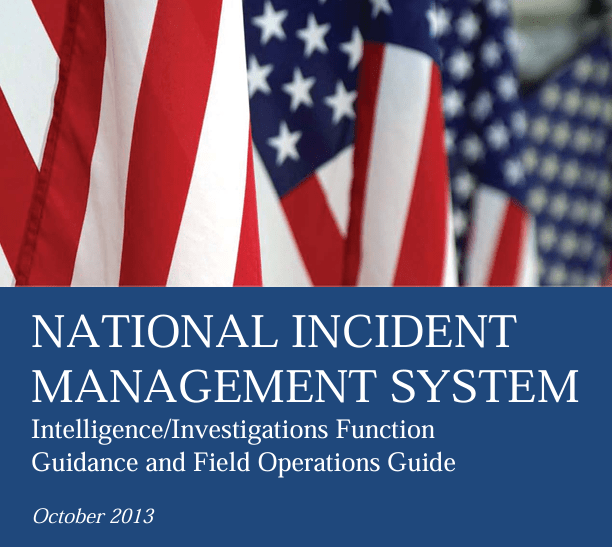
These concepts have been included in the NIMS doctrine and have been supported within the NIMS Intelligence/Investigations Function Guidance and Field Operations Guide, though oddly enough, this second document ONLY addresses the organization of an I/I Section and not the other three options.

The Reality

Organization of I/I can and does certainly occur through any one of these four organizational models, though my own experiences and experiences of others as described to me have shown that very often this kind of integration of I/I within the ICS structure simply does not occur. Having worked with numerous municipal, county, state, federal, and specially designated law enforcement agencies, I’ve found that the I/I function is often a detached activity which is absolutely not operating under the command and control of the incident commander.

Many of the sources of I/I come from fusion centers, which are off-scene operations, or from agencies with specific authorities for I/I activities that generally have no desire or need to become part of the ICS structure, such as the FBI conducting a preliminary investigation into an incident to determine if it was a criminal act, or the NTSB investigating cause and origin of a transportation incident. These entities certainly should be communicating and coordinating with the ICS structure for scene access and operational deconfliction, but are operating under their own authority and conducting specific operations which are largely separate from the typical life safety and recovery operations on which the ICS structure is focused.

My opinion on this is that operationally it’s completely OK to have the I/I function detached from the ICS structure. There are often coordination meetings and briefings that occur between the I/I function and the ICS structure which address safety issues and acknowledge priorities and authorities, but the I/I function is in no way reporting to the IC. Coordination, however, is essential to safety and mutual operational success.

I find that the relationship of I/I to the ICS structure most often depends on where law enforcement is primarily organized within the ICS structure and who is managing that interest. For example, if the incident commander (IC) is from a law enforcement agency, interactions with I/I activities are more likely to be directly with the IC. Otherwise, interactions with I/I are typically handled within the Operations Section through a law enforcement representative within that structure. Similarly, I’ve also experienced I/I activity to have interactions with an emergency operations center (EOC) through the EOC director (often not law enforcement, though having designated jurisdictional authority and/or political clout) or through a law enforcement agency representative. As such, compared to the options depicted on an org chart through the earlier link, we would see this coordination or interaction depicted with a dotted line, indicating that authority is not necessarily inherent.

I think that the I/I function organized within the ICS structure is more likely to happen when a law enforcement agency has significant responsibility and authority on an incident, and even more likely if a law enforcement representative is the IC or represented in a Unified Command. I also think that the size and capabilities of the law enforcement agency is a factor, as it may be their own organic I/I function that is performing within the incident. As such, it would make sense that a law enforcement agency such as NYPD, another large metropolitan law enforcement agency, or a state police agency leading or heavily influencing an ICS structure would be more likely to bring an integrated I/I function to that structure. Given this, it makes sense that representatives from NYPD would have initially developed these four possible organizational models and seemingly exclude the possibility of a detached I/I function, but we clearly have numerous use cases where these models are not being followed. I’ll also acknowledge that there may very well be occurrences where I/I isn’t but should be integrated into the ICS structure. This is a matter for policy and training to address when those gaps are identified.

I believe that NIMS doctrine needs to acknowledge that a detached I/I function is not just possible, but very likely to occur. Following this, I’d like to see the NIMS Intelligence/Investigation Function Guidance and Field Operations Guide updated to include this reality, along with operational guidance on how best to interact with a detached I/I function. Of course, to support implementation of doctrine, this would then require policies, plans, and procedures to be updated, and training provided to reflect these changes, with exercises to test and reinforce the concepts.

What interactions have you seen between an ICS or EOC structure and the I/I function? What successes and challenges have you seen from it?

© 2024 Tim Riecker, CEDP

Emergency Preparedness Solutions, LLC®

Culture of Preparedness – a Lofty Goal

September is National Preparedness Month here in the US. As we soon head into October, it’s a good opportunity to reflect on what we’ve accomplished during the month, or even elsewhere in the year. While National Preparedness Month is an important thing to mark and to remind us of how important it is to be prepared, over the past several years I’ve come to question our approaches to community preparedness. What are we doing that’s actually moving the needle of community preparedness in a positive direction? Flyers and presentations and preparedness kits aren’t doing it. While I can’t throw any particular numbers into the mix, I think most will agree that our return on investment is extremely low. Am I ready to throw all our efforts away and say it’s not making any difference at all? Of course not. Even one person walking away from a presentation who makes changes within their household to become better prepared is important. But what impact are we having overall?

Culture of preparedness is a buzz phrase used quite a bit over the last number of years. What is a culture of preparedness? An AI assisted Google search tells me that a culture of preparedness is ‘a system that emphasizes the importance of preparing for and responding to disasters, and that everyone has a role to play in doing so.’ Most agree that we don’t have a great culture of preparedness across much of the US (and many other nations) and that we need to improve our culture of preparedness. But how?

People love to throw that phrase into the mix of a discussion, claiming that improving the culture of preparedness will solve a lot of issues. They may very well be correct, but it’s about as effective as a doctor telling you that you will be fine from the tumor they found once a cure for cancer is discovered. Sure, the intent is good, but the statement isn’t helpful right now. We need to actually figure out HOW to improve our culture of preparedness. We also need to recognize that in all likelihood it will take more than one generation to actually realize the impacts of deliberate work toward improvement.

The time has come for us to stop talking about how our culture of preparedness needs improvement and to actually do something about it. There isn’t one particular answer or approach that will do this. Culture of preparedness is a whole community concept. We rightfully put a lot of time, effort, and money into ensuring that our responders (broad definition applied) are prepared, because they are the ones we rely on most. I’d say their culture of preparedness is decent (maybe a B-), but we can do a lot better. (If you think my assessment is off, please check out my annual reviews of the National Preparedness Report and let me know if you come to a different conclusion). There is much more to our community, however, than responders. Government administration, businesses, non-government organizations, and people themselves compose the majority of it, and unfortunately among these groups is where our culture of preparedness has the largest gaps.

As with most of my posts, I don’t actually have a solution. But I know what we are doing isn’t getting us to where we want to be. I think the solution, though, lies in studying people, communities, and organizations and determining why they behave and feel the way they do, and identifying methodologies, sticks, and carrots that can help attain an improved culture of preparedness over time. We must also ensure that we consider all facets of our communities, inclusive of gender identity, race, culture, income, citizenship status, and more. We need people who know and study such things to help guide us. The followers of Thomas Drabek. The Kathleen Tierneys* of the world. Sociologists. Anthropologists. Psychologists. Organizational psychologists.  

A real, viable culture of preparedness, in the present time, is little more than a concept. We need to change our approach from using this as a buzz phrase in which everyone in the room nods their heads, to a goal which we make a deliberate effort toward attaining. A problem such as this is one where we can have a true union of academia and practice, with academics and researchers figuring out how to solve the problem and practitioners applying the solutions, with a feedback loop of continued study to identify and track the impacts made, showing not only the successes we (hopefully) attain, but also how we can continue to improve.

*Note: I don’t know Dr. Tierney personally and it is not my intent to throw her under the proverbial bus for such a project. I cite her because her writing on related topics is extremely insightful. I highly recommend Disasters: A Sociological Approach.

© 2024 Timothy Riecker, CEDP

Emergency Preparedness Solutions, LLC®

ICS Training Sucks – Progress Inhibited by Bias

It’s been a while since I’ve written directly toward my years-long rally against our current approach to Incident Command System (ICS) training. Some of these themes I’ve touched on in the past, but recent discussions on this and other topics have gotten the concept of our biases interfering with progress stuck in my head.

It is difficult for us, as humans, to move forward, to be truly progressive and innovative, when we are in a way contaminated by what we know about the current system which we wish to improve. This knowledge brings with it an inherent bias – good, bad, or otherwise – which influences our vision, reasoning, and decisions. Though on the other hand, knowledge of the existing system gives us a foundation from which we can work, often having awareness of what does and does not work.

I’m sure there have been some type of psychological studies done on such things. I’ve certainly thought about, in my continued rally against our current approach to ICS training, what that training could look like if we set individuals to develop something new if they’ve never seen the current training. Sure, the current training has a lot of valuable components, but overall, it’s poorly designed, with changes and updates through decades still based upon curriculum that was poorly developed, though with good intentions, so long ago.

In recent months, having had discussions with people about various things across emergency management that require improvement, from how we assess preparedness, to how we develop plans, to how we respond, and even looking at the entire US emergency management enterprise itself. Every one of these discussions, trying to imagine what a new system or methodology could look like, with every one of these people (myself included), were infected by an inherent bias that stemmed from what is. Again, I’m left wondering, what would someone build if they had no prior knowledge of what currently exists.

Of course, what would be built wouldn’t be flawless. To some solutions, those of us in the know may even shake our heads, saying that certain things have already been tried but were proven to fail (though perhaps under very different circumstances which may no longer be relevant). Some solutions, however, could be truly innovative.

The notion, perhaps, is a bit silly, as I’m not sure we could expect anyone to build, for example, a new ICS curriculum, without having subject matter expertise in ICS (either their own or through SMEs who would guide and advise on the curriculum). These SMEs, inevitably, would have taken ICS training somewhere along their journey.

All that said, I’m not sure it’s possible for us to eliminate our bias in many of these situations. Even the most visionary of people can’t shed that baggage. But we can certainly improve how we approach it. I think a significant strategy would be having a facilitator who is a champion of the goal and who understands the challenges, who can lead a group through the process. I’d also suggest having a real-time ‘red team’ (Contrarian?) element as part of the group, who can signal when the group is exercising too much bias brought forth from what they know of the current implementation.

In the example of reimagining ICS training, I’d suggest that the group not be permitted to even access the current curriculum during this effort. They should also start from the beginning of the instructional design process, identifying needs and developing training objectives from scratch, rather than recycling or even referencing the current curriculum. The objectives really need to answer the question – ‘What do we want participants to know or do at the completion of the course?’. Levels of training are certainly a given, but perhaps we need to reframe to what is used elsewhere in public safety, such as the OSHA 1910.120 standard which uses the levels of Awareness, Operations, Technician, and Command. Or the DHS model which uses Awareness, Performance, and Management & Planning. We need to further eliminate other bias we bring with us, such as the concept of each level of training only consisting of one course. Perhaps multiple courses are required to accomplish what is needed at each level? I don’t have the answers to any of these questions, but all of these things, and more, should be considered in any real discussion about a new and improved curriculum.

Of course, any discussions on new and improved ICS curriculum need to begin at the policy level, approving the funding and the effort and reinforcing the goal of having a curriculum that better serves our response efforts.

How would you limit the influence of bias in innovation?

© 2024 Tim Riecker, CEDP

Emergency Preparedness Solutions, LLC®

Properly Applying ICS in Function-Specific Plans

As with many of my posts, I begin with an observation of something that frustrates me. Through much of my career, as I review function-specific plans (e.g., shelter plans, point of distribution plans, debris management plans, mass fatality incident management plans) I see a lot of organization charts that are inserted into those plans. Almost always, the org chart is an application of a ‘full’ incident command system (ICS) org chart (Command, Command Staff, General Staff, and many subordinate positions). This is obviously suitable for a foundational emergency operations plan (EOP), an emergency operations center (EOC) plan, or something else that is very comprehensive in nature where this size and scope of an organization would be used, but function-specific plans are not that. This, to me, is yet another example of a misinterpretation, misunderstanding, and/or misuse of the principles of National Incident Management System (NIMS) and ICS.

Yes, we fundamentally have a mandate to use ICS, which is also an effective practice, but not every function and facility we activate within our response and recovery operations requires a full organization or an incident management team to run. The majority of applications of a function-specific plan are within a greater response (such as activating a commodity POD during a storm response). As such, the EOP should have already been activated and there should already be an ‘umbrella’ incident management organization (e.g., ICS) in place – which means you are (hopefully) using ICS. Duplicating the organization within every function isn’t necessary. If we truly built out organizations according to every well intentioned (but misguided) plan, we would need several incident management teams just to run a Type 3 incident. This isn’t realistic, practical, or appropriate.

Most function-specific plans, when activated, would be organized within the Operations Section of an ICS organization. There is a person in charge of that function – depending on the level of the organization in which they are placed and what the function is, there is plenty of room for discussion on what their title would be, but I do know that it absolutely is NOT Incident Commander. There is already one of those and the person running a POD doesn’t get to be it. As for ‘command staff’ positions, if there is really a need for safety or public information activity (I’m not even going to talk about liaison) at these levels, these would be assistants, as there is (should be) already a Safety Officer or PIO as a member of the actual Command Staff. Those working within these capacities at the functional level should be coordinating with the principal Command Staff personnel. As for the ‘general staff’ positions within these functions, there is no need for an Operations Section as what’s being done (again, most of the time that’s where these functions are organized) IS operations. Planning and Logistics are centralized within the ICS structure for several reasons, the most significant being an avoidance of duplication of effort. Yes, for all you ICS nerds (like me) there is an application of branch level planning (done that) and/or branch level logistics that can certainly be necessary for VERY complex functional operations, but this is really an exception and not the rule – and these MUST interface with the principal General Staff personnel. As for Finance, there are similarly many reasons for this to be centralized within the primary ICS organization, which is where it should be.

We need to have flexibility balanced with practicality in our organizations. We also need to understand that personnel (especially those trained to serve in certain positions) are finite, so it is not feasible to duplicate an ICS structure for every operational function, nor is it appropriate. The focus should be on what the actual function does and how it should organize to best facilitate that. My suggestion is that if you are writing a plan, unless you REALLY understand ICS (and I don’t mean that you’ve just taken some courses), find someone who (hopefully) does and have a conversation with them. Talk through what you are trying to accomplish with your plan and your organization; everything must have a purpose so ask ‘why?’ and question duplication of effort. This is another reason why planning is a team sport and it’s important to bring the right people onto the team.

© 2024 Tim Riecker, CEDP

Emergency Preparedness Solutions, LLC®

AHIMTA Incident Management Certification

I was very pleased to see last week’s announcement by the All-Hazards Incident Management Team Association (AHIMTA) about their certification services for incident management personnel. From their website, AHIMTA is utilizing the National Incident Management System (NIMS) and the National Qualification System (NQS) as the baseline for their AHIMTA Incident Management Certification System (AIMCS). Information, including trainee application information can be found at https://www.ahimta.org/certification. In many ways, the AIMCS is a continuation of the Interstate Incident Management Qualifications System (IIMQS) Guide that AHMITA developed in 2012.

AHIMTA is providing a much-needed service, filling a vacuum that has always existed in the all-hazards incident management team (IMT) program in the US. While FEMA is responsible for maintaining the NQS, they have not actually provided certification or qualification of IMTs or IMT personnel. Last year it was decided that the US Fire Administration would discontinue their management of the AHIMT program. While the USFA didn’t provide any certification services, the program guidance they provided was valuable. They were also the primary federal agency doing anything with external AHIMTs. While some states have implemented the FEMA NQS standard for IMTs and associated positions, others have not. Even among the states that have, some have only done so, officially, for state-sponsored teams/personnel and not for those affiliated with local governments or other entities. Clearly gaps exist that must be filled. AHIMTA has continued to advocate for quality AHIMTs and personnel across the nation.

AHIMTA’s role as a third-party certification provider presents an interesting use case. While not unique, a third party providing a qualification certification (not a training certificate) based on a federal standard is not necessarily common. AHIMTA doesn’t have any explicit authority to provide this certification from FEMA or others, but as a respected organization in the AHIMT area of practice, I don’t think their qualifications to do so can be denied. Certification demands a certain rigor and even assumes liability. The documentation of the processes associated with their certification are well documented in their AIMCS Guide. While AHIMTA can’t require their certification, states and other jurisdictions may very well adopt it as the standard by which they will operate, and can make it a requirement for their jurisdiction. Aside from some very specific certifications that have existed, such as those for wildfire incident management personnel, much of AHIMT practices has been self-certification, which can vary in quality and rigor. The AIMCS program can provide consistency as well as relieve the pressure from states and other jurisdictions in forming and managing their own qualification systems. There will also be an expected level of consistency and excellence that comes from AHIMTA.

All that said, I continue to have reservations about membership organizations offering professional certifications. While membership organizations arguably have some of the greatest interest in the advancement of their profession and adherence to standards, as well as the pool of knowledge within their practice, the potential for membership influencing the process or injecting bias against non-members can never fully be eliminated. I feel that certifications should be provided by government agencies or fully independent organizations that are not beholden to a membership. Not wishing to stall AHIMTA’s progress or success in this program, I’m hopeful they may be willing to create a separate organization solely for the purposes of certification credentialing. I’d also love to see, be it offered in conjunction with this program or otherwise, an EOC qualification certification program, ideally centered upon FEMA’s EOC Skillsets, but with qualification endorsements for various EOC organizational models, such as the Incident Support Model.

I’m very interested to see the progress to be made by the AIMCS and how states and other jurisdictions adopt it as their standard. This certification should have significant impact on the continued development of quality all-hazard incident management teams.

What are your thoughts on this certification program?

© 2023 Timothy Riecker, CEDP

Emergency Preparedness Solutions, LLC®

Gaps in ICS Doctrine and Documents

Last month I got to spend several days with some great international colleagues discussing problems and identifying solutions that will hopefully have a meaningful and lasting impact across incident management and emergency response. No, this wasn’t at an emergency management conference; this was with an incredible group of ICS subject matter experts convened by ICS Canada, with a goal of addressing some noted gaps in ICS doctrine, training, and other related documents. While the focus was specific to the documents under the purview of ICS Canada, most of these matters directly apply to ICS in the United States as well.

Overall, our doctrine, curriculum, etc. (collectively, documents) across ICS is a mess. Broadly, the issues include:

  • Poor definitions of key concepts and features of ICS.
  • Lack of proper emphasis or perspective.
  • Lack of inclusion of contemporary practices. (management concepts, social expectations, moral obligations, even legal requirements, etc.)
  • Lack of continuity from doctrine into supporting documents and curriculum. – Everything needs to point back to doctrine. Not that every tool needs to be explicitly included in the doctrine, but they should be based upon consistent standards.
  • A need to support updated training to improve understanding and thus implementation.

As we discussed among the group and I continued thought on this, I’ve realized that ICS, as it relates to the US (NIMS) has so little doctrine spread across a few NIMS documents (the core NIMS doctrine, National Qualification System documents, and a few guidance/reference documents – which aren’t necessarily doctrine). In the US, via the National Wildfire Coordinating Group (NWCG), we used to have a whole array of documents which could be considered ICS doctrine (in the days of NIIMS <yes, that’s two ‘eyes’>). When the responsibility for the administration of ICS (for lack of better phrasing) shifted to DHS, these documents were ‘archived’ by the NWCG and not carried over or adopted by the NIMS Integration Center (NIC) in DHS who now has responsibility for NIMS oversight and coordination. The NIC has developed some good documents, but in the 20 years since the signing of HSPD-5 (which created and required the use of NIMS) it seems the greatest progress has been on resource typing and little else.

Looking at current NIMS resources, I note that some are available from the core NIMS site https://www.fema.gov/emergency-managers/nims while others are available from EMI at https://training.fema.gov/emiweb/is/icsresource/. All these documents really need to be consolidated into one well organized site with doctrine identified separate from other resources and documents (i.e. job aids, guidance, etc.).

I thought it might be fun to find some examples so I decided to open up the ICS 300 instructor guide, flip through some pages, and look at a few concepts identified therein that might not have much doctrinal foundation. Here’s a few I came up with:

  • Formal and Informal Communication
    • These concepts aren’t cited anywhere in NIMS documents. While superficially they seem to be pretty straight forward, we know that communication is something we constantly need improvement in (see practically any after-action report). As such, I’d suggest that we need inclusion and reinforcement of foundational communications concepts, such as these, in doctrine to ensure that we have a foundation from which to instruct and act.
  • Establishing Command
    • This is mentioned once in the core NIMS doctrine with the simple statement that it should be done at the beginning of an incident. While often discussed in ICS courses, there are no foundational standards or guidance for what it actually means to establish command or how to do it. Seems a significant oversight for such an important concept.
  • Agency Administrator
    • While this term comes up several times in the core NIMS doctrine, they are simple references with the general context being that the Agency Administrator will seek out and give direction to the Incident Commander. It seems taken for granted that most often the Incident Commander needs to seek out the Agency Administrator and lead up, ask specific questions, and seek specific permissions and authorities.
  • Control Objectives
    • Referenced in the course but not defined anywhere in any ICS document.
  • Complexity Analysis
    • The course cites factors but doesn’t reference the NIMS Incident Complexity Guide. Granted, the NIMS Complexity Guide was published in June 2021 (after the most recent ICS 300 course material), but the information in the Complexity Guide has existed for some time and is not included in the course materials.
  • Demobilization
    • Another big example of the tail wagging the dog in NIMS. Demobilization is included across many ICS trainings, but there is so little doctrinal foundation for the concept. The core NIMS doctrine has several mentions of demobilization, even with a general statement of importance, but there is no standard or guidance on the process of demobilization beyond what is in curriculum – and training should never be the standard.

For ICS being our standard, we haven’t established it well as a standard. A lot of work needs to be done to pull this together, fill the gaps, and ensure that all documents are adequately and accurately cross-referenced. This will require a significant budget investment in the National Integration Center and the formation of stakeholder committees to provide guidance to the process. We need to do better.

What doctrine and document gaps do you see as priorities in NIMS?

© 2023 Tim Riecker, CEDP

Emergency Preparedness Solutions, LLC®

The Texas Emergency Management Academy

Continuing the recent theme of discussing standards and training in emergency management, a timely article was released with the latest Domestic Preparedness Journal Weekly Brief. The article (written by Dr. Michael Valiente, Senior Training Officer for TDEM) tells of the first Texas Emergency Management Academy, developed by the Texas Division of Emergency Management, which is an eight-month program providing training in a variety of topics. As an eight-month program (though I don’t know their class schedule) it’s certainly longer than the FEMA Basic Academy and seems quite intensive. There is even some indication of FEMA Basic Academy courses being included in the program. The article mentions starting with 20 cadets and graduating 17, which is an excellent graduation rate.

The program covers the expected topics of preparedness, mitigation, response, and recovery with some specific content identified from FEMA, TDEM, and seemingly some guest instructors from other agencies, which I think really enriches the learning experience (emergency management isn’t only performed by emergency management agencies, after all). I’m hopeful there was quality training in how to write various types of emergency plans. I’m just more and more discouraged nearly every day by the plans I’m seeing out there… but that’s a different topic.

Beyond the four fundamental areas, there are some notable additions. One of which is a basic EMT course. I’m kind of scratching my head on this one. As I’ve espoused before, I certainly have no issues with people getting additional training or professional certifications – especially in life saving skills, but EMS is not EM. I can certainly hear in my head a lot of the justifications people would use for this, and while I understand them, I just don’t know that I can agree with the inclusion of an EMT course into an EM program.

Having a program of extended duration such as this offers some great opportunity to build in some external activities, such as conferences, training, and exercises sponsored or conducted by other partners, which they absolutely did. Of course, they included training from the Texas A&M Engineering Extension Service (TEEX) which I’ve always found to be fantastic. They also had a capstone exercise which was held at the TEEX facility in College Station (highly recommend, by the way, for those who have never been). Certainly, a great opportunity to utilize a terrific resource in your back yard.

Another noteworthy addition was an emergency management job fair which was preceded by classes on resume building, interview techniques, and other skills. I think this is brilliant and incredibly valuable for participants.

Overall, this seems a good and valuable program, though from what I read, given the inclusion of the EMS training, the response courses, the field training (which included a lot of response activity), and the (response) capstone exercise, it very heavily leans toward response. Sure the ‘pointy end of the stick’ for many emergency managers comes down to the high-consequence crisis that must be managed – and as such these training and experiences hold great value – but so much of what emergency managers do is in the time before and after disasters, much of which is administrative and collaborative. I’m just hoping there was a lot of great content, activities, and opportunities that supported these things as well that simply weren’t highlighted as much in the article.

In the discussions that have been had as of late on standards in emergency management, an academy-style program like this could certainly be a standard. There are pros and cons, but certainly things to be considered. I’m curious about what TDEM learned from this first academy that they expect to change for the next. Would love to hear from TDEM folks (and others) involved in the program, as well as graduates!

© 2023 Tim Riecker, CEDP

Emergency Preparedness Solutions, LLC®