Don’t Just Take It From Me – There are Issues with ICS Training

The February 2016 edition of the Domestic Preparedness Journal highlighted, among other things, some concerns with ICS training in the United States.  First off, if you aren’t subscribed to the DPJ, you should be.  It’s free and they offer good content, with few extraneous emails beyond the journals.  Check them out at www.domesticpreparedness.com.

The specific article in this issue I’m referencing is Incident Command System: Perishable if Not Practiced, by Stephen Grainer. Mr. Grainer is the Chief of Incident Management Systems for the Virginia Department of Fire Programs.  Steve has a significant depth in ICS and understands all the nuances of preparedness and application.  I first met him when serving on the national NIMS steering committee with him several years back.

The title of the article is a bit deceptive – it’s not just focused on the issue of the training being perishable.  Right up front, Mr. Grainer, who is a longtime supporter and advocate of ICS, outlines a few shortcomings and constraints related to the application of ICS and ICS training.  He states that “little attention has been given to developing the students’ ability to recognize an evolving situation in which more formalized implementation of the ICS should be undertaken”.  This underscores one of my main points on the failings of the ICS curriculum.  We teach people all about what ICS is, but very little of how to use it.

After giving a few case studies that reflect on the shortcomings he highlighted, Mr. Grainer expresses his support for continued training, refresher training (something not currently required), and opportunities to apply ICS in ways that public safety and emergency management don’t do on a regular basis.  He summarizes by stating that not only does training need to continue to address succession and bench depth, but also the need to address how to maintain competencies and address misunderstandings in NIMS/ICS.

Yes, training does need to continue, but it must be the RIGHT training!  We continue doing a disservice by promoting the current ICS courses which fall well short of what needs to be accomplished.  Mr. Grainer’s mention of the need for our training to address better implementation of ICS, particularly beyond the routine, is perhaps a bit understated, but nonetheless present.  Refresher training also needs to be incorporated into a new curriculum, as these skills are absolutely perishable – particularly the aspects of ICS typically reserved for more complex incidents.

In the event you aren’t familiar with my earlier posts on ICS and my crusade for a better curriculum, check out these posts.  As I’ve said before, this isn’t a pick-up kickball game… this is public safety.  We can do better.

Shameless plug:  Assessments, Planning, Training, Exercises.  Emergency Preparedness Solutions does it all.  Contact us to find out how our experience can benefit your jurisdiction’s or organization’s emergency and disaster preparedness.  We are your partner in preparedness.  www.epsllc.biz.

© 2016 – Timothy Riecker

Emergency Preparedness Solutions, LLC

Updating ICS Training: Identification of Core Competencies

The crusade continues.  ICS training still sucks.  Let’s get enough attention on the subject to get it changed and make it more effective.

If you are a new reader of my blog, or you happened to miss it, check out this post from last June which should give you some context: Incident Command System Training Sucks.

As mentioned in earlier posts on the topic, the ICS-100 and ICS-200 courses are largely OK as they current exist.  Although they could benefit from a bit of refinement, they accomplish their intent.  The ICS-300 course is where we rapidly fall apart, though.  Much of the ICS-300 is focused on the PLANNING PROCESS, which is extremely important (I’ve worked a lot as an ICS Planning Section Chief), however, there is knowledge that course participants (chief and supervisor level responders) need to know well before diving into the planning process.

First responders and other associated emergency management partners do a great job EVERY DAY of successfully responding to and resolving incidents.  The vast majority of these incidents are fairly routine and of short duration.  In NIMS lingo we refer to these as Type IV and Type V incidents.  The lack of complexity doesn’t require a large organization, and most of that organization is dedicated to getting the job done (operations).  More complex incidents – those that take longer to resolve (perhaps days) and require a lot more resources, often ones we usually don’t deal with regularly – are referred to as Type III incidents.  Type III incidents, such as regional flooding or most tornados, are localized disasters.  I like to think of Type III incidents as GATEWAY INCIDENTS.  Certainly far more complex than the average motor vehicle accident, yet not hurricane-level.  The knowledge, skills, and abilities applied in a Type III, however, can be directly applied to Type II and Type I incidents (the big ones).

It’s not to say that what is done in a car accident, conceptually, isn’t done for a hurricane, but there is so much more to address.  While the planning process certainly facilitates a proactive and ongoing management of the incident, there are other things to first be applied.  With all that said, in any re-writing and restructuring of the ICS curriculum, we need to consider what the CORE COMPETENCIES of incident management are.

What are core competencies?  One of the most comprehensive descriptions I found of core competencies comes from the University of Nebraska – Lincoln, which I summarized below.  While their description is largely for a standing organization (theirs), these concepts easily apply to an ad-hoc organization such as those we establish for incident management.

Competency: The combination of observable and measurable knowledge, skills, abilities and personal attributes that contribute to enhanced employee performance and ultimately result in organizational success. To understand competencies, it is important to define the various components of competencies.

  • Knowledge is the cognizance of facts, truths and principles gained from formal training and/or experience. Application and sharing of one’s knowledge base is critical to individual and organizational success.
  • A skill is a developed proficiency or dexterity in mental operations or physical processes that is often acquired through specialized training; the execution of these skills results in successful performance.
  • Ability is the power or aptitude to perform physical or mental activities that are often affiliated with a particular profession or trade such as computer programming, plumbing, calculus, and so forth. Although organizations may be adept at measuring results, skills and knowledge regarding one’s performance, they are often remiss in recognizing employees’ abilities or aptitudes, especially those outside of the traditional job design.

When utilizing competencies, it is important to keep the following in mind:

  • Competencies do not establish baseline performance levels
  • Competencies support and facilitate an organization’s mission 
  • Competencies reflect the organization’s strategy; that is, they are aligned to short- and long-term missions and goals.
  • Competencies focus on how results are achieved rather than merely the end result. 
  • Competencies close skill gaps within the organization.
  • Competency data can be used for employee development, compensation, promotion, training and new hire selection decisions.

So what are the CORE COMPETENCIES OF INCIDENT MANAGEMENT?  What are the knowledge, skills, and abilities (KSAs) that drive organizational success in managing and resolving an incident?  Particularly for this application, we need to focus on WHAT CAN BE TRAINED.  I would offer that knowledge can be imparted through training, and skills can be learned and honed through training and exercises; but abilities are innate, therefore we can’t weigh them too heavily when considering core competencies for training purposes.

All in all, the current ICS curriculum, although in need of severe restructuring, seems to cover the knowledge component pretty well – at least in terms of ICS ‘doctrine’.  More knowledge needs to be imparted, however, in areas that are tangential to the ICS doctrine, such as emergency management systems, management of people in the midst of chaos, and other topics.  The application of knowledge is where skill comes in. That is where we see a significant shortfall in the current ICS curriculum.  We need to introduce more SCENARIO-BASED LEARNING to really impart skill-based competencies and get participants functioning at the appropriate level of Bloom’s Taxonomy.

Aside from the key concepts of ICS (span of control, transfer of command, etc.), what core competencies do you feel need to be trained to for the average management/supervisor level responder (not an IMT member)?  What knowledge and skills do you feel they need to gain from training?  What do we need a new ICS curriculum to address?

(hint: this is the interactive part!  Feedback and comments welcome!)

As always, thanks to my fellow crusaders for reading.

© 2016 – Timothy Riecker

Emergency Preparedness Solutions, LLC

Thinking Back and Looking Ahead – A Blogging Year in Review

Here it is, the close of one year and the dawn of another.  As with most of you, I’m taking some time to reflect on the past and look ahead to the future.  2015 was my best blogging year yet, doubling last year’s readership, for which I am thankful.  I’ve been humbled in getting readers from around the globe – 127 nations in all.  While most came from the US, I have a great number of readers in Canada and Australia.  Based on who commented, my readers include public safety and business continuity professionals, academics and scholars, and those simply curious about what we do and how we do it.  My thanks to you all!

2015

In case you may have missed them, below are my five most popular posts:

Incident Command System Training Sucks (June)  This post prompted a lot of discussion directly on my blog site as well as in numerous LinkedIn discussion forums.  I received phone calls, emails, and had several in person conversations about the need to revamp ICS training to make it more effective.  While sadly I’ve received no feedback directly from the National Integration Center, I will continue the crusade to get better and more effective ICS training for stakeholders.

ICS Training Sucks… So Let’s Fix It (September)  Riding the coat-tails of Incident Command System Training Sucks, this post reflected a bit more on what needed to be done to improve the curriculum.  I received lots of feedback on this post as well.

The Need for Practical Incident Command Training (March)  This post preceded Incident Command System Training Sucks, and marked my mental progression from an earlier post (which is listed next) to this piece’s most popular successor in the ad-hoc series.

Preparedness – ICS Is Not Enough (January)  This piece reflected mostly on ICS as a component of preparedness, identifying that many agencies think they are prepared simply because their staff have taken some ICS courses and they include the terms in their plans.  In this we see the danger of the requirements of NIMS, which often mean compliance to many people.

The Death of ADDIE? (November 2012)  Yes, this one was written back in my first year of blogging.  This piece still holds strong and I see many search terms about ADDIE and the Successive Approximation Model (SAM) which bring people to the post.  While I’m still an avid user and advocate of ADDIE, the emergence of SAM shows there is more than one way to skin the proverbial cat.

Looking ahead:

Clearly the topic of ICS training is an important one to those in emergency management and homeland security.  As mentioned, I will continue my crusade to advocate for better and more effective training in ICS for our personnel.

I also had the pleasure of co-authoring a post this year with Mr. Ralph Fisk of Fisk Consultants.  Prior to the release of the new Star Wars film, The Force Awakens, we wrote about public safety interests for jurisdictions, law enforcement, theater management, and the general public.  Fortunately there were no shootings or other similar violent incidents that arose during the first couple weeks of showing this blockbuster film.  It was fun collaborating with Ralph and we have already discussed some possible topics for collaboration in 2016.  I hope to do the same with others as well as hosting guest posts from other experts in public safety.

I hope all of you enjoy reading these posts as much as I like writing them.  Each post provides an opportunity for me to learn and to share what I have learned.  It has become a great networking tool and marketing tool for my consulting practice.  Together I hope we can improve the important work we do in emergency management, homeland security, business continuity, and public safety as a whole.  The thoughts you share on posts are greatly appreciated and I look forward to interacting with you all in 2016.

Health, wealth, and happiness in the New Year!

© 2015 – Timothy Riecker

Emergency Preparedness Solutions, LLC


Preparing to Use the Incident Command System

For a bit of context, if you haven’t already read them, please take a look at these other ICS related articles I’ve posted:

Incident Command System Training Sucks

ICS Training Sucks… So Let’s Fix It

Preparedness – ICS is Not Enough

The crusade to improve ICS training and implementation continues…

We invest a lot of time and effort into training people in the use of the Incident Command System (ICS).  However, as a broad statement, the training we provide is massively inadequate.  We don’t actually train people to do anything – we simply tell them about ICS through an increasingly repetitive and complex series of courses.  At the risk of being repetitive myself, I refer you to the articles linked above for many of my foundational thoughts on the current state of ICS training.

The ICS core training curriculum aside, we – as both individuals and organizations – need to be better prepared to actually use ICS.  The thought that people are able to use ICS the minute they walk out of an ICS course is totally and completely false.  By ‘use ICS’, I don’t mean to simply function within an organizational chain of command that uses ICS, I’m referring to being a driving force within the system itself.  ICS isn’t something that happens automatically, it requires deliberate and constant actions.  This typically involves functioning at the Command or General Staff levels, but also within many of the subordinate positions which are absolutely critical to managing a complex incident and driving the system.

So how do we prepare to use ICS?  I often refer to the preparedness capability elements of POETE (Planning, Organizing, Equipping, Training, and Exercising) when I’m talking about preparedness activities.  These same concepts apply here.  We need to remember that planning is the foundation of all preparedness efforts.  If it’s not documented, then why are we doing it?  So we have to have plans, polies, and procedures which call for the implementation of ICS and direct us in the nuances of how we will manage an incident.  I’m sure everyone’s plan has taken a page from the NIMS Doctrine and includes language about the requirement to use NIMS and ICS.  That’s all well and good, but like many things in our plans, we don’t reinforce these things enough.

I’m not talking about simply giving NIMS and ICS lip service.  I’m talking about procedure level integration of these concepts.  This begins with good planning, which means plans that are implementation-ready.  Would you consider your plans implementation-ready?  Do they describe how to use the ICS structure and concepts to actually implement the plan?  Maybe yes, maybe no.   If not, your team has some plan updating to do.

Your organization must be ready to respond using ICS.  That means that everyone is familiar with their assigned roles and responsibilities.  Often ICS training falls short of this.  This article: Training EOC Personnel – ICS is Not Enough, details many of the reasons why, at least for an EOC environment.  Many of the points made in the article, however, can be reasonably applied to other environments and organizations.  While ICS provides us with overall concepts, the application of those concepts will differ for various organizations and locations.  Every location, county, region, and state have different protocols which must be integrated into incident management practices.  (Refer back to planning).  Our organizations, both those that are static as well as those which are ad-hoc (assembled for the response to a particular incident or event) need to be ready to act.  This means familiarity not only with ICS or our specific applications of it, but also with our plans.  How often do ICS courses actually talk about the implementation of emergency plans?  Rarely.  Yet that’s what we are actually doing.  Do you have people assigned to ICS roles?  Are they ready to take on the responsibilities within these roles?  Do you have backups to these positions?  I’m not necessarily talking about a formal incident management team (IMT), although that may be suitable and appropriate.  Absent an IMT, the responders within a jurisdiction or organization should have a reasonable expectation of the role/roles they will play.  This helps them and your organization to be better prepared.

The implementation of ICS generally doesn’t take much equipping, but there are some basics.  Responders love radios and we use them often.  How about people who aren’t traditional responders, but may be called on to function with your ICS organization?  Do they know how to use a radio?  Do you have a standing communication plan to help you implement their use?  How do you track incident resources?  I didn’t just ask about fire service resources – I mean all resources.  Do you have a system for this?  T-Cards are great, but take training and practice to use them – plus they require that all responders know their responsibilities for accountability.  The same goes with a computer-based solution.  For whatever equipment or systems you plan on using, you must ensure that they are planned through and that people are very familiar with how to use them.

Training… I think I’ve talked about the need for better ICS training quite a bit, so I’m not going to continue with that point here.  What I will mention is a need for refresher training and jurisdiction-specific training on incident management.  This isn’t necessarily ICS focused, but it is ICS based.  For many years now, FEMA has believed that by including three slides on NIMS in every training program that they are helping with NIMS compliance.  Nothing could be further from the truth.  You have to actually talk about how these concepts are key to implementing plans.  Responders need to be familiar with the emergency management system they are working within.  Train people to the plans and procedures.  Let them know who is in charge of what and when, who the decision makers are, and any other training needs identified in the earlier POETE activities.  Prepare them to implement ICS!

Lastly, exercises.  Incident management should be something that is practiced and tested in almost every exercise.  Applying these concepts is not something we do on a regular basis, therefore knowledge and skills erode over time.  Certainly we have to be familiar with the system, not just at an awareness level but at a functional and operational level.  Regardless of the state of the current curriculum, that involves practice.  Exercises don’t have to be elaborate, remember that they can range from discussion-based to operations-based.  Table top exercises are great to talk things through, drills are good for focused activities, and even full-scale exercises can be small and contained.  So long as the exercise is designed, conducted, and evaluated well, that’s what counts.  Don’t forget that evaluation piece.  The feedback to the entire system (plans, organization, equipment and systems, and training) is extremely important to continued improvement.

This is public safety, not a pick-up kick ball game.  We can do better.

Thanks for listening… what are your thoughts?

Does your organization or jurisdiction need help preparing to implement ICS?  Emergency Preparedness Solutions can help!

© 2015 – Timothy Riecker

Emergency Preparedness Solutions, LLC
ICS Training Sucks… So Let’s Fix It

A great many of you are familiar with the piece I wrote in June called Incident Command System Training Sucks.  In it, I identify that the foundational ICS courses (ICS-100 through ICS-400 – but especially ICS-300 and ICS-400) simply do not provide the skills training that emergency managers across all disciplines require to utilize the system efficiently, effectively, and comfortably.  ICS Training Sucks turned out to be a popular piece which had a great deal of support from the first responder and emergency management community – which I am very grateful for.  The amount of comments and feedback was indicative to me that I was on the right track and that I need to revisit the topic and explore more.

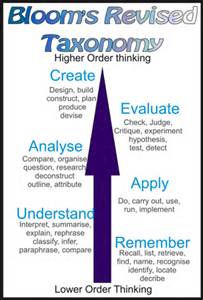
At the center of my argument stands Bloom’s Taxonomy.  Bloom’s is a learning hierarchy which helps to identify the depth of instruction and learning.  Here is Bloom’s Revised Taxonomy.  We’ll be referencing it a bit in the examples I provide.

Bloom's Revised Taxonomy

Bloom’s Revised Taxonomy

Take a moment to read through the descriptions of each of the ‘orders of thinking’ in Bloom’s.  Go ahead, I’ll wait…

Done?  Good.  Most would agree that courses such as ICS-300 and ICS-400 should attempt to convey learning at the Apply level, correct?  Unfortunately, that perception, while wildly popular, is wrong.  Most of the learning objectives of the two courses (objectives are our reference points for this) are at the Understand and Remember levels.  Yeah, I was a bit surprised, too.

In ICS Training Sucks, I provided a greater detail of the background analysis (it summarized the narrative of a Master’s research paper I wrote), so if you want more, simply go back and check it out.  While I make a few broad recommendations in that piece, there has been a need to examine our path to fixing this more closely.

In the development of curriculum, there exist several models.  The most commonly used model is the ADDIE model, which stands for Analysis, Design, Development, Implementation, and Evaluation.  The first step, Analysis, is really the most important, although often the most ignored or cut short.  People think they know what the need is, but often don’t really understand it.  If you are interested, I’ve written a piece on the topic of Analysis for Training Magazine last year.

Even though we are suggesting a re-write of the ICS curriculum, or parts thereof, Analysis is extremely important.  The roots of the current curriculum we use goes back to circa 1970s wildfire ICS courses.  These are good courses, and while I’m not sure if they fully met the need then (although they did advance us quite a bit), their evolved versions certainly DO NOT now.  There is no sense in repackaging the same product, so let’s first figure out what people need to know to do their jobs effectively.  Essentially, this leads us to identifying a list of key core competencies in ICS.  Core competencies will define the level of competence needed in a particular job or activity.  We can easily use the levels of Bloom’s as our reference point to establish common definitions for the levels of competence.  What am I talking about?

Let’s pick one key activity in ICS to examine.  Resource Management is a great example as it shows the disparity between what exists and where we need to be.  Resource Management is discussed in Unit 6 of the ICS-300 course.  I think most would agree that we expect most every jurisdiction to be able to implement sound resource management practices.  Implement is the key word.  Implementation is indicative of the Apply level of Bloom’s Taxonomy.  When looking at unit objectives in the ICS-300 course for unit 6, the key words are identify and describe.  Identify is indicative of the Remember level of Bloom’s Taxonomy, while describe is indicative of the Understand level.  Both fall short of application.  While we aren’t looking for this curriculum to create incident management teams, we still expect most jurisdictions to be able to manage resources, which is certainly a core competency of incident management.

I think the NIMS doctrine provides a good starting point for identifying core competencies.  In an effective study, there may be other competencies identified – perhaps topics such as leadership, that may not necessarily be found in a revised ICS curricula, but can be obtained through other training courses.  This could lead to an important differentiation between core competencies (those that MUST be included in ICS training) and associated competencies which can be sourced elsewhere.

Further, we can capitalize on what we have learned through implementation of the current ICS curriculum and previous iterations.  We know that multidisciplinary training is most effective since larger incidents are multidisciplinary.  We also know that training must be interactive and maximize hands-on time.  The past few updates to the ICS courses have done a great job of encouraging this, but we need more.

Making more detailed recommendations on fixing ICS training will take time and effort, as a solid Analysis must first be done.  Once core competencies can be identified and defined, then a strategy for revamping ICS training can be developed.  As mentioned in ICS Training Sucks, this approach should be multi-faceted, using both new and (good) existing courses to support it. Let’s not be bound by what currently exists.  We don’t necessarily have to create a ‘new’ ICS-300 or ICS-400 course.  Let’s create courses within a broader program that meets the needs of the emergency management community.  They may no longer be called ICS-300 and ICS-400.  Perhaps these two will be replaced by four smaller courses?  Who knows where this path will take us? The bottom line is that we need to be responsive to the needs of the learners, not bound by “the way we’ve always done it.”

As always, feedback is appreciated.  Perhaps there exists an institution that has the desire and funding to pursue this further?  I’m fully onboard!

© 2015 – Timothy Riecker

Emergency Preparedness Solutions, LLC

WWW.EPSLLC.BIZ