2017 National Preparedness Report – A Review

With my travel schedule, I missed the (late) release of the 2017 National Preparedness Report (NPR) in mid-October.  Foundationally, the findings of the 2017 report show little change from the 2016 report.  If you are interested in comparing, you can find my review of the 2016 NPR here.

The 2017 NPR, on the positive side, provided more data and more meaningful data than its predecessor.  It appeared to me there was more time and effort spent in analysis of this data.  If you aren’t familiar with the premise of the NPR, the report is a compilation of data obtained from State Preparedness Reports (SPRs) submitted by states, territories, and UASI-funded regions; so the NPR, fundamentally, should be a reflection of what was submitted by these jurisdictions and regions – for the better or worse of it.  The SPR asks jurisdictions to provide an honest analysis of each of the core capabilities through the POETE capability elements (Planning, Organizing, Equipping, Training, and Exercising).

From the perspective of the jurisdictions, no one wants to look bad.  Not to say that any jurisdiction has lied, but certainly agendas can sway subjective assessments.  Jurisdictions want to show that grant money is being spent effectively (with the hopes of obtaining more), but not with such terrific results that anyone would think they don’t need more.  Over the past few years the SPRs, I believe, have started to normalize and better reflect reality.  I think the authors of the NPR have also come to look at the data they receive a little more carefully and word the NPR to reflect this reality.

The 2017 NPR (which evaluates 2016 data from jurisdictions) identified five core capabilities the nation needs to sustain.  These are:

  • Environmental Response/Health and Safety
  • Intelligence and Information Sharing
  • Operational Communications
  • Operational Coordination
  • Planning

I’m reasonably comfortable with the first two, although they both deal with hazards and details that change regularly, so keeping on top of them is critical.  Its interesting that Operational Communication is rated so high, yet is so commonly seen as a top area for improvement on after-action reports of exercises, events, and incidents.  To me, the evidence doesn’t support the conclusion in regard to this core capability.  Operational Coordination and Planning both give me some significant concern.

First, in regard to Operational Coordination, I continue to have a great deal of concern in the ability of responders (in the broadest definitions) to effectively implement the Incident Command System (ICS).  While the implementation of ICS doesn’t comprise all of this core capability, it certainly is a great deal of it.  I think there is more room for improvement than the NPR would indicate.  For example, in a recent exercise I supported, the local emergency manager determined there would be a unified command with him holding ‘overall command’.  Unfortunately, these false interpretations of ICS are endemic.

I believe the Planning core capability is in a similar state inadequacy.  Preparedness lies, fundamentally, on proper planning and the assessments that support it. While I’ve pontificated at length about the inadequacy of ICS training, I’ve seen far too many plans with gaps that you could drive a truck through.  I’ve recently exercised a college emergency response plan that provided no details or guidance on critical tasks, such as evacuation of a dormitory and support of the evacuated students.  The plan did a great job of identifying who should be in the EOC, but gave no information on what they should be doing or how they should do it.  The lack of plans that can be operationalized and implemented is staggering.

The NPR identified the top core capabilities to be improved.  There are no surprises in this list:

  • Cybersecurity
  • Economic Recovery
  • Housing
  • Infrastructure Systems
  • Natural and Cultural Resources
  • Supply Chain Integrity and Security

Fortunately, I’m seeing some (but not all) of these core capabilities getting some needed attention, but clearly not enough.  These don’t have simple solutions, so they will take some time.

Page 10 of the NPR provides a graph showing the distribution of FEMA preparedness (non-disaster) grants by core capability for fiscal year 2015.  Planning (approx. $350m) and Operational Coordination (approx. $280m) lead the pack by far.  I’m curious as to what specific activities these dollars are actually being spent on, because my experience shows that it’s not working as well as is being reported.  Certainly there has been some positive direction, but I’m guessing that dollars are being spent on activities that either have negligible impact or actually have a negative impact, such as funding the development of some of the bad plans we’re seeing out there.

I’m curious as to what readers are seeing out in real life.  What capabilities concern you the most?  What capabilities do you see successes in?  Overall, I think everyone agrees that we can do better.  We can also get better and more meaningful reports.  This NPR was a step in the right direction from last year’s, but we need to continue forward progress.

© 2017 – Timothy Riecker, CEDP

Emergency Preparedness Solutions, LLC

The NIMS Refresh, aka NIMS 3.0

This morning my inbox was inundated with notices from FEMA and from colleagues about the release of the ‘refreshed’ NIMS, which has finally occurred at almost exactly 18 months after the draft of this document was released.  You can find the new document here. 

As I’m reading through the updated document, there are a few things catching my eye:

  • The term ‘center management system’ has apparently been scrapped, thankfully. First of all, there should not be a separate system for managing emergency operations centers (EOCs) and similar facilities.  I’ve seen the greatest success come from an organization model that mirrors ICS.  Second, the acronym CMS is most commonly related to the Centers for Medicare and Medicaid Services, particularly in regard to the CMS rules for healthcare facility preparedness.  (Want to know more about this?  See my article here)
  • Multi-Agency Coordination as a concept is briefly defined and referenced often without being described enough. It’s such an essential concept of incident management, yet it’s being paid very little heed. There is material on a MAC Group, which, while an implementer of multi-agency coordination at a policy level, is not the only multi-agency coordination that takes places within incident management.
  • The final version still uses the term ‘EOC Director’.  This is a term that is fundamentally incorrect when held to ICS doctrine.  Those in charge of facilities in ICS are called managers.  An EOC, even a virtual one, functions as a facility.  Similarly, the EOC analogs to the command staff, should be referred to as ‘management staff’ in an EOC, not command staff.
  • In the draft there were nearly two pages of references to federal EOC-like facilities. It was unnecessary and irrelevant to the document.  Thankfully those references and descriptions were removed.
  • One of my favorite graphics continues to be used! Figure 10 on page 48 is, to me, one of the most meaningful graphics in all of emergency management.  It pays heed to all critical elements in a response and shows the flow of requests and assistance.
  • I’m a big fan of the Essential Elements of Information (EEI) concept included in the Incident Information section of the document. This should serve as a foundation to all situation assessment and size up documents in all public safety disciplines, moving forward.
  • The appendices offer some additional information, but are largely redundant of the core document.

Overall, NIMS 3.0 is a good document to move forward with.  While there are some elements that I don’t necessarily agree with, none of them are damaging to our field of practice.  While NIMS remains our core doctrine for response, what is missing from this document that we saw heavily included in earlier versions was the concept of integrating NIMS into other aspects of emergency management.  Primarily, it is something that must be prepared for.  It simply isn’t enough to include a one-liner in your emergency plans saying that you are using NIMS.  The elements of NIMS, and not just ICS, but things like EOC management, multi-agency coordination, resource management, and joint information management, need to be fully engrained in your plans.  Plans serve as the foundation for preparedness, so what is in our plans must be trained on and exercised in a continuous cycle.  I would have liked to have seen some very apparent reference to the National Preparedness Goal in this document.  Otherwise, it appears to many that these doctrine are unrelated.

Now that the center management system is gone and they were less heavy handed with EOC management concepts, I wonder what that means for training related to EOC management.  The current FEMA curriculum on EOC management is simply horrible (thus why I’ve created EOC management courses for various jurisdictions).

What are your thoughts on the NIMS refresh?  What did they do well?  What did they miss? Was it too safe with too few changes?  Were there other changes needed to improve our coordination of incident management?

As always, thanks for reading!

© 2017 – Timothy Riecker, CEDP

Emergency Preparedness Solutions, LLC

The Inability to Apply NIMS is a Human One

With a busy month of travel and project work, it’s been a few weeks since I’ve had much opportunity to write.  While there are always a great number of topics to write about, I find myself regularly drawn to certain focus areas, such as NIMS or exercises, since these topics are regularly the emphasis of my work.

As many of my readers know, Domestic Preparedness Journal is one of my regular reads.  Each issue features a slate of excellent articles from practitioners in the field.  While I don’t always agree with all the articles in DomPrep, they are at least thought provoking and occasionally provide me with some ideas for my blog.

A quick note: Many students of emergency management, homeland security, and related fields reference this blog for research – something I greatly appreciate and am humbled by!  Be sure to search back issues of the Domestic Preparedness Journal, as well.  There is a lot of good stuff there!

I believe I’ve posted my thought in the past that emergency management is largely a sociological endeavor.  This is nothing new or revolutionary… if you care to consider this further, I suggest any of Thomas Drabek’s work.  While emergency management exists to protect and serve people, the actions are implemented by people.  I’ve also written in the past about the human factor of incident management, because that’s what truly makes or breaks our efforts.  Essentially, it’s humans that fail.  Not plans, not incident management systems, or any other excuses that can be contrived.  Human failure is our greatest enemy.

In discussing failure, it doesn’t have to be a total failure.  It can be a mistake, an oversight, or a wrong decision.  It might be intentional, given the body of knowledge we have and other factors, like ego.  Or it might be due to a lack of information; sometimes we have to make a best guess.  Often times we don’t realize until afterwards, if ever, that these even occurred or that there were better choices.  Despite advanced analytics and diligent after action reports, where we are quick to criticize, we don’t often identify what choices individuals (not just the incident commander or other leadership) had available to them.

Back to the Domestic Preparedness Journal.  Last month’s issue had an article penned by Chief Charles Bailey, titled Where Incident Management Unravels.  Chief Bailey offers a thought provoking argument against the effectiveness of NIMS in certain incidents, particularly those that are highly dynamic.  He argues, particularly, that once a situational assessment is completed and accepted early in the ICS planning process, that the process enters a largely static state since plans are developed to address that snapshot of the situation and are unable to account for situational changes during the rest of that planning process.

Fundamentally, Chief Bailey isn’t wrong.  What he mentions is exactly what we are taught and these are criticisms of ICS I’ve heard many times through the years.  Remember, Incident Command System Training Sucks!  (if you aren’t familiar with my thoughts on the sad state of ICS training, click that link and read the few articles I’ve written on the topic).

Let’s examine the situation that Chief Bailey describes.  Most incidents, especially early on, have dynamic elements.  Does this mean we can’t use ICS?  No.  In fact we still need to.  If we don’t make efforts to proactively address the incident, we will continue reacting instead of getting ahead of it.  Our tactics will be purely reactionary and we’ll never have the resources we need when we need them.  We can’t allow the incident to be in charge, we need to manage it.  To do so, we need to acknowledge that new and changing situations will occur, and plan for them.  Just because we are taught to plan in a static situation, does that mean that’s our only option?  Nope.  What we learn little to nothing about in ICS training are concepts like contingency planning.  Interestingly enough, we regularly see first responders account for this.  When an incident occurs with unknown factors, we often hear fire departments call for additional resources to be sent to staging.  Sometimes this is in anticipation of needing them, sometimes this is a contingency plan.  A ‘just in case’.  While no one likes to be stuck in staging and never deployed, it’s better to have the resources immediately available and not need them then to need them right away and have to wait.

Not only can these resources in staging be identified in our incident action plans, we can also develop these resources and even identify tactics (roughly) in our IAPs to account for dynamic situations.  It’s easy enough to identify an objective for contingency planning and have efforts dedicated to it.  Resources in staging can be pulled together into task forces and strike teams for anticipated application.  Our IAPs can pre-identify these potential applications and give the resources tactical parameters, allowing task force and strike team leaders some latitude in their initial tactical response.  While the rest of the incident organization is addressing known issues and proactively managing the incident, we have elements in reserve to tackle pop-up situations.  At best, these reserve forces are able to fully address these emergent needs, at the very least, they can sustain life safety matters until additional resources can be deployed.

Further, if any incident management organization isn’t able to change based on a dynamic situation, I severely question their credentials.  Incidents and disasters are by nature unpredictable.  We must acknowledge that any situational assessment is only, at best, mostly accurate.  For any significant incident, we can’t possibly know everything we need to know when we need to know it.  Having reserve forces and contingency plans, and being able to quickly identify emergent situations and redeploy resources is simply smart incident management.

So while Chief Bailey makes great points about some book answers to ICS applications, I argue that any failures that exist, at least in these regards, are human ones and have little to nothing to do with shortfalls in NIMS/ICS.  First, there are tools available to us to address these situations; although most people aren’t aware of them because of issues with ICS training.  Second, even if direct applications of the system weren’t in place to address certain situations, we can’t be slaves to the system.  We need to be able to think ‘beyond NIMS’ (words used by Chief Bailey, himself).  Finally, I’m not being critical at all of Chief Bailey’s points.  He closes his article identifying a need for creating ‘nimble response paradigms’; I’m just pointing out that we have that ability within the NIMS construct.  It’s our (human) ability to apply these where we often get stuck.

As always, I’m highly interested in the thoughts of readers on the topics I write about.

In closing, a quick but heartfelt thanks to all the responders and organizations who have been working tirelessly as of recent to save lives and help communities stabilize after the impacts of far too many hurricanes and the earthquake in Mexico.  Every small action you take makes a world of difference to those you are helping.  Be safe.

© 2017 – Timothy Riecker, CEDP

Emergency Preparedness Solutions, LLC (ß have you checked out our new website????)

NIMS is Worthless, Unless You Put it into Action

It’s so often that I hear people proclaim in response to a problem that NIMS will fix it.  I’ve written in the past that many organizations reference the National Incident Management System (NIMS) and the Incident Command System (ICS) in their plans, as they should, but it’s often a reference with no substance.  The devil is in the details, as the saying goes; and the details of implementation are necessary to ensure that difficulties can be overcome.

The premise is simple… NIMS is a doctrine, only as valuable as the paper you print it on.  So fundamentally, NIMS has no value – unless it is implemented.  This human factor is the biggest hurdle organizations and jurisdictions must face, yet so many are lulled into a false sense of security because they cite it in their plans and they’ve taken some ICS courses.  I encourage every organization to review the NIMS doctrine and give your organization an honest assessment of how you are actually following it.  It’s bound to be pretty eye opening for many.

nims_document

We also have to keep in mind that NIMS isn’t just for your own organization.  While there are plenty of great practices in NIMS for your own organization, the greatest value in it is for multi-agency responses.  These don’t have to be to the extent of Hurricane Katrina or a massive wildfire, either.  Multi-agency responses occur in most jurisdictions every day – even what we regard as some of the most simple or routine incidents require multiple agencies to respond.  While the actions and responsibilities of these agencies are fairly rote and well-practiced, a slight increase in complexity can cause significant changes.

Consider that different agencies, even those within the same discipline have some different ways of doing things.  These can be simply in the mechanics of what they do, or they can be driven by procedures, equipment, or personality.  Some of this may be in writing, some may not.  Where this matters is in tactics.  NIMS won’t solve differences in tactical application or ensuring interoperability.  Only preparedness can accomplish that.  Before an incident occurs, we need to be having regular conversations with other agencies within our jurisdiction and outside of it.  How often do you exercise with your mutual aid partners?  I mean really exercise with them…  It’s great that you all arrive to the exercise site and set up your own stuff, but how about mixing and matching equipment?  What will work?  What won’t?  How will it impact tactical application?  These are some of the most meaningful lessons learned.

Bottom line – don’t try to pencil-whip NIMS as the solution to your problems.  It’s meaningless unless it’s actually put into action – and the way to proactively do that is through preparedness efforts.   Work together through POETE activities – Planning, Organizing, Equipping, Training, and Exercises.  Once you put the concepts of NIMS into action, then it will work for you!

How has your organization implemented NIMS concepts?

© 2017 –  Timothy Riecker, CEDP

Emergency Preparedness Solutions, LLC

Management and Organization of EOCs

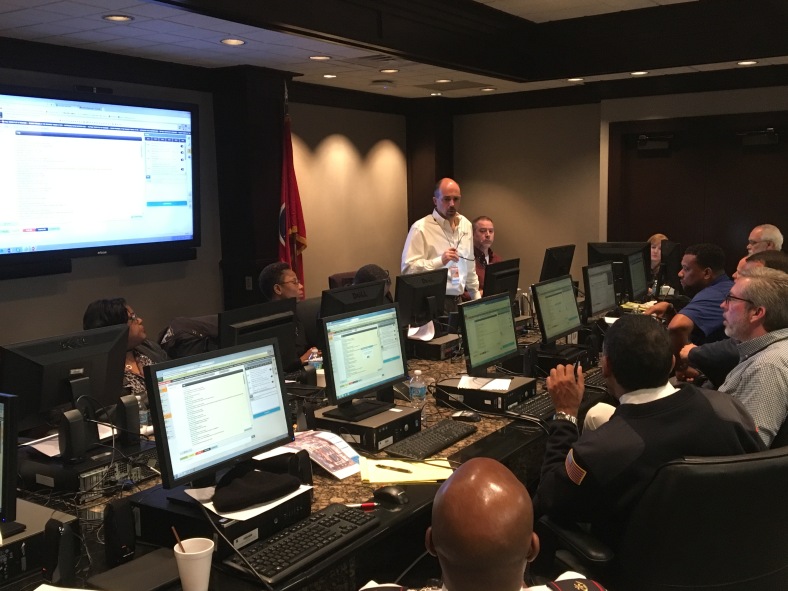
I’ve always been fascinated by emergency operations centers (EOCs).  Through my career I’ve worked in many of them across the nation as a responder, trainer, and exerciser (is that a word?).  I’ve seen EOCs large and small, dedicated facilities and multi-use rooms.  I’ve been in EOCs on the top floor of buildings, so as to have a bird’s-eye view; and those underground, originally designed to withstand a Soviet nuclear attack.  I’ve seen technology that rivals NASA’s Mission Control, and EOCs that drop phone and internet lines from the ceiling when needed.  While the size, layout, and technology can all support an EOC’s mission, it’s really all about the people.

IMG_3226Over the past several months I’ve seen an even greater variety of EOCs due to a broad range of consulting projects I’ve led for my company.  These projects have brought me to EOCs in states, cities, and airports across the nation.  While coordination is the commonality, there are a great deal of differences between and among these EOCs, not only in their physical space, but also in how they operate.  While all pay heed to the National Incident Management System (NIMS) in some fashion, some lean more heavily on the Incident Command System (ICS) than others, while some prefer the emergency support function (ESF) model, and others yet seem to be in limbo, searching for the best model.

It’s been over a year since the National Integration Center (NIC), charged with maintaining NIMS, released a draft for public comment of the NIMS Refresh, which included the Center Management System (CMS) concept.  CMS is/was intended as a model for organizing EOCs and other such incident support functions.  Despite promises, we have yet to see any of that come to fruition.  That said, there are certain expectations and activities that must still exist for an EOC to be successful and productive.

With tactics being managed by the Operations Section in the Incident Command Post (ICP), planning is really the focal point of an EOC.  The perspective of an EOC is generally much bigger picture than that of an ICP.  Assuming a traditional coordination and support role of an EOC, the Operations Section of an EOC is really geared toward pulling agencies together and facilitating strategic-level problem solving through proper coordination.  For an EOC to function properly, current information is just as important as the ability to anticipate future needs so that problems can be solved and resources obtained.  This information management and forecasting is the responsibility of the Planning Section in an ICS-centered model, or of a planning function in any other model.

Every agency that contributes to the EOC, regardless of the model, should be prepared to contribute time and potentially even staff to this planning function.  Often, the incident is ‘routine’ enough that the planning staff are familiar with the various facets of the incident to do proper information collection, analysis, and forecasting; but on occasion subject matter experts are needed to support each of these critical activities.  Those subject matter experts often come from the agencies or emergency support functions represented in the EOC.  As forecasting is performed, opportunities are identified for needs that may need to be supported.  This is where the forecasting loops back to Operations to coordinate the agencies/emergency support functions to solve these problems.

None of this actually means that an EOC doesn’t oversee tactics, even indirectly.  While an ICP, for most incidents, doesn’t report to the EOC, there may be ancillary organizations developed to address other matters which the ICP isn’t overseeing.  While the ICP is focused on immediate life-safety issues, the EOC may be coordinating evacuation, sheltering, or public health matters.  In each of these examples, or numerous others which could be contrived, someone has to be in charge of them.  If the incident commander’s attention is focused on the highest priorities, these other matters are likely to be run by the EOC.  Typically, these would be within the chain of command of the EOC’s Operations Section or through an ESF.

I love seeing how different EOCs address problems and manage their own functions.  I’m all for creativity, but there fundamentally should be some standardization to the organization and management structure.  What’s unfortunate, however, is that so many EOCs don’t have proper plans which identify these functions or how they will be managed.  Some simply insert the phrase ‘NIMS/ICS’ into their plan, and assume that’s enough (it’s not).  Others have no plan at all.  The enemy of coordination is chaos, and if you don’t have quality plans in place, which have been trained to and exercised, the EOC stands to add even more chaos to the incident at hand.

Put some thought into your EOC management structure and plans.    How would the EOC run if you or someone else who usually runs it weren’t there?  Are plans and procedures detailed enough for it to operate smoothly?  Are personnel from all agencies trained properly in their roles and responsibilities?  Have you exercised these plans recently?  If so, what lessons learned do you usually see and have you worked to address them?

Feedback is always welcome!

© 2017 – Timothy Riecker, CEDP

Emergency Preparedness Solutions, LLC

Customization of ICS

Even since before the National Incident Management System (NIMS), I’ve seen individuals and organizations have a desire to customize the Incident Command System (ICS).  This has always been troubling to me, as customization is fully contradictory to using a standardized system.

ICS offers an abundance of flexibility.  If you are familiar enough with the system, its foundational features, and the intent of the roles and responsibilities within the system, you can meet practically every need utilizing these functions and features.  Is ICS perfect?  No.  Is it the best we have?  Yep, it sure is.  Having many years as a practitioner, trainer, and evaluator of ICS, I’m confident that it can meet 95% of needs that an organization will have.

Generally, I find the argument that many organizations who insist on customization put forward is that the rigidity of ICS does not accommodate their needs, structure, and culture. On the occasion that I’ve had to sit down with the organization’s personnel and ask questions about what they are trying to accomplish, it becomes quite clear that they simply don’t have a good understanding of ICS.  Some can be fairly obvious, such as moving the Safety Officer position to Operations.  Others require a bit more analysis, such as creating an element in the Operations Section to address security needs of their own facility.  Security of your own facility is actually a responsibility of the Facilities Unit within Logistics, not an Operations responsibility.

Foundationally, let’s consider the main purpose of ICS – interagency coordination.  ICS is a standardized system which supports integration, cooperation, and unity of effort between and among multiple organizations.  One of the main reasons I see organizations struggling to fit elements into an ICS organization chart is because some simply don’t belong there.  If you have functions internal to your own agency, even if they are used during emergency operations, but don’t interact with others, I honestly couldn’t care if you organize them within ICS, so long as they are accounted for within your own organization’s own chain of command.  There is no doctrine or best practice that requires organizations to account for every internal function within an ICS org chart.

The other reason, which I eluded to earlier, for organizations trying to customize ICS for their purposes, is a lack of understanding of ICS.  While I’m aware that some people who have done this might only have taken ICS 100, giving them only a scratched surface of ICS knowledge, which they easily misapply since they don’t have a good understanding of the fundamental concepts of ICS.  However, I’m aware of plenty of individuals who have taken ICS 300 and possibly ICS 400 who still fall into this trap.  I feel this situation stems from a result of misapplied learning, which ultimately comes from poor ICS curriculum.  (If you want to read more on my opinions on how ICS Training Sucks ⇐visit here).

ICS training should not only provide learning to support operational implementation of ICS concepts, but also adequate preparedness activities, such as integrating ICS into plans, policy, and procedures.  Current training leaves many people feeling they know enough about ICS to integrate it into these important documents, but they feel compelled to be creative, when not only is creativity generally not required, it flies in the face of a standardized system.  ICS has an abundance of flexibility which can accommodate a multitude of functions; one just has to relate these to the fundamental features of ICS to identify where they might go.  I’m not opposed to creating a new organizational element, just make sure that it fits appropriately, without duplicating efforts, usurping responsibility from another standard element, or violating span of control.

Consider this: will your organization chart integrate with others?  If so, how?  Is there operational integration or is it through an agency representative?  If the answer is the latter, there is less concern, but if there is an expectation for operational integration or shared functions, such as Planning or Logistics, sticking to the standards is even more important.

I’m interested to hear your thoughts on ICS customization, the reasons behind it, and the ramifications of it.  Fire away!

© 2017 – Timothy Riecker, CEDP

Emergency Preparedness Solutions, LLC

Incident Management & Proper Demobilization Planning

A fair amount of courses, especially those oriented toward the Incident Command System (ICS), mention demobilization, but that mention is usually fairly gratuitous.  Even the core ICS courses generally only offer a couple of paragraphs or a handful of bullet points.  The ICS 300, since it does focus more on incident planning, does contain some good additional material, but it’s still quite brief.  Demobilization is a best practice of incident management, along with staging areas, that are rarely done properly.  It’s not a surprise, though… there isn’t a lot of emphasis on them in ICS and related training, and generally what is out there is pretty poor quality.  This has been further emphasized through nine separate functional exercises I’ve conducted over the past couple of months where it was easily identified that most participants weren’t really familiar with what demobilization meant to them and their organizations. This is no slight on them… it comes down to training.

There is certainly room for improvement when it comes to the ICS National Training Curriculum.  In case you aren’t familiar, I’ve written pretty extensively on it in the past.  And yes, I still believe that ICS Training Sucks (click here to check out a few articles I’ve written on the topic).  In regard to demobilization, much of what is out there (including the ICS curriculum and otherwise), in addition to the couple of paragraphs or handful of bullet points, also puts a lot of emphasis on the Demobilization Check-Out (ICS form 221).  By all means, STOP THAT.  Throwing another form in front of people without proper context simply serves to confuse them further.  I’m not saying we need to train everyone to be a Demobilization Unit Leader (there is a specific course for that… and it’s less than great), but shoving another form in front of someone for seven seconds doesn’t do a damn bit of good… and in fact it probably does some measure of harm – especially for building the case made by some that ICS is nothing but a bunch of bureaucracy.  We need to actually show purpose.

Largely, those bits of prose contained in courses do a decent job in explaining why we need to demobilize.  Simply put, we don’t want people and other resources standing around for hours before they are told they can go home.  Along with this is usually the book answer of when we begin to plan for demobilization – that’s as soon as we order the resource.  In reality, I’ll give that a ‘kind of’ instead of a resounding agreement.  Most of the time, no, we’re not considering that, especially at the onset of an incident.  But we do need to start considering it early on, especially when we no longer need a lot of resources at the end of the first phase of an incident.  Further down the road, we also tend to have a lot of expensive resources and teams that need to be disengaged and dismantled from our incident organization and the operating area rather carefully before they can be sent home.  These deliberate actions are another good reason for proper demobilization planning.

Demobilization planning?  Yes, planning.  NOT the ICS 221.  That form is nothing more than an accountability sheet.  It is NOT a plan.  First off, demobilization planning is a team effort.  There needs to be involvement and input across much of the command and general staff of your incident management structure (be it a formal incident management team or otherwise).  It’s a planning effort, so it should be centered within your Planning Section.  For a larger incident, certainly designate a Demobilization Unit to do coordinate this.

How do we even make this happen?  First, the concept needs to be sold to command.  They will initially say no.  Expect it.  Many Incident Commanders not well practiced in formal demobilization think that even discussion of the term must be reserved for late in the game.  It might take a couple of attempts and a need to make your case.  Demob doesn’t signal an end to the entire operation, and in fact additional resources may be flowing into the incident as others are being demobilized.  Once command is sold on it, then it needs to be discussed with the entire command and general staff.  Everyone has input.  Most of the resources belong to ops, so they should be able to identify when certain resources will complete their operations and will no longer be needed.  The logistics organization may have a fair amount of resources in place largely to support operations, therefore, as certain operations are demobilized, logistics may also be able to demobilize some of their resources.  They may also want certain things returned and accounted for, such as radios.  And if any hazardous material was present, the Medical Unit within logistics may be arranging long-term medical monitoring, which needs to become part of demobilization.  The Liaison Officer may be getting pressured by outside agencies or organizations to release resources and/or may have to explain to certain assisting agencies why their resources are no longer needed.  Finance/Administration is aware of how much certain resources are costing the responsible party, both in direct costs as well as maintenance costs.  There may be others with input as well.

As this discussion occurs, Planning/Demobilization should be keeping good notes as these comments, concerns, and priorities may become part of the demobilization plan.  The plan itself consists of five standard sections:

  1. General information – what does this plan pertain to and generally, what’s it about (it’s an overview).
  2. Responsibilities – This identifies, within the ICS structure, who is responsible for what in regard to demobilization
  3. Release Priorities – These are the agreed upon priorities identified by command and general staff.
  4. Release Procedures – This should have the most detail, starting with identification, authorization, and notification of the resource of their impending demobilization status. How far ahead of the demobilization are they advised?  Who do they have to talk to along the way?  What equipment should be returned?  Do they need to submit any reports or paperwork?  Who do they actually sign out with?  How and when do they return home?  Based on the nature of the incident, consider a mandatory overnight before they can travel, medical monitoring, and a debrief.  And always require resources to confirm that they have arrived safely back to their home station.  This, by the way, is where you reference the ICS 221 form, which will maintain accountability of the demobilization process.  Certainly customize this form to match your procedures.
  5. Reference Information – This can include travel information, contact information for key personnel (such as the Demobilization Unit Leader), maps, schedules, reminders, and other info.

Like the majority of implementations of ICS, demobilization planning is generally accomplished in the head of the IC and perhaps other staff.  That’s likely fine for more routine type 5 incidents, and even some type 4 incidents.  There may be some type 4 incidents that have enough complexity and disparity of resources, that a written plan is a good idea.  Certainly anything more complex should have a written plan.  Just as we should be writing incident action plans for planned events, demobilization plans should also be used.  If anything, it makes for good practice.  For the same argument, it’s also great for exercises (not only for the players, but also for exercise management).

Looking for a demobilization plan template?  Here’s one.  I’m not familiar with the authors, but it’s a fairly standard template for such a plan.  I’m generally wary of templates, but this is pretty basic.  If you might find yourself in the position of organizing incident demobilization for your agency or jurisdiction, save it and start modifying it now.  There are likely a set of standard priorities and procedures which you can identify now that you can include in the plan.  Be sure to have an ICS 221 that you can modify for implementation as well.  Just be sure to not ‘finalize’ either one of these… just like an IAP, they are documents developed specifically for an incident, event, or exercise.

So there you have it, a bit of demobilization planning advice from someone who is trained and experienced in actually doing it.  I hope this was helpful.  Of course I’m happy to provide some direct advice as well as happy to hear from others who are experienced themselves in demobilization.  What best practices have you identified?

© 2017 – Timothy Riecker, CEDP

Emergency Preparedness Solutions, LLC


Measuring Preparedness – An Executive Academy Perspective

A recent class of FEMA’s Emergency Management Executive Academy published a paper titled Are We Prepared Yet? in the latest issue of the Domestic Preparedness Journal.  It’s a solid read, and I encourage everyone to look it over.

First off, I wasn’t aware of the scope of work conducted in the Executive Academy.  I think that having groups publish papers is an extremely important element.  Given that the participants of the Executive Academy function, presently or in the near future, at the executive level in emergency management and/or homeland security, giving others the opportunity to learn from their insight on topics discussed in their sessions is quite valuable.  I need to do some poking around to see if papers written by other groups can be found.

As most of my readers are familiar, the emphasis of my career has always been in the realm of preparedness.  As such, it’s an important topic to me and I tend to gravitate to publications and ideas I can find on the topic.  The authors of this paper bring up some excellent points, many of which I’ve covered in articles past.  They indicate a variety of sources, including literature reviews and interviews, which I wish they would have cited more completely.

Some points of discussion…

THIRA

The authors discuss the THIRA and SPR – two related processes/products which I find to be extremely valuable.  They indicate that many believe the THIRA to be complex and challenging.  This I would fully agree with, however I posit that there are few things in the world that are both simple and comprehensive in nature.  In particular regard to emergency management and homeland security, the inputs that inform and influence our decisions and actions are so varied, yet so relevant, that to ignore most of them would put us at a significant disadvantage.  While I believe that anything can be improved upon, THIRA and SPR included, this is something we can’t afford to overly simplify.

What was most disappointing in this topic area was their finding that only a scant majority of people they surveyed felt that THIRA provided useful or actionable information.  This leaves me scratching my head.  A properly done THIRA provides a plethora of useful information – especially when coupled with the SPR (POETE) process.  Regardless, the findings of the authors suggest that we need to take another look at THIRA and SPR to see what can be improved upon, both in process and result.

Moving forward within the discussion of THIRA and SPR, the authors include discussion of something they highlight as a best practice, that being New York State’s County Emergency Preparedness Assessment (CEPA).  The intent behind the CEPA is sound – a simplified version of the THIRA which is faster and easier to do for local governments throughout the state.  The CEPA includes foundational information, such as a factual overview of the jurisdiction, and a hazard analysis which ranks hazards based upon likelihood and consequence.  It then analyses a set of capabilities based upon the POETE elements.  While I love their inclusion of POETE (you all know I’m a huge fan), the capabilities they use are a mix of the current Core Capabilities (ref: National Preparedness Goal) and the old Target Capabilities, along with a few not consistent with either and a number of Core Capabilities left out.  This is where the CEPA falls apart for me.  It is this inconsistency with the National Preparedness Goal that turns me off.  Any local governments looking to do work in accordance with the NPG and related elements, including grants, then need to cross walk this data, as does the state in their roll-up of this information to their THIRA and SPR.

The CEPA continues with an examination of response capacity, along the lines of their response-oriented capabilities.  This is a valuable analysis and I expect it becomes quite a reality check for many jurisdictions.  This is coupled with information not only on immediate response, but also sustained response over longer periods of time.  Overall, while I think the CEPA is a great effort to make the THIRA and POETE analysis more palatable for local jurisdictions, it leaves me with some concerns in regard to the capabilities they use.  It’s certainly a step in the right direction, though.  Important to note, the CEPA was largely developed by one of the authors of the paper, who was a former colleague of mine working with the State of New York.

The Process of Preparedness

There are a few topic areas within their paper that I’m lumping together under this discussion topic.  The authors make some excellent points about our collective work in preparedness that I think all readers will nod their heads about, because we know when intuitively, but sometimes they need to be reinforced – not only to us as practitioners, but also to other stakeholders, including the public.  First off, preparedness is never complete.  The cycle of preparedness – largely involving assessment, planning, organizing, equipping, training, and exercising – is just that – a cycle.  It’s endless.  While we do a great deal of work in each of these, our accomplishments are really only temporary.

The authors also mention that our information is not always precise.  We base a lot of what we do in preparedness on information, such as a hazard analysis.  While there are some inputs that are factual and supported by science, there are many that are based on speculation and anecdote.  This is a reality of our work that we must always acknowledge.  As is other of their points – there is no silver bullet.  There is no universal solution to all our woes.  We must constantly have our head in the game and consider actions that we may not have ever considered before.

ICS Improvement Officer

The authors briefly discuss a conceptual position within the ICS Command Staff they call the ICS Improvement Officer.  The concept of this fascinating, if not a bit out of place in this paper given other topics of discussion.  Essentially, as they describe this position, it is someone at the Command Staff level who is responsible for providing quality control to the incident management processes and implementations of the organization.  While I’ve just recently read this paper and haven’t had a lot of time to digest the concept, I really can’t find any fault with the concept.  While the planning process itself is supposed to provide some measure of a feedback loop, there isn’t anyone designated in the organization to shepherd that process beginning to end and ultimately provide the quality control measures necessary.  In practice, I’ve seen this happen collaboratively, among members of the Command and General Staff of a well-staffed structure, as well as by the individual who has the best overall ICS insight and experience in an organization – often the Planning Section Chief.  The authors elude to this position also feeding an AAR process, which contributes to overall preparedness.  I like this idea and I hope it is explored more, either formally or informally.

Conclusion

There are a number of other topic areas of this paper which I haven’t covered here, but I encourage everyone to read on their own.  As mentioned earlier, I’d like to see more of the research papers that come from FEMA’s Emergency Management Executive Academy available for public review.  Agree or disagree with their perspectives, I think their discussions on various topics are absolutely worth looking at.  It’s these discussions like these which will ultimately drive bigger discussions which will continue to advance public safety.

I’m always interested in the perspectives of my readers.  Have you read the paper?  What do you think of the discussion topics they presented?

© 2017 – Timothy M Riecker, CEDP

Emergency Preparedness Solutions, LLC


Incident Action Planning

Hello readers!  It’s been a couple of months since I’ve last posted – along with the holidays, I’ve been fortunate to be busy with some great projects and a bit of travel.  While I’m still busy, I’ve been itching to get back to posting.

Over the past few months, I’ve had an opportunity to look at some different aspects of incident action planning.  Having worked as a Planning Section Chief for numerous state and federally declared disasters, I’ve created Incident Action Plans (IAPs), part and parcel, for a variety of incidents.  Teaching hundreds of course offerings of ICS and EOC management, I’ve also had a lot of opportunity to help others understand and appreciate the value of an IAP.

What is an IAP?

The Incident Action Plan is really the culmination of the planning process.  It documents our expected actions for the next operational period, which, through that planning process, should be ready to be supported through an identified organization and necessary resources.  It begins, foundationally, with an understanding of the situation and objectives built to solve the problems that situation imposes upon us.  IAPs identify some situational information, the incident objectives, and tactics – which specific resource assignments – to accomplish those objectives.  To support the tactics, additional elements are added to the IAP, such as the organizational structure, a medical plan (for responders), a communications plan, and specific safety messages.  Based upon the unique characteristics of each incident, additional material can be added.

The planning process, and thus IAPs, are a standard of practice within NIMS/ICS.

Issues with Teaching the Planning Process

For those coming up through the ranks, as it were, of ICS training, the forms integrated into ICS are often one of the most frustrating aspects.  Responders want to do the hands-on stuff, not fill out forms.  Most areas and systems, however, are able to find the responders who are interested in becoming involved in incident management aspects, and engage them in formal or ad-hoc incident management teams.

Often the only exposure that responders have to IAPs is from the ICS 300 course, where they are able to see some samples and are walked through the planning process and associated forms of the IAP.   Having taught hundreds of these, I know it’s a challenge*.  We inundate course participants with a pile of forms and expect them to leave the class to go out and do great things.  While it might be a reasonable initial exposure, this needs to be followed up on, practices, and reinforced if we expect anyone to be successful, much less use the system.

*note: if you aren’t familiar with my position on the current state of ICS training, here are a few other blog posts to orient you.  In short… ICS Training Sucks!

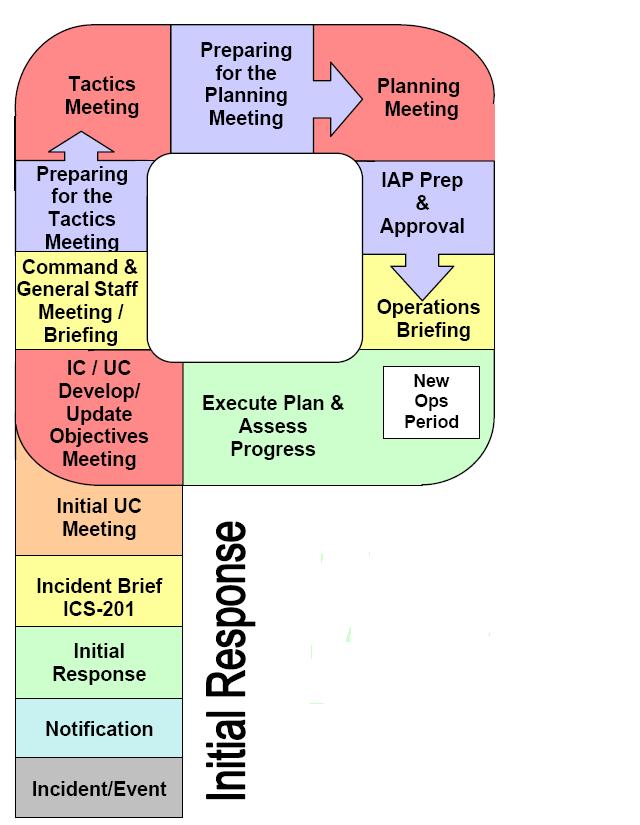
The planning process can be confusing – who does what?  When?  Based upon what information?  The Planning P is the best visual out there and incident management handbooks (aka Field Operations Guides or FOGs) are references that every IMT member should have in the utility pocket of their 5.11s.  While all based on the same system, I find the United States Coast Guard to have the best handbook out there.  These are great job aids for something we don’t go to work and do every day, no matter how proficient you might think you are.

planning P for Planning

Uses of IAPs

IAPs can be applied to anything we can/should apply the planning process to.  These include incidents, pre-planned events, and exercises.  Planned events and exercises provide a great opportunity to practice the planning process and development of IAPs.  It is certainly something that requires practice to be proficient.  Every member of the Command and General staff, as well as a number of support positions, have an important role to play and responsibilities to contribute to the planning process.  The forms themselves even require some practice to ensure that the right information is obtained.  Large incidents can also require a great deal of tactical planning, which means greater time for that and for documenting the tactics and necessary support.

One aspect that is often forgotten in the heat of battle is that our response should, ideally, be based on our emergency operations plans (EOPs).  These should be a regular reference to the Command and General staff, as they can, at the very least, provide some general guidance.  Good EOPs, and their associated annexes, should provide some detailed guidance on certain aspects of response, which can prevent the IMT from having to re-invent a plan in the midst of chaos.  The direction of EOPs, to the greatest extent possible, should be referenced in the planning process and reflected in the IAPs.  EOPs should serve as the foundation for the planning process – with that in mind, EOPs can be implementation-ready.  More thoughts on emergency plan development here.

As mentioned, exercises are a great opportunity for participants to practice the planning process and IAP development, along with other facets of ICS – especially those that we don’t get to apply so often.  Also consider, however, the use of an IAP for exercise management.  Our company, Emergency Preparedness Solutions, worked with the State of Vermont this past summer providing exercise control and evaluation services for their Vigilant Guard exercise.  This week-long exercise spanned nearly 60 distinct venues across the state and involved thousands of participants.  We coordinated over 100 control and evaluation staff throughout the exercise.  While staffing decisions were made weeks in advance, we knew that with so many variables, needs and assignments were bound to change.  For each operational period of the exercise, venues had staff assigned, a point of contact they should coordinate with, a need to communicate with the simcell and exercise management staff, a need to be aware of weather and safety matters, and processes to follow in regard to exercise management and reporting.  We recognized the similarities to a tactical deployment and decided to develop incident action plans for exercise management.  We called these eXercise Action Plans (XAPs).  Within just a couple of operational periods, we were receiving great feedback on the documents from exercise staff.  Use of XAPs were identified as a best practice in exercise management for that project.

Final Thoughts

Incident Action Plans are great tools that can help us put our emergency plans in action.  They allow us to apply incident or event-specific ground-truths and the realities of incident needs and resources.  While it’s understanding that some are frustrated with the forms used, the forms are job aids, tested through decades, to help us navigate complex incident management.  When I walk into a command post or an EOC, the IAP is the first thing I look for.  Because the format and forms are relatively standardized, I can flip through it, and in a couple of minutes have a good sense of the activity and who is responsible for what.  Someone told me long ago that ICS is forms facilitated, not forms driven – and that’s very true.  The forms (and thus the IAP) are products of the planning process, which is another decades-old practice in incident management.

What best practices have you seen in the application of the planning process and incident action plans?

Need assistance with planning, training, or exercises?  Emergency Preparedness Solutions can help!

Until next time.

© 2017 – Timothy Riecker, CEDP


ICS and the Human Factor

A number of my articles have mentioned the unpredictable human factor in executing emergency plans and managing incidents, particularly for complex incidents.  We can build great plans and have a great management system to facilitate the incident management process, but the human factor – that largely intangible level of unpredictability of human behavior – can steer even the best emergency plan astray or derail an incident management process.

An article published in the Domestic Preparedness Journal yesterday, written by Eric McNulty, reflects on this.  Mr. McNulty cites several human factors which have relevance within incident management and encourages leaders to understand these factors within themselves and others to bring about more effective leadership.  The introductory paragraph of his article suggests the need for integrating behavior training into ICS training to ‘improve performance and outcomes’.  Given the impact of behavior factors on how we respond, this is a concept I can certainly endorse for a much-needed rewrite of the ICS curriculum.

I’ve heavily referenced Chief Cynthia Renaud’s paper, The Missing Piece of NIMS: Teaching Incident Commanders How to Function in The Edge of Chaos, in the past and continue to hold her piece relevant, especially in this discussion.  Chief Renaud’s suggestions draw lines parallel to behavioral factors, which suggest to me that we certainly need to integrate leadership training into ICS training.  The current ICS 200 course attempts to do so, but the content simply panders to the topic and doesn’t address it seriously enough.  We need to go beyond the leadership basics and explore leadership training done around the world to see what is the most effective.

Incident management is life and death – not a pick-up game of stick ball.  Let’s start taking it more seriously and prepare people better for this responsibility.

© 2016 – Timothy Riecker, CEDP

Emergency Preparedness Solutions, LLCYour Partner in Preparedness