
An Update of Ontario’s Incident Management System

Just yesterday, the Canadian province of Ontario released an update of its Incident Management System (IMS) document. I gave it a read and have some observations, which I’ve provided below. I will say that it is frustrating that there is no Canadian national model for incident management, rather the provinces determine their own. Having a number of friends and colleagues from across Canada, they have long espoused this frustration as well. That said, this document warrants an examination.

The document cites the Elliot Lake Inquiry from 2014 as a prompt for several of the changes in their system from the previous iteration of their IMS document. One statement from the Inquiry recommended changes to ‘put in place strategies that will increase the acceptance and actual use of the Incident Management System – including simplifying language’. Oddly enough, this document doesn’t seem to overtly identify any strategies to increase acceptance or use; in fact there is scant mention of preparedness activities to support the IMS or incident management as a whole. I think they missed the mark with this, but I will say the recommendation from the Inquiry absolutely falls in line with what we see in the US regarding acceptance and use.

The authors reinforce that ICS is part of their IMS (similar to ICS being a component of NIMS) and that their ICS model is compatible with ICS Canada and the US NIMS. I’ll note that there are some differences (many of which are identified below) that impact that compatibility, though don’t outright break it. They also indicate that this document isn’t complete and that they already identified future additions to the document including site-specific roles and responsibilities, EOC roles and responsibilities, and guidance on resource management. In regard to the roles and responsibilities, there is virtually no content in this document on organizations below the Section Chief level, other than general descriptions of priority activity. I’m not sure why they held off of including this information, especially since the ICS-specific info is reasonably universal.

I greatly appreciate some statements they make on the application of Unified Command, saying that it should only be used when single command cannot be established. They give some clarifying points within the document with some specific considerations, but make the statement that “Single command is generally the preferred form of incident management except in rare circumstances where unified command is more effective” and reinforce that regular assessment of Unified Command should be performed if implemented. It’s quite a refreshing perspective opposed to what we so often see in the US which practically espouses that Unified Command should be the go-to option. Unified Command is hard, folks. It adds a lot of complexity to incident management. While it can solve some problems, it can also create some.

There are several observations I have on ICS-related organizational matters:

  • They use the term EOC Director. Those who have been reading my stuff for a while know that I’m really averse to this term as facilities have managers. They also suggest that the term EOC Command could be used (this might even be worse than EOC Director!).
  • While they generally stick with the term Incident Commander, they do address a nuance where Incident Manager might be appropriate (they use ‘manager’ here but not for EOCs??). While I’m not sure that I’m sold on the title, they suggest that incidents such as a public health emergency that is wide-reaching and with no fixed site is actually managed and not commanded. So in this example, the person in charge from the Health Department would be the Incident Manager. It’s an interesting nuance that I think warrants more discussion.
  • The document refers several times to the IC developing strategies and tactics. While they certain may have input to this, strategies and tactics are typically reserved for the Operations Section.
  • There is an interesting mention in the document that no organization has tactical command authority over any other organization’s personnel or assets unless such authority is transferred. This is a really nuanced statement. When an organization responds to an incident and acknowledges that the IC is from another organization, the new organization’s resources are taking tactical direction from the IC. Perhaps this is the implied transfer of authority? This statement needs a lot of clarification.
  • Their system formally creates the position of Scribe to support the Incident Commander, while the EOC Director may have a Scribe as well as an Executive Assistant. All in all, I’m OK with this. Especially in an EOC, it’s a reflection of reality – especially the Executive Assistant – which is not granted the authority of a Deputy, but is more than a Scribe. I often see this position filled by a Chief of Staff.
  • The EOC Command Staff (? – they don’t make a distinction for what this group is called in an EOC) includes a Legal Advisor. This is another realistic inclusion.
  • They provide an option for an EOC to be managed under Unified Command. While the concept is maybe OK, ‘command’ is the wrong term to use here.
  • The title of Emergency Information Officer is used, which I don’t have any particular issue with. What’s notable here is that while the EIO is a member of the Command Staff (usually), the document suggests that if the EIO is to have any staff, particularly for a Joint Information Center, that they are moved to the General Staff and placed in charge of a new section named the Public Information Management Section. (a frustration here that they are calling the position the EIO, but the section is named Public Information). Regardless of what it’s called or if there is or is not a JIC, I don’t see a reason to move this function to the General Staff.
  • Aside from the notes above, they offer three organizational models for EOCs, similar to those identified in NIMS
  • More than once, the document tasks the Operations Section only with managing current operations with no mention of their key role in the planning process to develop tactics for the next operational period.
  • They suggest other functions being included in the organization, such as Social Services, COOP, Intelligence, Investigations, and Scientific/Technical. It’s an interesting call out whereas they don’t specify how these functions would be included. I note this because they refer to Operations, Planning, Logistics, and Finance/Admin as functions (which is fine) but then also calling these activities ‘functions’ leads me to think they intend for new sections to be created for these. Yes, NIMS has evolved to make allowances for some flexibility in the organization of Intel and Investigations, something like Social Services (for victims) is clearly a function of Operations. While I appreciate their mention of COOP, COOP is generally a very department-centric function. While a continuity plan could certainly be activated while the broader impacts of the incident are being managed, COOP is really a separate line of effort, which should certainly be coordinated with the incident management structure, but I’m not sure it should be part of it – though I’m open to discussion on this one.
  • I GREATLY appreciate their suggestion of EOC personnel being involved in planning meetings of incident responders (ICP). This is a practice that can pay significant dividends. What’s interesting is that this is a measure of detail the document goes into, yet is very vague or lacking detail in other areas.

The document has some considerable content using some different terminology in regard to incidents and incident complexity. First off, they introduce a classification of incidents, using the following terminology:

  • Small
  • Large
  • Major
  • Local, Provincial, and National Emergencies

Among these, Major incidents and Local/Provincial/National Emergencies can be classified as ‘Complex Incidents’. What’s a complex incident? They define that as an incident that involves many factors which cannot be easily analyzed or understood; they may be prolonged, large scale, and/or involve multiple jurisdictions. While I understand that perhaps they wanted to simplify the language associated with Incident Types, but even with the very brief descriptions the document provided on each classification, these are very vague. Then laying the term of ‘complex incident’ over the top of this, it’s considerably confusing.

**Edit – I realized that the differentiator between small incident and large incident is the number of responding organizations. They define a small incident as a single organization response, and a large incident as a multi agency response. So the ‘typical’ two car motor vehicle accident that occurs in communities everywhere, requiring fire, EMS, law enforcement, and tow is a LARGE INCIDENT????? Stop!

Another note on complex incidents… the document states that complex incidents involving multiple response organizations, common objectives will usually be high level, such as ‘save lives’ or ‘preserve property’, with each response organization developing their own objectives, strategies, and tactics.  I can’t buy into this. Life safety and property preservation are priorities, not objectives. And allowing individual organizations to develop their own objectives, strategies, and tactics pretty much breaks the incident management organization and any unity of effort that could possibly exist. You are either part of the response organization or you are not.

Speaking of objectives, the document provides a list of ‘common response objectives’ such as ‘save lives’ and ‘treat the sick and injured’. These are not good objectives by any measure (in fact they can’t be measured) and should not be included in the document as they only serve as very poor examples.

So in the end there was a lot in this document that is consistent with incident management practices, along with some good additions, some things that warrant further consideration, and some things which I strongly recommend against. There are certainly some things in here that I’d like to see recognized as best practices and adopted into NIMS. I recognize the bias I have coming from the NIMS world, and I tried to be fair in my assessment of Ontario’s model, examining it for what it is and on its own merit. Of course anyone who has been reading my posts for a while knows that I’m just as critical of NIMS and related documents out of the US, so please understand that my (hopefully) constructive comments are not intended to create an international incident. I’m a big fan of hockey and poutine – please don’t take those away from me!

I’m always interested in the perspectives of others. And certainly if you were part of the group that developed this document, I’d love to hear about some of your discussions and how you reached certain conclusions, as well as what you envision for the continued evolution for the Provincial IMS.

© 2021 Timothy Riecker, CEDP
Emergency Preparedness Solutions, LLC®

Updating ICS Training: Identification of Core Competencies

The crusade continues.  ICS training still sucks.  Let’s get enough attention on the subject to get it changed and make it more effective.

If you are a new reader of my blog, or you happened to miss it, check out this post from last June which should give you some context: Incident Command System Training Sucks.

As mentioned in earlier posts on the topic, the ICS-100 and ICS-200 courses are largely OK as they current exist.  Although they could benefit from a bit of refinement, they accomplish their intent.  The ICS-300 course is where we rapidly fall apart, though.  Much of the ICS-300 is focused on the PLANNING PROCESS, which is extremely important (I’ve worked a lot as an ICS Planning Section Chief), however, there is knowledge that course participants (chief and supervisor level responders) need to know well before diving into the planning process.

First responders and other associated emergency management partners do a great job EVERY DAY of successfully responding to and resolving incidents.  The vast majority of these incidents are fairly routine and of short duration.  In NIMS lingo we refer to these as Type IV and Type V incidents.  The lack of complexity doesn’t require a large organization, and most of that organization is dedicated to getting the job done (operations).  More complex incidents – those that take longer to resolve (perhaps days) and require a lot more resources, often ones we usually don’t deal with regularly – are referred to as Type III incidents.  Type III incidents, such as regional flooding or most tornados, are localized disasters.  I like to think of Type III incidents as GATEWAY INCIDENTS.  Certainly far more complex than the average motor vehicle accident, yet not hurricane-level.  The knowledge, skills, and abilities applied in a Type III, however, can be directly applied to Type II and Type I incidents (the big ones).

It’s not to say that what is done in a car accident, conceptually, isn’t done for a hurricane, but there is so much more to address.  While the planning process certainly facilitates a proactive and ongoing management of the incident, there are other things to first be applied.  With all that said, in any re-writing and restructuring of the ICS curriculum, we need to consider what the CORE COMPETENCIES of incident management are.

What are core competencies?  One of the most comprehensive descriptions I found of core competencies comes from the University of Nebraska – Lincoln, which I summarized below.  While their description is largely for a standing organization (theirs), these concepts easily apply to an ad-hoc organization such as those we establish for incident management.

Competency: The combination of observable and measurable knowledge, skills, abilities and personal attributes that contribute to enhanced employee performance and ultimately result in organizational success. To understand competencies, it is important to define the various components of competencies.

  • Knowledge is the cognizance of facts, truths and principles gained from formal training and/or experience. Application and sharing of one’s knowledge base is critical to individual and organizational success.
  • A skill is a developed proficiency or dexterity in mental operations or physical processes that is often acquired through specialized training; the execution of these skills results in successful performance.
  • Ability is the power or aptitude to perform physical or mental activities that are often affiliated with a particular profession or trade such as computer programming, plumbing, calculus, and so forth. Although organizations may be adept at measuring results, skills and knowledge regarding one’s performance, they are often remiss in recognizing employees’ abilities or aptitudes, especially those outside of the traditional job design.

When utilizing competencies, it is important to keep the following in mind:

  • Competencies do not establish baseline performance levels
  • Competencies support and facilitate an organization’s mission 
  • Competencies reflect the organization’s strategy; that is, they are aligned to short- and long-term missions and goals.
  • Competencies focus on how results are achieved rather than merely the end result. 
  • Competencies close skill gaps within the organization.
  • Competency data can be used for employee development, compensation, promotion, training and new hire selection decisions.

So what are the CORE COMPETENCIES OF INCIDENT MANAGEMENT?  What are the knowledge, skills, and abilities (KSAs) that drive organizational success in managing and resolving an incident?  Particularly for this application, we need to focus on WHAT CAN BE TRAINED.  I would offer that knowledge can be imparted through training, and skills can be learned and honed through training and exercises; but abilities are innate, therefore we can’t weigh them too heavily when considering core competencies for training purposes.

All in all, the current ICS curriculum, although in need of severe restructuring, seems to cover the knowledge component pretty well – at least in terms of ICS ‘doctrine’.  More knowledge needs to be imparted, however, in areas that are tangential to the ICS doctrine, such as emergency management systems, management of people in the midst of chaos, and other topics.  The application of knowledge is where skill comes in. That is where we see a significant shortfall in the current ICS curriculum.  We need to introduce more SCENARIO-BASED LEARNING to really impart skill-based competencies and get participants functioning at the appropriate level of Bloom’s Taxonomy.

Aside from the key concepts of ICS (span of control, transfer of command, etc.), what core competencies do you feel need to be trained to for the average management/supervisor level responder (not an IMT member)?  What knowledge and skills do you feel they need to gain from training?  What do we need a new ICS curriculum to address?

(hint: this is the interactive part!  Feedback and comments welcome!)

As always, thanks to my fellow crusaders for reading.

© 2016 – Timothy Riecker

Emergency Preparedness Solutions, LLC

Musings of October – and the Crusade to End Bad ICS Courses

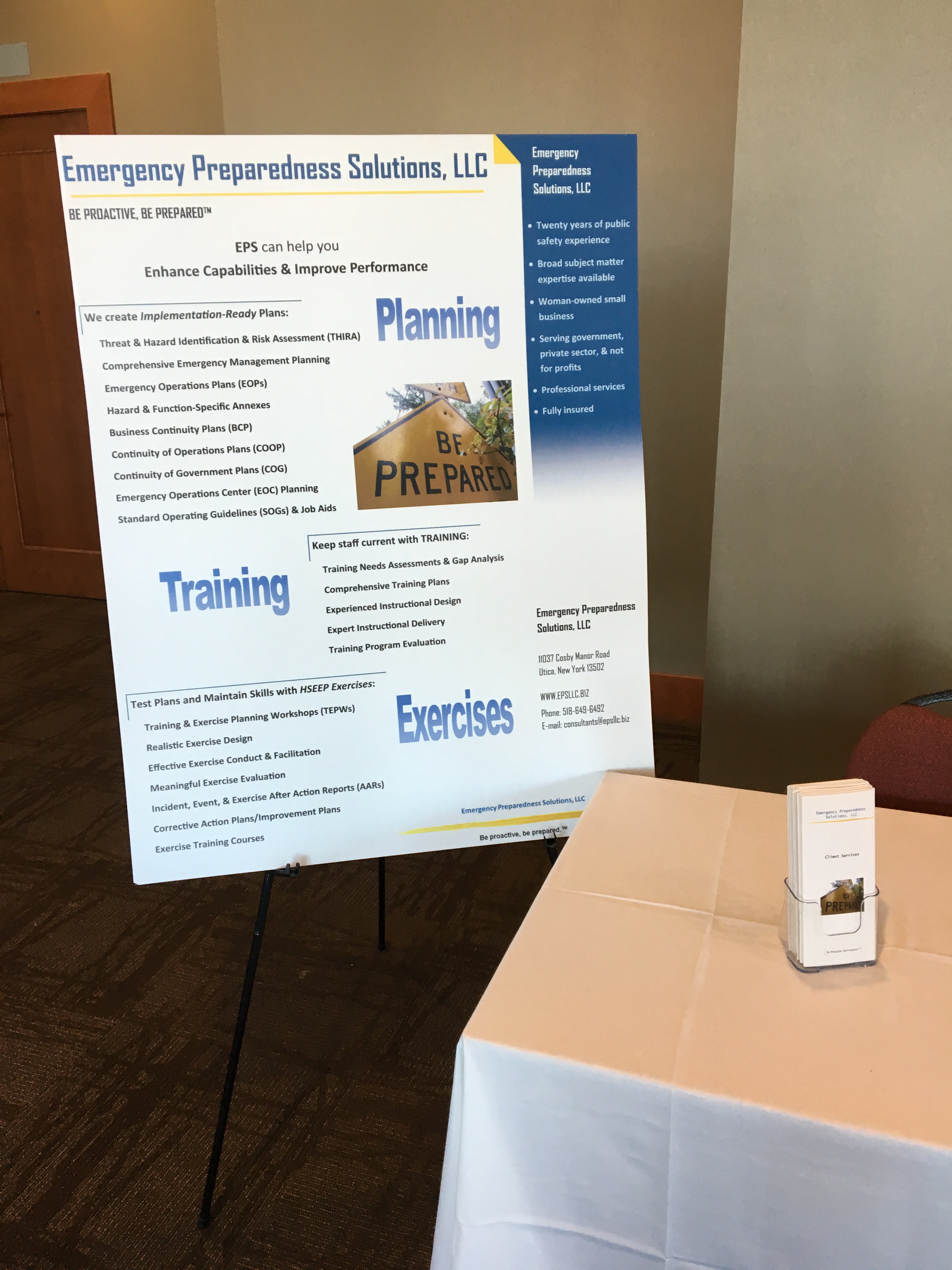
Last month sure was a busy one!  Much of the focus was on marketing for our company Emergency Preparedness Solutions.  I had the opportunity to meet a number of county and local government representatives in a reverse trade show in the Poconos and see some old and new faces at the Vermont Emergency Preparedness Conference.  Pictures of our booth are below.  I also had the opportunity to present with their State Training Officer on the State-Wide Emergency Management and Homeland Security Training Needs Assessment project we completed for the Vermont Division of Emergency Management and Homeland Security a few months ago.  We also need to congratulate Doug Babcock for being honored as Vermont’s Local Emergency Manager of the Year!

IMG_1205

IMG_1206

While those trips were great, the highlight of the month was a trip to Toronto.  The impetus for the trip was the Emergency Preparedness staff of Public Health Ontario, who, after reading my blog posts on the necessity for improvements in Incident Command System (ICS) training, extended an invitation for me to sit in on some training they offer that came about from just that need.  The course I attended was Public Health Emergency Preparedness – An IMS-based Workshop.  Fear not – this is not a reinvention of ICS (or Incident Management System – IMS – as they refer to it in Canada), rather this is an enhancement to the current curriculum.

The Canadian provinces have each adopted curricula for their IMS which are near 100% mirrors of the ICS courses we use here in the States.  While in Toronto, I also had the opportunity to sit in for a bit on an IMS-200 course being conducted by the Toronto Office of Emergency Management.  They were great hosts and have made excellent enhancements to the curriculum for a Toronto-based audience.  (Thank you Sherry and Sarah!) The course offered by Public Health Ontario is truly workshop based, with little lecture and a lot of group work to walk participants through concepts of IMS.  The workshop is positioned between IMS-100 (which most took online) and IMS-200, and is public health focused.

While I’m often weary of discipline-specific courses in emergency management, since the essence of emergency management is cooperative, this workshop absolutely made sense.  Why?  Two big themes built the foundation for this… First, practitioners must be comfortable with their own sand box before they can play with the neighborhood kids.  Second, this particular application works for public health (and several other disciplines) because most of the public health response occurs at the population level, not necessarily at an incident site.  Because of this, public health will almost always function (at least the higher echelons of their incident management structure) from an emergency operations center or departmental operations center.  As such, it pays to invest some training time on a homogeneous audience.  That said, the scenarios that drove the workshop were in no way introverted only to public health concerns and the instructors encouraged thought and discussion toward other activities and associated agencies which would be involved in an incident.

With the positioning of this training between IMS-100 and IMS-200, Public Health Ontario has armed participants with better knowledge and familiarity of the IMS, allowing those who will progress through further (and multi-disciplinary) training a better perspective of how IMS is applied by public health which allows for a better understanding of the system itself.  Not only does the workshop address some internal incident management training needs for public health, it also addresses some of the issues I’ve mentioned previously with ICS training as a whole.  The workshop is expertly designed by the Emergency Preparedness team at Public Health Ontario, and embraces concepts of adult educational methodology which we need to pay more attention to.  The high level of interaction lends to improved transfer of knowledge and better outcomes.  They included information such as the phases of emergency management and the need to reference deliberate planning efforts such as Emergency Operations Plans (EOPs) and Continuity of Operations Plans (COOPs).  This is certainly something we don’t have enough of in ICS courses yet is critically related.  Do you think the majority of our attendees know what these are, much less what is in theirs?  Guess again!

More information on this workshop can be found at https://www.publichealthontario.ca/en/About/Departments/Pages/Incident-Management-System-for-Public-Health.aspx.  Many thanks to Moira, Richard, and Evanna for the invite and the hospitality!

With my road trips complete, I am returning back to the normal pace of work and preparing for another graduate course which begins next month.  I’ve also considered the need to ramp up my concern on this matter of poor ICS curricula from an occasional rant to a crusade.  This is a matter of public safety – from a sociological perspective there is nothing more important than our ability to effectively respond to save lives, stabilize the incident, and preserve property.  Let’s make some changes!

As always, many thanks to my readers; and if you are with a government entity, not for profit, or private interest that is seeking consulting services in the areas of emergency and disaster planning, training, exercises, and anything in between, please feel free to contact me.

© Timothy Riecker

Emergency Preparedness Solutions, LLC