ICS: Let’s Keep Talking

I find it interesting that a topic so seemingly mundane – that of the incident command system (ICS) has seen an increase of discussion lately.  The NIMS Refresh seems to have fueled some of that, but other writings and conversations have also been taking place.  While I’ve certainly been critical of the national ICS training program in several of my writings, there have been other thoughts posted on ICS, some you absolutely must take a look at:

Are We Overthinking ICS?  This article, posted by noted emergency management consultant Lucien Canton has some great thoughts on the proposed NIMS Refresh.  He brings up an excellent point about the disappearance of Multi-Agency Coordination Systems (MACS) – something I had myself completely missed in my review.  A must read.

ICS and ESF: An Unhappy Marriage?  Another article by Lu Canton.  This piece gives a concise review of the differences between ICS and FEMA’s Emergency Support Function (ESF) structure and gives some ideas on how the two can be brought together.  I’ve seen the things Lu suggests in action, and I promise you, they can work.

Where Incident Management Unravels.  This article by Charles Bailey in the August edition of the Domestic Preparedness Journal took me on a wild ride, for which I’ll have some extended commentary here… I’ve read and reread this article several times, each time having different reactions and responses.  Through my first read, I saw this piece as being highly critical of ICS. Then I read it again, and I began to understand.  While I don’t agree with all Chief Bailey’s points, I respect everything he is saying and absolutely appreciate the thoughts and ideas this article offers.  I’ll leave you to read the article for yourself and form you own opinions.  The bottom line is the importance of early efforts to gain control over the chaos of the incident.  NIMS/ICS doesn’t provide us with all the answers for how to do that – something that I think needs to be reflected in better instruction of the principles of ICS.  Chief Bailey mentions toward the end of his piece the need to create ‘nimble response paradigms’ for initial response – a concept I fully agree with.  I also think that Chief Cynthia Renaud has some incredible insights on this matter in her Edge of Chaos paper.

I’m excited about the volume of discussion over NIMS and ICS lately.  It’s the system we rely on to manage incidents, coordinate resources, and ultimately save lives.  It’s kind of a big deal.  It should be good, and we should do it right.  While it’s the best we currently have, that doesn’t mean the system is perfect, nor will it ever likely be.  Similarly, the human elements involved in training, interpretation, and implementation of the system means that we will rarely do things ‘by the book’, but we are never handed disasters ‘by the book’, either, which emphasizes the number of variables involved in incident management.  The system must continue to evolve to be effective and to reflect our new and changing ideas on incident management.  We need to regularly examine the system critically and as realists and implement positive changes.  That said, change needs to be carefully administered.  We can’t make change for the sake of change, and we must be mindful that constant change will itself create chaos.

Have you read any other great articles on ICS lately?  What thoughts do you have on ICS, ICS training, and the need for ICS to evolve?  What’s missing?

© Timothy Riecker, CEDP

Emergency Preparedness Solutions, LLCYour Partner in Preparedness

Do you Really Know Unified Command?

Despite how much incident command system (ICS) instructors try to hammer this one home, there still remains some measure of confusion about what the concept of unified command really is. I regularly review documents or sit in meetings where unified command is improperly defined, applied, and discussed.  There are many who espouse that they use unified command instead of ICS.  Unified command is, in fact, an application of ICS, just like many other concepts within the system.  It is not a different system. When unified command is used, all other concepts within ICS remain the same.

From the National Incident Management System (2008) document, unified command is defined as follows: In incidents involving multiple jurisdictions, a single jurisdiction with multiagency involvement, or multiple jurisdictions with multiagency involvement, Unified Command allows agencies with different legal, geographic, and functional authorities and responsibilities to work together effectively without affecting individual agency authority, responsibility, or accountability.

Once we can gain an understanding of what unified command is, implementation of unified command is where the greatest misconceptions lie.  People often think that unified command is applied with a concept best described as ‘We use unified command, but the Fire Chief is in charge.’.  Nope.  That’s not it.  That’s simply an application of single command, with deputies coming from other agencies.  Unified command is truly unified.  The participants in unified command operate at the same level of authority.  Obviously standards of professionalism and legal authority should hold true, ensuring that none are issuing orders contrary to those of their counterparts, and often there is deference to the member of unified command who may have certain jurisdiction or subject matter expertise as it applies to a particular matter, but decisions and made and applied jointly.  The unified command, therefore, acts and speaks as a single entity.

Given the factors described above, as well as the need to properly synchronize incident management (see my recent article on this topic, here), unified command is absolutely something that should be prepared for.  Because of the nuances of its application, planning for unified command is helpful.  While the application of unified command is generally optional, some regulations and policies may require its use under certain circumstances. Be it required or not, plans establish a course of action for stakeholders to follow and can be strongly supported by procedures.  Plans should at least acknowledge that unified command may be an option for certain incidents, and may need to identify who makes the decision to implement unified command.  I’ve seen some plans require unified command for certain incidents, which I’m not crazy about.  Unified command, as mentioned, is just one more application of ICS.  Given the right circumstances, a single command may be the best option.  That said, if something isn’t included in a plan, even as an option, it may not even be considered during an incident.  Unified command should always at least be an option.

As an example of unified command application, the United States Coast Guard (USCG) commonly encourages and participates in unified command for many of their incidents, often pulling together, at a minimum, the USCG, a local or state government representative, and a representative of the responsible party (owner and/or operator).  They do this because it makes sense.  While the USCG has legal authority over navigable waterways and a response requirement within those waterways, incidents can also impact the shorelines, which are generally the responsibility of state and local governments.  State and local governments may also be providing a great deal of resources to assist in the incident.  International laws require that responsible parties do, in fact, take responsibility (usually financially) for incidents caused by or involving their vessels, which makes them a significant (although sometimes reluctant) stakeholder.

Further preparedness measures are needed for practitioners to become proficient in the application of unified command.  The inclusion of the option in plans alone isn’t enough.  It should be trained, so people understand what it is and how best to apply it.  The concept of unified command is incorporated into every level of the ICS national training curriculum.  Sadly, the common misconceptions associated with unified command tell me that we aren’t communicating well enough what unified command actually is.  Beyond training, the best opportunity to reinforce the application of unified command is exercises.  Exercises obviously offer an opportunity for a no-fault environment which allow for informal feedback and formal evaluation, which should both inform potential improvements. Unified command certainly should be practiced to be successful.  The reason it’s so successful with USCG applications is because their people train and exercise heavily in ICS concepts, including unified command.  They also enter a unified command environment with an eye toward coaching other participants who may not be so familiar with it and how it works.

There are a number of keys to success for unified command.  Chief among them are an understanding of what it is and what is expected and an ability to work as a team.  Working well as a team involves essential elements such as communication, coordination, and checking your ego at the door. Rarely is unified command successful when someone is trying to strong-arm the matter.  A successful unified command requires discussions to identify the priorities that each agency or jurisdiction has, and determining how to properly plan, shape, and synchronize the response efforts to ensure that each of these is handled appropriately.  Clearly, some measure of negotiation must regularly take place.

People often ask who should be part of the unified command.  The membership of unified command should remain fairly exclusive.  Representatives should only come from those agencies or jurisdictions that are significant stakeholders within the incident (i.e. they have responsibility or authority for major components of the response).   Just because an agency or jurisdiction is providing resources or support to an incident does not mean they should be part of the unified command.  Unified command functions best when it is small.  If your unified command effort is exceeding five or six people, you are entering the land of management by committee, and that should be avoided.  While some claim that there are a multitude of interests that should be represented in the management of an incident, I would suggest establishing a multi-agency coordination group, which is a policy-level body who can guide the incident command/unified command from that level.  The goal is to have only essential agencies working at the command level.

As I continue the crusade of improving ICS training, we will need to ensure that the concept of unified command gets some special attention to ensure better understanding of what it is and how it works.

I’m interested to hear your thoughts and practices on how you prepare for and implement unified command within your jurisdiction or organization.

© 2016 – Timothy Riecker, CEDP

Emergency Preparedness Solutions, LLCYour Partner in Preparedness


Incident Management Synchronization

I wrote most recently on Building a System of Response, focusing on the preparedness perspective of bringing stakeholders together to better anticipate each other’s priorities and objectives through collaborative planning, training, and exercising.  Incident synchronization is the step beyond having a system of response.  It’s the implementation where we make the system work.  Effective incident synchronization, however, is not as simple as building a good system of response.  There are a number of factors at play.

Incident Timeline

Every incident has its own timeline.  There are parts of this timeline that we can control, and parts that we can only respond to.  Most incidents occur with little or no notice, which already puts us in the passenger seat, regardless of our level of preparedness.  There is a period of time where we must play catch-up.  This initial response MUST be an early focus of incident management synchronization.  The success of our initial response will set a tone for the rest of the incident.

Looking at the incident timeline as a whole, we find that most incidents we deal with have a focus on response, with little need for intensive recovery activity.  Major incidents may have a response of a few hours or days, with recovery lasting months or even years.  The impacts of the incident largely determine the overall timeline.  The activities within the timeline, however, are determined by us.

Incident Priorities

Our response and recovery actions have certain timelines associated with them.  In response, our timelines are largely dictated by the three priorities of:

  1. Life Safety
  2. Incident Stabilization
  3. Property Conservation

These priorities should be addressed in order – that is, our life safety activities tend to go before incident stabilization and property conservation, although we do often have some overlap of activities associated with these priorities, especially where it can make sense to prevent further life safety issues.  These priorities, particularly life safety, are reflected in our initial response.

Depending on the nature and impacts of the incident, other priorities may be introduced by various stakeholders as we go into an extended response.  The extended response brings about a measure of bureaucracy, as responders enter non-emergency activities and non-traditional responders arrive to take part in matters related to their areas of responsibility.  These non-emergency activities and areas of responsibility may be associated with laws and regulation, plans, organizational charter, executive direction, or simply managing expectations. Of all of these, plans, particularly interagency plans, stand the best chance of respecting a system of response, aiding in a synchronization of incident management.  This extended response is often associated with incidents of Type 3 or larger.  Effective incident management synchronization during the extended response is critical. 

The Transition to Recovery

While politicians like to make declarations about the end of response and the beginning of recovery, these lines are rarely, if ever, so solid and defined.  On even the simplest of incidents – a motor vehicle accident – the incident commander will call for a tow truck early in the response activity.  In the microcosm of the small-scale Type 5 incident, this is a recovery activity.  Clearly then, when extending these concepts to a larger incident, we also initiate a number of short and long-term recovery activities within our response phase.

Recovery tends to bring in a number of agencies and organizations with little concern about response, but rather with a focus on getting people, organizations, and infrastructure back to where they were pre-incident, if not better.  We look at capabilities such as infrastructure systems, economic recovery, health and social services, housing, and natural and cultural resources.  We are addressing human needs, continuity of operations, restoration of infrastructure, social stabilization, and environmental remediation.  Clearly there are a variety of organizations and priorities at play.  While many of these activities, for a time, will run parallel to response, there are intersections, and recovery will continue well past the response phase.  Incident management synchronization must account for the integration of and transition to recovery. 

Accomplishing Incident Management Synchronization

Good preparedness leads to good implementation.  If we have built an effective system of response (and recovery), this lays an essential foundation for our success in incident management synchronization.  A big factor of our plans being effective is if they can actually be implemented.  Some good reading on operational emergency plans here.  Frameworks and conceptual plans offer a good start, but an effective plan should walk you through key activities.  We also need to recognize that our system of response is actually a system of systems.

Implementation of plans and synchronization of incident management is strongly supported by an incident management system, such as the Incident Command System (ICS).  ICS supports short term and long term incidents.  ICS embraces a planning process, which is summarized visually by the Planning P.  The planning process provides a system for developing incident action plans for the next operational period.  When performed properly, the planning process should be informed by all stakeholders, integrating their priorities, objectives, and activities into one consolidated plan.  Their objectives are vetted by the incident commander (or unified command, if used), which helps to ensure coordination, synchronization, and support throughout the timeline of the incident.
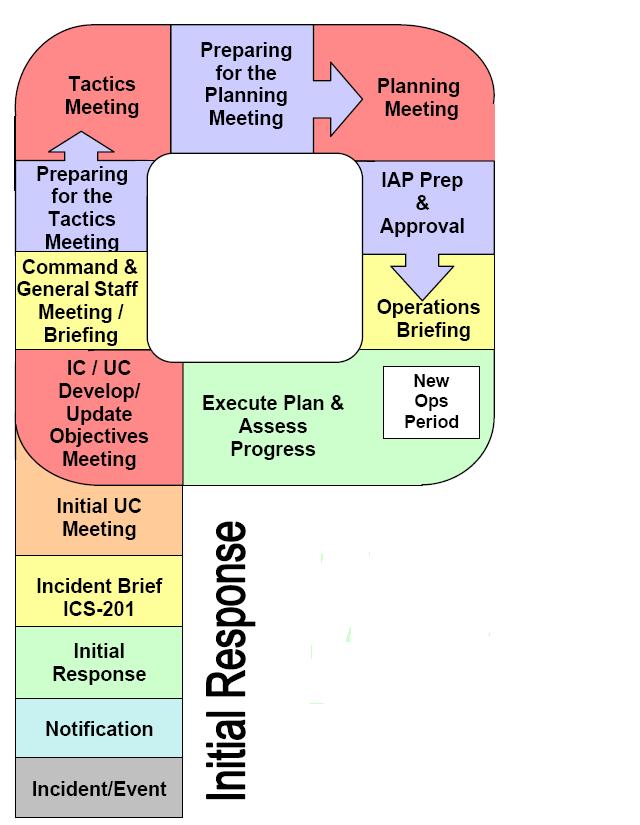
planning P for Planning

Despite this standard of incident management, there are still some organizations and individuals that work in disaster recovery that view ICS and concepts such as the planning process as too response-oriented and refuse to use it.  Looking back on the need to integrate recovery activities with response early in the incident, I find this myopic perspective simply foolish and a significant contributor to the disconnect between response and recovery.  I certainly acknowledge that ICS is foundationally very response-oriented, but just as it was adapted from wild-fire response, ICS can (and has been) adapted into recovery, with the foundational principles of incident management continuing to hold true.

Outside of ICS, incident management synchronization will only be successful with good communication among and between all stakeholders.  Effective communication fosters all measure of effective incident management.  Hopefully preparedness measures helped ensure that the organizations and perhaps the personnel involved were familiar with each other, but if not, communication can help overcome that gap.

To further reinforce the connection and need for synchronicity between response and recovery, I reflect again upon preparedness measures.  Short-term recovery activities should be anticipated and planned for alongside and integrated with response.  The full transition to long-term recovery should also be planned, acknowledging that the transition must be phased.  Further, key staff must be trained in these plans and the plans should be exercised at every opportunity.

As always, thanks for reading.  I’m interested in your perspectives, thoughts, and experiences with incident management synchronization.

© Timothy Riecker, CEDP

Emergency Preparedness Solutions, LLC – Your Partner in Preparedness


Building a System of Response

On even relatively simple incidents, multiple agencies respond, each with their own priorities, objectives, and authorities.  Even on these small and fairly routine incidents, agencies will complain about one another, typically from a lack of understanding of their role and priorities at an incident scene.  On-scene conflict between police and fire departments is almost cliché, but if you’ve been in this business for a while, you’ve certainly seen it occur.

The number of agencies and interests often expands with great leaps and bounds as the size, duration, and complexity of an incident grows.  While we have incident management systems (such as the incident command system or ICS) which help us to organize and manage the multitude of resources and interests involved during an incident, it’s critical that we have a better understanding and accountability of these agencies and interests before a complex incident occurs.  How can this best be done?

Management Level

Establishing this mutual understanding and accountability is the foundation of a system of response.  From the broadest levels, this is established in the National Response Framework, which is a national-level document describing how the US Federal government organizes to response to large incidents, but also identifies, in general terms, the roles and responsibilities of state, local, tribal, private, nonprofit, faith-based, and community stakeholders; along with how they interrelate during a response.  In the US, states have their own emergency operations plans, which further narrow this perspective within their state, addressing their own unique hazards, resources, laws, and ways of operating.  County and local governments, individual agencies, organizations, and others can and often times do have their own plans with a continually refined focus.

It is through the creation and ongoing maintenance of these planning documents where our system of response is first built.  Dialogue and understanding among the stakeholders are essential.  We must learn who are partners are in emergency response (and mitigation, recovery, prevention, and protection, for that matter) and what their interests and objectives are.  Sometimes those partners are asked to participate, other times they simply arrive on scene, leaving local responders and the person in charge feeling insecure and frustrated.  In your planning efforts, try to anticipate who might be involved in a critical incident so you can better anticipate those needs.

Responder Level

To further this understanding, especially with those who may find themselves working directly with responders of other agencies, it is important to train and exercise together.  Joint training and exercises give responders an opportunity to navigate course and exercise objectives together, leveraging their own knowledge, experience, and capabilities along with those of others; increasing the value of the learning experience as well as their aptitude for joint operations.

Many training courses are well suited for mixed audiences – from the management and planning level to the tactical level.  Incident command system courses, which all responders should take to an appropriate level, are also ideal for this, especially since they should encourage discussion about operational priorities, objectives, and strategies.  Additionally, courses that are heavy in scenario-based training can greatly maximize this synergy, since they are a combination of training and structured exercises.  Courses that use simulation tables are excellent for cross-discipline integration.

Joint training and exercises might not always be practical, especially for those new to their field of practice.  Acknowledging that, consider including information on the other disciplines within the basic or academy-level training that is conducted.  A brief amount of time spent on the legal authorities, priorities, and operational objectives of partner disciplines can be valuable to creating understanding on a complex incident.

Keep it Going

As with all preparedness efforts, ‘one and done’ is not a mantra you want to follow.  To be effective, contemporary, and impactful; you have to build a legacy program.  As the program continues, strive to constantly improve.  Don’t only keep plans up to date, but create procedures on integration that lead to an effective system of response.  Use training to support these plans and procedures and use exercises as both an opportunity for practice as well as an opportunity to identify strengths and areas for improvement within the plans and procedures.  Joint exercises will help identify areas that need to be addressed, such as interoperable communications, conflicting protocols, and competing priorities.  It’s better to identify and address these matters now than during a critical incident.

© 2016 – Timothy Riecker, CEDP

Emergency Preparedness Solutions, LLC Your Partner in Preparedness

Using Departmental Operations Centers for Incident Management Success

Increasingly, government agencies and departments are identifying the benefits of establishing and activating departmental operations centers (DOCs) to help manage their responses to incidents.  At the Vermont Vigilant Guard 2016 exercise, which concluded last week, I had some opportunity to discuss the benefits of DOCs, particularly with an agency who used theirs for the first time in this exercise.

For most agencies, a DOC can relieve agency representatives in an EOC from also having to manage and track their agency’s response activity.  In an EOC, an agency representative is largely a conduit for communication and they provide knowledge of their agency and their agency’s capabilities as they contribute to the greater discussions within the EOC.  According to NIMS/ICS, an agency representative should have some decision-making capability for their agency, although political and practical realities often dictate otherwise.  The overall scope of activity for an agency representative in an EOC largely precludes them from also managing the details of their agency’s response, particularly if that response is even moderately complex.

A DOC is the ideal location from which an agency can oversee and coordinate their own response to an incident.  They can deploy and track resources, address internal logistics matters, and coordinate external logistics matters back through their agency representative at the EOC.  DOCs are also an excellent application for large agencies, which may have a variety of technical functions organized throughout, such as a health department or transportation department.  Pulling together representatives from each organizational element within the agency to collectively troubleshoot, problem solve, and share resources, is excellent use of a DOC.  In a way, this application of a DOC could be considered similar to a multi-agency coordination center (MACC).

Does a DOC need to mirror NIMS/ICS (or the new Center Management System) standards?  While there is no set standard for organizing and managing a DOC, there are a lot of applications of ICS that can certainly be applied.  If you look at the main activities of your DOC, you will see where opportunities for integration of ICS principles exist.  Consider that a DOC should have and maintain good situational awareness.  While much of this can be provided by the EOC, the EOC may (should) be looking for some specific information from your agency.  A situation unit within your DOC would certainly be helpful.  Likewise, DOCs often address tactical or near-tactical application, by deploying and directing resources from throughout their agency.  Having a resource unit within your DOC will help tremendously in the tracking of these resources.  Depending on the size and scope, it may be prudent for your DOC to establish an incident action plan (IAP) of its own.

Logistics, mentioned earlier, may be another need within a DOC.  Certainly an element of finance is important for the approval of procurements and tracking of costs within the agency related to the incident.  If resources are being deployed, someone should be in charge of operations.  Lastly, any organization needs to maintain someone in charge.  A DOC Manager would be the ideal generic term for this position.

What are the draw backs of establishing a DOC?  First of all, it’s an additional layer of incident management.  While possibly necessary based on factors discussed earlier, adding layers of incident management can make incident management more complex, especially if roles of each layer and function are not well defined.  The best way to address this is pre-planning!  Staffing can also be a significant concern.  Many agencies may be too small to warrant, much less have staff available, for a DOC.  If such is the case, just as in other applications of ICS, you should be able to collapse down to a manageable size.

An often seen pitfall of DOCs is that they can quickly devolve into a management by committee type of structure; particularly with larger agencies where senior staff, who are used to regular meetings with each other, are now representing their functional interests within the DOC.  I’ve seen this result in what is essentially one endless meeting, interrupted by phone calls and emails which introduce new problems and perpetuate more discussion.  Strong leadership is absolutely required to ensure that a group such as this stays focused and on task, resolving issues on a timely basis.

Overall, the use of Departmental Operations Centers is a smart practice.  Work internally to plan their use, scoping out when and how it will be applied, where it will be located, the organization to be used, and how it is integrated into the overall incident management effort.  Once plans are developed and appropriate training is performed, exercise the plan to identify areas for improvement, turning those into corrective actions, and implementing them for continued success.

© 2016 – Timothy Riecker, CEDP

Emergency Preparedness Solutions, LLC – Your Partner in Preparedness

ICS Training (Still) Sucks… One Year Later

Just over a year ago, I posted my article Incident Command Training Sucks, which to date has been viewed almost 2000 times on the WordPress blog platform, alone.  Since then, I’ve written several more times on the necessity to change the foundational ICS training curriculum in the US to programs that are focused on application of ICS in initial and transitional response instead of just theory and vague instruction.  I am greatly appreciative of all the support these articles have received and the extra effort so many have taken to forward my blog on to the attention of others.  These posts have led to some great dialogue among some incredible professionals about the need to update ICS training.  Sadly, there is no indication of action in this direction.

A recent reader mentioned that it often ‘takes guts to speak the truth’.  It’s a comment I appreciate, but I think the big issue is often complacency.  We settle for something because we don’t have an alternative.  Also, I’ve found that people are reluctant to speak out against the current training programs because there are so many good instructors or because the system, foundationally, is sound.  My criticisms are not directed at instructors or the system itself – both of which I overwhelmingly believe in.  I’m also not being critical of those who have participated in the creation of the current curriculum or those who are the ‘keepers’ of the curriculum.

Much of the existing curriculum has been inherited, modified from its roots in wildfire incident management, where it has served well.  While adjustments and updates have been made through the years, it’s time we take a step away and examine the NEED for training.  Assessment is, after all, the first step of the ADDIE model of instructional design.  Let’s figure out what is needed and start with a clean slate in designing a NEW curriculum, instead of making adjustments to what exists (which clearly doesn’t meet the need).

Another reader commented that ‘The traditional ICS courses seem to expect the IC to just waive their hands and magically the entire ICS structure just would build beneath them’.  It is phrases we find in the courses such as ‘establish command’ or ‘develop your organization’ that are taken for granted and offer little supporting content or guides to application.  The actions that these simple phrases point to can be vastly complicated.  This is much of the point of Chief Cynthia Renaud’s article ‘The Missing Piece of NIMS: Teaching Incident Commanders to Function on the Edge of Chaos’.  We need to train to application and performance – and I’m not talking about formal incident management teams, I’m talking about the responders in your communities.  The training programs for incident management teams are great, but not everyone has the time or ability to attend these.

I’m hoping that my articles continue to draw attention to this need.  Perhaps the changes that come as a result of the final NIMS refresh will prompt this; hopefully beyond just a simple update to the curriculum giving us a real, needs-based rewrite.  As I’ve mentioned before, this is public safety, not a pick-up game of kickball.  We can do better.

© 2016 – Timothy Riecker, CEDP

Emergency Preparedness Solutions, LLCYour Partner in Preparedness

Achieving Coordination Through Unity of Effort

WESA 90.5, Pittsburgh’s NPR News Station, posted an interesting article titled ‘Trump Rally To Blame for Emergency Response Revamp’.  As the articles tells the story, an internal City committee spent several weeks reviewing communications and other information after an April rally in which three were arrested and four police officers suffered minor injuries.  The findings of the committee’s work included the discovery of fractured planning and response within the City of Pittsburgh.  Assuming this has been a regular practice, I’m surprised it took them this long to discover the issue and begin work to address it – although when a jurisdiction functions in a fractured fashion, it’s an easy observation to miss.

The City’s Public Safety Director stated a new system is being implemented in which a ‘unified and streamlined approach to planning’ and a ‘clearer chain of command’ will be put in place.  The article indicates that the City’s Emergency Management Office will have more of a role in coordination.

It’s good to see that Pittsburgh is making some changes to how they plan for and respond to incidents.  This should serve as a role model for a significant number of jurisdictions across the nation – and I’m sure across the world – which have siloed planning and response, with each agency conducting their own activities with little to no coordination.  Proper and safe emergency management requires a team approach, and every team needs someone to coordinate and lead.  This doesn’t necessarily mean that emergency management is in charge – in fact I feel it’s a rare occasion that emergency management should be in charge – but coordination is still an essential element of success, particularly for complex planning and operations.

The term ‘unity of effort’ is gaining more and more traction through the years.  I first heard it probably ten or twelve years ago.  I was pleased to see the intention of adding the term officially to our lexicon in the draft NIMS Refresh document that was released a couple months back.  Although it was just a mention, it was rather encouraging.  Unity of effort doesn’t require an emergency management office or an emergency manager, but having a central point of coordination helps – especially one that isn’t focused or constrained by the mission and tactics of other public safety agencies.  The mission of emergency management IS coordination!

How do you rate the public safety coordination in your jurisdiction?  Is there room for improvement?  While politics are often at play, sometimes it just takes a good measure of facilitation to bring people together in one room and talk about what needs to be accomplished.

© 2016 – Timothy Riecker, CEDP

Emergency Preparedness Solutions, LLC – Your Partner in Preparedness

Taking Another Look at Mass Casualty Incidents

In case you missed it, the NTSB issued their findings and recommendations relative to the derailment of Amtrak 188 in the City of Philadelphia last May, which resulted in the loss of eight lives and injuries to over 200 other passengers.

The NTSB surmised that the engineer was distracted by reports over Amtrak’s radio of a nearby train having rocks thrown at it, which is apparently a common occurrence on a certain stretch of tracks through Philadelphia.  His distraction resulted in him speeding up the train, rather than slowing it prior to heading into a curve.  Taking the curve at high speed led directly to derailment of the train.  It has been pointed out that the presence of an automatic Positive Train Control system, not installed on many trains, would have slowed the train and likely prevented the derailment.  A rail industry union consortium indicated that the presence of two engineers on the train may have also mitigated this incident.

What I found most interesting in the report was that after listing findings and recommendations related to the derailment itself, the NTSB report identified issues beyond the crash.  The report states that

“…as a result of victims being transported to hospitals without coordination, some hospitals were over utilized while others were significantly underutilized during the response to the derailment.  The NTSB further found that that current Philadelphia Police Department, Philadelphia Fire Department, and Philadelphia Office of Emergency Management policies and procedures regarding transportation of patients in a mass casualty incident need to be better coordinated.”

Why is the NTSB providing recommendations on how mass casualty incidents are handled?  These recommendations are, in fact, fully within the scope of their mission statement as they address, ultimately, how victims are cared for.  The NTSB has also brought us best practices that extend beyond crashes, such as Family Assistance Centers.

The recommendations the NTSB provides in this report are spot on.  Mass casualty incidents MUST be coordinated.  Triage, treatment, and transport.  We’ve all heard of these three key activities.  Yes, it’s excruciatingly difficult to not ‘Scoop and Run’ when we encounter an injured victim, but let’s consider a few reasons why we shouldn’t:

  1. Patients with certain injuries, such as those to the cervical spine, are not being stabilized, and could have their injury worsened.
  2. A patient could ‘crash’ from a multitude of causes, which require the resources of an ambulance and paramedic to address, absent being in a hospital.
  3. Scoop and Run violates the concept of triage, which is intended to provide care and transport for the most critically injured first.
  4. The emergency personnel and vehicles involved in Scoop and Run may be otherwise needed at the scene.
  5. Depending on the incident, victims may be contaminated. Scoop and Run can endanger personnel who are not aware of this.
  6. Scoop and Run circumvents patient tracking and accountability, which is important for on-scene operations, liability and insurance, post-incident medical monitoring, and investigation.
  7. Scoop and Run, as the NTSB report pointed out directly, doesn’t account for spreading patients among receiving hospitals, meaning that some patients can end up at hospitals unequipped for their type of injury as well as overcrowding of hospitals.

While the City of Philadelphia did a great job overall, this gave them cause to take another look at their mass casualty plans and procedures; resulting in Philadelphia Office of Emergency Management asking for better coordination of the multiple entities involved in a mass casualty incident.  While this incident provided some great lessons learned for the City of Philadelphia, it also provides lessons learned for all of us.  It’s a good opportunity to convene your mass casualty planning group and give a review of your plan.  Any jurisdiction can be susceptible to a mass casualty incident.

In need of a structured plan review, planning, training, or exercises involving mass casualty incidents?  Emergency Preparedness Solutions can help!  Contact us now!

© 2016 – Timothy Riecker, CEDP

Emergency Preparedness Solutions, LLCYour Partner in Preparedness!

Battling Wild Fires and Perspectives

Hello readers!  Apologies for my absence over the past couple of weeks.  I’m grateful, especially as a founder and company partner, that we’ve been so busy as of late.  The design, conduct, and evaluation of a couple of great exercises for one client; the design of several impactful training courses for another; along with preparations for two new contracts have had our small business buzzing with activity.  We will be recruiting a lot of people for one of those contracts, so stay posted on the blog (www.triecker.wordpress.com), my LinkedIn profile, and both my personal (@triecker) and our company (@epsllc) Twitter accounts, as well as the company website (www.epsllc.biz) for more info.

Although I’ve not been blogging for the last couple of weeks, I’ve still been keeping up on current events.  The wildfire in Fort McMurray, Alberta, Canada has been consistently one of the biggest stories as the fires still continue to spread, having caused massive devastation to property and the environment, and having displaced around 100,000 people.  Hundreds of vehicles were abandoned during evacuations, either due to mechanical trouble or lack of fuel.  The Canadian Red Cross, partnering with federal and provincial governments, is providing tens of millions of dollars in direct aid to impacted individuals and families.  Thousands of workers are being evacuated from the oil sands area north of the Fort McMurray, stalling more than a million barrels of production each day.  Firefighters, law enforcement, military personnel, and other resources are battling dry conditions, high temperatures, and winds in this massive and constantly shifting fire.  Other provincial and local governments and even citizens are helping to shelter and care for evacuees, many of which have lost much of their property.

One thing I often find interesting is the difference between perspectives, especially between public safety and citizens.  While our focus in public safety is… well… to make sure the public is safe, we always have to keep tabs on perception.  Take the seemingly conflicting reports of these two articles, for example.  The first article, published Thursday May 5, tells the story of residents evacuated from an area who are questioning the organization of response efforts and general preparedness of officials.  One individual tells of no police officers to guide evacuees out of town.  The second article, published on Saturday May 7 tells of military and police overseeing evacuations across the incident.  I believe I read these two articles back to back, causing the dichotomy of the two to really jump out at me.

Truth, of course, likely lies in both articles.  Yes, thousands of public safety and military personnel are involved and doing what they can.  Some evacuation orders, as indicated in the first article, are sudden, based upon rapidly changing factors, giving public safety little time to mobilize to the new area.  There must also be a consideration that evacuation orders may have been issued without proper coordination of resources.  Any of these things are possibilities, especially in the fast moving environment of wild fires.  Still, they provide opportunities for us to learn and improve.  Not knowing the details of what may or may not have transpired, I am always reluctant to speculate.  As with all incidents, events, and exercises, however, once the work is done, we have an excellent opportunity to review and evaluate information in a collaborative manner to identify strengths and areas for improvement.  Organizing these notes creates a corrective action plan, the implementation of which will, over time, make us better at what we do.

© 2016 – Timothy Riecker

Preparing to Use the Incident Command System

For a bit of context, if you haven’t already read them, please take a look at these other ICS related articles I’ve posted:

Incident Command System Training Sucks

ICS Training Sucks… So Let’s Fix It

Preparedness – ICS is Not Enough

The crusade to improve ICS training and implementation continues…

We invest a lot of time and effort into training people in the use of the Incident Command System (ICS).  However, as a broad statement, the training we provide is massively inadequate.  We don’t actually train people to do anything – we simply tell them about ICS through an increasingly repetitive and complex series of courses.  At the risk of being repetitive myself, I refer you to the articles linked above for many of my foundational thoughts on the current state of ICS training.

The ICS core training curriculum aside, we – as both individuals and organizations – need to be better prepared to actually use ICS.  The thought that people are able to use ICS the minute they walk out of an ICS course is totally and completely false.  By ‘use ICS’, I don’t mean to simply function within an organizational chain of command that uses ICS, I’m referring to being a driving force within the system itself.  ICS isn’t something that happens automatically, it requires deliberate and constant actions.  This typically involves functioning at the Command or General Staff levels, but also within many of the subordinate positions which are absolutely critical to managing a complex incident and driving the system.

So how do we prepare to use ICS?  I often refer to the preparedness capability elements of POETE (Planning, Organizing, Equipping, Training, and Exercising) when I’m talking about preparedness activities.  These same concepts apply here.  We need to remember that planning is the foundation of all preparedness efforts.  If it’s not documented, then why are we doing it?  So we have to have plans, polies, and procedures which call for the implementation of ICS and direct us in the nuances of how we will manage an incident.  I’m sure everyone’s plan has taken a page from the NIMS Doctrine and includes language about the requirement to use NIMS and ICS.  That’s all well and good, but like many things in our plans, we don’t reinforce these things enough.

I’m not talking about simply giving NIMS and ICS lip service.  I’m talking about procedure level integration of these concepts.  This begins with good planning, which means plans that are implementation-ready.  Would you consider your plans implementation-ready?  Do they describe how to use the ICS structure and concepts to actually implement the plan?  Maybe yes, maybe no.   If not, your team has some plan updating to do.

Your organization must be ready to respond using ICS.  That means that everyone is familiar with their assigned roles and responsibilities.  Often ICS training falls short of this.  This article: Training EOC Personnel – ICS is Not Enough, details many of the reasons why, at least for an EOC environment.  Many of the points made in the article, however, can be reasonably applied to other environments and organizations.  While ICS provides us with overall concepts, the application of those concepts will differ for various organizations and locations.  Every location, county, region, and state have different protocols which must be integrated into incident management practices.  (Refer back to planning).  Our organizations, both those that are static as well as those which are ad-hoc (assembled for the response to a particular incident or event) need to be ready to act.  This means familiarity not only with ICS or our specific applications of it, but also with our plans.  How often do ICS courses actually talk about the implementation of emergency plans?  Rarely.  Yet that’s what we are actually doing.  Do you have people assigned to ICS roles?  Are they ready to take on the responsibilities within these roles?  Do you have backups to these positions?  I’m not necessarily talking about a formal incident management team (IMT), although that may be suitable and appropriate.  Absent an IMT, the responders within a jurisdiction or organization should have a reasonable expectation of the role/roles they will play.  This helps them and your organization to be better prepared.

The implementation of ICS generally doesn’t take much equipping, but there are some basics.  Responders love radios and we use them often.  How about people who aren’t traditional responders, but may be called on to function with your ICS organization?  Do they know how to use a radio?  Do you have a standing communication plan to help you implement their use?  How do you track incident resources?  I didn’t just ask about fire service resources – I mean all resources.  Do you have a system for this?  T-Cards are great, but take training and practice to use them – plus they require that all responders know their responsibilities for accountability.  The same goes with a computer-based solution.  For whatever equipment or systems you plan on using, you must ensure that they are planned through and that people are very familiar with how to use them.

Training… I think I’ve talked about the need for better ICS training quite a bit, so I’m not going to continue with that point here.  What I will mention is a need for refresher training and jurisdiction-specific training on incident management.  This isn’t necessarily ICS focused, but it is ICS based.  For many years now, FEMA has believed that by including three slides on NIMS in every training program that they are helping with NIMS compliance.  Nothing could be further from the truth.  You have to actually talk about how these concepts are key to implementing plans.  Responders need to be familiar with the emergency management system they are working within.  Train people to the plans and procedures.  Let them know who is in charge of what and when, who the decision makers are, and any other training needs identified in the earlier POETE activities.  Prepare them to implement ICS!

Lastly, exercises.  Incident management should be something that is practiced and tested in almost every exercise.  Applying these concepts is not something we do on a regular basis, therefore knowledge and skills erode over time.  Certainly we have to be familiar with the system, not just at an awareness level but at a functional and operational level.  Regardless of the state of the current curriculum, that involves practice.  Exercises don’t have to be elaborate, remember that they can range from discussion-based to operations-based.  Table top exercises are great to talk things through, drills are good for focused activities, and even full-scale exercises can be small and contained.  So long as the exercise is designed, conducted, and evaluated well, that’s what counts.  Don’t forget that evaluation piece.  The feedback to the entire system (plans, organization, equipment and systems, and training) is extremely important to continued improvement.

This is public safety, not a pick-up kick ball game.  We can do better.

Thanks for listening… what are your thoughts?

Does your organization or jurisdiction need help preparing to implement ICS?  Emergency Preparedness Solutions can help!

© 2015 – Timothy Riecker

Emergency Preparedness Solutions, LLC