Incident Command System Training Sucks

There it is.  I said it.  Before you unleash the hounds, hear me out.

A bit of background:

As another grad course at American Military University was coming to a close last month I was racking my brain over the theme of my term paper.  In one of our final assignments I was dissecting NIMS – and that’s where it struck me.  ICS training is all wrong.  Now that my paper is all wrapped up and submitted, I wanted to get some discussion on my blog.  So, since I don’t want to bore everyone with the paper itself, what follows is a much less academic and more conversational version of my term paper.

For those of you who read my blog, you will be familiar with a few fairly recent posts that involve ICS:  The Human Aspect of ICS and Overcoming Transitional Incidents, Preparedness – ICS is Not EnoughTraining EOC Personnel – ICS is not Enough, and finally The Need for Practical Incident Command Training.  In that last one I feel I was headed in the right direction but not yet on the right road.

Before we go any further, here is my disclaimer.  I am a big believer in ICS.  If you take a look at the aforementioned posts, you’ll see that.  It’s a system that has been in use for a long time and has a proven track record of working well when properly applied.  Along with that, I’ve been an ICS practitioner, instructor, and instructor trainer – since before NIMS, in fact.  I’ve also been in positions influencing NIMS-related policy at both the state and national level.  So I have a fair amount of familiarity with the system, how it is used, and how it is taught.

Defining the need:

A great many after action reports (AARs) reflect on Operational Coordination (the current core capability which most heavily features ICS), On-Scene Incident Management (the previous iteration under the target capabilities), and just ICS in general.  These AARs often go on to recommend that responders need more ICS training.  How can they say that, though?  Following NIMS compliance requirements, darn near everyone who has been required to take ICS training has done so over the past 10 years.  So how could we be so off base?

The reality is summed up in this simple statement from John Morton: “With respect to using ICS from NIMS… training incorporated in the NIMS doctrine largely does not provide any actual skills training or development.”  If you aren’t yet familiar with John Morton’s work, I suggest you take a look here: Book Review – Next-Generation Homeland Security.  Brilliant guy.

Looking at the substance of Mr. Morton’s quote, it’s true that the foundational ICS courses (ICS-100 through ICS-400) don’t provide any skills training.  However, there is a significant expectation that taking these courses is somehow a magic bullet.

Much of my paper focuses on the ICS-300 and ICS-400 courses.  The ICS-100 and ICS-200 courses are probably not far off from where they actually need to be.  There exists, however, a higher expectation from people to have learned something from the ICS-300 and ICS-400 courses which can be readily applied in the field.  One of the foundations for my paper was an analysis of the course objectives from the current ICS-300 and ICS-400 courses through the lens of Bloom’s Taxonomy.  Bloom’s is a learning hierarchy which helps identify the depth of instruction and thus learning.  The revised version of Bloom’s is a scale of six levels, ranging from ‘Remembering’ to ‘Creating’, with remembering being pretty basic and creating being quite advanced.  The expectation of ICS training, obtained from a few sources as well as our perception, is that it falls somewhere in the middle under the taxonomy level of ‘Applying’.   The reality is that most of the objectives from these two courses fall short of that expectation.

How is it possible that we have been expecting more from people when we haven’t been giving them the proper training to do so?  In essence, all we have been training people in is theory.  Sorry, but theory doesn’t save lives, application does.  Why does the fire chief of even the small city (population ~62k) closest to me care what an incident complex or branch-level planning is?  It’s not something he can use.  He and his officers require proficiency in the system for not only the day to day type 4 and 5 incidents they deal with (which they generally have), but also enough for the type 3 incidents which occasionally occur from storms, hazmat incidents, and the like.

Yes, we do have position-specific courses for those who are members of incident management teams (IMTs).  Those courses presumably identify at a higher taxonomy level (I haven’t had a chance to do an analysis on them).  IMTs are great assets, but let’s have another brief shot of reality … not every jurisdiction is suited for an IMT.  Identifying potential members, getting them trained and experienced, and maintaining their skills is an investment that most jurisdictions simply aren’t willing or able to make.  The result is a huge gap between those who have only the core ICS training, which we have already identified does not meet the real need, and an IMT from a larger jurisdiction or region.  Jurisdictions need to be able to function for at least two days, if not longer, on their own.  Most incidents will be resolved at that point or ready for transition to an IMT.  If appropriate, the IMT can then apply things like branch-level planning.  That is the level of application expected from IMTs.

What can we do about it:

So what is needed?  Here are my rough ideas.  First off, at a micro level, we need a full rewrite of the ICS-300 and 400 courses.  Let’s make them more meaningful and focus on application.  Pull out all the theory and structure them around practical learning practices.  Second, we need refresher training.  Let’s stop the argument about that.  Knowledge and skills deteriorate over time, we all know that.  So let’s go with annual refresher training.  Not a day of being lectured, to, either.  Something more involved which reflects the identified need for applicable learning.  Third, continued reinforcement through exercises.  If you don’t use it you lose it.  The last ten years or so have seen a strong emphasis on exercises which we should certainly continue.  Lastly, all of this culminates at the macro level as a restructuring of the whole training program.  Why is that needed?  Well, aside from the current one being ineffective, we need to logically identify what training is needed for certain audiences based upon their roles and responsibilities and support it through accessible training programs.

In regard to restructuring the whole training program, I would suggest adoption of the Awareness, Management and Planning, and Performance course structure (AWR, MGT, PER).  ICS-100 is certainly awareness.  Awareness level training is appropriate for most responders and staff of assisting and supporting agencies who don’t have any leadership or decision-making roles and don’t need to have a high degree of interaction with larger system.  ICS-200 has some operational application for first line supervisors, so it’s probably a suitable introductory MGT course.  The ICS-300 should continue with a focus on the planning process but obviously needs to be bolstered with more application-level content and instruction.  With that, the target here is probably higher level management and planning.  The ICS-400, still needing a rewrite, is best left for those functioning at higher levels of incident management, such as EOC management and IMTs.  It will probably serve as a good foundational performance level course.  Now, just don’t leave it at that.  Let’s pull other courses in line to support this.  Many of those courses already exist, particularly those that have a strong ICS relationship, like the FEMA EOC and ICS/EOC courses (which are also in desperate need of rewrites to focus on application), the TEEX Enhanced Incident Management course (which is excellent), and others.  Let’s build a real, viable program for incident management as we have for other technical areas.  Without incident management we remain in chaos and the impacts of other activities are greatly minimized.  Let’s give it the respect it deserves.

Now that I’ve put all that out there, I’m absolutely prepared for your thoughts, ideas, and feedback.  I’m also hoping that someone forwards this on to Doc Lumpkins at the NIC.  Doc – let’s talk!  I might have an idea or two…

Unleash the hounds!

© 2015 – Timothy Riecker

Emergency Preparedness Solutions, LLC
WWW.EPSLLC.BIZ

The Human Aspect of ICS and Overcoming Transitional Incidents

Most often when we consider the Incident Command System (ICS), we think of boxes in an organization chart, forms to be completed, and specific processes to be followed.  True, these are, in essence, aspects of ICS, but they alone will not pave the way to success.  What we must remember is that ICS is conducted by people.

Typically the most difficult aspect of a complex incident is the transition from what we normally do and how we normally respond to elevating our response to a more appropriate level given the scope of the incident.  The groundwork for this transition lies in our initial response, which many experienced responders know can set the tone for the entire operation.  This initial response is based largely on the decisions we make with the information we have.  While there are policies, plans, procedures, play books, checklists, and myriad training that help to inform us, it all comes down to the human factor.  People make decisions based upon the stimuli they are presented with and their own experiences.

Chief Cynthia Renaud in her paper The Missing Piece of NIMS: Teaching Incident Commanders How to Function in the Edge of Chaos discusses approaches to initial response as an oft forgotten aspect of how we teach ICS.  While we know that responders conduct initial responses all the time, there is a significant difference in scope between a routine incident and a complex incident.  This difference in scope requires a different and more open mindset.  While our size up actions may generally be the same, we need to think bigger and this kind of thinking is difficult to train.

The implementation of the ‘bigger’ (i.e. beyond what is routinely used) aspects of ICS is also a challenging mindset for responders.  These aspects of ICS, such as the initial delegation of other organizational aspects and the need for a written Incident Action Plan, do not come easily when they are not practiced.  The fact of the matter is that the implementation of ICS requires a conscious, deliberate decision accompanied by people with knowledge and skilled intent to guide its expansion suitable to the incident at hand.  It also requires a bigger picture mindset recognizing the need to expand the management of the response proportionate to the complexity of the incident and the resources required to address it.  When is it needed?  How do we do it?

One problem is that most of the people we count on to manage these initial responses are trained to manage tactics, not large incidents.  They excel at managing a handful of resources in a rapid deployment and resolving an incident quickly.  This is exactly what they are needed for and they do it well.  Chief Renaud indicates a need to train these first level supervisors to recognize complex incidents for what they are and give them the tools (and authority) to implement broader measures, including an expanded implementation of ICS.

I’m a firm believer in ICS, but I know that people have to drive it.  It’s not something we can put on autopilot and expect it to bring us to our destination.  It has to be consciously and deliberately implemented.  When people criticize ICS, I often find that their criticism is due to false expectations and inappropriate implementation.  With that, I firmly believe we need to do a better job at training to address these issues and help responders better understand the system and demystify its use.

How do we make our training better for the average (non Incident Management Team) responder?  How do we help bridge this gap between the routine and the complex?

© 2015 – Timothy Riecker

Emergency Preparedness Solutions, LLC

www.epsllc.biz 

Emergency Managers Need to be More Like Engineers and Less Like Shopkeepers

I was inspired by this short (~1 minute) video from TrainingJournal.com.  In the presenter’s brief but pointed message, he describes many trainers as being akin to shopkeepers, providing organizations often times with rote solutions just as a shopkeeper will pull a product off their shelves. He goes on to say that this these solutions are usually effective, but only for a limited duration.  He offers, instead, that trainers need to be more like engineers, examining every facet of a problem and constructing lasting solutions.  As an experienced trainer and proponent of a detailed root cause analysis, I couldn’t agree more, but as I readied myself to write a post about the implications of this on training, my mind carried this metaphor to many of our practices in emergency management.

Consider how often we quickly dismiss identified gaps with an assumed solution.  Write a plan, conduct a training, install a bigger culvert.  Those are usually our solutions to an identified problem.  Are they wrong?  No – we’re correct more often than not.  Are these lasting solutions?  Rarely!  How often does the problem rear its head again within a relatively short span of time?  How do we address the re-occurrence?  As shop keepers we simply pull another solution off the shelf.  Can we do better?

The things we do in emergency management are often based upon best and current practices.  We address problems through the prevalent way of dealing with such things industry-wide.  Emergency management has a great community of practice.  I’ve mentioned in several previous blog posts the spirit of sharing we have and the benefits we see come of that.  It doesn’t seem often, though, that we engage in an industry-wide groupthink to solve various problems.  We use and adapt ideas of individuals and small groups, we see a steady and determined progression of the practices within our progression, but we rarely see ‘game changing’ ideas that revolutionize how prevent, prepare for, respond to, or recover from disasters.  Why is this?

Perhaps we need a greater collective voice locally, where practitioners are dealing with the problems directly?  Our methods of practice in emergency management are generally driven by the federal government (THIRA, NIMS, HSEEP, etc.).  I’m not saying any of these are bad – in fact they are excellent standards that we need to continue to refine and apply, but it’s generally not the federal government that is dealing directly with the constant flow of issues being dealt with at a state, and even more so, a local level.  We need to follow that metaphor of being engineers to apply more permanent solutions to these problems.  We need to create, innovate, and problem solve. Or do we?

Necessity, as they say, is the mother of invention.  We often miss the necessity of improving because we have current, functional solutions – we have things that work.  So why fix it if it’s not broken?  I say we can do better.  The realization of the need for lasting solutions is the necessity we need.  If the solutions we have on the shelf don’t work for us 100%, let’s figure out a better way.

I don’t know what or how, but I’m sure that as a community we can identify needs and prioritize what must be addressed.  Given the right people, time, and maybe a bit of money, we can be innovative and effect some lasting change.

I’d love to hear what others think on this topic.

© 2015 – Timothy Riecker

Emergency Preparedness Solutions, LLC

www.epsllc.biz

The Need for Practical Incident Command Training

I’ve written a couple of articles in past few months (See: Preparedness – ICS is Not Enough; and Training EOC Personnel – ICS is Not Enough) where I’ve been a little rough on the Incident Command System (ICS), or rather the trust that people put in it as a magic pill to cure all their incident management ills.  As it turns out, there is no apologia; rather I’m going to continue challenging the status quo, this time as it relates to how ICS training is conducted.

The driving force behind this is the realization of a gap that exists in ICS training and the ability of learners to apply what they have learned to a reasonable degree within an emergency response environment.  The foundational ICS courses (ICS 100 – 400) provide learners with a progressive understanding of the concepts, terms, organizational elements, and primary processes within ICS, but provide little opportunity to practically apply what they have learned.  Progressive instructional design methods through course revisions have added more hands-on activities within these courses to enhance learning, but these courses still fall short of providing the kind of practical exercising needed for learners to have any degree of confidence or proficiency.  That said, these courses accomplish exactly what they are intended to.  They are not designed to provide much practical application.

To the other side of the ICS training spectrum is training for Incident Management Teams (IMTs), which provides intensive and in depth training, mostly focused on the individual positions within an incident command organization, and the key activities and responsibilities of those positions.  IMT training also includes capstone courses in which IMTs complete a combination of didactic and hands-on instruction in a team environment.  Much of this training is coordinated by FEMA and the US Fire Administration through the NIMS ICS All-Hazards Position Specific Training Program with their focus primarily on building capability at the Type III (extended operations) level, with training at the higher (Type II and I) levels available through appropriately intensive efforts.  While some training is available for Type IV and V IMTs, this is often not taken advantage of because rural areas may not be able to assemble enough personnel for a functional team.  The training is also still fairly intensive, even at this level, and requires a number of courses, each with a team of instructors.  This comes at a high cost of time and dollars.  The need for local personnel to function within an incident command structure at the local level still exists, but goes largely unaddressed with performance level training being focused on IMTs.

Certainly exercises can provide an opportunity for individuals to work together as an ad-hoc team to resolve an incident.  While exercises provide for great practice, instructive feedback usually doesn’t occur at all, with usually only a few out of context comments coming until well after the experience by way of an After Action Report.  Structured learning environments which provide a series of simulations where individuals can practice what they have learned are ideal, particularly when immediate hotwashes are provided after each scenario, allowing learners to grow and apply what they have learned in the next scenario.

Of the learning opportunities that current exist, the Enhanced All-Hazards Incident Management/Unified Command course (MGT 314) from TEEX comes closest to this type of experience.  I have direct experience taking this course at the TEEX location several years ago and found it to be a great experience.  Because of the technology used to facilitate the course it is only offered as a resident program at TEEX and seats fill quickly.  While this is a great program, we need more like it and an ability to reach down to small local governments where there is an urgent need for this type of practical training.

Several years ago colleagues and I developed a course called the ‘IAP Workshop’, which is a daylong scenario-driven training where students practice working the ICS planning process and ultimately developing an IAP.  Through the day of training, participants go through this process several times in a crawl-walk-run progression with feedback provided by facilitators.  Participants are required to have completed the ICS 300 course as a prerequisite.  This course has proven successful, despite naysayers and traditionalists who default to the ICS curriculum fulfilling all ICS training needs.  That said, there is more to ICS and ICS application than the planning process.

Practical training in any subject, particularly the Incident Command System, builds confidence and improved application of knowledge and skills.  Since most incidents are best managed locally, we need to invest in better training to enhance local capabilities.  The foundational ICS courses are just that – foundational.  IMT training may simply not be the best solution to meet this need.  Let’s talk about the ICS training gap and find some solutions.

What ICS training gaps have you identified?  Have you discovered or designed any solutions?

© 2015 – Timothy Riecker

Emergency Preparedness Solutions, LLC

www.epsllc.biz

Training EOC Personnel – ICS is not Enough!

A consistent misconception is that if an emergency operations plan calls for an Emergency Operations Center (EOC) to utilize the Incident Command System (ICS), then EOC personnel only require ICS training to be successful in their jobs.  ICS training, however, only gets personnel part way to success.

Regular readers of my blog know that I am a big advocate of conducting needs assessments.  Often times, agencies don’t know how to conduct a needs assessment, don’t think it’s important enough to conduct one, don’t think that conducting one is necessary, or simply don’t even consider conducting a needs assessment.  The result is creating training or using existing training that does not meet the real needs.  Certainly if an EOC is using the foundations of ICS to define its organizational structure and processes, then ICS training is absolutely important.  Consider, however, the multitude of other processes that take place in an operational EOC that are not included (in whole or in part) in ICS training.  Processes including financial management and procurement, situation reporting, and use of EOC management and resource tracking software are so diverse and can very from jurisdiction to jurisdiction.

The unique application of Multi-Agency Coordination Systems (MACS), an element of the National Incident Management System (NIMS), just like ICS, by each jurisdiction also has to be considered.  While there are numerous best practices in MACS, their interface with ICS – often implemented through an EOC – is influenced significantly by governmental structure, statutory responsibilities, and politics more than can be addressed by any training curriculum. Consider simply the differences between a state EOC, a county EOC, and a local government EOC and their unique roles and needs. For as much standardization NIMS encourages, there will still be different ways of implementing these systems.  In the end, the challenge remains the same – how do we train people to function in EOCs?

First, do conduct that needs assessment.  What do people have to know and what skills must they have to be successful in an EOC?  At this point, I speak foundationally, as additional and more in-depth training can be explored based on position and responsibility.  Certainly ICS – with sufficient detail in positions of the organization and the planning process.    What else do they need to know?  ICS training does not address in detail what an EOC is or does – an important understand for people to have.  What processes must they be familiar with?  What tools or methodologies does the EOC use that must be trained on?  Are there specific organizational elements that require unique interactions with the greater organization (such as emergency support functions <ESFs>)?  Look through your jurisdiction’s EOC Standard Operating Procedures/Guidelines (you do have one, right?) to help you identify some of these needs.

Second, identify how to address these training needs.  ICS organization and the planning process are covered in the ICS-300 course, so that will meet some of your needs.  Unfortunately, since so many of the other needs are unique to your jurisdiction, you will have to build custom training to meet these needs.  Yes, FEMA does have available a course called EOC Management and Operations (IS/G – 775).  While some material in this course may or may help meet your training needs, chances are the course in its entirety will not.  First, it dedicates time discussing ideal facilities for an EOC (not really necessary if you already have such a facility), and second, while it provides an outline for general EOC operations it still won’t address all of your specific needs, although course materials can be used as a resource to inform your instructional design.

Third, build staying power into your training.  Much of what is learned is quickly forgotten, especially when people don’t practice it often.  There are a few strategies to combat this knowledge loss… 1) offer refresher training, 2) conduct regular exercises, 3) create job aids.  ICS is big on job aids – that’s very simply what the ICS forms are.  There are a multitude of additional job aids that you can create for your EOC.  Practically every position and process can have checklists and flow charts which help remind staff of what they need to do and in what order to do it in.

This can all be a lot of work, but it will pay off next time you have to activate your EOC.  Remember, there is always help available.  My consulting firm, Emergency Preparedness Solutions, has a great deal of experience working in a variety of EOCs across the country.  We have developed plans, procedures, job aids, training, and exercises unique to each EOC.  We can help you!  Check out our website at www.epsllc.biz or contact us at consultants@epsllc.biz.  Be Proactive, Be Prepared!™

© 2014 – Timothy Riecker

Having a Resource Management Common Operating Picture

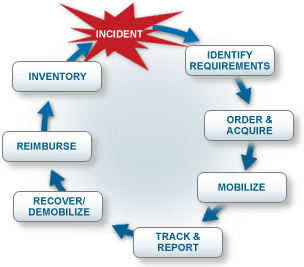
Resource management is one of the most complex aspects of emergency management.  The resource management cycle could be seen as a microcosm of the emergency management cycle with a number of steps operating in sequence and some simultaneously before, during, and after a disaster.  We need to properly establish our resource management systems, procedures, and policies and keep them, as well as our inventories, up to date.

Referencing the Core Capabilities, the capabilities of Public and Private Services and Resources, Planning, Critical Transportation, and Operational Coordination all have bearing on resource management.  Resource management is also one of the key components of NIMS.  The following graphic on the resource management cycle comes from NIMS doctrine.  While this is largely a logistics issue, the importance of it all cuts across all levels of all organizations.

NIMS Resource Management Cycle

NIMS Resource Management Cycle

Consider each of the steps identified in the resource management cycle.  There is quite a bit of complexity to each.  An additional challenge is that they are always in motion as requirements regularly change, new resources are obtained, and obsolete resources are retired from service.  Often one change in a step of the cycle requires changes cascading to other steps.  Also consider the variety of people involved in each step.  No one agency or department has all the resources, therefore we are relying on information from others to create a common operating picture of resource management.  Additionally, the regularity of changes in this information require us to have establish and maintain a system which allows for real-time tracking of this information.

Any information can be viewed in a variety of manners.  A fairly simple web-based tool can allow for multiple stakeholders to input data and change resource status, but the display of that information the reporting available from such as system allows for better utility.  The integration of GIS can help us identify not only where our resources are, but what their status is (NIMS provides us with three resources status indicators: Assigned, Available, and Out of Service), as well as detailed information on the resource such as the kind and type (again, these are NIMS-driven definitions that describe the capability of a resource), the owner of the resource along with contact information, and other information including technical, operational, and maintenance information.

In a pre-incident condition we should know what we have, what capability of those resources, and the conditions for deployment.  Operating under ICS, once an incident occurs, Logistics obtains resources for the incident where tracking becomes the responsibility of the Resource Unit in the Planning Section.  After an incident, these resources return to their owners where they are maintained and re-inventoried.  Depending on the incident, owners may be reimbursed for their use which requires reporting on a variety of metrics.

Wildfire incident management practices brought us the T-Card system – a great low-tech way of tracking incident resources.  A T-Card system is easy to learn and deploy and does a great job of tracking resources but can be very labor intensive and certainly has a delay in reporting.  I’ve also used spreadsheets and stand alone databases, which allow for more flexibility and automated reporting, but still suffer from a delay with a single point of data input and management.  Networked systems allow for immediate inclusion of staging areas, bases, and other mobilization or stockpile areas and are suited for simple and complex incidents.  Consider leveraging technology to maximize your resource management common operating picture on both a daily basis and for incident management.  Of course it’s always good to have a low-tech back up (and the know-how to use it!).

What systems do you have in place for resource management?  What best practices have you identified?

© 2014 Timothy Riecker


FEMA National Preparedness System Updates

This afternoon EMForum.org hosted Donald ‘Doc’ Lumpkins, the Director of the National Integration Center from the National Preparedness Directorate. Doc had some great information on their current and near future activities regarding updates to the National Incident Management System (NIMS) and new Comprehensive Preparedness Guides (CPGs) expected to be released this year.  This is great news as we are always seeking additional national guidance and revisions which help us to maintain standards of practice.

Regarding NIMS, the guiding document has not been revised since 2008.  Doc specifically mentioned updates to NIMS to include:

  • the National Preparedness Goal and the National Preparedness System
  • Expanding NIMS across all five mission areas (Prevention, Protection, Mitigation, Response, and Recovery)
  • Encouraging whole community engagement and understanding
  • Continued emphasis that NIMS is more than just the Incident Command System (ICS)
  • Integrating incident support structures (such as EOCs – more on EOCs later)
  • Integrating situational awareness content
  • Incorporating lessons learned from exercises and real world events (Doc mentioned his office’s activity of culling through LLIS.gov to gain much of this information)
  • Including stakeholder feedback in the revision efforts
  • NIMS update activities will be conducted through the summer with an expected release of a new document this fall

As a significant component of the NIMS update, there will also be continued efforts to update the resource typing list.  Priority will be given to resources which are often requested.

The next topic of discussion was the Comprehensive Preparedness Guides (CPGs).  I was very excited to see a list of likely and potential CPGs either currently under development or expected to be developed soon.  These included:

  • Updating CPG 101
  • A CPG for Strategic Planning (This should shape out to be excellent guidance and essentially serves as a ‘catch all’ for many of the strategic planning tasks we do in emergency management)
  • Incident Action Planning (Doc said this will not be anything new or a replacement of best practices such as the Planning P.  Rather this document will serve to capture these best practices and ensure currency and critical linkages)
  • Planning for mass casualty incidents
  • Social media (a critical aspect of emergency management that is still changing regularly, and I don’t yet feel that we have a firm grasp on it and how to best use it.)
  • Access/Re-Entry to disaster sites
  • Improvised Explosive Devices (crafting hazard-specific annexes)
  • EOC guidelines (I’m hoping this document, while outlining best practices, provides flexibility for different management models of EOCs)
  • Search and rescue management

I’ve come to greatly appreciate that the National Preparedness System is a blanket thrown over the five mission areas, recognizing that each mission area (again – Prevention, Protection, Mitigation, Response, and Recovery) must be prepared for at every level of government to achieve the greatest measure of effectiveness.  There are many critical linkages within preparedness that are found within each or at least most mission areas and the continued efforts of the National Preparedness Directorate seem to be going in a good direction and incorporating the right people and information in their efforts.  Within this frame of thought, Doc mentioned that all of these efforts will utilize subject matter experts from across the country, with many drafts having public comment periods.  Be on the look out for these (I’ll post them as I see them) and be sure to review and comment on them.

As a final note, this was the last broadcast for EMForum.  After 17 years they are shutting down their program.  There has been no mention as to why they are shutting down.  While I’ve not attended every webinar, I do catch a few each year when the topic and/or speaker interest me.  The loss of EMForum is a loss to emergency management and the spirit of sharing information we have.  Through EMForum, there have been many great webinars, such as this one, where new programs and best practices are shared.  I’m hopeful the function that EMForum has served in facilitating this soon replaced so we can continue to stay up to date on what is transpiring.

©2014 Timothy Riecker