Building a System of Response

On even relatively simple incidents, multiple agencies respond, each with their own priorities, objectives, and authorities.  Even on these small and fairly routine incidents, agencies will complain about one another, typically from a lack of understanding of their role and priorities at an incident scene.  On-scene conflict between police and fire departments is almost cliché, but if you’ve been in this business for a while, you’ve certainly seen it occur.

The number of agencies and interests often expands with great leaps and bounds as the size, duration, and complexity of an incident grows.  While we have incident management systems (such as the incident command system or ICS) which help us to organize and manage the multitude of resources and interests involved during an incident, it’s critical that we have a better understanding and accountability of these agencies and interests before a complex incident occurs.  How can this best be done?

Management Level

Establishing this mutual understanding and accountability is the foundation of a system of response.  From the broadest levels, this is established in the National Response Framework, which is a national-level document describing how the US Federal government organizes to response to large incidents, but also identifies, in general terms, the roles and responsibilities of state, local, tribal, private, nonprofit, faith-based, and community stakeholders; along with how they interrelate during a response.  In the US, states have their own emergency operations plans, which further narrow this perspective within their state, addressing their own unique hazards, resources, laws, and ways of operating.  County and local governments, individual agencies, organizations, and others can and often times do have their own plans with a continually refined focus.

It is through the creation and ongoing maintenance of these planning documents where our system of response is first built.  Dialogue and understanding among the stakeholders are essential.  We must learn who are partners are in emergency response (and mitigation, recovery, prevention, and protection, for that matter) and what their interests and objectives are.  Sometimes those partners are asked to participate, other times they simply arrive on scene, leaving local responders and the person in charge feeling insecure and frustrated.  In your planning efforts, try to anticipate who might be involved in a critical incident so you can better anticipate those needs.

Responder Level

To further this understanding, especially with those who may find themselves working directly with responders of other agencies, it is important to train and exercise together.  Joint training and exercises give responders an opportunity to navigate course and exercise objectives together, leveraging their own knowledge, experience, and capabilities along with those of others; increasing the value of the learning experience as well as their aptitude for joint operations.

Many training courses are well suited for mixed audiences – from the management and planning level to the tactical level.  Incident command system courses, which all responders should take to an appropriate level, are also ideal for this, especially since they should encourage discussion about operational priorities, objectives, and strategies.  Additionally, courses that are heavy in scenario-based training can greatly maximize this synergy, since they are a combination of training and structured exercises.  Courses that use simulation tables are excellent for cross-discipline integration.

Joint training and exercises might not always be practical, especially for those new to their field of practice.  Acknowledging that, consider including information on the other disciplines within the basic or academy-level training that is conducted.  A brief amount of time spent on the legal authorities, priorities, and operational objectives of partner disciplines can be valuable to creating understanding on a complex incident.

Keep it Going

As with all preparedness efforts, ‘one and done’ is not a mantra you want to follow.  To be effective, contemporary, and impactful; you have to build a legacy program.  As the program continues, strive to constantly improve.  Don’t only keep plans up to date, but create procedures on integration that lead to an effective system of response.  Use training to support these plans and procedures and use exercises as both an opportunity for practice as well as an opportunity to identify strengths and areas for improvement within the plans and procedures.  Joint exercises will help identify areas that need to be addressed, such as interoperable communications, conflicting protocols, and competing priorities.  It’s better to identify and address these matters now than during a critical incident.

© 2016 – Timothy Riecker, CEDP

Emergency Preparedness Solutions, LLC Your Partner in Preparedness

Using Departmental Operations Centers for Incident Management Success

Increasingly, government agencies and departments are identifying the benefits of establishing and activating departmental operations centers (DOCs) to help manage their responses to incidents.  At the Vermont Vigilant Guard 2016 exercise, which concluded last week, I had some opportunity to discuss the benefits of DOCs, particularly with an agency who used theirs for the first time in this exercise.

For most agencies, a DOC can relieve agency representatives in an EOC from also having to manage and track their agency’s response activity.  In an EOC, an agency representative is largely a conduit for communication and they provide knowledge of their agency and their agency’s capabilities as they contribute to the greater discussions within the EOC.  According to NIMS/ICS, an agency representative should have some decision-making capability for their agency, although political and practical realities often dictate otherwise.  The overall scope of activity for an agency representative in an EOC largely precludes them from also managing the details of their agency’s response, particularly if that response is even moderately complex.

A DOC is the ideal location from which an agency can oversee and coordinate their own response to an incident.  They can deploy and track resources, address internal logistics matters, and coordinate external logistics matters back through their agency representative at the EOC.  DOCs are also an excellent application for large agencies, which may have a variety of technical functions organized throughout, such as a health department or transportation department.  Pulling together representatives from each organizational element within the agency to collectively troubleshoot, problem solve, and share resources, is excellent use of a DOC.  In a way, this application of a DOC could be considered similar to a multi-agency coordination center (MACC).

Does a DOC need to mirror NIMS/ICS (or the new Center Management System) standards?  While there is no set standard for organizing and managing a DOC, there are a lot of applications of ICS that can certainly be applied.  If you look at the main activities of your DOC, you will see where opportunities for integration of ICS principles exist.  Consider that a DOC should have and maintain good situational awareness.  While much of this can be provided by the EOC, the EOC may (should) be looking for some specific information from your agency.  A situation unit within your DOC would certainly be helpful.  Likewise, DOCs often address tactical or near-tactical application, by deploying and directing resources from throughout their agency.  Having a resource unit within your DOC will help tremendously in the tracking of these resources.  Depending on the size and scope, it may be prudent for your DOC to establish an incident action plan (IAP) of its own.

Logistics, mentioned earlier, may be another need within a DOC.  Certainly an element of finance is important for the approval of procurements and tracking of costs within the agency related to the incident.  If resources are being deployed, someone should be in charge of operations.  Lastly, any organization needs to maintain someone in charge.  A DOC Manager would be the ideal generic term for this position.

What are the draw backs of establishing a DOC?  First of all, it’s an additional layer of incident management.  While possibly necessary based on factors discussed earlier, adding layers of incident management can make incident management more complex, especially if roles of each layer and function are not well defined.  The best way to address this is pre-planning!  Staffing can also be a significant concern.  Many agencies may be too small to warrant, much less have staff available, for a DOC.  If such is the case, just as in other applications of ICS, you should be able to collapse down to a manageable size.

An often seen pitfall of DOCs is that they can quickly devolve into a management by committee type of structure; particularly with larger agencies where senior staff, who are used to regular meetings with each other, are now representing their functional interests within the DOC.  I’ve seen this result in what is essentially one endless meeting, interrupted by phone calls and emails which introduce new problems and perpetuate more discussion.  Strong leadership is absolutely required to ensure that a group such as this stays focused and on task, resolving issues on a timely basis.

Overall, the use of Departmental Operations Centers is a smart practice.  Work internally to plan their use, scoping out when and how it will be applied, where it will be located, the organization to be used, and how it is integrated into the overall incident management effort.  Once plans are developed and appropriate training is performed, exercise the plan to identify areas for improvement, turning those into corrective actions, and implementing them for continued success.

© 2016 – Timothy Riecker, CEDP

Emergency Preparedness Solutions, LLC – Your Partner in Preparedness
A Review and 3 Highlights of the DHS Active Shooter Preparedness Workshop

Last month I had the opportunity to attend a day-long active shooter workshop in Rochester, NY conducted by the DHS Office of Infrastructure Protection.  The focus was awareness of, preparedness for, and response to an active shooter event, with a lean towards a facilities-based audience rather than public safety.

The workshop began with discussions on recognition, then worked through each of the five mission areas (Prevention, Protection, Mitigation, Response, and Recovery).  The primary speaker was excellent, with real-world experience in active shooter situations.  While they referred to the offering as a pilot, the workshop has been around for a few years in various versions.  Understandably, and unfortunately, it’s difficult for the workshop to keep up with lessons learned from recent events.

As mentioned, the workshop weaves through the five mission areas, rather awkwardly trying to also align with the CPG 101 planning process.  I’m not sure that the two really fit well and it was clearly something new to the course, as the primary speaker missed some of the indicators for activities.  The workshop agenda also fell short, with the facilitators clearly offering a higher than usual number of breaks and of longer than usual length to maintain the workshop as a full day.

The activities were table-based, and focused on the primary steps as outlined in CPG 101, with the goal of giving some ideas and structure to the creation of an active shooter preparedness plan for a facility.  Ideas and discussion generated at our table and others were great, as attendees came from a broad array of facilities, such as schools, night clubs, health care, office buildings, and others.  The most disappointing comments were those about roadblocks people faced within their own organizations in planning and other preparedness activities for active shooters.  There is clearly a lot of denial about these incidents, which will only serve to endanger people.

With a number of public safety professionals in attendance, there was some great reflection on coordination with public safety in both preparedness and response.  One of the gems of the workshop was the number of audio and video clips provided throughout.  The segments included media and 911 clips, as well as post incident interviews with victims and responders.  The insight offered by these was excellent and they were a great value add.

Three pieces of information resonated above all others in this workshop:

  • Run, Hide, Fight (or variants thereof) was stressed as the best model for actions people can take in the event of an active shooter.
  • The inclusion of planning for persons with disabilities is extremely important in an active shooter situation. They may have less of an ability to Run, Hide, and/or Fight, and this should be accounted for in preparedness measures.
  • Essential courses of action for planning include:
    1. Reporting
    2. Notification
    3. Evacuation
    4. Shelter in Place
    5. Emergency Responder Coordination
    6. Access Control
    7. Accountability
    8. Communications Management
    9. Short Term Recovery
    10. Long Term Recovery

Since the workshop was in pilot form, there were no participant manuals provided, which a number of people were hopeful to have.  They did, however, provide a CD with a plethora of materials, including references, some videos, and planning guides.  Many of these I’ve seen and used before, but some were new to me.  There was a commitment to send us all an email with a link to a download of the participant manual once it was available.  Some of those resources can be found here.

All in all, this was a good workshop.  The mix of an audience (numbering over 60, I believe) contributed to great discussion and the primary speaker was great.  The presentation materials were solid and provided a lot of context.  While I was disappointed in the lack of a participant manual and the inclusion of too many breaks, I certainly understand that this is the pilot of a redeveloped program which they are trying to keep as timely and relevant as possible.  While I already knew of many of the concepts and standards, there was some great material and discussion, especially in the context of facilities rather than public safety response.  This is a good program which I would recommend to facility owners, managers, and safety/emergency management personnel as well as jurisdiction emergency management and public safety personnel.

© 2016 – Timothy Riecker, CEDP

Emergency Preparedness Solutions, LLC Your Partner in Preparedness

Five Guidelines for Creating Effective Disaster Exercise Injects

While there is a lot of important and necessary planning that takes place before the development of exercise injects can even be considered, injects themselves are where the proverbial rubber meets the road.  How we craft those injects can often times make or break the conduct of the exercise.  Injects provide context, as if the events of the exercise were occurring in real life.  While we try to avoid delivering injects that directly prompt player responses, injects will often provide information which will lead players to react to the information provided.  Here are five guidelines to help you develop effective exercise injects:

  1. Injects must be purposeful and each one must relate back to one or more exercise objectives. Far too often we see injects that have no real bearing on the objectives of the exercise.  These are simply distractions and lead to busy work.  Keep things focused.  Just a few well-crafted injects can engage a number of players in active discussion or activity.
  2. Realistic injects are a must. While there will always be a grumble from some people claiming that something would ‘never happen that way’, due diligence must go into ensuring that injects are as realistic and grounded as possible.
  3. Be aware of who an inject would actually originate from. A common mistake I see is injects being scripted to originate from inappropriate sources.  This distracts from reality.  Also, injects should never originate from a player.
  4. Be flexible and aware. Sometimes players accomplish what they need to without an inject.  In that event, there may not be a need to use that inject.  Similarly, players may not respond to an inject as expected, so further action on the part of the Facilitators/Controllers/Simcell may be needed.
  5. Always have backups! As you build your Master Scenario Events List (MSEL), maintain a side list of contingency injects that can be used to speed up or slow down the exercise, or to address occurrences where players did not respond as expected.

Thoughts and ideas on these and other guidelines are always welcome!

© 2016 – Timothy Riecker, CEDP

Emergency Preparedness Solutions, LLC Your Partner in Preparedness!

Achieving Coordination Through Unity of Effort

WESA 90.5, Pittsburgh’s NPR News Station, posted an interesting article titled ‘Trump Rally To Blame for Emergency Response Revamp’.  As the articles tells the story, an internal City committee spent several weeks reviewing communications and other information after an April rally in which three were arrested and four police officers suffered minor injuries.  The findings of the committee’s work included the discovery of fractured planning and response within the City of Pittsburgh.  Assuming this has been a regular practice, I’m surprised it took them this long to discover the issue and begin work to address it – although when a jurisdiction functions in a fractured fashion, it’s an easy observation to miss.

The City’s Public Safety Director stated a new system is being implemented in which a ‘unified and streamlined approach to planning’ and a ‘clearer chain of command’ will be put in place.  The article indicates that the City’s Emergency Management Office will have more of a role in coordination.

It’s good to see that Pittsburgh is making some changes to how they plan for and respond to incidents.  This should serve as a role model for a significant number of jurisdictions across the nation – and I’m sure across the world – which have siloed planning and response, with each agency conducting their own activities with little to no coordination.  Proper and safe emergency management requires a team approach, and every team needs someone to coordinate and lead.  This doesn’t necessarily mean that emergency management is in charge – in fact I feel it’s a rare occasion that emergency management should be in charge – but coordination is still an essential element of success, particularly for complex planning and operations.

The term ‘unity of effort’ is gaining more and more traction through the years.  I first heard it probably ten or twelve years ago.  I was pleased to see the intention of adding the term officially to our lexicon in the draft NIMS Refresh document that was released a couple months back.  Although it was just a mention, it was rather encouraging.  Unity of effort doesn’t require an emergency management office or an emergency manager, but having a central point of coordination helps – especially one that isn’t focused or constrained by the mission and tactics of other public safety agencies.  The mission of emergency management IS coordination!

How do you rate the public safety coordination in your jurisdiction?  Is there room for improvement?  While politics are often at play, sometimes it just takes a good measure of facilitation to bring people together in one room and talk about what needs to be accomplished.

© 2016 – Timothy Riecker, CEDP

Emergency Preparedness Solutions, LLC – Your Partner in Preparedness

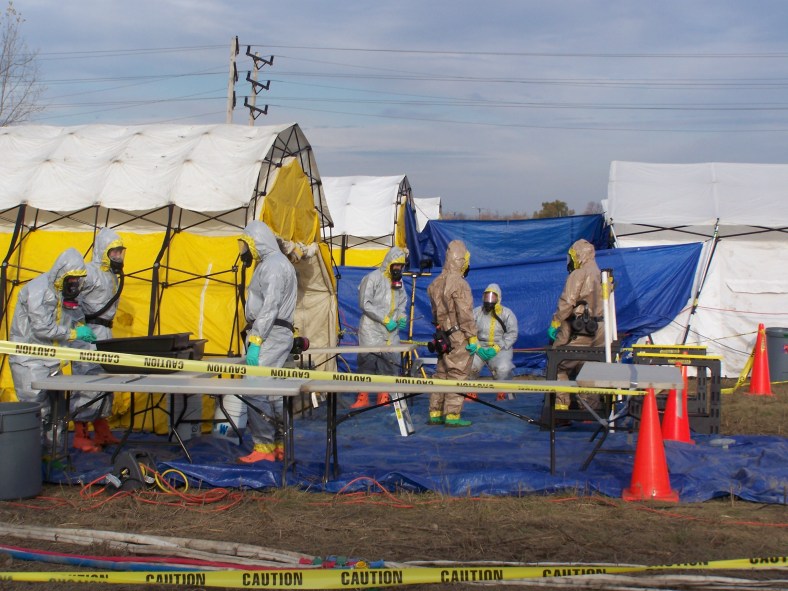
A Decontamination Game Changer

Last week, the way we remove chemical contamination from victims of a terror attack or chemical accident has changed… well, not quite yet, but it should soon.  A partnership between the US Department of Health and Human Services’ (HHS) Office of the Assistant Secretary for Preparedness and Response (ASPR) and the University of Hertfordshire in England and Public Health England found that “…removing clothes removes up to 90 percent of chemical contamination and wiping exposed skin with a paper towel or wipe removes another nine percent of chemical contamination.  After disrobing and wiping with a dry cloth, showering and drying off with a towel or cloth provides additional decontamination, bringing contamination levels down 99.9 percent.”

100_2534

Essentially, what they discovered was that despite recommendations for doing so, victims have often not been required to disrobe for decontamination.  When victims would progress through a decontamination (water spray down), much of the chemical they have been exposed to remains in the clothing and trapped against the skin.  Clearly this is not effective.

I see this new methodology being a significant change to how we decontaminate victims.  As the study hypothesizes, decontamination is much more effective when the chemical is wiped from the body after the victim disrobes.  Following this, they may progress then through a water spray.  This, essentially, adds a step to the typical protocols used in North America, Europe, and other locations.  I’m told the wipe methodology has been used in Japan for some time now.  I also believe that wipes have been in use by the US (and other) military forces for units in the field.

Links of interest:

HHS Press Release on the study.

Implementation of new protocols in the UK and other European nations

Many thanks to my colleague Matt for passing this information on to me.

As with any new procedure, the devil is in the details.  Standards must be established and adopted, supplies and equipment must be identified and obtained, personnel must be trained, and exercises must be conducted to validate.

I’m interested to hear opinions on these findings and recommendations, as well as thoughts on implementation in the US and abroad.

© 2016 – Timothy Riecker, CEDP

Emergency Preparedness Solutions, LLC Your Partner in Preparedness


Emergency Management – Who Knows About Your Plans?

In emergency management and homeland security we put a lot of emphasis on planning.  Plans are important, afterall.  We need to take the time to identify what our likely hazards are and how we will address them.  But what happens when the plan is complete?  We congratulate members of the planning team and send them final copies.  Those copies get filed electronically or end up on a shelf, a trophy of our accomplishment and hard work.  Congratulations!

So… that’s it?  Is that all?

NO!  Of course not!  People need to be trained to the plan.  “Trained?” you ask.  Yes – trained.  Not just sent a copy and told to review it.  Let’s be honest, here.  Even assuming the highest degree of dedication and professionalism, many people simply won’t give it the time and attention it needs.  Very quickly the plan will get buried on their desks or the email will become one of dozens or hundreds in the inbox.  Even if they do give it a look through, most will only give a quick pass through the pages between meetings (or during a meeting!), not giving much attention to the details in the plan.

How effective do you expect people to be?

Sports analogy – when a coach creates new plays, do they simply give them to the players to become familiar with and expect proficiency?  No.  Of course not.  We’re all familiar with the classic, if not cliché, setting of the coach reviewing plays on a chalk board with the players in a locker room.  That’s training.  Then after that training, they go out in the field and practice the plays.

Back to our reality… The first real step of making people familiar with the plan is to review it with them.  This usually doesn’t need to be a sleep inducing line-for-line review of the plan (unless it is a detailed procedure), but a review of the concepts and key roles and responsibilities.  In fact, that’s who you invite to the training – those who are identified in the plan.  This is likely to include people in your own agency as well as people in other agencies (emergency management, after all, is a collaborative effort).  In states with strong county governments, we often see county-level emergency management offices creating plans that dictate or describe the activities of local governments and departments.  Most often, the local departments have no awareness of these plans, much less receive any training on them.  I’m guessing that plan won’t work.

Once you’ve trained these key stakeholders, be sure to conduct exercises on various aspects of the plan.  Exercises serve not only to validate plans, but to also help further familiarize stakeholders with the plan, their roles, and expectations of others.  When we plan, we tend to make many assumptions which exercises help to work through.  Through exercising we also identify other needs we may have.

Need help with planning? Training? Exercises?  EPS can do it!  Link below.

© 2016 – Timothy Riecker

Emergency Preparedness Solutions, LLC 


So Your AAR Says Bad Things… Now What?

There it is.  Your recently delivered after action report (AAR).  Uncomfortably sitting across the room from you.  You eye it like Tom Hanks looking at Wilson for the first time.

Wilson

Wilson!!!

You know what’s in it.  It says bad things.  Things you don’t like.  Things your boss really doesn’t like.  But what will you do?

First, let’s assume that, despite you being unhappy with the areas for improvement identified in the AAR, they are fair representations.  What will you do with the dreaded information now that you have it?  Your AAR may have come with a corrective action plan (CAP), but this is only guidance that still needs to be reviewed and acted upon.

First, each identified area for improvement should be prioritized.  After all, if everything is important, then nothing is important.  Even if the areas for improvement and/or corrective actions are already identified in the AAR (particularly if done by a third party or if the AAR is representative of a multi-agency exercise) you should review this prioritization with your own organization’s stakeholders.  This means pulling together a committee (sorry for cursing!) comprised of key areas within your organization.  This may even mean people from areas that may not have participated, such as information technology, as I’m betting there was something in the exercise about computer systems, programs, internet connection, data access, data continuity, etc.  Don’t forget the finance people, either… some fixes aren’t cheap!

Once everyone has had an opportunity to review the AAR, each identified area for improvement should prioritized, at least to the degrees of high, medium, and low; with a secondary filtering of short-term vs long-term projects.  While some may be relatively quick fixes, others can take months, if not years, to accomplish.  Activities should also be identified that are dependent upon others which may need to be completed first (i.e. a procedure needs to be written before it can be trained on).

That’s probably enough for one meeting.  But the people you gathered aren’t cut loose yet… in fact they are pretty much locked in, so you need to be sure that the people you bring together for this corrective action group have the knowledge, ability, and authority to commit resources within their respective areas of responsibility.  Now that activities have been prioritized, it’s time to assign them… this is why involvement of your boss (if you aren’t the boss) is so important.

Some individuals within your organization will be able to act on their own to make the corrective actions that are needed – while others will need to work together to make these happen.  Consider that there may be more activities than just those identified in the AAR.  For example, the AAR may identify a need for a resource management plan.  That’s good, but we all know you can’t just build a plan and expect it to be ready for action.

For those who are regular readers of my blog, you know I’m a big fan of the POETE elements.  (More on POETE here).  What is POETE?  POETE is an acronym that stands for:

  • Planning
  • Organizing
  • Equipping
  • Training
  • Exercising

What is the value of POETE and what does it all mean?  POETE is a great reminder of the key activities we need to do to enhance our preparedness.  Given that, when we look at an identified need for improvement, we need to consider how to properly address it.  So start at the top:

  • What plans, policies, and procedures are needed to implement and support this corrective action?
  • What organizational impact will occur? Do we need to change our organization in any way?  Do we need to form any special teams or committees to best implement this corrective action?
  • What equipment or systems are needed to support the corrective action?
  • What do people need to be trained in to support the corrective action? Do we need to train them in the plan, about a new policy or procedure?  Do they need training on organizational changes?  How about training in the use of equipment or systems?
  • Lastly, once you’ve made a corrective action, it’s a good idea to test it. Exercises are the best way to accomplish this.

There are obviously other considerations depending on the specific corrective actions and the circumstances of your organization.  Funding is often times one of the most significant.  If you need to obtain funding to make corrective actions, the AAR is one of the best documented investment justifications you can get.

From a project management perspective, the committee should regularly reconvene as a matter of checking in to see how the corrective actions are going.  On a continuing basis, the progress of corrections should be tracked (spreadsheets are great for this), along with who has been tasked with addressing it, timelines for completion, related finances, progress notes, etc.  Otherwise, in our otherwise busy days, these things get lost in the shuffle.

From a program management perspective, this is a process that should be engrained culturally into your organization.  Ideally, one person should be responsible in your organization for coordinating and tracking this corrective action process.  As additional exercises are conducted and actual incidents and events occur, corrective actions from these will be brought into the mix.  It is all too often that organizations complain of seeing the same remarks on every AAR or from experiencing the same issues for every response.  BREAK THE CYCLE!  Establishing a corrective action program for your organization will go a long way toward making these chronic issues go away.

By the way, the same concept can be applied to multi-organizational/agency efforts at any level – local, county, state, federal, regional, etc.  Since we respond jointly, there are great benefits to joint preparedness efforts.  We will likely find that even that we have our own house in order, working with someone else is a very different experience and will require a whole new list of corrective actions as we identify areas for improvement.  This process works great with multi-agency committees.

The bottom line – the biggest reason why we exercise is to test our capabilities.  When we test them, we find faults.  Those faults need to be corrected.  Capitalize on the investment you made in your exercise effort to address those identified deficiencies and improve your capabilities.

What ideas do you have for addressing corrective actions?

Need help with preparedness activities?  Be Proactive and Be Prepared™ – Reach out to Emergency Preparedness Solutions!  We’re always happy to help.

Thanks for reading!

© 2015 – Timothy Riecker

Emergency Preparedness Solutions, LLC

Gauging Return on Investment in Preparedness: Exercises

In this last article of the Return on Investment series, I’ll be discussing the investments and benefits of preparedness exercises to help organizations determine their return on investment – or ROI.  The series has followed the model of the five POETE elements (Planning, Organizing, Equipping, Training, Exercising).  The inspiration for the series was a piece I wrote called Measuring Return on Investment in Emergency Management and Homeland Security: Improving State Preparedness Reports.  If you haven’t had the opportunity to review the earlier articles in the series, they are linked below:

Planning

Organizing

Equipping

Training

We conduct preparedness exercises for two main reasons: 1) to test plans and procedures, and 2) to provide people with an opportunity to practice their roles and responsibilities.  Exercises can be stand-alone activities or integrated into training and education through scenario-based learning. In the US we use the Homeland Security Exercise and Evaluation Program (HSEEP) as our model for both the macro and micro levels of exercise management.  If you are interested in an in-depth look on HSEEP and its components, you can check out an earlier series I did called Managing an Exercise Program.

As with most major activities we do, exercise-related tasks can be divided out into program management (the macro level) and project management (the micro level).  Since we usually examine ROI for individual activities, we will focus on the micro level of exercises, that is the project management piece, or individual exercises, to identify specific costs (investments) and benefits.

Conducting an exercise takes a fair amount of preparation.  The more complex the exercise, the greater period of time it should take to prepare.  Complexity of an exercise is measured by a few different factors – the number of participants involved, the span of time for the exercise, the complexity of the tasks/plans being exercised, and the number of locations being exercised.  Most of us who have been involved in emergency management and homeland security for a while have seen the full gamut of exercises – from discussion-based exercises like table top exercises, workshops, and seminars; to operations-based exercises like drills, functional, and full-scale exercises.  Often we view functional and full scale exercises as being the most complex, however I’ve been involved in table top exercises and workshops which have involved significant efforts.

Up front, the most significant investment any organization can make in an exercise is personnel time.  All exercise efforts will have a lead planner, and most will be supported by a planning team.  If the exercise involves only one organization, that planning team will typically involve only internal people, while multi-organizational exercises should involve some measure of representation from every organization, either directly or indirectly.  Planning an exercise requires a great attention to detail, drafting and editing of documents, and arranging of logistical matters.  Experience helps, so those who do this less often will typically require more time to do it.  This is why many organizations hire consultants (like me!) to help them with exercises.

During the planning phase for the exercise, you may have some associated costs, such as meeting space, food, and travel for planning meetings.  You may also have these costs for the exercise itself which should be identified during the planning phase.  It is also important to identify any costs associated with audio-visual equipment, communications equipment (including internet connectivity), and even things as simple as name badges and signage.

For the exercise itself, personnel costs are still significant.  You must not only consider the time of all participants (as well as potential travel costs), but also the time of your exercise management staff – an exercise director, controllers, evaluators, and possibly staff for a simulation cell.  Again, experience helps to support a successful exercise, so if you don’t have the depth of experience in your organization, consider hiring consultants for the conduct and evaluation of the exercise as well.  Either way, exercises can be significant investments.

Once the exercise is complete, the activity isn’t over – and neither are the costs.  The evaluation team needs to draft the after action report (AAR), and conduct an AAR meeting with the planning team and principal participants to ensure that everything was captured accurately.  Once the AAR is finalized, action items identified in the AAR are assigned to responsible parties to address improvements.  These improvements are generally not considered part of the cost of the exercise itself, but rather part of your general preparedness costs (these will all fall within the POETE elements).

While exercises come at no insignificant cost, the benefits are tremendous – if the exercise is done properly.  A well designed, conducted, and evaluated exercise provides better outcomes and benefits.  The AAR should reflect not only best practices that should be continued, but also areas for improvement which should be addressed to enhance preparedness.  Any of these, as mentioned in the last paragraph, can fall within the five POETE elements – Planning, Organizing, Equipping, Training, and Exercising.  While each of these certainly have costs associated with them, the benefit from the exercise was identification and documentation of need.  Perhaps you are exercising a new active shooter response plan and through the exercise realize that a certain procedure was based on poor assumptions – if this plan was put in place without being exercised, the outcomes in a real life event could have been catastrophic.  It’s better to identify these issues through an exercise so they can be addressed with much less cost.

As I mentioned earlier, another reason to exercise is to provide participants with an opportunity to practice plans, procedures, or skills in a safe and structured environment.  While there is a great deal of routine to what we do in emergency management, homeland security, and public safety, there are certainly activities that we don’t do very often, resulting in degradation of skill over time.  Many of these activities, though, are absolutely critical when needed, which means that we must give practitioners ample opportunity to practice and apply what they have learned through training.  The benefits of this, depending on the activity, can include increased efficiency (time), reductions in injury and loss of life, and proper use of equipment and protocols.  Additionally, there are benefits to getting people to work together in these activities, especially for those who don’t usually work together.  Emergency management, after all, is about collaboration.

Because of the wide range of things we exercise, it’s up to you to examine what your investments and benefits might be.  At EPS, we can help you with designing, conducting, and evaluating exercises; identifying potential costs and benefits of an exercise; and other preparedness activities.  We’re happy to help!

Feedback from this return on investment series of posts has been very positive, which I greatly appreciate.  We also got some good dialogue across all mediums including the blog home page (www.triecker.wordpress.com) and various LinkedIn discussion groups – some of which provided some excellent additional ideas on how to better capture information on investments and benefits.  The challenge remains to not only identify these, but to convert them into meaningful information for decision makers, which usually involves currency values.  Thank you, as always, for your time and attention.

© 2015 – Timothy Riecker

Emergency Preparedness Solutions, LLC

Preparing to Use the Incident Command System

For a bit of context, if you haven’t already read them, please take a look at these other ICS related articles I’ve posted:

Incident Command System Training Sucks

ICS Training Sucks… So Let’s Fix It

Preparedness – ICS is Not Enough

The crusade to improve ICS training and implementation continues…

We invest a lot of time and effort into training people in the use of the Incident Command System (ICS).  However, as a broad statement, the training we provide is massively inadequate.  We don’t actually train people to do anything – we simply tell them about ICS through an increasingly repetitive and complex series of courses.  At the risk of being repetitive myself, I refer you to the articles linked above for many of my foundational thoughts on the current state of ICS training.

The ICS core training curriculum aside, we – as both individuals and organizations – need to be better prepared to actually use ICS.  The thought that people are able to use ICS the minute they walk out of an ICS course is totally and completely false.  By ‘use ICS’, I don’t mean to simply function within an organizational chain of command that uses ICS, I’m referring to being a driving force within the system itself.  ICS isn’t something that happens automatically, it requires deliberate and constant actions.  This typically involves functioning at the Command or General Staff levels, but also within many of the subordinate positions which are absolutely critical to managing a complex incident and driving the system.

So how do we prepare to use ICS?  I often refer to the preparedness capability elements of POETE (Planning, Organizing, Equipping, Training, and Exercising) when I’m talking about preparedness activities.  These same concepts apply here.  We need to remember that planning is the foundation of all preparedness efforts.  If it’s not documented, then why are we doing it?  So we have to have plans, polies, and procedures which call for the implementation of ICS and direct us in the nuances of how we will manage an incident.  I’m sure everyone’s plan has taken a page from the NIMS Doctrine and includes language about the requirement to use NIMS and ICS.  That’s all well and good, but like many things in our plans, we don’t reinforce these things enough.

I’m not talking about simply giving NIMS and ICS lip service.  I’m talking about procedure level integration of these concepts.  This begins with good planning, which means plans that are implementation-ready.  Would you consider your plans implementation-ready?  Do they describe how to use the ICS structure and concepts to actually implement the plan?  Maybe yes, maybe no.   If not, your team has some plan updating to do.

Your organization must be ready to respond using ICS.  That means that everyone is familiar with their assigned roles and responsibilities.  Often ICS training falls short of this.  This article: Training EOC Personnel – ICS is Not Enough, details many of the reasons why, at least for an EOC environment.  Many of the points made in the article, however, can be reasonably applied to other environments and organizations.  While ICS provides us with overall concepts, the application of those concepts will differ for various organizations and locations.  Every location, county, region, and state have different protocols which must be integrated into incident management practices.  (Refer back to planning).  Our organizations, both those that are static as well as those which are ad-hoc (assembled for the response to a particular incident or event) need to be ready to act.  This means familiarity not only with ICS or our specific applications of it, but also with our plans.  How often do ICS courses actually talk about the implementation of emergency plans?  Rarely.  Yet that’s what we are actually doing.  Do you have people assigned to ICS roles?  Are they ready to take on the responsibilities within these roles?  Do you have backups to these positions?  I’m not necessarily talking about a formal incident management team (IMT), although that may be suitable and appropriate.  Absent an IMT, the responders within a jurisdiction or organization should have a reasonable expectation of the role/roles they will play.  This helps them and your organization to be better prepared.

The implementation of ICS generally doesn’t take much equipping, but there are some basics.  Responders love radios and we use them often.  How about people who aren’t traditional responders, but may be called on to function with your ICS organization?  Do they know how to use a radio?  Do you have a standing communication plan to help you implement their use?  How do you track incident resources?  I didn’t just ask about fire service resources – I mean all resources.  Do you have a system for this?  T-Cards are great, but take training and practice to use them – plus they require that all responders know their responsibilities for accountability.  The same goes with a computer-based solution.  For whatever equipment or systems you plan on using, you must ensure that they are planned through and that people are very familiar with how to use them.

Training… I think I’ve talked about the need for better ICS training quite a bit, so I’m not going to continue with that point here.  What I will mention is a need for refresher training and jurisdiction-specific training on incident management.  This isn’t necessarily ICS focused, but it is ICS based.  For many years now, FEMA has believed that by including three slides on NIMS in every training program that they are helping with NIMS compliance.  Nothing could be further from the truth.  You have to actually talk about how these concepts are key to implementing plans.  Responders need to be familiar with the emergency management system they are working within.  Train people to the plans and procedures.  Let them know who is in charge of what and when, who the decision makers are, and any other training needs identified in the earlier POETE activities.  Prepare them to implement ICS!

Lastly, exercises.  Incident management should be something that is practiced and tested in almost every exercise.  Applying these concepts is not something we do on a regular basis, therefore knowledge and skills erode over time.  Certainly we have to be familiar with the system, not just at an awareness level but at a functional and operational level.  Regardless of the state of the current curriculum, that involves practice.  Exercises don’t have to be elaborate, remember that they can range from discussion-based to operations-based.  Table top exercises are great to talk things through, drills are good for focused activities, and even full-scale exercises can be small and contained.  So long as the exercise is designed, conducted, and evaluated well, that’s what counts.  Don’t forget that evaluation piece.  The feedback to the entire system (plans, organization, equipment and systems, and training) is extremely important to continued improvement.

This is public safety, not a pick-up kick ball game.  We can do better.

Thanks for listening… what are your thoughts?

Does your organization or jurisdiction need help preparing to implement ICS?  Emergency Preparedness Solutions can help!

© 2015 – Timothy Riecker

Emergency Preparedness Solutions, LLC