Using Departmental Operations Centers for Incident Management Success

Increasingly, government agencies and departments are identifying the benefits of establishing and activating departmental operations centers (DOCs) to help manage their responses to incidents.  At the Vermont Vigilant Guard 2016 exercise, which concluded last week, I had some opportunity to discuss the benefits of DOCs, particularly with an agency who used theirs for the first time in this exercise.

For most agencies, a DOC can relieve agency representatives in an EOC from also having to manage and track their agency’s response activity.  In an EOC, an agency representative is largely a conduit for communication and they provide knowledge of their agency and their agency’s capabilities as they contribute to the greater discussions within the EOC.  According to NIMS/ICS, an agency representative should have some decision-making capability for their agency, although political and practical realities often dictate otherwise.  The overall scope of activity for an agency representative in an EOC largely precludes them from also managing the details of their agency’s response, particularly if that response is even moderately complex.

A DOC is the ideal location from which an agency can oversee and coordinate their own response to an incident.  They can deploy and track resources, address internal logistics matters, and coordinate external logistics matters back through their agency representative at the EOC.  DOCs are also an excellent application for large agencies, which may have a variety of technical functions organized throughout, such as a health department or transportation department.  Pulling together representatives from each organizational element within the agency to collectively troubleshoot, problem solve, and share resources, is excellent use of a DOC.  In a way, this application of a DOC could be considered similar to a multi-agency coordination center (MACC).

Does a DOC need to mirror NIMS/ICS (or the new Center Management System) standards?  While there is no set standard for organizing and managing a DOC, there are a lot of applications of ICS that can certainly be applied.  If you look at the main activities of your DOC, you will see where opportunities for integration of ICS principles exist.  Consider that a DOC should have and maintain good situational awareness.  While much of this can be provided by the EOC, the EOC may (should) be looking for some specific information from your agency.  A situation unit within your DOC would certainly be helpful.  Likewise, DOCs often address tactical or near-tactical application, by deploying and directing resources from throughout their agency.  Having a resource unit within your DOC will help tremendously in the tracking of these resources.  Depending on the size and scope, it may be prudent for your DOC to establish an incident action plan (IAP) of its own.

Logistics, mentioned earlier, may be another need within a DOC.  Certainly an element of finance is important for the approval of procurements and tracking of costs within the agency related to the incident.  If resources are being deployed, someone should be in charge of operations.  Lastly, any organization needs to maintain someone in charge.  A DOC Manager would be the ideal generic term for this position.

What are the draw backs of establishing a DOC?  First of all, it’s an additional layer of incident management.  While possibly necessary based on factors discussed earlier, adding layers of incident management can make incident management more complex, especially if roles of each layer and function are not well defined.  The best way to address this is pre-planning!  Staffing can also be a significant concern.  Many agencies may be too small to warrant, much less have staff available, for a DOC.  If such is the case, just as in other applications of ICS, you should be able to collapse down to a manageable size.

An often seen pitfall of DOCs is that they can quickly devolve into a management by committee type of structure; particularly with larger agencies where senior staff, who are used to regular meetings with each other, are now representing their functional interests within the DOC.  I’ve seen this result in what is essentially one endless meeting, interrupted by phone calls and emails which introduce new problems and perpetuate more discussion.  Strong leadership is absolutely required to ensure that a group such as this stays focused and on task, resolving issues on a timely basis.

Overall, the use of Departmental Operations Centers is a smart practice.  Work internally to plan their use, scoping out when and how it will be applied, where it will be located, the organization to be used, and how it is integrated into the overall incident management effort.  Once plans are developed and appropriate training is performed, exercise the plan to identify areas for improvement, turning those into corrective actions, and implementing them for continued success.

© 2016 – Timothy Riecker, CEDP

Emergency Preparedness Solutions, LLC – Your Partner in Preparedness

A Review and 3 Highlights of the DHS Active Shooter Preparedness Workshop

Last month I had the opportunity to attend a day-long active shooter workshop in Rochester, NY conducted by the DHS Office of Infrastructure Protection.  The focus was awareness of, preparedness for, and response to an active shooter event, with a lean towards a facilities-based audience rather than public safety.

The workshop began with discussions on recognition, then worked through each of the five mission areas (Prevention, Protection, Mitigation, Response, and Recovery).  The primary speaker was excellent, with real-world experience in active shooter situations.  While they referred to the offering as a pilot, the workshop has been around for a few years in various versions.  Understandably, and unfortunately, it’s difficult for the workshop to keep up with lessons learned from recent events.

As mentioned, the workshop weaves through the five mission areas, rather awkwardly trying to also align with the CPG 101 planning process.  I’m not sure that the two really fit well and it was clearly something new to the course, as the primary speaker missed some of the indicators for activities.  The workshop agenda also fell short, with the facilitators clearly offering a higher than usual number of breaks and of longer than usual length to maintain the workshop as a full day.

The activities were table-based, and focused on the primary steps as outlined in CPG 101, with the goal of giving some ideas and structure to the creation of an active shooter preparedness plan for a facility.  Ideas and discussion generated at our table and others were great, as attendees came from a broad array of facilities, such as schools, night clubs, health care, office buildings, and others.  The most disappointing comments were those about roadblocks people faced within their own organizations in planning and other preparedness activities for active shooters.  There is clearly a lot of denial about these incidents, which will only serve to endanger people.

With a number of public safety professionals in attendance, there was some great reflection on coordination with public safety in both preparedness and response.  One of the gems of the workshop was the number of audio and video clips provided throughout.  The segments included media and 911 clips, as well as post incident interviews with victims and responders.  The insight offered by these was excellent and they were a great value add.

Three pieces of information resonated above all others in this workshop:

  • Run, Hide, Fight (or variants thereof) was stressed as the best model for actions people can take in the event of an active shooter.
  • The inclusion of planning for persons with disabilities is extremely important in an active shooter situation. They may have less of an ability to Run, Hide, and/or Fight, and this should be accounted for in preparedness measures.
  • Essential courses of action for planning include:
    1. Reporting
    2. Notification
    3. Evacuation
    4. Shelter in Place
    5. Emergency Responder Coordination
    6. Access Control
    7. Accountability
    8. Communications Management
    9. Short Term Recovery
    10. Long Term Recovery

Since the workshop was in pilot form, there were no participant manuals provided, which a number of people were hopeful to have.  They did, however, provide a CD with a plethora of materials, including references, some videos, and planning guides.  Many of these I’ve seen and used before, but some were new to me.  There was a commitment to send us all an email with a link to a download of the participant manual once it was available.  Some of those resources can be found here.

All in all, this was a good workshop.  The mix of an audience (numbering over 60, I believe) contributed to great discussion and the primary speaker was great.  The presentation materials were solid and provided a lot of context.  While I was disappointed in the lack of a participant manual and the inclusion of too many breaks, I certainly understand that this is the pilot of a redeveloped program which they are trying to keep as timely and relevant as possible.  While I already knew of many of the concepts and standards, there was some great material and discussion, especially in the context of facilities rather than public safety response.  This is a good program which I would recommend to facility owners, managers, and safety/emergency management personnel as well as jurisdiction emergency management and public safety personnel.

© 2016 – Timothy Riecker, CEDP

Emergency Preparedness Solutions, LLC Your Partner in Preparedness

Five Guidelines for Creating Effective Disaster Exercise Injects

While there is a lot of important and necessary planning that takes place before the development of exercise injects can even be considered, injects themselves are where the proverbial rubber meets the road.  How we craft those injects can often times make or break the conduct of the exercise.  Injects provide context, as if the events of the exercise were occurring in real life.  While we try to avoid delivering injects that directly prompt player responses, injects will often provide information which will lead players to react to the information provided.  Here are five guidelines to help you develop effective exercise injects:

  1. Injects must be purposeful and each one must relate back to one or more exercise objectives. Far too often we see injects that have no real bearing on the objectives of the exercise.  These are simply distractions and lead to busy work.  Keep things focused.  Just a few well-crafted injects can engage a number of players in active discussion or activity.
  2. Realistic injects are a must. While there will always be a grumble from some people claiming that something would ‘never happen that way’, due diligence must go into ensuring that injects are as realistic and grounded as possible.
  3. Be aware of who an inject would actually originate from. A common mistake I see is injects being scripted to originate from inappropriate sources.  This distracts from reality.  Also, injects should never originate from a player.
  4. Be flexible and aware. Sometimes players accomplish what they need to without an inject.  In that event, there may not be a need to use that inject.  Similarly, players may not respond to an inject as expected, so further action on the part of the Facilitators/Controllers/Simcell may be needed.
  5. Always have backups! As you build your Master Scenario Events List (MSEL), maintain a side list of contingency injects that can be used to speed up or slow down the exercise, or to address occurrences where players did not respond as expected.

Thoughts and ideas on these and other guidelines are always welcome!

© 2016 – Timothy Riecker, CEDP

Emergency Preparedness Solutions, LLC Your Partner in Preparedness!

ICS Training (Still) Sucks… One Year Later

Just over a year ago, I posted my article Incident Command Training Sucks, which to date has been viewed almost 2000 times on the WordPress blog platform, alone.  Since then, I’ve written several more times on the necessity to change the foundational ICS training curriculum in the US to programs that are focused on application of ICS in initial and transitional response instead of just theory and vague instruction.  I am greatly appreciative of all the support these articles have received and the extra effort so many have taken to forward my blog on to the attention of others.  These posts have led to some great dialogue among some incredible professionals about the need to update ICS training.  Sadly, there is no indication of action in this direction.

A recent reader mentioned that it often ‘takes guts to speak the truth’.  It’s a comment I appreciate, but I think the big issue is often complacency.  We settle for something because we don’t have an alternative.  Also, I’ve found that people are reluctant to speak out against the current training programs because there are so many good instructors or because the system, foundationally, is sound.  My criticisms are not directed at instructors or the system itself – both of which I overwhelmingly believe in.  I’m also not being critical of those who have participated in the creation of the current curriculum or those who are the ‘keepers’ of the curriculum.

Much of the existing curriculum has been inherited, modified from its roots in wildfire incident management, where it has served well.  While adjustments and updates have been made through the years, it’s time we take a step away and examine the NEED for training.  Assessment is, after all, the first step of the ADDIE model of instructional design.  Let’s figure out what is needed and start with a clean slate in designing a NEW curriculum, instead of making adjustments to what exists (which clearly doesn’t meet the need).

Another reader commented that ‘The traditional ICS courses seem to expect the IC to just waive their hands and magically the entire ICS structure just would build beneath them’.  It is phrases we find in the courses such as ‘establish command’ or ‘develop your organization’ that are taken for granted and offer little supporting content or guides to application.  The actions that these simple phrases point to can be vastly complicated.  This is much of the point of Chief Cynthia Renaud’s article ‘The Missing Piece of NIMS: Teaching Incident Commanders to Function on the Edge of Chaos’.  We need to train to application and performance – and I’m not talking about formal incident management teams, I’m talking about the responders in your communities.  The training programs for incident management teams are great, but not everyone has the time or ability to attend these.

I’m hoping that my articles continue to draw attention to this need.  Perhaps the changes that come as a result of the final NIMS refresh will prompt this; hopefully beyond just a simple update to the curriculum giving us a real, needs-based rewrite.  As I’ve mentioned before, this is public safety, not a pick-up game of kickball.  We can do better.

© 2016 – Timothy Riecker, CEDP

Emergency Preparedness Solutions, LLCYour Partner in Preparedness

Achieving Coordination Through Unity of Effort

WESA 90.5, Pittsburgh’s NPR News Station, posted an interesting article titled ‘Trump Rally To Blame for Emergency Response Revamp’.  As the articles tells the story, an internal City committee spent several weeks reviewing communications and other information after an April rally in which three were arrested and four police officers suffered minor injuries.  The findings of the committee’s work included the discovery of fractured planning and response within the City of Pittsburgh.  Assuming this has been a regular practice, I’m surprised it took them this long to discover the issue and begin work to address it – although when a jurisdiction functions in a fractured fashion, it’s an easy observation to miss.

The City’s Public Safety Director stated a new system is being implemented in which a ‘unified and streamlined approach to planning’ and a ‘clearer chain of command’ will be put in place.  The article indicates that the City’s Emergency Management Office will have more of a role in coordination.

It’s good to see that Pittsburgh is making some changes to how they plan for and respond to incidents.  This should serve as a role model for a significant number of jurisdictions across the nation – and I’m sure across the world – which have siloed planning and response, with each agency conducting their own activities with little to no coordination.  Proper and safe emergency management requires a team approach, and every team needs someone to coordinate and lead.  This doesn’t necessarily mean that emergency management is in charge – in fact I feel it’s a rare occasion that emergency management should be in charge – but coordination is still an essential element of success, particularly for complex planning and operations.

The term ‘unity of effort’ is gaining more and more traction through the years.  I first heard it probably ten or twelve years ago.  I was pleased to see the intention of adding the term officially to our lexicon in the draft NIMS Refresh document that was released a couple months back.  Although it was just a mention, it was rather encouraging.  Unity of effort doesn’t require an emergency management office or an emergency manager, but having a central point of coordination helps – especially one that isn’t focused or constrained by the mission and tactics of other public safety agencies.  The mission of emergency management IS coordination!

How do you rate the public safety coordination in your jurisdiction?  Is there room for improvement?  While politics are often at play, sometimes it just takes a good measure of facilitation to bring people together in one room and talk about what needs to be accomplished.

© 2016 – Timothy Riecker, CEDP

Emergency Preparedness Solutions, LLC – Your Partner in Preparedness
How Prepared are US Households?

Within the 2013 American Housing Survey, the United States Census Bureau asked US residents how prepared they were for disasters.  They assembled a great infographic on their findings, which can be found here.  Thanks to Jason S for posting this on LinkedIn last week! (commentary below)

Measuring America: How Ready Are We?

I find many of the numbers to be interesting, and am quite honestly skeptical of several of them.  I’m sure the methodology of the Census Bureau’s survey is sound, but I question some of the results based upon my own interactions with the public regarding preparedness.  I’d be interested in seeing the questions.  I did a bit of digging around and found the Census website for the American Housing Survey, which is located here.  There are a variety of data tables available, including breakdowns related to these preparedness questions, but nothing that I can find that specifically provides the questions.  From what I’ve seen, it appears the survey was only conducted in major metropolitan areas around the US.

Emergency Water Supply: 54.3% of households state that they have at least three gallons of water for each person in the household.  This number seems high to me.  I’m left wondering if some people may have thought this included tap water?

Non-Perishable Emergency Food: 82% of households said they have enough non-perishable food to sustain their family for three days.  Have you looked in your pantry lately?  I fully agree with this number.  You may not be able to make full meals or have them be nutritionally balanced, but I do believe that most pantries can provide adequate sustenance for a family for three days.

Prepared Emergency Evacuation Kit: 51.5% of households say they have one.  Really?  I’m not convinced.

Emergency Meeting Location: 37.4% of households say they have an identified emergency meeting location.  While the number still might be a little high, I think it’s within a realistic range.

Communication Plan: 33% of households say they have a communication plan which includes a contingency for the disruption of cell service.  Same as the previous item, perhaps a little high, but I think it’s in the ballpark.

Evacuation Vehicles: 88.6% of households say they have a vehicle or vehicles able to carry all household members, pets, and supplies up to 50 miles away.  I did a bit of digging around, and this number seems accurate, as about 90% of US households have vehicles.  I’m a bit surprised about how high the number is considering that this survey canvassed major metropolitan areas, though.

Evacuation Funds: 69.8% of households said they have access to up to $2000 in the event of evacuation.  In all, between cash and credit, I can believe this number.  They may have to get out of the disaster area, however, to access funds electronically.

House or Building Number Clearly Visible: 77.5% of households said they have this.  Having worked as a firefighter and EMT for many years, I’d agree that somewhere between 2/3 to ¾ of building numbers are visible.

Generator Present: 18.3% of households say they have a generator present.  All in all a sound number, I believe, but perhaps a bit high for urban areas.

Access to Financial Information: 76.8% of households say they have access to their financial information.  This is a question I’d like to see the wording on, but aside from taking time to dig through old bills, I’m skeptical.  Emergency Financial First Aid Kits are a great idea and should be maintained regularly.

I’m hopeful that many of these numbers are reflections of reality, but even if they are we have a long way to go.  One of the best resources out there is WWW.READY.GOV.  Everyone should check it out and make some progress toward individual and family preparedness.  First responders and emergency managers – this means you, too!

What are your thoughts on these statistics?  Those of you in other nations – what kind of preparedness data have you seen for your country?

Stay safe!

© 2016 – Timothy Riecker, CEDP

Emergency Preparedness Solutions, LLCYour Partner in Preparedness


2016 National Preparedness Report Released

The fifth National Preparedness Report has been released by FEMA.  The National Preparedness Report is based upon, as the report states, input of more than 450 data sources and 190 stakeholders, including 66 non-federal organizations (which would account for state preparedness report submissions and information from Urban Area Security Initiative regions).  The report is intended as a summary of where the nation stands in regard to each of the 32 Core Capabilities outlined in the National Preparedness Goal.

As mentioned, this is the fifth National Preparedness Report to hit the streets.  While they have some value and demonstrate that the data collection that is done is actually collated, I feel that through the years they are offering less meat and more potatoes.  I appreciate the highlighting of best practices for each mission area, but, to me, there is a missed opportunity if a report is simply providing data and not recommendations.  While it’s understood that the goal of the National Preparedness Report is not to provide recommendations (it would also take longer to publish the report, and the people pulling the data together do not likely have the expertise to create recommendations), I’d like to see FEMA (and stakeholders) have follow up efforts to provide recommendations in each mission area and not miss this valuable opportunity to then apply the findings and look forward.

Below, I’ve included their overall findings with a bit of my own commentary.  Overall, I will say that there is nothing eye opening in this report for anyone who pays attention.  It’s pretty easy to guess those Core Capabilities which are at the top and those which are at the bottom.

  • Planning; Public Health, Healthcare, and Emergency Medical Services; and Risk and Disaster Resilience Assessment are the three Core Capabilities in which the Nation has developed acceptable levels of performance for critical tasks, but that face performance declines if not maintained and updated to address emerging challenges.
    • My commentary: BULLSHIT.  If these Core Capabilities are at ‘acceptable levels’, then our standards must be pretty low.  Planning is the one that disturbs me most.  We continue to see plenty of poor plans that are not realistic, can’t be operationalized, and are created to meet requirements (which are typically met by formatting and buzzwords).  Have we improved?  Sure.  But I wouldn’t say we are at ‘acceptable levels’.  As for Public Health, Healthcare, and Emergency Medical Services, we are struggling in certain areas to simply keep our heads above water.  While we are fairly solid in some areas of public health, one only needs to look at the Ebola incident to view how fragile our state of readiness is.  The findings for Planning and Public Health, to me, are nothing but shameful pandering and we need to get realistic about where we are at and the challenges we face.  Gold stars won’t stand up to the next disaster.  As for Risk and Disaster Resilience Assessment I have admittedly less experience personally.  I do know that we have some pretty incredible tools available that can help us determine impacts of various hazards for any given area under a variety of conditions, which is an amazing application of technology.  My concerns here are that there are still many who don’t know about these tools, don’t use them, and/or don’t follow the findings of information from these tools in their hazard mitigation actions.
  • Cybersecurity, Economic Recovery, Housing, and Infrastructure Systems remain national areas for improvement. Two additional Core Capabilities – Natural and Cultural Resources, and Supply Chain Integrity and Security – emerged as new national areas for improvement.
    • My commentary: NO KIDDING. While we have made a great deal of progress on Cybersecurity, we are still far behind the criminal element in most respects.  It also needs to be fully recognized in the National Preparedness Goal that Cybersecurity is a Core Capability common to all five mission areas.  Economic Recovery will always be a challenge, as every community impacted by an incident has a certain way it heals, essentially along the lines of Maslow’s Hierarchy.  A strong local economy is important to this healing, ensuring that the community has access to the resources it needs to rebuild and a return to normalcy.  While I’m sure studies have been done, we need to examine more closely how the economic recovery process evolves after a disaster to identify how it can be best supported.  Housing is the absolutely most challenging Core Capability in the National Preparedness Goal.  While I don’t have a solution for this, I do know that our current approaches, philosophies, and ways of thinking haven’t moved us an inch toward the finish line on this one.  We need to change our current way of thinking to be successful.  As for Infrastructure Systems, I could go on for days about this.  I’ve written previously, several times, (as have many others) on the critically fragile state of our infrastructure.  It’s no big secret.
  • States and territories continue to be more prepared to achieve their targets for Response Core Capabilities, while they are least prepared to meet their targets in the Recovery Mission Area.
    • This is another NO KIDDING. While we must always have a greater focus on Response, as that’s where lives are saved and the immediate danger is addressed, we can’t lose sight of Recovery.  Some recovery activities are more clear cut than others, and FEMA often muddies the waters more by inadvertently intimidating state and local governments when it comes to disaster recovery, as the focus becomes centered more on reimbursable activities vs doing what needs to be done.  The report included some interesting findings (take a look in the Recovery Mission Area drop down on the web site) on ‘mixed trends in exercising recovery capabilities’.  Again, this is nothing earth shattering, but it’s nice to see the matter addressed.  Yes, we clearly need to exercise Recovery Mission Area Core Capabilities better and more often.

These reports are always worth looking through, even though much of the information is generally known by those of us in the profession.  There are always little nuggets of learning available, and data from the report may be used to support your own endeavors for additional funding or resources for your own program.

As always, I’m interested in your insights and thoughts on this post and the National Preparedness Report.

© 2016 – Timothy Riecker, CEDP

Emergency Preparedness Solutions, LLC – Your Partner in Preparedness


Taking Another Look at Mass Casualty Incidents

In case you missed it, the NTSB issued their findings and recommendations relative to the derailment of Amtrak 188 in the City of Philadelphia last May, which resulted in the loss of eight lives and injuries to over 200 other passengers.

The NTSB surmised that the engineer was distracted by reports over Amtrak’s radio of a nearby train having rocks thrown at it, which is apparently a common occurrence on a certain stretch of tracks through Philadelphia.  His distraction resulted in him speeding up the train, rather than slowing it prior to heading into a curve.  Taking the curve at high speed led directly to derailment of the train.  It has been pointed out that the presence of an automatic Positive Train Control system, not installed on many trains, would have slowed the train and likely prevented the derailment.  A rail industry union consortium indicated that the presence of two engineers on the train may have also mitigated this incident.

What I found most interesting in the report was that after listing findings and recommendations related to the derailment itself, the NTSB report identified issues beyond the crash.  The report states that

“…as a result of victims being transported to hospitals without coordination, some hospitals were over utilized while others were significantly underutilized during the response to the derailment.  The NTSB further found that that current Philadelphia Police Department, Philadelphia Fire Department, and Philadelphia Office of Emergency Management policies and procedures regarding transportation of patients in a mass casualty incident need to be better coordinated.”

Why is the NTSB providing recommendations on how mass casualty incidents are handled?  These recommendations are, in fact, fully within the scope of their mission statement as they address, ultimately, how victims are cared for.  The NTSB has also brought us best practices that extend beyond crashes, such as Family Assistance Centers.

The recommendations the NTSB provides in this report are spot on.  Mass casualty incidents MUST be coordinated.  Triage, treatment, and transport.  We’ve all heard of these three key activities.  Yes, it’s excruciatingly difficult to not ‘Scoop and Run’ when we encounter an injured victim, but let’s consider a few reasons why we shouldn’t:

  1. Patients with certain injuries, such as those to the cervical spine, are not being stabilized, and could have their injury worsened.
  2. A patient could ‘crash’ from a multitude of causes, which require the resources of an ambulance and paramedic to address, absent being in a hospital.
  3. Scoop and Run violates the concept of triage, which is intended to provide care and transport for the most critically injured first.
  4. The emergency personnel and vehicles involved in Scoop and Run may be otherwise needed at the scene.
  5. Depending on the incident, victims may be contaminated. Scoop and Run can endanger personnel who are not aware of this.
  6. Scoop and Run circumvents patient tracking and accountability, which is important for on-scene operations, liability and insurance, post-incident medical monitoring, and investigation.
  7. Scoop and Run, as the NTSB report pointed out directly, doesn’t account for spreading patients among receiving hospitals, meaning that some patients can end up at hospitals unequipped for their type of injury as well as overcrowding of hospitals.

While the City of Philadelphia did a great job overall, this gave them cause to take another look at their mass casualty plans and procedures; resulting in Philadelphia Office of Emergency Management asking for better coordination of the multiple entities involved in a mass casualty incident.  While this incident provided some great lessons learned for the City of Philadelphia, it also provides lessons learned for all of us.  It’s a good opportunity to convene your mass casualty planning group and give a review of your plan.  Any jurisdiction can be susceptible to a mass casualty incident.

In need of a structured plan review, planning, training, or exercises involving mass casualty incidents?  Emergency Preparedness Solutions can help!  Contact us now!

© 2016 – Timothy Riecker, CEDP

Emergency Preparedness Solutions, LLCYour Partner in Preparedness!

A Decontamination Game Changer

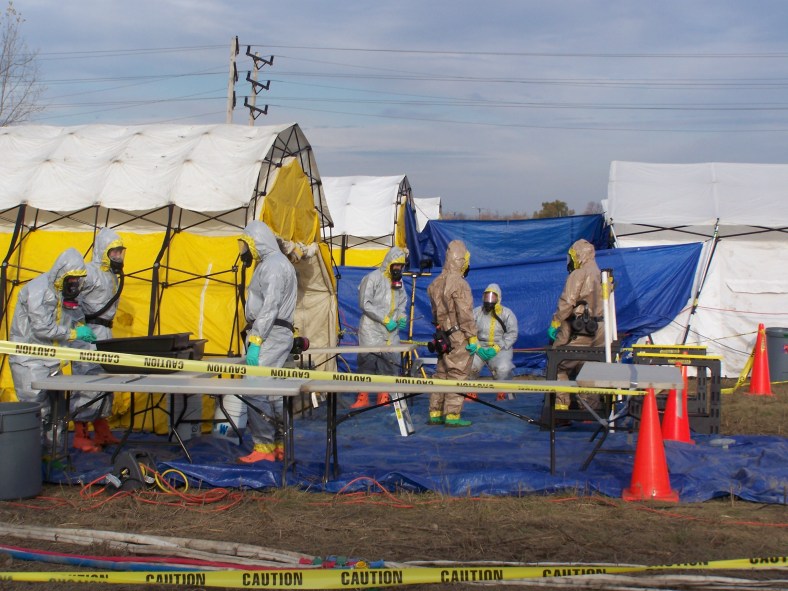
Last week, the way we remove chemical contamination from victims of a terror attack or chemical accident has changed… well, not quite yet, but it should soon.  A partnership between the US Department of Health and Human Services’ (HHS) Office of the Assistant Secretary for Preparedness and Response (ASPR) and the University of Hertfordshire in England and Public Health England found that “…removing clothes removes up to 90 percent of chemical contamination and wiping exposed skin with a paper towel or wipe removes another nine percent of chemical contamination.  After disrobing and wiping with a dry cloth, showering and drying off with a towel or cloth provides additional decontamination, bringing contamination levels down 99.9 percent.”

100_2534

Essentially, what they discovered was that despite recommendations for doing so, victims have often not been required to disrobe for decontamination.  When victims would progress through a decontamination (water spray down), much of the chemical they have been exposed to remains in the clothing and trapped against the skin.  Clearly this is not effective.

I see this new methodology being a significant change to how we decontaminate victims.  As the study hypothesizes, decontamination is much more effective when the chemical is wiped from the body after the victim disrobes.  Following this, they may progress then through a water spray.  This, essentially, adds a step to the typical protocols used in North America, Europe, and other locations.  I’m told the wipe methodology has been used in Japan for some time now.  I also believe that wipes have been in use by the US (and other) military forces for units in the field.

Links of interest:

HHS Press Release on the study.

Implementation of new protocols in the UK and other European nations

Many thanks to my colleague Matt for passing this information on to me.

As with any new procedure, the devil is in the details.  Standards must be established and adopted, supplies and equipment must be identified and obtained, personnel must be trained, and exercises must be conducted to validate.

I’m interested to hear opinions on these findings and recommendations, as well as thoughts on implementation in the US and abroad.

© 2016 – Timothy Riecker, CEDP

Emergency Preparedness Solutions, LLC Your Partner in Preparedness


Battling Wild Fires and Perspectives

Hello readers!  Apologies for my absence over the past couple of weeks.  I’m grateful, especially as a founder and company partner, that we’ve been so busy as of late.  The design, conduct, and evaluation of a couple of great exercises for one client; the design of several impactful training courses for another; along with preparations for two new contracts have had our small business buzzing with activity.  We will be recruiting a lot of people for one of those contracts, so stay posted on the blog (www.triecker.wordpress.com), my LinkedIn profile, and both my personal (@triecker) and our company (@epsllc) Twitter accounts, as well as the company website (www.epsllc.biz) for more info.

Although I’ve not been blogging for the last couple of weeks, I’ve still been keeping up on current events.  The wildfire in Fort McMurray, Alberta, Canada has been consistently one of the biggest stories as the fires still continue to spread, having caused massive devastation to property and the environment, and having displaced around 100,000 people.  Hundreds of vehicles were abandoned during evacuations, either due to mechanical trouble or lack of fuel.  The Canadian Red Cross, partnering with federal and provincial governments, is providing tens of millions of dollars in direct aid to impacted individuals and families.  Thousands of workers are being evacuated from the oil sands area north of the Fort McMurray, stalling more than a million barrels of production each day.  Firefighters, law enforcement, military personnel, and other resources are battling dry conditions, high temperatures, and winds in this massive and constantly shifting fire.  Other provincial and local governments and even citizens are helping to shelter and care for evacuees, many of which have lost much of their property.

One thing I often find interesting is the difference between perspectives, especially between public safety and citizens.  While our focus in public safety is… well… to make sure the public is safe, we always have to keep tabs on perception.  Take the seemingly conflicting reports of these two articles, for example.  The first article, published Thursday May 5, tells the story of residents evacuated from an area who are questioning the organization of response efforts and general preparedness of officials.  One individual tells of no police officers to guide evacuees out of town.  The second article, published on Saturday May 7 tells of military and police overseeing evacuations across the incident.  I believe I read these two articles back to back, causing the dichotomy of the two to really jump out at me.

Truth, of course, likely lies in both articles.  Yes, thousands of public safety and military personnel are involved and doing what they can.  Some evacuation orders, as indicated in the first article, are sudden, based upon rapidly changing factors, giving public safety little time to mobilize to the new area.  There must also be a consideration that evacuation orders may have been issued without proper coordination of resources.  Any of these things are possibilities, especially in the fast moving environment of wild fires.  Still, they provide opportunities for us to learn and improve.  Not knowing the details of what may or may not have transpired, I am always reluctant to speculate.  As with all incidents, events, and exercises, however, once the work is done, we have an excellent opportunity to review and evaluate information in a collaborative manner to identify strengths and areas for improvement.  Organizing these notes creates a corrective action plan, the implementation of which will, over time, make us better at what we do.

© 2016 – Timothy Riecker