Another Great Emergency Management and Homeland Security Podcast

A couple months ago I came across another great podcast.  This one is done by a company called PreparedEx – www.preparedex.com and on Twitter @preparedex.  They link to their podcast from their website but you can also find it in the iTunes podcast listing.  They are only seven episodes in, and most episodes are about a half hour long, so you can catch up pretty quickly.  They generally post two episodes a month, which is excellent frequency.

PreparedEx is a consulting firm specializing in preparedness exercises.  Yes, they are technically a competitor of my company, but from what I’ve seen and heard, they are quite capable and do some really cool stuff.

The host of their podcast is Robert Burton, who is the company’s managing director.  Robert has some great counterterrorism creds and facilitates the podcast well.  What I love most about this podcast is the interview format.  Nearly every episode focuses on an interview, and they have gotten some great subjects – from state emergency management directors to corporate security specialists.  The interviews offer excellent insight and are very conversational and easy to listen to. They cover topics in emergency management, homeland security, and business continuity.

Go check them out and enjoy!

– TR

Emergency Management – Who Knows About Your Plans?

In emergency management and homeland security we put a lot of emphasis on planning.  Plans are important, afterall.  We need to take the time to identify what our likely hazards are and how we will address them.  But what happens when the plan is complete?  We congratulate members of the planning team and send them final copies.  Those copies get filed electronically or end up on a shelf, a trophy of our accomplishment and hard work.  Congratulations!

So… that’s it?  Is that all?

NO!  Of course not!  People need to be trained to the plan.  “Trained?” you ask.  Yes – trained.  Not just sent a copy and told to review it.  Let’s be honest, here.  Even assuming the highest degree of dedication and professionalism, many people simply won’t give it the time and attention it needs.  Very quickly the plan will get buried on their desks or the email will become one of dozens or hundreds in the inbox.  Even if they do give it a look through, most will only give a quick pass through the pages between meetings (or during a meeting!), not giving much attention to the details in the plan.

How effective do you expect people to be?

Sports analogy – when a coach creates new plays, do they simply give them to the players to become familiar with and expect proficiency?  No.  Of course not.  We’re all familiar with the classic, if not cliché, setting of the coach reviewing plays on a chalk board with the players in a locker room.  That’s training.  Then after that training, they go out in the field and practice the plays.

Back to our reality… The first real step of making people familiar with the plan is to review it with them.  This usually doesn’t need to be a sleep inducing line-for-line review of the plan (unless it is a detailed procedure), but a review of the concepts and key roles and responsibilities.  In fact, that’s who you invite to the training – those who are identified in the plan.  This is likely to include people in your own agency as well as people in other agencies (emergency management, after all, is a collaborative effort).  In states with strong county governments, we often see county-level emergency management offices creating plans that dictate or describe the activities of local governments and departments.  Most often, the local departments have no awareness of these plans, much less receive any training on them.  I’m guessing that plan won’t work.

Once you’ve trained these key stakeholders, be sure to conduct exercises on various aspects of the plan.  Exercises serve not only to validate plans, but to also help further familiarize stakeholders with the plan, their roles, and expectations of others.  When we plan, we tend to make many assumptions which exercises help to work through.  Through exercising we also identify other needs we may have.

Need help with planning? Training? Exercises?  EPS can do it!  Link below.

© 2016 – Timothy Riecker

Emergency Preparedness Solutions, LLC 


Updating ICS Training: Identification of Core Competencies

The crusade continues.  ICS training still sucks.  Let’s get enough attention on the subject to get it changed and make it more effective.

If you are a new reader of my blog, or you happened to miss it, check out this post from last June which should give you some context: Incident Command System Training Sucks.

As mentioned in earlier posts on the topic, the ICS-100 and ICS-200 courses are largely OK as they current exist.  Although they could benefit from a bit of refinement, they accomplish their intent.  The ICS-300 course is where we rapidly fall apart, though.  Much of the ICS-300 is focused on the PLANNING PROCESS, which is extremely important (I’ve worked a lot as an ICS Planning Section Chief), however, there is knowledge that course participants (chief and supervisor level responders) need to know well before diving into the planning process.

First responders and other associated emergency management partners do a great job EVERY DAY of successfully responding to and resolving incidents.  The vast majority of these incidents are fairly routine and of short duration.  In NIMS lingo we refer to these as Type IV and Type V incidents.  The lack of complexity doesn’t require a large organization, and most of that organization is dedicated to getting the job done (operations).  More complex incidents – those that take longer to resolve (perhaps days) and require a lot more resources, often ones we usually don’t deal with regularly – are referred to as Type III incidents.  Type III incidents, such as regional flooding or most tornados, are localized disasters.  I like to think of Type III incidents as GATEWAY INCIDENTS.  Certainly far more complex than the average motor vehicle accident, yet not hurricane-level.  The knowledge, skills, and abilities applied in a Type III, however, can be directly applied to Type II and Type I incidents (the big ones).

It’s not to say that what is done in a car accident, conceptually, isn’t done for a hurricane, but there is so much more to address.  While the planning process certainly facilitates a proactive and ongoing management of the incident, there are other things to first be applied.  With all that said, in any re-writing and restructuring of the ICS curriculum, we need to consider what the CORE COMPETENCIES of incident management are.

What are core competencies?  One of the most comprehensive descriptions I found of core competencies comes from the University of Nebraska – Lincoln, which I summarized below.  While their description is largely for a standing organization (theirs), these concepts easily apply to an ad-hoc organization such as those we establish for incident management.

Competency: The combination of observable and measurable knowledge, skills, abilities and personal attributes that contribute to enhanced employee performance and ultimately result in organizational success. To understand competencies, it is important to define the various components of competencies.

  • Knowledge is the cognizance of facts, truths and principles gained from formal training and/or experience. Application and sharing of one’s knowledge base is critical to individual and organizational success.
  • A skill is a developed proficiency or dexterity in mental operations or physical processes that is often acquired through specialized training; the execution of these skills results in successful performance.
  • Ability is the power or aptitude to perform physical or mental activities that are often affiliated with a particular profession or trade such as computer programming, plumbing, calculus, and so forth. Although organizations may be adept at measuring results, skills and knowledge regarding one’s performance, they are often remiss in recognizing employees’ abilities or aptitudes, especially those outside of the traditional job design.

When utilizing competencies, it is important to keep the following in mind:

  • Competencies do not establish baseline performance levels
  • Competencies support and facilitate an organization’s mission 
  • Competencies reflect the organization’s strategy; that is, they are aligned to short- and long-term missions and goals.
  • Competencies focus on how results are achieved rather than merely the end result. 
  • Competencies close skill gaps within the organization.
  • Competency data can be used for employee development, compensation, promotion, training and new hire selection decisions.

So what are the CORE COMPETENCIES OF INCIDENT MANAGEMENT?  What are the knowledge, skills, and abilities (KSAs) that drive organizational success in managing and resolving an incident?  Particularly for this application, we need to focus on WHAT CAN BE TRAINED.  I would offer that knowledge can be imparted through training, and skills can be learned and honed through training and exercises; but abilities are innate, therefore we can’t weigh them too heavily when considering core competencies for training purposes.

All in all, the current ICS curriculum, although in need of severe restructuring, seems to cover the knowledge component pretty well – at least in terms of ICS ‘doctrine’.  More knowledge needs to be imparted, however, in areas that are tangential to the ICS doctrine, such as emergency management systems, management of people in the midst of chaos, and other topics.  The application of knowledge is where skill comes in. That is where we see a significant shortfall in the current ICS curriculum.  We need to introduce more SCENARIO-BASED LEARNING to really impart skill-based competencies and get participants functioning at the appropriate level of Bloom’s Taxonomy.

Aside from the key concepts of ICS (span of control, transfer of command, etc.), what core competencies do you feel need to be trained to for the average management/supervisor level responder (not an IMT member)?  What knowledge and skills do you feel they need to gain from training?  What do we need a new ICS curriculum to address?

(hint: this is the interactive part!  Feedback and comments welcome!)

As always, thanks to my fellow crusaders for reading.

© 2016 – Timothy Riecker

Emergency Preparedness Solutions, LLC

The Force Awakens – A Potential Soft Target?

“There has been an awakening.  Have you felt it?”  This line from the first trailer of the new Star Wars movie is chilling.  Many of my readers are aware that I am a HUGE Star Wars fan.  As you would expect, I am incredibly excited about the release of Star Wars: The Force Awakens next week.

download

Image courtesy of Disney and Lucasfilm Ltd.

With the recent terror attacks and shootings, though, safety at the theater has certainly been on my mind.  We need to work together as a whole community – theater goers, theater owners/managers and staff, law enforcement, and municipalities.

When I first starting thinking about writing a post on this, I quickly realized that I needed some input from an expert in security.  I reached out to a colleague that not only has the qualifications, but is also a fellow blogger and consultant: Ralph Fisk.  You can find Ralph’s blog here: https://fiskconsultants.wordpress.com/.  He has some great insights on security and risk assessment matters – I strongly suggest you check out his blog, follow, participate, etc.  Ralph agreed to collaborate on a piece related to this global event.  He is also posting this same article on this blog.  Enjoy – and May the Force be With You!

– TR

~

(This article, cross-posted and co-authored by Ralph Fisk and Tim Riecker, draws collectively on our experiences and expertise to provide guidance to municipalities, theaters, and movie goers on awareness, preparedness, and response concerns as we look toward this global event.)

The rapidly approaching release of Star Wars: The Force Awakens stands to be the largest premiere in theater history.  It has already broken a multitude of pre-sale records, with more records certainly to be broken on opening day and opening weekend, both domestically and internationally.  Even if you aren’t a Star Wars fan, you must certainly be at least aware of a new movie being released.  But what does this have to do with emergency management and homeland security?

On July 20, 2012 James Eagan Holmes killed 12 and injured 70 others when opening fire on patrons in an Aurora, CO theater.  This mass murder took place at the midnight premiere of the Batman film The Dark Knight Rises. The recent terrorist attacks in Paris involved a music venue, in which nearly 100 people were killed.  Gathering places like movie theaters are just one more item on the list of potential soft targets for people wishing to do harm, be they terrorists, disgruntled, or disturbed.

IMDB provides a listing of international release dates for The Force Awakens here.  We caution that this list isn’t entirely accurate.  For example, while December 18th is the official release date of The Force Awakens in the US, thousands will be seeing the movie at a select list of theaters participating in a 7pm special premiere time on the 17th.  While you should certainly be aware of the date and time of this premiere at your local theaters, it should be emphasized that theaters will be packed with fans for some time.

While there are no credible threats involving this premiere that we are aware of, municipalities, theaters, and movie goers all need to be aware of the potential for an attack and what each can do.  Surprisingly, despite high visibility active shooter and terrorist events of the past few years, most municipalities still do not have appropriate preparedness measures in order.  While there isn’t time to assemble a solid response plan prior to the premiere of The Force Awakens, there is still plenty of time for beneficial, albeit ad-hoc preparedness efforts.

Our thoughts are below…

With the release of the much anticipated next chapter of the Star Wars Saga, The Force Awakens; theaters and local first responders need to have a heightened level of awareness. There are a number of potential threat indicators associated with this release:

1)            Of course the current terrorism threat situation is first and foremost in our minds

2)            The history of an Active Shooter Attacks on movie theaters goes back to 1989 during the screening of Harlem Nights in Chicago, Sacramento, and Richmond California; on 20 July 2012 during the midnight release, in Aurora, Colorado, of the much anticipated film – Batman: The Dark Knight Rises; another Active Shooter Incident that involved another movie theater in Lafayette, Louisiana on 23 July 2015 during the screening of Train Wreak.

3)            But also other considerations should be given to just the more than “normal” volume of theater goers, and which possible incidents could result from that.

Theaters are known to be soft targets and as such we need to be aware of the threat and how to address it.

We are going to cover the first two indicators listed above as they are not only the largest possible casualty producers, but also pose the greatest immediate impact.

Below are some suggestions and considerations for an ad hoc plan not just for the venues featuring these events; but also for those that maybe in attendance.

Introduction:

Most Active Shooter Incidents, an estimated 90%, are single actor attacks, meaning unless that person has been overt in their planning, little is known about the possibility of an Active Shooter Attack;

Unlike Terrorist Cells; which typically contain up to 4 – 6 members, not just for ease of control and planning, but also for the strict adherence to Operational Security, on the part of the Terrorists.

The difference between the two attacks may appear to be subtle to the uninitiated;

The main goal of an Active Shooter incident is to cause as much destruction as possible in a very short time span; Active Shooter incidents are different from other weapons related crimes in that they intend to commit mass murder.

Terrorist Attacks however have a very distant signature. They are commented for a number of political or ideological reasons; and may result in mass murder or hostage taking. Terrorist attacks may seem very methodical in nature of the execution.

Terrorism:

Terrorism is all around us, whether we chose to look for it or not. Terrorist Groups tend to fall into one of six different categories;

  • Nationalist/Separatist – Sometimes referred to as Freedom Fighters
  • Religious – and we are not just talking about Radical Islamic terrorists here
  • Political – which include; right and left-wing
  • Anarchist – Freedom without the burden of a Central Government
  • ECO/Animal Rights – Motivated by Environmental/Animal Political Policies
  • Single Issue Causes – involves the use of force and violence for the purpose of coercing a government and/or population to modify its behavior with respect to a specific area of concern. Typically, these types of organizations do not have an overall political agenda

Which any number of these groups with related or different causes are already operating in the heart of the Country. Terrorist Attacks could have one or more of these four main objectives;

  • Recognition of the groups’ cause or purpose
  • Coercion toward the populace and/or government to the groups’ ideology
  • Intimidation to cause fear or terror; to cause the populace to lose faith in their governments’ ability to protect them
  • Provocation: attacks are aimed to cause the ruling government to take repressive actions against the population; demonstrate the weakness of the government and the strength of the terror organization

It would be almost impossible to go into the ideology of every single group. Suffice it to say, that they all mean to get their points across, sometimes with protesting, sometimes with criminal destruction of property, and yes, sometimes they will introduce violence.

Violence could be in almost any form imaginable. The most used form of violence directed towards a population tends to lean toward Armed Attacks and/or Bombings (Including suicide bombings); because for the most part these are relatively inexpensive approaches, the logistics to effect these types of attacks are relatively easy to obtain and these tend to produce the most casualties and incite the most fear in the general population. Between 1998 and 2007 out of the estimated 28000 terrorist attacks around the world, almost 21000 involved one of these two types of tactics.

Other terror techniques also used could include; Assassination, Arson, Hijacking, Hostage Taking, Kidnapping, Sabotage, Seizure, Sniper Attacks/Mass Shootings, Threats or Hoaxes, Cyber Terrorism, Agricultural Terrorism, Civil Disturbances and Weapons of Mass Destruction (WMD). WMD is the use of any weapon or device that is intended or has the capability to cause death or serious bodily injury to a significant number of people through the release; dissemination; or impact of one of the following means; Toxic or poisonous chemicals or their precursors; diseases, biological organisms; radiation or radioactivity.

Combined attacks of different types have also been used in the recent past. The attacks on the United States on 11 September 2001 included the use of Airplanes as Weapons of Mass Destruction; the Terrorists Hijacked the planes through the use of an armed attack, albeit the arms were box-cutters, and crashed the planes into buildings causing the planes themselves to be used as WMD’s

Terrorists seek to create public fear and anxiety in order to influence government policy. Through the randomness and unpredictability of their acts, terrorists attempt to undermine confidence in government’s ability to protect the public. Terrorists hope the resulting insecurity fuels public demands for government concessions in order to stop the terrorist acts.

Today, as has been evident with recent terror attacks and attempted attacks, terrorist target selection wants to affect the maximum number of innocent people, in order to generate the fear, they desire. As the government has mobilized to protect our infrastructure from attack, our less protected target; schools, universities, shopping malls, et al., become more attractive targets.

As other sites and venues are “hardened” for security, these measures cannot be implemented across all avenues of society. One, it would infringe on our basic constitutional rights, two, the potential cost associated with “hardening” every facility would surely bankrupt the organization or governmental body imposing such restrictions, and three, we would become a “jailed” society.

Planning for terror incidents doesn’t require you have access to CIA, FBI or other intelligence organizational files, it, for the most part, only requires Common Sense, Situational Awareness of your surroundings, and a Communications Plan.

Some things to take into consideration when you’re making your plans to be in these potential soft target environments:

  • Remain Alert
  • Develop an informed vigilance; meaning, know what possible terror threats could be in your area or the area you’re going to
  • Let someone, not going with you, know your plans; where you’re going; when you expect to return
  • Attempt to blend in with your surroundings, Don’t try to stand out
  • Know your surroundings; Know how to exit the area you will be in; what is the shortest way out; have an alternate plan should that not be a viable opinion should there be an issue
  • Communicate that information to your family and others with you
  • Identify a meeting place if you become separated

Report any suspicious activity. Again remember to use your common sense; examples of suspicious actions could include:

  • People loitering in the same general area without a recognizable legitimate reason; people who appear preoccupied with a specific building or area; electronic audio and video devices in unusual places
  • Just because someone seems to belong there, they might not be whom they seem especially if they are exhibiting any of the actions stated above
  • DO NOT TRY TO DEAL WITH ANY INDIVIDUAL YOURSELF contact the venue security or Law Enforcement Personnel
  • Look for things out-of-place; bags left unattended; packages; persons attempting to conceal items either on their person or receptacles

In threatening situations, take steps to reduce your exposure – leave the immediate area

If an incident does occur; follow the instructions of venue staff, emergency personnel and first responders.  If you are close to the incident walk away with your hands visible.  Walk, do not run as secondary injuries can occur to you or others; move toward the walls as people evacuating a building tend to gravitate in the center

Active Shooter:

Although mass killings have been around for some time, Active Shooter incidents have only relatively recently come into the main stream. I’m not going to mention them as most of you reading this post know the infamous locations of these horrific incidents.

 The National Tactical Officers Association defines an Active Shooter as:

  • One or more subjects who participate in a random or systematic shooting spree
  • Demonstrating their intent to continuously cause serious physical injury or death to others
  • Their overriding objective appears to be that of mass murder, rather than some other criminal conduct such as robbery, hostage taking, etc.
  • In most cases some type of firearm is used, however, the Active Shooter may use any weapon that may be available
  • A suspect is considered an active shooter if he or she is still actively shooting, has access to additional potential victims, and has a willingness to harm others until stopped by authorities or his/her own suicide

Most Active Shooter incidents are often over within 10 to 15 minutes, in a 2012 FBI Active Shooter report, 37% of Active Shooter incidents last under five minutes, before law enforcement arrived on the scene, individuals must be prepared both mentally and physically to deal with an active shooter.

We will cover some very basic steps to plan for, react to and recover from an Active Shooter Incident. As with every planning recommendation I give; this is not all inclusive, I would highly recommend you attend an Active Shooter Training Seminar or ask for a visit from your local law enforcement organization that can give you a block of instruction on Active Shooter.

No matter where you find yourself, at work, in a restaurant, or any other venue where people congregate, you could very well be a target for an individual or individuals’ intent on causing great harm.

First rule in any Emergency Situation, Active Shooter included;

YOU ARE THE MOST IMPORTANT PERSON IN THE EQUATION! YOUR SAFETY IS PARAMOUNT!

I have talked numerous times about maintaining your situational awareness. When you arrive at any venue take a few seconds to find the exits; which one is closest to you; how will you evacuate the area should you have too? What is around you that could protect you? I personally like sitting at booth tables in restaurants; with my back against a wall or other solid object: having a complete view of the whole restaurant if possible and facing the door.

Remember there are three basic fundamentals to reacting to an Active Shooter Incident;

RUN – Leave everything behind; find that exit and GET OUT! Encourage others to come with you, but if they don’t want to leave, REMEMBER YOU ARE THE MOST IMPORTANT PERSON IN THE EQUATION!

HIDE – Put as many barriers/walls between you and the shooter as you can, turn off cell phones, radios, any device that could make a noise and give up your position! Lock or block the door; hide under a desk, remain quiet and claim!

FIGHT — AS A LAST RESORT, AND ONLY WHEN YOUR LIFE IS IN IMMINENT DANGER: Act as aggressively as possible against him/her; Throwing items and improvising weapons; Committing to your actions; Attempt to incapacitate the active shooter; (EXERCISE EXTREME PREJUDICE IN YOUR ACTIONS) That last part isn’t a fancy movie catch phrase; remember you are in a fight for your life!

Once police arrive on the scene here are a few do’s and don’ts;

DON’T:

  • Run up to the police; Their first priority will be to eliminate the threat(s) and secure the scene to allow EMS to come in and assess and treat casualties
  • Avoid making quick movements toward officers such as attempting to hold on to them for safety
  • Don’t stop to ask officers for help or direction when evacuating, just proceed in the direction from which officers are entering the premises.

DO:

  • Be VERY AWARE! That once Law Enforcement Personnel arrive on the scene you may very well be considered a suspect. That is normal response protocol
  • DO AS YOUR TOLD, it is BETTER YOU PLACE YOUR HANDS OVER TOP YOUR HEAD
  • YOU may be told to get on the ground…. Just do it…… Better to be treated like a criminal at first and then cleared, than being shot. You made it that far, go home at the end of the day

Active Shooter Preparedness is also becoming a very large part of Workplace Violence Planning and Training.

Although it is good to receive some rudimentary training on Active Shooter; each organization will need to tailor their response plans to fit into their building lay out.

Corporate Climates cannot afford to have a lackadaisical approach to workplace violence, emergency response or security, this is a leadership/management issue. Corporate Leadership must take ownership of safety, emergency response and workplace violence responsibilities for their organizations and require their First-tier leaders to stress the importance of these processes and procedures, one of the first things I learned about leadership was, led by example. You can direct more people into doing what you want if you first do it yourself! If you don’t, what makes you think that the employees will!

Active Shooter Awareness has to be incorporated with emergency response planning and work place violence planning; you are setting yourself and your company up for failure by not planning, training and conducting exercises.

This next point has greatly concerned me, I have seen some reports lately that companies are being sued for conducting Active Shooter Awareness Training and most, if not all claimants say they were traumatized by the training. Well I’ll simply put it this way, would you rather have some knowledge and a sense of what to expect should you ever have to act in an Active Shooter Situation; or would you rather be a victim. A 2012 FBI Active Shooter report indicated that over 50% of Active Shooter Incidents occurred at a business.

I’d also recommend that you receive some treatment for Post-Traumatic Stress (PTSD) after the incident, as you would have seen and experienced things that no person should every have too.

Recommendations both for Active Shooter and Terror Attacks for those that may not have a developed response plan

Municipalities;

  • Consider activating, even with minimum staffing, the local Emergency Operations Center
  • Consider “up-staffing” Law Enforcement, Fire and EMS Personnel, not only the first night but a number of consecutive nights as well
  • Consider a review of local mutual aid plans (Police, Fire, EMS)
  • Consider having a Public Safety Organizational meeting prior to release

Law Enforcement Organizations;

  • Consider high visibility patrols in theater areas, not only the first night, but a number of consecutive nights as well
  • Meet with theater owners/management to discuss awareness, protocols, and expectations
  • Consider reviewing your Active Shooter and Terrorism Response Plans
  • Act immediately on any reported perceived threats
  • Consider “Up-staffing” patrol personnel
  • Consider a review of local mutual aid plans
  • Check with local FBI Field office, Joint Terrorism Task Force, or if so supported, Fusion Center; prior to release night for any updates of possible threats

Fire/EMS

  • Consider having one medical and one fire unit “staged” close to the venue
  • Consider reviewing your Active Shooter and Terrorism Response Plans
  • Consider “up-staffing” the closet Engine/Ladder/EMS Companies
  • If possible, predesignate locations for Medical and Fire Staging Locations
  • Consider Review Local Mutual Aid Plans

Theater Company

  • Consider coordinating with local law enforcement for security
  • Brief Theater Staff that will be working those nights, on Emergency Response and Active Shooter Plans
  • Maintain a Passive Security Posture the entire night; Some Passive Security measure suggestions can be found above
  • Know the limitations of the theater rooms and know when they are close to capacity
  • Assign personnel with no other responsibility but to observe theater patrons; Only in an observe and report capacity
  • Consider review of local mutual aid plans
  • All theater staff must know where all the exits are and how to lead patrons to them; remind the staff the closest exit maybe behind them

Conclusion

As a sociality we have become increasingly dangerous, in that we have to worry about the seemingly random act of an Active Shooter; although most are not random at all, but go through as many as five phases before the shooter executes his/her actions. I fear that we will continue on this path of wanton violence and the better educated you are, not to these types of incidents, but any type, the better you will be to handle the situation.

As with any planning you do, whether you’re planning for a natural disaster or human initiated events/incidents, you need to take into account your own special considerations, also keep in mind that these planning and situational mindset ideas will not always be all inclusive. Your primary focus should be on personal safety, continued situational awareness and exercise your common sense.

The world has changed over the last few decades, more than anyone of us could have ever imagined. Thirty years ago, the only emergency-related thing we had to worry about at school was the surprise annual fire drill. The escalating violence in our world and attacks on soft targets like schools, churches, and hospitals has taught us that we are no longer safe in those places we once considered as morally protected sanctuaries. We must strive to provide a safe environment for all of us.
Wanna be a Facilitator? Toughen up!

I just read a great post by Robert Burton on LinkedIn titled 5 Common Tabletop Exercise Mistakes.  Robert gives a good review of the common issues that can doom a TTX from the beginning.  Go check it out!

My addition to his post reflected on the need for good and strong facilitation.  I figured it would be worthwhile to develop a separate post and expand on that a bit.  Facilitation itself is certainly an art – be it for a meeting, a workshop, or a tabletop exercise.  I would offer that while there are similar skills, abilities, and traits that will lend to success for all these applications, there are also some differences.  Facilitation for all applications requires that one speak up, follow an agenda, clearly communicate, and give everyone a chance to participate.  Charisma helps carry things along.  In some instances, you also need to be tough.  In a meeting, you have to be tough to enforce sticking to the agenda.  In a table top exercise, you need to be a little tough with the participants.

We’ve certainly all witnessed poor exercise facilitation.  They facilitator doesn’t follow the MSEL, tells their own stories, leads participants to answers, and puts up with softball answers that don’t tell much of anything.  Remember, the ultimate purpose of an exercise is to test plans.  Plans are executed by people.  We are testing the plans through these people.  If we aren’t getting good answers, we aren’t meeting our goal of testing the plans.

In one of the best table top exercises I ever witnessed, the facilitator provided injects, as expected, to a group of agency department heads.  The facilitator had a very distinct position in the agency, though… he was their new director.  He requested that we put together a TTX focusing on agency response plans.  When we asked who he wanted to facilitate, he said he would do it.  Now there are certainly pros and cons to this, but he was the boss, and the results were quite eye opening.

As follow ups to the injects, participants were asked questions such as ‘What is your role?’ ‘How would you respond to this?’ and ‘What would you do next?’.  This is how participants should be drawn out to obtain good information.  Additionally, facilitators should consider asking ‘Why’ when participants give certain responses.  (Check out my post Ask Why 5 Times – I explore the power of this question a bit more).  Do they think their response was a good idea or is it actually called for in a plan?  ‘Who’ is another good question.  It’s easy for participants to throw out generalities in response to questions (i.e. We would do x.).  Well WHO specifically would do it?  And WHY? And what if they weren’t around?  What does the plan say?

After getting a few answers he wasn’t very comfortable with, the new director then lobbed in a heck of a hand grenade – Show me.  This threw participants for a loop.  Now, I will grant you that this is rather unorthodox in a TTX, although not completely unheard of.  Given his position, no one was going to challenge him, though.  Out scampered one person.  A few more questions, then the phrase again – Show me.  Out scampered another person in search of another binder.  In the end, some had supported their claims, others did not.  These were great lessons learned.  We found holes in plans, necessary connections between plans, and a need to update plans and train people on those plans.

After this exercise, I learned lessons myself and approached facilitation of future exercises very differently.  I began asking more questions as follow ups to participants’ responses.  We dug deeper and found out more – so did the participants.  Sometimes they don’t like it, and sometimes you feel like you are being antagonistic.  Obviously you don’t want to create an unpleasant experience for anyone, but if they aren’t able to handle a few tough questions from an exercise facilitator, they certainly won’t like handling them from their boss, their bosses boss, or the media.

Bottom line, if you are going to facilitate an exercise, toughen up.  Ask follow up questions.  Get clarity on the answers and don’t let participants get away with easy answers.  If participants squirm a bit, that’s OK.

What are your exercise facilitation experiences?  Any best practices to add?

© 2015 – Timothy Riecker

Emergency Preparedness Solutions, LLC

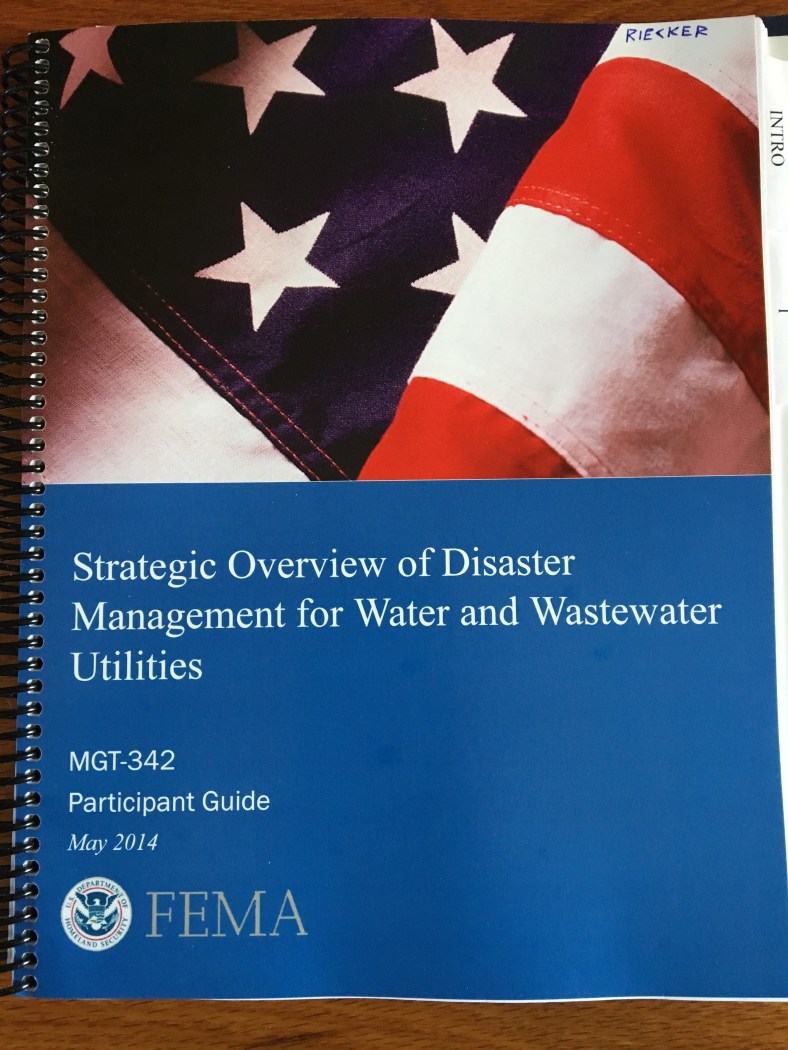
Course Review: MGT-342 Strategic Overview of Disaster Management for Water and Wastewater Utilities

I took the opportunity yesterday to attend the aforementioned class held at the New York State Preparedness Training Center in Oriskany, New York.  This half day (0800-1200) course was well attended by water and wastewater personnel from around central New York, a couple of emergency management types, and even a representative from a local brewery (no samples, sadly).  This DHS approved course is designed and instructed by personnel from the Texas A&M Engineering Extension Service (TEEX) National Emergency Response and Rescue Training Center (NERRTC).

IMG_1263

Through my career in emergency management I have regularly worked, albeit tangentially, with water and wastewater professionals, which are generally regarded as a niche of public works.  In many small towns across the nation, water and wastewater systems are among the only critical infrastructure these small towns have.  In larger municipalities, water and wastewater systems are extensive and necessary for not only their residents, but for business and industry as well.  We often see impacts to water and wastewater systems from disasters ranging from earthquakes, to utility outages, floods, and other disasters, including criminal acts.  I’m always interested in an opportunity to learn more and this course was convenient in location and schedule.

This course is a condensed half-day version of a two-day course also taught by TEEX.  When instructors reviewed the morning’s agenda, I was skeptical, and rightfully so.  The participant manual, like most products developed by TEEX, is excellently done, with an abundance of reference material.  Even if the material was to be just reviewed, I knew that addressing most, if not all of it, would be a significant task for the instructors.  The lead instructor was very knowledgeable and experienced in the subject matter and very well spoken.  While he had a lot of value to provide to participants, he may have provided a bit too much relative to getting through the three units of the course as intended.

The course units are largely broken into three main topic areas: Threats, Preparedness, and Response; all obviously relative to water and wastewater systems.  The first unit, Threats, was covered thoroughly, taking nearly the full class time.  The information provided was excellent and realistic in scope.  Examples of actual impacts to water and wastewater systems around the world from a variety of threats and hazards were used to drive the point home about the vulnerability of these systems.  I was dismayed, though, that the second unit, Preparedness, was not covered at all.  Fortunately, there is a great amount of materials in the participant guide for after class reference.

The third unit, Response, also contains a great deal of information, especially for those who are not used to complex and multi-agency responses.  Unfortunately, we only had time to review a case study which was in the unit.  While the case study (the Charleston, WV spill from January 2014) was excellent and certainly time well spent, it would have been great to dig into the other response related materials in the course.  Again, at least we have these for post-course review.

This content of this course is quite valuable, relevant, and up to date.  It was expertly instructed, discounting some time management issues.  I do think, though, that the instructional design in more to blame, as the quantity of content contained in the course is simply too much to be adequately covered in a half day.  It certainly had me wanting to take the two day course, and definitely from the same instructor.  I provided similar comments on the course evaluation sheet, and I hope they do make some necessary changes to this class to maximize the amount of information provided.  Would I still recommend this course – yes, but just know going into it (at least in its present form) that you may not experience delivery of all the material.  If the quality of material and instruction is any indication of what to expect in the two day course, though, I would absolutely recommend it.

If you have any questions on the course, or experiences of your own, I’d love to hear them.

  • TR

So Your AAR Says Bad Things… Now What?

There it is.  Your recently delivered after action report (AAR).  Uncomfortably sitting across the room from you.  You eye it like Tom Hanks looking at Wilson for the first time.

Wilson

Wilson!!!

You know what’s in it.  It says bad things.  Things you don’t like.  Things your boss really doesn’t like.  But what will you do?

First, let’s assume that, despite you being unhappy with the areas for improvement identified in the AAR, they are fair representations.  What will you do with the dreaded information now that you have it?  Your AAR may have come with a corrective action plan (CAP), but this is only guidance that still needs to be reviewed and acted upon.

First, each identified area for improvement should be prioritized.  After all, if everything is important, then nothing is important.  Even if the areas for improvement and/or corrective actions are already identified in the AAR (particularly if done by a third party or if the AAR is representative of a multi-agency exercise) you should review this prioritization with your own organization’s stakeholders.  This means pulling together a committee (sorry for cursing!) comprised of key areas within your organization.  This may even mean people from areas that may not have participated, such as information technology, as I’m betting there was something in the exercise about computer systems, programs, internet connection, data access, data continuity, etc.  Don’t forget the finance people, either… some fixes aren’t cheap!

Once everyone has had an opportunity to review the AAR, each identified area for improvement should prioritized, at least to the degrees of high, medium, and low; with a secondary filtering of short-term vs long-term projects.  While some may be relatively quick fixes, others can take months, if not years, to accomplish.  Activities should also be identified that are dependent upon others which may need to be completed first (i.e. a procedure needs to be written before it can be trained on).

That’s probably enough for one meeting.  But the people you gathered aren’t cut loose yet… in fact they are pretty much locked in, so you need to be sure that the people you bring together for this corrective action group have the knowledge, ability, and authority to commit resources within their respective areas of responsibility.  Now that activities have been prioritized, it’s time to assign them… this is why involvement of your boss (if you aren’t the boss) is so important.

Some individuals within your organization will be able to act on their own to make the corrective actions that are needed – while others will need to work together to make these happen.  Consider that there may be more activities than just those identified in the AAR.  For example, the AAR may identify a need for a resource management plan.  That’s good, but we all know you can’t just build a plan and expect it to be ready for action.

For those who are regular readers of my blog, you know I’m a big fan of the POETE elements.  (More on POETE here).  What is POETE?  POETE is an acronym that stands for:

  • Planning
  • Organizing
  • Equipping
  • Training
  • Exercising

What is the value of POETE and what does it all mean?  POETE is a great reminder of the key activities we need to do to enhance our preparedness.  Given that, when we look at an identified need for improvement, we need to consider how to properly address it.  So start at the top:

  • What plans, policies, and procedures are needed to implement and support this corrective action?
  • What organizational impact will occur? Do we need to change our organization in any way?  Do we need to form any special teams or committees to best implement this corrective action?
  • What equipment or systems are needed to support the corrective action?
  • What do people need to be trained in to support the corrective action? Do we need to train them in the plan, about a new policy or procedure?  Do they need training on organizational changes?  How about training in the use of equipment or systems?
  • Lastly, once you’ve made a corrective action, it’s a good idea to test it. Exercises are the best way to accomplish this.

There are obviously other considerations depending on the specific corrective actions and the circumstances of your organization.  Funding is often times one of the most significant.  If you need to obtain funding to make corrective actions, the AAR is one of the best documented investment justifications you can get.

From a project management perspective, the committee should regularly reconvene as a matter of checking in to see how the corrective actions are going.  On a continuing basis, the progress of corrections should be tracked (spreadsheets are great for this), along with who has been tasked with addressing it, timelines for completion, related finances, progress notes, etc.  Otherwise, in our otherwise busy days, these things get lost in the shuffle.

From a program management perspective, this is a process that should be engrained culturally into your organization.  Ideally, one person should be responsible in your organization for coordinating and tracking this corrective action process.  As additional exercises are conducted and actual incidents and events occur, corrective actions from these will be brought into the mix.  It is all too often that organizations complain of seeing the same remarks on every AAR or from experiencing the same issues for every response.  BREAK THE CYCLE!  Establishing a corrective action program for your organization will go a long way toward making these chronic issues go away.

By the way, the same concept can be applied to multi-organizational/agency efforts at any level – local, county, state, federal, regional, etc.  Since we respond jointly, there are great benefits to joint preparedness efforts.  We will likely find that even that we have our own house in order, working with someone else is a very different experience and will require a whole new list of corrective actions as we identify areas for improvement.  This process works great with multi-agency committees.

The bottom line – the biggest reason why we exercise is to test our capabilities.  When we test them, we find faults.  Those faults need to be corrected.  Capitalize on the investment you made in your exercise effort to address those identified deficiencies and improve your capabilities.

What ideas do you have for addressing corrective actions?

Need help with preparedness activities?  Be Proactive and Be Prepared™ – Reach out to Emergency Preparedness Solutions!  We’re always happy to help.

Thanks for reading!

© 2015 – Timothy Riecker

Emergency Preparedness Solutions, LLC

Gauging Return on Investment in Preparedness: Exercises

In this last article of the Return on Investment series, I’ll be discussing the investments and benefits of preparedness exercises to help organizations determine their return on investment – or ROI.  The series has followed the model of the five POETE elements (Planning, Organizing, Equipping, Training, Exercising).  The inspiration for the series was a piece I wrote called Measuring Return on Investment in Emergency Management and Homeland Security: Improving State Preparedness Reports.  If you haven’t had the opportunity to review the earlier articles in the series, they are linked below:

Planning

Organizing

Equipping

Training

We conduct preparedness exercises for two main reasons: 1) to test plans and procedures, and 2) to provide people with an opportunity to practice their roles and responsibilities.  Exercises can be stand-alone activities or integrated into training and education through scenario-based learning. In the US we use the Homeland Security Exercise and Evaluation Program (HSEEP) as our model for both the macro and micro levels of exercise management.  If you are interested in an in-depth look on HSEEP and its components, you can check out an earlier series I did called Managing an Exercise Program.

As with most major activities we do, exercise-related tasks can be divided out into program management (the macro level) and project management (the micro level).  Since we usually examine ROI for individual activities, we will focus on the micro level of exercises, that is the project management piece, or individual exercises, to identify specific costs (investments) and benefits.

Conducting an exercise takes a fair amount of preparation.  The more complex the exercise, the greater period of time it should take to prepare.  Complexity of an exercise is measured by a few different factors – the number of participants involved, the span of time for the exercise, the complexity of the tasks/plans being exercised, and the number of locations being exercised.  Most of us who have been involved in emergency management and homeland security for a while have seen the full gamut of exercises – from discussion-based exercises like table top exercises, workshops, and seminars; to operations-based exercises like drills, functional, and full-scale exercises.  Often we view functional and full scale exercises as being the most complex, however I’ve been involved in table top exercises and workshops which have involved significant efforts.

Up front, the most significant investment any organization can make in an exercise is personnel time.  All exercise efforts will have a lead planner, and most will be supported by a planning team.  If the exercise involves only one organization, that planning team will typically involve only internal people, while multi-organizational exercises should involve some measure of representation from every organization, either directly or indirectly.  Planning an exercise requires a great attention to detail, drafting and editing of documents, and arranging of logistical matters.  Experience helps, so those who do this less often will typically require more time to do it.  This is why many organizations hire consultants (like me!) to help them with exercises.

During the planning phase for the exercise, you may have some associated costs, such as meeting space, food, and travel for planning meetings.  You may also have these costs for the exercise itself which should be identified during the planning phase.  It is also important to identify any costs associated with audio-visual equipment, communications equipment (including internet connectivity), and even things as simple as name badges and signage.

For the exercise itself, personnel costs are still significant.  You must not only consider the time of all participants (as well as potential travel costs), but also the time of your exercise management staff – an exercise director, controllers, evaluators, and possibly staff for a simulation cell.  Again, experience helps to support a successful exercise, so if you don’t have the depth of experience in your organization, consider hiring consultants for the conduct and evaluation of the exercise as well.  Either way, exercises can be significant investments.

Once the exercise is complete, the activity isn’t over – and neither are the costs.  The evaluation team needs to draft the after action report (AAR), and conduct an AAR meeting with the planning team and principal participants to ensure that everything was captured accurately.  Once the AAR is finalized, action items identified in the AAR are assigned to responsible parties to address improvements.  These improvements are generally not considered part of the cost of the exercise itself, but rather part of your general preparedness costs (these will all fall within the POETE elements).

While exercises come at no insignificant cost, the benefits are tremendous – if the exercise is done properly.  A well designed, conducted, and evaluated exercise provides better outcomes and benefits.  The AAR should reflect not only best practices that should be continued, but also areas for improvement which should be addressed to enhance preparedness.  Any of these, as mentioned in the last paragraph, can fall within the five POETE elements – Planning, Organizing, Equipping, Training, and Exercising.  While each of these certainly have costs associated with them, the benefit from the exercise was identification and documentation of need.  Perhaps you are exercising a new active shooter response plan and through the exercise realize that a certain procedure was based on poor assumptions – if this plan was put in place without being exercised, the outcomes in a real life event could have been catastrophic.  It’s better to identify these issues through an exercise so they can be addressed with much less cost.

As I mentioned earlier, another reason to exercise is to provide participants with an opportunity to practice plans, procedures, or skills in a safe and structured environment.  While there is a great deal of routine to what we do in emergency management, homeland security, and public safety, there are certainly activities that we don’t do very often, resulting in degradation of skill over time.  Many of these activities, though, are absolutely critical when needed, which means that we must give practitioners ample opportunity to practice and apply what they have learned through training.  The benefits of this, depending on the activity, can include increased efficiency (time), reductions in injury and loss of life, and proper use of equipment and protocols.  Additionally, there are benefits to getting people to work together in these activities, especially for those who don’t usually work together.  Emergency management, after all, is about collaboration.

Because of the wide range of things we exercise, it’s up to you to examine what your investments and benefits might be.  At EPS, we can help you with designing, conducting, and evaluating exercises; identifying potential costs and benefits of an exercise; and other preparedness activities.  We’re happy to help!

Feedback from this return on investment series of posts has been very positive, which I greatly appreciate.  We also got some good dialogue across all mediums including the blog home page (www.triecker.wordpress.com) and various LinkedIn discussion groups – some of which provided some excellent additional ideas on how to better capture information on investments and benefits.  The challenge remains to not only identify these, but to convert them into meaningful information for decision makers, which usually involves currency values.  Thank you, as always, for your time and attention.

© 2015 – Timothy Riecker

Emergency Preparedness Solutions, LLC

Preparing to Use the Incident Command System

For a bit of context, if you haven’t already read them, please take a look at these other ICS related articles I’ve posted:

Incident Command System Training Sucks

ICS Training Sucks… So Let’s Fix It

Preparedness – ICS is Not Enough

The crusade to improve ICS training and implementation continues…

We invest a lot of time and effort into training people in the use of the Incident Command System (ICS).  However, as a broad statement, the training we provide is massively inadequate.  We don’t actually train people to do anything – we simply tell them about ICS through an increasingly repetitive and complex series of courses.  At the risk of being repetitive myself, I refer you to the articles linked above for many of my foundational thoughts on the current state of ICS training.

The ICS core training curriculum aside, we – as both individuals and organizations – need to be better prepared to actually use ICS.  The thought that people are able to use ICS the minute they walk out of an ICS course is totally and completely false.  By ‘use ICS’, I don’t mean to simply function within an organizational chain of command that uses ICS, I’m referring to being a driving force within the system itself.  ICS isn’t something that happens automatically, it requires deliberate and constant actions.  This typically involves functioning at the Command or General Staff levels, but also within many of the subordinate positions which are absolutely critical to managing a complex incident and driving the system.

So how do we prepare to use ICS?  I often refer to the preparedness capability elements of POETE (Planning, Organizing, Equipping, Training, and Exercising) when I’m talking about preparedness activities.  These same concepts apply here.  We need to remember that planning is the foundation of all preparedness efforts.  If it’s not documented, then why are we doing it?  So we have to have plans, polies, and procedures which call for the implementation of ICS and direct us in the nuances of how we will manage an incident.  I’m sure everyone’s plan has taken a page from the NIMS Doctrine and includes language about the requirement to use NIMS and ICS.  That’s all well and good, but like many things in our plans, we don’t reinforce these things enough.

I’m not talking about simply giving NIMS and ICS lip service.  I’m talking about procedure level integration of these concepts.  This begins with good planning, which means plans that are implementation-ready.  Would you consider your plans implementation-ready?  Do they describe how to use the ICS structure and concepts to actually implement the plan?  Maybe yes, maybe no.   If not, your team has some plan updating to do.

Your organization must be ready to respond using ICS.  That means that everyone is familiar with their assigned roles and responsibilities.  Often ICS training falls short of this.  This article: Training EOC Personnel – ICS is Not Enough, details many of the reasons why, at least for an EOC environment.  Many of the points made in the article, however, can be reasonably applied to other environments and organizations.  While ICS provides us with overall concepts, the application of those concepts will differ for various organizations and locations.  Every location, county, region, and state have different protocols which must be integrated into incident management practices.  (Refer back to planning).  Our organizations, both those that are static as well as those which are ad-hoc (assembled for the response to a particular incident or event) need to be ready to act.  This means familiarity not only with ICS or our specific applications of it, but also with our plans.  How often do ICS courses actually talk about the implementation of emergency plans?  Rarely.  Yet that’s what we are actually doing.  Do you have people assigned to ICS roles?  Are they ready to take on the responsibilities within these roles?  Do you have backups to these positions?  I’m not necessarily talking about a formal incident management team (IMT), although that may be suitable and appropriate.  Absent an IMT, the responders within a jurisdiction or organization should have a reasonable expectation of the role/roles they will play.  This helps them and your organization to be better prepared.

The implementation of ICS generally doesn’t take much equipping, but there are some basics.  Responders love radios and we use them often.  How about people who aren’t traditional responders, but may be called on to function with your ICS organization?  Do they know how to use a radio?  Do you have a standing communication plan to help you implement their use?  How do you track incident resources?  I didn’t just ask about fire service resources – I mean all resources.  Do you have a system for this?  T-Cards are great, but take training and practice to use them – plus they require that all responders know their responsibilities for accountability.  The same goes with a computer-based solution.  For whatever equipment or systems you plan on using, you must ensure that they are planned through and that people are very familiar with how to use them.

Training… I think I’ve talked about the need for better ICS training quite a bit, so I’m not going to continue with that point here.  What I will mention is a need for refresher training and jurisdiction-specific training on incident management.  This isn’t necessarily ICS focused, but it is ICS based.  For many years now, FEMA has believed that by including three slides on NIMS in every training program that they are helping with NIMS compliance.  Nothing could be further from the truth.  You have to actually talk about how these concepts are key to implementing plans.  Responders need to be familiar with the emergency management system they are working within.  Train people to the plans and procedures.  Let them know who is in charge of what and when, who the decision makers are, and any other training needs identified in the earlier POETE activities.  Prepare them to implement ICS!

Lastly, exercises.  Incident management should be something that is practiced and tested in almost every exercise.  Applying these concepts is not something we do on a regular basis, therefore knowledge and skills erode over time.  Certainly we have to be familiar with the system, not just at an awareness level but at a functional and operational level.  Regardless of the state of the current curriculum, that involves practice.  Exercises don’t have to be elaborate, remember that they can range from discussion-based to operations-based.  Table top exercises are great to talk things through, drills are good for focused activities, and even full-scale exercises can be small and contained.  So long as the exercise is designed, conducted, and evaluated well, that’s what counts.  Don’t forget that evaluation piece.  The feedback to the entire system (plans, organization, equipment and systems, and training) is extremely important to continued improvement.

This is public safety, not a pick-up kick ball game.  We can do better.

Thanks for listening… what are your thoughts?

Does your organization or jurisdiction need help preparing to implement ICS?  Emergency Preparedness Solutions can help!

© 2015 – Timothy Riecker

Emergency Preparedness Solutions, LLC

Gauging Return on Investment in Preparedness: Training

This is my fourth article in a series examining how organizations can gauge their return on investment for various emergency management and homeland security preparedness projects.  These were inspired by an original article I wrote called Measuring Return on Investment in Emergency Management and Homeland Security: Improving State Preparedness Reports.  The POETE model (Planning, Organizing, Equipping, Training, Exercising) helps us to identify all activities related to preparedness.  Thus far, we have covered:

Planning

Organizing

Equipping

If you haven’t already reviewed these articles, check them out for additional context and information.  Within each, I outline the general activities within the preparedness element, and identify the potential costs and benefits of these activities to the organization.  While some costs and benefits are direct (meaning we can readily identify them in terms of currency), most are not, and require some measure of analysis.

We put a lot of money (and faith) into training as a central preparedness activity.  And why shouldn’t we?  Training, by definition, is a transfer of learning.  We have a lot of information to communicate to our staff and other stakeholders, with the goal of that information collectively becoming a body of knowledge, and a vision of these people applying what they have learned to future circumstances.

In emergency management and homeland security we train quite a bit, with some training being required by organizational, local, state, national, international, or federal standards; while other training will help develop and advance staff.  We include HR-required training; soft skills like communication, leadership, decision making, and the like; as well as technical skills such as emergency planning, exercise design, and incident management.  Emergency management and homeland security are broad fields of practice, which intersect public safety, public health, and other essential government and social functions.  Most emergency management and homeland security practitioners have roots in one or more of these fields and typically continue receiving training relative to those as well.

Training comes from a variety of sources including our home organizations, local and county governments, state government, private and not for profit entities, and the federal government.  Particularly for training that is sponsored by a government entity, most training is ‘free’.  In the US, federal training entities, such as FEMA’s Emergency Management Institute, also reimburse travel expenses and provide lodging for all levels of government employees.  On the surface, the cost of most emergency management and homeland security training is fairly low.

Of course depending on perspective, the cost of training can vary.  As a former state training officer who managed all emergency management related training delivered across my state, I could identify our agency’s cost of training.  This would include our staff admin time for course prep and record keeping, the cost of duplicating participant manuals, any costs associated with the hosting facility (although we usually utilized no cost facilities), the cost of paying our instructors for their time and travel, and, if applicable, any lodging and/or meal costs for participants who may have traveled a distance.  These costs, however, are only part of the picture.

What about the cost to the organization that is sending people to be trained?  Directly, this is salary time in which little to no work is actually being accomplished for the organization.  The organization may also be footing the bill for travel costs for their participants.  Depending on who is sponsoring the training, there may be a fee for the course.  Indirectly, what is the cost of that employee being away?  Who is doing their work?  This often depends on the organization and the position the individual holds in that organization.  Firefighters, police officers, health care professionals, and others may be covering shifts that will still need to be filled, especially if policies or union contracts require certain staffing levels.  Sometimes this backfilling isn’t as simple as changing schedules, as most employees are already scheduled at full time status.  Therefore, someone may need to be paid overtime to fill this position for the duration of the training.  Perhaps the learner themselves is being paid overtime to tend to priority tasks outside of training hours.  Maybe others can simply absorb some extra tasks while this person is gone, or the learner will be swamped for some period of time once they return from training.  Each of these mechanisms, all dealing with productivity, has a cost associated to it.

Training can get expensive, which is why it’s often one of the first activities cut when an organization’s budget gets tight.  We try to minimize the cost of training through a variety of practices such as shorter training days, online training, and local training.  These, however, have various impacts on the organization’s ability to obtain the training as well as the overall effectiveness of the training.  Sometimes we simply defer the training, but the organization may have little choice, particularly with mandated training.

So what benefits can training provide?  As mentioned, I have quite a bit of background as a trainer and training manager.  I’d love to tell you that training has the greatest of all benefits, but that would be a complete lie. Just like any other preparedness activity, it has to be properly applied.  Training won’t fix everything.  I’ve written a lot of pieces on training in my blog… just search for ‘training’ and you will find plenty of articles about how training should/shouldn’t be applied.  With that caveat, training can have great benefit.  Not only can it make people more effective and efficient in their jobs and related tasks, it can also help defer liability from the organization.  Training also has benefits which more directly apply to the learner vs the organization, such as providing background for advancement and/or promotion (which can be internal or external to the organization).  There are many practices in emergency management and homeland security for which training aids in health and safety, not only of the staff member who took the training, but also of others.  In training, the impacts can go pretty far… you just have to follow the bouncing ball.  As an example: Jane gets trained in how to write emergency plans.  The emergency plans she writes will help the organization respond more effectively in the event of a disaster.  When the organization responds more effectively, lives and property are protected.  While this is a great ideal outcome, it makes for some difficulty in determining the benefits in terms of currency.

Often, the most direct benefits from training are rooted in compliance and proficiency.  Organizations have a variety of compliance matters they have to meet.  These obligations may be HR driven, required by an executive, a higher level of government, an accreditation body, or a funding source.  Safety matters are also usually linked with a compliance matter.  I often try to associate training activities to these requirements.  Sometimes we can directly link a financial benefit to these compliance matters, while other times compliance is simply factually stated.  Second is proficiency.  People need to stay current in essential skills.  This might require regularly recurring training for staff, well as training for new staff.  Staff need to be proficient in new procedures, software, and equipment operation.  Certain staff may need to be trained to more advanced levels.  Gauging the benefit in financial terms for proficiency is generally more difficult, although the need for the training is apparent.  The benefit simply needs to be extrapolated.  For instance, if the training is in a new process, what is the time and/or quality difference between the old process and the new?

As mentioned earlier, it is often times not easy to determine the financial return on investment for many of our activities.  We need to dig deep and identify quantifiable metrics which can be examined before and after we apply our preparedness activity.  We must assign reasonable currency figures to those metrics to help us and other decision makers better understand our investment and the benefits it will potentially bring.

Soon I’ll be wrapping up this series with the last key preparedness activity – exercises.  As always I’m happy to hear your thoughts on how we can better identify the returns on our investments in preparedness activities.  As a resource, I’d encourage you to search Training Magazine (trainingmag.com), which often has articles on analyzing the return on investment in training.

© 2015 – Timothy Riecker

Emergency Preparedness Solutions, LLC