Preparing for Ebola – and Whatever Else May Come

Unless you’ve been living under a rock lately, you should be quite aware of the headlining threat in public health and public safety – Ebola hemorrhagic fever.  Ebola has been in existence for quite a while, but the current outbreak of this deadly virus in western Africa has garnered much attention.  Thus far, beyond western Africa, infected persons have been identified in Spain and the United States.  The ease and frequency of air travel, combined with the virulence of Ebola have led to a frenzied reaction by politicians, the media, and our health care system.  While we are at a stage in the US where only a handful of infected persons have been identified, this virus is quite dangerous and could easily and rapidly spread.

While I’m not a public health expert, preparedness is universal.  Public health is at the tip of the spear for this fight and must be supported by other professions within public safety and beyond – that’s what emergency management is all about.  That said, this is proving to be quite a test for our public health partners.  The consequences of failure could be devastating.

Considering the five mission areas, we are most strongly functioning within Prevention, Protection, and Response for Ebola.  Certainly the three common Core Capabilities of Planning, Operational Coordination, and Public Information and Warning are all fully engaged across the three mission areas.  Additionally, we are seeing a great deal of work within in the Intelligence and Information Sharing; Screening, Search, and Detection; Public Health and Medical; and Situational Assessment Core Capabilities; along with some work in other capabilities to a lesser degree.  Why is it important to recognize the mission areas and Core Capabilities?  It helps to keep us focused and prompts us to examine the critical activities for each.

In which mission areas and Core Capabilities does your agency fit in?

What are you responsible for?

Are you doing it?

Do you have all the information you need to do it safely and effectively or are you waiting for public health to call and tell you what to do?  I’m betting you haven’t gotten that phone call.

In a situation like this, we are seeing a lot of activity and emphasis at the Federal level through US Health and Human Services and the Centers for Disease Control.  Their focus is on solving the problem in front of them.  While they have people engaged in getting messages out and engaging partners, they have a lot to accomplish and likely haven’t gotten to all the stakeholders.  We will hopefully see some more aggressive messaging given the circumstances that have been described at the Texas hospital where Ebola patients have been treated.  So what should you do?  Hopefully your agency is already in contact with your local health department to discuss both your role in the public safety system and the potential exposures and vulnerabilities you may have to Ebola.  If your local health department doesn’t seem to have much information, reach up to your state health department.  Don’t wait to get a call… by then it could be too late.

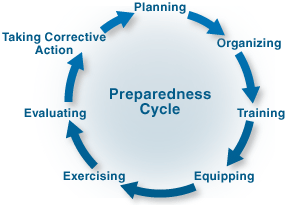
Very simply, we are looking at preparations for your agency’s role.  These preparations, although slightly different based on the agency, apply to all agencies; from first responder agencies, to local government, K-12 and higher education schools, hospitals, private sector, and not for profits.  Let’s break this down with the Preparedness Cycle:

The Preparedness Cycle - FEMA

The Preparedness Cycle – FEMA

Plans, policies, procedures – do you have them in place and up to date?  Depending on the role and function of your agency you can have several of the following – emergency operations plan, emergency procedures, infection control plan and procedures, public health plan, communicable disease or pandemic influenza plan.  You should engage with public health experts to ensure that your plans, policies, and procedures address everything known about Ebola.  You may need to create some procedures specifically addressing issues pertaining to Ebola and your agency’s role.  Do your plans, policies, and procedures link up to your agency’s critical activities for each Core Capability you are engaged in?  What agencies do you need to coordinate with to be effective?

Organizing – depending on your agency’s role, you may need to make some internal changes or designations within your organization to better streamline your activities.

Training – train everyone who has anything to do with any component of the plan in what they need to do.  This is a great opportunity to ensure that everyone is trained up in their role of the emergency operations plan.  If your agency has physical contact with the public, training in personal protective equipment (PPE), identification of signs and symptoms, and patient care are extremely important.  Given the detail of the activities and the just-in-time training, job aids will be a great help to your staff to ensure that they follow the procedures you provide for them.  Don’t get caught short… communicate to your staff in what is going on, what your agency is or may be responsible for, and what they will be called upon to do.

Equipping – your staff need the right equipment for the job.  Not only PPE, but the forms and databases used to record information, decontamination equipment, etc.  It is extremely important that staff are trained not only in how to use equipment but to prevent contamination of equipment and prevention of cross contamination.  Do you have all the equipment you need?  If not, who does?

Exercising – Conduct table top exercises to talk through policies and higher levels plans to validate and become familiar with them.  Identify shortfalls and correct them immediately.  Conduct drills to test the skills of staff for specific activities and larger exercises – functional or full scale – to test multiple functions and plans.

Evaluating – Evaluation is a constant throughout all of the preparedness cycle.  We need to evaluate every step within the preparedness cycle and make adjustments and improvements as needed.  Embrace best practices and fix shortfalls.  This leads directly to the next step…

Taking Corrective Action – Some corrective actions are quick and easy fixes while others can take a while or cost money above budget to address.  A corrective action plan (aka improvement plan) will help you keep track of what needs to be fixed, the priority it holds, who is responsible for making it happen, and a strategy to make it happen – it’s a living document.

The preparedness cycle can be applied to any hazard, be it Ebola or a flood.  With all this attention on Ebola, it’s a great opportunity to pull plans off the shelf and have discussions with internal and external stakeholders on these preparedness steps.

© 2014 – Timothy Riecker

Exercising Foundational Skills with Unorthodox Scenarios

Does the scenario of an exercise activity really matter?  Can we use a zombie scenario to exercise evacuation and sheltering?  Can we use a holiday food distribution to the needy to practice our POD (point of distribution) plan?  Do scenarios always have to be realistic or related to our jurisdiction’s hazards?

I’m a foodie.  As such I find myself occasionally watching shows like Cutthroat Kitchen and Chopped.  These are fun shows that strike a balance of cooking with game shows, including the cash prize in the end.  The competitors are legitimate cooks, some trained in culinary schools, some successful in their careers and earning the title of ‘chef’.  The competitors are given, on the spot, either a dish to create (Cutthroat Kitchen) or a box full of ingredients which must all be incorporated into a dish (Chopped), using a kitchen and pantry generally unfamiliar to them, within a relatively short amount of time – and make it better than their competitors.  Is competing on these shows anything like running a professional kitchen?  Hell no.  Does it make them better cooks?  From interviews I’ve heard, the answer is yes.

Can we recreate this in emergency management?  Of course we can, and we should.  How would this help emergency managers and other public safety professionals?  Recall that within the exercise design component of the HSEEP process the Core Capabilities to be focused on and the objectives to be tested are selected prior to determining the scenario.  This tells us that the activities to be performed are more important than the scenario in which they will be performed.  In these cooking competitions, the participants must fall back on their foundational skills to be successful.  It’s those foundational skills and the activities which they foster that we evaluate in our exercises.

Certainly a scenario has some importance.  It provides context, allowing the participants to get their head into what they are doing.  A scenario can be different, even a bit silly or fantastical (alien invasion, anyone?), but it still has to correlate to the objectives of the exercise; i.e. there must be a compelling reason to perform mass prophylaxis or to evacuate an area.  That said, the scenario is simply a vehicle to get our participants to perform what we intend to test.  Don’t we always tell our participants to not fight the scenario?  Well if it’s something they’ve never before experienced, they have little ground to stand on.

Another benefit to using an unfamiliar or alternate scenario is getting participants to break from the routine and face unexpected and new challenges.  What if digital communications fail?  What if they have to relocate to an alternate EOC? What if that alternate facility is likewise compromised?  Consider using the scenario to remove a critical resource from use.  How will the participants overcome this new problem?  In Cutthroat Kitchen, participants are faced with unseemly injects to their food preparation, such as replacing all cooking utensils with a Swiss Army knife or only being able to cook using a microwave.  Some of your participants may balk at such occurrences, but emergency management is about managing the unknown, the unfortunate, and the unexpected.

Regardless of the measure of reality we choose to base our exercises on, the scenarios we develop are really another level of fiction to help facilitate exercise participation.  Yes, often times we want to test hazard specific plans (a zombie apocalypse exercise can not replace the need of a hurricane exercise), but if the scenario itself doesn’t matter, consider using something ‘outside the box’.  Routine makes us complacent and complacency is very dangerous in emergency management.  We must always expect the unexpected and continually have the mindset to improvise, adapt, and overcome.

© 2014 – Timothy Riecker

4 Steps to Individual and Family Preparedness

As mentioned in earlier posts, September is National Preparedness Month.  Through the lens of whole community emergency management, individual and family preparedness is truly the foundation of all our efforts.  If families are not properly prepared our systems in emergency management, response, social services, healthcare, etc. will be completely overwhelmed in the event of a disaster.  If individuals have not prepared themselves for disasters they will not be able to go to work – effectively shutting down government, businesses, and not for profits which provide so many critical services – especially during disasters. 

While my focus lies generally on preparing governments, businesses, and not for profits for disaster, I often get asked questions about individual and family preparedness.  I also stress individual and family preparedness when I speak with clients, as the preparedness of their employees, suppliers, distributors, customers and clients is so important to their continuity of operations.  Every organization should promote preparedness concepts to their employees as part of their business continuity plan. 

There are an abundance of resources out there on individual and family preparedness.  Overall, the best of these resources is Ready.gov.  They make preparedness simple by breaking it down into four key activities:

  1. Get a kit
  2. Make a plan
  3. Be informed
  4. Get involved. 

1. Get a Kit – FEMA promotes getting (or better yet – building) an emergency kit that will sustain you and your family for at least 3 DAYS.  I would suggest that you prepare to be on your own for as long as you can.  If you can do 3 days, why not 4? 

Everyone’s kit is going to be a little bit different based on your needs and your budget. Here are some ideas to get you started.

  • Water.  It’s a biological essential.  Have AT LEAST 1 gallon of water per person per day for hydration and basic sanitation.  If you live in a warmer climate you will need more. 
    • Pro tip – While you should prepare for your water needs with gallon jugs, consider other water sources to supplement this such as the water in the tank of your toilet or your hot water heater. 
  • Food, another biological essential.  Be sure to have at least three days of non-perishable food per person.  Canned food is always an easy option, although it can be heavy (don’t forget the can opener!).  A lighter-weight option would be military MREs (meals ready to eat) or camping meals (found in most outdoors and hunting stores).  Protein bars and dried fruit are great options as well as they are high in calories (something you may need in a survival situation) and nutrient dense. 
    • Pay special attention to dietary needs or restrictions.  Food allergies are important to note when buying your food.  Also note the amount of sodium usually found in pre-packaged food in the event that a member of your family has sodium sensitivities. 
    • Have pets?  Don’t forget food and water for them, too!
  • Medications.  These can consist of over the counter medications such as ibuprofen, anti-histamines, or anti-diuretics which your family may need (and which you should pack!) as well as any prescription medications. 
    • All food, water, and medications have an expiration date.  Keep a list of your items in your kit with expiration dates noted.  Rotate new stock in when needed. 
  • First aid kit.  Injuries can and do occur during disasters so you should be prepared with a first aid kit.  This is something you can purchase in whole or in part, supplemented with additional items.  Rolled gauze, triangular bandages, and bandaids are important and often used – so stock up! 
    • Get training and know how to provide first aid!  Everyone in your family should take a first aid and CPR class.  Check with the Red Cross, your local community college, or ambulance squad.  Keep a small first aid book in your kit as well – you might not remember everything! 
  • Toiletry and sanitation supplies.  Garbage bags are excellent multi-purpose items.  They can be used to dispose of waste (human or otherwise), to carry goods, or to act as a barrier.  Be sure to have some rolls of toilet paper, feminine products, cleaning solution (a spray bottle of bleach solution is best!), and hand wipes.  Have a baby?  Be sure to pack diapers!
    • Toilet seats that fit on 5 gallon buckets are a great convenience and are available through many commercial outlets.  Before a disaster you can also store some of your emergency supplies in the bucket
  • Emergency communications.  Battery operated, solar, or hand crank radios are a great addition to your kit.  They will allow you to stay aware of the situation and receive important government messages.  These are available through many commercial outlets. 
    • Many of these radios also include features such as flashlights and cell phone chargers.  Be sure that you are familiar with their operation before disaster strikes! 
    • Consider how you will store your kit and how you might have to move it in the event of evacuation.  Plastic bins are a great storage solution buy may not be convenient to move.  Store all items in backpacks inside the bins.  Bright red bins are great to use and should be labeled and easy to find and access. 
    • You don’t have to assemble your kit all at once.  If it’s more cost effective for you and your family, create a preparedness budget and purchase items over a period of time. Tools and supplies.  Other tools and supplies may be necessary to help you survive depending on your situation.  Items to consider are duct tape, a good knife, a folding camping or military style shovel, a hatchet, a wrench, and rope or para-cord. 

2. Make a Plan –Along with checklists for your kit, you can also find checklists and templates on Ready.gov for your plans. A family communications plan is one of the most important plans you can make. How will family members contact each other during a disaster? Consider both cell phone and landline contact methods. Also, an out of state contact should be identified. If family members can’t contact each other, perhaps they can contact this out of state person to let them know they are OK.

Families should plan for sheltering in place by identifying the resources and actions necessary for staying where they are and staying safe. Likewise, families should create an evacuation plan in the event that an evacuation is ordered. What will you take with you?

Lastly, you should be knowledgeable of the emergency plans at school and work. How will notifications be made? What will schools do with children? Where will your meeting place be?

3. Be Informed. It is important to be informed about disasters, be notified of them when they are about to occur, and be able to receive emergency alerts and instructions from government in the event of a disaster. Most states have emergency notification systems established which are free to subscribe to. These systems will contact you per your instructions (cell phone, land line, text, email) to notify you of an emergency and provide you with emergency instructions. Some major cities also have their own similar alert systems. Know what is available in your area and subscribe.

4. Get Involved. Once you have prepared you and your family, help your community to become better prepared. There are a variety of organizations who can benefit from your interest in preparedness. Perhaps you would like to be a health and safety instructor with the American Red Cross or maybe you would like to volunteer through a faith based organization such as the Salvation Army or your local church, mosque, or temple. Local Citizen Corps Councils, if you have one, are focused on disaster preparedness and relief efforts. Volunteermatch.org is a great way to find local community organizations to volunteer with.

Remember, this is just a quick synopsis.  More information can be found from Ready.gov or from the other links provided.  More information on individual and family preparedness can also be found from fellow blogger Kathleen at oyoinfo.net

Be Proactive, Be Prepared! ™

 © 2014 – Tim Riecker


What’s the (next) Big Idea in Emergency Management?

Innovation.  It seems to be what everyone clamors for.  In emergency management we see people striving for it across the board: in government and in education we try to build the better emergency management mouse trap.  We establish think tanks to find new solutions and the private sector looks for better ways to protect their investments.  But what is it that we are looking for?  What systemic problems do we still face in emergency management that require change? 

There is plenty out there that needs to be improved upon.  There always will be.  Until we can prepare for, prevent, and mitigate disasters to the point that little to no response is ever needed and no loss of life occurs we will continue to strive for better ways of doing things.  I’m guessing that day is a long way off, so we have plenty of work to do.  Before we can innovate, however, we must find cause.  Necessity, as they say, is the mother of invention.  So what needs exist that must be corrected? 

Certainly our after action reports (AARs) identify areas of needed change.  But those generally only show us gaps in local systems.  Threat and Hazard Identification and Risk Analysis (THIRA) likewise shows gaps in local systems.  Does this information ever get fed to higher levels?  Of course it does… in some measure but only some of the time.  States assemble State Preparedness Reports (SPRs) which, in current practice, conduct an analysis of each core capability through each of the POETE elements (planning, organizing, equipping, training, and exercising).  These in turn inform the National Preparedness Report (NPR).  The 2014 NPR was released by FEMA earlier this month, identifying areas for improvement in several of the core capabilities.  This is certainly a resource to help us identify needs, but none of these resources or mechanisms are perfect.  What is missing?  How do we improve them?

Interestingly enough, some opine that we aren’t examining the right data.  The Congressional Research Service suggests that we might need better measures of preparedness, according to their report and this article from FierceHomelandSecurity.com.  The report gives no answers, but poses several questions.  Overall, what can we do better?

Returning to innovation, where do the gaps truly exist?  How do we validate those gaps?  Can we address those gaps with current systems or do we need to create new systems (innovations)?  If it is with current systems, what are the barriers to getting the gaps addressed in the short term?  If it is not with current systems where does the innovation come from? 

Despite having worked in Emergency Management for over fifteen years and having seen, felt, and experienced the myriad changes which have occurred – especially since 9/11 – and with every administration subsequent to the attacks I really hadn’t sat and considered the changes that have occurred.  I’m about half way through an amazing book by John Fass Morton called Next-Generation Homeland Security: Network Federalism and the Course to National Preparedness.  The first 200 pages or so of the book provide a thorough review of civil defense/emergency management/homeland security through decades and over a dozen presidential administrations.  The gravity of it all has left my head spinning.  So many changes – and most simply for the sake of politics.  Much of it seems like wasted effort, but Mr. Morton connects the dots so brilliantly and identifies that D certainly could not have happened if not for A, B, and C… even though C and A were essentially the same.  IT seems that through these years so much has occurred, but so little has actually changed.  I would argue that the practice of emergency management is in a better place now than ever, but what will emergency management look like tomorrow?  Will our continued evolution be through measured change or through innovation?  What makes that determination? 

© 2014 – Timothy Riecker


An Academic Study in Ferguson Civil Disorder

From an academic and emergency management lessons learned perspective, there will be a great deal to learn from the events in Ferguson, Missouri.  In this brief article on Western Illinois University’s Emergency Management program, faculty comment on how a few of the courses within their degree program expect to analyze this social disaster. 

I anticipate a lot of post-incident analysis once we have the facts of this event.  Respecting the loss of life as we do in any disaster, the practice of emergency management within the greater professions of public safety and even government administration stand to learn a great deal from an after action analysis of this incident to help us improve by preparing for and preventing the impacts of future incidents. 

Keeping Up With Changes in Emergency Management

As with many things in life, the field of emergency management has changed and will continue to do so.  Much of this change is an evolution – generally positive and productive adjustments to make us more effective and efficient in what we do supported by doctrine and models to guide our actions and provide consistency of application.  Sometimes changes are made which simply give the illusion of progress or are applied much like a Band-Aid as a knee-jerk stop-gap measure which usually fail unless a better implementation is put in place.  Many of the better thought out applications, however, do tend to stick.  While we have seen a great deal of change in the field over the last 14 years, we have largely seen a clear progression with practitioners and policy makers learning from previous programs. 

Yesterday I encountered two separate instances which did not apply current practices and policies. The first was an advertisement for a training program which discussed the four phases of emergency management.  The second was an article in which the author stated that ‘…preparedness is no longer part of the (emergency management) lexicon…’.  The two items, while different, are related in that they both indicate a lack of understanding in the evolution we have made from the four phases of emergency management – mitigation, preparedness, response, and recovery. 

In a nutshell, these long standing phases began to change soon after the terrorist attacks of 9/11 with the integration of homeland security with emergency management resulting in the inclusion of ‘prevention’ into the emergency management phases – thus prevention, mitigation, preparedness, response, and recovery.  As minor as this seems, it was quite a change for those of us who had been in the world of the four phases for a while and was a difficult pill to swallow.  Along with the human nature of resistance to change there was still a feeling that the matter wasn’t quite fully settled – in other words, more change would come. 

For several years different models were kicked around but none really gained traction until the issuance of Presidential Policy Directive 8 (PPD8), which created the National Preparedness Goal and the National Preparedness System.  These begat things like the Core Capabilities (a revamping of the predecessor Target Capabilities) and the introduction of the Threat and Hazard Identification and Risk Assessment (THIRA) as well as a new way of viewing the major activities within emergency management and homeland security – the five mission areas of prevention, protection, mitigation, response, and recovery.  These five mission areas have re-defined, or perhaps more accurately defined what it is that we do in emergency management and homeland security. 

The traditional four phases were often depicted in a cycle.  Taken literally, this meant that you progressed from one phase to the next in a series.  The truth of the matter was that each of the four phases could actually run simultaneously.  There was also a misunderstanding that preparedness was an isolated activity, when in actuality our preparedness efforts applied to all activities.  With the further evolution of homeland security the foundational activities of prevention and then protection were identified and defined.  Pulling together these five mission areas – prevention, protection, mitigation, response, and recovery – the National Preparedness System provides for distinct preparedness activities identified for each mission area, an organization of the Core Capabilities within each mission area, and national planning frameworks which identify the role and goals of each mission area in achieving the national preparedness goal.  Not only has preparedness not gone away, but it has been elevated in status. 

PPD8 was probably the presidential directive with the greatest and broadest impact on our field of practice since Homeland Security Presidential Directive 5 (HSPD5) in 2003 which drove the implementation of the National Incident Management System (NIMS).  Keeping up with critical changes in our evolution such as these is absolutely imperative for practitioners.  Not only do these policy changes impact how we do our jobs individually and programmatically, but they impact how we coordinate with each other, which is and always will be the foundational essence of emergency management. 

How do you keep up with changes in our field of practice?

© 2014 Timothy Riecker

Having a Resource Management Common Operating Picture

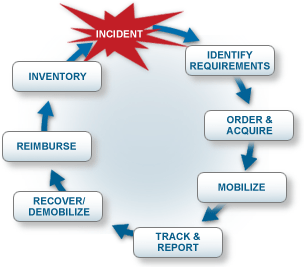
Resource management is one of the most complex aspects of emergency management.  The resource management cycle could be seen as a microcosm of the emergency management cycle with a number of steps operating in sequence and some simultaneously before, during, and after a disaster.  We need to properly establish our resource management systems, procedures, and policies and keep them, as well as our inventories, up to date.

Referencing the Core Capabilities, the capabilities of Public and Private Services and Resources, Planning, Critical Transportation, and Operational Coordination all have bearing on resource management.  Resource management is also one of the key components of NIMS.  The following graphic on the resource management cycle comes from NIMS doctrine.  While this is largely a logistics issue, the importance of it all cuts across all levels of all organizations.

NIMS Resource Management Cycle

NIMS Resource Management Cycle

Consider each of the steps identified in the resource management cycle.  There is quite a bit of complexity to each.  An additional challenge is that they are always in motion as requirements regularly change, new resources are obtained, and obsolete resources are retired from service.  Often one change in a step of the cycle requires changes cascading to other steps.  Also consider the variety of people involved in each step.  No one agency or department has all the resources, therefore we are relying on information from others to create a common operating picture of resource management.  Additionally, the regularity of changes in this information require us to have establish and maintain a system which allows for real-time tracking of this information.

Any information can be viewed in a variety of manners.  A fairly simple web-based tool can allow for multiple stakeholders to input data and change resource status, but the display of that information the reporting available from such as system allows for better utility.  The integration of GIS can help us identify not only where our resources are, but what their status is (NIMS provides us with three resources status indicators: Assigned, Available, and Out of Service), as well as detailed information on the resource such as the kind and type (again, these are NIMS-driven definitions that describe the capability of a resource), the owner of the resource along with contact information, and other information including technical, operational, and maintenance information.

In a pre-incident condition we should know what we have, what capability of those resources, and the conditions for deployment.  Operating under ICS, once an incident occurs, Logistics obtains resources for the incident where tracking becomes the responsibility of the Resource Unit in the Planning Section.  After an incident, these resources return to their owners where they are maintained and re-inventoried.  Depending on the incident, owners may be reimbursed for their use which requires reporting on a variety of metrics.

Wildfire incident management practices brought us the T-Card system – a great low-tech way of tracking incident resources.  A T-Card system is easy to learn and deploy and does a great job of tracking resources but can be very labor intensive and certainly has a delay in reporting.  I’ve also used spreadsheets and stand alone databases, which allow for more flexibility and automated reporting, but still suffer from a delay with a single point of data input and management.  Networked systems allow for immediate inclusion of staging areas, bases, and other mobilization or stockpile areas and are suited for simple and complex incidents.  Consider leveraging technology to maximize your resource management common operating picture on both a daily basis and for incident management.  Of course it’s always good to have a low-tech back up (and the know-how to use it!).

What systems do you have in place for resource management?  What best practices have you identified?

© 2014 Timothy Riecker


Planning for a Mass Fatality Incident

Planning for a mass fatality incident can be almost as complex as responding to such an incident.  Mass fatalities can arise from transportation incidents, pandemics, mud slides, mass shooting, or other sudden incidents.  Thankfully mass fatality incidents do not occur often, but due to the impacts and complexity of managing such incidents every jurisdiction should have a plan in place to address them.

A mass fatality incident management plan should be an annex to a comprehensive emergency management plan.  Just as with any deliberate emergency planning effort (ref CPG 101), we start by assembling a planning team.  This planning team should represent all relevant stakeholders from across the community.  Beyond your usual public safety agencies, the team should also include the coroner or medical examiner, public health, public works, hospitals, social services agencies, the American Red Cross, funeral directors, and cemetarians.  It is also important to consider the cultural and/or spiritual requirements of how the deceased are handled so community leaders from these groups should also be included in your planning process.

Your plan should acknowledge the hazards in your community which can lead to a mass fatality incident.  These should already have been identified through your hazard analysis/THIRA.  If you have not conducted a THIRA, your planning team should discuss the impacts of such an event through a briefly outlined credible worst-case scenario then identify what capabilities are needed to address these impacts.

Assisting agencies may have some slightly different roles in the management of a mass fatality incident than they would in other incident responses.  These differences should be identified in the mass fatality incident response plan.  It should also be recognized that the causal nature of the incident is most likely to drive who will be in charge of such an incident.  Typically there are other matters which must be mitigated to save lives, protect property, and stabilize the incident which will determine who is in charge.  Because it is a mass fatality incident the coroner or medical examiner will be managing a significant portion of the incident and may also be driving policy based upon their legal responsibilities, but they may not be in command, although they may be likely to be part of a unified command.

While the coroner or medical examiner will be handling the deceased, it must absolutely be remembered that the living must also be cared for.  First and foremost are the immediate survivors, if any, of the incident who will require emergency medical care.  Depending on the nature of the incident, others may need to be treated for exposure.  Mental health care is a much more prominent issue in a mass fatality than perhaps any other incident – and the need for mental health care applies to everyone working the incident, families and friends of victims and survivors, and the community at large.

A common venue in mass fatality incidents for providing mental health assistance to families and friends of victims and survivors is a Family Assistance Center (FAC).  The Aviation Disaster Family Assistance Act of 1996 requires family assistance centers to be established for major transportation incidents (the joint responsibility of the NTSB and the American Red Cross) but these centers have been used for other mass fatality incidents as well.  In additional to crisis mental health counseling, a variety of other services can also be provided at a FAC.  A FAC should be established very quickly and it should be recognized that surviving victims may be stranded in the area and that family and friends will flock to the area – many of which may have little support structure or plans for essentials such as lodging.  A FAC is also an ideal location for authorities to obtain information from survivors about the missing or deceased which will help with future identification.  FACs are often located in hotels where large conference facilities, lodging, food, and other services can be obtained.

Another facility common to a mass fatality incident is a temporary morgue.  Temporary morgues are established either as a matter of operational convenience (rather than having to transport remains to the jurisdiction’s usual morgue site) or because the usual morgue site is too small to accommodate a larger operation.  Usually in conjunction with a temporary morgue is the need for cold storage for remains.  This is most often accomplished via refrigerated trucks/containers.  The incident morgue is obviously a secure location, with only authorized personnel being allowed access.

The amount of logistical planning required to establish and support facilities such as a family assistance center and temporary morgue lend themselves greatly to pre-planning efforts, including MOUs, site-specific standard operating procedures, mobile caches of disaster supplies, and exercises to test the standard operating procedures for setting up and running such facilities.  There are a variety of resources available to assist you with assembling your mass fatality incident response plan from LLIS, the federal Disaster Mortuary Response Team (DMoRT), state health departments, state emergency management agencies, and funeral home director’s associations.  The National Association of County and City Health Officials also has information which can assist you.

Take the time to create a mass fatality incident management plan, train personnel on the plan, and exercise it regularly.  Mass fatalities represent some of the most complex incidents I’ve ever been involved in and are very multifaceted.  As always, if your jurisdiction needs assistance in any preparedness efforts, Emergency Preparedness Solutions, LLC is here to help!

© 2014 Timothy Riecker


Business Continuity and Emergency Management Standards and Requirements

When building a business continuity or emergency management program – or the foundation of that program in a business continuity or emergency management plan – there is a lot of research that needs to be performed before much work can even begin.  Some of the most critical research is the identification of the standards and requirements which apply to your program/plan.  Note a significant difference in terminology between requirement and standard.  Requirements are generally items that are in passed into law or included in regulation.  Standards are typically developed by standards organizations or accrediting bodies and are generally looked upon as best practices within an industry.  Standards are also more likely to be regularly updated whereas requirements (laws) are generally updated on a less often basis.

Where should you look for requirements and standards which apply to you?  Much of it is based upon what industry you are in and where you are located.

Start locally.  Research local laws and codes which may have requirements for certain industries.  Local emergency management planning codes that I’ve seen include industries that use or produce specific chemicals, healthcare facilities, day care programs, and the hospitality industry (hotels and resorts), to name a few.  These codes may require certain planning or notification elements which you must address.  You should search the codes/laws of your city/town/village as well as your county.  The clerks or emergency management officials for those jurisdictions should be of great help to you.  States usually also have specific planning requirements found in state law and/or regulation which cover requirements for local jurisdictions as well as many of the industries mentioned previously.  Contact your state emergency management agency as well as the state agency that regulates your industry for the best information.

Local and state laws comprise most of the requirements you will find – however certain industries may have federal laws or regulations which must be followed – many of these come from the EPA.  Nationally, however, you are more likely to find standards.  FEMA’s standard for emergency planning (which largely applies to jurisdictions but can certainly be used by other organizations) is found in Comprehensive Preparedness Guide (CPG) 101 – Developing and Maintaining Emergency Operations Plans.  While there is no up front legal requirement to follow CPG 101 from FEMA, it may be a requirement of grant funding – yet another requirement you must explore and address.  Certain industries seeking ISO (International Standards Organization) accreditation may need to follow various ISO standards on emergency management and safety.  Overall, if your industry has a professional association or accrediting body, they are an excellent resource for you.

But isn’t there some standard that applies broadly to everyone?  Yes – that is NFPA 1600.  The National Fire Protection Association (NFPA) creates standards which apply to many industries and are often legally adopted as code by jurisdictions.  The NFPA itself does not create law or regulation but they drive many of the standards we see across the nation in many applications including chemical production and handling, engineering, electrical, plumbing, building and development codes, fire codes and others.  NFPA documents are developed through a consensus standards development process approved by the American National Standards Institute (ANSI).  NFPA 1600 is the Standard on Disaster/Emergency Management and Business Continuity Programs.  Typically access to NFPA documents requires membership or a fee per document (their material is copyrighted), however NFPA 1600 is seen as so critical and broad-reaching that the NFPA offers access to the document free of charge.

NFPA 1600 is comprehensive yet open enough for individual application.  You won’t see from NFPA 1600 any detailed guidance in how to write a plan, but you will see the steps of a planning process and key benchmarks they recommend be addressed in a plan.  In addition to planning, the standard also addresses program management, training and exercises, and program improvement.  Intended to be used as a tool, the standard also includes program evaluation checklists and references other best practices in emergency management and business continuity including DRII (Disaster Recovery Institute International) and United Nations programs.  An annex within the standard even addresses family preparedness programs intended for employees.

While the standards you must follow are dependent upon your location and industry, NFPA 1600 can be applicable to all organizations and should be referenced in the building and maintenance of your emergency management and business continuity plan.  For those of you dependent upon access to information on your mobile devices, they even have a free NFPA 1600 mobile app (I reference it often!).

Adherence to requirements and standards helps ensure that your program meets or exceeds all expectations and best practices.  Even if you are not legally obligated to do so, following standards, such as NFPA 1600, provides you with a comprehensive program which will help you better prepare for, respond to, and recover from disaster.

If you need help navigating your emergency management requirements or standards, contact Emergency Preparedness Solutions.  Visit our website at www.epsllc.biz.

© 2014 Timothy Riecker

Don’t Just Prepare for Disasters Passed

As mentioned in an earlier post, I’ve been reading Rumsfeld’s Rules, a bit of a memoir by former Congressman, Secretary of Defense (twice over), and CEO Donald Rumsfeld.  Much of the book is highlighted by quotes which have influenced him in various stages of his life.  One of his anecdotes references the Maginot Line, a multi-layered defensive system created by the French after World War I along their border with Germany, intended to protect France from any future invasion from Germany.  The Maginot Line would have proven a rather effective defense, had Germany used similar strategies in World War II as they had in World War I.  Obviously the Nazis were quite successful in their invasion of France, quickly conquering and occupying the nation.  The difference was that the Nazis were fighting a new war, whereas France was preparing to fight the last war – which is the quote Rumsfeld references with this anecdote.

What can we learn from this in emergency management and homeland security?  It can’t possibly apply to us, can it?  Obviously we base many of our plans and preparations on disasters of the past.  We have an in-depth trove of information from sources like LLIS which allow us to learn from past disasters.  Much of our hazard analysis is based upon what occurred in the past.  We study past disasters, examining them from inception through recovery, arm-chair quarterbacking all facets of response – from command, to organization, to logistics.  From this we learn what practices to embrace and what needs to be improved upon.  Since we’re quoting, it was Benjamin Franklin who said “Experience the best teacher.”

To the contrary, we have a rather prolific saying in emergency management that no two disasters are alike.  So why all this effort to examine the past?  There is a lot to be learned from the past.  As previously mentioned, we spend a lot of time and effort examining earlier disasters so we can learn from them.  While every disaster is different, there are also many commonalities – all of which we can better prepare for.  The past also puts disasters and their magnitude in context for us.  We can’t be stuck in the past, however.  While the next disaster may have similarities to one passed, there will be differences.  It is our job and our responsibility to predict to the greatest extent of our efforts what the impacts will be of future disasters, as well as the hazards they will stem from.  Yes we must learn from the past, but we must always look to the future.

How do we look into the future?  Reconvene your planning groups and discuss this new context.  Engage members to continually reassess what is changing – in the climate, the geography and landscape, and the new or changed technological hazards in our areas.  We must look beyond our borders both literally and figuratively as I outlined in a previous post, and consider all possibilities.  Use exercises which introduce scenarios new to us instead of those based upon disasters of the past to help us contextualize this and better prepare.

My challenge to you – Take an honest look at your plans, policies, procedures, and training – are you preparing to fight the last war or the next one?

© 2014 Timothy Riecker