As a follow up to yesterday’s post on Collegiate Emergency Management, here’s a bunch of resources for colleges and universities courtesy of FEMA. This information brought to my attention by the folks at All Hands Consulting via Twitter @AllHandsDotNet.
Tag preparedness
Planning in Perspective
 I just finished reading an article by Lucien Canton, CEM – who is a well-respected and often published emergency management professional. He maintains a blog, which he posts to often, and provides great insight to various EM-related topics. The article that struck my interest was ‘Paper Plans and Fantasy Documents’. Canton poses the question as a subtitle to his article – ‘Are we over-thinking planning?’. In all actuality, based on his article and my own experiences, no – in fact we’re under-thinking it by maintaining a cookie cutter approach across the entire nation.
Canton’s commentary is similar to the thoughts I had in an earlier post on the (mis)use of templates in emergency planning. Standards are good to have in every industry, certainly in emergency management and homeland security. There are folks who become true experts through a great deal of experience, research, and trial and error. The best ones share their expertise with the rest of the world in the hopes that we can all benefit. Eventually, these standards become embraced by ‘standard setters’ – those in government or regulatory bodies who can pass laws, regulations, or codes to compel others to adhere to these standards. This is all absolutely necessary – but, as Canton mentions, these standards become the basis for how people plan.
Just like I often write in my training-related posts, it’s all about the audience. Our planning priority must be to meet the needs of the jurisdiction/company/organization who will be using the plan. The plan must have utility – i.e. it must be usable. Just because a plan meets established standards, does not mean that it can be operationalized. Obviously our plans must still meet standards, but that really is a secondary concern to usability. I think we are missing the forest for the trees and need to seriously re-think how we plan.
Any ideas?
Safeguarding our Electrical Grid – Reblog
More thoughts on the vulnerabilities of our electrical grid. Great post.

Popular Science (28 January 2013) has an interesting article on “How To Save The Electrical Grid.”
Power use has skyrocketed with home appliances, TVs, and computers, causing a significant increase in demand and “pushing electricity through lines that were never intended to handle such high loads.”
Our electrical infrastructure is aging with transformers “now more than 40 years old on average and 70% of transmission lines are at least 25 years old” while at the same time over the last three decades average U.S. household power consumption has tripled!
The result is that the U.S. experiences over 100 mass outages a year to our electrical systems from storms, tornados, wildfires and other disasters.
According to the Congressional Research Service, “cost estimates from storm-related outages to the U.S. economy at between $20 billion and $55 billion annually.”
For example, in Hurricane Sandy 8 millions homes in 21 states lost power, and…
View original post 350 more words
Strenghtening 9-1-1 Systems
 This morning, Government Security News (GSN) published an article regarding the FCC‘s examination of last June’s derecho storms that severely impacted Virginia, Maryland, West Virginia, DC, and Ohio. The FCC looked into the long-lasting down time of 9-1-1 call centers in these impacted areas, provided comment, as well as recommendations – which largely are pretty sound.
If you’ve read earlier blog posts of mine, you’ll know that I more-often-than-not tend to defend utility companies. Yes, we can all be better prepared, but I believe that sometimes the expectations are unreasonably high, especially with wide-spread disasters. Also, utility companies are just that – companies – their primary goal is to be profitable. With this in mind, there comes a point when the cost of mitigation may, at least in the short-term, make them unprofitable. While in theory I would say ‘suck it up’, share holders tend not to see things that way. So that does leave us with a bit of a quandary.
9-1-1 is an absolutely critical service. Outages and disturbances in these systems occur every day throughout the nation, but are typically short in duration. The derecho left 3.6 million people with interrupted 9-1-1 service, some for many days. While there are general infrastructure issues that result from storms that can impact a utility system, this was compounded after the derecho by continued high winds for a few days, making many repairs impossible. The FCC report cites, however, a few easy fixes that could have greatly reduced both the number of outages and the duration of many of these outages – including emergency power generators at central offices and distribution hubs. There were also planning gaps that were discovered, that, once addressed should help reduce impacts by both number and duration. I believe we also need to harness the technology we have to discover redundancies and back-ups that can be implemented in the even of future system failures.
Every incident is a learning experience for all involved – and hopefully even for those fortunate enough to not be involved. The challenge is accepting these lessons learned and applying them to improve our measure of preparedness, increasing our awareness, and better enabling us to respond more effectively the next time around.
What lessons have you learned from disasters???
Today is the Day Before
I subscribe to disaster recovery e-mails from a company called Agility Recovery, whose primary focus is IT disaster recovery but they recognize the value of a comprehensive approach. They have great marketing and outreach, including regular webinars on various emergency management topics.
This week’s ‘Disaster Recovery Tip’ from Agility made me aware of a new campaign by FEMA (and I must say, FEMA’s campaigns have gotten MUCH better over the last few years – Kudos to FEMA!!!). This one is entitled ‘The Day Before’, and reminds us that we never know what will happen tomorrow, so we should always be prepared. Link to the video below.
NYPD Active Shooter Recommendations and Analysis – December 2012

NYPD Logo
This document, updated by NYPD last month in the wake of the Sandy Hook shooting, was brought to my attention through LLIS. It’s also posted on the NYPD’s website here. This document is a good compilation of practitioner research; official recommendations suitable for schools, businesses, and public buildings; and reflects on the ‘Run, Hide, Fight’ recommendations we’ve seen (NYPD’s version is a little more of a mouth-full – Evacuate, Hide, Take Action). I like that they provide some information relative to attackers including gender, age, number of attackers (98% of active shooter incidents are carried out by a single attacker), planning tactics, targets, number of casualties, location of attack, weapons used, attack resolution, and other statistics – with this data provided for over 300 case studies (all included in the document).
The real value of this document is that the information which is provided to the reader allows for better informed (instead of emotional or ‘trendy’) decisions on facility security and planning relative to active shooter scenarios.
Thanks to the fine folks at NYPD for doing this work and sharing it with the public safety community.
Active Shooter Video – Run, Hide, Fight
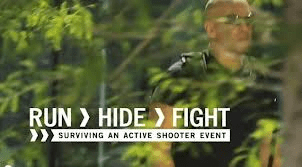 Alabama Homeland Security, at the request of the Governor, modified the City of Houston’s Run, Hide, Fight video in the aftermath of the Sandy Hook school shooting. Despite a few comments I’ve seen around the internet about the video being ‘sensationalized’, I think it’s a very well done video hitting emotions as best as possible through an instructional video.
It appears that the concept of ‘Run, Hide, Fight’ is the best approach we have against these types of horrific incidents. It makes sense.
– Tim Riecker
Managing an Exercise Program – Part 3: Identifying Program Resources and Funding
This post is part of a 10-part series on Managing an Exercise Program. In this series I provide some of my own lessons learned in the program and project management aspects of managing, designing, conducting, and evaluating Homeland Security Exercise and Evaluation Program (HSEEP) exercises. Your feedback is appreciated!
Managing an Exercise Program – Part 1
Managing an Exercise Program – Part 2: Develop a Preparedness Strategy
Managing an Exercise Program – Part 3: Identify Program Resources and Funding
Managing an Exercise Program – Part 4: Conduct an Annual Training & Exercise Planning Workshop.
Managing an Exercise Program – Part 5: Securing Project Funding
Managing an Exercise Program – Part 6: Conducting Exercise Planning Conferences
Managing an Exercise Program – Part 7: Develop Exercise Documentation
Managing an Exercise Program – Part 8: Preparing Support, Personnel, & Logistical Requirements
Managing an Exercise Program – Part 9: Conducting an Exercise
Managing an Exercise Program – Part 10: Evaluation and Improvement Planning
Exercises can be very resource intensive, have no doubt about that. Generally speaking, the more you invest in them, though, the more you get out of them. Certainly discussion-based exercises are usually not as expensive as operations-based exercises. For all exercise types, however, the largest costs are in the design (staff or consultant time, as well as meeting time), and conduct (again, staff or consultant time, plus the time of the participants). What resources do you need for your exercise program as a whole? How do you get them?
First of all, let’s discuss human resources. In Managing an Exercise Program – Part 1, I discussed the importance of having an exercise program manager and what some of the qualifications should be for that person. A program manager is probably the most important human resource you could have for exercises, but certainly this person can’t do it alone. A good exercise program is able to leverage the experience, support, and ideas of others – both within and outside. The exercise program manager needs to be a great networker, able to draw people from various agencies into a mutually beneficial partnership. Some of these agencies will come and go, but some will be strong, permanent partners. Each partner agency, including your own, should be contributing to the efforts of the group – not only with ideas, but with people to serve as controllers, evaluators, planning team members, etc., physical resources suitable for whatever types of exercises you conduct, and perhaps even funding.
In March of 2008, I founded and co-chaired the New York State Exercise Coordination Committee, composed of several state agencies, departments, authorities, and the Red Cross. Meeting regularly and communicating often, we were able to pool our resources not only for each individual exercise, but for exercise program management as a whole throughout New York State. We formulated consistent policies and practices, allocated Homeland Security funds state-wide for exercises and corrective actions, and developed and delivered exercise-related workshops and training courses. We became the core group for the Training & Exercise Planning Workshop (more on this in the next part) and applied for and coordinated funding requests to FEMA for the Regional Exercise Support Program (RESP), which provided contractor resources to state and local exercise initiatives. We were not only able to help each other, but we were able to benefit the state as a whole. This model can be applied to other states; county and local governments; and consortia of public, private, and not for profit groups.
Keep in mind that the HSEEP cycle is just that, a cycle. You will constantly be revisiting each of these steps – sometimes out-of-order – including determining needs and sourcing of resources.
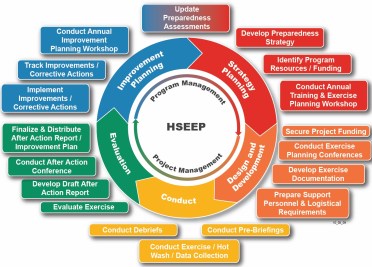
HSEEP Cycle
What resources do you think you will need to manage your program?
Be on the lookout for Managing an Exercise Program – Part 4: Conducting an Annual Training & Exercise Planning Workshop.
Kudos to Cleveland
As I was typing away at the State Preparedness Report for a client late into the night last night, I would check new blog posts while the FEMA web tool would save and load new pages (the PREPCAST portal was gruelingly slow as the deadline for every state is December 31st). Every couple of hours, a new post would go up in the WordPress Emergency Preparedness category from the Cleveland, Ohio Public Safety Department as they updated readers on the weather, road conditions, snow removal, parking, and safety matters. Essentially, they would provide a mini situation report for the public and include whatever information residents needed to know.
This is certainly a best practice and excellent utilization of a blog to provide up to date information. Great job Cleveland!
How does your jurisdiction disseminate emergency information?
Active Shooter Info from DHS
Good active shooter info from DHS.

The tragedy in Newtown, Conn. raised awareness of the Active Shooter threat. Listed below please find links to a number of reference and training resources which highlight response to the Active Shooter threat.
DHS Reference Materials:
DHS, Active Shooter – Booklet: How to Respond www.dhs.gov/xlibrary/assets/active_shooter_booklet.pdf
- DHS, Active Shooter – Pocket Card: Information www.dhs.gov/xlibrary/assets/active_shooter_pocket_card.pdf
- DHS, Active Shooter – Poster: How to Respond When an Active Shooter Is in Your Vicinity www.dhs.gov/xlibrary/assets/active_shooter_poster.pdf
FEMA Online Courses:
Active Shooter: What You Can Do http://training.fema.gov/EMIWeb/IS/IS907.asp
- Workplace Security Awareness http://training.fema.gov/EMIWeb/IS/IS906.asp
 The Contrarian Emergency Manager