Failures in Preparedness

In May the GAO released a report titled “National Preparedness: Additional Actions Needed to Address Gaps in the Nation’s Emergency Management Capabilities”. I encourage everyone to read the report for themselves and also reflect on my commentary from several years of National Preparedness Reports. I’ll summarize all this though… it doesn’t look good. The National Preparedness Reports really tell us little about the state of preparedness across the nation, and this is reinforced by the GAO report as they state “FEMA is taking steps to strengthen the national preparedness system, but has yet to determine what steps are needed to address the nation’s capability gaps across all levels of government”.

First of all, let me be clear about where the responsibility of preparedness lies – EVERYONE. Whole community preparedness is actually a thing. It’s not FEMA’s job to ensure we are prepared. As also made evident in the GAO report (for those who haven’t worked with federal preparedness grants), most preparedness grants are pretty open, and as such, the federal government can’t force everyone to address the most critical capability gaps. Why wouldn’t jurisdictions want to address the most critical capability gaps, though? Here are some of the big reasons:

  • Most or all funding may be used to sustain the employment of emergency management staff, without whom there would be no EM program in that jurisdiction
  • The jurisdiction has prioritized sustaining other core capabilities which they feel are more important
  • The jurisdiction has decided that certain core capabilities are not for them to address (deferring instead to state or federal governments)
  • Shoring up gaps is hard
  • Response is sexier

The GAO report provided some data to support where priorities lie. First, let’s take a look at spending priorities by grant recipients:

While crosscutting capabilities (Operational Coordination, Planning, and Public Information and Warning) were consistently the largest expenditures, I would surmise that Operational Coordination was the largest of the three, followed by Planning, with Public Information and Warning coming in last. And I’m pretty confident that while these are cross cutting, these mostly lied within the Response Mission Area. Assuming my predictions are correct, there is fundamentally nothing wrong with this. It offers a lot of bang for the buck, and I’ve certainly spoken pretty consistently about how bad we are at things like Operational Coordination and Planning (despite some opinions to the contrary). Jumping to the end of the book, notice that Recovery mission area spending accounts for 1% of the total. This seems like a poor choice considering that three of the five lowest rated capabilities are in the Recovery mission area. Check out this table also provided in the GAO report:
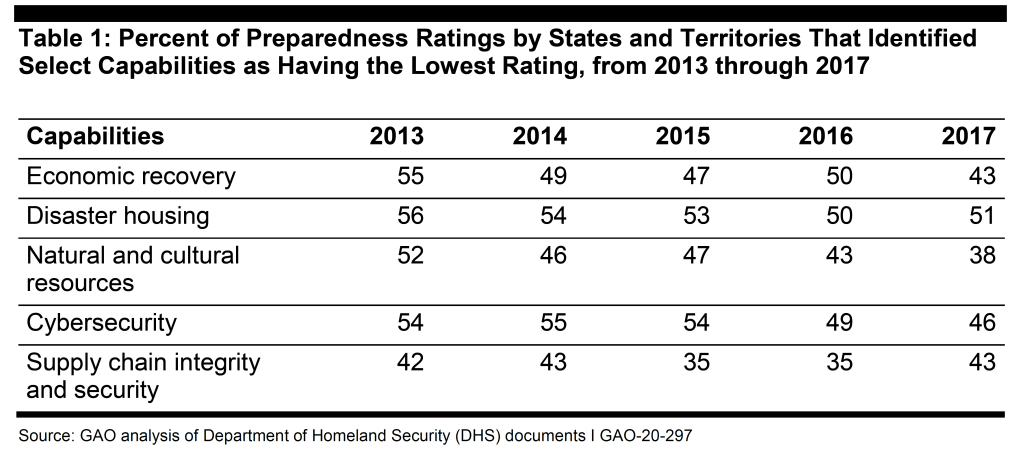
Through at least a few of these years, Cybersecurity has been flagged as a priority by DHS/FEMA, yet clearly, we’ve not made any progress on that front. Our preparedness for Housing recovery has always been abysmal, yet we haven’t made any progress on that either. I suspect that those are two areas, specifically, that many jurisdictions feel are the responsibility of state and federal government.

Back in March of 2011, the GAO recommended that FEMA complete a national preparedness assessment of capability gaps at each level of government based on tiered, capability-specific performance objectives to enable prioritization of grant funding. This recommendation has not yet been implemented. While not entirely the fault of FEMA, we do need to reimagine that national preparedness system. While the current system is sound in concept, implementation falls considerably short.

First, we do need a better means of measuring preparedness. It’s difficult – I fully acknowledge that. And for as objective as we try to make it, there is a vast amount of subjectivity to it. I do know that in the end, I shouldn’t find myself shaking my head or even laughing at the findings identified in the National Preparedness Report, though, knowing that some of the information there can’t possibly be accurate.

I don’t have all the answers on how we should measure preparedness, but I know this… it’s different for different levels of government. A few thoughts:

  • While preparedness is a shared responsibility, I don’t expect a small town to definitively have the answers for disaster housing or cybersecurity. We need to acknowledge that some jurisdictions simply don’t have the resources to make independent progress on certain capabilities. Does this mean they have no responsibility for it – no. Absolutely not. But the current structure of the THIRA, while allowing for some flexibility, doesn’t directly account for a shared responsibility.
  • Further, while every jurisdiction completing a THIRA is identifying their own capability targets, I’d like to see benchmarks established for them to strive for. This provides jurisdictions with both internal and external definitions of success. It also allows them an out, to a certain extent, on certain core capabilities that have a shared responsibility. Even a small town can make some progress on preparedness for disaster housing, such as site selection, estimating needs, and identifying code requirements (pro tip… these are required elements of hazard mitigation plans).
  • Lastly, we need to recognize that it’s difficult to measure things when they aren’t the same or aren’t being measured the same. Sure, we can provide a defined core capability, but when everyone has different perspective on and expectation of that core capability and how it should be measured, we aren’t getting answers we can really compare. Everyone knows what a house is, but there is a considerable difference between a double wide and a McMansion. Nothing wrong with either of them, but the differences give us very different base lines to work from. Further, if we need to identify how big a house is and someone measures the length and width of the building, someone else measures the livable square footage of a different building, and a third person measures the number of floors of yet another house, we may have all have correct answers, but we can’t really compare any of them. We need to figure out how to allow jurisdictions to contextualize their own needs, but still be playing the same game.

In regard to implementation, funding is obviously a big piece. Thoughts on this:

  • I think states and UASIs need to take a lot of the burden. While I certainly agree that considerable funding needs to be allocated to personnel, this needs to be balanced with sustaining certain higher tier capabilities and closing critical gaps. Easier said than done, but much of this begins with grant language and recognition that one grant may not fit all the needs.
  • FEMA has long been issuing various preparedness grants to support targeted needs and should not only continue to do so, but expand on this program. Targeted grants should be much stricter in establishing expectations for what will be accomplished with the grant funds.
  • Collaboration is also important. Shared responsibility, whole community, etc. Many grants have suggested or recommended collaboration through the years, but rarely has it been actually required. Certain capabilities lend themselves to better development potential when we see the realization of collaboration, to include the private sector, NGOs, and the federal government. Let’s require more of it.
  • Instead of spreading money far and wide, let’s establish specific communities of practice to essentially act as model programs. For a certain priority, allocate funds for a grant opportunity with enough to fund 3-5 initiatives in the nation. Give 2-3 years for these programs to identify and test solutions. These should be rigorously documented so as to analyze information and potentially duplicate, so I suggest that academic institutions also be involved as part of the collaborative effort (see the previous bullet). Once each of the grantees has completed their projects, host a symposium to compare and contrast, and identify best practices. Final recommendations can be used to benchmark other programs around the nation. Once we have a model, then future funding can be allocated to support implementation of that model in other areas around the nation. Having worked with the National Academies of Sciences, Engineering, and Medicine, they may be an ideal organization to spearhead the research component of such programs.
  • Recognize that preparedness isn’t just long term, it’s perpetual. While certain priorities will change, the goals remain fundamentally the same. We are in this for the long haul and we need to engage with that in mind. Strategies such as the one in the previous bullet point lend themselves to long-term identification of issues, exploration of solutions, and implementation of best practices.
  • Perhaps in summary of all of this, while every jurisdiction has unique needs, grant programs can’t be so open as to allow every grantee to have a wholly unique approach to things. It feels like most grant programs now are simply something thrown at a wall – some of it sticks, some of it falls right off, some might not even make it to the wall, some slowly drips off the wall, and some dries on permanently. We need consistency. Not necessarily uniformity, but if standards are established to provide a foundational 75% solution, with the rest open for local customization, that may be a good way to tackle a lot of problems.

In the end, while FEMA is the implementing agency, the emergency management community needs to work with them to identify how best to measure preparedness across all levels and how we can best implement preparedness programs. Over the past few years, FEMA has been very open in developing programs for the emergency management community and I hope this is a problem they realize they can’t tackle on their own. They need representatives from across the practice to help chart a way ahead. This will ensure that considerations and perspectives from all stakeholder groups are addressed. Preparedness isn’t a FEMA problem, it’s an emergency management problem. Let’s help them help us.

What thoughts do you have on preparedness? How should we measure it? What are the strengths and areas for improvement for funding? Do you have an ideal model in mind?

© 2020 Timothy Riecker, CEDP
Emergency Preparedness Solutions, LLC®

NIMS Guidance – Resource Management Preparedness

Last week FEMA issued a national engagement period for updated NIMS guidance on resource management preparedness. This is the first version of such a document, with most material on the subject matter, to date, being included in the NIMS doctrine and a few other locations. I regularly participate in the national engagement periods and encourage others to do so as I think it’s a great opportunity for practitioners and subject matter experts to provide input.

Some observations:

  1. The footer of the document states that it’s not for public distribution. I’m guessing that was an error.
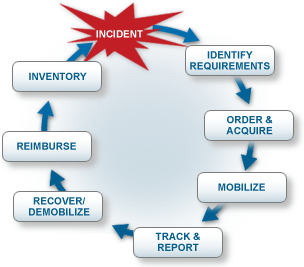
  2. The phrase of ‘resource management preparedness’ rubs me the wrong way. While I understand that there are resource management activities that take place within the preparedness phase of emergency management, we’re not preparing to manage resources. All the activities outlined in the document are actually part of resource management. If they want to put a time stamp on this set of activities, they can refer to them as ‘pre-incident’, but inventorying, typing, etc. are all actually part of the resource management cycle.
  3. I’d prefer to see a comprehensive NIMS Resource Management guide that addresses all aspects of resource management. Considering that resource management is a cycle, let’s actually cover the entire cycle. I think there will be far more value in that. Hopefully that’s eventually where this will go.
  4. The document is too stuck in NIMS. What do I mean by this? It seems that more and more people seem to forget that NIMS is a doctrinal component of incident management. While the document is focused on NIMS, it would have greater value if it addressed pre-incident resource management activities that might not found in the NIMS doctrine (though some are), but are none-the-less best practices in resource management. Many of these practices begin pre-incident.
  • One of the biggest things is resource tracking. Yes, resource tracking is a concept found in NIMS, but it’s not at all addressed here. How many jurisdictions struggle to figure out how to track resources in the middle of an incident (answer: most of them). The best time to figure out the means and methods of tracking resources is before an incident ever occurs. Resource tracking has a fair amount of complexity, involving the identification of what will be tracked, how, and by who; as well as how changes is resource status are communicated. Data visualization and dashboarding is also big. People want to see maps of where major resources are, charts that depict utilization, and summaries of resource status. All things best determined before an incident.
  • Resource inventories should identify operating requirements, such as maintenance and service. This is vaguely referenced in the guidance, but not well. Before any resource is deployed, you damn well better have the ability to operate and support that resource, otherwise it’s nothing more than a really large expensive paperweight. Do you only have one operator for that piece of equipment? That’s a severe limitation. All things to figure out before an incident.
  • How will resource utilization be tracked? This is important for cost controls and FEMA reimbursement. Figure that one out now.
  • What consumables are stockpiled or will be needed? What is the burn rate on those under various scenarios? (We’ve learned a lot about this in the pandemic)
  • What about resource security? When it’s not being used where and how will it be secured? What if the resource is left unattended? I have a great anecdote I often tell about a portable generator used in the aftermath of a devastating snow storm to power the traffic lights at a critical intersection. The maintenance crew doing their rounds found it to be missing, with the chain cut. Luckily the state’s stockpile manager had GPS trackers on all of them. It was located and re-acquired in little time, and the perpetrators charged. This success was due to pre-incident activity.
  • Resource ordering processes must also be established. What are the similarities and differences in the process between mutual aid, rental, leasing, or purchasing? What are your emergency procurement regulations and how are they implemented? How are the various steps in the ordering process assigned and tracked? This is highly complex and needs to be figured out before an incident.
  1. Resource typing. I honestly think this is the biggest push in emergency management that isn’t happening (maybe perhaps second to credentialing). Resource typing has been around for a long time, yet very very few jurisdictions I’ve worked with or otherwise interacted with have done it and done it well. I find that most have either not done it at all, started and gave up, or have done it rather poorly. I’ve been involved in resource typing efforts. It’s tough and tedious. I’ve done it for resources that we’re yet typed at the national level, leaving agencies and jurisdictions to define their own typing scheme. This literally can devolve into some heated discussions, particularly fueled by the volume of rather heavy customization we tend to do with resources as technology evolves, giving resources that may fundamentally appear to have similar capability to in reality be quite different. I’ve also done it for resources that have been typed at the national level. This certainly helps, as you aren’t first having to figure out your own thresholds, but it can still be challenging to pigeon hole resources that, again, may be heavily customized and don’t cleanly fit within a certain pre-defined category. It’s even more frustrating to have developed your own typing scheme in the absence of a national one, only to have national guidance issued a couple years later and needing to go back to those discussions.

I’m not saying resource typing is bad, in fact the benefits, both internally and externally, can be incredibly helpful. That said, it’s a time-consuming effort that, in the broader sense of limited time and other assets available to most emergency managers, is perceived to pay a lesser dividend than other activities such as developing and updating plans, training people on the implementation of those plans, and exercising those plans. It also can be difficult convincing agencies that it should be done. I can’t tell you how many times I get the response of ‘We know what we have’. I know that’s not the point, but that’s how the effort of typing resources is perceived. Even after some explanation of the benefits, most agencies (and I think rightfully so) would rather invest their time and effort into preparedness activities are that are seen as more beneficial. It leaves me wondering… is there a better way?

While it’s good to see information on the topic of early resource management steps being collated into one document, along with some resources and references that I’ve not seen before, this document is missing a lot. I just wrote last night about emergency managers being our own worst enemy. If we are just focused on implementing NIMS, we will absolutely fail. NIMS is not the end all/be all of incident management, but it is fundamentally promoted as such. Yes, the concepts of NIMS are all incredibly important, brought about from lessons learned and identified best practices of incident management through decades of experience. But the documents related to NIMS seem to pick and choose what they will focus on, while leaving out things that are highly critical. Perhaps some of these will be covered in future editions of resource management guidance, but they aren’t doing anyone any favors by omitting them from a document on pre-incident activity. We need to think broader and more comprehensive. We need to do better.

What are your observations on this document? What feedback do you have on my observations?

© 2020 Timothy Riecker, CEDP

Emergency Preparedness Solutions, LLC®

It’s Not Too Late To Prepare

The phrase I’ve been using lately when I speak to people has been “It’s not too late to prepare”.  Many people perceive that in the middle of a disaster we are unable to prepare.  Quite the contrary, we have the potential to integrate all of our preparedness steps into a response.  Because we have problems in front of us that need to be addressed, we have an opportunity to continuously improve, ensuring that organizationally we are offering the very best we can. 

There is a reason why there isn’t a mission area for preparedness in the National Preparedness Goal.  This is because preparedness is ongoing.  It’s not a separate or distinct activity.  Rather it is comprised of activities that support all mission areas, no matter when they are actioned.  Preparedness is continuous.

Assessment

Assessment is a key activity within preparedness.  In fact, assessment is foundational in understanding what’s going on.  During a disaster, good management practices dictate that we should be monitoring our response and adjusting as needed.  What exactly should we be monitoring?  Similar to evaluating an exercise, consider the following:

  • What was the effectiveness of deliberate planning efforts? 
    • Were planning assumptions correct?
    • Was the concept of operations adequate in scope and detail? 
    • What was lacking?
    • What worked well?
  • What was the effectiveness of plan implementation?
    • If aspects of plan implementation need improvement, what was the reason for the shortfall?
      • A poor plan
      • Lack of job aids
      • Lack of/poor/infrequent training
      • Lack of practice
      • Lack of the proper resources or capabilities
      • The plan wasn’t followed
  • Did resources and capabilities meet needs?  If not, why?

Planning

While some planning gaps will require a longer time period to address, I’m aware of many jurisdictions and organizations which have been developing plans in the midst of the pandemic.  They recognized a need to have a plan and convened people to develop those plans.  While some of the planning is incident-specific, many of the plans can be utilized in the future we as well, either in the form they were written or adjusted to make them more generally applicable without the specific details of this pandemic.  I’d certainly suggest that any plans developed during the pandemic are reviewed afterwards to identify the same points listed above under ‘assessment’ before they are potentially included in your organization’s catalogue of plans. Also consider that we should be planning for contingencies, as other incidents are practically inevitable.

Training

Training is another fairly easy and often essential preparedness activity which can performed in the midst of a disaster.  Many years ago FEMA embraced the concept of training during disasters.  FEMA Joint Field Offices mobilize with training personnel.  These personnel not only provide just in time training for new personnel or to introduce new systems and processes, but they provide continuing training a variety of topics throughout response and recovery, providing a more knowledgeable workforce.  I’ve seen some EOCs around the country do the same.  Recently, my firm has been contracted to provide remote training for the senior leadership of a jurisdiction on topics such as continuity of operations and multi-agency coordination, which are timely matters for them as they continue to address needs related to the pandemic. 

Exercises

While assessments, planning, and training are certainly activities that may take place during a disaster, exercises are probably less likely, but may, if properly scoped and conducted, still have a place.  Consider that the military will constantly conduct what they call battle drills, even in active theaters of war, to ensure that everyone is familiar with plans and protocols and practiced in their implementation.  Thinking back on new plans that are being written in the midst of the pandemic, it’s a good idea to validate that plan with a tabletop exercise.  We know that even the best written plans will still have gaps that during a blue-sky day we would often identify through an exercise.  Plans written in haste during a crisis are even more prone to have gaps simply because we probably don’t have the opportunity to think everything through and be as methodical and meticulous as we would like.  A tabletop exercise doesn’t have to be complex or long, but it’s good to do a talk through of the plan.  Depending on the scope of the plan and the depth of detail (such as a new procedure, conducting a walk-through of major movements of that plan (that’s a drill) can help ensure validity of the plan and identify any issues in implementation.  While you aren’t likely to go the extent of developing an ExPlan, an evaluator handbook, or exercise evaluation guides (yes, that’s totally OK), it’s still good to lay out a page of essential information to include objectives and methodology since taking the time to write these things down is one more step to ensure that you are doing everything you need for the validation to be effective.  Documentation is still important, and while it can be abbreviated, it shouldn’t be cut out entirely.  It’s also extremely important to isolate the exercise, ensuring that everyone is aware that what is being performed or discussed is not yet part of the response activity.  Evaluators should still give you written observations and documented feedback from participants.  You probably don’t need a full AAR, especially since the observations are going to be put into an immediate modification of the plan in question, but the documentation should still be kept together as there may still be some observations to record for further consideration. 

Evaluation and After Action

Lastly, incident evaluation is something we shouldn’t be missing.  We learn a lot about incident evaluation from exercise evaluation.   I’ve written on it before, which I encourage you to look at, but the fundamentals are ensuring that all actions and decisions are documented, that a hotwash is conducted (or multiple hotwashes to capture larger numbers of people or people who were engaged in very different functions), and that an after action report is developed.   Any incident should provide a lot of lessons learned for your organization, but the circumstances of a pandemic amplify that considerably.  Ensure that everyone in your organization, at all levels, is capturing observations and lessons learned daily.  Ensure that they are providing context to their observations as well, since once this is over, they may not recall the details needed for a recommendation. You may want to consider putting together a short form for people to capture and organize these observations – essentially identifying the issue, providing context, and putting forth a recommendation to address the issue. Don’t forget to encourage people to also identify best practices.  In the end, remember that if lessons learned aren’t actually applied, nothing will change. 

I welcome any insight on how we can continue to apply preparedness in the midst of a disaster. 

Be smart, stay safe, stay healthy, and be good to each other. 

©2020 Timothy Riecker, CEDP

Emergency Preparedness Solutions, LLC

Facing Coronavirus/COVID19 and Implementing Business Continuity

Many organizations are trying to figure out how to sustain in the midst of COVID19.  While we have been advocating business continuity plans for decades, many organizations haven’t seen the necessity.  COVID19 seems to be demonstrating that necessity.  Understanding that many organizations are not familiar with business continuity, I’m offering some considerations in this article and have written on the topic in the past as well.  You may be tempted to short-cut the planning process in a sense of urgency… don’t do it.  This can result in missing important things. 

  1. Don’t do it alone.  The first step in all emergency planning is to build a team.  Get the right people together in a room to talk things through.  It ensures you have multiple perspectives and helps you divide the work. 
  2. Document, document, document.  Documentation is a key to successful planning and implementation. It helps support effective communication and understanding internally and externally. 
  3. Identify your Mission Essential Functions.  Mission Essential Functions are those activities that are absolutely necessary to keep your organization running.  Things like finance, payroll, HR, IT, and critical organizational operations (the activities that make you money or the activities that are part of your core organizational charter) are among your Mission Essential Functions.
  4. What else to think about? What work can or can’t be performed remotely?  Consider how your organization will handle the absence of your own employees if they become ill, must care for an ill family member, or have to care for children if schools are closed.  It’s also important to identify considerations for key partners (shippers, suppliers, etc.) if they are unable to conduct their services for a time.  How will these things impact your organization? 
  5. Engage HR.  Your Human Resources staff are critical cogs in the wheel of business continuity.  They will help identify HR/personnel/labor union policies, contracts, and other matters that may encumber the success of your business continuity.  Once problems are identified, set them to addressing those problems.  Sick leave policies, remote work policies, child care, and worker safety are among the priority discussions we’ve been seeing lately. 
  6. Engage IT.  Information Technology is a big aspect of business continuity.  Most business continuity plans call for many of an organization’s staff to work remotely.  Amazingly, so many organizations still have policies against working remotely, or at least no standard addressing how remote work is to be implemented, conducted, and managed.  HR and IT should be partnering on policies and procedures to address accountability, expectations of the organization, expectations of staff working remotely, and expectations of any staff still working in the office.   
    1. Along with policy matters, there are also matters of hardware, connectivity, and procedures.  What staff will be working remotely?  Has the organization provided them with the tools to do so?  Do they have internet connectivity from their remote location?  What systems and information will be accessed remotely and how?  How will system security be monitored and maintained?  Will a help desk be available to address problems?
    1. Test, test, test.  If you’ve not engaged a number of your staff in remote work before, now is the time.  Have some staff work from home and see how it goes.  Don’t just pick your most tech-savvy staff, either.  Now is the time to identify and address problems. 
  7. Consider the impacts of your changes.  Whatever organizational operations you are changing will have some impact on how you do business.  Where will your phones be directed to?  How will you conduct meetings?  How will signatures be handled?  How will you accept deliveries?  How will staff send mail from their remote work location?  Will you still meet face to face with clients/customers?  Does the office still need to be staffed? 
  8. Staff Communication.  Ensure that staff know what’s going on. Don’t leave them in the dark on this. Keep safety as the central point of your messaging.  Listen to their questions and concerns, and be timely and honest in your responses.  Keep open lines of communication.
  9. Stakeholder Communication.  Vendors, clients/customers, shippers, boards of directors, even the public at large… they all need to know what’s going on and how the continuity event will impact them and their interests.  Just as with your staff, listen to their questions and concerns, and be timely and honest in your responses.  Keep open lines of communication.

The items I listed here are some of the more common concerns and considerations I’ve seen as of recent.  There are a lot of other aspects to business continuity and business continuity planning.  Pressure may be on, but move with urgency, not reckless haste.  If your plan and systems aren’t properly in place, your organization will suffer from poor preparations. 

© 2020 Timothy Riecker, CEDP

Emergency Preparedness Solutions, LLC®

Operational Readiness in Emergency Management

Back in 2017 I wrote a piece on defining operational readiness.  It’s a topic, which, after some recent discussion with a colleague, I think bears revisiting and expanding upon.  Specifically, how we apply it in emergency management, or not.  Readiness is really a final comprehensive perspective of preparedness.  That is, once you have reached a certain level of preparedness, you can be ready, but being prepared doesn’t necessarily make you ready.  Preparedness is generally perceived as an ongoing process, though a state of readiness is typically a snapshot in time.

It struck me that the military tends to have more of a focus on readiness, while emergency management has a focus on preparedness.  While you will find both concepts within the doctrine of emergency management and military, the actual applications are considerably skewed.  After my discussion, I began to wonder why there this difference exists and what we can learn from it.

Having worked a considerable amount with various National Guard elements, I’ve come to highly respect their processes and their endeavor for readiness.  Not that we don’t have similar rigor in emergency management, but the focus seems to be more on the processes of preparedness rather than a state of operational readiness.  Sometimes the differences are so subtle that I have to sit back and think them through, but they are certainly there, and they are meaningful.  Given the military’s focus on operational readiness, they serve as a good source of information, though it needs to be properly filtered for application to emergency management.

As I’ve applied more thought to this, I’ve assembled a refined definition of readiness as it applies to emergency management, that being:

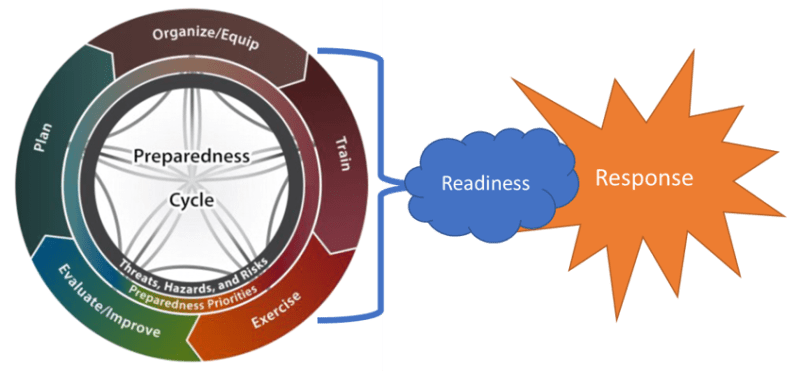
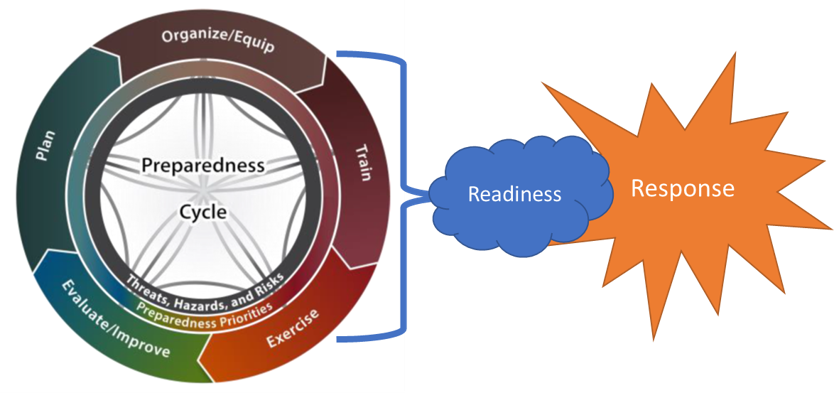
[Readiness is the nexus of benchmark outcomes of preparedness matched with the needs of a specific kind and type of response. A state of operational readiness is achieved when all applicable preparedness benchmarks are met and the organization is willing and able to adequately leverage the resulting capabilities against a corresponding threat or hazard.]

I’ve put together a graphic I think reasonably represents this relationship below.  Readiness is represented by a cloud because, as I explore further in this writing, it is itself rather amorphic and complex.

Readiness

To explain the components of my definition…  Readiness comes from a culmination of outcomes from preparedness activities, but only when each of these outcomes achieves a specific benchmark state.  The achievement of benchmarked preparedness activities define a measure of capability.  These capabilities are associated with a specific threat(s) or hazard(s).  As such, that state of readiness is only applicable to a specific kind (threat or hazard) and type (size and complexity) incident.  To help illustrate my points, here are a couple of examples using field response scenarios:

We can assume that a volunteer fire department is prepared to handle a room and contents fire.  They should have all the elements needed to do so, and in fact, these elements have standards (benchmarks) defined by the NFPA and state fire marshals.  Does this mean they have achieved readiness?  Hopefully yes, but perhaps not.  Given the rather extensive crisis of low membership in volunteer fire departments, the department in question may not have adequate staff to respond to this fire if it occurs, for example, in the middle of a week day.  This gives them a measure of degraded, or even negligible readiness.

Similarly, if we take the same fire department, having accomplished the benchmarks of preparedness for response to a room and contents fire, and even given adequate staff to do so, they may not have a state of readiness to fully address a hazardous materials incident.  While many of the elements of preparedness apply to both types of incidents, there are some critical differences which they would have to overcome to establish a state of readiness for a different type of incident.  Likewise, we could revert back to the room and contents fire and make it bigger – say a fully involved structure fire. While the department might have operational readiness to address the room and contents fire, they may not have the operational readiness to address a structure fire.

I think it’s fair to say that we can be prepared for something without having operational readiness for it.  Years ago, when there was a planetary ‘near miss’ by a meteor, a news outlet contacted our state OEM PIO.  They asked if we had a plan for a meteor strike.  The PIO acknowledged that we didn’t have a plan specific to that, but we did have a comprehensive emergency management plan, through which, and supported by various functional annexes, we were prepared to respond to such an incident and its effects should it occur.  Was the PIO wrong?  Not at all.  Assuming the other elements of preparedness were reasonably in place (and they were), it would be fair to say we were generally ‘prepared for anything’.  Were we ready, however?  Absolutely not.  The operational readiness needs for such an extraordinary, high impact incident are near-impossible to achieve.

When we examine this, it’s important to identify that a state of readiness can wax and wane, based on our ability to apply the identified preparedness measures to the incident in question. Considering the first example of the fire department and the room and contents fire, the department has a state of operational readiness when, as included in the definition I gave, all the preparedness benchmarks are met and they are willing and able to adequately leverage the resulting capabilities against a corresponding threat or hazard.  Changes in capability and/or the willingness or ability to apply those capabilities will result in degradation of readiness.  Depending on the factor in question, it may fully disqualify their readiness, or it may decrease their readiness by some measure.

So why is readiness important?  Readiness is the green light.  If we accomplish a state of operational readiness, we increase our chances of success in addressing the threat or hazard in question.  If we haven’t achieved readiness, we still can obviously be successful, but that success may come at a greater cost, longer period of time, and/or increased error.

How do we achieve readiness?  The current approach we have in emergency management certainly isn’t enough.  While some efforts may culminate in operational readiness, there is, as a whole, a significant lack of focus on operational readiness.  This seems to largely be a cultural issue to overcome.  In general, we seem to have the attitude that preparedness equates to readiness, and that preparedness itself is an end state. Even though we intuitively, and doctrinally, know that preparedness is a cycle, we seem to take comfort in ‘completing’ certain tasks among the preparedness elements – planning, organizing, equipping, training, exercises, and improvement – and then assuming readiness.  Readiness itself is actually the end state, though it is a dynamic end state; one that we can easily lose and must constantly strive to maintain.  To accomplish and maintain operational readiness, it is imperative that we aggressively and rigorously pursue activity in each of the elements of preparedness.  We must also continually monitor our ability to execute the capabilities we are preparing.  That ability, ultimately, is our measure of readiness.

The scale and unit of measuring readiness is something I’m not exploring in depth here (it really warrants its own deliberate effort), but expect to revisit in the future.  I surmise that the factors may be different based upon the various capabilities, and types and kinds of threats/hazards we are trying to address.  We need to examine capability requirements at a granular (task) level to truly assess our current state of readiness and identify what we need to address to increase our readiness.  I also assume that there is a somewhat intangible factor to readiness, one that likely revolves around the human factor. Things like leadership, decision-making, confidence, and ability to improvise. The measure of readiness may also involve certain external factors, such as weather.  The measurement of readiness certainly is complex and involves numerous factors.

I do know that practice is a significant factor in operational readiness.  Earlier I mentioned my experience with the National Guard.  Much of that revolves around exercises, which is one of the best (though not the only) measures of readiness.  Operational military units seem to constantly exercise.  Sometimes small scale, sometimes large.  They exercise different aspects, different scenarios, and different approaches.  It’s the regular repetition that builds competence and confidence, along with identifying shortfalls within the capability such as planning gaps, equipment failures, and the need to anticipate and prepare for certain contingencies.  While we exercise a fair amount in emergency management, we still don’t exercise enough.  I see a lot of people in emergency management leadership develop a complacency and virtually declare that ‘close enough is enough’.  It’s absolutely not enough to exercise a plan or capability once a year, which is something we often see (and often at best).

Preparedness is not something we achieve, it’s something we do; but through it we strive to achieve and maintain readiness.

It’s interesting to note that at the level of federal doctrine, we have a National Preparedness Goal.  We need to recognize that preparedness isn’t the goal – Readiness is.  A possible starting point for change would be the assembly of a blue-ribbon panel, likely by FEMA, to explore this topic and provide recommendations on a unified way ahead for emergency management to recognize the need for operational readiness, including purposeful changes in doctrine and culture to emphasize this desired end state.  We need a solid definition, means of measurement, guidelines for implementation, and an identification of the barriers to success with recommendations on how to overcome them (yep, I already know money and staff are the big ones).

I hope I’ve given some food for thought in regard to readiness.  The simple act of writing this and the bit of associated reading and thinking I’ve done on the topic certainly has me thinking about things differently.  As always, I’m curious to hear your thoughts on operational readiness, what it means to you, and what we can do to achieve it.

© 2020 Timothy Riecker, CEDP

Emergency Preparedness Solutions, LLC®


NEW: 2020 HSEEP Revision

Earlier today FEMA dropped the latest version of the Homeland Security Exercise and Evaluation Program (HSEEP) doctrine.  Doing a quick comparison between this new version and the previous (2013) version, I’ve identified the following significant changes:

  • They replaced the ‘Elected and Appointed Officials’ mentions within the document with ‘Senior Leaders’. This makes sense, since often the elected and appointed officials simply aren’t involved in many of these activities.  The previous terminology is also exclusionary of the private sector and NGOs.
  • The document specifically references the Preparedness Toolkit as a go-to resource.
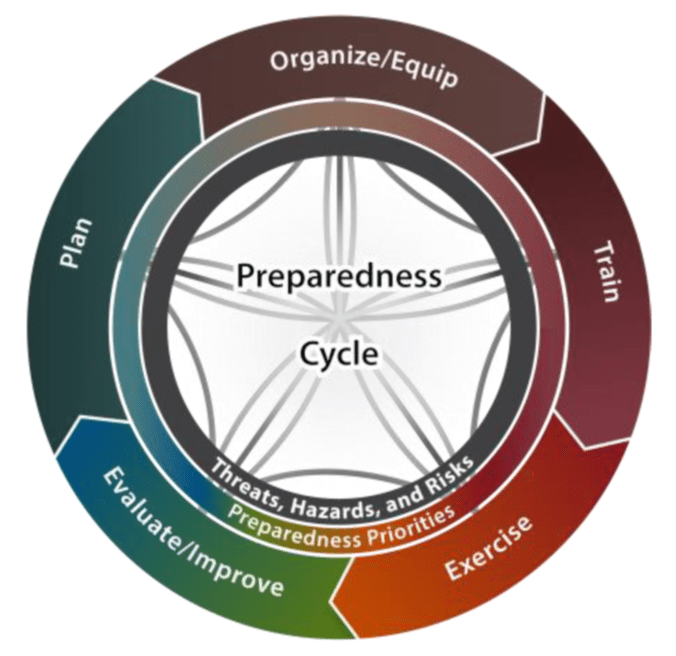
  • A big emphasis through the document is on the Integrated Preparedness Cycle (see the graphic with this post). The Integrated Preparedness Cycle covers all POETE (Planning, Organizing, Equipping, Training, and Exercising) elements plus Evaluate/Improve.  The graphic also eludes to these activities not necessarily happening in a specific order, as well as the consideration of Preparedness Priorities and Threats, Hazards, and Risks.  Developing a preparedness plan is something I wrote about back in 2016.
  • Integrated Preparedness Cycle
    • Going along with the Integrated Preparedness Cycle, they have done away with the Training and Exercise Plan (TEP) and replaced it with the Integrated Preparedness Plan (IPP), which is developed through input obtained during an Integrated Preparedness Planning Workshop (IPPW). I serious HOPE this shift is successful, as I’ve mentioned in the past how often the training aspect of the TEP was ignored or phoned in.  This approach also does a lot to integrate planning, organizing, and equipping (but ESPECIALLY planning) into the effort.  This is all tied together even more if a jurisdiction has completed a THIRA.  The Integrated Preparedness Cycle and IPP are the things I’m happiest about with the updated document.
  • The new document provides easier to find and read layouts for information associated with exercise types and each of the planning meetings.
  • For years, HSEEP doctrine has suggested (though thankfully not required) an ICS-based organization for exercise planning. I’ve never used this as I found it awkward at best (though I know others often use it and have success in doing so).  The update provides a different suggestion (better, in my opinion) of a functionally organized planning team organization.  Consider that this is still a suggestion, and that you can use it, or a version of it, or an ICS-based one, or anything else you desire.
  • The update provides better delineation between the planning and conduct needs of discussion-based exercises vs those of operations-based exercises. Those of us who have been doing it for a while know, but for those who are new to exercises this should be very helpful.
  • Lastly, the document suggests making corrective actions SMART, as these are really objectives.

FEMA is hosting a series of webinars (listed on the HSEEP website) to discuss these changes.

I’m very happy with the changes made to the doctrine.  It’s a great continued evolution of HSEEP and preparedness as a whole.  For as much as I’m a champion of the Integrated Preparedness Plan, though, having it (thus far) only included in the HSEEP doctrine makes it easy to miss or dismiss by some.  I’m hopeful broader promotion of this concept, perhaps even including it as an emergency management performance grant requirement, will help adoption of this concept.

What are your thoughts?

© 2020 Timothy Riecker, CEDP

Emergency Preparedness Solutions, LLC®

Public-Private Partnerships Should be a Two-Way Relationship

Public-private partnerships are not a new concept to emergency management.  There are municipalities, regional areas, and states that have formed committees and strategized how the private sector can provide support during a disaster.  Certainly we have seen a lot of support, on both a large scale and locally, from the ‘big box’ stores, such as Wal-Mart, Lowes, and Home Depot.  Tide’s Loads of Hope program, something so simple but extraordinarily impactful, provides a means for disaster victims to have clean clothing.  Insurance companies have established a response capability to expedite their assessments and services to their clients.  Private sector partners know that these things are not just good public relations, but that they have a means of supporting communities that government and relief organizations may not.

There is another aspect to public-private partnerships that doesn’t seem to be widely addressed, and that’s the community business.  How can they help the community in a disaster?  First, business continuity is essential, since they may also be impacted by the disaster.  Small businesses don’t have the level of capability to leverage that large companies do.  Yes, the SBA can help them with long-term recovery, but the ability of some small businesses to get back to operations quickly can directly help a community recover.  I work with a lot of small communities, many of them serviced by small shops and independent grocers.  There are no big box stores for many, many miles.  For grocers, power outages result in spoiled food.  Road closures result in crippling supply chain problems.  While we’d like all businesses to have mitigation measures and preparedness for disasters, many small businesses simply don’t have the capitol to invest in things like generators and they obviously can’t control road closures.

What’s to be done?  Local municipalities absolutely need to bring these small business owners to the table, establish relationships, identify their needs, and consider identifying them as part of the community’s critical infrastructure.  The resilience of small grocers, lumber companies, and other purveyors is essential to the resilience and recovery of so many small towns.  The impacts are easy to see… if a store can keep running, they are not only providing essential goods and services to the community, they are also supporting the economy by keeping their employees working. What do they need?  Things like power and access, obviously, but tangential things like the availability of child care is huge.  Following disasters schools usually close and often become community shelters. Many parents work when their kids are in school.  If school is closed, they need access to child care.

How far can government go in supporting the private sector?  Many governments tend to avoid supporting the private sector as if it were some kind of disease.  It took many months to convince FEMA in the aftermath of Sandy to make dredging of private marinas eligible for disaster cost recovery.  These marinas (mostly small businesses themselves) support capabilities of fire and police watercraft, recreation (which has economic impact), and a significant fishing and crabbing industry, which is the livelihood of many off and on shore.  Obviously, FEMA needs to maintain accountability of funds and ensure they are being spent appropriately, but a big part of this was resistance to the idea of government providing direct support to the private sector.

While I agree that there are many nuances to this situation, it seems that in many cases the impact of small, local businesses in short-term recovery are disregarded, especially by state and federal governments, and that there exists a one-way door for business participation, where in this ‘partnership’ they are asked to provide goods and services, but how is government contributing to that partnership?  With the big box stores and other large companies, local governments certainly help with some permit expediting and perhaps physical space to set up and access to utilities, there is typically not much support required beyond that.  Small businesses may need more direct support to recover.  They may need help clearing their private access road or parking lot.  They may need the public road they are located on to be cleared for traffic sooner.  They may need a generator that can power their building.  They may need quantities of potable water brought on-site.  Their employees may need child care or public transportation.  These are things they either can’t immediately afford or simply don’t have access to. Local government may have better access to these resources, though, and with the justification of these small businesses providing essential goods and services to the community, the choice is easy.

Does this open government to potential criticism?  Absolutely.  Some business owners may claim discriminatory practices of government supporting some businesses and not others.  Some tax payers may even complain about the use of tax dollars in such a fashion.  While people may always complain, legal consequences and public relations problems should certainly be mitigated.  The road to addressing this is preparedness.  Engage your local attorney and the legal council for the state’s emergency management agency.  Municipal laws and state laws regarding authorities that can be enacted during a state of emergency need to be explored to not only make sure that local government has the legal ability to provide this support, but the conditions and procedures required for doing so.  The legal sources and procedures and standards for providing this support should be documented and made part of the local emergency plan. The municipality should have a criteria for determining what types of businesses could be included in such direct support (what is regarded as the municipality’s privately owned critical infrastructure?), and even outline requirements for those businesses, such as having a business continuity plan, implementing certain resiliency measures, or participating in coordination activities prior to a disaster.  Memoranda of understanding may be required, or other legal tools to identify the terms and conditions of support.

While this type of support from government to the private sector isn’t common, there are some municipalities who do it well.  I’m certainly interested in hearing what you’ve implemented and what best practices you’ve identified.

© 2020 Timothy Riecker, CEDP

Emergency Preparedness Solutions, LLC®℠

The 2019 National Preparedness Report, or ‘How Are We Measuring Preparedness?’

FEMA recently released the 2019 National Preparedness Report.  Simply put, I’m confused.  Nothing in the report actually lines up with doctrine.  It leaves me wondering how we are actually measuring preparedness.  So what’s the issue?

While the National Preparedness Report is initially structured around the five mission areas (Prevention, Protection, Mitigation, Response, and Recovery), the only full inclusion of the Core Capabilities in the report is a table on page 9, outlining usage of grant funds per Core Capability.  After this, the Core Capabilities for each mission are listed in the title page for each mission area within the detailed findings for those mission areas.  No detail of progress within these Core Capabilities is provided, however.  With the absence of this analysis, we are not seeing data on the progression of preparedness, which, per the National Preparedness Report, is measured through the lens of each of the Core Capabilities.

This is further confused on pages 45 and 48, in particular, where tables list the Community Lifelines with some sort of correlated ‘capabilities’ (noted with a lowercase ‘c’… thus not the Core Capabilities).  These capabilities are not from any doctrine that I can find or recall, including the components and subcomponents for each Community Lifeline provided in the Community Lifelines Toolkit.  For each of these they provide some analytical data, but it’s unclear what this is based upon.  The methodology provided early in the document does nothing to identify why this change in format has occurred or where these specific data sets come from, much less why they are deviating from the previous format and the standards provided through the National Preparedness Goal.

Some perspective… It would seem logical that the National Preparedness Report would be assessing our national state of preparedness relative to the National Preparedness Goal, as it has since its inception.  The National Preparedness Goal is structured around the five mission areas and the 32 Core Capabilities.  With the emergence of the Community Lifelines and their inclusion in the recent update of the National Response Framework, it makes sense that we will see Community Lifelines further integrated into standards, doctrine, and reports, but they have yet to be integrated into the National Preparedness Goal (the current version is dated 2015).  We have not yet seen a comprehensive crosswalk between the Community Lifelines and the Core Capabilities, but it should be recognized that there are certain aspects, even if you just examine the Response Mission Area, that don’t match up.

In an unrelated observation on the National Preparedness Report, the trend continues with citing after action reports from the year, but not actually providing any analysis of lessons learned and how those are being applied across the nation.

Bottom line… while there are some valuable nuggets of information included in this report, I find most of it to be confusing, as it lacks a consistent format on its own, as well as inconsistency with the existing standard of measurement as defined by the National Preparedness Goal.  Why is this a big deal?  First, it’s a deviation from the established standard.  While the standard may certainly have room for improvement, the standard must first be changed before the metrics in the reporting can be changed.  Second, with the deviation from the standard, we aren’t able to measure progress over time.  All previous National Preparedness Reports have provided data within the scope of Core Capabilities, while this one largely does not.  This breaks the possibility of any trend analysis.  Third, there is no reasoning provided behind the capabilities (lowercase ‘c’) associated with each of the Community Lifelines in the report.  It’s simply confusing to the extent that it becomes irrelevant because the information provided is not within the existing lexicon which is used for measurement of practically everything in preparedness.

Simply put, this year’s report is even more disappointing than those provided in previous years.  In fact, since it doesn’t conform with the current standard, I’d suggest it’s not even valid.  This should be far better.

Thoughts?

© 2019 – Timothy Riecker, CEDP

Emergency Preparedness Solutions, LLC


An Updated Community Lifelines Toolkit and Relationships to Incident Management

Earlier this year, FEMA released guidance on the Community Lifelines.  I wrote a piece in the spring about integrating the concept into our preparedness and response activities.  Last month, FEMA issued updated guidance for Community Lifeline Implementation through Toolkit 2.0.  In this update, FEMA cites some lessons learned in actually applying the Lifeline concept in multiple exercises across the nation, as well as from feedback received by stakeholders. Based on these lessons learned and feedback, they have made some adjustments to their toolkit to reflect how they understand, prioritize, and communicate incident impacts; the structure and format for decision-making support products. And planning for these impacts and stabilization prior to and during incidents.  They have also made some changes based upon the updated National Response Framework.  The documents associated with the updated Community Lifelines all seem to reflect an inclusion in the efforts of the National Response Framework.  It’s great to see FEMA actually tying various efforts together and seeking to provide grounded guidance on application of concepts mentioned in doctrine-level documents.

The biggest addition to the Community Lifelines update is the inclusion of the FEMA Incident Stabilization Guide.  The ‘operational draft’ is intended to serve as a reference to FEMA staff and a resource to state, local, and tribal governments on how “FEMA approaches and conducts response operations”.  It’s a 77-page document the obviously leans heavily into the Community Lifelines as a standard for assessing the impacts to critical infrastructure and progress toward restoration, not only in response, but also into recovery operations.  It even reflects on bolstering Community Lifelines in resilience efforts, and ties in the THIRA and capability analysis efforts that states, UASIs, and other governments conduct.  I’m not sure the document is really a review of how FEMA conducts operations, as they say, but it does review the ideology of a portion of those operations.  Overall, there is some very useful information and references contained in the document, but this brings me to a couple of important thoughts:

  1. The utility of this document, as with the entire Community Lifelines concept, at the state and local level is only realized through integration of these concepts at the state and local levels.
  2. We finally have guidance on what ‘incident stabilization’ really entails.

To address the first item… In my first piece on Community Lifelines, I had already mentioned that if states or communities are interested in adopting the concept of Community Lifelines, that all starts with planning.  An important early step of planning is conducting assessments, and the most pertinent assessment relative to this initiative would be to identify and catalog the lifelines in your community.  From there the assessment furthers to examine their present condition, vulnerabilities, and align standards for determining their operational condition aligned with the Community Lifelines guidelines.  I would also suggest identifying resiliency efforts (hopefully these are already identified in your hazard mitigation plan) which can help prevent damages or limit impacts.  As part of your response and short-term recovery lexicon, procedures should be developed to outline how lifeline assessments will be performed, when, and by who, as well as where that information will be collected during an incident.

As for my second item, the concept of incident stabilization has an interesting intersection with a meeting I was invited to last week.  I was afforded the opportunity to provide input to an ICS curriculum update (not in the US – more on this at a later time), and as part of this we discussed the standard three incident priorities (Life Safety, Incident Stabilization, and Property Conservation).  We identified in our discussions that incident stabilization is incredibly broad and can ultimately mean different things to different communities, even though the fundamental premise of it is to prevent further impacts.  This Incident Stabilization Guide is focused exclusively on that topic.  In our endeavor to make ICS training better, more grounded, less conceptual, and more applicable; there is a great deal of foundational information that could be distilled from this new document for inclusion in ICS training to discuss HOW we actually accomplish incident stabilization instead of making a one-off mention of it.

Going a bit into my continued crusade against the current state of ICS training… I acknowledge that any inclusion of this subject matter in ICS training would still be generally brief, and really more of a framework, as implementation still needs to be grounded in community-level plans, but this document is a great resource.  This also underscores that “learning ICS” isn’t just about taking classes.  It’s about being a professional and studying up on how to be a more effective incident manager.  ICS is simply a tool we use to organize our response… ICS is NOT inclusive of incident management.  Not only are we teaching ICS poorly, we are barely teaching incident management.

While I’ve been away for a while working on some large client projects, I’m looking forward to ending the year with a bang, and getting in a few more posts.  It’s great that in my travels and interactions with colleagues, they regularly mention my articles, which often bring about some great discussion.  I’m always interested in hearing the thoughts of other professionals on these topics.

© 2019 Timothy Riecker, CEDP

Emergency Preparedness Solutions, LLC®

A Deeper Review of FEMA’s E/L/G 2300 EOC Intermediate Course

A couple months ago I got my hands on the materials for the ELG 2300 EOC Intermediate course.  Back in early June I gave an initial review of this course, based on information from a webinar and the course’s plan of instruction.   Unfortunately, upon reviewing the actual course materials, my initial concerns have been reinforced.

First, I’ll start off with what I think are the positives of this course. The course doesn’t stray from NIMS, and applies a practical integration of the NIMS management concepts, which we are mostly used to seeing in ICS, into the EOC environment.  This is 100% appropriate and should always be reinforced.  The course also references the EOC National Qualification System skillsets.  It’s great to see the NQS referenced in training as they otherwise receive very little attention, which actually brings about a lot of concern as to their overall adoption.  Two units within the course provide some incredibly valuable information.  Those are Unit 5 (Information and Intelligence Management) and Unit 7 (EOC Transition to Recovery).

On to the down side of things… As mentioned in my review a couple months back, the course objectives simply don’t line up with what this course needs to do – that is, it needs to be teaching people how to work in an EOC.  So much of the content is actually related to planning and other preparedness activities, specifically Units 3, 4, and 8. Unit 3 dives into topics such as position tack books, organizational models, EOC design, staff training and qualifications, exercises and more.  Though, ironically enough, there is little to no emphasis on deliberate PLANNING, which is what all this relates to.  This isn’t stuff to be thinking about during an EOC activation, but rather before an activation.  Unit 4, similarly, gets into triggers for activation, how to deactivate the EOC, and other topics that are planning considerations.  Unit 8 dives more into design, technology, and equipment.  While it’s valuable for people to know what’s available, this is, again, preparedness content.

There is a lot of repetitive content, especially in the first few units, along with some typos, which is really disappointing to see.  There are also some statements and areas of content which I wholeheartedly disagree with.  Here are a few:

  • There is ‘no common EOC structure’.   There are actually a few.  Hint: they are discussed in the NIMS document.  I think what they are getting at with this statement is that there is no fixed EOC structure.
  • ‘EOC leaders determine the structure that best meets their needs’. False. Plans determine the structure to be used.  While that organizational model is flexible in terms of size of staff and specific delegations, the lack of context for this statement seems to indicate that the EOC Manager or Director will determine on the fly if they will use the ICS-based model, the Incident Support Model, or another model.
  • One slide indicates that use of the ICS-based model doesn’t require any additional EOC training beyond ICS for EOC staff. Absolutely false!  In fact, this sets you up for nothing but failure.  Even if the model being applied is based on ICS, the actual implementation in an EOC is considerably different.  I’ve written about this in the past.
  • The Incident Support Model ‘is not organized to manage response/recovery efforts’. Wrong again.  With the integration of operations functions within the Resource Support Section, response and recovery efforts can absolutely be managed from the EOC.

There is another area of content I take particular exception with.  One slide describes ‘incident command teams’, and goes on to describe the Incident Command Post (which is a facility, not a team), and an Incident Management Team, with the formal description of a rostered group of qualified personnel.  Not only is this slide wrong to include an Incident Command Post as a ‘team’, they are fundamentally ignoring the fact that ‘incident command teams’ are comprised every damn day on the fly from among responders deploying to an incident.  These are the exact people I espouse the need to train and support in my discussions on ICS.

My conclusions… First of all, this course does not do as it needs to do, which is training people how to work in an EOC.  While the preparedness information it gives is great, operators (people assigned to work in an EOC) will be taking this course expecting to learn how to do their jobs.  They will not learn that.  I’ve advocated before for most training to be set up similar to HazMat training, utilizing a structure of Awareness, Operations, Technician, Management, and Planning focused courses which are designed to TEACH PEOPLE WHAT THEY NEED TO KNOW based upon their function.  Largely, this course is a great Planning level course, that is it’s ideal for people who will be developing EOC operational plans, standard operating guidelines, position qualification standards, and other preparedness material.  I think that Operations, Technician, and Management level training is going to be left to jurisdictions to develop and implement, as it certainly isn’t found here.

I urge a lot of caution to everyone before you decide to teach this course.  Take a look at the material and decide if it’s really what your audience needs.

What are your thoughts on this course?  Will your jurisdiction get use out of it?

© 2019 – Timothy Riecker, CEDP

Emergency Preparedness Solutions, LLC®