This past weekend I had the opportunity to attend AWR-147 Rail Car Incident Response conducted by the Rural Domestic Preparedness Consortium (RDPC) and Findlay University. This is a one day awareness level course that focused on response to incidents involving freight rail cars and hazardous materials.
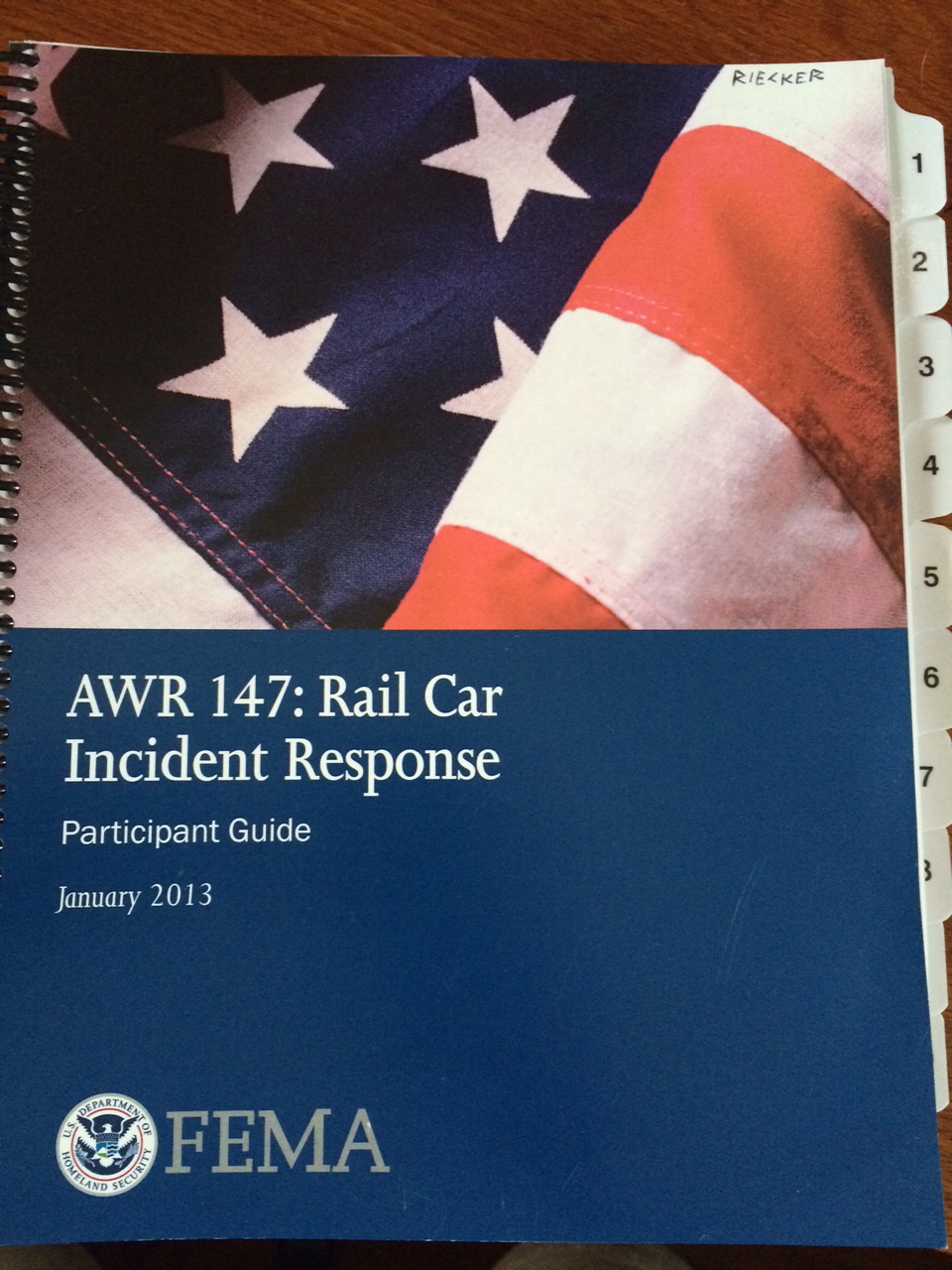
AWR-147 Participant Manual
All in all this was a good course which I recommend to anyone who has the opportunity to attend it. For those not familiar with the RDPC you can find their website at https://www.ruraltraining.org/. Although only an awareness level course, it is suitable for any responder or emergency manager who has a jurisdiction with freight rail lines. It’s also quite suitable as additional training for HazMat teams, as the information provided relative to the identification of the different types of rail cars and potential hazards associated with them is excellent.
The course construction follows the usual DHS format, including a pre and post test, plenty of student materials, and a mix of instruction, videos, and participant interaction and discussion. Given the variety of rail cars which can be encountered and rail incidents do dissect, there are plenty of visuals and case studies to drive the program.
I would have liked to have seen the inclusion of a unit to discuss current topics, particularly Bakken crude and even a bit on HazMat associated with passenger train incidents. Also, while the course focused on response, there was little mention of community preparedness measures which can/should be taken. Of course I had a small ulcer form with one of the final units which was on NIMS/ICS. I see little value in rehashing the primary components of NIMS and showing an ICS org chart, particularly when there is little/no discussion on the nuances of applicability relative to a rail incident. It was all rather gratuitous.
There were some great activities which reinforced use of the DOT Emergency Response Guidebook as well as other sources of information which can be referenced during a rail response, including a worksheet which could easily be used as a job aid for real life application. Along with the participant manual, all students received a copy of the current DOT Guidebook as well as the Association of American Railroads Field Guide to Tank Cars, which is a handy reference to help you identify the specific type of tank car you are dealing with and where key infrastructure on each (brakes, vents, valves, etc.) can be located.
This was the first course I had taken from the RDPC, although I have been aware of their course selection for quite some time and have referred others to their great array of courses. Don’t let the term ‘rural’ fool you – the material they teach is relevant to rural, suburban, and urban responders alike. I had taken CSX’s rail response course several years ago and this course blows it away. Overall well done and highly recommended.
© 2015 – Timothy Riecker
Emergency Preparedness Solutions, LLC
 The Contrarian Emergency Manager